© 2017 IJSRST | Volume 3 | Issue 8 | Print ISSN: 2395-6011 | Online ISSN: 2395-602X Themed Section: Science and Technology
A Comparative Study on the Implementation of Block Cipher
Algorithms on FPGA
Lavanya R
*1, Karpagam M
2, Jaikumar R
3*1Department of Electronics and Communication Engineering, Sri Ramakrishna Institute of Technology, Coimbatore, Tamilnadu, India 2Department of Electrical and Electronics Engineering, Hindusthan College of Engineering and Technology, Coimbatore,Tamilnadu, India 3Department of Electronics and Communication Engineering, R V S College of Engineering and Technology, Coimbatore,Tamilnadu, India
ABSTRACT
Advanced Encryption Standard(Rijindael) is a widely used algorithm for data security, but there are many notable block cipher algorithms which have not been widely adopted for usage. The algorithms such as Blowfish, Serpent, Twofish and RC6 were the top finalist of the AES contest but are not widely used. They have strong security features compared to that of AES and cryptanalysis of these algorithms are still difficult. These algorithms are realized on FPGA to carry out a comparative study on the timing, functional blocks and area requirements. This study helps understand different aspects of the algorithms and identify suitable applications with given limitations where they can be applied.
Keywords: Cryptography, Symmetric Encryption, Block Ciphers, FPGA
I.
INTRODUCTION
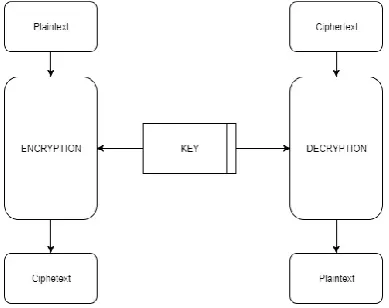
Internet is now an essential platform where personal databases are stored, bank transactions are carried out, social interaction happens and exchange of large important information takes place, and hence security becomes an extremely important issue for all users. One essential way of delivering security to end users is through cryptography. Cryptography is a technique, which applies complex mathematical transformations to hide secret information that needs to be communicated through unsafe channels. Cryptography provides privacy/confidentiality for the information/message intended for the recipient whereby it helps in concealing data from the third party. In cryptography the original information is called the plaintext and the process of converting the plaintext to unintelligible information is called encryption. The resultant information is called the cipher text. The conversion is done by using an essential component called the Key. At the receiver, the process of inverse conversion from cipher text to plaintext is called as decryption. There are many encryption algorithms formulated for the purpose of secure information transfer. The cryptographic algorithms can be classified based on the type of key used as secret key cryptography and public key
cryptography. Secret key cryptography is primarily used for privacy and confidentiality it uses a single key for
both encryption and decryption. Public key
cryptography is suited for authentication, non-repudiation, and key exchange it uses one key for encryption and another key for decryption.
II.
SECRET KEY CRYPTOGRAPHY
Stream ciphers encrypts data as a bit or as byte or as a bit stream as applicable to the algorithm used whereas block ciphers encrypts data in terms of blocks, one block at a time, each block is processed by the encryption algorithm using the same key.
Figure 1 : Symmetic Key Cryptography
In the case of stream ciphers the streams of data processed by the algorithm use a different key value for each encryption. The keys are generated through different forms of feedback mechanism.
A. Block Ciphers
Block ciphers consist of paired algorithms, one for encryption and the other for decryption. A block cipher handles a block of length n bits from a string of P bits, the key used is of size k bits. The Encryption function E yields a ciphertext C which of length n bits. In block ciphers plain text and ciphertext size are equal-n bits.
The Decryption algorithm is the inverse for E,D = E−1 is
a function taking a key K and a ciphertext C to return a plaintext value P.
Cn= Ek(Pn)
Pn = Dk(Cn)
Where
C - Ciphertext
E - Encryption function
P - Plaintext
D - Decrytion function
K - Key size
n - Block size
In general, the plaintext block will always encrypt to the same ciphertext when using the same key. The most commonly used encryption methodology in block ciphers is the combination of operations such as substitution, permutation and round function. A substitution function replaces the input data into another value of output data. The permutation function performs bit shuffling/ transposition operation on the processed bits from substitution function. The Round function is generally an XOR operation whereby the key is XORed with the processed plaintext. The most commonly used block cipher architecture is based on the Feistel structure. In this method the block is split into two equal halves, one half is processed using the round key function sing the sub-key derived from the master key. The output of round function is then XORed with the other half of the plain text. These two values are again swapped and the process is continued as an iterative structure for n number of rounds. The main advantage of feistel design is the invertibility, requiring only the reversal operation in decryption which reduces the system complexity in terms of hardware and software[1].
B. Modes of Operation of Block Cipher
key for all the blocks. The counter uses unique random values, whereby the initialization vector is used as a block counter and this counter is encrypted for each block of data. The modes of operation are meant to semantic security, it means that with a known part of ciphertext with unknown key one should not be able to practically derive any information.
C. Block Cipher Algorithms
There are a variety of block cipher algorithms that were proposed with its own advantage and security perspectives. A few of them are Camellia, CAST-128, IDEA, RC2, RC5, RC6, SEED, ARIA, Skipjack, DES, SDES, AES, PRESENT, BLOWFISH, TWOFISH, SERPENT. A Few notable block ciphers are taken for study of implementation aspects of the algorithms on the Virtex-7 FPGA platform[2].
1. Blowfish
Blowfish uses a feistel structure which encrypts a block of length 64 bits, the key length is variable from 32 bits to 448 bits shown in figure 2. It uses a iterative structure with 16 rounds of processing and it utilizes large key dependent S boxes. The structure of blowfish is similar to CAST-128, in which fixed S boxes were used. Each round of blowfish consists of four operations, the plaintext is split into two equal halves. The operations are performed using five sub key arrays. Blowfish's key schedule starts by initializing the P-array and S-boxes with values derived from the hexadecimal digits of pi, which contain no obvious pattern. There is one 18 entry P-array and there are four 256 entry S boxes called S0, S1, S2 and S3. The First operation involves performing
XOR operation of the left half of plaintext with the rth
P-array value, secondly this data is fed as input to the F- function of blowfish, next this value is XORed with the right half of the plaintext and lastly perform a swap operation of the two halves. The Function F take the 32 bit data as four 8-bit values, which are fed independently to the four S boxes. The outputs are added modulo 2 and then XORed to get the final 32 bit. Decryption is exactly the same as encryption, except that P1, P2,..., P18 are used in the reverse order. Blowfish is license-free and is available free for all uses and with use of P-array and
S-array based on Pi it offers good protection against brute-force attacks[2].
Figure 2. Blowfish Structure
2. Serpent
Figure 3. Serpent Structure
3. Twofish
Twofish is s a symmetric block cipher with a block size of 128 bits and variable key sizes of 128,192 and 256 bits shown in Figure.4. Twofish was one among the AES finalists. Twofish is a derivative of Blowfish in addition it uses pre-computed key dependent s boxes and a complex key schedule. In Twofish one half the key is used as the Key for the encryption process whereas the other half is used to produce the key dependent S-boxes, it utilizes pseudo Hadamard Transform in its process[4].
Figure 4. Twofish Structure
4. RC6
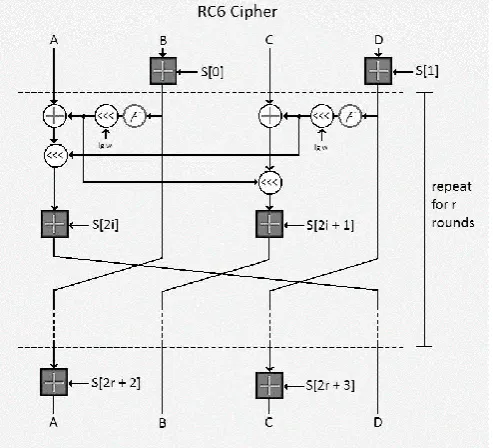
RC6 (Rivest cipher 6) is a symmetric key block cipher it operates on block length of 128 bits and allows the usage of key of length128, 192, and 256 bits up to
2040-bits.RC6 is parameterized to enable variable block length, key length and rounds. RC6 is similar to RC5 in structure. RC6 can be considered as two RC5 encryption processes running in parallel. RC6 encryption process involves sub process such as rotation, modular addition and XOR operation.RC6 uses data dependent rotations and an additional multiplication operation to increase the degree of confusion[5].
Figure 5. Twofish Structure
III.
IMPLEMENTATION ENVIRONMENT AND
RESULTS
In this section we present the main contribution of this paper where the above mentioned block cipher algorithms which were the finalists in the Advanced
Encryption Standard(AES)[6]contest are
implemented and tested for the purpose of comparative study to be carried on their timing requirements and architectural essentials on a Field
Programmable Gate Array(FPGA). These
TABLEI TIMING RESULTS Paramete rs Algorithm BLOWFI SH SERPE NT TWOF IS-H RC6 Input Plaintext size(bits)
64 128 128 128
Key
size(bits) 32-448
128,19 2 and 256 128,19 2 and 256 128,19 2 and 256 Minimum
period(ns) 6.842 21.196 10.838
608.29 9 Maximu m Frequenc y (MHz)
146.149 47.179 92.271 1.644
Minimum input arrival time before clock(ns)
1.583 1.439 1.055 1.808
Maximu m output required time after clock(ns)
6.173 0.575 0.575 0.575
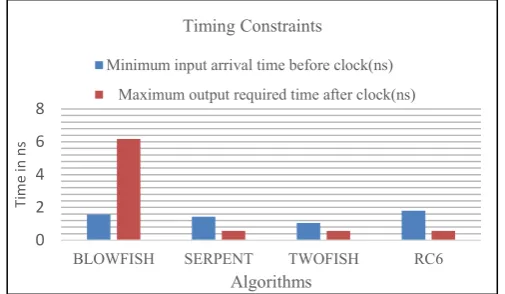
Figure 6. Timing constraints
The results above shown in Table I and Figure 6 indicate the maximum output required time after clock for blowfish has large deviation from the maximum input arrival time before clock. This increase in delay is attributed to the computation of the P-array and four S-array at run time. Whereas the blowfish variant Twofish which uses pre-computed arrays for keys shows a much lesser delay in the same comparison. The other two algorithms on the average have a smaller and acceptable delay.
III
SYNTHESIZED MACROSTATISTICS
Elements Algorithm
BLOWFI SH SERPE NT TWOF IS-H RC6 No. of
RAMs 7 1056 - -
No. of Adders/ Sub tractors
6 - 124 785
No. of
Registers 25 17060 216 27054
No. of Multiplex ers
82 363 201 909
No. of Multiplier s
- - - 40
0 2 4 6 8
BLOWFISH SERPENT TWOFISH RC6
Ti m e in ns Algorithms Timing Constraints
No. of Logic Shifters
- - - 211
No. of
FSMs 2 - - -
No. of
XORs 24 1058 2 80
TABLEIIIII
SLICE LOGIC UTILIZATION
Elements Algorithm
BLOWFI SH
SERPE NT
TWOF IS-H
RC6
Number of Slice Registers out of 2443200
794 17145 6947 27054
Number of Slice LUTs out of
1221600
801 89034 31968 46600
The Macro-statistics and slice logic utilization shown in table II and III gives an overall idea about the different elements that are required when synthesized onto a FPGA. The RC6 algorithm uses a complex operation such as the multiplier, which contributes to large delay and increase in area and computation time. As the number of registers depend on the code where variables are used to store signals and value, therefore it might vary hence it is not considered for comparison of the architectural aspects of the algorithm. Without the count of registers RC6 is still found to occupy larger area as seen from table 2 and 3. Even though serpent algorithm has it strength in terms of security it comes next to RC6 in terms of area overhead. A cryptographic algorithm is an additional block meant to improve the security of the data processed in the functional block. Hence, there has to be minimum space requirements for cryptographic
blocks on FPGA so as to allow us to accommodate larger functional block. Thus Blowfish tends to utilize lowest number of elements with less complex operations as compared to other algorithms. The security of blowfish is also good with no known practical cryptanalytic attacks. But a point to keep in mind is the data processed by the blowfish algorithm is only 64 bits and 16 rounds thus resulting in lower area. Twofish algorithms area requirement are mainly contributed by the pre-processed data.
IV.
CONCLUSION
In this paper, blowfish, serpent, Twofish and RC6 encryption architecture are studied. These algorithms are simulated in Xilinx IDE and synthesized in Virtex 7 family FPGA, the results have been tabulated. The statistics of timing and slice utilization results help us in understanding the requirements of the algorithm and provide an idea in choosing suitable block cipher architecture for applications of choice for a given constraint. From the study Blowfish uses the lowest area but there it has a large delay whereas twofish has lesser delay and a nominal resource usage. Serpent and RC6 utilize large number of LUTs, but RC6 uses complex mathematical operations which may tend to increase the overall delay.
V.
REFERENCES
[1] William Stallings, ―Cryptography and Network
Security: Principles and Practice‖, 2nd edition, Prentice-Hall, Inc., 1999 pp 23-50.
[2] Bruce Schneier ,‖Description of a new
variable-length key, 64-bit block cipher (Blowfish)‖,Part of the Lecture Notes in Computer Science book series (LNCS, volume 809),2005.
[3] E Biham, R Anderson, L Knudsen ,‖Serpent: A new
block cipher proposal‖,Fast Software Encryption, 1998, Springer
[4] R.L. Rivest, M.J.B. Robshaw, R. Sidney, Y.L. Yin,
―The RC6 block cipher,‖ Proc. of the 1st AES candidate conference, CD-1: Documentation, August 20– 22, 1998, Ventura.
[5] Bruce Schneier, John Kelsey, Doug Whiting, David
Twofish Key Schedule‖, Lecture Notes in Computer Science book series (LNCS, volume 1556).
[6] Joan Daemen, Vincent Rijmen,‖The Design of