e-ISSN: 2278-1676,p-ISSN: 2320-3331, Volume 14, Issue 3 Ser. III (May. – June. 2019), PP 56-63
www.iosrjournals.org
SVM Based Method for Discrimination of Internal Faults from
Other Disturbances in Power Transformer
Swapnil N Rahangdale
1, Roshan V. Lohe
2, Piyush Bahad
31
(Department of Electrical Engineering, Jhulelal Institute of India, India)
2(Koradi Thermal Power Station Mahagenco, India)
3(Department of Electrical Engineering, Jhulelal Institute of India, India)
Abstract:
This paper presents a differential protection scheme based on support vector machine (SVM)for power transformer, which can provide effective discrimination between internal faults and other disturbances, such as magnetizing inrush currents and over excitation conditions. The feature vector is obtained from differential signal by using standard deviation of detail 1 coefficients of wavelet transform. This feature vector is then fed to SVM classifier as an input for discrimination. Various simulation cases are simulated for transformer internal faults, various magnetizing inrush current conditions, over excitation conditions and normal operating conditions at different loadings. An existing power transformer of Maharashtra State Electricity Transmission Company Ltd. (MSETCL), Maharashtra, India is modeled for simulation studies using MATLAB Simulink software package.Keywords:
Power transformer, support vector machine (SVM), wavelet transform.I.
Introduction
The power transformer is one of most important equipment in electrical power system. Due to its immense importance its protection is also very important. Relays currently used for protection of power transformer are differential current based and uses filters to restrain the second harmonic component and sometimes even fifth harmonic component for avoiding false tripping against the magnetizing currents [2]. However harmonic component can be reduced by using proper magnetic material for manufacturing transformer core [4]. Some researchers have used artificial-neural-network (ANN) based protection technique to differentiate between magnetizing inrush from internal faults in power transformers [5]. Also large number of training data samples, slow convergence during training, and a tendency to over fit data are the limitations of ANN-based schemes. [7] Proposed a decision making method based on wavelet transform for discriminating internal faults from inrush currents but over excitation conditions have not considered by them.
Different waveform identification methods based on principal component analysis (PCA) and mathematical morphology(MM) have been proposed [8], [9]. Afterwards,[10] proposed power transformer protection scheme based on a combination of S-transform and pattern classifiers. And[11] presented a method based on instantaneous frequency for the average differential power signal to distinguish internal faults from the magnetizing inrush. Here also, the discrimination between internal faults and over excitation conditions has not been considered for the two aforementioned techniques. In this paper special types of internal faults, such as turn to turn and primary to secondary winding faults are also considered which are not considered by other researchers. Also this paper uses a SVM-based fault discrimination technique which can effectively discriminates between internal faults (including special types of faults such as turn-to-turn and primary-to-secondary winding) and other types of disturbances, such as magnetizing inrush and over excitation.
II.
Modeling and Simulation
Fig. 1 shows the model of a 3-phase, 50-Hz, 200-MVA, 220/132-kV, power transformer of MSETCL, Maharashtra, India, considered in this paper. The modeling is performed using the MATLAB Simulink. Three-phase differential current samples for one-cycle duration are acquired through CTs connected on both sides of the power transformer. The method used for generating various simulation cases for different types of internal faults and other disturbances is explained in next sections.
A. Internal faults
1) Line to Ground (LG), Line to Line (LL), and Double Line to Ground (LLG) Faults: A model is developed in MATLAB Simulink to simulate various types of internal faults. Various types of internal winding faults, namely, LG, LL, and LLG are applied at the terminal of the transformer, with a varying fault inception angle (FIA) at 0°, 80°, and 160° and different source impedance 100%, 120% and 80%.
Fig.1. Single-line diagram of the MATLAB Simulink model.
2) Turn to Turn Fault: It has observed that 70%–80% of power transformer failures are due to turn to turn insulation failures. These inter turn faults are because of the deterioration of the insulation due to thermal, electrical, and mechanical stresses. If these faults are not detected quickly, then they may convert into more serious ground faults and may lead to arcing in the power transformer tank. Although the traditional relays are able to detect these faults, the detection is delayed and may lead to inter winding faults. Turn to turn faults are modeled in Simulink using transformer with tapings by shorting winding by 2% and 4% on both primary and secondary side.
3) Primary to Secondary Winding Faults: For economic and insulation design constraints, the low-voltage (LV) winding is usually placed on the transformer core, whereas the high-voltage (HV) winding is placed over the LV winding, away from the core with inter winding insulation between LV and HV windings. Gradual aging and electrical and thermal stresses developed in power systems reduce the mechanical and dielectric strength of the transformer windings. This will cause deterioration or damage to inter winding insulation and sometimes the windings also. Primary to secondary winding faults are simulated by shorting primary and secondary winding with different source impedance value and at various fault inception angles.
B. Other System Disturbances
Various disturbances, such as inrush of different types(residual inrush, sympathetic inrush, and recovery inrush) and the over excitation situation have been considered for generating simulation cases.
1) Magnetizing Inrush: When a transformer is switched on at an instant when the prospective flux of the transformer is different from the instantaneous flux, a peaky saw tooth current, known as magnetizing inrush, initially flows through the transformer. If an energized transformer is disconnected from the supply, the possibility exists that the flux does not become zero. This flux is known as residual flux and inrush current flowing through the winding after re-energization of the transformer is known as initial inrush including residual magnetism. This situation has been simulated with a variation in source impedance at different switching angels having the positive and negative polarity of residual flux and with different loading conditions on the transformer. Sympathetic magnetizing inrush occurs on an in service power transformer, upon switching on of a parallel connected transformer. The dc component of the inrush current may result into saturation of the energized transformer and can cause superimposed inrush current to flow through the in service transformer. To illustrate sympathetic inrush, various simulations have been carried out with different loading conditions and various phase angles of source impedance.
2) Over Condition excitation: In order to avoid tripping of the differential protection scheme during an over excitation condition, a separate transformer over excitation circuit should be used. In order to check this phenomenon, various over excitation conditions are simulated with different values of terminal voltages 115% and 125% of rated voltage of the power transformer with +/-5% variation in fundamental frequency (50 Hz).
3) Normal Operating Condition: For a normal operating state, simulations have been carried out at different loading conditions with different values of source impedance and switching instances.
C. Feature Extraction Using Wavelet Transform
study. The mother wavelet, whose characteristics match closely with the signal under consideration, would be the best choice. It has found in the literature that the db wavelet is the most suitable one for fault signals [14]. Therefore, in this paper also, db wavelet has been used for the first stage analysis of fault current signals. After performing first level decomposition of current signals with the db4 wavelet and using standard deviation of detail 1 coefficients, fault discrimination accuracy of the order of 99.667% is obtained. An increase in decomposition level requires larger computational time and, hence, related hardware. Therefore, higher level decomposition is not considered.
Figs. 2–7 show waveforms for differential current along with standard deviation (using detail 1 co-efficient of db4 wavelet) during an internal fault, magnetizing inrush, and the over excitation condition, respectively. It can to be observed from Figs. 2–7 that the pattern of standard deviation is entirely different for internal fault, magnetizing inrush, and the over excitation condition respectively. Hence, it can be effectively used as an input to the SVM classifier.
Fig.2. Differential current during internal fault condition
Fig.3. Standard deviation of db4 wavelet
Fig.4. Differential current during magnetizing inrush
Fig.6. Differential current during over excitation
Fig.7. Standard deviation of db4 wavelet
1) SVM-based Scheme
technique has been implemented in a MATLAB environment using already available functions in MATLAB. The svmtrain function is used for training the SVM with 50% of datasets and svmclassify function is used for testing 50% of datasets. Here linear kernel functions are considered for SVM. First the SVM is configured using training data set. The input feature vector for each simulation case is obtained with first level wavelet decomposition of three phase differential current samples of one cycle duration, which can be easily acquired through conventional current transformers. Three phase current samples for one cycle duration (3×80 samples/cycle) are combined to get single signal (1×240 samples/cycle). This three-phase current sample is decomposed (up to level 1), and standard deviation is obtained which forms feature vector. These feature vectors are used as an input to the SVM classifier for training and testing of the proposed algorithm. SVM discriminates between the internal fault and disturbance in the form of output of the SVM (“1”’ for an internal fault and “-1” for disturbances and normal operating condition).
%Accuracy = (TP-TN)/Total testing dataset
Fig.8. Block diagram of the proposed scheme
III.
Results And Discussion
A) Training and Testing Datasets
Internal Faults
Fault: LG, LL, LLG (18) × Source impedance: 100%, 20%, 80% (3) × Fault inception angle: 0°, 80°, 160° (3)
Internal Faults cases = 297
Primary to secondary winding fault (3) × Source impedance: 100%, 120%, 80% (3) × Fault inception angle: 0°, 80°, 160° (3)
Turn to turn faults (6) × % fault turns: 2%, 4% (2) × Source impedance: 100%, 120%, 80% (3) × Fault inception angle: 0°, 80°, 160° (3)
Residual inrush Load: 25%, 50%, 75%, 100% (4) × Residual flux: 0, 0.8, -0.8 p.u. (3)× Source impedance: 100%, 120%, 80% (3) × Angle of switching: 0°, 80°, 160° (3)
Other disturbances
and Normal
condition cases = 300 Recovery inrush Load: 50%, 100% (2) × External fault type: LL, LLG, LLL (4) × Angle of switching:
0°, 80°, 160° (3) Sympathetic
inrush
Load: 25%, 50%, 75%, 100% (4) × Source impedance: 100% at 25°, 85° (2) × Angle of switching: 0°, 80°, 160° (3)
Over-excitation Load: 50%, 100% (2) × voltage 115%, 125% (2) × frequency 50Hz, 47.5Hz, 52.5Hz (3) × Source impedance: 100%, 120%, 80% (3)× Angle of switching: 0°, 80°, 160° (3) Normal
operating conditions
Load: 25%, 50%, 75%, 100% (4) × Source impedance: 100%, 120%, 80% (3) × Angle of switching: 0°, 80°, 160° (3)
Total number of data sets = 597
1) Analysis
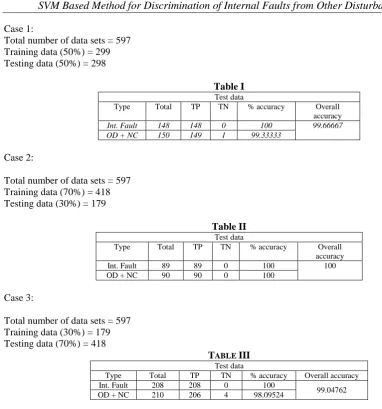
Case 1:
Total number of data sets = 597 Training data (50%) = 299 Testing data (50%) = 298
Table I
Test data
Type Total TP TN % accuracy Overall
accuracy
Int. Fault 148 148 0 100 99.66667 OD + NC 150 149 1 99.33333
Case 2:
Total number of data sets = 597 Training data (70%) = 418 Testing data (30%) = 179
Table II
Test data
Type Total TP TN % accuracy Overall
accuracy
Int. Fault 89 89 0 100 100
OD + NC 90 90 0 100
Case 3:
Total number of data sets = 597 Training data (30%) = 179 Testing data (70%) = 418
TABLE III
Test data
Type Total TP TN % accuracy Overall accuracy
Int. Fault 208 208 0 100
99.04762
OD + NC 210 206 4 98.09524
In the presented method, test datasets detected correctly and incorrectly are denoted as true positive (TP) and true negative (TN), respectively. Fault discrimination accuracy of the proposed scheme using full cycle data of fault/disturbances is shown in Table II. It is to be noted from Table II that the presented method gives an overall accuracy of 99.667% for case 1 i.e. 50% data for training and 50% data for testing, 100% for case 2 i.e. 70% data for training and 30% data for testing and 99.047% for case 3 i.e. 30% data for training and 70% data for testing, hence, provides effective discrimination between internal faults and disturbances. Also same scheme is also applied for another transformer of different rating and connection and an overall accuracy of 97.667% is obtained for 50% data for training and 50% data for testing scenario.
Furthermore, the proposed scheme provides higher sensitivity during internal faults (100%).Moreover, it gives an equally high level of stability during other disturbances (99.33%) during which the relay must restrain as otherwise it will cause false tripping of the transformer. In addition, the presented method is also able to discriminate special types of internal faults, such as a primary to secondary winding and turn to turn with external faults, which are difficult to detect by any of the conventional transformer protection techniques.
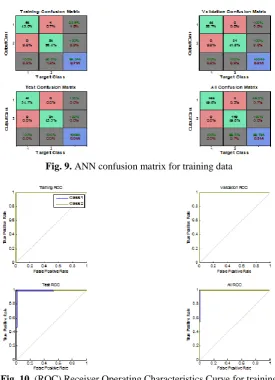
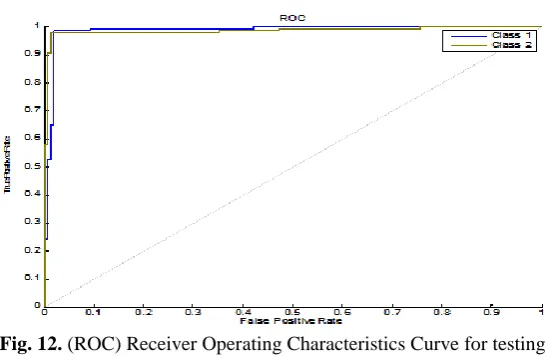
2) COMPARISION WITH ANN
Fig. 9. ANN confusion matrix for training data
Fig. 10. (ROC) Receiver Operating Characteristics Curve for training
Fig. 12. (ROC) Receiver Operating Characteristics Curve for testing
IV.
Conclusion
SVM-based differential protection scheme is presented which effectively differentiates internal faults with other type of disturbances in a power transformer. The performance of the presented method has been evaluated over 597 data sets considering variations in fault and system parameters The proposed scheme gives an overall accuracy of 99.66% using full-cycle fault/disturbance current signals when 50% data is used for training and 50% data is used for testing. It gives an overall accuracy of 100% when 70% data is used for training and 30% data is used for testing. It gives an overall accuracy of 99.04762% when 30% data is used for training and 70% data is used for testing. As compared to results obtained with ANN (98.3% accurate) results obtained with proposed method (99.667% accurate) are superior. As it is pattern recognition method rating of CTs doesn’t have any effect on discrimination. It is observed that this scheme may produce a false tripping but never had no trip condition for fault.
V.
Future Enhancement
The proposed scheme can be implemented using digital relays and better accuracy in discrimination between inrush current and internal faults can be achieved. The proposed scheme can also be implemented for generators, induction motors where differential protection scheme is used.
Appendix
Source data: Z = 20.09+j240.838 Ω
Power transformer data of MSPGCL: 3-phase, 50 Hz, 200 MVA, 220 kV/132 kV, Star-Delta, Power
Transformer (ICT-1) present at 220 kV MSETCL Substation, Amravati, Maharashtra. Reactance per phase at normal taps 10.62%.
Current transformer data: CT ratio 1:400 on HV side and 1:600 on LV side.
References
[1]. A. M. Shah and Bhavesh R. Bhalja, “Discrimination Between Internal Faults and Other Disturbances in Transformer Using the Support Vector Machine-Based Protection Scheme”, IEEE Transactions on Power Delivery, vol., 28, no. 3, July 2013
[2]. P. M. Anderson, Power System Protection. New York: IEEE, 1999.
[3]. Y. G. Paithankar, S. R. Bhide, Fundamentals of Power System Protection, Prentice-Hall of India Pvt. Ltd. New Delhi, 2003. [4]. M.-C. Shin, C.-W. Park, and J.-H. Kim, “Fuzzy logic-based relaying for large power transformer protection,” IEEE Trans. Power
Del., vol. 18, no. 3, pp. 718–724, Jul. 2003.
[5]. M. R. Zaman and M. A. Rahman, “Experimental testing of the artificial neural network based protection of power transformers,”
IEEE Trans. Power Del., vol. 13, no. 2, pp. 510–517, Apr. 1998.
[6]. M. Tripathy, R. P. Maheshwari, and H. K. Verma, “Power transformer differential protection based on optimal probabilistic neural network,” IEEE Trans. Power Del., vol. 25, no. 1, pp. 102–112, Jan. 2010.
[7]. J. Faiz and S. Lotfi-Fard, “A novel wavelet-based algorithm for discrimination of internal faults from magnetizing inrush currents in power transformers,” IEEE Trans. Power Del., vol. 21, no. 4, pp. 1989–1996, Oct. 2006.
[8]. E. Vázquez, I. I. Mijares, O. L. Chacón, and A. Conde, “Transformer differential protection using principal component analysis,”
IEEE Trans. Power Del., vol. 23, no. 1, pp. 67–73, Jan. 2008.
[9]. Z. Lu, W. H. Tang, T. Y. Ji, and Q. H. Wu, “A morphological scheme for inrush identification in transformer protection,” IEEE Trans. Power Del., vol. 24, no. 2, pp. 560–568, Apr. 2009.
[11]. A. Hooshyar, S. Afsharnia, M. Sanaye-Pasand, and B. M. Ebrahimi, “A new algorithm to identify magnetizing inrush conditions based on instantaneous frequency of differential power signal,” IEEE Trans. Power Del., vol. 25, no. 4, pp. 2223–2233, Oct. 2010. [12]. A. H. Osman and O. P.Malik, “Protection of parallel transmission lines using wavelet transform,” IEEE Trans. Power Del., vol. 19,
no. 1, pp. 49–55, Jan. 2004.
[13]. B. Ravikumar, D. Thukaram, and H. P. Khincha, “Application of support vectormachines for fault diagnosis in power transmission system,” Inst. Eng. Technol. Gen., Transm. Distrib., vol. 2, no. 1, pp. 119–130, Jan. 2008.