Research Article
CODEN: IJPNL6
DEVELOPMENT AND VALIDATION OF RP-HPLC METHOD FOR THE
ESTIMATION OF PROCESS RELATED IMPURITIES FROM NIMODIPINE BULK
AND FORMULATION
Kasture V.S.*, Pawar S.S., Patil P.P., Musmade D.S., Ajage R. K. and Gehlot Ganjendra
Department of quality assurance techniques, SRES’s Sanjivani College of Pharmaceutical
Education and Research, Kopargaon, MS, India-423603
*Corresponding author e-mail: [email protected]
ABSTRACT
The process related impurity of Nimodipine diethyl 1, 4-dihydro-2, 6-dimethyl pyridine 3, 5 dicarboxylate in bulk and formulations was synthesized, characterized and the RP-HPLC method was developed according to ICH Q2B guidelines for quantitation of impurity in bulk and formulations. The synthesis of intermediate was carried out by Hantzch process using m-nitrobenzaldehyde, ethylacetoacetate, in presence of ammonia and methanol as catalyst. The percentage yield was found to be 75%. The impurity was recrystallized and purified. The preliminary evaluation was done on lab scale viz. melting point, TLC and elemental analysis. The melting point of impurity was found to be 1560C. The TLC of impurity was carried by using Benzene and Methanol (6:1) and the Rf was found to be 0.80.
The confirmation of structure of synthesized impurity was carried out by using sophisticated instrument viz, FT-IR, NMR, GC-MS etc. Finally, the RP-HPLC method was developed to identify and quantify the impurity in Nimodipine bulk and formulation as per ICH Q2B guidelines. The method was validated as per ICH guidelines. The method was found to be linear, precise, accurate, robust and rugged. Finally diethyl 1,4-dihydro-2,6-dimethyl pyridine 3,5 dicarboxylate impurity was quantified from bulk Nimodipine and its marketed tablet formulation. It was revealed that the amount of impurity present in tablet batch I and II was found to be 0.28% and 0.33% respectively and the bulk was found to be negligible. As per the ICH limit the amount of impurity more than 0.1% indicates that the impurity found in tablet formulations is potential impurity.
Keywords: Impurity, nimodipine, HPLC, validation.
INTRODUCTION
ICH defines impurities profile of a drug materials is, “A description of the identified and unidentified impurities present in a new drug substance.” For Pharmaceutical products, impurities are defined as, “substance in the product that are not the API itself or the excipient used to manufacture it ” i.e. impurities are unwanted chemical that remains within the formulation or API in small amounts which can influence Quality, Safety and Efficacy, thereby causing serious health hazards. [1] Qualification of the impurities is the process of acquiring and evaluating data that establishes biological safety of an individual impurity; thus, revealing the need and scope of impurity profiling of drugs in
pharmaceutical research.[2] Identification of impurities is done by a variety of Chromatographic and Spectroscopic techniques, either alone or in combination with other techniques. There are different methods for detecting and characterizing impurities with TLC, HPTLC, and HPLC etc. Conventional Liquid Chromatography, particularly, HPLC has been exploited widely in field of impurity profiling; the wide range of detectors, and stationary phases along with its sensitivity and cost effective separation have attributed to its varied applications. Various regulatory authorities like ICH, USFDA, Canadian Drug and Health Agency are emphasizing on the purity requirements and the identification of impurities in Active Pharmaceutical Ingredient’s (API’s). According to ICH guidelines on impurities
International Journal of Pharmacy
in new drug products, identification of impurities below the 0.1% level is not considered to be necessary, unless potential impurities are expected to be unusually potent or toxic. According to ICH, the maximum daily dose qualification threshold is considered as follows; ≤ 2g/day 0.1% or 1 mg per day intake (whichever is lower) ≥ 2g/day 0.05%[3]
EXPERIMENTAL
The quantization of 1,4-DHP from bulk and formulation was carried out by HPLC method. The LC20AD Prominence Liquid Chromatograph
SPD20-A Shimadzu, Japan with UV-Vis detector and C18 column with dimension on 25 x 0.6 cm was used for the method development with flow rate 1.0 ml/min at wavelength 236 nm. The methanol: acetonitrile: water in proportion of (35v:38v:27v) as a mobile phase, for development of chromatogram. The method was validation for synthesized compound and various parameters according to ICH guidelines (Q2B) were studied.
Preparation of Mobile phase: The selection of mobile phase was according to polarity and non-polarity of solvents. The methanol: acetonitrile: water was selected as mobile phase in ratio of 35:38:27 and was filtered on membrane filter (0.45 μ) to remove degassing and were stirred for 10-15 min.
Preparation of Stock solution standard: The stock solution was prepared according to the standard procedure viz., 10 mg of synthesized compound was accurately weighed on analytical balance and using mobile phase it was dissolved to make volume up to 100 ml stock solution. The sample was prepared in the ppm in the range of 1-6 ppm in concentrations respectively for the method validation by HPLC.
Preparation of sample solution (formulation):
Stock solution of bulk Nimodipine, 2 different batches of Nimodipine marketed formulation of 100 ppm in 100 ml volumetric flask were prepared. Dissolve 10 mg of test sample in 100 ml diluents. 1ml of this stock was diluted to 10 ml to prepare 10 ppm stock solution. For the tablet formulation 20 tablets from each 2 tablet batch were crushed respectively. The powder of this formulation equivalent to 10 mg of the drug was used to prepare the stock solution. Further dilute to 1 ppm, 2 ppm, and so on, were prepared by taking 0.1 ml, 0.2 ml and so on of standard test solution and diluting it to 10 ml. Validation experiment was performed to demonstrate system suitability, linearity, precision, accuracy study, ruggedness and robustness as per ICH guidelines.
System Suitability Parameters: The area of respective concentrations, theoretical plates, number of theoretical plates per height and the peak symmetry was recorded.
Linearity: Dilution of standard impurity in the range of 1-6 μg/ml were prepared by taking suitable aliquots of working standard solution in different 10 ml volumetric flasks and diluting upto the mark with mobile phase. 20 µl was injected from it each time into the column at flow rate of 1 ml/min. The standard from elute was monitored at 236 nm and corresponding chromatogram were obtained from these chromatograms peak area were calculated. A plot of peak area over concentration was constructed. Regression of the plot was computed by least square regression method.
Precision: Precision of analytical method was studied by multiple injections of homogenous samples. 6 replicate of 4 ppm solution were prepared and injected for precision at the same flow rate of 1ml/min. The intra-day and inter-day precision was used to study the variability of the method. SD and RSD were calculated for both.
Accuracy: Accuracy of the method was studied using the method of standard addition. Standard impurity solutions were added to the unknown bulk and tablet formulation of Nimodipine. The percent recovery was determined at three different levels (50%, 75% and 100%). Impurity content was determined and the percent recovery was calculated.
Robustness: Robustness was studied by changing parameters like change in flow rate. The SD and RSD between the change parameter were calculated.
Ruggedness: Ruggedness was studied was carried out by using different analysts. The SD and RSD were calculated.
LOD and LOQ: Limit of detection and limit of quantitation of the method was calculated by formula given below
LOD= 3.3xSD/Slope LOQ= 10xSD/Slope
RESULT AND DISCUSSION
Linearity; The linearity of the proposed method was estimated by regression analysis at six concentration levels in the range of 1-6 µg/ml for intermediate. The correlation coefficient ( R2 ) was found to be 0.999 and intercept Y= 99.34x + 19.42 was linear.
Precision: The precision of the intermediate was quantified for repeated concentration of 4 µg/ml in range and was reliable with their area of chromatogram as shown in above table. The Standard deviation (SD) and Relative standard deviation (RSD) was found to be 1.331 and 0.317 respectively. The intra and interday precision was carrying out and difference in % RSD was found not much varies and remains less than 2% indicate preciseness of method.
Robustness: The robustness of the Intermediate was performed for change in flow rate upto 0.8 ml/min and method was robust with standard deviation 3.122 and relative standard deviation 0.395.
Ruggedness: The ruggedness of the Intermediate was carried out for change in analyst and method was found to be robust.
Accuracy : Accuracy study was performed by the recovery method. The results demonstrate that the percentage recovery in tablet was more than bulk due to the presence of impurity in the tablet. Percentage recovery was found to be more at higher concentration level a compare to lower concentration level.
Limit of detection: The LOD by HPLC was 44.62 ng and that of LOQ 135.2 ng the method is more sensitive and selective. To verify that analytical system is working properly and can give accurate and precise results the system suitability parameters are to be set and it was found to be in stated range.
Quantitation of Synthesized Compound:
Quantization of process related impurity of Nimodipine in bulk and tablets was carried out. Impurity was not found in bulk and in tablet I & II it was found to be 0.28%.and 0.33% respectively. As per the ICH limit the amount of impurity is more than 0.1% indicates that the impurity found in tablet formulations is potential impurity.
CONCLUSION
The plethora subscribed in the research is directed towards the synthesis, characterization and quantification of diethyl 1, 4- Dihydro-2, 6-dimethyl pyridine 3, 5 –dicarboxylate impurity in Nimodipine and its marketed formulations by Reverse Phase High Performance Liquid Chromatography method. The synthesis of a process related impurity of Nimodipine was successfully carried out by Hantzsch pyridine procedure. The impurity was purified by column chromatography. Characterization was done by I.R,
1
H-NMR, 13C-NMR and GC-MS. Based on the spectral data, the structure of impurity was characterized as diethyl 1, 4- Dihydro-2, 6-dimethyl pyridine 3, 5 –dicarboxylate. An efficient isocratic RP-HPLC was developed and validated according to ICH guidelines with respect to specificity, accuracy, linearity and precision. The validated HPLC method was used for detection and quantitation of diethyl 1, 4- Dihydro-2, 6-dimethyl pyridine 3, 5 – dicarboxylate, a process related impurity of Nimodipine, from Nimodipine bulk and tablet formulations. The above method was found to be specific, accurate, precise, rugged and robust and can be used for routine analysis.
ACKNOWLEDGEMENT
Author wish to express their sincere thanks to Dr. Kasture Sanjay B. Principal, SRES’s Sanjivani College of Pharmaceutical education and research, Kopargoan for his constant encouragement and support.
Figure No.02 HPLC chromatogram of synthesized compound
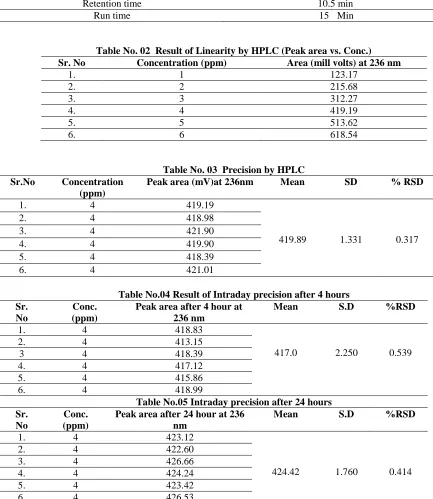
Figure No.03 HPLC Chromatogram of Nimodipine and synthesized compound mixture.
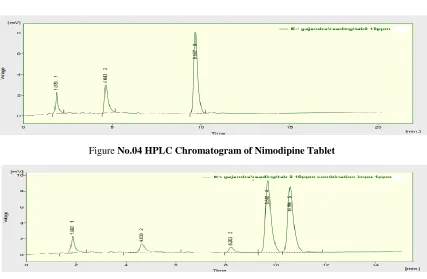
Figure No.04 HPLC Chromatogram of Nimodipine Tablet
Table No.01 Optimized chromatographic condition for RP-HPLC
Chromatographic Conditions SHIMADZU HPLC System
Mobile phase Methanol: Acetonitrile: Water(35:38:27) Column ARP-C18 (250 mm X 4.6 mm), 5μ column Flow rate 1 ml/min
Wavelength detection 236 nm Injection volume 20μl
Temperature Ambient Retention time 10.5 min Run time 15 Min
Table No. 02 Result of Linearity by HPLC (Peak area vs. Conc.) Sr. No Concentration (ppm) Area (mill volts) at 236 nm
1. 1 123.17
2. 2 215.68
3. 3 312.27
4. 4 419.19
5. 5 513.62
6. 6 618.54
Table No. 03 Precision by HPLC Sr.No Concentration
(ppm)
Peak area (mV)at 236nm Mean SD % RSD
1. 4 419.19
419.89 1.331 0.317 2. 4 418.98
3. 4 421.90 4. 4 419.90 5. 4 418.39 6. 4 421.01
Table No.04 Result of Intraday precision after 4 hours Sr.
No
Conc. (ppm)
Peak area after 4 hour at 236 nm
Mean S.D %RSD
1. 4 418.83
417.0 2.250 0.539 2. 4 413.15
3 4 418.39 4. 4 417.12 5. 4 415.86 6. 4 418.99
Table No.05 Intraday precision after 24 hours Sr.
No
Conc. (ppm)
Peak area after 24 hour at 236 nm
Mean S.D %RSD
1. 4 423.12
424.42 1.760 0.414 2. 4 422.60
Table No.06 Results of Robustness study by change in flow rate.
At flow rate of 0.8 ml/min
Sr. No
Conc. (ppm)
Peak area (mV) 0.8 ml/min
Mean S.D %RSD
1. 4 787.12
789.07 3.122 0.395 2. 4 784.96
3. 4 793.21 4. 4 786.68 5. 4 791.48 6. 4 789.07
Table No.07 Results of Ruggedness study by change in analyst. Sr.
No
Conc. (ppm)
Peak Area in mV Mean S.D %RSD
I II I II I II
Analyst I
Analyst II
1. 4 419.19 418.80
419.94 420.66 1.392 1.481 0.3314 0.3520 2. 4 418.98 420.18
3. 4 421.90 420.36 4. 4 419.86 421.79 5. 4 418.39 419.93 6. 4 421.34 422.98
Table No.08 Summary of Precision
Sr .No Parameter SD %RSD
1. Precision 1.331 0.317 2. Intraday precision 2.250 0.539 3. Interday precision 1.760 0.414 4. Robustness 3.122 0.395 5. Ruggedness 1.436 0.341
The summary of the precision is given in the above table and % RSD was found to be ≤ 2.
Table No.09 Result of recovery study by HPLC Sr.No. Drug /
Formulation
Percentage recovery Mean S.D. %RSD
50% 75% 100%
1. Bulk 98.18 99.07 99.89 99.04 0.852 0.863 2. Tablet I 99.22 101.30 103.79 101.43 2.288 2.255 3. Tablet II 99.25 101.68 103.13 101.30 1.969 1.934
Table No. 10 Summary of Method Validation Parameters of HPLC.
Sr.No. Parameter Observation
1. Linearity range 1-6 μg/ml
2. Slope 98.44
3. Intercept 21.54 4. Correlation coefficient 0.999
5. LOD 0.04462
Table No.11: Quantitation of process related impurity of Nimodipine in bulk and tablets. Sr.No. Bulk/ Formulation Quantisation of Impurity
1. Bulk Nimodipine Absent 2. Nimodipine tablet I 0.28% 3. Nimodipine tablet II 0.33%
REFERENCES
1. N.R.Rao,S.S.Kiran, N.L.Prasanth.. Ind. J. of Pharma.Edu. and Res. 2010; 44(3): 301-310.
2. R.S.Shah, M.A.Patel,M.V.Naik,P.K.Pradhan U.M.Upadhyay.Int.J.of Pharma.Sci. and Res. 2012; 3(10): 3603-3617.
3. S.B.Bari,B.R.Kadam,Y.S.Jaiswal A.A.Shirkhekar. Eur. J.of Anal. Chem. 2007; 2(1): 32-53. 4. ICH 3AQ12a, Impurities in New Medicinal Products, 1996, 95-105.
5. ICH Q2B: Guidance for Industry: Validation of Analytical Procedures: Methodology U.S. Department of Health and Human Services Food and Drug Administration, (CDER), (CBER), 1996, 1-10.
6. ICH Q3A, Guidance for Industry: Impurities in New Drug Substances U.S. Department of Health and Human Services Food and Drug Administration Centre for Drug Evaluation and Research (CDER), Centre for Biologics Evaluation and Research (CBER), 2008, 1-14.
7. ICH Q3A, Impurities Testing Guideline: Impurities in New Drug Substances, The European Agency for the Evaluation of Medicinal Products, 1995, 1-11.
8. ICH Q3B (R2), Impurities in New Drug Products, European Medicines Agency, 2006, 3-14.