
A Scale Adaptive Method Based On Quaternion
Correlation in Object Tracking
Jie Hu
College of Information, Zhejiang Sci-Tech University, Hangzhou 310018, China Email: [email protected]
2*Huaxiong Zhang, 3Yu Zhang, 4Jie Feng, 5Hanjie Ma
2*,4,5College of Information, Zhejiang Sci-Tech University, Hangzhou 310018, China 3School of Fashion Design & Engineering, Zhejiang Sci-Tech University, Hangzhou 310018, China
Email: *[email protected], 3[email protected]
Abstract—In this paper, we proposed a scale adaptive Kalman filter algorithm based on quaternion correlation of color image. First, Kalman filter is used to estimate the object motion direction. The correlation of object and the searching window image is calculated to get the accurate position of the object. The scale adaptive method is efficient to the situation of object size changing. In order to reduce the influence of illumination, we proposed to use HSV color space instead of RGB color space. Experiments results showed that the algorithm can detect the object correctly even the size and the color of the object changed.
Index Terms—scale adaptive; quaternion correlation; object tracking
I. INTRODUCTION
Object tracking is a process of locating a moving object (or multiple objects) over time in video by associating target objects in consecutive video frames based on some kind of tracking algorithm. Object tracking has been widely used in several areas, including motion-based recognition[1], automated surveillance[2], and traffic monitoring[3].The aim of object tracking is to locate the object's position in every frame of the video. A number of approaches of object tracking method have been proposed. Tracking methods can be categorized in three components: point tracking, kernel tracking and silhouette tracking[4].
Mean-shift algorithm[5] is an kernel based method which use color histograms to represent the object. Objects are tracked by computing the kernel motion. But when the target moves too fast so that the target area in the two neighboring frame will not overlap, tracking object often converges to a wrong object. If the size of object changes, we will also get wrong result. Bastian Leibe et al.[6] presented an approach to multi-scale object categorization using scale-invariant interest points and a scale-adaptive mean-shift search. Bo Li et al.[7] proposed an improved mean-shift algorithm used in multi-object tracking. The histogram difference between the histograms of background and moving object was computed to obtain the back projection image.
Kalman filter [8, 9] and particle filter[10, 11] are the typical algorithms of point tracking, but an external mechanism is required to detect the object position in every frame. In this paper, Hypercomplex number was used to detect the object position. Hypercomplex number was first proposed by Hamilton in 1843 [12]. Ell and Sangwine [13] described the hypercomplex Fourier transform of color image in detail. Sangwine et al. [14] proposed phase correlation of color image based on hypercomplex Fourier transforms, which can be used in image registration.
Reference[15] proposed an improved Kalman filter algorithm based on quaternion correlation of color image. Kalman filter is used to predict the object moving direction, then the correlation of the object and the area of searching window is calculated to get the accurate position of the object. But if the object size changed a lot, the location accuracy decreased. Reference[16] proposed auto scaled adaptive method to modify the template. In this paper we proposed a scale adaptive method based on HSV, which can be used in lumination variance video.
The rest of this paper is organized as follows. In section II, we introduced tracking method of Kalman filter based on quaternion correlation. In section III the proposed method is described in details. Section IV showed the comparative results and in section V, we made a conclusion for this paper.
II.
METHODS
A. Kalman Filter
The Kalman filter is a set of mathematical equations to estimate the state of a process efficiently and to minimize the mean of the squared error. In this paper, we used Kalman filter to estimate the position of the object.
There are two steps in Kalman filter performing tracking: time update and measurement update. In the time update step, the current state is projected forward (in time) and error covariance is estimated to obtain the a priori estimates for the next time step. We can get the predicted state and error covariance as follows.
| 1 1| 1 1
ˆ
k k kˆ
k k k kx
−=
F x
− −+
B u
− (1) Predicted estimate covariance:| 1 1| 1 1
T
k k k k k k k
P
−=
F P
− −F
+
Q
− (2)where
x
ˆ
k k| is a posteriori state estimate at time k given observations up to and including at time k.P
k k| is a posteriori error covariance matrix.The measurement update step is incorporating a new measurement into the a priori estimate to obtain an improved a posteriori estimate The Kalman Gain is calculated by the priori predicted error covariance as (3) and (4). Then the filter corrects the state model by Kalman gain and measurement residual as (5) and (6). Finally the filter corrects the error covariance as (7). The two phases alternate until the next scheduled observation and the update incorporating the observation.
Innovation covariance | 1 T
k k k k k k
S
=
H P
−H
+
R
(3)Optimal Kalman gain | 1 T 1
k k k k k
K
=
P
−H S
− (4)Measurement residual
y
k= −
z
kH x
kˆ
k k| 1− (5) Updated state estimatex
ˆ
k k|=
x
ˆ
k k| 1−+
K y
kk (6)Updated estimate covariance
P
k k|= −
(
I
K H
k k)
P
k k| 1− (7)B. Quaternion Correlation
Kalman filter should be used combined with another algorithm to detect the accurate position of the object. In this paper we used Quaternion correlation to detect the object.
A hypercomplex number is a traditional term for an element of an algebra over a field where the field is the real numbers or the complex numbers. The quaternions are a number system that extends the complex numbers, which have one real part and three imaginary parts. A quaternion is defined as
0 1 2 3
( )
( )
( )
( )
( )
q n
=
q n
+
iq n
+
jq n
+
kq n
(8) whereq n
0( )
,q n
1( )
,q n
2( )
,q n
3( )
are real, and i, j, kare imaginary operators.
In digital image processing, we can define a pixel of color image
f m n
( , )
by pure quaternion as( , )
( , )
( , )
( , )
f m n
=
R m n i G m n j
+
+
B m n k
(9) whereR m n G m n B m n
( , ), ( , ), ( , )
are the red, green and blue components of the pixel respectively.Although the image can be described by RGB model, the model is not suitable for some situations, such as lumination changing. Thus, we change the color space to HSV space, the pixel
f m n
( , )
can be represented by( , )
( , )
( , )
( , )
f m n
=
H m n i
+
S m n j V m n k
+
(10) whereH m n S m n V m n
( , ), ( , ), ( , )
are the hue, saturation and value components of the pixel respectively.Quaternion Fourier transform and inverse transform are defined as follows[13,15].
1 1 2
0 0
{ ( , )}
( , )
1
( , )
R R mv nu M N M N m nF
f m n
F v u
f m n e
MN
μ π⎛ ⎞ − − − ⎜ + ⎟ ⎝ ⎠ = ==
=
∑∑
(11)1 1 2
0 0
{ ( , )}
( , )
1
( , )
L L mv nu M N M N m nF
f m n
F v u
e
f m n
MN
μ π⎛ ⎞ − − − ⎜ + ⎟ ⎝ ⎠ = ==
=
∑∑
(12)1 1 2
0 0
{ ( , )}
( , )
1
( , )
R R mv nu M N M N m nF
f m n
F
v u
F u v e
MN
μ π − − ⎛ ⎞ − − ⎜ + ⎟ ⎝ ⎠ = ==
=
∑∑
(13)1 1 2
0 0
{ ( , )}
( , )
1
( , )
L L mv nu M N M N m nF
f m n
F
v u
e
F u v
MN
μ π − − ⎛ ⎞ − − ⎜ + ⎟ ⎝ ⎠ = ==
=
∑∑
(14)where M and N are the height and width of the image
respectively. μ is any unit pure quaternion. It can be set as
(
i
j
k
) / 3
μ
= + +
or other vector.( , )
m n
is the coordinate of time domain and( , )
u v
is the coordinate of frequency domain. RF
denotes the right Fouriertransform of
f m n
( , )
. LF
denotes the left Fouriertransform. R
F
− denotes the inverse right Fouriertransform and L
F
− denotes the inverse left Fouriertransform.
Image correlation is a very useful technique in many areas, such as image registration. The quaternion correlation of two color images are defined as
1 1
0 0
( , )
M N( , ) (
,
)
q p
m n
f
g
f q p g q
m p
n
σ
− −= =
= ∗ =
∑∑
−
−
(15) where * is correlation operate.
f
andg
are the images ofsize
M
×
N
. The improved correlation formula is shown as||
( , ) R[ ( , ) ( , ) ( , ) ( , )]
R L R L
m n F F v u G v u F v u G v u
σ −
− ⊥
= +
(16)
where
G
L||( , )
v u
andG
L⊥( , )
v u
are the parallel andperpendicular component of
G v u
L( , )
.( , )
( , )
|
( , ) |
R r
r
C m n
C
f g
F
C m n
φ
=
−(17) where
||
( , ) ( , ) ( , ) ( , ) ( , )
r R L R L
C m n =F v u G v u +F− v u G ⊥ v u
( , )
r
C m n
is the magnitude ofC m n
r( , )
.If we want to find whether the image G is one part of
the image F, we can do cross-correlation of G and F. The
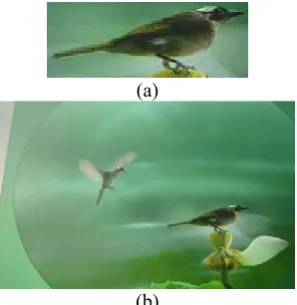
peak of correlation result is the matching area. As shown in Figure1, (a) is image G, (b) is image F, (c) is the searching result image, and (d) shows the result of correlation, the peak represent the position of the matching area.
In the past, quaternion correlation is done in RGB space. But in real video sequences, the same object in different frames is captured at different time under the different illuminate conditions. So the detailed color of two frames will differ. If phase correlation is done in RGB space, there will be mismatch because of different color. In this paper, we proposed to use HSV space instead of RGB space and set Hue component to zero to reduce the influence of illumination.
In Ref[15], we proposed a Kalman filter method based on quaternion correlation algorithm. First the object image F of size M*N is extracted from the first frame.
The position coordinate (x0,y0) of the object is sent to
Kalman filter to estimate the next position (x1, y1). Then
we got the search window image S (with the center of (x1, y1) and the size of (M+n)*(N+n), n is an positive
integer such as 5, 7, …). The phase correlation of S and F
is calculated. If the object F is in the window image S, there is an impulse at that position. The position coordinates are sent to Kalman filter to do the next prediction. Repeat the upper steps until the end of video sequence.
C. Scale Adaptive Algorithm
The algorithm of section A and B gets better results than Meanshift algorithm as described in Ref[15]. But when the size of object changed a lot, the location accuracy decreased. To fix this problem, we proposed scale adaptive method to modify the template.
(a)
(b)
(c)
(d)
Figure 1. Result of quaternion phase correlation. (a) image G; (b) image F; (c) search result; (d) meshgrid of search result.
Figure 2. Main frame of proposed algorithm.
object size has changed. If the object size changed a lot, the new object area is used to do tracking. The algorithm is suitable for the condition of objects’ size change.
III.RESULT AND DISCUSSION
The proposed scale adaptive matching algorithm was applied to a variety of synthetic and real images. In this section, we first give the experimental results of RGB space and HSV space. Then the results of our method and REF[15] are compared. Finally, the proposed method was used to multi-object tracking.
A. Matching Result in RGB Space and HSV Space
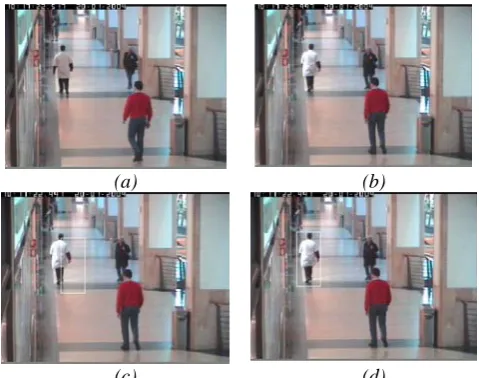
In video sequences, the same object in different frames is captured at different times under the different illuminate conditions. So the detailed color of two frames will differ. We take the real video sequence (REF[17]) for example. As shown in Figure 3, the white clothes’ color is different in (a) and (b). If phase correlation is done in RGB space, there will be mismatch because of different color as shown in (c). In this paper, we use HSV space instead of RGB space to decrease the influence of illumination. Hue component is set to 0, and the matching result is shown in (d). It’s obviously that using HSV space can get better result.
B. Result of Proposed Algorithm
We performed our method and method in Ref[15] both of the algorithms on real video sequences [17]. Figure4 shows the tracking results of real videos. The 1st and 3rd rows are the results of our algorithm and the 2nd and 4th rows are the results of Ref[15] algorithm.
In the video sequences, the women's size changed from small to large. It was shown that when the women's size did not change too much, both of the two algorithms could get accuracy results. When the women came closer, the size changed. The algorithm of Ref[15] did not consider the situation so that it got a unsatisfied result in frame 360 and 380. In this paper, we measured the size of person every 5 frames. If the ratio of old and new object size was larger than a threshold, the new object was used as model. It can be seen that our method had better results.. In the other hand, in frame 250-380, the color of clothes changed because of illumination changing. The HSV space was used in quaternion correlation. It can reduce the influence of illumination to get accurate location.
Figure 3. Matching result of RGB space and HSV space. (a) frame 135; (b) frame 146; (c) result of RGB space; (d) result of HSV space.
Our method can also be used in obscured situation. As shown in Figure 5, a man walked in front of the woman. The object area increased suddenly while using background subtraction method. The object is so large that the position of the women we tracked is shifted. To solve this problem, we did not update the object model if the ratio of old and new object size increased or decreased too fast. The result was shown in the left column of figure5.
Figure6 showed that our method is suitable for tracking multi-object too.
IV.CONCLUSION
In this paper, we proposed a scale adaptive Kalman filter algorithm based on quaternion correlation of color image. Kalman filter is used to estimate the object moving direction. The correlation of object and the searching window image is calculated to get the accurate position of the object. Scale adaptive method is efficient to the situation of object size changing. Experiments results showed that the accuracy of our algorithm is higher than Ref[15].
To reduce the influence of illumination, HSV space is used to do phase correlation. The algorithm can also be used in multi-object tracking and be useful in some areas of object tracking and cloth dynamic simulation.
ACKNOWLEDGEMENT
This work was supported by the open fund of Zhejiang Province University Top priority Discipline(2013KF08) and the applied basic research programs of China National Textile and Apparel Council.
(a) (b)
frame 250
frame 270
frame 300
frame 330
frame 360
frame 380
Figure 4. Walking sequence tracked by our method and method of Ref[12]. The left column is the results of our method. The right column
is the results of Ref[12].
Frame 220
Frame 225
Frame 230
Frame 235
Frame 240
Figure 5. Walking sequence with obscure tracked (the left column is the result of our method and the right column is the result of Ref[12] )
(frame 220,225,230,235 and 240)
REFERENCES
[1] Claudette Cédras, Mubarak Shah, "Motion-based recognition: a survey," Image and Vision Computing, vol. 13, pp.129-155, 1995.
[2] Mubarak Shah, Omar Javed, Khurram Shafique, "Automated Visual Surveillance in Realistic Scenarios," Multimedia, IEEE, vol. 14, pp.30-39, 2007.
[3] Kilger M., "A Shadow Handler in a Video-based Real-time Traffic Monitoring System," Applications of Computer Vision, Proceedings, pp.11-18, 1992.
[4] Alper Yilmaz, Omar Javed, Mubarak Shah, "Object Tracking: A Survey," ACM Computing Surveys, vol. 38. pp.1-45, 2006.
[5] Comaniciu D., Ramesh V. and Meer P., “Kernel-Based Object Tracking,” IEEE Transactions on .Pattern Analysis and Machine Intelligence, vol.25, pp. 564-577, 2003 [6] Bastian Leibe, Bernt Schiele, "Scale-Invariant Object
Categorization Using a Scale-Adaptive Mean-Shift Search," Pattern Recognition Lecture Notes in Computer Science, vol. 3175, pp.145-153, 2004.
[7] Bo Li, Zhiyuan Zeng, Zhongru Wu, "Multi-Object Tracking Based on Improved Mean-shift Algrithm," Image and Signal Processing, 2009. CISP '09. 2nd International Congress on, pp.1-5, 2009.
[8] R. E. Kalman, “A new approach to linear filtering and Prediction Problems,” Transactions of the ASME, Journal of Basic Engineering, vol. 82, pp. 34-45, 1960.
[9] Saira Saleem Pathan, Ayoub Al-Hamadi, Bernd Michaelis, "Intelligent feature-guided multi-object tracking using Kalman filter," 2nd International Conference on Computer Control and Communication pp. 1-6, 2009
[10]N. Cui, L. Hong, J.R. Layne, "A comparison of nonlinear filtering approaches with application to ground target tracking," Signal Processing, vol. 85 pp. 1469–1492, August 2005
[11]Lang Hong, Devert Wicker, "A spatial-domain multiresol utional particle filter with thresholded wavelets", Signal Processing, vol. 87 pp. 1384 – 1401, 2007
[12]W. R. Hamilton , Elements of Quaternions . London, U.K.: Longmans Green, 1866.
[13]Todd A. Ell, and Stephen J. Sangwine,"Hypercomplex Fourier Transforms of Color Images" IEEE Transactions on image processing, vol. 16, January 2007
[14]S.J. Sangwine, T.A. Eli and C.E. Moxey, "Vector phase correlation," Electronic Letters, Vol. 37, pp. 1513-1515, December 2001
[15]Jie Hu, Huaxiong Zhang, Hai Huang, Jie Feng et al., “An Improved Kalman Filter Algorithm Base On Quaternion Correlation In Object Tracking,” The Ninth International Conference on Fuzzy Systems and Knowledge Discovery, FSKD, pp.1739-1743, 2012.
[16]Jie Hu, Huaxiong Zhang, Jie Feng, Hai Huang et al, " A Scale Adaptive Kalman Filter Method Based On Quaternion Correlation In Object Tracking," The Third International Conference on Networking and Distributed Computing , ICNDC, pp.170-174, 2012.
![Figure 5. Walking sequence with obscure tracked (the left column is the result of our method and the right column is the result of Ref[12] )](https://thumb-us.123doks.com/thumbv2/123dok_us/7820120.1664726/5.595.55.548.80.650/figure-walking-sequence-obscure-tracked-column-result-method.webp)
