Scheduling Program of the Track and Field
Sports Competition Based on
R_Timetable Algorithm
Yongxin WangNanyang Institute of Technology/Department of Physical Education, Nanyang, China Email: [email protected]
Jianying Wangand Qiufen Wang
Nanyang Institute of Technology/ Department of Applied Mathematics, Nanyang, China Nanyang Institute of Technology/ Department of Computer Science and Technology, Nanyang, China
Email: [email protected], w_qiufen @163.com
Abstract—The characteristics and several common open questions of the scheduling program in the track and field sports competition are analyzed in this paper, and then an automation method based on R-timetable algorithm, which is achieved effectively through the C++ program design, is provided to solve the corresponding problems. It has been found that the method in this paper immensely optimizes the organization, and perfectly improves the efficiency of arrangement of the sports competition.
Index Terms—R-timetable, Track and Field Sports Competition, Scheduling program, Algorithm.
I.INTRODUCTION
Competition schedule is very important. It determines whether the whole competition can carry out smoothly, since it shows all the arrangements for all of the athletes to compete in a contest, also for the judges to work and for the audiences to watch. Thus arranging the agenda is definitely complicated and difficult, The reasons lists showing as following.
Firstly arranging the competition schedule is a sort of problems which belongs to the time planning program or belongs to kind of NP problems, and the deterministic algorithm for solving this kind of problems has not yet been achieved till now.
Secondly the principally key part of arranging the competition schedule is to ascertain the best permutation, and it’s generally a huge number of permutation for all of
the items. Taking 10 items for example, the number of
permutation is 3,628,800.
Lastly due to the influence of a number of factors, which are related to each other and meanwhile restricted or impacted mutually, for instance, javelin item and shot item cannot be arranged at the same period, 3,000-meter item and 5,000-meter item cannot be conducted on the same day, etc. We are still looking forward to finding out one of the best way to arrange the competition schedule.
At present, there are still a series of typical problems against the arrangement of sports competition schedule, mainly showing as follow.
Firstly the schedule of the school sports competition is usually worked out just by simple hand working, so it’s common to make mistakes with inefficiency.
Secondly the arrangement of competition schedule mostly bases on the past experiences, instead of carrying out according to the logical scientific theory.
Lastly there are only a few methods up to now, such as cut-and-try method, genetic algorithm[1], search method[2] etc, which are studied and applied to arrange the sports competition schedule. Although all these methods can speed the arrangements effectively, it’s hard to ensure the approving results as well.
In view of the above-mentioned facts, an automation method based on R-timetable algorithm is given to optimize the organization and improve the efficiency of arrangement of the sports competition in this paper.
II.FOCUSED BACKGROUND
There are a series of particular characteristics of the track and field sports competition holding in the colleges or universities compared with other significant official sports competitions[3-7],showing as following.
Firstly, at present for many contemporary colleges and universities, there are usually at least two playgrounds can be used for athletic fields, thus track competition and field competition can be arranged at the same periods but Manuscript received August 20, 2011; accepted September 2,
2011.
Yongxin Wang(1978-), male, Master, Lecturer, Research direction: Sports teaching & training, Computer aided instruction & management.
Jianying Wang(1981-), Female, Bachelor, Lecturer, Research direction: Applied Mathematics, ordinary differential equation.
the different sports grounds. Consequently arrangements for sports competition can be carried out easily just by considering the conflicts of concurrently items.
Secondly, there are just three days by a definite date of the school sports competition, and the concurrently items are seldom regular ways since all of the athletes are students or teachers but not the professional athletes, thus they join the different items just according their hobbies. Thirdly, school sports competitions commonly include many different kinds of groups, such as man and women items groups of students, man and women items groups of young teachers, men and women items groups of middle age teachers, men and women items groups of senior age teachers.
Lastly, it’s flexible for arranging the agenda of school sports competition compared with the professional sports competitions. According to the actually special situation, there are some recreational items for senior age teachers arranged during the common items, such as the games of upland fishing, carrying things run.
Therefore, the principle of arrangement for the school sports competition is trying to avoid the clashes of the
concurrently items since it’s really complicated because of much more different groups and special items. By considering the R-timetable algorithm method is one of the most effective way to solve time planning problems, the agenda arrangement is carried out by the R-timetable automation algorithm in this paper.
III.R_TIMETABLE ALGORITHM
A. Temporal Matrix of Relation
For a random event, let the starting time be si, and the finishing time be fi (si<fi), define the time interval of the event as [si, fi], denoted by Ii. Then the relations between any two random events can be shown by corresponding time intervals of each other.
For the random event I1 and another random event I2,
the two time intervals of these two random events should be denoted as I1(s1,f1) and I2(s2,f2) respectively, then there
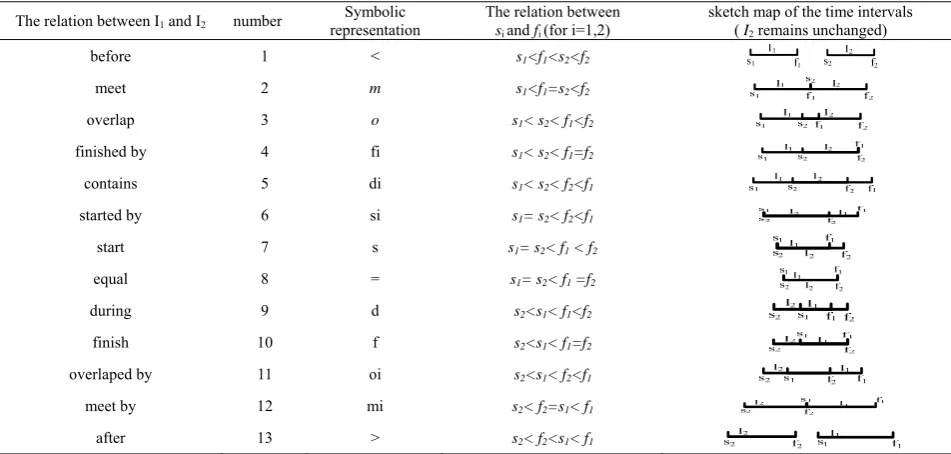
are 13 different time intervals for all of possible relations between these two events I1 and I2 , showing as the
following table 1.
TABLE 1:
THE 13DIFFERENT TIME INTERVALS FOR ALL POSSIBILITIES BETWEEN THE TWO EVENTS I1AND I2
The relation between I1 and I2 number representation Symbolic The relation between si and fi (for i=1,2)
sketch map of the time intervals ( I2 remains unchanged)
before 1 < s1<f1<s2<f2
meet 2 m s1<f1=s2<f2
overlap 3 o s1< s2< f1<f2
finished by 4 fi s1< s2< f1=f2
contains 5 di s1< s2< f2<f1
started by 6 si s1= s2< f2<f1
start 7 s s1= s2< f1 < f2
equal 8 = s1= s2< f1 =f2
during 9 d s2<s1< f1<f2
finish 10 f s2<s1< f1=f2
overlaped by 11 oi s2<s1< f2<f1
meet by 12 mi s2< f2=s1< f1
after 13 > s2< f2<s1< f1
In the rectangular coordinate system, the ordered pair, such as (si, fi), can be denoted by a point. Then the time intervals of the events including all possibilities can be represented by coordinate points in the plane. There are 5 cases among s1and I2, which are s1<s2, s1=s2, s2<s1<f2,
s1=f2, s1>f2. Similarly, there are 5 cases among f1and
I2.which are f1<s2, f1=s2, s2<f1<f2, f1=f2, f1>f2. Number 1,
2, 3, 4, 5 represent the corresponding intervals or points (-∞, s2), [s2], (s2, f2), [f2], (f2, +∞) respectively, thus the
figural relations between I1 and I2 show as figure 1. Moving forward to follow the same method, assume that X1={-1,0,1} and number -1, 0, 1 represent intervals or points of (-∞, s2), [s2], (s2, +∞) respectively.
In the same way, let Y1={-1, 0, 1} and the number -1, 0, 1 represent the intervals or points of (-∞, s2), [s2], (s2,+ ∞) respectively; Similarly, let Y2={-1, 0, 1} and the number -1,0,1 represent the intervals or points (-∞,f2), [f2],(f2,+ ∞)
respectively, then Y can be expressed as the subset of the space domain Y1×Y2.
Supposing that if R(1, 2) is the simple-ingredient time relational constraints [8]between I1 and I2, then R(1, 2) can also be denoted by using a 2×2 matrix. For
example, if R(1,2)={<}=(1)×(1)=((-1)×(-1))×((-1)×(-1)),then it can
be expressed as a matrix
⎟⎟ ⎠ ⎞ ⎜⎜ ⎝ ⎛ − − − − 1 1 1 1 .
In general, supposing that if the set of events is{(i, Ii),i=1, 2, 3, …, n} and the time interval Ii is (si, fi) for
any random event i(i=1, 2, 3, … n),then for any two random events Ii and Ij, the time interval relational constraints between them should be
R(i,j)=(A1(i,j) ×A2(i,j)) ×(B1(i,j)×B2(i,j)),
since A1、A2、B1、B2are the subsets of the set{-1, 0, 1}, the
corresponding matrix should be
M(i,j)= , i j
j) (i, B j) (i, B j) (i, A j) (i, A 2 1 2 1 ≠ ⎟⎟ ⎠ ⎞ ⎜⎜ ⎝ ⎛ ,
especially when i=j we get
M(i, i)= ⎟⎟ ⎠ ⎞ ⎜⎜ ⎝ ⎛ − 0 1 1 0 . The matrix M= ⎟⎟ ⎟ ⎟ ⎟ ⎠ ⎞ ⎜⎜ ⎜ ⎜ ⎜ ⎝ ⎛ n) M(n, M(n,2) M(n,1) n) M(2, M(2,2) M(2,1) n) M(1, M(1,2) M(1,1) L M M M M L L
is called the corresponding relational matrix of {R(i, j)}, or time matrix of relation for short, and M(j, i)=-M(i, j)T. It contains n2 2×2 matrices, in other words, it’s a matrix of 2n×2n and any element can be written in the form of M (i, j) i,j=1,2,…,2n.
B. Description of the Algorithm
a. Data structure
The main data structure in the R-timetable algorithm
includes structure types, set types and array types. All of the specific details show as following.
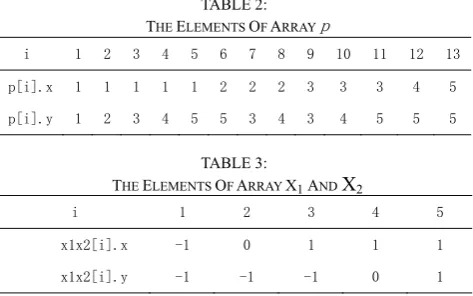
The 1-dimension structure types data for saving the time intervals p[i] and x1 and x2, the relations between them showing in the figure 1 and figure 2, and the data of storage listing in the following table 2 and table 3.
TABLE 2: THE ELEMENTS OF ARRAYp
i 1 2 3 4 5 6 7 8 9 10 11 12 13
p[i].x 1 1 1 1 1 2 2 2 3 3 3 4 5
p[i].y 1 2 3 4 5 5 3 4 3 4 5 5 5
TABLE 3:
THE ELEMENTS OF ARRAY X1 ANDX2
i 1 2 3 4 5
x1x2[i].x -1 0 1 1 1
x1x2[i].y -1 -1 -1 0 1
R is the 2-dimension integral types array for storing the data of time intervals. For the specific event sets E, pick up any random element event i and another element event
j(j∈E-{i}), the relation of the event i and j are stored in the 2-dimension integral types array R(i,j), which should be denoted as
R(i,j)
⊂
{1,2,3,4,5,6,7,8,9,10,11,12,13}.Substitute the corresponding value for example, it can be
R(1,2)={1,2},R(1,3)={1},R(2,3)={13}.
M is the 2-dimension integral array for storing the data of time matrix of relation.
HJ is the set of the corresponding line numbers related to the temporal matrix of relation M.
e is the line number of the corresponding non-positive row vector.
S keeps the records of consistent subsets of e in the 1-demension integral array.
b. Design of the algorithm
Assume that there are n random events, then the steps of the algorithm show as following.
Step 1, Input temporal matrix of relation M and the set of the corresponding line numbers HJ(M).
Step 2, Let S=Φ.
Step 3, If HJ (M)=Φ, then output S, since S is the permutation number of the events, which can meet the conditions of time relational constraints, the program ends. If not, move on to the step 4.
Step 4, If M has non-positive row vectors, then ei (starting from i=1) represents the set of the line numbers for these row vectors, and move on to step 5. If not, the program ends.
Step 5, Work out the compatible subset of ei , denoted by di, move on to step 6. If not, the program ends.
Step 5-1, Let ei={x1,x2,…,xm},j=1;
Step 5-2, If j≥m+1, the program ends. Otherwise, let L0={xj},L1={y|m(xj,y)={0,1}or ={0},y∈HJ(M)},
Lk+1={y|∃x∈Lk,m(x,y)={0,1}or ={0},y∈HJ(M)}. Step 5-3,
L(xj)= k
k L
U .For
∀
z
∈
HJ(M),{1}
and
Φ
z)
m(y,
) L(x y j≠
≠
∈
I
.Then let di=L(xj), and di is the compatible subset of ei including xj, if it’s done, move on to step 6. If not, move back to step 5-1 for j++.
Step 6, Delete all of the row elements and the column elements related to di from the matrix M, then we’ll get the corresponding sub matrix Mi.
Step 7, Adding all of the elements of di to S, giving M the value again with Mi for i++, move back to step 3.
Note: Non-positive row vectors, which are denoted by (ai1,ai2,…,ai2n), for
aij=min{t|t∈m(i,j)}(j=1,2,…,2n), and aij≤0.
IV.CASE STUDY OF ARRANGING THE COMPETITION SCHEDULE
A. Set Up Temporal Matrix of Relation a. Elementary principles for arranging the schedule
1) Short distance sport items first, and then the long distance ones.
2) Preliminary contest first, and then finals. 3) Track first, and then the field events.
4) Spacing interval during the same sport events should be reasonable to make sure athletes have enough time to rest or get ready for next item[9-10].
5) Try to arrange attractive or interesting items and the others alternately.
6) Minimize the clashes in a possible way according to the situation of the multiple occupied athletes, and try to prolong the time spanamong any items if simultaneous entries happen.
One of the effective way to minimize the clashes of the multiple occupations is to interlude items and hold the concurrently item in the different time spans, which is the precedence essentially related to each of the time interval of sport events.
According to the statistical data of the entry form list, for the items of Men’s 100-meter and Men’s 400-meter, Women’s 100-meter and Women’s 200-meter, athletes usually take part in the items at the same time. In order to leave enough time for the multiple occupied athletes to rest, the schedule can be arranged as following way
Men’s 100-meter→Women’s 100-meter→Men’s 400-meter→Women’s 200-meter.
The contradistinctive nexus among the four items can be shown as the following table 4.
TABLE 4.
THE TIME INTERVALS OF CONCURRENTLY ITEMS Men’s
100-meter
Men’s 400-meter
Women’s 100-meter
Women’s 200-meter Men’s
100-meter = < < <
Men’s = > <
400-meter Women’s
100-meter = <
Women’s
200-meter =
From the above table, we know that Men’s 100-meter < Men’s 400-meter, which means that the item of Men’s 100-meter is arranged prior to Men’s 400-meter. In the same way, Men’s 400-meter > Women’s 100-meter means that the item of Men’s 400-meter is arranged behind the item of Women’s 100-meter. Consequently, the clash of concurrent items is removed in a perfect way by putting the item Women’s 100-meter in the item Men’s 100-meter and Men’s 400-meter.
b. Case study of the competition schedule
Taking the agenda of the 17th track and field sports competition of Nanyang Institute of Technology for the example, we worked out one of the best scheme of the competition schedule. Preliminary contests and finals of the typical items in the track items and field items were principally researched in what follows.
Typical items mentioned above include Men’s 100 meter , Men’s 400-meter , Men’s 3000-meter ,Women’s 100-meter , Women’s 400-meter , Women’s 3000-meter , Men’s shot-put , Women’s shot-put , Men’s long jump, Women’s long jump. Now regard all of these items as individual events and put them in order, the opening and closing ceremony both are ordered in the serial number. There are 18 events in total, showing as follow table 5.
TABLE 5.
SPORTS EVENT AND SERIAL NUMBER Serial number Sports event
1 Men’s 100-meter preliminary 2 Women’s 100-meter preliminary
3 Men’s 400-meter preliminary 4 Women’s 400-meter preliminary
5 Men’s 3000-meter final 6 Women’s 3000-meter final
7 Men’s 100-meter final 8 Women’s 100-meter final 9 Men’s 400-meter final
10 Women’s 400-meter final 11 Men’s shot-put qualifying round
12 Women’s shot-put qualifying round 13 Men’s long jump qualifying round
14 Women’s long jump qualifying round 15 Men’s long jump final
16 Women’s long jump final 17 Opening ceremony
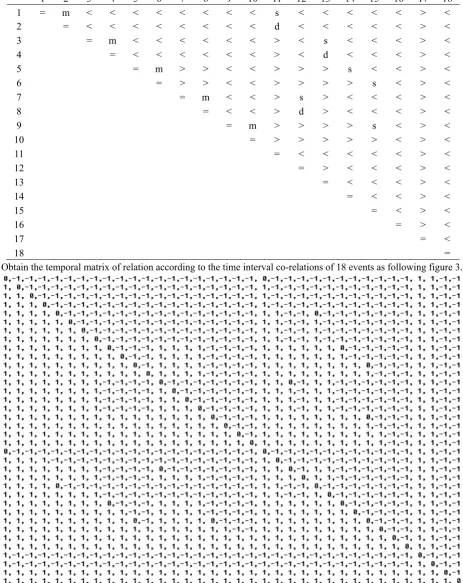
Obtain the temporal matrix of relation according to the time interval co-relations of 18 events as following figure 3.
Figure 3:Temporal matrix of relation of case study TABLE 6.
CO-RELATIONS OF 18 EVENTS’ TIME INTERVAL
1 2 3 4 5 6 7 8 9 10 11 12 13 14 15 16 17 18
1 = m < < < < < < < < s < < < < < > < 2 = < < < < < < < < d < < < < < > < 3 = m < < < < < < > < s < < < > < 4 = < < < < < < > < d < < < > < 5 = m > > < < > > > s < < > < 6 = > > < < > > > > s < > <
7 = m < < > s > < < < > <
8 = < < > d > < < < > <
9 = m > > > > s < > <
10 = > > > > > < > < 11 = < < < < < > < 12 = > < < < > < 13 = < < < > < 14 = < < > < 15 = < > <
16 = > <
17 = <
B. Consequence and Analysis of the Case Study Arrangement
a. Consequence of case study
According to the temporal matrix of relation, run the
program based on R_time table algorithm, we can obtain the data as following:
e1={33},d1={33},e2={34},d2={34},e3={1,21},
d3={1,21},e4={2},d4={2},e5={3},d5={3},e6={4},d6={4},e 7={22},d7={22},e8={5,25},d8={5,25},e9={6},d9={6},e10= {7},d10={7},e11={8},d11={8},e12={26},d12={26},e13={13, 23},d13={13,23},
e14={14},d14={14},e15={15},d15={15},e16={16},
d16={16},e17={24},d17={24},e18={9,27},d18={9,27},e19={ 10},d19={10},e20={28},d20={28},e21={11,29},d21={11,29 },e22={12},d22={12},e23={17},d23={17},e24={18},d24={1
8},e25={30},d25={30},e26={19},d26={19},e27={20},d27={ 20},e28={31},d28={31},e29={32},d29={32},e30={35},d30= {35},e31={36},d31={36}
Then the corresponding R_time table should be:
(33,34,(1,21),2,3,4,22,(5,25),6,7,8,26,(13,23),14,15,16,24 ,(9,27),10,28,(11,29),12,17,18,30,19,20,31,32,35,36) and the marshalling sequence of all these events shows as figure 4.
Figure 4:The marshalling sequence of the case study events
b. Analysis of case study resolution
According to the above conclusion data, the whole procedure should be: Opening ceremony first.
For track items, the sequence should be:
Men’s 100-meter preliminary→Women’s 100-meter preliminary→Men’s 400-meter preliminary→Women’s 400-meter preliminary item →Men’s 100-meter final item→ Women’s 100-meter final→Men’s 3000-meter final→ Women’s 3000-meter final→Men’s 400-meter final→Women’s 400-meter final;
For field events, the sequence should be:
Men’s shot-put qualifying round→Men’s long jump qualifying round item →Women’s shot-put qualifying round→Women’s long jump qualifying round→Men’s long jump final→Women’s long jump final.
For interlude items, the sequence should be:
Men’s shot-put qualifying round item should start while Men’s 100-meter preliminary item is being in play, Men’s long jump qualifying round item should start while Men’s 400-meter preliminary item is being in play, Women’s shot-put qualifying round item should start while Men’s 100-meter final item is being in play, Men’s long jump qualifying round item should start while Men’s 3000-meter final item is being in play, Men’s long jump final item should start while Women’s 3000-meter final item is being in play, Women’s long jump final item should start after Women’s 3000-meter final item ends.
This agenda is highly logical and rigorously scientific by following almost all of the elementary principles of arrangement and taking account of the other factors, such as, consider to collocate the short distance items and the long distance ones, combine the preliminary contests and the finals, intersect the track and the field events, of course leave the reasonable spacing interval during the same sport events so that athletes have enough time to rest or get ready for next item, and also arrange attractive or interesting items and the others alternately, etc.
V.CONCLUSION
This paper provides an automation method based on R-timetable algorithm, which is achieved effectively through the C++ program design, since it’s proved to be logically feasible, according to the characteristics and several common questions of the scheduling program in the track and field sports competition.
The data of experimental results indicate that the method contributes many merits and advantages with respect to many common and typical problems, mainly show as follows:
First, the method optimizes the assembly of programs perfectly, including less clashes of merged programs, reasonable interludes of attractive programs, etc.
Second, it also remarkably increases the efficiency, makes the arrangement easier and more concise than before.
REFERENCE
[1] Feng Lin and Jin-yuan Yang. “Track and field sports meeting scheduling based on genetic algorithm”. JOURNAL OF JILIN INSTITUTE OF CHEMICAL TECHNOLOGY, 4thed,vol 27,2010,pp.88-90.
[2] Dan Li and Li-chen Wang, “An Algorithm Model of Popular Track and Field Sports Competition Schedule” ,JORUNAL OF PHYSICAL EDUCATION INSTITUTE OF SHANXI TEACHERS UNIVERSITY, 4thed,vol 17, 2002,pp.55-57.
[3] Beijing Physical Education DepartmentsTeaching Materials Compilation Committee. track and field .Beijing: People's Sports Publishing House,1978.
[4] Chinese Athletic Association Validation. Track and Field Competition Rules. Beijing: People's Sports Publishing House,1995.
[5] Rong-fang GAO, Li-jun YIN and Jing ZHANG. “Design and Realization of a Dynamic Grouping Algorithm Dynamic Grouping Algorithm Based on Track Events”.
COMPUTER ENGINEERING & SOFTWARE,1sted,vol31,2011,pp.1-3.
[7] Hui HE. “On the Determination of Time Duration of Each Stage of a Track Event to Improve Scheduling of Track and Filed Meet”. JOURNAL OF XI'AN INSTITUTE OF PHYSICAL EDUCATION, 2nded, vol 18, 2001, pp. 110-112.
[8] Bo Zhang and Ling Zhang,“Relational matrix method of temporal planning”,CHINESE JOURNAL OF COMPUTERS, 6thed,vol 14, 1991,pp.411-422.
[9] Xianjun Lan, “Description of scheduling program for the track and field sports meeting”, READ AND WRITE PERIODICAL, 11thed,vol 5, 2008,pp.82.
[10] Laoming Li, “A manual for arbiters of track and field”.Beijing:BEI JING SPORT UNIVERSITY PRESS, 2005.
Yongxin Wang was born in Henan, China, in 1978, and
received the B.S and M.S degree in physical education from Henan University, Kaifeng, China, in 2002 and 2010 respectively.
He has been a lecturer for 3 years at the department of Physical Education of Nanyang Institute of Technology in Nanyang, China. He researched in martial art and also focused on network, software guide. He joined the projects researched in volleyball teaching and studying, and in comparative research in the current physical education of the universities between China and USA.
Mr wang was proficient in many kinds of physical arts and also interested in computer science and algorithm .
Jianying Wang was born in Gansu, China, and received the B.S
degree in applied mathematics from Lanzhou University in 2004, Lanzhou, China.
She has been a lecturer for 2 years and worked at the department of applied mathematics in Nanyang Institute of Technology, Nanyang, China. She researched at the ordinary differential equation, published papers about Modified Models for Time Series and compiled the Advanced mathematics textbook, she also took part in the projects of research and application related to Nonconforming Finite Element Method for a kind of Nonlinear Parabolic Equations, and Intelligent Control System based on Fan Boolean Algebra, etc.
Ms wang also achieved the first place in the competition of Teaching Technique and the first Award of Henan Province Zone in the China Undergraduate Mathematical Contest in Modeling in 2005 and 2007. Ms Wang focused on the applied mathematics and she was always interested in the computer scince and algorithm.
Qiufen Wang was born in Henan, China, in 1978, and received
the B.S degree in computer science and application in 2002 from Henan University, Kaifeng, China, and M.S degree in computer science in 2005 from Zhejiang Science and Technology University, Hangzhou, China.
She has been a lecturer for 3 years and worked at the department of Computer Science and Technology in Nanyang Institute of Technology, Nanyang, China.
She researched at the software science and the design of web-based inquiry learning platform for college science education, signal processing systems software. she published several papers about operating system principles and the application of competition mechanism in teaching operating system. She was in charge of several important computer projects of Research and Application related to Ajex technique.