Performance Improvement of Cotton Processing
Industry by using Taguchi Doe
G. K. Dhongade S. V. Bansod
Lecturer Assistant Professor
Department of Mechanical Engineering Department of Mechanical Engineering
Government Polytechnic, Amravati [M.S.] India P.R.M.I.T. & R. Badnera [M.S.] India
N. J. Shirbhate A. N. Chavan
Assistant professor Assistant Professor
Department of Mechanical Engineering Department of Mechanical Engineering
Government Polytechnic, Amravati [M.S.] India Shree L R Tiwari College of Engg .Mumbai [M.S.] India.
Abstract
Double roller gins are commonly used in India for ginning seed cotton. But studies reveal that slow ginning rates and higher electrical consumption are the limitations of the DR gin. The main objective of present research work was to design of experiment set up of modified double roller gin by using Taguchi design method that had a higher ginning rate and less power consumption. Experiments were carried out on a specially designed modified double ginning machine experimental setup to select optimal operating parameters for existing DR gins. Seed cottons of different staple lengths were ginned at three levels of roller and moisture contents. Taguchi L9 array method revealed that a roller speed of 122 RPM and a Cotton grade A coupled with 7 % seed cotton moisture content showed the highest ginning rate with maximum savings in electric energy. Analysis of results of the power requirement for ginning the various types of cotton on the modified DR gin revealed that the saving in electrical energy ranged from 15.80 to 31.20 %. Further, the ginning rate of the modified DR gin was found to be 16 to 24.9 % higher than the existing DR gin. The fibre parameters during the experimental trial no significant differences being observed. Keywords: moisture content, cotton grade, lint output, roller speed of DR machine
________________________________________________________________________________________________________
I. INTRODUCTION
Raw cotton is a natural fiber, raw cotton contains both lint and non-lint material. The cotton fiber is called lint, and all other foreign matter in cotton is called non-lint material or trash. Seed cotton refers to the harvested cotton that is hauled to the gin plant for processing. The roller ginning process for cotton was invented by Fones McCarthy in 1840 process mechanically separates cotton fibers from seeds by means of one or more rollers to which fibers adhere while the seeds are struck off or pulled loose. Fig. 01 shows the working principle of the roller ginning process. [1]. Ginning is an important operation within the overall cotton production system. Ginning is a process where cotton seed and foreign matter (trash) are removed from the lint [3]. India ranks first in area under cotton cultivation (9.0 million hectares) and is the second largest producer of cotton fiber in the world producing 4.59 million tons during 2006-07, Ginning is the process by which seed cotton is separated into lint (fibers) and seed and machine used for its separation is called as gin. Thus ginning is the first engineering activity that cotton undergoes on its way from cotton field to textile mills.
There are mainly three types of gin viz; (i) Saw gin (ii) Rotobar gins (iii) Double roller gin. In India, mostly roller gins are used for commercial ginning. About 50,000 double roller (DR) gins are operating in India for ginning and producing 5.1 million tons of fibers (90 % of total cotton lint production) on DR gin in year 2006-2007. Further only 10 % of seed cotton is ginned on saw gins particularly in northern part of India and since last five years the saw gins are being replaced by the roller gins.
II. OBJECTIVE
The sole purpose of this work is to increase the performance improvement of existing modified Double roller ginning machine by using Taguchi L9 array experimental setup.
- To study the various processes, involved in the cotton processing for improvement of performance.
- To design the suitable experiment by Taguchi Design of experiment and perform the experiment accordingly.
- To analyzing the results obtain in the experiment and suggest suitable measure for performance improvement.
III. GINNING PROCESSES
Saw Gins:
Saw Gins are normally usable for upland cotton and not suitable for extra-long cotton. Moreover, each machine is of very high capacity hence in case of lower capacity requirement no adjustment is possible. Further, this gin generates higher neps and cuts the length of fibre. There has not been any improvement in these parameters by the recent advances only ginning speed has improved; hence comparative user friendliness has not improved in saw gin [5].
Rotobar Gins
Rotobar Gins are usable for long and extra-long staple cotton and not usable for short staple cotton. Further, unginned cotton goes with seed which can only be partially recovered. This also causes significant seed cuts, since the recent advances have not improved upon these parameters and focused only on higher outturn there is no enhancement in user friendliness. [5].
Double Roller Gin:
This gin is usable for any variety of cotton i.e. short, long or extra-long staple by simple adjustments of settings and retains maximum fibre length as well as natural fiber parameters. This ginning machine can be used for all type of capacity requirements i.e. small, medium, and large. The machine being very simple it can be used in rural atmosphere hence can provide a local solution to group of farmers for value addition in cotton. Since the recent advances have improved productivity as well as controlled the vibrations, thereby reducing the maintenance has improved user friendliness. [5].
IV. METHODOLOGY USED DURING CONDUCT OF ENGINEERING EXPERIMENTS
Seed cottons of different Staple length (Cotton A: 29.1-31.8 mm, Cotton B: 30-31 mm and Cotton C: 23-24 mm) were subjected to three levels of roller speeds (118, 120, & 122 RPM) and three levels of seed cotton moisture contents (6, 7 & 8 % on wet basis). Seed grids of the DR gin were selected as per seed size as defined by Mohsenin [1978]. The tests were conducted and analyzed as a completely randomized design replicated three times. In all, 27 experiments were conducted to ensure an adequate response in ginning rate, power consumption and Staple length. The approach proposed by H. Schenck [1961] was used for planning and execution of all experiments. A weight of 100 kg of seed cotton was used in each ginning lot. The cotton crop was raised in selected farmers’ fields and the seed cotton used in the ginning lots was the mixture from the first two pickings. Important fibre properties such as Staple length, micronaire, fibre tenacity and uniformity ratio were determined using High Volume Instrument HVI-900 of Uster Technologies (USA), and maturity ratio, neps, seed coat neps and immature fibre content were determined using the Advanced Fibre Information System (AFIS).[4]
V. EXPERIMENTAL SETUP AND RESULTS
Selection of Number of Level Setting for Each Independent Variable:
For the present experimental work the three process parameter have been considered. It is desirable to have three minimum levels of process parameter to reflect the true behavior of output parameters of study. Thus three parameter have been assigned three level. The process parameter named as factor and they are Moisture contain, Roller speed, and Cotton grade in the adjust column. The levels of the individual process factor are given in table.1
Table - 1
Selection of number of level
Symbol Factor Unit Level
1 2 3
Q Roller Speed RPM 118 120 122
R Cotton Grade Picking wise A B C
Assigning The Independent Variable To Each Column
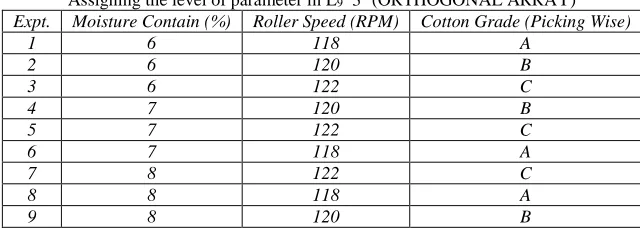
The order in which independent variables are assigned to vertical column is very essential. In case of mixed level variables and interaction between variables, the variables are assigned at right column as stipulated by the orthogonal array as shown in table 2.
Table - 2
Assigning the level of parameter in L9 34 (ORTHOGONAL ARRAY)
Expt. Moisture Contain (%) Roller Speed (RPM) Cotton Grade (Picking Wise)
1 6 118 A
2 6 120 B
3 6 122 C
4 7 120 B
5 7 122 C
6 7 118 A
7 8 122 C
8 8 118 A
9 8 120 B
Conducting The Experiment
Once the experiment design has been determine and the trial have been carried out, the measured performance characteristic from each trail can be used to analyze the relative effect of the different parameters shown in Table 3.
Cotton processing experiment on Double Roller Ginning machine was conducted for each set setting of parameter in three times Trial-1, Trial-2, and Trial-3 etc. For each setting the Lint output, Staple length, and Power Consumption was measured, total 27 trails was conducted.
Table - 3
Experimental data (Responses) as per Taguchi L9 Array during trail
Expt. No Lint Output kg/h (Response-1 )
T1 T2 T3 Mean
1 86.2 85.5 88.4 86.7
2 83.6 84.2 83.1 83.63
3 82.5 83.1 81.8 82.47
4 87.2 87.6 88.8 87.87
5 84.6 85.7 85.3 85.2
6 88.2 88.8 89.2 88.73
7 84.2 85.8 84.1 84.7
8 87.8 88.4 88.9 88.37
9 86.8 88.4 89.4 88.2
Power Consumption in kw-h (Response-2)
Trial T1 T2 T3 Mean
1 5.21 5.3 4.9 5.14
2 5.12 5.23 5.15 5.17
3 4.48 4.56 4.87 4.64
4 4.35 4.34 4.34 4.34
5 4.81 4.78 4.9 4.83
6 4.21 4.25 4.3 4.25
7 5.23 5.25 5.15 5.21
8 4.9 4.71 4.65 4.75
9 4.78 4.81 4.86 4.82
Staple length in mm (Response-3)
Trial T1 T2 T3 Mean
1 28.5 28.5 28.9 28.63
2 28.1 28.3 28.3 28.23
3 27.5 27.1 27.8 27.47
4 28.7 30.2 29.9 29.6
5 28.1 27.9 27.8 27.93
6 28.3 28.5 28.3 28.37
7 27.2 27.2 27.5 27.3
8 28.7 29.9 29.7 29.43
Selection Of Optimal Level Of Process Parameter
In order to study the significance of the process variable towards Lint output, analysis of variance (ANOVA) was performed. The ANOVA of S/N data and raw data for Lint Output are given in table 4. Respectively
Table - 4
Analysis of Variance for LO, using Adjusted SS for Tests Source DF Seq SS Adj SS Adj MS F P
M C 2 16.99 16.99 8.498 11.06 0.083
RS 2 1.014 1.014 0.507 0.66 0.602
CG 2 22.36 22.36 11.18 14.56 0.064 Error 2 1.536 1.536 0.763
Total 8 41.91 S = 0.876511 R-Sq = 96.33 % R-Sq (adj) = 85.34 %
DF- degree of freedom, SS- Sum of Squares, MS- Mean squares (Variance), F-Ratio of variance of a source to variance of error, P < 0.10 – determines significance of a factor at 95 % confidence level.
In order to study the significance of the process variable towards Staple length, analysis of variance (ANOVA) was performed. The ANOVA of S/N data and raw data for Staple Length are given in table 5. Respectively
Table - 5
Analysis of Variance for SL, using Adjusted SS for Tests Source DF Seq SS Adj SS Adj MS F P
M C 2 0.476 0.476 0.238 0.38 0.727 RS 2 0.803 0.803 0.401 0.63 0.612 CG 2 2.591 2.591 1.295 2.04 0.329 Error 2 1.268 1.268 0.634
Total 8 5.140 S = 0.796520 R-Sq = 75.31 % R-Sq (adj) = 1.25 %
DF- degree of freedom, SS- Sum of Squares, MS- Mean squares (Variance), F-Ratio of variance of a source to variance of error, P < 0.10 – determines significance of a factor at 95 % confidence level.
In order to study the significance of the process variable towards Power Consumption, analysis of variance (ANOVA) wa s performed. The ANOVA of S/N data and raw data for Power Consumption are given in table 6. Respectively.
Table - 6
Analysis of Variance for PC, using Adjusted SS for Tests Source DF Seq SS Adj SS Adj MS F P
M C 2 0.460 0.460 0.230 2.15 0.318 RS 2 0.228 0.228 0.114 1.07 0.484 CG 2 0.049 0.049 0.024 0.23 0.814 Error 2 0.214 0.214 0.107
Total 8 0.953 S = 0.327450 R-Sq = 77.91 % R-Sq (adj) = 9.79 %
DF- degree of freedom, SS- Sum of Squares, MS- Mean squares (Variance), F-Ratio of variance of a source to variance of error, P < 0.10 – determines significance of a factor at 95 % confidence level.
VI. ANALYSIS AND DISCUSSION OF RESULTS
In this section the individual effect of cotton processing parameter on Lint out, Staple length and power consumption is discussed. The average value and S/N ratio of the response characteristic for each variable at different levels were calculated from experimental data. The main effect of process variables both for raw data and S/N data were plotted. The response characteristics. The analysis of variance (ANOVA) of raw data and S/N data is carried out to identify the significant variables and to quantify their effects on the response characteristics. The most favorable values (optimal setting) of process variables in terms of mean response characteristics are established by analyzing the response curves and the ANOVA tables
Lint Output (Effect Of Roller Speed And Moisture Content On Ginning Rate)
increases for cotton A,B, and C respectively. For seed cotton having moisture content of 7% the amount of lint ginned in kg per hour increased for cotton A,B, and C respectively. For seed cotton moisture content of 8% it is observed that by increasing the speed of roller from 120 to 122 revolution per minute the amount of lint ginned in kg per hour increased for cotton A,B, and C respectively. The analysis clearly indicates that maximum increase in ginning rate was observed for higher staple length for fibre (Cotton A and B) as compared to lower staple length of fibre (Cotton C) Statistical analysis by Taguchi Method shown in table2. Experimental mean value vs predicted value of Taguchi method.
Staple Length - (Effect Of Process Parameter On Staple Length)
This study revealed that highest roller speed of 120 RPM coupled with 7 % moisture content of seed cotton grade A showed highest ginning rate with maximum saving in electric energy. Further, highest ginning rate and maximum energy saving were observed for higher staple length of fiber as compared to lower staple length of fibers. Fiber properties of lint obtained fr om different treatments were measured using HVI and AFIS system and results showed that the important fiber parameters remain unaffected.
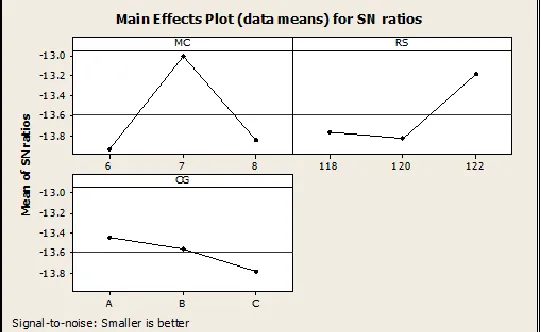
For 6% moisture content and 118RPM roller speed revealed that lower staple length obtained and also for the 8% moisture content and 122 RPM revealed that lower staple length obtained. as per the main effects plot for means and main effect plot for S/N ratio.
Power Consumption (Effect Of Process Parameter On Power Consumption)
Result revealed that, for a moisture content of 7% and an increase in roller speed from 118 to 120 RPM, the electrical energy consumed in kilo watts by the gin stand increase for cotton A,B and C respectively. It was also noticed that, for moisture content of 7% with an increase in roller speed from 120 to 122 RPM, the energy consumed in kilo watts by the gin stand was increased for cotton A,B and C respectively. Power consumption increases with increase with roller speed but roller speed also increases the lint output. During experiments on cotton A having 7% moisture, it was observed that for a roller speed of 118 RPM, the average power consumption requirement and lint output were found to be 4.71 kw-h and 87.93 kg/h respectively. When roller speed was increased from 118 to 120 RPM the average power consumption requirement and lint output were also increased. A further increase in roller speed from 120 to 122 RPM, again increased the average power requirement and lint output.
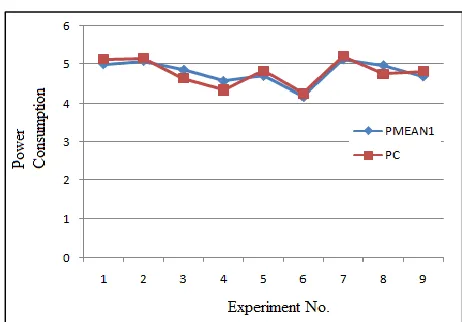
Result as shown in table 4.15 Experimental mean value vs predicted value of Taguchi method revealed that electrical units consumed to gin 100kg lint was lowest of 7% moisture content and roller speed 122 RPM and found 4.25kWh, 4.34kWh,and 4.83kWh for Cotton A,B and C respectively. Also at the roller speed of 122 RPM, there is a saving in power consumption of 25.4, 22.2 and 8.7 % for cotton A,B and C respectively when compared to a roller speed 120 RPM. There it is concluded that for achieving the maximum ginning rate and minimum electrical consumption, optimum seed cotton moisture and speed of the roller was found to be 7% moisture and 122 RPM respectively. Main effect plot for means and main effect plot for S/N ratio shows the relationship between the speed of the roller and power consumption for ginning 100kg lint for different varieties of cotton.
VII. VALIDATION OF EXPERIMENT
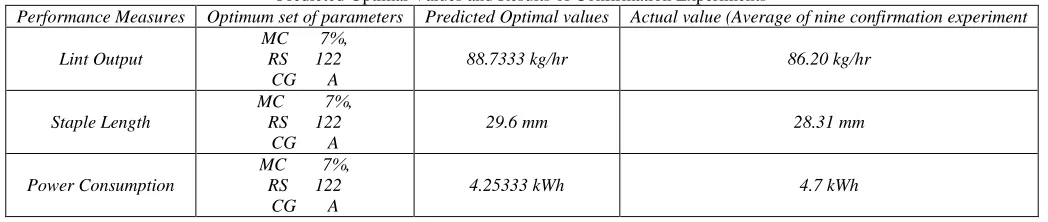
In order to validate the result obtained, nine confirmation experiments in three times were conducted for each of the response characteristic i.e. Lint output, Staple Length and Power Consumption at optimum level of the process parameters. The average values of the characteristics were obtained and compared with predicted values. Minitab software was used to predict the of S/N ratios and mean. The results are given in table 7. It is to be pointed out that these optimal values are within the specified range of process variables.
Table - 7
Predicted Optimal Values and Results of Confirmation Experiments
Performance Measures Optimum set of parameters Predicted Optimal values Actual value (Average of nine confirmation experiment
Lint Output
MC 7%, RS 122
CG A
88.7333 kg/hr 86.20 kg/hr
Staple Length
MC 7%, RS 122
CG A
29.6 mm 28.31 mm
Power Consumption
MC 7%, RS 122
CG A
4.25333 kWh 4.7 kWh
VIII. CONCLUSION
major in Vidharbha west region. During study, performance efficiency of Double Roller Ginning Machine is about 70% and Bale Pressing Machine efficiency is about 66%. It was decided to use of modified L9 Orthogonal array, with three parameters required only 27 trail to conduct the experiment on Double roller ginning machine. After result and discussion by using Taguchi
DOE we conclude that it will increase the overall efficiency of Double roller machine by 15.1% and Pressing machine by 14.14%.
Fig. 2. Residual Plots for Lint Output (Raw Data)
Fig. 3: Experimental mean value Vs predicted value of Taguchi method (Lint Output)
Fig. 4: Effect of Process Parameter on Power Consumption (S/N Data)
M e a n o f S N r a ti o s 8 7 6 38.9 38.8 38.7 38.6 38.5 122 120 118 C B A 38.9 38.8 38.7 38.6 38.5 MC RS CG
Main Effects Plot (data means) for SN ratios
Signal-to-noise: Larger is better
Residual P e r c e n t 1.0 0.5 0.0 -0.5 -1.0 99 90 50 10 1 Fitted Value R e s id u a l 90 88 86 84 82 0.50 0.25 0.00 -0.25 -0.50 Residual F r e q u e n c y 0.4 0.2 0.0 -0.2 -0.4 -0.6 3 2 1 0 Observation Order R e s id u a l 9 8 7 6 5 4 3 2 1 0.50 0.25 0.00 -0.25 -0.50
Normal Probability Plot of the Residuals Residuals Versus the Fitted Values
Fig. 5: Residual Plots for Power Consumption (Raw Data)
Fig. 6: Graph 2. Experimental mean value vs predicted value of Taguchi method (SL)
ACKNOWLEDGEMENT
Authors are thankful to undertake this work in Mechanical Field of Cotton Processing and Mechanical Department of Government Polytechnic and P.R.M.I.T. & R. Badnera, Amravati.
REFERENCES
[1] Gurumurthy Vijayan Iyer and Dr. M. G. R. University, “Design and Production of an eco-friendly ginning chnology for the processing of Cotton Fibres” . Journal of the Textile Association – March-April 2007. P.P 255-262.
[2] Mr. M.K. Sharma, “Cotton Ginning Technologies - Selection Criteria for Optimum Results”, Bajaj Steel Industries Limited, Nagpur-440 018 India. Fourth Breakout Session on Thursday, November 20, 2008 during 67th Plenary Meeting of the ICAC in Ouagadougou, Burkina Faso.
[3] Siti A. Ismail, Guangnan Chen and, Craig Baillie, “Energy uses for cotton ginning in Australia”, journal of bio systems engineering 109 (2011) 140 e147. [4] Prashant kumar Gulabrao Patil and Vaishali Patil , “Development of Prototype Double Roller Gin with Improved Power Transmission and its Performance
Evaluation”. Journal of Engineered Fibers and Fabrics Volume 5, Issue 4 – 2010.
[5] M.K.Sharma and lav bajaj, “Recent Advances in Ginning for lowering Cost and Improving of efficiency”, Presented at 5th Meeting of Asian Cotton Research and Development Network at Lahore). Available At Http: //Www. Cotton. Org /Journal/2005-09/3/155.Cfm.
[6] Madhav S Phadke, ‘Quality engineering using robust design’, Prentice-Hall, N.J, USA (1990)
![Fig. 1: working principle of cotton roller Ginning [2]](https://thumb-us.123doks.com/thumbv2/123dok_us/7828176.1666462/1.612.139.473.547.715/fig-working-principle-cotton-roller-ginning.webp)