© 2018, IRJET | Impact Factor value: 6.171 | ISO 9001:2008 Certified Journal | Page 3694
Development Of Aluminium Composite Beam And Study Of Its Static
And Dynamic Behaviour
Priyanka Bhagat
1, Kachare P.S
21Miss. Priyanka Bhagat, Dept. of Mechanical Engineering, SVERI’s COE, Maharashtra, India 2Dr. Kachare P.S. Dept. of Mechanical Engineering, SVERI’s COE, Maharashtra, India
---***---Abstract
- In order to conserve natural resources andeconomize energy, weight reduction has been the main focus of automobile manufacturers in the present scenario. Weight reduction can be achieved primarily by the introduction of better material, design optimization and better manufacturing processes. The Sandwich panels are made of two high strength skins bonded to either side of a light weight core and are used in applications where high stiffness combined with low structural weight is required. The purpose of this work is to compare the mechanical response of several sandwich panels whose core materials are having different thickness. Sandwich panels with two different cores thickness; PU (Poly Urethane) and skin material is Aluminium (Al). After manufacturing of sandwich plates UTM (Universal Testing Machine) testing will be conducted on this sandwich panel like tensile test and flexural test.
Key Words:Sandwich Panels, mechanical response, poly urethane, Aluminium, UTM, tensile, flexural.
1. INTRODUCTION
Sandwich material panel is a structure made of three layers, low density core inserted in between two relatively thin skin layers. This sandwich setup allows to achieve excellent mechanical performance at minimal weight. The core material is normally low strength material, but its higher thickness provides the sandwich composite with high bending stiffness with overall low density.Sandwich composite materials are increasingly being used in a variety of industrial applications such as, marine, aerospace, automobile industry etc. The use of sandwich construction is the result of an increasing demand for light and strong structures. Weight saving is a dominant factor in the transport sectors such as high speed trains, high speed boats, cars etc. The sandwich concept takes advantages over single skin laminated structures in terms of flexural properties with a reduced weight. Flexural stiffness and strength are just two of a variety of design criteria to be considered. Sandwich panels have the best stiffness over lightness ratio. It’s what makes them very useful in industrial applications for instance aerospace, transport and maritime fields. The influence of a multi-layer core is analyzed using a three-point
bending test and the results correlated to the final properties of the composite.
1.1Types of sandwich materials
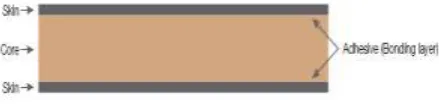
1. Foam Core Sandwich: The composite foam or direct composite material is placed as core material. The upper & lower material is called skin. Middle foam material is called core. Skin & core material are sticked together by using adhesive.
Fig -1: Foam core Sandwich
2. Honeycomb sandwich Panel:The honeycombs of hexagonal cell structure are characterized by
considerable rigidity in shear, high crushing stress, almost constant crushing force, long stroke, low weight and relative insensitivity to local loss of stability the honeycomb industry has its own
terminology to define various aspects of honeycomb core.
Fig -2: Honeycomb sandwich panel
1.2Applications of Sandwich Panels:
[image:1.595.325.545.347.399.2] [image:1.595.346.518.553.674.2]© 2018, IRJET | Impact Factor value: 6.171 | ISO 9001:2008 Certified Journal | Page 3695
a) Aerospace Field:
To fulfil the required mission of the aircraft various structural designs are accomplished in aerospace industry. There are wide applications list of sandwich applications in aircraft/helicopter includes ailerons, pressure tanks Fuselages and wings Honeycomb sandwich structures have been widely used for load-bearing purposes in the aerospace due to their lightweight, high specific bending stiffness and strength under distributed loads in addition to their good energy-absorbing capacity.
b) Building Construction:
Architects use sandwich construction made of a variety of materials for walls, ceilings, floor panels, and roofing. Cores for building materials include urethane foam (slab or foam-in-place), polystyrene foam (board or mold), phenolic foam, phenolic-impregnated paper honeycomb, woven fabrics (glass, nylon, silk, metal, etc.), balsa wood, plywood, metal honeycomb, aluminum and ethylene copolymer foam. Facing sheets can be made from rigid vinyl sheeting (fiat or corrugated)glass-reinforced,acrylic-modified polyester,
acrylic sheeting, plywood, hardwood, sheet metal (aluminum or steel); glass reinforced epoxy; decorative laminate, gypsum, asbestos and poured concrete.
1.3Objectives and Methodology:
Objectives:
1. Analysis of various tests on UTM machine of different sandwich materials.
2. Comparison of UTM results and selecting best material.
Methodology:
1) Selection of the materials for sandwich panel(s).
2) Manufacturing of sandwich panel(s).
4) Taking different test with UTM testing machine viz. tensile test and bending test etc.
5) After above test find the new best possible application for the sandwich materials.
2. LITERATURE REVIEW
Labans Edgarsa, et.althis paper describes design, prototyping and experimental tests of wood based
sandwich panels with plywood surfaces. In the first case 3D core of the sandwich panel is formed by thermoplastic glass fibre / polypropylene (GF/PP) composite and bonded to plywood in one manufacturing step. Average flexural modulus for sandwich panels with stiffener/foam core is 6.2 GPa and flexural strength 26.1 MPa at density of 325 kg/m3. Thermoplastic composite core allows to reach flexural modulus of 4.18 GPa and strength of 22.6 MPa.
From the results obtained by the present model, a very good accuracy is found with all of the available literature solutions, obtained by alternative models. For benchmark purposes, some applications are also proposed for sandwich FGM-viscoelastic plate and shell structures.
Lorenzo Graziani, et.althe purpose of this work is to assess if traditionally used welded connectors for joining the two skins of reinforced concrete (RC) sandwich panels, used as structural walls and horizontal structural elements, can be substituted with bent ones. In this way, the scope of the effort is to reduce drastically the energy required during manufacturing. Structural performances were examined by testing full-scale sandwich panels under (axial and eccentric) compression and flexural loads. Additionally, a Finite Element (FE) study was developed to investigate and to optimize the dimension of welded mesh and the number of connectors. The major findings show that it is possible to substitute welded connectors with bent ones without compromising the structural performance of the tested RC sandwich panels, thus having a more sustainable way for producing these last ones.
© 2018, IRJET | Impact Factor value: 6.171 | ISO 9001:2008 Certified Journal | Page 3696
behavior of the E-glass fiber/Rigid polyurethane foam were also determined by performing related ASTM tests on these materials.
3. DESIGN, MANUFACTURING OF LAMINATES
AND TESTING OF ITS SPECIMENS.
3.1 Selection of Matrix Material: Epoxy resin 520, Epoxy hardener-PAM. The epoxy resin and epoxy hardener were mixed in the ratio of 10:1 by the weight as suggested. The epoxy resin has the density of 1.22 g/cc. The Epoxy Resin-520 and Epoxy hardener-PAM were mixed in the ratio of 10:1 by weight as suggested.
Each laminate was cured under constant pressure
near about 24hr in the mould and further cured at
room temperature at least 12 hrs.
3.2 Properties of epoxy resin are as follows:
1. Specific density: 1.22 g/cc 2. Young’s Modulus: 3.792 Gpa
3. Ultimate Tensile Strength: 82.74 Mpa
3.3Materials:
1. Polyethylene (PE): Polyethylene is a thermoplastic polymer with variable crystalline structure and an extremely large of applications depending on the particular type. It is one of the most widely produced plastics in the world. Many kinds of polyethylene are known with the chemical formula (C2H4)n. PE is usually a mixture of ethylene with various of n.
Fig -3: polyethylene (PE) material
2. Polyurethane (PU):Polyurethane (PU) are organic polymers that contain the urethane group in the structure. Typically, polyurethanes are formed via the reaction of a polyol OH group) with a isocyanate (-NCO group). Polyureas contain the urea group in the structure. Combinations may be contain just urethane group or a combination of urea and urethane groups
.
Fig -4: Polyurethane (PU) material
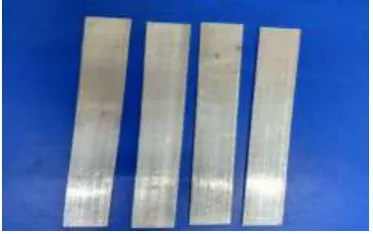
[image:3.595.343.523.93.214.2]2. Aluminium (Al):Aluminium or Aluminum is a chemical element with symbol Al and atomic number 13. It is silvery-white, soft, nonmagnetic metal and ductile in the boron group. By mass, aluminium makes up about 8% of the Earth’s crust; it is the third most abundant element after oxygen and silicon and the most abundant metal in the crust, through it is less common in the mantle below. Aluminium metal is so chemically reactive that native specimens are rare and limited to extreme reducing environments. Instead it is found combined in over 270 different minerals.
Fig -4.1 : Aluminium (Al) material
3.4Manufacturing of Sandwich Panels.
Sandwich components may be produced using following method:
[image:3.595.341.528.416.533.2] [image:3.595.66.261.530.646.2]© 2018, IRJET | Impact Factor value: 6.171 | ISO 9001:2008 Certified Journal | Page 3697
and inserts may be included and located by the honeycomb core or with simple tooling.
Heated press is shown in Figure.
Fig -5: Heated press
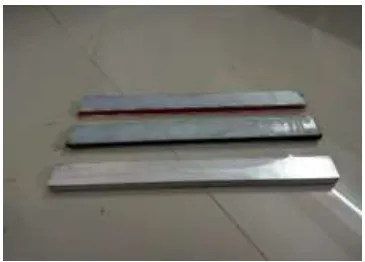
3.4.1 Manufactured Specimens: Specimens are manufactured in two different combination that is with varying the specimen thickness, three specimen are of 9 mm thickess and other three specimen are of 14mm thickness.
Fig -6: Specimens of Aluminium and Composite Polyurethene and polyethylene (14 mm)
Fig -7: Specimens of Aluminium and Composite Polyurethene and polyethylene (9 mm)
3.5Testing For Mechanical Properties:
1. Tensile and flexural testing: Uniaxial tensile test is known as a basic and universal engineering test to achieve material parameters such as ultimate Strength, yield strength, % elongation, % area of Reduction and Young's modulus. These important parameters obtained from the standard tensile testing are useful for the selection of engineering materials for any applications required. The tensile testing is carried out by applying longitudinal or axial load at a specific extension rate to a standard tensile specimen with known dimensions (gauge length and cross sectional area perpendicular to the load direction) till failure. The applied tensile load and extension are recorded during the test for the calculation of stress and strain.
3. Tensile Testing:
Fig -8: Mounting of tensile specimen on UTM
2. Flexural Testing:
[image:4.595.69.250.143.313.2] [image:4.595.324.504.303.463.2] [image:4.595.67.242.407.528.2] [image:4.595.347.522.526.633.2] [image:4.595.70.253.572.703.2]© 2018, IRJET | Impact Factor value: 6.171 | ISO 9001:2008 Certified Journal | Page 3698
[image:5.595.34.281.549.646.2]3.6Tensile strength and Flexural strength Result:
Table 01: Tensile strength and Flexural strength Result
3.7 Stress vs. Strain Graphs for Tensile and Flexural testing:
1. For tensile testing(AL+PU+AL)
Chart -1: Stress-Strain diagram for Tensile Test of AL+PU+AL 9mm thick
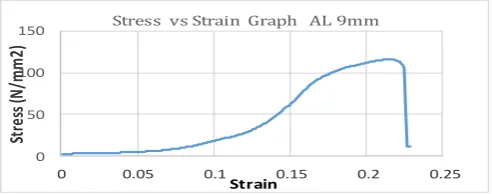
2. For tensile testing: (AL)
Chart -2: Stress-Strain diagram for Tensile Test of AL 9mm
3. For Flexural testing: (AL+PU+AL)
0 100 200 300
0 0.02 0.04 0.06
St
re
ss
(N
/m
m
2
)
Strain
Stress vs Strain Graph AL+PU+AL 9mm
Chart -3: Stress-Strain Diagram for Flexural Test of AL+PU+AL 9mm thick
4.For Flexural testing: (AL)
Chart -4: Stress-Strain Diagram for Flexural Test of AL 9mm thick
4. CONCLUSIONS
From the above work we conclude that aluminium can be replaced by light weight aluminum composite panel, which is having polyurethane material clubbed in between aluminium.Both the tensile and flexural results for are good for AL+PU+AL when compared to only AL.
REFERENCES
[1] Nayak AK, Satapathy AK, “Stochastic damped free
vibration analysis of composite sandwich plates”, 12th International Conference on Vibration Problems, ICOVP 2015
.
[2] A. Treviso, B. Van Genechten, D. Mundo, M. Tournour ,
“Damping in composite materials:Properties and models Composites Part B 78 2015.
[3] Tukaram Zore, Saurabh Singh, Sunil Gaonkar, Neena
Panandikar, “Modal analysis of a simply supported sandwich beam” International Journal of Research in Engineering and Technology, Volume: 05 Issue: 06,Jun-2016
[4] Lorenzo Graziani, Enrico Quagliarini, Marco D’Orazio,
Stefano Lenci and Agnese Scalbi (2017) “A More Sustainable Way for Producing RC Sandwich Panels On-Site and in Developing Countries”.
Sr. No.
Sample Tensile Strength(Mpa)
Flex.Strength (MPa)
1 AL+PU+AL.9mm 189.86 222.042
2 AL+PE+AL 9mm 96.52 36.18
3 AL 9mm 116.08 134.259
4 AL+PU+AL14mm 263.20 249.79
5 AL+PE+AL 9mm 79.86 21.91
6 AL 14mm 196.23 269.575
0 50 100 150 200
0 0.05 0.1 0.15 0.2 0.25
St
re
ss
( N
/m
m
2)
Strain
Sress vs Strain Graph AL+PU+AL 9mm
0 50 100 150
0 0.05 0.1 0.15 0.2 0.25
St
re
ss
(N
/m
m
2)
Strain