Abstract
This paper examines theassociations between: (i) business strategy and organisational culture with the usage of multidimensional performance measures and (ii) the use of multidimensional performance measures and information system characteristics with the effectiveness of performance measurement systems (PMSs). Using a mail survey method, data were collected from a random sample of 540 senior financial officers in Australian manufacturing organisations. The results revealed that business strategy (product differentiation and low cost) and a teamwork oriented culture were associated with the use of multidimensional performance measures. In addition, the use of multidimensional performance measures and all four information system characteristics (i.e. scope, timeliness, integration and aggregation) were associated with the performance related outcome dimension of PMS effectiveness, while the use of multidimensional performance measures and integrated information were associated with staff and strategic related outcomes. The study contributes to the literature by examining the use and effectiveness of PMSs.
Keywords: Performance measurement systems; multidimensional performance measures; effectiveness; business strategy; organisational culture; information system characteristics.
ASSOCIATIONS WITH THE USE OF
MULTIDIMENSIONAL PERFORMANCE
MEASURES AND THE EFFECTIVENESS
OF PERFORMANCE MEASUREMENT
SYSTEMS
Rahat Munir Kevin Baird
Zehao Si
Introduction
Performance measurement systems (hereafter PMSs) are used to provide managers with information about how the business is performing and to enable managers to adjust business operations, with the goal being to improve the performance of their organisation (Lebas, 1995). Traditionally, PMSs have primarily focused on using financial measures such as profit margins, cash flows and the return on investment (Chan, 2004). However, with the initiation of new competitive realities such as increased customization, flexibility, the need for rapid response to customer expectations, and new manufacturing technologies such as Just in Time and Total Quality Management, many scholars have argued that financially based PMSs are no longer adequate as they are short-term oriented, not actionable, backward looking and subject to manipulation (Chow and Stede, 2006; Kaplan and Norton, 1996). Consequently, academics increasingly refer to the combined use of both financial and non-financial measures with multidimensional PMSs such as the Balanced Scorecard (Kaplan and Norton, 1992), the Performance Pyramid (Lynch and Cross, 1991) and the Performance Prism System (Neely and Adams, 2000) advocated by many scholars (Bryant et al., 2004; Hendricks et al., 2004; Kaplan and Norton, 2001, 1996, 1992).
associated with business practice while organisational culture has been proposed as a significant factor that might affect the choice of performance measures (Franco-Santos and Bourne, 2003).
In addition to examining the extent to which business units are adopting multidimensional performance measures, the study will also examine the effectiveness of PMSs. The focus on the effectiveness of using multidimensional performance measures is important with Deem et al. (2010) and Franco-Santos and Bourne (2005) suggesting that setting up a PMS in an organisation does not guarantee performance improvement. Rather, what matters is the effectiveness of such a system. While previous research has examined the effectiveness of using multidimensional performance measures, these studies have shown mixed results. In addition, these studies have tended to focus on the effect on organisational performance.
However, Amaratunga and Baldry (2003, p.174) state that a PMS should be assessed in respect to ‘the effectiveness of organizational operations in terms of their specific contributions to organizational objectives’ and hence this study will assess effectiveness in respect to a different factor, the extent to which desired organisational outcomes are achieved. Furthermore, while it is accepted that a PMS can make a positive contribution to organisational effectiveness, there is less clarity regarding what practices or factors can enhance the effectiveness of a PMS (Lawler, 2003). Accordingly, the study will also examine the influence of the use of multidimensional performance measures and specific information system characteristics on PMS effectiveness. While information system support has been referred to in the literature as a potential determinant of PMS effectiveness (Keen, 1991; Bititci et al., 2000; Neely, 1999; Ho and Mckay, 2002), this association has not been empirically examined.
The paper is structured as follows. Section 2 reviews the relevant literature and develops the hypotheses. Section 3 describes the methodology used including the measurement of the variables. Section 4 then provides the results and Section 5 discusses the results, highlights the study’s contributions, and provides suggestions for future research.
Literature Review
The Use of Multidimensional Performance Measures
Traditional financial performance measures were used by organisations until the late 1980s when financial performance measures began to receive increasing criticism by many researchers and practitioners (Johnson and Kaplan, 1987; Hayes and Abernathy, 1980; Neely et al., 1995). Given the rapid changes in the business environment, technological advancements and increased competition between and across industries, traditional financial measures were considered to be inappropriate as they are one dimensional, focus on the past and do not identify areas of strategic improvement (Ittner and Larcker 1998; Neely, 1999). Financial measures were also criticized due to their inherent inability to provide managers with the strategic information required to remain competitive (Perera et al., 1997).
In particular, Skinner (1989) argues that the performance measurement process is strategic in nature and should provide multidimensional information which relates to an organisation’s strategy. Managers require such information to measure and manage competencies which are essential to maintaining a competitive edge. Consequently, to overcome the inadequacies of traditional financial performance measures, new (or contemporary) PMSs have been developed which encourage a broader set of measures aimed at balancing the traditional focus on financial results with non-financial performance measures (Tangen, 2004). Of these new systems, the Balanced Scorecard1 (hereafter BSC) is the most commonly used and
is regarded as the most influential multidimensional PMS developed in the past couple of decades (Harper, 2001). Accordingly, this study examines
1Kaplan and Norton’s (1992) BSC involves the combination of financial performance measures with
the use of multidimensional performance measures in respect to the extent of use of the BSC.
Despite the proclaimed benefits of the BSC, there is mixed evidence concerning the use of this approach (Rigby and Bilodeau, 2009 [53%]; Chung et al., 2006 [31%]; Ittner et al., 2003 [20%]; Speckbacher et al., 2003 [26%]). Accordingly, this study attempts to provide insights into the use of multidimensional performance measures by examining the association between business strategy and organisational culture with the use of multidimensional performance measures.
Business Strategy
While several definitions of business strategy have been used in the literature, this study employs Porter’s (1980) competitive strategy model which recognizes that a business unit can develop a sustainable competitive position by implementing either a cost leadership strategy or differentiation strategy. The management accounting literature has stressed the importance of designing PMSs in line with the business strategy of the organisation (Langfield-Smith, 1997; Dent, 1990; Simons, 1987; Otley, 1980). For instance, Slater et al. (1997) argue that organisations should determine which measures to focus on and which to ignore based on the strategy they choose. Similarly, Gosselin (2005) states that business strategy has a great influence on the design of the PMS. Furthermore, Chenhall (2003) identified business strategy as one of the fundamental contingency variables with the potential to affect the design and use of PMSs. In particular, an inherent characteristic of the BSC is the link to the strategy of the organisation (Kaplan and Norton, 1996, p. 24) with Otley (1999, p. 374-375) stating that ‘a major strength of the balanced scorecard approach is the emphasis it places on linking performance measures with business unit strategy’.
are directly related to cost control and efficiency (Chenhall and Langfield-smith, 1998). Improvement in efficiency can also be assisted by focusing on measures relating to the internal business perspective such as the time from order to delivery, the percentage of on-time deliveries, and the stock-out percentage rate.
Alternatively, business units that adopt a differentiation strategy focus on the development of products or services that offer unique attributes which are valued by customers (Porter, 1980). Shank (1989) found that financial measures were inadequate in assessing how the production process supports a variety of customer- focused strategies. It is therefore expected that when units pursue a differentiation strategy, there will be a shift ‘from treating financial figures as the foundation for performance measurement’ to a broader set of measures designed to support flexibility as a strategic priority (Eccles, 1991, p.131). For instance, a differentiation strategy will require a company to be sensitive to customers’ needs and provide products which match their particular preferences. Hence, units adopting a differentiation strategy will focus on measures that guide their attention to product quality using measures such as the warranty rate and product defect rate. Other procedures may also be introduced to encourage employees to share the organisation’s customer-focused orientation such as providing focused training, and improving employee facilities (Storey, 1995). These procedures are all reflected in the learning and growth perspective.
While those units adopting a differentiation strategy will focus on measures relating to the customer and learning and growth perspectives, they will still be concerned with efficiency and financial performance, and hence are still expected to use measures relating to the internal and financial perspectives. Hence, while business units with a low cost strategy will mainly focus on measures relating to the financial and internal business process, units adopting a differentiation strategy will also focus on the customer and learning and growth perspectives. Thus, it can be hypothesised that:
Organisational Culture
Organisational culture can be defined as ‘the pattern of shared and stable beliefs and values that are developed within a company across time’ (Gordon and DiTomaso, 1992, p.784). Organisational culture affects practically all aspects of organisational interactions and plays an important role in designing management control systems, particularly the PMS (Henri, 2006; Kerr and Slocum, 1987).
This study operationalizes organisational culture using the 26-item Organisational Culture Profile instrument developed by O’Reilly et al. (1991). The following sections discuss the association between four dimensions of O’Reilly’s culture profile (Innovation, Attention to detail, Outcome orientation and Teamwork) with the use of multidimensional performance measures.
Innovation
Innovation refers to ‘a business unit’s receptivity and adaptability to change, and its willingness to experiment’ (O’Reilly et al., 1991, p. 505). A business unit with a more innovative culture will focus on differentiating their product and building strong relationships with customers. More innovative units are expected to use a wider range of measures to encourage creativity. For instance, they would be expected to have a greater focus on customer measures as they would need to communicate with customers to find out what they want in order to set the direction for innovation. They would also emphasize measures relating to the learning and growth perspective as they would need to assess their success in innovation. Finally, they would focus on measures relating to the internal business process perspective as innovation can also be related to improvements in operational efficiency (The European Foundation for Quality Management, 2000).
Attention to detail
attention to detail to a greater extent will require more information in respect to all aspects of the unit’s performance, and therefore, it is expected that they will use multidimensional performance measures to a greater extent. Outcome orientation
The outcome orientation dimension focuses on ‘the extent to which business units emphasize action and results, and have high expectations for performance and personal achievement’ (O’Reilly et al., 1991, p.505). Outcome oriented units are expected to focus more on financial results as opposed to the methods used to attain such results. Accordingly, they are more likely to emphasize short-term financial performance rather than the processes which can enhance performance in the long term. Hence, it is expected that business units that are more outcome oriented will focus on using financial measures and use multidimensional measures to a less extent. Team work oriented
Team work refers to ‘the extent to which employees work in unison to achieve organizational goals’ (Baird and Wang, 2010, p.579). The PMS forms an integral part of the information base (Tissen et al., 1998) and is identified by Lawler (1986) as one of the important elements necessary to achieve team success. Teams often consist of individuals from different functional areas (for example, marketing, manufacturing, research and development and other related areas), and it is important that more diverse performance measures are used in order to capture the relevant aspects of tasks. Similarly, Kaplan and Norton (1992) state that multidimensional performance measures should be used as they enhance team performance.
The above discussion results in the development of hypothesis 2:
H2. Business units whose culture focuses more on the “innovation, attention to detail, (outcome orientation) and team work orientation” dimensions will use multidimensional performance measures to a greater (less) extent.
The Effectiveness of Performance Measurement Systems
available for controlling operations and fostering change’ (Lessner, 1989, p. 22) and serves an important role in managing important aspects of business such as resource allocation, employee motivation, and planning and control (Thor, 1991). Some researchers argue that the successful implementation of an effective PMS is contingent on specific organisational factors (Franco-Santos and Bourne, 2005). Accordingly, the following subsections discuss the association between the use of multidimensional PMSs and information system characteristics with the effectiveness of PMSs.
The Association between the Use of Multidimensional Performance Measures and PMS Effectiveness
Feltham and Xie (1994) used agency theory and found that PMSs which only focused on financial measures could not effectively motivate the agent to act in the interests of the principle. A number of authors have argued that broadening the use of performance measures enhances the effectiveness of PMSs (e.g., Tung et al., 2011; Bititci et al., 2000; Banker et al., 1993). Dumond (1994) reported that by incorporating multidimensional performance measures, employee satisfaction and manager’s decision making process were significantly improved. Hence, a balanced set of measures should be used to guide their attention to the critical success areas of the business (Kaplan and Norton, 1992).
Based on the above argument, it can be hypothesised that:
H3. The use of multidimensional performance measures is positively associated with PMS effectiveness.
The Association between Information System Characteristics and PMS Effectiveness
As business processes have become increasingly complex the transformation of raw data into usable information is a big challenge, especially in the case of the BSC as it includes both financial and non-financial measures, thereby making the data collection and analysis process more difficult (Neely, 1999). Business units have realised the importance of advanced information systems and incorporated them to automate, capture, store, process, use and communicate data and information. Some units have even built businesses supplying IT support information systems for performance measurement applications (Neely, 1999).
Besides capturing and storing data, information systems support the PMS in two main functions: (i) helping managers improve decision making processes through planning (performance and strategic target setting and ensuring an adequate level and mix of resources) and coordination (integrating disparate parts of a business to achieve the overall goal) (Simons, 2000) (ii) processing and providing feedback information on performance to properly motivate and evaluate employees (Neely, 1998).
following sections discuss the association between four characteristics of a good information system (timeliness, integration, aggregation and scope) with the effectiveness of PMSs.
Timeliness of information
The timeliness of information is conceptualized as both: the frequency and speed of reporting information (Bouwens and Abernethy, 2000). Timely feedback information is the base of the control function of a PMS as it enables deviation to be immediately detected and allows managers to take corrective action to rectify the deviation (Simon, 2000). Research in the field of psychological shows that people perform better if they are provided with clearly defined goals as well as timely feedback on their performance (Hall, 2008). Similarly, Forza and Salvador (2000) argue that timely performance feedback increases impact by providing information about the quality and effectiveness of an individual’s performance.
Integration of information
A PMS that generates integrated information is able to provide an overall view of performance and to guide against sub-optimization by means of communicating performance information between departments, thereby encouraging individual departments to make decisions to improve overall performance, rather than just focusing on narrow performance criteria like cost reduction (Dumond, 1994). Therefore, in order for managers to get the “whole picture” of the performance and align their business operation with the objectives of the entire organisation, it is important that the information system provides integrated performance feedback information which includes performance information of other departments within the organization, as well as information of how the decisions made in one department may influence the performance of other departments.
Aggregation of information
Aggregated information enables managers to process larger quantities of information. Information is processed into a format that can be processed quickly, thereby increasing the overall amount of information that can be processed within a given time. Thus, the potential for sub-optimal decision making owing to information overload is reduced (Choe, 1996). Aggregated information also helps managers to consider more alternatives and develop a better understanding of business operations both at the departmental level and across departments. This increases the probability that decisions will be made in the best interest of the organisation.
Scope of information
Broader information scope refers to when the information system provides information which is externally focused, future oriented and includes non-financial measures to supplement the internally focused, historically based financial information (Ittner at al., 2003). Future oriented information and process based information are viewed as key element in PMSs as they capture long term performance dimensions which are not captured when using short-term financial measures alone (Kaplan and Norton, 1992). Future oriented and process based information play an important role in explaining future performance, providing information on root causes, and measuring intangible assets such as employee satisfaction (Ittner et al., 2003). External information is essential for PMS to effectively perform the bench marking function. An effective PMS should not only focus on reporting information related to internal processes but also needs to pay attention to the external environment and the performance of competitors (Kaplan and Norton, 1996). By comparing performance with their competitors, business units are able to learn from the experiences of effective units and identify the areas that need improvement (Chenhall and Langfield-Smith, 1998).
Based on the above discussion, the following hypothesis is developed:
Method
The mail survey method was employed with the survey questionnaires mailed to the financial controllers of 540 Australian manufacturing business units. Business units2 were chosen as different units have a different focus
on PMSs, and hence the completion of the questionnaire at the organisational level would have caused confusion. The surveys were randomly distributed to business units identified in the Kompass Australia (2011)3 database.
Financial controllers were chosen as suitable employees given their knowledge of the information required and their familiarity with the PMS.
The survey was distributed in accordance with Dillman’s (2007) Tailored Design Method. This approach provides guidelines in respect to the design of the questionnaire, its distribution, and techniques to personalize the survey. A total of 69 questionnaires were returned following the initial mailout (12.8%), with a further 36 (6.7%) questionnaires returned in the follow up. Hence, a total of 105 (19.5%) questionnaires were returned. Non-response bias was tested through a comparison of the values of the independent and dependent variables between the early and late respondents. The results of the ANOVA tests showed no significant differences indicating that non-response bias was not a problem.
Measurement of Variables
Use of Multidimensional Performance Measures
In assessing the use of multidimensional performance measures respondents were required to indicate the extent to which their business unit used 21 different performance measures, on a 5-point Likert-type scale with anchors of “not at all” and “to a great extent”. These measures were drawn from the performance measurement literature (Epstein, 2008; Jusoh et al.,
2A business unit is defined as a logical segment of an organisation representing a specific business
function. It has a definite place on the organisational chart, under the direction of a manager. It is also sometimes referred to as a department, division or functional area. In some cases, the organisa-tion may be the business unit.
3The Kompass Australia (2011) database includes all businesses in Australia so a random sample
concern-2008; Kaplan and Norton, 1996, 2001) and were chosen to reflect the four dimensions of the BSC. Factor analysis resulted in the 21 items loading onto four dimensions (see Appendix A). Each of the four dimensions were scored as the average of the combined scores of the items which loaded onto the dimension. The overall usage of multidimensional performance measures was subsequently measured as the sum of these averages (ranging from 4 to 20), with higher (lower) scores indicating that multidimensional performance measures were used to a greater (lower) extent.
Effectiveness of PMS
The effectiveness of PMS was measured in respect to the extent to which sixteen desired PMS outcomes (see Appendix A) were achieved, using a 5-point Likert-type scale with anchors of “not at all” and “to a great extent”. These items were developed by Lawler (2003) and have been used in several other studies to measure the effectiveness of PMS (Tung et al., 2011; Baird, 2012). Factor analysis revealed that the items loaded onto three dimensions. The first dimension contained six items which all referred to the achievement of organisational goals and objectives. Therefore, this dimension was labeled as ‘performance related outcomes’. The second dimension included six items which were concerned with employees. Hence, this dimension was labeled as ‘staff related outcomes’. Finally, the third dimension consisted of four items which related to strategy implementation, and was consequently labeled as ‘strategic related outcomes’.
Information System Characteristics
Business Strategy
Business-level strategy was measured using the cost-leadership and differentiation dimensions with the measurement scale adapted from Luo and Zhao (2004). Both cost-leadership and differentiation dimensions were measured by asking the respondents to indicate, on a 5-point Likert-type scale with anchors of “not at all” and “to a great extent”, the extent to which their business unit focused on six specific attributes (see Appendix A). The two strategy dimensions were measured as the combined score for the six items (ranging from 6 to 30), with higher (lower) scores representing higher (lower) degrees of cost-leadership and differentiation.
Organisational Culture
Organisational culture was measured using the 26-item Organisational Culture Profile (OCP) instrument, developed by O’Reilly et al. (1991). Respondents were required to indicate the extent to which each item was valued in their business unit on a 5-point Likert-type with anchors of “not at all” and “to a great extent”. Lower (higher) scores represented higher (lower) values for each dimension.
Factor analysis of the 26 items measure of organisational culture was conducted with the 26 items loading on to seven dimensions (see Appendix A), explaining 73% of the total variance. The identified dimensions were consistent with O’Reilly et al. (1991) and with other studies (Baird et al., 2004).
Results
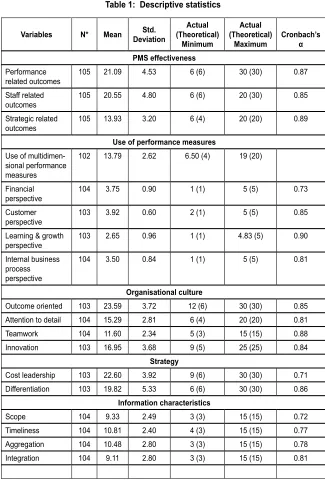
Table 1: Descriptive statistics
Variables N* Mean DeviationStd. (Theoretical)Actual Minimum
Actual (Theoretical)
Maximum Cronbach’s α PMS effectiveness
Performance
related outcomes 105 21.09 4.53 6 (6) 30 (30) 0.87 Staff related
outcomes 105 20.55 4.80 6 (6) 20 (30) 0.85 Strategic related
outcomes 105 13.93 3.20 6 (4) 20 (20) 0.89 Use of performance measures
Use of multidimen-sional performance measures
102 13.79 2.62 6.50 (4) 19 (20)
Financial
perspective 104 3.75 0.90 1 (1) 5 (5) 0.73 Customer
perspective 103 3.92 0.60 2 (1) 5 (5) 0.85 Learning & growth
perspective 103 2.65 0.96 1 (1) 4.83 (5) 0.90 Internal business
process perspective
104 3.50 0.84 1 (1) 5 (5) 0.81
Organisational culture
Outcome oriented 103 23.59 3.72 12 (6) 30 (30) 0.85 Attention to detail 104 15.29 2.81 6 (4) 20 (20) 0.81 Teamwork 104 11.60 2.34 5 (3) 15 (15) 0.88 Innovation 103 16.95 3.68 9 (5) 25 (25) 0.84
Strategy
Cost leadership 103 22.60 3.92 9 (6) 30 (30) 0.71 Differentiation 103 19.82 5.33 6 (6) 30 (30) 0.86
Information characteristics
The Association between Organisational Culture,
Business Strategy and the Use of Multidimensional
Performance Measures
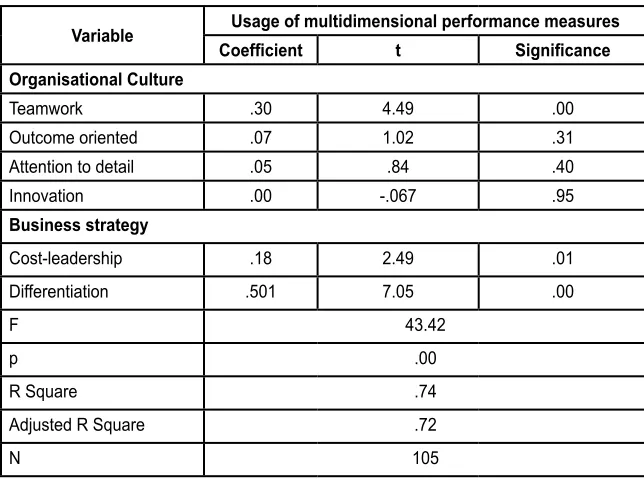
Table 2 shows the results of the multiple regression analysis of the association between organisational culture, business strategy and the usage of multidimensional performance measures. The results indicate that the overall model was statistically significant (F = 43.42; p = 0.00) at the 1% significance level with three factors (teamwork, cost-leadership, and differentiation) found to be significantly associated with the usage of multidimensional performance measures at the 5% significance level.
Table 2: Results of the multiple regression analysis of the association between organisational culture, business strategy and the usage of
multidimensional performance measures
Variable CoefficientUsage of multidimensional performance measurest Significance
Organisational Culture
Teamwork .30 4.49 .00
Outcome oriented .07 1.02 .31
Attention to detail .05 .84 .40
Innovation .00 -.067 .95
Business strategy
Cost-leadership .18 2.49 .01
Differentiation .501 7.05 .00
F 43.42
p .00
R Square .74
Adjusted R Square .72
N 105
performance measures to a less extent. Similarly, partial support is provided for H2 as no association was found between the other three hypothesised organisational culture factors (innovation, attention to detail, and outcome orientation).
Further exploratory analysis was undertaken to investigate the association between strategy and the use of each of the four performance measure dimensions (financial, customer, internal business process, learning and growth). Stepwise regression (see Table 3) revealed that the use of a cost leadership strategy was significantly associated with the use of financial measures at the 5% significance level and internal measures at the 1% significant level. Alternatively, the differentiation strategy was significantly related to the focus on customer measures at the 5% significance level and the financial, internal, and learning and growth perspectives at the 1% significant level. This finding supports the general nature of H1 with business units whose strategy is more focused on differentiation found to use performance measures relating to all four dimensions of the Balanced Scorecard to a greater extent while such an association was only found in respect to the financial and internal business process dimensions for cost leaders.
Table 3: Results of the stepwise regression analysis of the association between business strategy and the usage of
performance measures Performance
measure dimensions Financial Customer Internal Learning and growth Strategy type
Cost leadership 2.448 (.016) 5.496
(.000)
Differentiation 4.653 (.000) 2.496
(.014) 3.529 (.001) 8.882 (.000)
F 30.75 28.45 49.03 103.93
F sig .000 .000 .000 .000
R Square .383 .223 .498 .565
Adjusted
R Square .371 .215 .487 .507
The Association between Information System
Characteristics and the Use of Multidimensional
Performance Measures with the Effectiveness of
PMSs
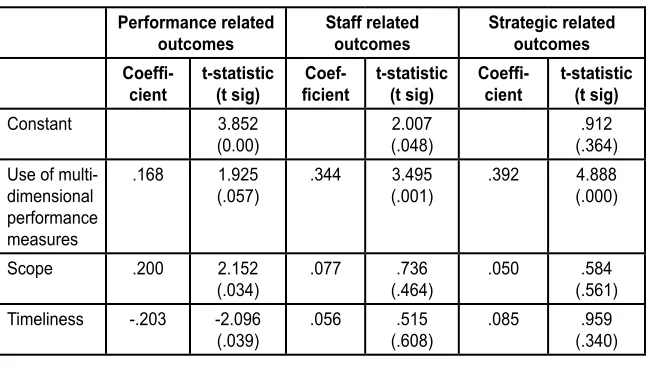
Table 4 provides the results of the multiple regression analysis evaluating the association between the use of multidimensional performance measures and the four information characteristics with the three dimensions of PMS effectiveness (performance, staff, and strategic). All three models were significant at the 1% significance level. Table 4 reveals that all four information characteristics were associated with the performance related outcomes at the 5% significance level, although timeliness was negatively associated4. The use of multidimensional performance measures was
significantly associated with performance related outcomes at the 10% significance level. In respect to the staff related and strategic related outcomes, only two factors, the use of multidimensional performance measures and integration were found to be significantly associated with PMS effectiveness. These findings provide support for hypotheses 3 and 4.
Table 4: Results of the multiple regression analysis of the association between information system characteristics and the use of multidimensional
performance measures with the effectiveness of PMSs
Performance related
outcomes Staff related outcomes Strategic related outcomes
Coeffi-cient t-statistic (t sig) ficientCoef- t-statistic (t sig) Coeffi-cient t-statistic (t sig)
Constant 3.852
(0.00) (.048)2.007 (.364).912
Use of multi-dimensional performance measures
.168 1.925
(.057) .344 (.001)3.495 .392 4.888 (.000)
Scope .200 2.152
(.034) .077 (.464).736 .050 (.561).584
Timeliness -.203 -2.096
(.039) .056 (.608).515 .085 (.340).959
4This finding implies that less timely information assists in the achievement of performance related
Aggregation .318 3.087
(.003) .050 (.666).434 -.006 (.949)-.064
Integration .336 3.363
(.001) .231 (.044)2.042 .412 4.477 (.000)
F 19.38 11.026 26.334
(Fsig) .000 .000 .000
R square .505 .367 .581
Adjusted
R Square .479 .334 .559
N 100 100 100
Discussion and Conclusion
The first objective of this study was to provide insights into the use of multidimensional performance measures by examining the association between business strategy and organisational culture with the use of multidimensional performance measures. The descriptive statistics reveal that Australian manufacturing organisations use multidimensional performance measures at a moderate level with organisations placing the greatest emphasis on measures relating to the customer perspective of the BSC, followed by the financial, internal business process and learning and growth perspectives. This finding differs from the majority of the literature which has found that organisations still use financial measures to the greatest extent (Hoque and James, 2000; Ittner and Larcker, 1998). The results suggest that Australian manufacturing organisations have realised the importance of customer measures and are transforming into customer-driven organisations. This is consistent with Scherr (1993) who states that the strategic importance of customer satisfaction has prompted many organisations to focus their attention on the core processes that drive customer values.
measures was affected by business strategy (Govindarajan and Gupta, 1985). The findings are also consistent with those of previous studies that maintained a differentiation strategy would use a diverse set of performance measures (Brignall, 1997; Ittner et al., 1997). However, the results are in conflict with those ofAbernethy and Lillis (1995) and Chenhall and Langfield-Smith (1998) who claimed that organisations following a low cost strategy tended to focus more on financial measures and use non-financial measures to a less extent.
Surprisingly, the association between a product differentiation strategy and the use of financial measures was actually stronger than it was for those using the cost leadership strategy. These findings indicate that performance measurement practices have changed, with business units following a cost leadership strategy no longer just focusing on financial and internal business process measures. Rather, it appears that there is a need to respond to customers’ needs and to learn and grow. At the same time, the results highlight the importance for those units adopting a differentiation strategy to incorporate a diverse set of performance measures. In particular, the strong emphasis on financial measures is indicative of the importance of monitoring performance to ensure adequate performance in an uncertain environment. Accordingly, it is recommended that organisations that follow either a cost leadership or differentiation strategy should use multidimensional performance measures.
In respect to organisational culture, the results reveal that organisations with a more teamwork oriented culture are more likely to use multidimensional performance measures in their PMSs. This finding is consistent with Kaplan and Norton (1992)’s statement that multidimensional performance measures should be used when measuring team performance.
four information system characteristics (scope, timeliness, integration and aggression), were significantly related to at least one dimension of PMS effectiveness.
The use of multidimensional performance measures was found to be associated with the performance related outcomes, indicating that the use of measures covering all four perspectives of the BSC can assist in achieving desired performance outcomes. Furthermore, the finding that the use of multidimensional performance measures was significantly associated with both the staff related and strategic related outcomes is consistent with the view that multidimensional performance measures can better motivate employees and assist in strategic implementation. These results suggest that the use of multidimensional performance measures will enhance the effectiveness of PMSs. Therefore, managers are encouraged to use a broad set of performance measures which includes both financial and non-financial measures when designing their PMSs.
The four information characteristics (scope, timeliness, integration and aggregation) were found to be positively associated with the performance related outcome dimension of PMS effectiveness, while the integration of information was found to be associated with the staff related and strategic related outcomes. The significant and positive association between the information system characteristics and PMS effectiveness suggests that PMSs tend to be more effective when the information system provides information on a broader, timely, integrated and aggregated basis. Such findings suggest that organisations seeking to develop a more effective PMS should should invest in information systems that can provide future oriented, externally focused information. In addition, information systems ought to generate feedback reports on a systematic, regular basis, and in a format that is suitable for input into decision models. Finally, a desirable information system should be able to provide information on the overall business unit’s performance, as well as the influence of other business unit manager’s decisions on the business unit.
2005). Future studies may combine the survey findings with interviews to gain a deeper insight into the hypothesised associations. Data could also be collected from multiple respondents across different management levels to broaden the data source. In addition, as the sample of this study is drawn only from large manufacturing organisations operating in the Australia, the generalisability of the findings is limited. Accordingly, future research may extend this study to other industry sectors or to manufacturing organisations outside Australia in order to enhance the generalisability of the findings.
REFERENCES
Abernethy, M.A. and Lillis, A.M. (1995). The Impact of Manufacturing Flexibility on Management Control System Design, Accounting, Organisations and Society, 20 : 241-258.
Amaratunga, D. and Baldry, D. (2003). A Conceptual Framework to Measure Facilities Management Performance, Property Management, 21, 2 : 171-189.
Anthony, R. N. (1965). Planning and Control Systems: Framework for Analysis, Boston: Graduate School of Business Administration Harvard University.
Baird, K. (2012). The Effectiveness of Strategic Performance Measurement Systems, Working Paper.
Baird, K., Harrison, G., and Reeve, R. (2004). Adoption of Activity Management Practices: A Note on the Extent of Adoption and the Influence of Organizational and Cultural Factors, Management Accounting Research, 15: 383-399.
Baird, K. and Wang, S. (2010). Employee Empowerment: Extent of Adoption and Influential Factors, Personnel Review, 39, 5 : 574-599. Banker, R.D., Potter, G. and Schroeder, R.G. (1993). Reporting
Manufacturing Performance Measures to Workers: An Empirical Investigation, Journal of Management Accounting Research, 3 : 33-55. Bierbusse, P. and Siesfeld, T. (1998). Measures that Matter, Journal of
Bititci U. S., Turner, T., Begemann, C. (2000). Dynamics of Performance Measurement Systems, International Journal of Operations and Production Management, 20, 6, : 692-704.
Bouwens, J., and M. A. Abernethy (2000). The Consequences of Customization on Management Accounting System Design, Accounting, Organisations and Society, 24, 2 : 221–241.
Brignall, T.J. (1997). A Contingent Rationale for Cost System Design in Services, Management Accounting Research, 8,3 : 325-346.
Bryant, L., Jones, D. and Widener, S., (2004). Managing Value Creation within The Firm: An Examination of Multiple Performance Measures, Journal of Management Accounting Research, 16 : 107-131.
Chan, Y-C.L. (2004). Performance Measurement and Adoption of Balanced Scorecards: A Survey of Municipal Governments in the USA and Canada, The International Journal of Public Sector Management, 17,3 : 204-221.
Chenhall, R., Langfield-Smith, K. (1998). The Relationship between Strategic Priorities, Management Accounting Techniques and Management Accounting: An Empirical Investigation Using A Systems Approach, Accounting, Organisations and Society, 23 : 243–264. Chenhall, R. (2003). Management Control Systems Design within its
Organizational Context: Findings from Contingency-Based Research and Directions for Future, Accounting, Organisations and Society, 28. 2-3 : 127-168.
Choe, J.M. (1996). The Relationships Among Performance of Accounting Information Systems, Influence Factors and Evolution Level of Information Systems, Journal of Management Information Systems, Spring 1996 : 215–239.
Chow C.W. and Van der Stede W.A. (2006). The Use and Usefulness of Non-Financial Performance Measures, Management Accounting, 7, 3 :1-8. Chung, L. H., Gibbons, P. and Schoch, H.P. (2006). The Management
Deem, J., Barnes, B., Huizenga, H., Segal, S., and Preziosi, R. (2010). The Relationship of Organizational Culture to Balanced Scorecard Effectiveness, SAM Advanced Management Journal, 75, 4: 31-39. Dent, J., (1990). Strategy, Organisation and Control: Some Possibilities
for Accounting Research, Accounting, Organisations and Society, 15, 1/2 : 3-25.
Dillman, D.A. (2007). Mail and Internet Surveys: The Tailored Design Method, second ed., Hoboken, John Wiley Co., New Jersey.
Drucker, P.E. (1990). The Emerging Theory of Manufacturing, Harvard Business Review, May-June : 94-102.
Dumond, E.J. (1994). Making Best Use of Performance-Measures and Information, International Journal of Operations & Production Management, 14 : 9, 16-31.
Eccles, R. G. (1991). The Performance Measurement Manifesto, Harvard Business Review, January-February : 131-137.
Epstein, M. J. (2008). Making Sustainability Work: Best Practices in Managing and Measuring Corporate Social, Environmental and Economic Impacts, Berret-Koehler Publishers, San Francisco.
Feltham, G.A. and Xie, J. (1994). Performance Measure Congruity and Diversity in Multi-Task Principal/Agent Relations, The Accounting Review, 69 : 429–453.
Franco-Santos, M. and Bourne, M. (2003). Factors that Play a Role in Managing through Measures’. Management Decision, 41, 8 : 698-710. Franco-Santos, M. and Bourne, M. (2005). An Examination of the
Literature Relating to Issues Affecting How Companies Manage Through Measures, Production, Planning and Control, 16, 2 :114-24. Forza, C. and F. Salvador, (2000). Assessing Some Distinctive Dimensions
Gordon, G. G., and N. DiTomaso (1992). Predicting Corporate Performance From Organizational Culture, Journal of Management Studies, 29 : 783-799.
Gosselin, M. (2005). An Empirical Study of Performance Measurement in Manufacturing Firms, International Journal of Productivity and Performance Management, 54, 5/6: 419- 437.
Govindarajan, V. and Gupta, A.K. (1985). Linking Control Systems to Business Unit Strategy: Impact on Performance, Accounting, Organisations and Society, 10 : 125-135.
Hall, M. (2008). The Effect of Comprehensive Performance Measurement Systems on Role Clarity, Psychological Empowerment and Managerial Performance, Accounting, Organisations and Society, 33, 2/3, 141-63. Harper, D (2001). Introducing BSC Software, Industrial Distribution; New
York, edn March : 94-96.
Hayes, R. H.; Abernathy, W. J. (1980). Managing Our Way to Economic Decline, Harvard Business Review, 58, July-August : 67-77.
Hendricks, K., Larry M. and Christine W. (2004). The Balanced Scorecard: To Adopt Or Not to Adopt?’ Ivey Business Journal, 69, 2 : 1-7. Henri, J.F. (2006). Organizational Culture and Performance Measurement
Systems, Accounting, Organisations And Society, 31, 1 : 77-103. Ho S. and McKay R.B. (2002). Balanced Scorecard: Two perspectives, The
CPA Journal, 72, 3 : 20-25.
Hopwood, A. G. (1974). Accounting and Human Behaviour, Hay market, London.
Hoque, Z. and James, W. (2000). Linking Balanced Scorecard Measures with Size and Market Factors: Impact On Organisational Performance, Journal of Management Accounting Research, 12 : 1-17.
Ittner, C.D. and Larcker, D.F. (1998). Innovations in Performance Measurement: Trends and Research Implications, Journal of Management Accounting Research, 10 : 205-238.
Ittner, C. D., Larcker, D. F., and Meyer, M. W. (2003). Subjectivity and The Weighting of Performance Measures: Evidence from A Balanced Scorecard, The Accounting Review, 78,3: 725–758.
Johnson, H.T. and Kaplan, R.S. (1987). Relevance Lost – The Rise and Fall of Management Accounting, Harvard Business School Press, Boston, MA.
Jusoh, R., Ibrahim, D. N. and Zainuddin, Y. (2008). The Performance Consequence Of Multiple Performance Measures Usage: Evidence from the Malaysian Manufacturers, International Journal of Productivity and Performance Management, 57, 2 : 119-136.
Kaplan, R.S. and Norton, D.P. (1992). The Balanced Scorecard - Measures That Drive Performance, Harvard Business Review, 70,1:.71-79. Kaplan, R.S. and Norton, D.P. (1996). The Balanced Scorecard – Translating
Strategy into Action, Harvard Business School Press, Boston, MA. Kaplan, R. S. and Norton D. P. (2001). The Strategy-Focused Organization:
How Balanced Scorecard Companies Thrive in the New Business Environment, Boston, MA: Harvard Business School Press.
Keen, P. G. W., (1991). Redesigning the Organization through Information Technology, Strategy and Leadership, 19, 3: 4-9.
Kerr, J.L. and Slocum, J.W. Jr. (1987). Managing Corporate Culture through Reward Systems, Academy of Management Executive, 1: 99-107. Langfield-Smith, K. (1997). Management Control Systems and Strategy: A
Critical Review, Accounting, Organisations and Society, 22, 2 : 207-232. Lawler, E. (1986). High-Involvement Management, New Jersey,
Jossey-Bass.
Lebas, M.J. (1995). Performance Measurement and Performance Management, International Journal of Production Economics, 41, 1: 23-35.
Lessner, J. (1989). Performance Measurement in a Just In Time/Environment: Can Traditional Performance Measurement Still be Used?, Journal of Cost Management for The Manufacturing Industry, 3, Fall: 22-28. Luo, Y. and Zhao, H. (2004). Corporate Link and Competitive Strategy in
Multinational Enterprises: A Perspective from Subsidiaries Seeking Host Market Penetration, Journal of International Management, 10 : 77-105.
Lynch, R.L. and Cross, K.F. (1991). Measure Up – The Essential Guide to Measuring Business Performance, Mandarin - Blackwell, London. Malmi, T. (2001). Balanced Scorecards in Finnish companies, Management
Accounting Research, 12, 2 : 207-220.
Mia, L. and Chenhall, R. (1994). The Usefulness of MAS Functional Differentiation and Management Effectiveness, Accounting, Organisation and Society, 19,1 : 1-13.
Miles, R. E. and Snow, C. C. (1978). Organizational Strategy, Structure, and Process, New York: McGraw Hill.
Miller, D. (1987). The Structural Environmental Correlates of Business Strategy, Strategic Management Journal, 8,1 : 55–76.
Neely, A.D., Gregory, M. and Platts, K. (1995). Performance Measurement System Design: A Literature Review and Research Agenda, International Journal of Operations and Production Management, 15,4 : 80-116.
Neely, A.D. (1998). Measuring Business Performance, Economist Books, London.
Neely, A.D. and Adams, C. (2000). Perspectives on Performance: The Performance Prism, In Handbook of Performance Measurement (ed. Bourne, M.), Gee Publishing, London.
Nudurupati, S., Bititci, U., Kumar, V. and Chan, F. (2011). State of the Art Literature Review on Performance Measurement, Computers and Industrial Engineering, 60, 2 : 279-290.
O’Reilly, C.A., Chatman, J.A., and Caldwell, D. (1991). People and Organisational Culture: A Q-Sort Approach to Assessing Person-Organisation Fit, Academy of Management Journal, 34 : 487-516. Otley, D. (1980). The Contingency Theory of Management Accounting:
Achievement and Prognosis, Accounting, Organisations and Society, 5,4 : 413-428.
Otley, D. (1999). Performance Management: A Framework for Management Control Systems Research, Management Accounting Research, 10, 10 : 363-382.
Perera, S., Harrison, G., and Poole, M. (1997). Customer-Focused Manufacturing Strategy and the Use of Operation Based Non-Financial Performance Measures: A Research Note, Accounting, Organisations and Society, 22, 6 : 557-572.
Rigby, D. and Bilodeau, B. (2009). Management Tools and Trends 2009, Bain and Company, Inc.
Porter, M. E. (1980). Competitive Strategy and Techniques for Analyzing Industries and Competitors, New York: The Free Press. Porter, M.E. (1985). Competitive Advantage: Creating and Sustaining
Superior Performance, New York, NY: The Free Press.
Scherr, A.L. (1993). A New Approach to Business Process, IBM Systems Journal, 32,1 : 80-98
Simons, R. (1987). Accounting Control Systems and Business Strategy: An Empirical Analysis, Accounting, Organisations, and society, 12 , 4 : 357-374.
Simons, R. (1990). The Role of Management Control Systems in Creating Competitive Advantage: New Perspectives, Accounting, Organisations and Society, 15, 1/2 : 127-143.
Simons, R. (2000). Performance Measurement and Control Systems for Implementing Strategy, Prentice Hall, Upper Saddle River, NJ. Singleton Jr. R.A. and Straits, B.C. (2005), ‘Approaches to Social Research,
fourth ed., Oxford University Press, New York, NY.
Skinner, W. (1989). Manufacturing-Missing Link in Corporate Strategy, Harvard Business Review, May-June : 136-45.
Slater, S.F., E.M. Olson, V.K. Reddy (1997). Strategy-Based Performance Measurement, Business Horizons, July-August : 37-44.
Speckbacher, G., Bischof, J. and Pfeiffer, T., (2003). A Descriptive Analysis on the Implemention of Balanced Scorecards in German-Speaking Countries, Management Accounting Research, 14, 4 : 364-387. Storey, J. (1995). Introduction: from Personnel Management to Human
Resource Management, In Storey, J. (Ed), New Perspectives on Human Resource Management, London: Routledge.
Tangen, S. (2004), Performance Measurement: from Philosophy to Practice, International Journal of Productivity and Performance Management, 53, 8 : 726 -737.
Thor, C. G. (1991). Performance Measurement in a Research Organisation, National Productivity Review, Autumn, 499-507
The European Foundation for Quality Management (2000), Brochure of European Foundation for Quality Management 2001, EFQM, Brussels, Belgium.
Knowledge Intensive, People Rich , Amsterdam, Addison-Wesley Longman.
Tung, A., Baird, K. and Schoch, H. P. (2011). Factors Influencing the Effectiveness of Performance Measurement Systems, International Journal of Operations and Production Management, 31,12 : 1287 -1310.
Internal Business Process
n Usage/wastage of resources n Productivity
n Cycle time n Quality of product n Number of product returns n Expenditure on warranty claims
Learning and Growth
n Hours of training provided n Improvements made to employee
facilities
n Number of employee suggestions
implemented
n Time to market for new products n Percentage of revenue from new
product/application
n Number of new products produced
Staff related outcomes
n Addressing the concerns of staff n Ensuring staff time is used efficiently n Identifying talented employees n Rewarding talented employees n Identifying poor performing staff n Managing poor performing staff
Financial
n Sales revenues n Return on Investment
n Improvement in net assets/liabilities
Customer
n Customer satisfaction n On-time product delivery n Number of new customers
n Percentage of orders from suppliers
delivered on time
n Supplier satisfaction
n Number of disputes with suppliers
PMS effectiveness
Performance related outcomes
n Motivating performance
n Assisting in the achievement of goals n Developing a performance oriented
culture
n Providing useful performance feed
back to employees
n Providing an accurate assessment of
business unit performance
n Linking individual performance to
business unit performance
Strategic related outcomes
n Developing individual’s skills and
knowledge
n Supporting change efforts n Implementing the organisational
strategy
n Ensuring staff commitment to
organisations objectives
Information system characteristics
Timeliness
n The business unit’s information system
provided reports frequently on a systematic, regular basis
n Information was delivered immediately
upon request
n Information was provided automatically
upon its input into the system
Integration
n There are precise targets for each
activity performed in all departments within the business units
n Information is provided on the impact that
decisions have on the performance of all departments within the business units
n Information is provided on the influence
of other business units managers’ decisions on the business units
Outcome orientation
n Being competitive
n Being achievement oriented
n Having high expectations for performance n Being results oriented
n Being analytical n Being action oriented
Attention to detail
n Being careful
n Paying attention to detail n Being precise
n Being rule oriented
Aggregation
n Information is provided for multiple time
periods
n Information is provided in formats
suitable for inputs into decision models
n Information is provided on an effect of
different departments’ activities on the performance of business units
Scope
n Future-oriented information n External information is provided n Non-financial information is provided
Teamwork
n Being people oriented n Being team oriented
n Working in collaboration with others
Innovation
n A willingness to experiment n Not being constrained by many rules n Being quick to take advantages of
opportunities
n Being innovative n Risk taking
NB The following items did not load on the above culture dimensions: fairness; respect for the rights of the individual; tolerance; being socially responsible; security of employment; stability; being aggressive; predictability.
Differentiation
n New product development or existing
product adaption to better serve customers
n Introducing new products to the market n The intensity of advertising and marketing n Building strong brand identification n Price competition
n Developing and utilising the sales force
Business strategy
Cost-leadership
n The efficiency of securing raw materials
or components
n Tight control of selling/general/
administrative expenses
n Production capacity utilisation n Finding ways to reduce costs n Price competition