INTERNATIONALJOURNAL OFINTEGRATEDENGINEERINGVOL. 11 NO. 9 (2019) 174-181
© Universiti Tun Hussein Onn Malaysia Publisher’s Office
IJIE
Journal homepage:http://penerbit.uthm.edu.my/ojs/index.php/ijie
ISSN : 2229-838X e-ISSN : 2600-7916
The International
Journal of
Integrated
Engineering
Reduction of Indoor Air Temperature by Using POFA
Foamed Concrete Block
Hanizam Awang
1,*, Wenny Arminda
1, Alonge Olayiwola Richard
11School of Housing, Building and Planning,
Universiti Sains Malaysia, 11800 Gelugor , Penang, MALAYSIA
*Corresponding Author
DOI: https://doi.org/10.30880/ijie.2019.11.09.019
Received 15 February 2019; accepted 02 October 2019, available online 31 December 2019
Abstract:People use air conditioning (AC) systems to enhance the indoor thermal comfort of buildings, especially those that are located in tropical countries such as Malaysia. Despite reducing the indoor air temperature, AC systems consume a high amount of energy and produce negative effects on the urban thermal environment. The carbon dioxide released by AC systems also trigger a greenhouse effect, which in turn can thicken the thermal blanket of the earth. Lightweight foamed concrete blocks have been recently highlighted for their potential use in addressing the harmful effects of AC systems. Therefore, this study examines how POFA foamed concrete blocks can reduce the indoor air temperature of buildings and other structures. The results show that these blocks reduce the indoor air temperature to levels that are lower than the outdoor temperature for approximately 10 hours a day. The reduction in temperature can reach as high as 5.69 ºC during peak periods. Given their ability to reduce the indoor air temperature, POFA foamed concrete blocks can also reduce the energy consumption of AC systems with their long-term use.
Keywords:Indoor air temperature, reduction, POFA, foamed concrete, block
1. Introduction
The high level of indoor air temperature that reduces the indoor thermal comfort in buildings is influenced by the materials and technologies used in the construction [1]. Walls and roofs are the largest parts of a building envelope that are exposed to external environmental conditions, including solar radiation, outside air temperature, wind and precipitation [2]. The use of concrete as the basic material for construction in tropical regions increases the environmental temperature and urban heat island (UHI) intensity, both of which contribute to global warming and climate change [3]. These harmful effects are mainly driven by the characteristics of concrete, including its easy absorption of solar radiation, storage of heat and transfer of absorbed heat into buildings [4].
Unlike traditional houses that are built from timber, modern concrete houses are made of non-permeable and porous materials, thereby bringing thermal discomfort to their occupants, especially those in tropical regions [5][6]. However, given the high demand for building construction and the increasing value of land, the use of concrete as a primary building material has grown over time.
Concrete buildings in urban areas overheat by approximately 3 °C in a day. The hot and humid air trapped in these structures can increase the indoor air temperature because the excessive heat transmitted through the building envelope is stored in the concrete walls and floor slabs [7].
People often use air conditioning (AC) systems to cope with the increasing temperature. However, AC systems consume much electricity. If the energy source is not renewable, then using AC systems contributes to UHI and
*Corresponding author: [email protected]
2019 UTHM Publisher. All rights reserved. penerbit.uthm.edu.my/ojs/index.php/ijie
Hanizam Awang et al, Int. J. of Integrated Engineering Vol.11 No. 9 (2019) p. 174-181
175
ambient heat temperature, which are amongst the drivers of climate change [8]. Buildings consume approximately 40% of energy resources around the world [9]. Meanwhile, the outside temperature increases by 0.5 °C to 2 °C in the evenings (7 pm to 2 am) due to the heat being discharged by AC systems [10].
To improve the energy efficiency of buildings, active or passive energy efficiency strategies, such as improving the building envelope elements, can be implemented. Those walls that serve as the main parts of a building envelope can provide thermal and acoustic comfort inside the building [11].
Sadineni et al. [11] classified walls into wood-, metal- and masonry-based walls based on their material. Another type of advanced building wall design, called lightweight concrete wall, is known to improve the energy efficiency of buildings [11]. One type of lightweight concrete is called lightweight foamed concrete.
Foamed concrete has been used around the world since the 1920s [12]. This material is generally known for its many advantages, including its high flowability, low self-weight, minimal consumption of aggregate, controlled strength and excellent thermal insulation properties [13].
To enhance the properties of foamed concrete, researchers have examined the feasibility of including mineral admixture and supplementary cementing material in the production of foamed concrete. One substitute material that can be used for producing foamed concrete is palm oil fuel ash (POFA). POFA is a byproduct of the combustion of palm oil biomass, including palm oil fibre and kernel shell, which serves as an alternative source of fuel for generating electricity in palm oil mills. The incineration of biomass produces 5% POFA by the weight of the solid waste [14] and these ashes are usually disposed around the mills. The uncontrolled disposal of these materials may contribute to environmental deterioration [15].
Since the 1920s, researchers have investigated the use of POFA as a replacement for cement in the production of normal concrete [16],[17], high-strength concrete [14],[18]-[19], aerated concrete [20],[21] and lightweight foamed concrete [22], [23]. Hung Mo et al. [24] reported that the thermal conductivity of mortar can be reduced by 15% to 50% by including 50% POFA as a partial cement replacement, whilst Aminudin et al. [25] found that including 10% POFA as a cement substitute can reduce the thermal conductivity of aerated concrete.
To supplement the findings of previous research, this paper examines the potential of POFA as cement replacement in producing lightweight foamed concrete. The mechanical and thermal properties of foamed concrete are also investigated. The optimum design of foamed concrete comprising POFA is casted in a large-scale block production and is subsequently implemented in a model house.
.
2. Laboratory Experiment
Foamed concrete with a density of 900 kg/m3 and a cement-to-sand ratio of 1:1.5 was used in the experiment.
POFA was used to partially replace cement at replacement levels of 20%, 30%, 40%, 50% and 60%.
2.1 Materials
In the laboratory experiment, the concrete mixtures were produced by using two types of binder materials, namely, Portland composite cement and POFA. The dried fine sand passing through a 600 µm sieve with a fineness modulus and specific gravity of 1.35 and 2.74, respectively, was used as a fine aggregate. Stable foam with a density of 65 kg/m3was produced by using a protein-based foaming agent with a dilution ratio of 1:30 and aerated by a portafoam
machine. 1% polycarboxylate-based superplasticiser (SP) and 5% silica fume (SF) were added by the weight of the binder to improve the workability and strength of the foamed concrete.
2.2 POFA Characterization and Treatment Process
POFA was collected from a palm oil mill in Penang, Malaysia. This ash is a by-product of combusting biomass containing palm oil fibre and kernel shell that is burned at temperatures above 1000 °C. The collected raw POFA was dried in an oven at 105±5 °C for 24 hours to remove the moisture content. The raw POFA was then sieved through a 300 µm sieve to remove any unburned shell and fibres before being grounded by using a ball mill machine to produce finer ashes. The grounded POFA had a median particle size (d50)and specific gravity of 4.03 µm and 2.47, respectively.
The chemical compositions of the cement and POFA are shown in Table 1. The utilised POFA comprised 54.93% silicon dioxide (SiO2), 62.16% SiO2+ Al2O3+ Fe2O3and an LOI of 5.66%. Therefore, this POFA can be classified as
class C-F pozzolana.
2.3 Foamed Concrete Mix
Six foamed concrete mixtures with the same target density of 900 kg/m3 and water binder ratio of 1:1.5 were
Si 14. 54.
Al2O3 3. 3.
Fe2O3 2. 2.
Ca 56. 56.
MgO 1. 1.
S 2. 2.
Na2
O bdl** bdl**
P2
O5
0.
06 060.
L -
-* SiO2 +Al2O3 +Fe2O3
** Below the limit of detection tools
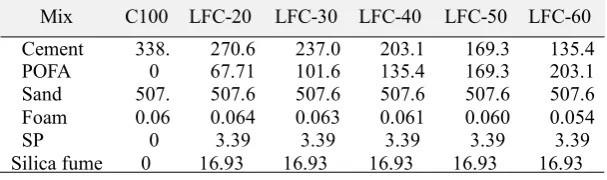
Table 2 - Mixture proportion of the foamed concrete(kg/m3)
Mix C100 LFC-20 LFC-30 LFC-40 LFC-50 LFC-60 Cement 338. 270.6 237.0 203.1 169.3 135.4 POFA 0 67.71 101.6 135.4 169.3 203.1 Sand 507. 507.6 507.6 507.6 507.6 507.6 Foam 0.06 0.064 0.063 0.061 0.060 0.054 SP 0 3.39 3.39 3.39 3.39 3.39 Silica fume 0 16.93 16.93 16.93 16.93 16.93
2.4 Casting, Curing and Testing Procedures
The dry materials, including cement, POFA, sand and silica fume, were blended by using a concrete mixer to obtain a homogenous mixture. During blending, the water and superplasticiser were gradually added into the mixture until a homogenous mixture and a required spread value (220 mm to 240 mm) were obtained. The consistency of the mortar was tested by conducting the Brewer test [12]
.
Upon obtaining a homogenous mixture, the fresh concrete was placed into greased moulds without any compaction. The specimens were then dismantled from the mould after 24 hours. After demoulding, the samples were weighed, wrapped in plastic cling and stored until the testing date. Sealed curing is a typical industry practice for foamed concrete.Three tests were performed to investigate the properties of the POFA foamed concrete. Cube specimens of 100×100×100 mm were used to test compressive strength, which was measured as the average compressive strength of three specimens. The porosity of the foamed concrete was recorded by using a vacuum saturation apparatus. Porosity readings were conducted on 50 mm cylinders cored out from foamed concrete prisms of 100×100×500 mm. The samples were oven dried at 105±5 °C until a constant weight was obtained. The samples were then placed in a desiccator for at least 3 hours. Afterwards, the desiccator was filled with de-aired, distilled water. The thermal conductivity test was performed by using a thermal constant analyser.
3.0 Properties of the POFA Foamed Concrete
3.1 Compressive Strength
Fig. 1 shows the effect of POFA on the compressive strength of foamed concrete at days 7, 28, 56 and 90. The LFC-20 with 20% POFA showed the highest compressive strength on day 28 with 3.21 MPa. The foamed concrete containing up to 50% POFA obtained a higher compressive strength than the control specimen (Fig. 1). On day 28, LFC-20, -30, -40, and -50 obtained compressive strengths that were 141%, 73%, 61% and 4% higher than that of C100 (1.33 MPa), respectively.
These results can be attributed to the high SiO2 content of POFA that enhanced the pozzolanic reaction upon the
addition of POFA. The pozzolanic reaction between calcium hydroxide (Ca(OH)2) from the cement hydration process
and SiO2from POFA increased the production of calcium silicate hydrate (CSH). This hydration process also increased
the strength of the foamed concrete [14], [26]. The fine particle size of POFA that greatly filled the void also enhanced the strength and contributed to increasing the densification of POFA foamed concrete [27], [28].
Hanizam Awang et al, Int. J. of Integrated Engineering Vol.11 No. 9 (2019) p. 174-181
177
Fig. 1 - Compressive strength development of POFA foamed concrete
3.2 Porosity
Fig. 2 presents the porosity value of the foamed concrete including POFA cured for 7, 28, 56 and 90 days. Including up to 50% POFA in foamed concrete reduced its porosity value. Specifically, the porosities of LFC20, 30, -40, -50 were 15.4%, 12.8%, 12.7% and 4.5% lower than that of C100, respectively. Increasing the quantity of POFA in foamed concrete also affected its porosity value. Given its high porosity, POFA has a natural tendency to absorb large amounts of water.
However, the porosity of foamed concrete reduced over time due to the densification of its structure. This result can be linked to the pozzolanic reaction between silica in POFA and calcium hydroxid from the cement hydration process. Porosity shows a positive relationship with strength development, that is, a higher compressive strength corresponds to a lower porosity value.
Fig. 2 - Porosity readings of POFA foamed concrete
3.3 Thermal conductivity
Table 3 shows the thermal conductivity of POFA foamed concrete. The foamed concrete incorporated with 20% to 40% POFA as a partial cement replacement showed a higher thermal conductivity compared with the foamed concrete with 100% cement content at a 28-day curing. This condition can be ascribed to the densification of the microstructures of the POFA foamed concrete and such assumption can be justified by the high compressive strength reported in the results. Meanwhile, the densification of microstructures in the foamed concrete specimens can be attributed to the pozzolanic reaction between SiO2in POFA and Ca(OH)2in cement hydration, which not only increased the strength but
also slightly increased their thermal conductivity readings. A similar result was reported by Lim et al. [29].
Table 3 - The 28-day thermal conductivity of POFA foamed concrete Mixtur
e
28-day compressive strength (MPa)
Thermal conductivity (W/mK)
C100 1. 0.2
LFC- 3. 0.3
LFC- 2. 0.3
LFC- 2. 0.3
LFC- 1. 0.2
(0.292 W/mK). Fig. 3 illustrates the relationship between the compressive strength and thermal conductivity of POFA foamed concrete.
Fig. 3 - Compressive strength as a function of the thermal conductivity of POFA foamed concrete at 28 days
4.0 Field Experiment
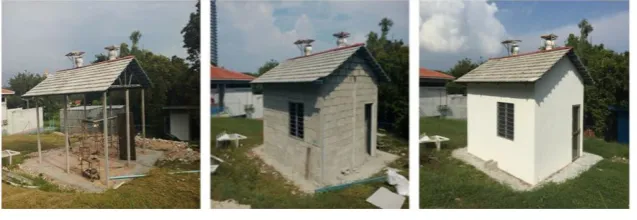
The foamed concrete with 20% POFA was used to fabricate a block with a size of 100×500×200 mm. The blocks were installed as partition wall in a single-storey building with a floor area of 20 m2and height of 3 m. The building is
located at the School of Housing, Building and Planning in the main campus of Universiti Sains Malaysia (USM), Penang (latitude 5o2ʹN and longitude 100o2ʹE).
This building has a concrete floor slab, plastered block wall (100-mm-thick block finished with a 2 mm plaster), a 30° pitched roof (made of 25-mm-thick concrete composite roof and a ceiling made of plaster boards) and two operable louver windows with dimensions of 1 m×1 m (Fig. 4).
Fig. 4 - Construction of the real scale model for the empirical study
The real scale experiment was performed in USM under real climatic conditions during the hot and sunny days of June 2018.
The testing days were randomly selected considering that global warming and climate change have increased the global temperature and released intense heat waves. This study focuses on the impact of POFA foamed concrete on the indoor air temperature and the temperature difference between indoor and outdoor environments under any condition.
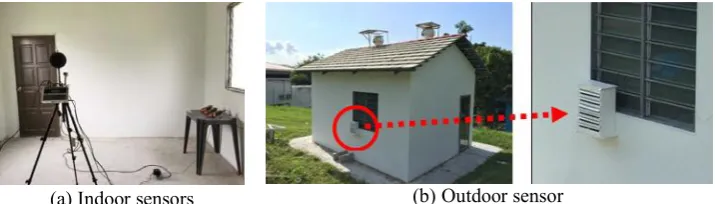
In the measurement process, the equipment was placed inside the building and a sensor was placed outside the station to measure the outdoor air temperature. The data for measuring indoor air temperature were collected by using LSI-LASTEM, which probes, including the black globe thermometer probe (which allows BABUC to calculate the mean radiant temperature) and psychometer (for measuring air temperature and relative humidity), were placed inside the building at the level of its occupants (Fig. 5a). Meanwhile, the sensor for recording the outdoor temperature was placed in a Stevenson screen, a chamber that not only protects the instrument (thermometer) from direct exposure to solar radiation and precipitation but also provides adequate ventilation (Fig. 5b).
Hanizam Awang et al, Int. J. of Integrated Engineering Vol.11 No. 9 (2019) p. 174-181
179
(a) Indoor sensors (b) Outdoor sensor
Fig. 5 - Setup of the thermal measurement tools for the empirical study
5.0 Field Experiment Results
Fig. 6 shows the thermal behavioural pattern of outdoor and indoor air temperatures during the six selected days in June 2018. The recorded outdoor pattern represents the actual and normal behaviour of tropical hot days in Malaysia.
The results show that the indoor and outdoor temperatures intersect at 8:00 am to 9:00am each day, during which the indoor air temperature starts to become hotter than the outdoor temperature.
The outdoor temperature peaked at 3:00 pm (day 1), 4:00 pm (day 2), 4:00 pm (day 3), 3:00 pm (day 4), 2:00 pm (day 5) and 2:00 pm (day 6) before dropping to its cross path with indoor air temperature between 6:00 pm and 7:00 pm. The indoor temperature is lower than the outdoor temperature for approximately 10 hours a day.
Meanwhile, the indoor air temperature was warmer than the outdoor air temperature at 6:00 pm for all 6 days and maintains this level up to 8:00 am the next day (±14 hours). This phenomenon is expected because during daytime, the building material stores the heat when exposed to the sun for about 8 to 9 hours. When the sun begins to set, the outdoor temperature gradually cools down yet the indoor temperature persists given the lack of ventilation to accelerate the heat release. This trend lasted for about 14 hours. The thermal behaviour patterns of the indoor and outdoor temperatures were similar to those reported by Rifa et al. [30].
Fig. 6 - Indoor and outdoor temperatures of the building using POFA foamed concrete block
Table 4 shows the difference between the indoor and outdoor temperatures (ΔT) at the hottest time for all 6 days. Using POFA foamed concrete clearly reduced the indoor air temperature relative to the outdoor air temperature, particularly during the hottest day of the data collection period. A high outside air temperature facilitated the temperature reduction, which ranged between 1.52 °C and 5.69 °C.
The differences in the recorded values indicate that the application of the POFA foamed concrete wall block has produced a significant gap between the outdoor and indoor peak temperatures.
Table 4 - Temperature differences at the hottest outdoor temperature
Testing day Time Outdoor Temp. (°C)
Indoor Temp.
(°C) Temp. Difference(°C)
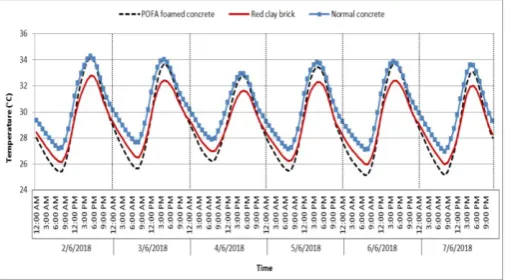
foamed concrete building showed the lowest indoor temperature, which can be ascribed to the different characteristics and specifications of the materials. The building made of normal concrete, which has the highest thermal conductivity amongst all the other materials, showed the highest indoor air temperature. Normal concrete can rapidly absorb heat yet releases the stored heat very slowly. Meanwhile, red clay brick has an insulation ability that allows this material to absorb and release heat slowly. Apart from rapidly absorbing heat, the POFA foamed concrete can release heat much faster than clay brick because of its low density and porous structure. Those materials with high porosity tend to have high insulation because of their air content, which is a very poor thermal conductor [31]. The indoor temperature of the POFA foamed concrete building demonstrated the same trend across all testing days.
Fig. 7 - Comparison between POFA foamed concrete and other wall materials via IES-VE software simulation
6.0 Conclusion
This paper describes in detail the properties of foamed concrete that uses POFA as a cement replacement. The foamed concrete with 20% POFA was used to fabricate a block and was installed as a partition wall in a single-floor building. The field experiment reveals that the indoor air temperature is lower than the outdoor air temperature for approximately 10 hours a day, starting from 8:00 am and lasting until 6:00 pm with a temperature reduction of up to 5.69 ºC. The comparison between POFA foamed concrete and the other materials shows that POFA foamed concrete wall achieves a lower indoor air temperature compared with red brick and normal concrete wall.
Acknowledgements
The authors gratefully acknowledge the University Sains Malaysia for providing financial support to this research through the USM RUI Grant Ref. No. 1001/PPBGN/8014015.
References
[1] Ahmad, A., Maslehuddin, M., and Al-hadhrami, L. In situ measurement of thermal transmittance and thermal resistance of hollow reinforced precast concrete walls.Energy and Buildings, volume 84, (2014), pp. 132–141.
[2] Kumar. A., and Suman, B.M. Experimental evaluation of insulation materials for walls and roofs and their impact on indoor thermal comfort under composite climate.Building and Environment,volume 59, (2013), pp.
635–643.
[3] Wong, N.H., Jusuf, S.K., Syafii, N.I., Chen, Y., Hajadi, N., Sathyanarayanan, H., and Manickavasagam, Y. V. Evaluation of the impact of the surrounding urban morphology on building energy consumption.Solar Energy,
volume 85, (2011), pp. 57–71.
[4] Rattanongphisat, W., and Rordprapat,W. Strategy for energy efficient buildings in tropical climate. Energy Procedia, volume 52, (2014), pp. 10–17.
[5] Hanafi, Z. Housing design in relation to environmental comfort — a comparison of the traditional Malay house and modern housing.Build. Res. Inf.(1994), 22:21–33
[6] Rahman, A.M.A. Housing design in relation to environmental comfort. Building Research and Information,
volume 23, (1995), pp. 49–54.
Hanizam Awang et al, Int. J. of Integrated Engineering Vol.11 No. 9 (2019) p. 174-181
181
[8] Lundgren, K, and Kjellstrom, T. Sustainability challenges from climate change and air conditioning use in urban areas.Sustainability, Volume 5, (2013), pp. 3116–3128.
[9] Nejat, P., Jomehzadeh, F., Taheri, M.M, Gohari, M., and Abdul Majid, M.Z. A global review of energy consumption, CO2 emissions and policy in the residential sector (with an overview of the top ten CO2 emitting countries).Renewable and Sustainable Energy Reviews,Volume 43, (2015), pp. 843–862.
[10] Hsieh, C.M., Aramaki, T., and Hanaki, K. The feedback of heat rejection to air conditioning load during the nighttime in subtropical climate.Energy and Buildings,Volume 39, (2007), pp. 1175–1182.
[11] Sadineni, S.B., Madala, S., and Boehm, R.F. Passive building energy savings: A review of building envelope components.Renewable and Sustainable Energy Reviews,Volume 15, (2011), pp. 3617–3631.
[12] Brady, K.C., Watts, G.R., and Jones, M.R.Specification for Foamed Concrete, (2001), UK: Highway Agency.
[13] Ramamurthy, K., Nambiar, E.K., and Ranjani, G.I.S. A Classification of studies on properties of foam concrete.
Cement & Concrete Composites, Volume 31, (2009), pp. 388–396.
[14] Sata, V., Jaturapitakkul, C., and Kiattikomol, K. Utilization of palm oil fuel ash in high-strength concrete.
Journal of Materials in Civil Engineering, Volume 16, No. 6, (2004), pp. 623–628.
[15] Khankhaje, E., Hussin, M.W., Mirza, J., Rafieizonooz, M., Salim, M.Z., Siong, H.C., and Warid, M.N.M. On blended cement and geopolymer concretes containing palm oil fuel ash. Material and Design, Volume 89,
(2016), pp. 385–398.
[16] Tay, B.J. Ash from oil palm waste as concrete material. Journal of Materials in Civil Engineering, Volume 2,
No. 2, (1990), pp. 94–105.
[17] Sata, V., Jaturapitakkul, C., and Rattanashotinunt, C. Compressive strength and heat evolution of concretes containing palm oil fuel ash.Journal of Material in Civil Engineering,Volume 22, (2010), pp. 1033–1038.
[18] Sata, V., Jaturapitakkul, C., and Kiattikomol, K. Influence of pozzolan from various by-product materials on mechanical properties of high-strength concrete.Construction and Building Material,Volume 21, (2007), pp.
1589–1598.
[19] Megat Johari, M.A., Zeyad, A.M., Bunnori, N.M., and Ariffin, K.S. Engineering and transport properties of high-strength green concrete containing high volume of ultrafine palm oil fuel ash. Construction and Building Materials,Volume 30, (2012), pp. 281–288.
[20] Abdullah, K., Hussin, M.W., Zakaria, F., Muhamad, R., and Hamid, Z.A. Pofa : a Potential partial cement replacement material in aerated concrete. Proceedings of the 6th Asia-Pacific Structural Engineering and Construction Conference (APSEC 2006), (2006), pp. 5–6.
[21] Abdullah, K., and Hussin M. Fire resistance properties of palm oil fuel ash cement based aerated concrete.
Concrete Research Letters, Volume 1, No. 3, (2010), pp. 1–5.
[22] Islam, M.M.U., Mo, K.H., Alengaram, U.J., and Jumaat, M.Z. Mechanical and fresh properties of sustainable oil palm shell lightweight concrete incorporating palm oil fuel ash. Journal of Cleaner Production, Volume 115,
(2015), pp. 307–314.
[23] Awang, H., and Al-Mulali, M. Strength of sieved only oil palm ash foamed concrete.International Journal of Engineering and Technology,Volume 8, (2016), pp. 354–357.
[24] Mo, K.H., Bong, C.S., Alengaram, U.J., Jumaat, M.Z., and Yap, S.P. Thermal conductivity, compressive and residual strength evaluation of polymer fibre-reinforced high volume palm oil fuel ash blended mortar.
Construction and Building Materials,Volume 130, (2017), pp. 113–121.
[25] Aminudin, E., Din M.F.M., Hussin M.W., Abdullah, A.H., Iwao, K., and Ichikawa, Y. Properties of agro-industrial aerated concrete as potential thermal insulation for building.MATEC Web of Conferences,Volume 47,
04020, (2016) .
[26] Muthusamy, K., Zamri, N., Zubir, M.A., Kusbiantoro, A., and Ahmad, S.W. Effect of mixing ingredient on compressive strength of oil palm shell lightweight aggregate concrete containing palm oil fuel ash. Procedia Engineering,Volume 125, (2015), pp. 804–810.
[27] Chindaprasirt, P, Homwuttiwong, S., and Jaturapitakkul, C. Strength and water permeability of concrete containing palm oil fuel ash and rice husk-bark ash. Construction and Building Materials, Volume 21, (2007),
pp. 1492–1499.
[28] Tangchirapat, W., Saeting, T., Jaturapitakkul, C., Kiattikomol, K., and Siripanichgorn, A
.
Use of waste ash from palm oil industry in concrete.Waste Management,Volume 27, (2007), pp. 81–88.[29] Lim, S.K., Tan, C.S., Lim, O.Y., and Lee, Y.L. Fresh and hardened properties of lightweight foamed concrete with palm oil fuel ash as filler.Construction and Building Materials,Volume 46, (2013), pp. 39–47.
[30] Rifa, R.T., Al-Obaidi, K.M., and Rahman, A.M.A. Improving Stack Effect in Hot Humid Building Interiors with Hybrid Turbine Ventilator(s).MATEC Web Conferences,Volume 17, 01012, (2014).
[31] Sarani, N.A., and Kadir, A.A. Thermal Conductivity of Fired Clay Bricks Incorporated with Cigarette Butts.