Streamer Structures in Experiment and Modeling
∗
)
Takuma YAMADA
1,2), Makoto SASAKI
2,3), Naohiro KASUYA
2,3), Yoshihiko NAGASHIMA
2,3),
Shigeru INAGAKI
2,3), Tatsuya KOBAYASHI
2,4), Masatoshi YAGI
2,5), Akihide FUJISAWA
2,3),
Sanae-I. ITOH
2,3)and Kimitaka ITOH
2,6)1)Graduate School of Frontier Sciences, The University of Tokyo, Kashiwa 277-8561, Japan 2)Itoh Research Center for Plasma Turbulence, Kyushu University, Kasuga 816-8580, Japan 3)Research Institute for Applied Mechanics, Kyushu University, Kasuga 816-8580, Japan
4)Interdisciplinary Graduate School of Engineering Sciences, Kyushu University, Kasuga 816-8580, Japan 5)Japan Atomic Energy Agency, Naka 311-0193, Japan
6)National Institute for Fusion Science, Toki 509-5292, Japan
(Received 7 December 2012/Accepted 18 February 2013)
Validation of modeling in meso-scale structure formation is undergoing by using multi-channel probe mea-surements and advanced analyzing techniques such as bispectrum. Study of meso-scale structures including streamers is important for understanding anomalous transports in magnetized plasmas. A streamer structure and its mediator mode were observed in the Large Mirror Device-Upgrade linear plasma. The mediator mode non-linearly coupled with many other drift wave modes and generated a streamer structure by phase locking. The radial biphase profiles indicating the phase locking showed the radial elongation of the streamer structure. Modes having similar characteristics to the mediator were also found in a theoretical work based on the Hasegawa-Mima model and a numerical simulation code.
c
2013 The Japan Society of Plasma Science and Nuclear Fusion Research
Keywords: linear plasma, turbulence, nonlinear coupling, streamer, bispectrum, validation of modeling DOI: 10.1585/pfr.8.2401022
1. Introduction
For understanding anomalous transports in magne-tized plasmas, study of drift wave turbulence has been an important subject. Theories and simulations have pre-dicted that the nonlinear couplings between the drift waves can generate meso-scale structures, such as zonal flows and streamers, which should have a strong influence on the anomalous transports [1]. Zonal flow is a radially local-ized, poloidally elongated structure that suppresses radial transport. In contrast, streamer is a poloidally localized, radially elongated structure that enhances radial transport [2–5]. The streamer structure lives longer than the charac-teristic turbulence correlation time and is a global meso-scale structure generated by nonlinear phase locking of several drift wave modes. The study of nonlinear pro-cesses, such as turbulent Reynolds stress, which induces meso-scale structures, is essential for understanding trans-ports of magnetized plasmas.
Theoretically, one example showed that envelope soli-tary vortices placing in the direction of the drift wave prop-agation, accompanied by a slow mode, were derived by a nonlinear Shr¨odinger equation based on the Hasegawa-Mima model [3]. The Numerical Linear Device (NLD) simulation code clearly presented the generation of the
author’s e-mail: [email protected]
∗)This article is based on the presentation at the 22nd International Toki
Conference (ITC22).
streamer structure and clarified that the collision frequency between ions and neutrals plays an important role for the selection rule of generating meso-scale structures includ-ing streamers [6,7]. Experimentally, zonal flows have been well studied, for example, zonal flow was first observed by a heavy ion beam probe in the Compact Helical System [8–12]. On the other hand, only few signatures of stream-ers have been found in toroidal plasmas so far [13, 14]. Al-though, in the Large Mirror Device-Upgrade (LMD-U), a streamer structure was first observed in a linear magnetized plasma [15]. This observation was accomplished by us-ing several multi-channel Langmuir probe measurements and bispectral analysis that investigates nonlinear coupling and phase locking between instability modes. In this way, validation of modeling in meso-scale structure formation is progressing by using multi-channel large-storage mea-surements and advanced analyzing tools. In addition, since the comparison between simulation and experiment has be-come more important, a turbulence diagnostic simulator project has been developed [16].
2. Theoretical Work
Meso-scale structures have been well studied in the-oretical works. When the plasma is bounded in ay di-rection and drifts in anxdirection, envelope solitary vor-tices placing in the x direction (fast mode) and a pair of large scale vortices (slow mode) are derived from the
c
2013 The Japan Society of Plasma
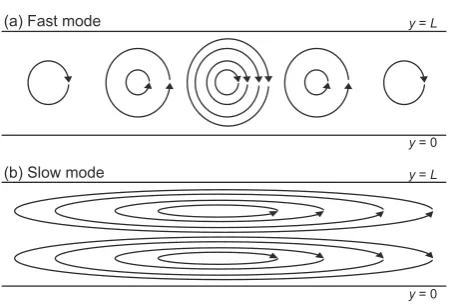
Fig. 1 Streamlines for the (a) fast and (b) slow modes de-rived from a nonlinear Schr¨odinger equation based on the Hasegawa-Mima model, with the case ofn=1 and kx=kn.
Hasegawa-Mima model [3]. The fast mode corresponds to the streamer structure when xandydirections are inter-preted as poloidal and radial directions, respectively. Ac-cording to Ref. [3], a pair of fast mode and slow mode including a streamer structure is derived as follows. In the Hasegawa-Mima model, the plasma density is given byn0expφ, where φ is an electrostatic potential. When
n0 is a slowly varying function ofy, i.e., (dn0/dy)/n0 is a
small constant, the Hasegawa-Mima model equation in the coordinates (x,y) takes the form
∂
∂t(Δφ−φ)−
∂φ ∂y
∂ ∂x−
∂φ ∂x
∂ ∂y
Δφ−b∂φ
∂x =0, (1)
wherebis a constant proportional to (dn0/dy)/n0. The
sec-ond term is the nonlinear Reynolds stress term, [φ,Δφ]. When the unperturbed potential isφ0 = −c0y, a dc
elec-tric field exists in theydirection, the plasma drifts in the
xdirection, and the disturbanceδφis excited on the drift motion. When the fixed boundary conditions are assumed at the plasma boundaries,δφ(x,0)=δφ(x,L)=0 (Lis the plasma length),δφhas the form δφ = X(x,t)Y(y), where
Y ∝ sinkny, kn = nπ/L, andn is a natural number. It
is anticipated that ifδφis small, wave-modulations in the
xdirection will be described by a nonlinear Schr¨odinger equation. Whenφis expressed as
φ=φ0(y)+
α=1
εαφα, (2)
the one-soliton solution is thatφ1andφ2take the forms φ1∝sechκ(x−λt)·cosk
xx·sinkny, (3)
φ2∝sech2κ(x−λt)·sink
2ny, (4)
whereλ = dω/dkx andκ is a function of kx,kn, c0 and
b. Figures 1 (a) and (b) are the schematic views of con-toursφ1=constant (the fast mode) andφ2=constant (the
slow mode), respectively. Figure 1 (a) shows a train of small convective cells placing at intervals of 1/kx in the
xdirection. The magnitudes decrease towards |x| → ∞.
Figure 1 (b) shows a pair of vortices of large scale. Whenx
andyare taken as the poloidal and radial directions, respec-tively, the fast mode is coincident with a solitary envelope structure localized in the poloidal direction (a streamer). This model also predicts the existence of large-scale vor-tices having doubled value ofkycompared to the fast mode.
3. Experimental Results
A streamer structure in a linear plasma experiment was observed for the first time in the LMD-U plasma [15]. A mediator, which is an important mode for creating the streamer structure, was also found [17]. The LMD-U vac-uum vessel has an axial (z) length of 3.74 m and an inner diameter of 0.45 m. Under the experimental conditions of 3 kW of 7 MHz radio-frequency wave power, 0.01–0.15 T of axial magnetic field, and 1–6 mTorr of argon pressure inside the source region, which is a quartz tube with an in-ner diameter of 95 mm, the peak electron density is about 1019m−3and the electron temperature is about 3±0.5 eV inside the plasma. The electron density gradient is steep in the radius ofr=30–40 mm, and produces resistive drift wave instabilities propagating in the positive poloidal di-rectionθ, which is the electron diamagnetic drift direction. A 64-channel poloidal Langmuir probe array [18] was used to measure the drift wave turbulence at the radiusr=
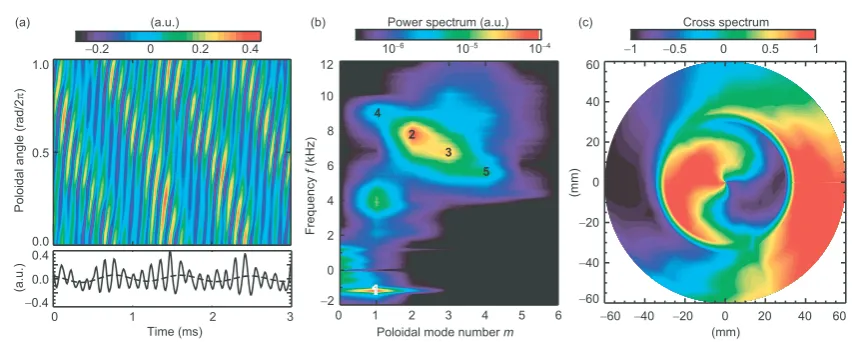
40 mm and the axial positionz=1885 mm. When the axial magnetic field was low and/or the argon pressure was high, the spatiotemporal waveform measured with the poloidal probe array became coherent. By varying the discharge conditions, i.e., increasing the axial magnetic field and/or decreasing the argon pressure, the spatiotemporal behav-ior changed from a coherent to a turbulent regime, passing through a periodic and solitary regime. By reducing the ar-gon pressure furthermore, a meso-scale streamer structure was formed in the turbulent regime. Figure 2 (a) shows the spatiotemporal of the ion saturation-current fluctuation in the laboratory frame with the axial magnetic field of 0.09 T and the argon pressure of 1.5 mTorr. With this discharge condition, a bunching of waves in the fluctuation waveform at the radius of 40 mm was clearly observed. The dominant modes have poloidal mode numberm=2–3 and frequency
f ∼7–9 kHz. The bunching of waves is poloidally local-ized, i.e., separated into high-amplitude and low-amplitude regions, and the envelope forms anm=1 structure in the poloidal space. While the dominant modes propagate in the electron diamagnetic direction, the envelope structure propagates in the ion diamagnetic direction (at least in the laboratory frame). The figure below the spatiotemporal contour is the temporal waveform at the zero poloidal an-gle position. It consists of bunching waves with a beat fre-quency of 1.2 kHz and a slow sinusoidal wave with f =
struc-Fig. 2 (a) Spatiotemporal waveform of ion saturation-current fluctuation measured at radius of 40 mm with a 64-channel poloidal probe array. Below is temporal waveform at zero poloidal position. Dashed line is low frequency component. (b) Two-dimensional power spectrum of (a). Mode “1” is mediator and modes “2”–“5” are carrier drift waves of streamer structure. (c) Real part of cross spectrum for mode “1” component between poloidal probe array atr=40 mm and radially mobile probe. There is a node in radial direction atr=30 mm.
ture. Figure 2 (b) is the two-dimensional power spectrum
S(m,f) of the turbulence. The dominant modes in the electron diamagnetic direction are (m,f) =(2, 7.8 kHz), (3, 6.6 kHz), (1, 3.9 kHz), (4, 5.4 kHz), (1, 9.0 kHz), and so on (some of the modes are labeled as “2”–“5”). From Fig. 2 (a), it is clear that modes “2” and “3” are the fine structures in the spatiotemporal waveform and they are the carriers for the formation of the poloidally localized struc-ture. There also exists a large amplitude mode in the ion diamagnetic direction labeled as “1”, that is, (m,f)=(1,
−1.2 kHz), which has the same property as the envelope structure. The phase structure of mode “1” in the whole plasma cross section was investigated. Figure 2 (c) shows the real part of the cross spectrum of f =1.2 kHz com-ponent between the 64-channel poloidal probe array atr =40 mm and a radially mobile probe. It consists of two large-scale structures neighboring in the radial direction and propagating in the ion diamagnetic direction [coun-terclockwise in Fig. 2 (c)]. The propagating direction was confirmed by shifting the time series between the probe array and mobile probe. The phase jumps atr=30 mm. Compared to the theoretical work, when theydirection in Fig. 1 (b) is taken as the radial direction, these two struc-tures become similar.
Next, it can be considered that mode “1” nonlinearly couples with a carrier wave, creates another quasi-mode carrier, and the carriers form a beat structure with the same property as mode “1”. The accumulation of these nonlin-ear couplings forms a bunching of waves. If this is true, the phases of mode “1” and carriers must be locked and that can be examined by bispectral analysis. To investigate the phase locking between mode “1” and the envelope, bis-pectral analysis was applied to the Fourier transformed ex-pressionsZ1=Z(1,−1.2 kHz),Z2=Z(2, 7.8 kHz), andZ3
=Z(3, 6.6 kHz) of the three pronounced modes “1”, “2”,
and “3”. The results for 390 ensembles yield a squared bi-coherence value of 0.57, which clearly proves that the three modes are nonlinearly coupled, since it is higher than the confidence level, 0.003 (=1/390). In other words, the three modes exist independently, and their phases are locked. The strong bicoherence values were also confirmed in the mode pairs of “135” and “142”. Mode “1” also strongly coupled with other coherent modes. Therefore, mode “1” is an important mode for forming the poloidally localized structure and can be called a mediator for meso-scale for-mation [7].
A streamer is a localized structure of the fluctuation in the poloidal direction, and it must have a radially elongated structure. To confirm that the poloidally localized structure measured in LMD-U is a streamer, the radial structure of the envelope was investigated. The structure is mainly gen-erated by modes “2” and “3”. The biphase between modes “1”, “2”, and “3” indicates the phase difference between mode “1” and the envelope. When mode “1” measured at the radius of 40 mm with the poloidal probe array is taken as a reference signal, and the biphases between this and modes “2” and “3” at different radii are calculated, the phase structure of the envelope along the radial direction can be determined. Since the radially mobile probe makes a single-point measurement, Z1 =Z(1, −1.2 kHz), Z2 =
Z(7.8 kHz), andZ3=Z(6.6 kHz) are taken for the biphase
nonlin-Fig. 3 Radial profiles of the biphase between modes “123” (closed circles), “135” (squares), and “142” (triangles). Z1=Z(1,−1.2 kHz), measured with 64-channel poloidal
probe array (reference signal), andZ(f) measured with a radially mobile probe for the others, were used for the calculation. Three results indicate that the poloidally lo-calized structure is almost radially independent. Open circles indicate radial phase profile of mode “1”, which jumpsπradians atr=30 mm.
early coupled with the mediator mode and the biphases of the mode couplings had nearly flat radial profiles. It means that these coherent modes contribute to form the poloidally localized structure, which is elongated in the radial direc-tion. It is clearly shown that this poloidally localized struc-ture is confirmed to be a streamer. In addition, the radial phase profile of mode “1” was also calculated by taking the cross phase of the 1.2 kHz component between the poloidal probe array and the mobile probe. As is shown by open cir-cles in Fig. 3, the phase jumps forπradians atr=30 mm, indicating that it has a node in the radial direction.
4. Discussion from Simulation
A numerical simulation played an important role to discover the streamer structure [15], and it has clarified a selection rule of turbulent structures [7]. The impor-tance of the comparison between simulation and experi-ment has been recognized, and turbulence diagnostic sim-ulator project has been developed [16]. Here, we discuss a simulation result on the spatial structure of the mediator in the case when the streamer is observed by the NLD code. The code is based on the three-field (density, electrostatic potential, and parallel velocity of electrons) reduced fluid model with a simple cylindrical geometry [6]. Following parameters are used: plasma radiusa=70 mm, length of the device 4 m, electron density at the center of the plasma 1019m−3, and the electron temperature 3 eV. The
calcula-tion is carried out with a fixed particle source, whose pro-file is given asSN(r)=S0L−N2[1−(r/LN)2] exp[−(r/LN)2],
whereS0=0.2 andLN =67 mm. The collision frequency
between ions and neutrals is a control parameter of insta-bility here, which gives a selection rule of turbulent struc-ture formations such as zonal flows and streamers. The
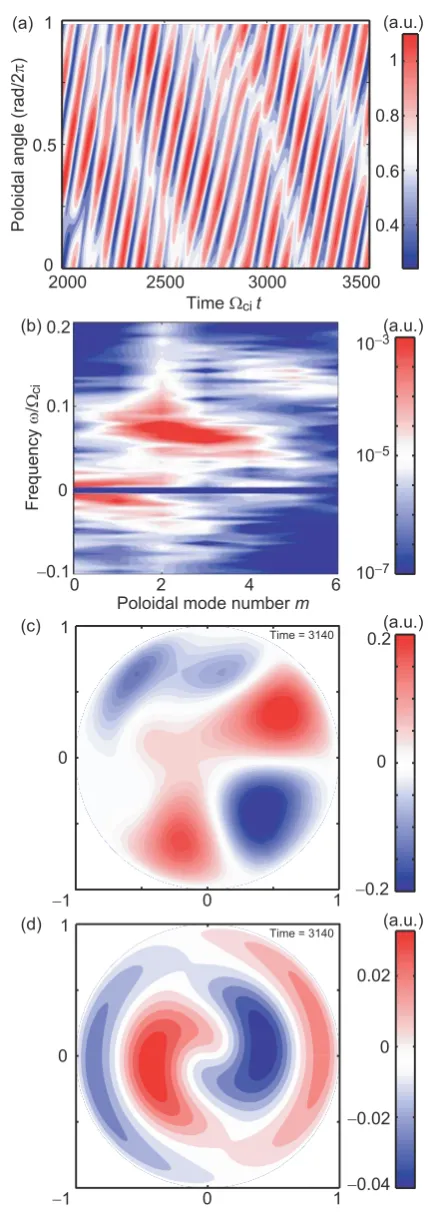
Fig. 4 (a) Spatiotemporal, (b) two-dimensional power spectrum, and screenshots of (c) whole turbulence and (d) (m,n)= (1,−2) mode of electron density fluctuation calculated by NLD simulation code.
value is chosen as 0.03Ωci (Ωci is the ion cyclotron
are (m,n, ωm,n)=(2,1,0.007Ωci) and (3,−1,0.005Ωci). In
addition to the linearly unstable drift waves, a wave with (m,n, ωm,n)=(1,−2,−0.002Ωci) is driven by the
nonlin-ear coupling between the dominant drift waves, which is thought to be the mediator. The dominant drift waves and the driven mode satisfy the matching conditions. As shown in Fig. 4 (a), the density fluctuation propagates in the electron diamagnetic drift direction, while its modula-tion propagates in the ion diamagnetic direcmodula-tion. Here, the positive direction of the poloidal angle is chosen as that of the electron diamagnetic drift. The figures are shown in the laboratory frame, however, the propagating direc-tions do not change with in the plasma frame. Figure 4 (b) shows the two-dimensional (frequency and poloidal mode number) power spectrum. As likely as Fig. 2 (b), there are majorm = 2–3 modes with positive frequencies and an
m=1 nonlinear driven mode with a negative frequency. The frequency of the modulation is as same as the non-linear driven mode with (m,n) =(1,−2). The bunching of the fluctuation can be seen in the poloidal cross sec-tion as shown in Fig. 4 (c). Figure 4 (d) shows the poloidal cross section of the nonlinearly driven mode (m,n, ωm,n)
=(1,−2,−0.002Ωci), which propagates in the ion
diamag-netic direction [counterclockwise in Fig. 4 (d)]. The radial wavenumber of this nonlinear mode is twice of the drift waves. These characteristics are similar to that of the the-oretical prediction [3] and the mediator observed in LMD-U. Especially, both simulation and experiment results have similar comma-shaped structures, of which the tails of the comma shapes are facing in the ion diamagnetic direction, at the inner parts of the plasma cross sections. Such kind of a mediator mode having a node in the radial direction was found for the first time in simulation results. More quan-titative comparison with experimental results by configur-ing the plasma conditions is planned for understandconfigur-ing the mechanism of the mediator.
5. Summary
In summary, a streamer structure and its mediator mode, which plays an important role for the streamer for-mation, were observed in the LMD-U linear magnetized plasma. The mediator mode propagating in the ion dia-magnetic direction nonlinearly couples with other drift wave modes propagating in the electron diamagnetic di-rection, generates another quasi-drift wave modes, and modulates the drift wave modes by phase locking. The modulation envelope forms the same structure as the medi-ator mode and propagates in the ion diamagnetic direction.
The new finding is that not only the pair of the dominant drift wave modes but also two other pairs of drift wave modes strongly coupled with the mediator mode. Their radial biphase profiles were also nearly constant indicat-ing the radial elongation of the streamer structure. Such kind of modes similar to the mediator was also found in modeling. Nonlinear Shr¨odinger equation based on the Hasegawa-Mima model derived envelope solitary vortices placing in the drift wave propagation direction, accompa-nied by a slow mode, which was a pair of large vortices having double value of the radial wavenumber compared to the solitary vortices. The NLD simulation code found a mediator mode having a node in the radial direction for the first time in numerical calculations. The characteristics of these modes from theory and simulation agree well with the mediator mode found in the experiment.
Acknowledgments
This work was supported by Grants-in-Aid for Sci-entific Research (S) of JSPS (21224014 and 24740372), collaboration research program of RIAM, Kyushu Univer-sity (24 S2-9), and the collaboration programs of NIFS (NIFS10KOAP023) and RIAM, Kyushu University.
[1] P.H. Diamond, S.-I. Itoh, K. Itoh and T.S. Hahm, Plasma Phys. Control. Fusion47, R35 (2005).
[2] V.I. Petviashvili, Sov. J. Plasma Phys.3, 150 (1977). [3] K. Nozaki, T. Taniuti and K. Watanabe, J. Phys. Soc. Jpn.
46, 991 (1979).
[4] J.F. Drake, A. Zeiler and D. Biskamp, Phys. Rev. Lett.75, 4222 (1995).
[5] S. Champeaux and P.H. Diamond, Phys. Lett. A288, 214 (2001).
[6] N. Kasuyaet al., J. Phys. Soc. Jpn.76, 044501 (2007). [7] N. Kasuya, M. Yagi, K. Itoh and S.-I. Itoh, Phys. Plasmas
15, 052302 (2008).
[8] A. Fujisawaet al., Phys. Rev. Lett.93, 165002 (2004). [9] G.R. Tynanet al., Plasma Phys. Control. Fusion48, S51
(2006).
[10] C. Hollandet al., Phys. Rev. Lett.96, 195002 (2006). [11] C. Hidalgoet al., Plasma Phys. Control. Fusion48, S169
(2006).
[12] A. Fujisawa, Nucl. Fusion49, 013001 (2009). [13] P.A. Politzer, Phys. Rev. Lett.84, 1192 (2000). [14] Y. Hamadaet al., Phys. Rev. Lett.96, 115003 (2006). [15] T. Yamadaet al., Nature Phys.4, 721 (2008).
[16] N. Kasuya, S. Nishimura, M. Yagi, K. Itoh and S.-I. Itoh, Plasma Sci. Tech.13, 326 (2011).