C
lassroom
P
raCtiCe
and
the
Q
uality
of
t
eaChing
: W
here
a
n
ation
is
g
oing
?
Meng Yew Teea University of Malaya Moses Samuel Taylor’s University Norjoharuddeen Bin Mohd Nor Renuka A/p V Sathasivam Hutkemri University of Malaya
Abstract:This article reports the findings on classroom practice in Malaysia, as the nation attempts to transform the education system to better prepare children for the 21st Century. The goal of the study is to describe an overview of classroom practice in Malaysia, to provide essential empirical data to inform discussions in one of the most important areas in education – what happens in the classroom in relation to national aspirations, policies and practices. A random sampling of 24 secondary schools from across the country led to a sample size of 140 teachers. Lessons facilitated by these teachers were video recorded and analysed. The findings revealed that classroom practice was largely the same throughout the country, and lacked the kinds of activities widely associated with creating engaging and thinking classrooms. Systemic issues and possible ways forward are discussed in light of these findings.
Keywords: classroom practice, pedagogical practice, instructional practice, assessment practice, curriculum implementation practice, national video study
Introduction
While the quality of teachers’ practice in the classroom is critical within a formal schooling system (e.g., Hanushek, Kain, O’Brien, & Rivkin, 2005; Rivkin, Hanushek, & Kain, 2005; Rockoff, 2004; Sanders & Rivers, 1996; Singh & Sarkar, 2015), not enough is known about what actually goes on in what is sometimes referred to as the black box of education (Black et al, 2004; Long, 1980). As Black et al (2004) put it, inputs are fed into the schooling system and some expected outputs are to follow. What is often most discussed in the public and policy-making spheres are these inputs and outputs. What is often least discussed is what happens inside the classroom – where much of the learning process is expected to take place.
The purpose of this paper is to present data about classroom practice in Malaysia to better inform policy discussions about the aforementioned inputs and outputs, as well as how to support the teachers and learners in raising the quality of learning. A recent government-initiated study cited in the Malaysian Education Blueprint (Ministry of Education Malaysia, 2013) broadly identifies issues of practice in Malaysian classrooms but does not adequately describe and conceptualize specific aspects of teacher practice for development. This paper reports on a large scale, nationwide study which aims to describe with a greater specificity the practice patterns that are deemed most pertinent to the system today, namely: 1) What instructional, assessment and curriculum implementation
practices are present—or otherwise—to help students develop thinking skills? 2) Are there discernible differences in these practices based on teachers’ years of experience?
Background: Malaysia
Malaysia has a population of 30 million, with a primary- and secondary-level (Year 1-11) student population of more than 5 million students (Ministry of Education Malaysia, 2013). Malaysia gained independence from the British in 1957, and since then, has dedicated significant resources to develop its education system. In the period immediately after independence, a majority of the population did not have any formal schooling, with only 6 per cent of the people having secondary level schooling (Ministry of Education Malaysia, 2013). By 2010, Malaysia had an enrolment rate of 96 per cent at the primary school level, and 91 per cent at the lower secondary school level. Despite the recent growth of private schooling, an overwhelming majority of Year 1 to 11 students – about 90 percent of school-going aged children – are enrolled in the national public-school system (Ministry of Education Malaysia, 2013).
In the early decades after independence, the focus was on capacity building and increasing access to schooling. By the 1980s, the focus was on helping Malaysia shift from its dependence on agriculture and mining to manufacturing. By the turn of the century, the primary concern was to help Malaysia to be better prepared for a knowledge-based and globalized economy. The goal was to become a developed and high-income nation by 2020. Malaysia committed consistently large allocations for education from its national budget. Between 2000 and 2012, for example, the percentage expenditure on education as proportion to total federal spending was in the range of 14.2 to 18 percent (UNESCO, 2015). As a percentage of GDP, the spending was in the 3.1 to 4 percent range during this period.
While adequate financing is an important indicator of commitment to education, it is not enough in it of itself. Therein lies Malaysia’s great challenge in education. Potential employers have expressed concerned about Malaysian students and graduates, indicating that high school and university graduates lack essential communication and higher-order thinking skills (Mustafa, 2015; The Star Online, 2012, 2014; World Bank, 2014).
The OECD (2013, p. 207) reported that “learning standards have declined over the last decade” in Malaysia. Results from recent assessments such as the Programme for International Student Assessment (PISA) and the Trends in International Mathematics and Science Study (TIMSS) reaffirm Malaysia’s struggles, as it remains stuck at the bottom third of the international league table. When details are compared against peer countries, the image gets even more disconcerting. For example, in PISA 2012, Malaysia had 1.1 percent of its students scoring at the advanced Band 5 level or higher in Mathematics, and 51.8 percent scoring at the Band 2 level or less. Singapore had 40.8 percent at the Band 5 level or higher, and 8.3 percent at the Band 2 level or less. Korea had 30.9 percent at the Band 5 level or higher, and 9.1 percent at the Band 2 level or less. Singapore was once part of Malaysia, up till 1965. In the early 1980s, Malaysia and Korea had similar GDP per capita. Other than regional proximity, these other countries also have a heavily centralized education system.
When compared to itself across time, Malaysia has also struggled. The country witnessed the largest decline in test scores of all countries participating in TIMSS between 2003 and 2011 (UNESCO, 2014, p.207). International assessments such as TIMSS are designed increasingly to measure higher order thinking capacities such as problem-solving.
shift the national examinations structures to include a higher proportion of what is referred to as higher order thinking questions. This is being done with the intention to “refocus teachers’ attention on developing higher order thinking skills” (Ministry of Education Malaysia, 2013, p. 4-6).
Framing this Study as the System Begins its Shifts
The operational framing of this study focused on classroom practice, an area that was identified in the Education Blueprint as needing a key shift from its present state (Ministry of Education Malaysia, 2013). Classroom practice can encompass many aspects, but the key aspects in focus in this study are instructional practices, assessment for learning practices as well as curriculum implementation practices. These aspects, while essential to research on classroom practice (which will be discussed in the next section), are also central to the systems shifts being initiated in Malaysia.
In 2011, the Ministry of Education Malaysia began a comprehensive review of the education system against historical and international indicators. As discussed in the preceding narrative, the conclusion of the review was that not enough was being done to prepare Malaysia’s children for the needs of the 21st century. The review led to the pivotal preliminary blueprint to lay down the plans for transformation in the 2013-2025 timeframe (Ministry of Education Malaysia, 2013).
The blueprint identified the urgent need to ensure that every student has access to a high-quality education. The document recognized that “… Malaysian students have historically always excelled at reproducing subject content. However, this skill is less valuable in today’s ever changing economy” (Ministry of Education Malaysia, 2013, p.E-11). It also states that “students need to be able to reason, to extrapolate, and to creatively apply their knowledge in novel and unfamiliar settings… (but currently) our students struggle with higher-order thinking skills.”
It goes on to state that by 2016, higher-order thinking questions will make up 80 per cent of questions for UPSR (the Year 6 primary level national exam), 80 per cent of the Year 9 national assessment, 50 to 75 per cent of the questions for SPM (the Year 11 secondary level national exam). These changes were preceded by shifts starting in 2011 towards school-based assessments (SBA) from a highly centralized examination system. One of the key components of SBA was incorporating the use of assessment-for-learning methods to be carried “out continuously in schools by teachers during the teaching and learning process.” (Ministry of Education Malaysia, 2011, p.1)
The blueprint also recognized that for these changes to be made successfully, there must be effective groundwork to improve “classroom instruction to ensure that students develop higher-order thinking skills” (Ministry of Education Malaysia, 2013, p.8-3). Action goals as part of the first wave of planned change for the period 2013 to 2015 were put in place to improve the quality of classroom instruction, curriculum implementation and in-class assessment— these three areas became the focus of this study—alongside enhancing ministry and school leadership, and raising language proficiency levels.
A constructivist conceptual foundation was adopted to underpin the analysis of the three major dimensions of classroom practices: instruction, assessment and curriculum implementation. Existing evidence suggests that constructivist approaches would help the development of such skills (Bransford et al, 1999; Hmelo-Silver, 2004; Swartz, Fischer & Parks, 1998). This is consistent with Malaysia’s needs to develop educational practices that are more conducive to the development of higher order thinking.
Method
and the second wide-angle camera was used to capture the whole-class perspective. The audio recorder was attached to the teacher to ensure clear audio quality. Additional microphones and cameras were considered to allow a closer look at student activities, but this was eventually ruled out due to budgetary constraints. Recording of all the lessons took place between March and September of 2014.
Video recordings were treated as a form of observation, with advantages outweighing disadvantages. Video recordings provide lasting records that make it possible to pause, re-scrutinize, and re-interpret teaching and learning processes by multiple researchers (Erickson, 2011; Klette, 2009a). Video also provides a visual representation of aspects of classroom processes that may escape the observer’s gaze. In addition, Janik, Seidel and Najvar (2009) also point out that video studies allow researchers to code and re-code as required in order to capture the rich complexity of classroom practices. These distinct advantages made it possible for the researchers in this study to analyse classroom practice through at least three different lenses, namely instructional, assessment for learning as well as curriculum implementation practices. For further conceptual details of this video study, please refer to Tee, Samuel, Mohd Nor and Nadarajan (2016).
Sampling
This study randomly selected 24 schools from the list of 2000 public secondary schools in Malaysia. Note that 88 percent of secondary-level students attend public schools (Ministry of Education Malaysia, 2013). At each of these schools, teachers teaching the four core subjects in Year 7— Mathematics, Science, English and Malay—were approached for their informed consent. In total, 140 teachers participated in the study. Also, consent from relevant authorities was obtained. Procedures to ensure confidentiality and privacy of research participants was also put in place.
Data Analysis Strategy
The use of a priori coding frameworks helps with reducing complexity in large-scale video studies (Klette, 2009b). Using an a priori coding framework as a template for analysis also allowed researchers to explore resemblances of practice against established good practices. The notion of resemblance is based on the notion that similar categories exhibit a gradient structure wherein some practices are better exemplars of good practices than others (Rosch, 1978; Smith & Strahan, 2004; Sternberg & Horvath, 1995). In other words, the greater the similarity of exhibited practice with the coding framework, the greater the probability that it belongs to the category.
After reviewing existing coding frameworks for studying classroom educational practices (e.g. Danielson, 2007, 2011, 2013; Grossman et al., 2010; Hill et al., 2008; Kane & Staiger, 2012; Kane et al., 2013; Klette, 2009b; Lingard, Hayes, & Mills, 2003; Luke, Freebody, Cazden, & Lin, 2004; Pianta, La Paro, & Hamre, 2008; Tedlie et al, 2006), the decision was made to adopt the Framework For Teaching or FFT (Danielson, 2011), because of its constructivist underpinnings which is consistent with both the project and the national goals. The FFT also has an established track record, has been widely used in different research projects, and has been found to be robust (Kane & Staiger, 2012). It was then adapted to analyze instructional practice of the recorded lessons.
As for analyzing assessment practices, the research team had to develop its own coding framework based on the Assessment for Learning conceptions (Black et al, 2004; Black et al, 2006). A key reason for this decision was because Malaysia had just began implementing school-based assessment (SBA) —which emphasizes the use of assessment for learning approaches—in secondary schools nationwide in 2012. The data collection of data began in 2014 – third year into the SBA implementation.
teachers in Malaysia implemented the national curriculum i.e. did they offload, adapt or improvise the curriculum as they carried out the lessons? Lingard et al.’s productive pedagogies framework, on the other hand, provided the lens for the project to study if teachers in Malaysia connected the formal curriculum to other disciplines as well as students’ real world experiences. Both frameworks were essential in helping us understand how teachers were adjusting their practices in relation to the centralized national curriculum.
Fundamentally, the coding frameworks were decided based on what was deemed essential to Malaysia’s current context, including its aspirations and on-going challenges. The national aspiration to help students develop higher level thinking abilities keyed the constructivist underpinning for the initial coding frameworks. This constructivist underpinning formed a cohesive lens for studying Malaysian teachers’ classroom pedagogical practices, including their instructional, curriculum implementation and assessment practices.
Validity and reliability procedures were carried out at multiple levels. Firstly, three 1-day pre-coding sessions were held over a span of two weeks—involving about 20 researchers and research assistants—to qualitatively calibrate, or “get on the same page” in the way the coding framework was used to make judgments against pilot videos. Secondly, a paired-coding system was installed. Two coders would watch the same video, and then coded the video by consensus. Thirdly, a quantitative post hoc approach was used to measure reliability score. The correlation between coding by experts and the research assistants were statistically significant at p<.0001, based on the Single Measures Intraclass Correlation Coefficient (.631).
Findings
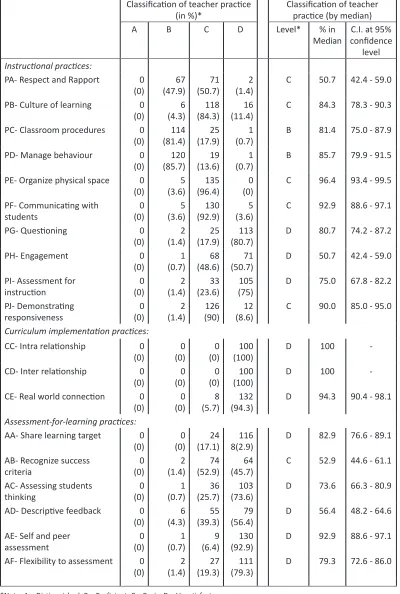
Based on the analyses of video recordings of classroom proceedings of 140 teachers teaching Mathematics, Science, English and Malay, we found significant confluence in their practice. The practices seen in the classroom were surprisingly very similar, regardless of the experience of the teachers. A summary of the findings is presented in Table 1, followed by a more detailed discussion based on the three focal areas in classroom practice: instruction, curriculum implementation and assessment.
Instructional Practices
In terms of instructional practices, three broad clusters emerged from the findings (refer to Figure 1). The two practice dimensions in the first cluster were the most positive, where more than 80 per cent of “proficient” practice were in the median (refer to Table 1). The second cluster included five practice dimensions where more than 50 to 96 percent of “basic” practice were in the median. And the final cluster had 3 practice dimensions where more than 50 to 81 percent of “unsatisfactory” practice were in the median.
First cluster. The two practice dimensions in this cluster, where the median level of practice was ‘proficient’ were Classroom Procedures (81.4%; C.I. 75.0% - 87.9%) and Manage Behaviour (85.7%; C.I. 79.9% - 91.5%). In managing student behaviour, most teachers established somewhat clear standards of conduct and did so without acrimony between teacher and students. The teachers demonstrated general awareness of students’ conduct, reinforced positive behaviour and dealt with misbehaviour effectively, proportionately as well as respectfully. Consistently distinguished practice was absent in large part due to several missing good practices, namely: proactive preventive action without getting distracted by misbehaviours as well indicators of a classroom culture where students actively and respectfully regulate each other’s behaviour. There were a number of delays at the start of class, but once the lessons got started, it was apparent that most routines were well established.
Table 1. Teachers’ Practices in Malaysia
Classification of teacher practice (in %)*
Classification of teacher practice (by median)
A B C D Level* % in
Median
C.I. at 95% confidence
level
Instructional practices:
PA- Respect and Rapport 0 (0) 67 (47.9) 71 (50.7) 2 (1.4)
C 50.7 42.4 - 59.0
PB- Culture of learning 0 (0) 6 (4.3) 118 (84.3) 16 (11.4)
C 84.3 78.3 - 90.3
PC- Classroom procedures 0 (0) 114 (81.4) 25 (17.9) 1 (0.7)
B 81.4 75.0 - 87.9
PD- Manage behaviour 0 (0) 120 (85.7) 19 (13.6) 1 (0.7)
B 85.7 79.9 - 91.5
PE- Organize physical space 0 (0) 5 (3.6) 135 (96.4) 0 (0)
C 96.4 93.4 - 99.5
PF- Communicating with students 0 (0) 5 (3.6) 130 (92.9) 5 (3.6)
C 92.9 88.6 - 97.1
PG- Questioning 0 (0) 2 (1.4) 25 (17.9) 113 (80.7)
D 80.7 74.2 - 87.2
PH- Engagement 0 (0) 1 (0.7) 68 (48.6) 71 (50.7)
D 50.7 42.4 - 59.0
PI- Assessment for instruction 0 (0) 2 (1.4) 33 (23.6) 105 (75)
D 75.0 67.8 - 82.2
PJ- Demonstrating responsiveness 0 (0) 2 (1.4) 126 (90) 12 (8.6)
C 90.0 85.0 - 95.0
Curriculum implementation practices:
CC- Intra relationship 0 (0) 0 (0) 0 (0) 100 (100)
D 100
-CD- Inter relationship 0 (0) 0 (0) 0 (0) 100 (100)
D 100
-CE- Real world connection 0 (0) 0 (0) 8 (5.7) 132 (94.3)
D 94.3 90.4 - 98.1
Assessment-for-learning practices:
AA- Share learning target 0 (0) 0 (0) 24 (17.1) 116 8(2.9)
D 82.9 76.6 - 89.1
AB- Recognize success criteria 0 (0) 2 (1.4) 74 (52.9) 64 (45.7)
C 52.9 44.6 - 61.1
AC- Assessing students thinking 0 (0) 1 (0.7) 36 (25.7) 103 (73.6)
D 73.6 66.3 - 80.9
AD- Descriptive feedback 0 (0) 6 (4.3) 55 (39.3) 79 (56.4)
D 56.4 48.2 - 64.6
AE- Self and peer assessment 0 (0) 1 (0.7) 9 (6.4) 130 (92.9)
D 92.9 88.6 - 97.1
AF- Flexibility to assessment 0 (0) 2 (1.4) 27 (19.3) 111 (79.3)
D 79.3 72.6 - 86.0
dimension of Culture of Learning it was found that 84.3% (C.I. 78.3% - 90.3%) of teachers were at the “basic” level of practice. For the dimension of Organize Physical Space, 96.4% (C.I. 93.4% - 99.5%) of teachers were deemed to be at the “basic” level of practice. For the dimension of Communicating with Students, the study found that 92.9% (C.I. 88.6% - 97.1%) of teachers were at the “basic” level of practice. For the dimension of Demonstrating Responsiveness, it was found that 90.0% (C.I. 85.0% - 95.0%) of teachers were at the “basic” level of practice.
The classrooms typically had a traditional setup – desks and chairs neatly arranged in rows facing the teacher. Even when the furniture was arranged in clusters, collaborative learning by design rarely took place. The goals of learning were not always clearly communicated, and most of the times the teaching going on in class were not situated within broader learning objectives or linked to students’ interests and experiences.
In terms of cultivating a vibrant culture of learning, a large number of lessons saw teachers “going through the motions” with cognitive energy not clearly evident. The teachers did not create a sense that what was happening was important and it was essential to master it. Few of the classes observed exuded positive energy or the urgency to learn or understand something. Teachers’ expectations for the students, and the students’ expectations of themselves, did not seem very high. In terms of responsiveness, the teachers merely made perfunctory attempts to incorporate students’ interests and questions, drawing on a limited repertoire of strategies.
Third cluster. The third and final cluster was mostly classified in the “unsatisfactory” range of practice. For the Questioning dimension, 80.7% (C.I. 74.2% - 87.2%) of teachers were found to be at the “unsatisfactory” level of practice. For the dimension of Engagement it was found that 50.7 % (C.I. 42.4% - 59.0 %) of teachers were at the “unsatisfactory” level of practice. For the dimension of Assessment for instruction, 75.0 % (C.I. 67.8% - 82.2%) of teachers were deemed to be at the “unsatisfactory” level of practice.
In terms of engaging students in learning, most class activities involved passive listening as well as rote tasks. Most of the learning activities were teacher-directed, driven by facts and procedures
1.4 11.4
0.7 0.7 0 3.6
80.7
50.7
75
8.6 50.7
84.3
17.9 13.6
96.4 92.9
17.9
48.6
23.6 90
47.9
4.3
81.4 85.7
3.6 3.6 1.4 0.7 1.4 1.4 0 0 0 0 0 0 0 0 0 0
0 10 20 30 40 50 60 70 80 90 100
and required minimal higher order thinking. Students seem more compliant than cognitively engaged. The practices in this third cluster contrast sharply with those in the first cluster above. While the practices in first cluster emphasise ordering or structuring of learning experiences, the practices in cluster three focus more on the cognitive or intellectual demands of deep or higher order thinking.
Malaysian teachers also seemed to be teaching based on the assumption that the students understood what was being taught, as there was very little evidence of proactive monitoring of students’ progress. The most commonly used monitoring strategy was to ask questions to elicit evidence of student understanding. However, this was only performed in a global and general sense without substantive impact to the instructional approach. The use of other strategies such as self or peer assessment was also conspicuously absent.
There was also a general absence of high quality questions and discussions. Questions and discussions, when effectively planned and facilitated, should cause students to think and reflect, to deepen their understanding, and to test their ideas against those of their classmates. Instead, most of the questions and discussions were narrow and almost entirely teacher-directed, with little room for students to contribute meaningfully to the discussion. Exchanges tended to brief and somewhat superficial, and cognitively unengaging. Questions revolved around a single right answer, and discussions generally did not require higher order thinking.
Curriculum Implementation Practices
In terms of curriculum implementation practices of teachers, the analyses of the video data was used to determine whether teachers had offloaded, adapted or innovated the recommended curriculum and the supporting curriculum materials when implementing the curriculum in the classroom. Figure 2 below shows that 89.3% (CI 84.2% - 94.4%) of teachers were found to have offloaded instructional responsibility by relying significantly or entirely on existing recommended curriculum and the supporting curriculum materials. About 10.0% (CI 5.0% - 15%) of teachers adapted from the existing curriculum by adding their own design elements. The remaining 0.7% (CI 0.7% - 2.1%) of teachers had innovated in their classroom implementation practices, using the existing curriculum as a “seed” but eventually implemented the curriculum in novel ways.
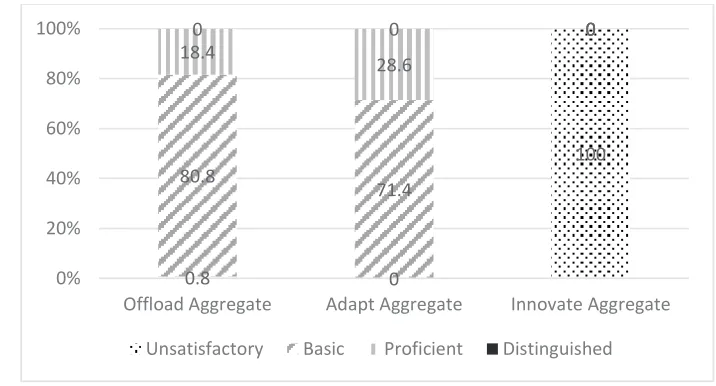
Analyses were also conducted to determine the level of curriculum implementation practice when teachers offloaded, adapted or innovated in the classroom. Figure 3 below presents the results of the analyses.
Figure 3 shows that for teachers who offloaded and adapted the curriculum in the classroom, the median level of practice was “Basic”. A total of 80.8% (CI 73.9% - 87.7%) of the teachers who offloaded were at the “Basic” level of curriculum implementation practice. These teachers were found to have delivered unchanged the content from the available curriculum materials, accurately but ineffectively. The Figure 3 also shows that about 71.4% (CI 47.73% to 95.07%) of the teachers who adapted were at the “Basic” level of curriculum implementation practice. These teachers adopted certain elements of the curriculum materials but also contributed their own design to classroom instruction, accurately but ineffectively. There was only one teacher in the sample who had innovated but this teacher was found to be at the “Unsatisfactory” level of curriculum implementation practice. This teacher was found to have delivered the content mainly with materials of his own but it was delivered inaccurately.
prerequisite concept. The teachers were familiar with the discipline but did not help the students to see the conceptual relationships of the various topics within the subject area. For the dimension of Inter-Disciplinary relationship of the curriculum, 100% of the teachers were at the “Unsatisfactory” level. The teachers did not help students to see how one topic could be connected to other subjects. Table 1 also shows only about 5.7% (CI 1.8% -12.4%) of the teachers were at the “Basic” level for the dimension Real-World Connections which means that they had attempted to connect the lesson topic and activities to students’ experiences and contemporary external situations.
Figure 2. Curriculum Implementation Practices: Offloading, Adapting and Innovating (in percentage)
89.3
10
0.7
0 10 20 30 40 50 60 70 80 90 100
Offload Adapt Innovate
Figure 3. Levels of Curriculum Implementation Practice by Types of Curriculum Implementation Practices
0.8 0
100 80.8
71.4
0
18.4 28.6
0
0 0 0
0% 20% 40% 60% 80% 100%
Offload Aggregate Adapt Aggregate Innovate Aggregate
Assessment Practices
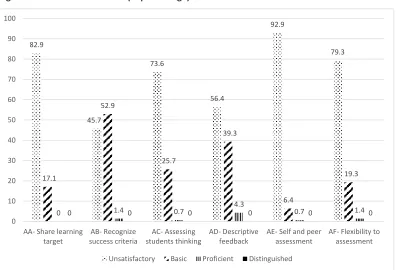
As presented in Figure 4, a majority of teachers’ assessment practices were in the “unsatisfactory” and “basic” clusters and a minuscule number of teachers showed practices in the “proficient” cluster (generally less than 5 %). For example, 92.2 % of the teachers showed “unsatisfactory” practices in terms of self- or peer-assessment. Similarly, 82.9 % of the teachers did not share their learning targets with their students. About 19.3 % demonstrated flexibility and responsiveness to the results from in-class assessments and activities in the “basic” cluster. Similarly, 26.4% of the teachers used questions that assess students’ thinking. Other assessment-for-learning practices were present but mostly in basic forms. For example, more than 50% of the teachers communicated the criteria of success but only did so orally and in rather superficial manner. More than 40% provided feedback, but mostly in a general way.
Figure 4: Assessment Practices (in percentage)
Differences in Classroom Practices by Teachers’ Experience
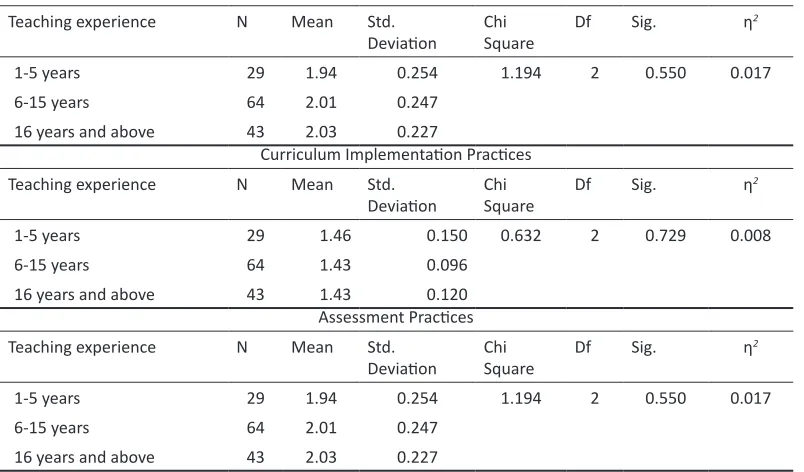
The data of classroom practices were analysed to ascertain if there were significant differences between instructional, curriculum implementation and assessment practices across levels of teachers’ experience, as measured by years in the teaching service. Table 2 below reports on the Kruskal Wallis test scores for instructional, curriculum implementation and assessment practices by teachers’ teaching experience.
82.9
45.7
73.6
56.4
92.9
79.3
17.1
52.9
25.7
39.3
6.4
19.3
0 0 1.4 0 0.7 0 4.3 0 0.7 0 1.4 0
0 10 20 30 40 50 60 70 80 90 100
AA- Share learning target
AB- Recognize success criteria
AC- Assessing students thinking
AD- Descriptive feedback
AE- Self and peer assessment
AF- Flexibility to assessment
Table 2. Instructional, Curriculum Implementation and Assessment Practices by Teachers’ Teaching Experience
Instructional Practices
Teaching experience N Mean Std.
Deviation
Chi Square
Df Sig. η2
1-5 years 29 1.94 0.254 1.194 2 0.550 0.017
6-15 years 64 2.01 0.247
16 years and above 43 2.03 0.227
Curriculum Implementation Practices
Teaching experience N Mean Std.
Deviation
Chi Square
Df Sig. η2
1-5 years 29 1.46 0.150 0.632 2 0.729 0.008
6-15 years 64 1.43 0.096
16 years and above 43 1.43 0.120
Assessment Practices
Teaching experience N Mean Std.
Deviation
Chi Square
Df Sig. η2
1-5 years 29 1.94 0.254 1.194 2 0.550 0.017
6-15 years 64 2.01 0.247
16 years and above 43 2.03 0.227
A Kruskal Wallis was conducted to determine differences in pedagogy based on teaching experience. The Kruskal Wallis test was used because of the number of sample in one of the groups based on teaching experience is less than 30 (Pallant, 2005). The table reveals that there was no significant difference between more experienced and less experienced teachers for instructional, curriculum implementation and assessment practices. This is occurring in a context where teacher preparation has supposedly gone through significant changes over the years. Constructivist practices have been emphasized more overtly in the last decade, but despite that, the findings indicate that teachers who have been teaching for less than 5 years are teaching no differently than teachers who have taught more than a decade. Continuous professional development is currently quite widespread, with a large majority of the teachers more than meeting the 7-hour-per-year in-service training requirements. Unfortunately, neither pre-service or in-service development as well as significant increases in resource allocation has transformed classroom pedagogical practices particularly in relation to developing higher order thinking.
Discussion
classrooms is that there is a conspicuous homogeneity of teacher practices, and that too, of practices that are not positive.
Given this scenario, two pertinent questions arise: first, how can we explain this homogeneity across the system? And second, what future actions can change the trajectory of this present state?
How Can We Explain the Absence of Teaching Practices Associated with Thinking? What is striking about the convergence of teacher practices in our data is not just the homogeneity across the board, but more crucially that the practices that are dominant do not encourage thinking. This seeming paradox merits closer scrutiny. First, focusing on macro-level policies, we can ask what aspects of these policies contribute to the resultant homogeneity at the micro-level. We know for instance, that Givvin et al. (2005), have argued that ‘national’ patterns do exist, especially in more centralised education systems. They point to the likelihood that a country can have distinctive patterns of practice as its teachers and students adapt to national expectations, cultural beliefs and values, including assumptions about the nature of a subject and how students learn. This seems to be the case for Malaysia. Key elements of Malaysia’s education system including national policies, teacher training, curriculum planning, national examinations, key performance indicators for students as well as teachers, school administrative structure, architecture of school buildings and school uniforms are largely decided at a central or national level. This centrality may potentially shape and be intricately linked to distinctive national patterns of practice. However, the high degree of centralization of the Malaysian education system per se does not in itself explain the patterns of practice that show up in the data analysed above.
This is because, on one hand, the national policy aspirations and documents are seen to be pushing towards thinking classrooms, but yet on the other hand, the teachers’ practices continue to be antithetical to the thinking classroom. For instance, the Malaysia Educational Blueprint explicitly places a high premium on student thinking. Another example of this commitment is reflected in the preamble to the newly launched 2017 national curriculum for primary schools (known by its Malay acronym KSSR, for Kurikulum Standard Sekolah Rendah, translated Standardised Curriculum for Primary schools) and the new national curriculum for secondary schools (known by its Malay acronym KSSM, for Kurikulum Standard Sekolah Menengah, translated Standardised Curriculum for Secondary schools) place strong emphasis on higher order thinking. Still, these macro-level aspirational goals in national plans and curriculum documents in a system that is highly centralised does not match with the micro-level practices at the classroom level. In actual fact, they seem to be diametrically opposed.
social order may be symptomatic of practices that are valued in Malaysian classrooms, where social order is given a higher emphasis in teacher priorities than active thinking and engagement with content and learning processes.
This still, begs the question: what do teachers make of the official endorsement of thinking skills in the mandated national curriculum? One possible reason that may explain why teachers may tend to disregard policy reforms is that in recent Malaysian education history, there have been several instances of sharp policy reversals which contribute to ‘mixed signals’ to teachers at the chalk face. One such instance is what has been known by its Malay acronym as the PPSMI policy. PPSMI is the acronym for Pengajaran dan Pembelajaran Sains and Matematik dalam Bahasa Inggeris
(translated ‘Teaching of Mathematics and Science in English). The decision to begin the teaching of mathematics and science in English was announced in 2005, for implementation in 2006 in Year 1 (grade 1) of primary school and Form 1 in secondary school and Form 6 (grade 7 and grade 12 respectively). However, by 2008 the policy was reversed so that Mathematics and Science from then on were progressively taught in Malay, beginning in Year 1 and Form 1. These policy reversals were partly a reaction to political pressure from language rights groups and a response by UMNO, the dominant political party within the ruling coalition government (Samuel & Tee, 2013).
Likewise, to cite another example, in 2008 the government announced that a pass in English would be compulsory from 2016 onwards for the school exit, Sijil Pelajaran Malaysia (SPM) examination at the end of grade 11. However, in 2015, a year before its implementation, the policy decision was rescinded. Similarly, in 2011, the Malaysian government introduced school-based assessment which was subsequently downplayed in 2015 in the light of resistance from teachers citing the added burden to teachers’ workload.
Teachers and school leaders at the school level when faced with abrupt policy reversals may find it difficult to read the overall policy directions or may be sceptical of newer initiatives when they are announced. The announcement of new policy initiatives often with great fanfare – as in the case of PPSMI or school-based assessment discussed above -- did not always allow for adequate planning and prior teacher preparation for implementation nationwide. And reversals in policy – often again at short notice –when implementation problems were encountered or when there was political pressure, resulted in a lack of coherence in direction and emphasis. Thus, despite a highly centralised education system, there appeared to be a lack of policy coherence at the macro level resulting in a lack of investment on the part of teachers who had to cope with the fatigue of frequent policy reversals. The lack of policy coherence may lead teachers to fall back on their “tried and tested” practices which may in part explain the findings reported here.
What Future Actions Can Change the Trajectory of the Present State?
bureaucracy, as well as the governing institutions. These entities interact with the macrosystem, which includes the attitude and ideologies of the culture shaped by the historical and sociological development of the nation.
A deeper analysis that takes into account these different levels and the relationship between these levels will more likely lead to a more nuanced understanding of the complex interrelationships that go into shaping the eventual classroom practice seen throughout the country. The classroom can be seen as a nexus-like space instead of a self-contained space, independent from outside influences (Lefebvre, 1991). In this view, the classroom is seen as a “complex of mobilities” which highlights the numerous in and out conduits that shapes the space within. Lefebvre (1991, p.93) used the house as a metaphor, illustrating that this space is shaped by permeation from every direction “streams of energy which run in and out of it by every imaginable route: water, gas, electricity, telephone lines, radio and television signals, and so on.”
In other words, what is needed here is for overall policy coherence and for the entities within the different systems (e.g. federal ministries, states and district education offices and schools) to become more informed about how each of the actions contribute to classroom practice. This would involve (a) close and coherent monitoring and sharing of essential practices and (b) supporting and sustaining the development of essential practices. In instances, where new policy directions may not be in line with current teacher practices, adequate time needs to be factored into the preparatory stage before implementation, so that radical policy reversals may at least be avoided due to implementational resistance midway through the reform period. In this regard, it may be too simplistic to apportion blame solely to teachers for their conservative practices. The systems that support the educational processes have a significant influence in shaping teachers’ practices. Thus, teachers will not change their practices unless the cultures in schools in which they work, the education bureaucracy, and the society at large also change.
Conclusion
In this study, we sought to describe teacher’s classroom practices in Malaysia, as the nation attempts to transform the education system to better prepare her children for the 21st Century. The data on
teachers’ classroom practices in Malaysia goes against the grain of stimulating student thinking, despite the official emphasis on developing student thinking through a highly centralized national curriculum reform effort. Teachers’ practices in Malaysia’s classrooms seem to contradict the needs of the growing knowledge society. While the teachers do relatively well in classroom management dimensions, they struggled with using pedagogical practices that are more conducive for cultivating thinking. These findings were consistent across experienced and less experienced teachers. We have argued that in order to change the way teaching is practiced in school, there is a need to take cognisance of the larger eco-system within which teachers operate, to address the “complex of mobilities” (Lefebvre, 1991) that impact classroom life.
Notes
1This work was funded in part by the University of Malaya Research Grant (UMRG) RP004-13SBS, the Equitable Society
Research Cluster and the University of Malaya Rakan Penyelidikan Grant CG035-2013.
References
Black, P., Harrison, C., Lee, C., Marshall, B. and Wiliam, D. (2004). Working inside the black box: Assessment for learning in the classroom. Phi Delta Kappan, September 2004, pp. 9-21. Black, P., McCormick, R., James, M. and Pedder, D. (2006). Learning how to learn and assessment
for learning: A theoretical inquiry. Research Papers in Education, 21(2), pp. 119-132.
Bronfenbrenner, U. (1994). Ecological models of human development. Readings on the Development of Children, 2, pp. 37-43.
Brown, M. (2009). The teacher-tool relationship: Theorizing the design and use of curriculum materials. In J. Remillard, G. Lloyd and B. Herbel-Eisenmann (Eds.), Mathematics Teachers at Work: Connecting Curriculum Materials and Classroom Instruction. New York: Routledge, pp. 17-36.
Cuban, L. (1990). Reforming again, again, and again. Educational Researcher, 19(1), pp. 3-13. Cuban, L. (2013). Why so many structural changes in schools and so little reform in teaching practice?.
Journal of Educational Administration, 51(2), pp. 109-125.
Danielson, C. (2007). Enhancing Professional Practice: A Framework for Teaching. Alexandria, VA: Association for Supervision and Curriculum Development.
Danielson, C. (2011). The Framework for Teaching Evaluation Instrument (2011 edition). Princeton, NJ: The Danielson Group.
Danielson, C. (2013). The Framework for Teaching Evaluation Instrument(2013 edition). Princeton, NJ: The Danielson Group.
Erickson, F. (2011). Uses of video in social research: a brief history. International Journal of Social Research Methodology, 14(3), pp. 179-189.
Givvin, K.B., Hiebert, J., Jacobs, J.K., Hollingsworth, H. and Gallimore, R. (2005). Are there national patterns of teaching? Evidence from the TIMSS 1999 video study. Comparative Education Review, 49 (3), pp. 311-343
Grossman, P., Loeb, S., Cohen, J., Hammerness, K., Wyckoff, J., Boyd, D., et al. (2010). Measure for Measure: The Relationship Between Measures of Instructional Practice in Middle School English Language Arts and Teachers’ Value-Added Scores. Washington, DC: CALDER.
Hanushek, E. A., Kain, J. F., O’Brien, D. M. and Rivkin, S. G. (2005). The Market for Teacher Quality. (Working Paper No. 11154). Cambridge, MA: National Bureau of Economic Research.
Hill, H.C., Blunk, M., Charalambous, C., Lewis, J., Phelps, G.C., Sleep, L., et al. (2008). Mathematical knowledge for teaching and the mathematical quality of instruction: An exploratory study.
Cognition and Instruction, 26(4), pp. 430-511.
Hmelo-Silver, C. E. (2004). Problem-based learning: What and how do students learn? Educational Psychology Review, 16(3), pp. 235-266.
Hofstede, G. (2011). Dimensionalizing cultures: The Hofstede model in context. Online Readings in Psychology and Culture, 2(1). https://doi.org/10/9707/2307-0919.1014.
Hugener, I., Pauli, C., Reusser, K., Lipowsky, F., Rakoczy, K. and Klieme, E. (2009). Teaching patterns and learning quality in Swiss and German mathematics lessons. Learning and Instruction, 19(1), pp. 66-78.
Janik, T. and Seidel, T. (2009). The Power of Video Studies in Investigating Teaching and Learning in the Classroom. Münster: Waxmann Publishing.
Janik, T., Seidel, T. and Najvar, P. (2009). Introduction: On the power of video studies in investigating teaching and learning. In T. Janik and T. Seidel (Eds.), The Power of Video Studies in Investigating Teaching and Learning in the Classroom. Münster: Waxmann Publishing, pp. 7-19.
Kane, T. J., McCaffrey, D. F., Miller, T. and Staiger, D. O. (2013). Have We Identified Effective Teachers? Validating Measures of Effective Teaching Using Random Assignment. Research Paper. MET Project. Bill & Melinda Gates Foundation.
Kane, T. J. and Staiger, D. O. (2012). Gathering Feedback for Teaching: Combining High-Quality Observations with Student Surveys and Achievement Gains. Research Paper. MET Project. Bill & Melinda Gates Foundation.
Kennedy, J. and Mansor, N. (2000). Malaysian culture and the leadership of organizations: A GLOBE study. Malaysian Management Review, 35(2), pp. 44-53.
Hopkins (Eds.), Second International Handbook of Educational Change. Springer Netherlands, pp. 1001-1015.
Klette, K. (2009b). Challenges in strategies for complexity reduction in video studies: Experiences from the PISA+ study: A video study of teaching and learning in Norway. In T. Janik and T. Seidel (Eds.), The Power of Video Studies when Investigating Teaching and Learning in Classrooms. Münster: Waxmann Publishing, pp. 61-82.
Lefebvre, H. (1991). The Production of Space (D. Nicholson-Smith, Trans.). Cambridge, MA: Blackwell. Lingard, B., Hayes, D. and Mills, M. (2003). Teachers and productive pedagogies: Contextualising,
conceptualising, utilising. Pedagogy, Culture and Society, 11(3), pp. 397-422
Long, M. H. (1980). Inside the ‘black box’: Methodological issues in classroom research on language learning. Language Learning, 30, pp. 1-42.
Luke, A., Freebody, P., Cazden, C. and Lin, A. (2004). Singapore Pedagogy Coding Scheme. Singapore: Center for Research in Pedagogy and Practice.
Ministry of Education Malaysia (2011). Frequently Asked Questions: PBS concept. Available at http:// www.moe.gov.my/en/soalan-lazim-view?id=147&keyword=& [Accessed 1 February 2018]. Ministry of Education Malaysia (2013). Malaysia Education Blueprint 2013-2025. Putrajaya: Ministry
of Education Malaysia, Government of Malaysia.
Mustafa, Z. (2015). Bridging the Classroom-Workplace Gap. Available at: http://www.nst.com.my/ news/2015/11/bridging-classroom-workplace-gap [Accessed 15 May 2015].
OECD (2013). Structural policy country notes: Malaysia. In Economic Outlook for Southeast Asia, China and India 2014: Beyond the Middle-Income Trap. Paris: OECD Publishing
Pallant J. (2005). SPSS Survival Manual: A Step by Step Guide to Data Analysis using SPSS, 2nd ed. Sydney: Allen & Unwin.
Pianta, R.C., La Paro, K.M. and Hamre, B.K. (2008). Classroom Assessment Scoring System. Maryland: Paul H. Brookes.
Praetorius, A. K., Pauli, C., Reusser, K., Rakoczy, K. and Klieme, E. (2014). One lesson is all you need? Stability of instructional quality across lessons. Learning and Instruction, 31, pp. 2-12
Rivkin, S. G., Hanushek, E. A. and Kain, J. F. (2005). Teachers, schools, and academic achievement.
Econometrica, 73(2), pp. 417-458.
Rockoff, J. E. (2004). The impact of individual teachers on student achievement: Evidence from panel data. American Economic Review, 94(2), pp. 247–252.
Rosch, E. (1978). Principles of categorization. In Rosch, E. and Lloyd, B. (Eds.), Cognition and Categorization. Hillsdale, NJ: Lawrence Erlbaum, pp.27-48.
Sanders, W. L. and Rivers, J. C. (1996). Cumulative and Residual Effects of Teachers on Future Student Academic Achievement. Knoxville, TN: University of Tennessee Value-Added Research and Assessment Center.
Sarason, S. B. (1982). The Culture of the School and the Problem of Change. Boston: Allyn and Bacon. Sarason, S. B. (1991). The Predictable Failure of Educational Reform. San Francisco: Jossey Bass. Seidel, T. and Prenzel, M. (2006). Stability of teaching patterns in physics instruction: Findings from
a video study. Learning and Instruction, 16(3), pp. 228-240.
Singh, R. and Sarkar, S. (2015). Does teaching quality matter? Students learning outcome related to teaching quality in public and private primary schools in India. International Journal of Educational Development, 41, pp. 153-163.
Smith, T.W. and Strahan, D. (2004). Toward a prototype of expertise in teaching a descriptive case study. Journal of Teacher Education, 55(4), pp. 357-371.
Sternberg, R.J. and Horvath, J.A. (1995). A prototype view of expert teaching. Educational Researcher, 24(6), pp. 9-17.
Teddlie, C., Creemers, B., Kyriakides, L., Muijs, D. and Yu, F. (2006). The international system for teacher observation and feedback: Evolution of an international study of teacher effectiveness constructs. Educational Research and Evaluation, 12(6), pp. 561-582.
Tee, M. Y., Samuel, M., Nor, N. B. M. and Nadarajan, S. (2016). A Methodological Approach for Researching National Classroom Practices. Journal of International and Comparative Education (JICE), 5 (1), pp. 1-17.
The Star Online (2012). Education System not Producing Thinking Graduates, Say Experts. Available at: http://www.thestar.com.my/news/nation/2012/03/04/education-system-not-producing-thinking-graduates-say-experts/ [Accessed 15 May 2015].
The Star Online (2014). Matching Talent to Jobs: Trends in Graduate Employability. Available at: http://m.mystarjob.com/articles/story.aspx?file=/2014/8/9/mystarjob_careerguide/150493 73&sec=mystarjob_careerguide [Accessed 15 May 2015].
Tyack, D. and Tobin, W. (1994). The “grammar” of schooling: Why has it been so hard to change?.
American Educational Research Journal, 31(3), pp. 453-479.
UNESCO (2014). Teaching and Learning: Achieving Quality for All. EFA Global Monitoring Report 2013/14. Paris: UNESCO.
UNESCO (2015). Malaysia National Education for All Review Report: End of Decade Review. Available at: http://unesdoc.unesco.org/images/0022/002297/229719E.pdf [Accessed 2 May 2016]. World Bank (2014). Malaysia Economic Monitor: Boosting Trade Competitiveness. Bangkok: World