A Comprehensive Review and Meta-Analysis on
Applications of Machine Learning Techniques in Intrusion
Detection
Manojit Chattopadhyay
Indian Institute of Management Raipur IndiaRinku Sen
NSHM College of Management and Technology Kolkata India
Sumeet Gupta
Indian Institute of Management Raipur India
Abstract
Securing a machine from various cyber-attacks has been of serious concern for researchers, statutory bodies such as governments, business organizations and users in both wired and wireless media. However, during the last decade, the amount of data handling by any device, particularly servers, has increased exponentially and hence the security of these devices has become a matter of utmost concern. This paper attempts to examine the challenges in the application of machine learning techniques to intrusion detection. We review different inherent issues in defining and applying the machine learning techniques to intrusion detection. We also attempt to identify the best technological solution for the changing usage pattern by comparing the different machine learning techniques on different datasets and summarizing their performance using various performance metrics. This paper highlights the research challenges and future trends of intrusion detection in dynamic scenarios of intrusion detection problems in diverse network technologies.
Keywords: Intrusion detection, machine learning, soft computing, dataset, performance metrics, cyber-infrastructure, mobile communications, mobile systems, security, wireless technology
1
Introduction
intrusion detection. Since then various researchers applied different techniques to mitigate the more sophisticated form of attacks increasing day by day.
The information security company – Hold Security – reported recovery of 360 million account credentials for web services from the black market (Meyer, 2017). Seals (2015) reported that the world wide distributed denial of service attack doubled from the 1st quarter of year 2014 to starting of year 2015. Companies such as eBay suffered a massive attack where 233 million users’ personal databases were hacked. The heartbleed encryption bug affected about 17% of the Internet's secure web servers by making passwords vulnerable which was protected by SSL/TLS encryption (McCartney, 2014; McGregor, 2014).
The intrusion detection process encompasses various set of activities. The most difficult task is to demarcate a clear boundary between normal and malicious activities in a system. In the late 80s and early 90s, statistical approach, expert system, and time series models were capable enough of building a detection model. However, they failed to perform well in a complex highly correlated dataset and their performance degraded with noisy data. Machine learning techniques with self-learning ability can effectively overcome the above limitation. Research has been conducted on how data mining, soft computing (Fuzzy logic), and statistical (Bayesian network) approaches have been applied to solve the intrusion detection problem with discussion on the concept of honeypots to detect intrusion (Lee et al., 200; Kabiri et al., 2005). Applications of computational intelligence techniques, datasets and performance evaluation has also been surveyed in literature (Wu and Banzhaf., 2010). However, there is a dearth of literature on the detailed quantitative analysis of the vast number of machine learning algorithms successfully applied for intrusion detection.
The aim of this review is therefore to perform a comprehensive analysis of machine learning techniques, and in the process try to find out the applications of the most popular machine learning techniques on the most popular dataset. The effectiveness of these techniques on datasets in terms of performance metrics has been also evaluated. Lastly, we assess different challenges prevailing in this field and identify possible research direction.
The novelty of the present study is in performing the numerical analysis on the applied machine learning techniques to elucidate the success of intrusion detection from widely published literature and provide a trend for machine learning approaches to detect attack. We divide our study into the following sections. In section 2, an overview of intrusion detection technology is discussed. Section 3 introduces current state-of-the-art techniques in intrusion detection. The results of the critical review are provided in section 4 and subsequently discussed in section 5. Finally, the in-depth observation on surveyed outcomes concludes in section 6.
2
Literature review
2.1
Intrusion Detection
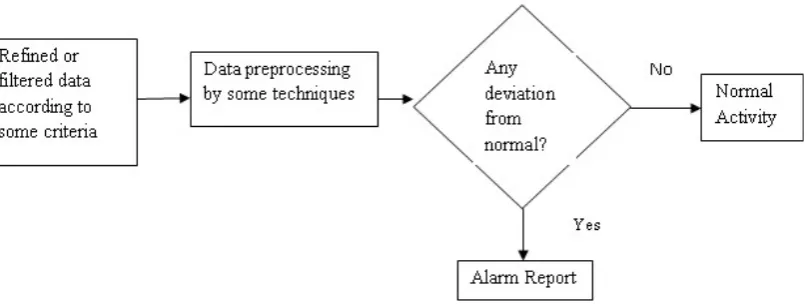
Figure 1. Steps in intrusion detection
Intrusion detection can be classified into two types, namely misuse and anomaly. Misuse detection identifies intruders by comparing them with predefined description of events that denote attack. It matches an event which has already occurred with these predefined events, and any case of deviation is categorized as intrusion. However, this method cannot determine new or unknown attacks. On the other hand, anomaly detection builds models of normal events, and any deviations from these normal events are categorized as attacks.
2.2
Technology Types
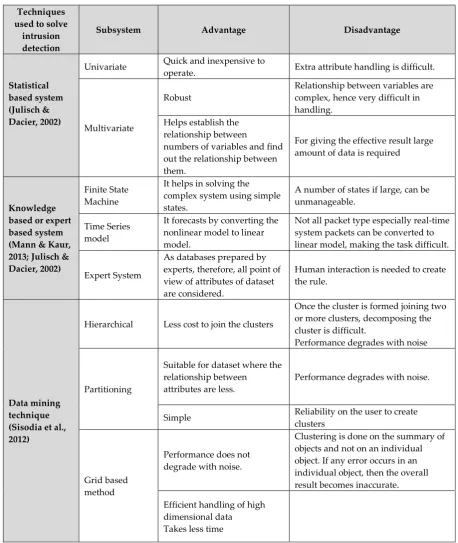
Different technologies are applied to detect intruders, but each has its own limitations as summarized in Table 1.
Techniques used to solve
intrusion detection
Subsystem Advantage Disadvantage
Statistical based system (Julisch & Dacier, 2002)
Univariate Quick and inexpensive to operate. Extra attribute handling is difficult.
Multivariate
Robust Relationship between variables are complex, hence very difficult in handling.
Helps establish the relationship between
numbers of variables and find out the relationship between them.
For giving the effective result large amount of data is required
Knowledge based or expert based system (Mann & Kaur, 2013; Julisch & Dacier, 2002)
Finite State Machine
It helps in solving the complex system using simple states.
A number of states if large, can be unmanageable.
Time Series model
It forecasts by converting the nonlinear model to linear model.
Not all packet type especially real-time system packets can be converted to linear model, making the task difficult.
Expert System
As databases prepared by experts, therefore, all point of view of attributes of dataset are considered.
Human interaction is needed to create the rule.
Data mining technique (Sisodia et al., 2012)
Hierarchical Less cost to join the clusters
Once the cluster is formed joining two or more clusters, decomposing the cluster is difficult.
Performance degrades with noise
Partitioning
Suitable for dataset where the relationship between
attributes are less. Performance degrades with noise.
Simple Reliability on the user to create clusters
Grid based method
Performance does not degrade with noise.
Clustering is done on the summary of objects and not on an individual object. If any error occurs in an individual object, then the overall result becomes inaccurate.
Efficient handling of high dimensional data Takes less time
Table 1. Popular intrusion detection techniques and their advantages and disadvantages
2.3
Detection Methodologies
To overcome problems the limitations of various techniques as mentioned in Table 1 in intrusion detection, it is important to identify the exact requirement of intrusion detection in the current environment characterized by rapidly changing data, large volume and variety. From the extensive study of articles mentioned in Table 2, we found out that the researcher has effectively solved one or two perspectives of the problem. We feel that to keep pace with the changing pattern of attack, solving one or two approaches may not be sufficient. Along with a good detection rate and accuracy, the following requirements (presented in the form of objectives – obj1, obj2 …) have to be addressed for a reliable intrusion detection.
Obj1: Efficient clustering and classification, that is, the machine should not be over-trained and should give unbiased result
The articles mentioned in Table 2 basically classify and cluster the attacks on a particular system. Henceforth, the techniques used by different authors is based on doing feature selection (which select the most relevant attributes contributing to the attack) and then training the system of the possible vulnerabilities. When a new set of attack is fed to the system, they can identify and classify new attack by comparing with the normal data. Any machine learning technique has a tendency of overfitting, which leads to erroneous results on a new data set. Due to overfitting, the technique fails to segregate a normal data from malicious attack and misleads the user by making proper prediction.
Obj2: Less human interaction
Human beings, in the form of system administrator or programmers, are usually involved in intrusion detection for configuring the environmental settings, writing requisite code and analysing the results. However, attacks evolve every fortnight and demand improvement of the human personal in detecting attacks or anomalies. Machine learning techniques make their task easier because of their self-learning capability, if these techniques are trained with certain set of patterns. The similar kind of patterns can be identified by them automatically without requiring human intervention.
Obj3: Low computational overhead and cost
The data required to be handled for intrusion detection is huge. Handling this huge amount of data is a herculean task for any researcher. Optimal selection of criteria which can identify the majority type of attacks is a challenging task for a researcher. Tsang (2005) tried to select an optimal feature subset for dimensionality reduction. Aslahi-Shahri et al (2016) and Chung and Wahid (2012) also tried to reduce the data, so that the execution time is reduced, and space management becomes effective. Hu et al (2014) also tried to reduce the communication cost of handling a distributed database. Most of the studies have strived to achieve this through the feature selection mechanism, otherwise results obtained by analysing un-filtered data by compromising space, time and system performance will have no significance later, especially in case of a real time attack.
Obj4: Identification of the new type of attacks
new types of attack by training the system with some predefined pattern. Hu et al. (2014) tried to identify new types of attack by reducing the communication cost. Stopel et al. (2009) proposed a system to detect new types of computer worms which will give good detection rate and accuracy and can be effectively used for identifying newly discovered attacks.
Obj5: Robustness- Capability of handling large interrelated datasets and real type packets
Dataset used for intrusion detection is huge with interrelated data, especially when we are dealing with real time data. Different researcher like Bankovic et al (2007), Denning and Neumann (1985), and Creech and (2014) has proposed a system for dealing with real time attacks. To classify a real time attack is a challenging task as they are interrelated with respect to time. For example, it is really difficult to accurately structure the behaviour of the system by extracting on an exact point, when two or more consecutive attacks are executed (Chen et al., 2017). Moreover, the user-content analysis demands accurate result within a fraction of second. If the system is not robust to handle this situation, it can be catastrophic and can jeopardize the system.
3
Exploring current state–of-the-art techniques in intrusion
detection
3.1
Research Methodology
Research articles related to several key words of the machine learning techniques and applications in intrusion detection were searched for and selected from Science Direct, Taylor & Francis, Springer, Scopus, Google Scholar, and the Emerald online portals. We obtained more than 400 articles from these sources. The sample size considered was larger than that obtained in earlier studies. Out of these 400, we considered the top 60 articles from reputed journals and analysed them. In all these 60 articles, author(s) obtained effective results by using the techniques such as SVM, ANN and fuzzy by one way or another. So we have included only these 60 articles in our paper and try to summarize the result based on them, so that from it we can give a new direction to the researcher. Surveyed articles on intrusion detection are mentioned in Table 6 in the Appendix.
Sl. No. Article Ref. No. Sl. No. Article Ref No.
1 Abraham (2005) 1 35 Mitrokotsa (2005) 49
2 Aburomman (2016) 2 36 Njogu (2013) 52
3 Aslahi (2015) 5 37 Orfila (2009) 54
4 Ashfaq (2016) 4 38 Ozyer (2007) 55
5 Bankovic (2007) 6 39 Pinzón (2013) 57
6 Chen (2005) 8 40 Powers (2007), 58
7 Chung(2012) 10 41 Peddabachigari (2007) 56
8 Creech (2014) 11 42 Ramasubramanian (2006) 59
9 Damopoulos (2012) 12 43 Revathi (2014) 61
10 De (2015) 13 44 Sangkatsanee (2011) 63
11 Elbasiony (2013) 15 45 Sani (2015) 64
12 Elhag (2014) 16 46 Shamshirband (2014) 66
Table 2: Top works in the field of intrusion detection
4
Data Analysis and Results
The distribution of our studies on intrusion detection in the area of machine learning field from 2002 to 2015 is presented in Figure 2. Figure 2 reveals that the use of machine learning was at its peak in 2007, reduced in 2011, but again gained momentum during 2013-2016.
Figure 2. Showing the distribution of research in the field of intrusion detection
14 Fisch (2010) 18 48 Shon (2007) 68
15 Ganapathy (2012) 20 49 Sindhu (2012), 69
16 Grediaga (2006) 22 50 Stopel (2009) 72
17 Han (2006) 23 51 Subbulakshmi (2010) 73
18 Hoang (2009) 24 52 Tajbakhsh (2009) 74
19 Horng (2011) 25 53 Tong (2009) 75
20 Hu (2014 b) 26 54 Toosi (2007) 76
21 Hu (2008) 27 55 Tsang (2007) 77
22 Jazzar (2008) 28 56 Wang (2010) 78
23 Jiang (2009) 29 57 Yin (2005) 80
24 Jiang (2006) 30 58 Zanero (2005) 81
25 Khan (2006) 33 59 Zhang (2007) 82
26 Kim (2014) 34 60 Zhang (2005) 83
27 Kuang (2014) 35
28 Kumar (2015) 36
29 Kumar (2013) 38
30 Lei (2012) 40
31 Li (2009) 41
32 Liao (2009) 42
33 Luo (2014) 43
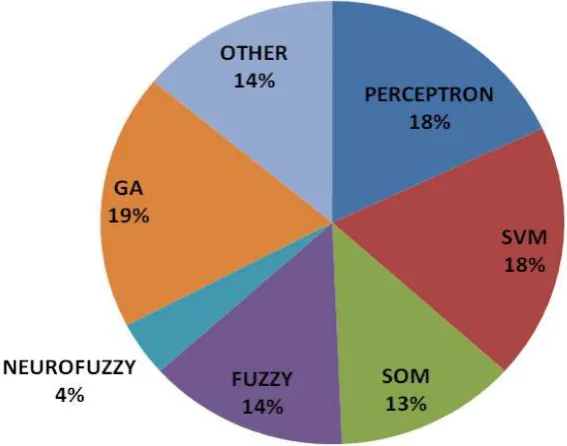
We attempted to identify the most popular techniques through our survey and summarize the result in the form of a pie chart in Figure 3.
Figure 3. Popular machine learning techniques in intrusion detection
Figure 3 reveals that Perceptron (single layer and multi-layer) - 18%, Fuzzy logic - 14%, Genetic Algorithm - 19% and Support Vector Machine - 18% are the most popular techniques for intrusion detection. We now attempt to sub-categorize these techniques with respect to the dataset it was capable of handling effectively. We obtained these data sets from the following sources:
i. data packets from networks
ii. data collected from SNORT or TCPDump, and iii. system call or CPU usage or memory usage. These datasets can be summarized as follows:
• IDS_Bag1: This dataset comprises a collection of system call sequences collected at Massachusetts Institute of Technology Lincoln Lab for one week.
• BSM Dataset: This dataset is collected from the victim’s Solaris machine. BSM audit logs contain system calls produced by the program running on Solaris machine. For each day, a ‘BSM list file’ is prepared and each line of the file indicates a session. The line contains information such as time, service, source IP, and destination IP. A ‘0’ at the end of the line indicates the session is normal and a ‘1’ indicates the session is intrusive.
• DARPA Intrusion Detection Evaluation: DARPA Intrusion Detection Evaluation has two parts, one operates in offline evaluation mode, and another operates in real-time evaluation mode. The offline mode normally operates in the batch mode and uses network traffic and audit logs collected on the simulated network. The system tries to identify attacks in the middle of normal activities. In the online mode, which is the real time mode, these systems are inserted into the AFRL network test bed and are used to identify attack sessions in the middle of normal activities, in real time.
• NSL-KDD: is a dataset which has solved many problems found in KDD dataset, though it is not suitable for real time networks because of lack of public data sets for network-based IDSs. It does not have redundant or duplicate records. The number of training and testing data is reasonable.
Effectiveness of a technique on a particular dataset can only be judged by analysing the correctness or accuracy of the result obtained. Several performance metrics or measures are taken into consideration for this purpose, namely, sensitivity or true positive rate (proportion of correctly classified positive cases), detection rate (ratio of true positive data to the total number of intrusion data present in the system), accuracy (total number of correct predictions) and ROC Curve (graph used to measure the performance of binary classifier).
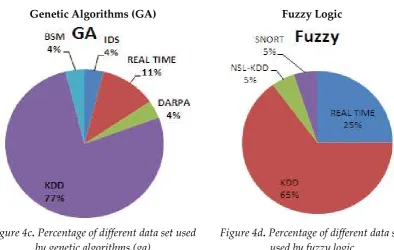
From the 60 articles surveyed, we have found that GA covers 19%, SVM covers 18%, Fuzzy + neuro Fuzzy covers 18%, SOM covers 18% and Perceptron covers 18% of the total articles (Figure 3). We did not include perceptron because its effectiveness in handling real time data, as well as in other types of readily available data, is not promising as in case of other techniques. The performance of numerous techniques using these parameters on the above-mentioned dataset is summarized in Figures 4a-4d.
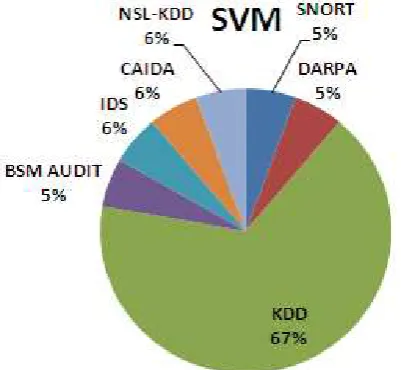
Support Vector Machines (SVM) Self Organizing Maps (SOM)
Figure 4a. Percentage of different data set used
Genetic Algorithms (GA) Fuzzy Logic
Figure 4c. Percentage of different data set used by genetic algorithms (ga)
Figure 4d. Percentage of different data set used by fuzzy logic
We can see from Figure 4 that Fuzzy, Self-organizing maps, and genetic algorithm are used extensively in detecting real time attacks, whereas SVM is used extensively with publicly available dataset (SNORT, CAIDA, etc.). However, among all datasets, most of the experiments were carried out on KDD dataset. To further justify our claim, we take the help of the graphs in Figure 5.
Figure 5. Showing the popular datasets used with various techniques
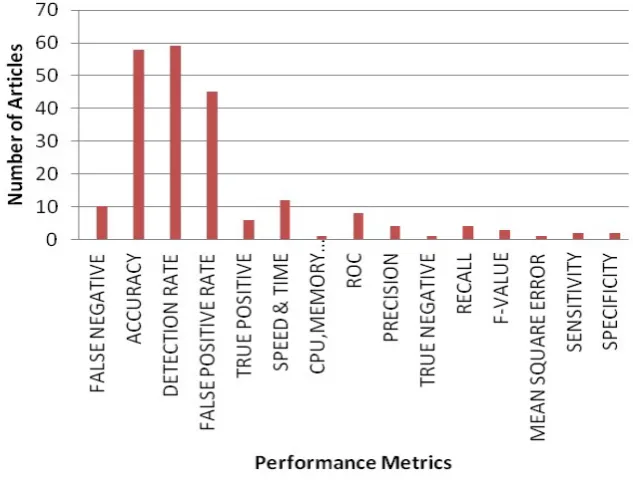
After understanding the popular datasets, we now try to understand the most popular performance metrics used by the above-mentioned techniques, and we obtain Figure 6 which provides the evaluation of the different performance measures of intrusion detection.
Figure 6. Showing the different performance metrics used by our popular techniques
From Figure 6, we can see that accuracy and detection rate and false positive rate are the most popular performance metrics used with machine learning techniques.
5
Discussion
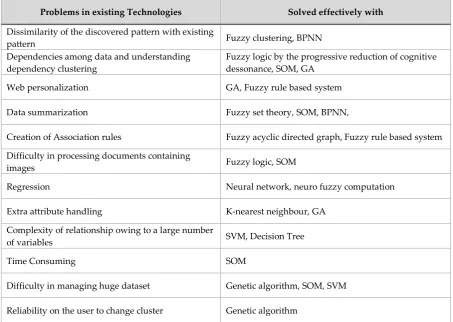
Problems in existing Technologies Solved effectively with
Dissimilarity of the discovered pattern with existing
pattern Fuzzy clustering, BPNN
Dependencies among data and understanding
dependency clustering Fuzzy logic by the progressive reduction of cognitive dessonance, SOM, GA
Web personalization GA, Fuzzy rule based system
Data summarization Fuzzy set theory, SOM, BPNN,
Creation of Association rules Fuzzy acyclic directed graph, Fuzzy rule based system Difficulty in processing documents containing
images Fuzzy logic, SOM
Regression Neural network, neuro fuzzy computation
Extra attribute handling K-nearest neighbour, GA
Complexity of relationship owing to a large number
of variables SVM, Decision Tree
Time Consuming SOM
Difficulty in managing huge dataset Genetic algorithm, SOM, SVM
Reliability on the user to change cluster Genetic algorithm
Table 3: Machine learning techniques and their solution as identified in Table 1
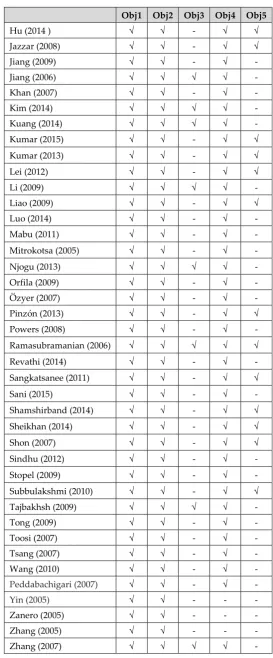
Obj1 Obj2 Obj3 Obj4 Obj5
Abrahim (2007) √ - √ √ √
Aburomman (2016) √ √ - √ -
Ashfaq (2016) √ √ - √ √
Aslahi (2015) √ √ √ √ -
Bankovic (2007) √ √ √ √ -
Chen (2005) √ √ - √ -
Chung (2012) √ √ - √ √
Creech (2014) √ √ - √ √
Damopoulos (2012) √ √ - √ √
De (2015) √ √ - √ √
Elbasiony (2013) √ √ - √ √
Elhag (2014) √ √ - √ √
Feng (2014) √ √ √ √ √
Fisch (2010) √ √ - √ √
Ganapathy (2012) √ √ √ √ √
Grediaga (2006) √ √ - √ √
Han (2005) √ √ √ √ -
Hoang (2009) √ √ √ √ -
Horng (2011) √ √ √ √ -
Obj1 Obj2 Obj3 Obj4 Obj5
Hu (2014 ) √ √ - √ √
Jazzar (2008) √ √ - √ √
Jiang (2009) √ √ - √ -
Jiang (2006) √ √ √ √ -
Khan (2007) √ √ - √ -
Kim (2014) √ √ √ √ -
Kuang (2014) √ √ √ √ -
Kumar (2015) √ √ - √ √
Kumar (2013) √ √ - √ √
Lei (2012) √ √ - √ √
Li (2009) √ √ √ √ -
Liao (2009) √ √ - √ √
Luo (2014) √ √ - √ -
Mabu (2011) √ √ - √ -
Mitrokotsa (2005) √ √ - √ -
Njogu (2013) √ √ √ √ -
Orfila (2009) √ √ - √ -
Özyer (2007) √ √ - √ -
Pinzón (2013) √ √ - √ √
Powers (2008) √ √ - √ -
Ramasubramanian (2006) √ √ √ √ √
Revathi (2014) √ √ - √ -
Sangkatsanee (2011) √ √ - √ √
Sani (2015) √ √ - √ -
Shamshirband (2014) √ √ - √ √
Sheikhan (2014) √ √ - √ √
Shon (2007) √ √ - √ √
Sindhu (2012) √ √ - √ -
Stopel (2009) √ √ - √ -
Subbulakshmi (2010) √ √ - √ √
Tajbakhsh (2009) √ √ √ √ -
Tong (2009) √ √ - √ -
Toosi (2007) √ √ - √ -
Tsang (2007) √ √ - √ -
Wang (2010) √ √ - √ -
Peddabachigari (2007) √ √ - √ -
Yin (2005) √ √ - - -
Zanero (2005) √ √ - - -
Zhang (2005) √ √ - - -
Zhang (2007) √ √ √ √ -
• Obj1: Efficient clustering and classification that is the machine should not be over trained and give bias result.
• Obj2: Less human interaction
• Obj3: Low computational and cost overhead • Obj4: Identification of new type of attack
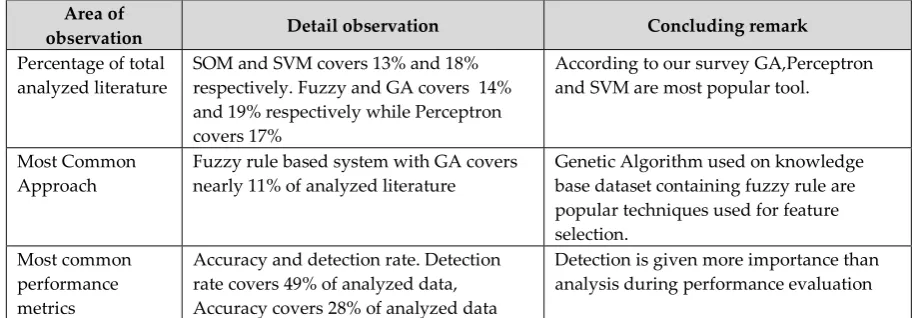
• Obj5: Robustness- Capability of handling large interrelated datasets and real type packets In Table 4 we map our objectives (Obj1 to Obj5) with the existing articles and we conclude that though most of the articles fulfil requirements of Obj1, Obj2 and Obj4, they are unable to meet the requirements of Obj3 and Obj5. As already pointed out that real time data are interrelated and demands special mechanism for segregation and this calls for special attention. We can observe that machine learning techniques with their self-learning or supervisory mode are able to detect most of the attacks and have provided very good detection and accuracy rate. However, these metrics alone do not consider the hostility of the environmental condition. For this reason, certain other metrics such as cost and sensitivity need to be taken into consideration. If the environmental condition is not taken into consideration, detection of new types of attack will be a difficult task. Moreover, reliability on KDD dataset is also not a good solution to judge the efficacy of the system regarding detection of attacks. The KDD dataset contains redundant records and has laid less stress on U2R and R2L attacks. In most of the training experiments, these attacks are likely to be missed, as the number of rows is less as compared to other types of attacks. Moreover, 75% to 78% of the records are duplicate. Based on the training of KDD dataset, the new dynamic real time attack may not be handled by the system. There is still requirement for a unified architecture or technique, which will provide a platform to identify real time attack, and also a standardized solution in handling wired and wireless attack, as shown in Table 5. It is evident from Table 5 that different environmental conditions favour different techniques.
Area of
observation Detail observation Concluding remark
Percentage of total
analyzed literature SOM and SVM covers 13% and 18% respectively. Fuzzy and GA covers 14% and 19% respectively while Perceptron covers 17%
According to our survey GA,Perceptron and SVM are most popular tool.
Most Common
Approach Fuzzy rule based system with GA covers nearly 11% of analyzed literature Genetic Algorithm used on knowledge base dataset containing fuzzy rule are popular techniques used for feature selection.
Most common performance metrics
Accuracy and detection rate. Detection rate covers 49% of analyzed data, Accuracy covers 28% of analyzed data
Detection is given more importance than analysis during performance evaluation
Table 5: Observation based on machine learning techniques approach in intrusion detection
attacks at different levels of architecture of a cloud. Meanwhile as stated by Modi et al (2013), internal attacks are also increasing. There is a lack of suitable mechanism to handle them. Sensor networks on the other hand are more sensitive to attack. Mobile nodes with poor inbuilt security mechanism are easy to capture via wired networks. An attacker can listen to traffic, modify the traffic or can act as one of the legitimate users. As there is no such central architecture which can help in intrusion detection, proper cryptography via public or private key is difficult to implement in mobile adhoc or sensor network. Our article has identified the impact of machine learning on intruded packets and at the same time has identified the issue of security concern that are left to be handled when dealing with real time data, sensitive data in mobile phones and sensor networks.
6
Conclusion
This study provides an insight into the progress of research on intrusion detection based on machine learning techniques. It has discussed the most popular machine learning techniques, and their advantages and disadvantages. As machine learning techniques are extensively used with soft computing techniques we have been analysed them separately. This review graphically provides a clear indication of the overall picture of research in the field of intrusion detection with changing usage pattern, in terms of popular performance metrics and most widely used techniques and datasets. Most of the techniques perform well with KDD. Fuzzy logic techniques perform well with real time datasets. The study also revealed that machine learnings approaches applied to intrusion detection are quite successful except in the matter of fulfilling the objectives of low computational and cost overheads and robustness (capability of handling large interrelated datasets and real type packets). Therefore, the future research may be directed towards those machine learning tools that will achieve both of these objectives (i.e. low computational cost and robustness). More obvious gap is the labelled data application like KDD dataset on which majority of the techniques are applied and it would be more worthy if intrusion data is collected and labelled partially. As the machine learning techniques require training and testing data so they can be trained using partial labelled dataset for the known attack and tested on unknown data for measuring performance. Therefore, the promising techniques may be further tested on these new data set for developing effective and efficient intrusion detection system for breakthrough performance.
Moreover since majority of the results are based on KDD dataset, approximation of the actual performance of the intrusion detection system on real time data is difficult to evaluate. The effectiveness of these techniques on real time data and effective performance metrics used for their evaluation is an open area for the future researchers.
References
Aburomman, A. A., & Ibne Reaz, M. Bin. (2016). A novel SVM-kNN-PSO ensemble method for intrusion detection system. Applied Soft Computing Journal, 38, 360–372. https://doi.org/10.1016/j.asoc.2015.10.011
Arun Raj Kumar, P., & Selvakumar, S. (2013). Detection of distributed denial of service attacks using an ensemble of adaptive and hybrid neuro-fuzzy systems. Computer Communications, 36(3), 303–319. https://doi.org/10.1016/j.comcom.2012.09.010
Ashfaq, R. A. R., Wang, X. Z., Huang, J. Z., Abbas, H., & He, Y. L. (2017). Fuzziness based semi-supervised learning approach for intrusion detection system. Information Sciences, 378, 484–497. https://doi.org/10.1016/j.ins.2016.04.019
Aslahi-Shahri, B. M., Rahmani, R., Chizari, M., Maralani, A., Eslami, M., Golkar, M. J., & Ebrahimi, A. (2016). A hybrid method consisting of GA
and SVM for intrusion detection system. Neural Computing and
Applications, 27(6), 1669–1676. https://doi.org/10.1007/s00521-015-1964-2 Banković, Z., Stepanović, D., Bojanić, S., & Nieto-Taladriz, O. (2007). Improving network
security using genetic algorithm approach. Computers and Electrical Engineering, 33(5–6), 438–451. https://doi.org/10.1016/j.compeleceng.2007.05.010
Chen, C., Ghassami, A., Mohan, S., N. K. (2017), A Reconnaissance Attack Mechanism for Fixed-Priority Real-Time Systems. Arxiv.Org.
Chung, Y. Y., & Wahid, N. (2012). A hybrid network intrusion detection system using simplified swarm optimization (SSO). Applied Soft Computing, 12(9), 3014–3022. https://doi.org/10.1016/j.asoc.2012.04.020
Creech, G., & Hu, J. (2014). A semantic approach to host-based intrusion detection systems using contiguous and discontiguous system call patterns. IEEE Transactions on Computers, 63(4), 807–819. https://doi.org/10.1109/TC.2013.13
Damopoulos, D., Menesidou, S. A., Kambourakis, G., Papadaki, M., Clarke, N., & Gritzalis, S. (2012). Evaluation of anomaly-based IDS for mobile devices using machine learning
classifiers. Security and Communication Networks, 5(1), 3–14.
https://doi.org/10.1002/sec.341
De la Hoz, E., De La Hoz, E., Ortiz, A., Ortega, J., & Prieto, B. (2015). PCA filtering and probabilistic SOM for network intrusion detection. Neurocomputing, 164, 71–81. https://doi.org/10.1016/j.neucom.2014.09.083
Denning, D. & Neumann, P. (1985). Requirements and model for IDES—a real-time intrusion detection expert system. Document A005, SRI International, California. 1-74. Retrieved from faculty.nps.edu/dedennin/publications/IDESReportSRI1985.pdf (accessed on 31-05-2018)
Elbasiony, R. M., Sallam, E. A., Eltobely, T. E., & Fahmy, M. M. (2013). A hybrid network intrusion detection framework based on random forests and weighted k-means. Ain Shams Engineering Journal, 4(4), 753–762. https://doi.org/10.1016/j.asej.2013.01.003
Elhag, S., Fernández, A., Bawakid, A., Alshomrani, S., & Herrera, F. (2015). On the combination of genetic fuzzy systems and pairwise learning for improving detection rates on Intrusion Detection Systems. Expert Systems with Applications, 42(1), 193–202. https://doi.org/10.1016/j.eswa.2014.08.002
Fisch, D., Hofmann, A., & Sick, B. (2010). On the versatility of radial basis function neural networks: A case study in the field of intrusion detection. Information Sciences, 180(12), 2421–2439. https://doi.org/10.1016/j.ins.2010.02.023
Fossaceca, J. M., Mazzuchi, T. A., & Sarkani, S. (2015). MARK-ELM: Application of a novel Multiple Kernel Learning framework for improving the robustness of Network Intrusion Detection. Expert Systems with Applications, 42(8), 4062-4080.
Ganapathy, S., Kulothungan, K., Yogesh, P., & Kannan, A. (2012). A novel weighted fuzzy C -means clustering based on immune genetic algorithm for intrusion detection. In Procedia Engineering (Vol. 38, pp. 1750–1757). https://doi.org/10.1016/j.proeng.2012.06.213
Gao, Z., Member, S., Cecati, C., Ieee, F., & Ding, S. X. (2015). A Survey of Fault Diagnosis and Fault - Tolerant Techniques Part II : Fault Diagnosis with Knowledge - Based and Hybrid
/ Active Approaches. IEEE Transactions on Industrial Electronics, 62(6), 3768–3774. https://doi.org/10.1109/TIE.2015.2419013
Grediaga, Á., Ibarra, F., García, F., Ledesma, B., & Brotóns, F. (2006). Application of Neural Networks in Network Control and Information Security. In Advances in Neural Networks ISNN 2006 (pp. 208–213). https://doi.org/10.1007/11760191_31
Han, S.-J., & Cho, S.-B. (2006). Evolutionary neural networks for anomaly detection based on the behavior of a program. IEEE Transactions on Systems, Man, and Cybernetics. Part B, Cybernetics : A Publication of the IEEE Systems, Man, and Cybernetics Society, 36(3), 559–570. https://doi.org/10.1109/TSMCB.2005.860136
Hoang, X. D., Hu, J., & Bertok, P. (2009). A program-based anomaly intrusion detection scheme using multiple detection engines and fuzzy inference. Journal of Network and Computer Applications, 32(6), 1219–1228. https://doi.org/10.1016/j.jnca.2009.05.004
Horng, S. J., Su, M. Y., Chen, Y. H., Kao, T. W., Chen, R. J., Lai, J. L., & Perkasa, C. D. (2011). A novel intrusion detection system based on hierarchical clustering and support vector machines. Expert Systems with Applications, 38(1), 306–313. https://doi.org/10.1016/j.eswa.2010.06.066
Hu, W., Gao, J., Wang, Y., Wu, O., & Maybank, S. (2014). Online ada boost-based parameterized methods for dynamic distributed network intrusion detection. IEEE Transactions on Cybernetics, 44(1), 66–82. https://doi.org/10.1109/TCYB.2013.2247592 Hu, W., Hu, W., & Maybank, S. (2008). AdaBoost-based algorithm for network intrusion
detection. IEEE Transactions on Systems, Man, and Cybernetics, 38(2), 577–583. https://doi.org/10.1109/TSMCB.2007.914695
Jazzar, M., & Jantan, A. (2008). An approach for anomaly intrusion detection based on causal knowledge-driven diagnosis and direction. Studies in Computational Intelligence, 149, 39– 48. https://doi.org/10.1007/978-3-540-70560-4_4
Jiang, H., & Ruan, J. (2009). The application of genetic neural network in network intrusion detection. Journal of Computers, 4(12), 1223–1230. https://doi.org/10.4304/jcp.4.12.1223-1230
Julisch, K., & Dacier, M. (2002). Mining intrusion detection alarms for actionable knowledge. In Proceedings of the eighth ACM SIGKDD international conference on Knowledge discovery and data mining - KDD ’02 (p. 366). https://doi.org/10.1145/775047.775101
Kabiri, P., & Ghorbani, A. A. (2005). Research on intrusion detection and response: A survey. International Journal of Network Security, 1(2), 84–102. https://doi.org/10.1.1.129.698 Khan, L., Awad, M., & Thuraisingham, B. (2007). A new intrusion detection system using
support vector machines and hierarchical clustering. The VLDB Journal, 16(4), 507–521. https://doi.org/10.1007/s00778-006-0002-5
Kim, G., Lee, S., & Kim, S. (2014). A novel hybrid intrusion detection method integrating anomaly detection with misuse detection. Expert Systems with Applications, 41(4 PART 2), 1690–1700. https://doi.org/10.1016/j.eswa.2013.08.066
Kuang, F., Xu, W., & Zhang, S. (2014). A novel hybrid KPCA and SVM with GA model for intrusion detection. Applied Soft Computing Journal, 18, 178–184. https://doi.org/10.1016/j.asoc.2014.01.028
Kumar, G., & Kumar, K. (2015). A Multi-objective Genetic Algorithm Based Approach for Effective Intrusion Detection Using Neural Networks. In Intelligent Methods for Cyber Warfare (pp. 173–200). https://doi.org/10.1007/978-3-319-08624-8_8
Kumar, G., Kumar, K., & Sachdeva, M. (2010). The use of artificial intelligence based techniques for intrusion detection: A review. Artificial Intelligence Review, 34(4), 369–387. https://doi.org/10.1007/s10462-010-9179-5
Lee, W., Stolfo, S., & Mok, K. (2000). Adaptive Intrusion Detection: A Data Mining Approach. Artificial Intelligence Review (Vol. 14). https://doi.org/10.1023/A:1006624031083
Lei, J. Z., & Ghorbani, A. A. (2012). Improved competitive learning neural networks for network intrusion and fraud detection. Neurocomputing, 75, 135–145. https://doi.org/10.1016/j.neucom.2011.02.021
Li, Y., Wang, J. L., Tian, Z. H., Lu, T. B., & Young, C. (2009). Building lightweight intrusion detection system using wrapper-based feature selection mechanisms. Computers and Security, 28(6), 466–475. https://doi.org/10.1016/j.cose.2009.01.001
Liao, N., Tian, S., & Wang, T. (2009). Network forensics based on fuzzy logic
and expert system. Computer Communications, 32(17), 1881–1892.
https://doi.org/10.1016/j.comcom.2009.07.013
Luo, B., & Xia, J. (2014). A novel intrusion detection system based on feature generation with visualization strategy. Expert Systems with Applications, 41(9), 4139–4147. https://doi.org/10.1016/j.eswa.2013.12.048
Mabu, S., Chen, C., Lu, N., Shimada, K., & Hirasawa, K. (2011). An Intrusion-Detection Model Based on Fuzzy Class-Association-Rule Mining Using Genetic Network Programming. IEEE Transactions on Systems, Man, and Cybernetics, Part C: Applications and Reviews, 41(1), 130–139. https://doi.org/10.1109/TSMCC.2010.2050685
http://www.in.techradar.com/news/software/security-software/The-top-10-data-breaches-of-the-past-12-months/articleshow/38472866.(Accessed on 12-05-2016).
McGregor, J. (2014). The Top 5 Most Brutal Cyber Attacks Of 2014 So Far, http://www.forbes.com/sites/jaymcgregor/2014/07/28/the-top-5-most-brutal-cyber-attacks-of-2014-so-far/#5722d80721a6.(Accessed on 12-05-2016).
Meyer, C., (2017). Data Theft, http://www.infosecwriters.com/Papers/CMeyer_DataTheft.pdf (accessed on 27-03-2018)
Mitrokotsa, A., & Douligeris, C. (2005). Detecting denial of service attacks using emergent self-organizing maps. Proceedings of the Fifth IEEE International Symposium on Signal Processing and Information Technology, 2005., 375–380. https://doi.org/10.1109/ISSPIT.2005.1577126 Modi, C., Patel, D., Borisaniya, B., Patel, H., Patel, A., & Rajarajan, M. (2013). A survey of
intrusion detection techniques in Cloud. Journal of Network and Computer Applications. https://doi.org/10.1016/j.jnca.2012.05.003
Mukkamala, S., Sung, A. H., & Abraham, A. (2005). Intrusion detection using an ensemble of intelligent paradigms. Journal of Network and Computer Applications, 28(2), 167–182. https://doi.org/10.1016/j.jnca.2004.01.003
Njogu, H. W., Jiawei, L., & Kiere, J. N. (2013). Network specific vulnerability based alert reduction approach. Security and Communication Networks, 6(1), 15–27. https://doi.org/10.1002/sec.520
Orfila, A., Estevez-Tapiador, J. M., & Ribagorda, A. (2009). Evolving high-speed, easy-to-understand network intrusion detection rules with genetic programming. In Lecture Notes in Computer Science (including subseries Lecture Notes in Artificial Intelligence and Lecture Notes in Bioinformatics) (Vol. 5484 LNCS, pp. 93–98). https://doi.org/10.1007/978-3-642-01129-0_11
Özyer, T., Alhajj, R., & Barker, K. (2007). Intrusion detection by integrating boosting genetic fuzzy classifier and data mining criteria for rule pre-screening. Journal of Network and Computer Applications, 30(1), 99–113. https://doi.org/10.1016/j.jnca.2005.06.002
Peddabachigari, S., Abraham, A., Grosan, C., & Thomas, J. (2007). Modeling intrusion detection system using hybrid intelligent systems. Journal of Network and Computer Applications, 30(1), 114–132. https://doi.org/10.1016/j.jnca.2005.06.003
Pinzón, C. I., De Paz, J. F., Herrero, Á., Corchado, E., Bajo, J., & Corchado, J. M. (2013). IdMAS-SQL: Intrusion Detection Based on MAS to Detect and Block SQL injection through data mining. Information Sciences, 231, 15–31. https://doi.org/10.1016/j.ins.2011.06.020
Powers, S. T., & He, J. (2008). A hybrid artificial immune system and Self Organising Map for network intrusion detection. Information Sciences, 178(15), 3024–3042. https://doi.org/10.1016/j.ins.2007.11.028
Rathore, M. M., Ahmad, A., & Paul, A. (2016). Real time intrusion detection system for ultra-high-speed big data environments. Journal of Supercomputing, 72(9), 3489–3510. https://doi.org/10.1007/s11227-015-1615-5
Revathi, S., & Malathi, A. (2014). Multi-tier framework using sugeno fuzzy inference system with swarm intelligence techniques for intrusion detection. Indian Journal of Science and Technology, 7(9), 1437–1443.
Sabhnani, M., Serpen, G., & More, K. K. (2003). Application of Machine Learning Algorithms to KDD Intrusion Detection Dataset within Misuse Detection Context. Proceedings of International Conference on Machine Learning: Models, Technologies, and Applications (MLMTA), 209–215. https://doi.org/citeulike-article-id:9827151
Sangkatsanee, P., Wattanapongsakorn, N., & Charnsripinyo, C. (2011). Practical real-time intrusion detection using machine learning approaches. Computer Communications, 34(18), 2227–2235. https://doi.org/10.1016/j.comcom.2011.07.001
Sani, R. A., & Ghasemi, A. (2015). Learning a new distance metric to improve an SVM-clustering based intrusion detection system. In Proceedings of the International Symposium on Artificial Intelligence and Signal Processing, AISP 2015 (pp. 284–289). https://doi.org/10.1109/AISP.2015.7123497
Seals, T. (2015). DDoS attacks more than double in 12 months. Infosecurity. Retrieved from http://www.infosecurity-magazine.com/news/ddos-attacks-more-than-double-in/ (accessed on 28-03-2018)
Shamshirband, S., Patel, A., Anuar, N. B., Kiah, M. L. M., & Abraham, A. (2014). Cooperative game theoretic approach using fuzzy Q-learning for detecting and preventing intrusions in wireless sensor networks. Engineering Applications of Artificial Intelligence, 32, 228–241. https://doi.org/10.1016/j.engappai.2014.02.001
Sheikhan, M., & Jadidi, Z. (2014). Flow-based anomaly detection in high-speed links using modified GSA-optimized neural network. Neural Computing and Applications, 24(3–4), 599–611. https://doi.org/10.1007/s00521-012-1263-0
Shon, T., & Moon, J. (2007). A hybrid machine learning approach to network
anomaly detection. Information Sciences, 177(18), 3799–3821.
https://doi.org/10.1016/j.ins.2007.03.025
Singh, K., Guntuku, S. C., Thakur, A., & Hota, C. (2014). Big Data Analytics framework for Peer-to-Peer Botnet detection using Random Forests. Information Sciences, 278, 488–497. https://doi.org/10.1016/j.ins.2014.03.066
Sisodia, D., Singh, L., Sisodia, S., & Saxena, K. (2012). Clustering Techniques: A Brief Survey of Different Clustering Algorithms. International Journal of Latest Trends in Engineering and Technology (IJLTET), 1(3), 82–87.
Sivatha Sindhu, S. S., Geetha, S., & Kannan, A. (2012). Decision tree based light weight intrusion detection using a wrapper approach. Expert Systems with Applications, 39(1), 129–141. https://doi.org/10.1016/j.eswa.2011.06.013
Subbulakshmi, T., Mercy Shalinie, S., Suneel Reddy, C., & Ramamoorthi, A. (2010). Detection and classification of DDoS attacks using fuzzy inference system. In Communications in Computer and Information Science (Vol. 89 CCIS, pp. 242–252). https://doi.org/10.1007/978-3-642-14478-3_25
Tajbakhsh, A., Rahmati, M., & Mirzaei, A. (2009). Intrusion detection using fuzzy association rules. Applied Soft Computing, 9(2), 462–469. https://doi.org/10.1016/j.asoc.2008.06.001 Toosi, A. N., & Kahani, M. (2007). A new approach to intrusion detection based on an
evolutionary soft computing model using neuro-fuzzy classifiers. Computer Communications, 30(10), 2201–2212. https://doi.org/10.1016/j.comcom.2007.05.002
Tsang, C. H., Kwong, S., & Wang, H. (2007). Genetic-fuzzy rule mining approach and evaluation of feature selection techniques for anomaly intrusion detection. Pattern Recognition, 40(9), 2373–2391. https://doi.org/10.1016/j.patcog.2006.12.009
Wang, G., Hao, J., Ma, J., & Huang, L. (2010). A new approach to intrusion detection using Artificial Neural Networks and fuzzy clustering. Expert Systems with Applications, 37(9), 6225–6232. https://doi.org/10.1016/j.eswa.2010.02.102
Wu, S. X., & Banzhaf, W. (2010). The use of computational intelligence in intrusion detection systems: A review. Applied Soft Computing Journal, 10, 1–35. https://doi.org/10.1016/j.asoc.2009.06.019
Yin, C., Tian, S., Huang, H., & He, J. (2005). Applying Genetic Programming to Evolve Learned Rules for Network Anomaly Detection. Advances in Natural Computation, First International Conference, ICNC 2005, Proceedings, Part III, 3612, 323–331. https://doi.org/doi:10.1007/11539902_38
Zanero, S. (2005). Analyzing TCP traffic patterns using Self Organizing Maps. Image Analysis and Processing - Iciap 2005, Proceedings, 3617, 83–90. https://doi.org/10.1007/11553595_10 Zhang, C., Jiang, J., & Kamel, M. (2005). Intrusion detection using hierarchical neural networks.
Pattern Recognition Letters, 26(6), 779–791. https://doi.org/10.1016/j.patrec.2004.09.045 Zhang, J.-R., Zhang, J., Lok, T.-M., & Lyu, M. R. (2007). A hybrid particle
Appendix
Refer ence.
No.
Reference details (selected sixty articles studied for meta-analysis in the research work)
1
Abraham A. (2005). Evolutionary Computation in Intelligent Network Management. In: Ghosh A., Jain L.C. (eds) Evolutionary Computation in Data Mining. Studies in Fuzziness and Soft Computing, vol 163. Springer, Berlin, Heidelberg, https://doi.org/10.1007/3-540-32358-9_9
2 Aburomman, A. A., & Ibne Reaz, M. Bin. (2016). A novel SVM-kNN-PSO ensemble method for intrusion detection system. Applied Soft Computing Journal, 38, 360–372. https://doi.org/10.1016/j.asoc.2015.10.011
3 Ashfaq, R. A. R., Wang, X. Z., Huang, J. Z., Abbas, H., & He, Y. L. (2017). Fuzziness based semi-supervised learning approach for intrusion detection system. Information Sciences,
4
Aslahi-Shahri, B. M., Rahmani, R., Chizari, M., Maralani, A., Eslami, M., Golkar, M. J., & Ebrahimi, A. (2016). A hybrid method consisting of GA and SVM for intrusion detection system. Neural Computing and Applications, 27(6), 1669–1676. https://doi.org/10.1007/s00521-015-1964-2
5 Banković, Z., Stepanović, D., Bojanić, S., & Nieto-Taladriz, O. (2007). Improving network security using genetic algorithm approach. Computers and Electrical Engineering, 33(5–6), 438–451. https://doi.org/10.1016/j.compeleceng.2007.05.010
6
Chen, W. H., Hsu, S. H., & Shen, H. P. (2005). Application of SVM and ANN for intrusion detection. Computers & Operations Research, 32(10), 2617-2634. doi:10.1016/j.cor.2004.03.019.
7 Chung, Y. Y., & Wahid, N. (2012). A hybrid network intrusion detection system using simplified swarm optimization (SSO). Applied Soft Computing, 12(9), 3014– 3022. https://doi.org/10.1016/j.asoc.2012.04.020
8
Creech, G., & Hu, J. (2014). A semantic approach to host-based intrusion detection systems using contiguousand discontiguous system call patterns. IEEE Transactions on Computers, 63(4), 807–819. https://doi.org/10.1109/TC.2013.13
9
Damopoulos, D., Menesidou, S. A., Kambourakis, G., Papadaki, M., Clarke, N., & Gritzalis, S. (2012). Evaluation of anomaly-based IDS for mobile devices using machine learning classifiers. Security and Communication Networks, 5(1), 3–14. https://doi.org/10.1002/sec.341
10 De la Hoz, E., De La Hoz, E., Ortiz, A., Ortega, J., & Prieto, B. (2015). PCA filtering and probabilistic SOM for network intrusion detection. Neurocomputing, 164, 71–81. https://doi.org/10.1016/j.neucom.2014.09.083
11
Elbasiony, R. M., Sallam, E. A., Eltobely, T. E., & Fahmy, M. M. (2013). A hybrid network intrusion detection framework based on random forests and weighted
k-means. Ain Shams Engineering Journal, 4(4), 753–762.
https://doi.org/10.1016/j.asej.2013.01.003
12
Refer ence.
No.
Reference details (selected sixty articles studied for meta-analysis in the research work)
13
Feng, W., Zhang, Q., Hu, G., & Huang, J. X. (2014). Mining network data for intrusion detection through combining SVMs with ant colony
networks. Future Generation Computer Systems, 37, 127–140.
https://doi.org/10.1016/j.future.2013.06.027
14 Fisch, D., Hofmann, A., & Sick, B. (2010). On the versatility of radial basis function neural networks: A case study in the field of intrusion detection. Information Sciences, 180(12), 2421–2439. https://doi.org/10.1016/j.ins.2010.02.023
15
Ganapathy, S., Kulothungan, K., Yogesh, P., & Kannan, A. (2012). A novel weighted fuzzy C -means clustering based on immune genetic algorithm for intrusion
detection. In Procedia Engineering (Vol. 38, pp. 1750–1757).
https://doi.org/10.1016/j.proeng.2012.06.213
16 Grediaga, Á., Ibarra, F., García, F., Ledesma, B., & Brotóns, F. (2006). Application of Neural Networks in Network Control and Information Security. In Advances in Neural Networks ISNN 2006 (pp. 208–213). https://doi.org/10.1007/11760191_31
17
Han, S.-J., & Cho, S.-B. (2006). Evolutionary neural networks for anomaly detection based on the behavior of a program. IEEE Transactions on Systems, Man, and Cybernetics. Part B, Cybernetics : A Publication of the IEEE Systems, Man, and Cybernetics Society, 36(3), 559–570. https://doi.org/10.1109/TSMCB.2005.860136
18
Hoang, X. D., Hu, J., & Bertok, P. (2009). A program-based anomaly intrusion detection scheme using multiple detection engines and fuzzy inference. Journal of Network and Computer Applications, 32(6), 1219–1228. https://doi.org/10.1016/j.jnca.2009.05.004
19
Horng, S. J., Su, M. Y., Chen, Y. H., Kao, T. W., Chen, R. J., Lai, J. L., & Perkasa, C. D. (2011). A novel intrusion detection system based on hierarchical clustering and support vector machines. Expert Systems with Applications, 38(1), 306–313. https://doi.org/10.1016/j.eswa.2010.06.066
20 Hu, W., Hu, W., & Maybank, S. (2008). AdaBoost-based algorithm for network intrusion detection. IEEE Transactions on Systems, Man, and Cybernetics, 38(2), 577– 583. https://doi.org/10.1109/TSMCB.2007.914695
21 Hu, W., Hu, W., & Maybank, S. (2008). AdaBoost-based algorithm for network intrusion detection. IEEE Transactions on Systems, Man, and Cybernetics, 38(2), 577– 583. https://doi.org/10.1109/TSMCB.2007.914695
22 Jazzar, M., & Jantan, A. (2008). An approach for anomaly intrusion detection based on causal knowledge-driven diagnosis and direction. Studies in Computational Intelligence, 149, 39–48. https://doi.org/10.1007/978-3-540-70560-4_4
23
Jiang, H., & Ruan, J. (2009). The application of genetic neural network in network intrusion detection. Journal of Computers, 4(12), 1223–1230. https://doi.org/10.4304/jcp.4.12.1223-1230
Refer ence.
No.
Reference details (selected sixty articles studied for meta-analysis in the research work)
25 Khan, L., Awad, M., & Thuraisingham, B. (2007). A new intrusion detection system using support vector machines and hierarchical clustering. The VLDB Journal, 16(4), 507–521. https://doi.org/10.1007/s00778-006-0002-5
26
Kim, G., Lee, S., & Kim, S. (2014). A novel hybrid intrusion detection method integrating anomaly detection with misuse detection. Expert Systems with Applications, 41(4 PART 2), 1690–1700. https://doi.org/10.1016/j.eswa.2013.08.066
27 Kuang, F., Xu, W., & Zhang, S. (2014). A novel hybrid KPCA and SVM with GA model for intrusion detection. Applied Soft Computing Journal, 18, 178–184. https://doi.org/10.1016/j.asoc.2014.01.028
28
Kumar, G., & Kumar, K. (2015). A Multi-objective Genetic Algorithm Based Approach for Effective Intrusion Detection Using Neural Networks. In Intelligent Methods for Cyber Warfare (pp. 173–200). https://doi.org/10.1007/978-3-319-08624-8_8
29
Arun Raj Kumar, P., & Selvakumar, S. (2013). Detection of distributed denial of service attacks using an ensemble of adaptive and hybrid neuro-fuzzy systems. Computer Communications, 36(3), 303–319. https://doi.org/10.1016/j.comcom.2012.09.010
30 Lei, J. Z., & Ghorbani, A. A. (2012). Improved competitive learning neural networks for network intrusion and fraud detection. Neurocomputing, 75, 135–145. https://doi.org/10.1016/j.neucom.2011.02.021
31 Li, Y., Wang, J. L., Tian, Z. H., Lu, T. B., & Young, C. (2009). Building lightweight intrusion detection system using wrapper-based feature selection mechanisms. Computers and Security, 28(6), 466–475. https://doi.org/10.1016/j.cose.2009.01.001
32 Liao, N., Tian, S., & Wang, T. (2009). Network forensics based on fuzzy logic and expert system. Computer Communications, 32(17), 1881–1892. https://doi.org/10.1016/j.comcom.2009.07.013
33
Luo, B., & Xia, J. (2014). A novel intrusion detection system based on feature generation with visualization strategy. Expert Systems with Applications, 41(9), 4139– 4147. https://doi.org/10.1016/j.eswa.2013.12.048
34
Mabu, S., Chen, C., Lu, N., Shimada, K., & Hirasawa, K. (2011). An Intrusion-Detection Model Based on Fuzzy Class-Association-Rule Mining Using Genetic Network Programming. IEEE Transactions on Systems, Man, and Cybernetics, Part C: Applications and Reviews, 41(1), 130–139. https://doi.org/10.1109/TSMCC.2010.2050685
35
Mitrokotsa, A., & Douligeris, C. (2005). Detecting denial of service attacks using emergent self-organizing maps. Proceedings of the Fifth IEEE International Symposium on Signal Processing and Information Technology, 2005., 375–380. https://doi.org/10.1109/ISSPIT.2005.1577126
36
Refer ence.
No.
Reference details (selected sixty articles studied for meta-analysis in the research work)
37
Orfila, A., Estevez-Tapiador, J. M., & Ribagorda, A. (2009). Evolving high-speed, easy-to-understand network intrusion detection rules with genetic programming. In Lecture Notes in Computer Science (including subseries Lecture Notes in Artificial Intelligence and Lecture Notes in Bioinformatics) (Vol. 5484 LNCS, pp. 93–98). https://doi.org/10.1007/978-3-642-01129-0_11
38
Özyer, T., Alhajj, R., & Barker, K. (2007). Intrusion detection by integrating boosting genetic fuzzy classifier and data mining criteria for rule pre-screening. Journal of Network and Computer Applications, 30(1), 99–113. https://doi.org/10.1016/j.jnca.2005.06.002
39
Pinzón, C. I., De Paz, J. F., Herrero, Á., Corchado, E., Bajo, J., & Corchado, J. M. (2013). IdMAS-SQL: Intrusion Detection Based on MAS to Detect and Block SQL injection through data mining. Information Sciences, 231, 15–31. https://doi.org/10.1016/j.ins.2011.06.020
40
Powers, S. T., & He, J. (2008). A hybrid artificial immune system and Self Organising Map for network intrusion detection. Information Sciences, 178(15), 3024–3042. https://doi.org/10.1016/j.ins.2007.11.028
41 Peddabachigari, S., Abraham, A., Grosan, C., & Thomas, J. (2007). Modeling intrusion detection system using hybrid intelligent systems. Journal of Network and Computer Applications, 30(1), 114–132. https://doi.org/10.1016/j.jnca.2005.06.003
42
Ramasubramanian, P., & Kannan, A. (2006). A genetic-algorithm based neural network short-term forecasting framework for database intrusion prediction system. Soft Computing, 10(8), 699–714. https://doi.org/10.1007/s00500-005-0513-9
43 Revathi, S., & Malathi, A. (2014). Multi-tier framework using sugeno fuzzy inference system with swarm intelligence techniques for intrusion detection. Indian Journal of Science and Technology, 7(9), 1437–1443.
44
Sangkatsanee, P., Wattanapongsakorn, N., & Charnsripinyo, C. (2011). Practical real-time intrusion detection using machine learning approaches. Computer Communications, 34(18), 2227–2235. https://doi.org/10.1016/j.comcom.2011.07.001
45
Sani, R. A., & Ghasemi, A. (2015). Learning a new distance metric to improve an SVM-clustering based intrusion detection system. In Proceedings of the International Symposium on Artificial Intelligence and Signal Processing, AISP 2015 (pp. 284–289). https://doi.org/10.1109/AISP.2015.7123497
46
Shamshirband, S., Patel, A., Anuar, N. B., Kiah, M. L. M., & Abraham, A. (2014). Cooperative game theoretic approach using fuzzy Q-learning for detecting and preventing intrusions in wireless sensor networks. Engineering Applications of Artificial Intelligence, 32, 228–241. https://doi.org/10.1016/j.engappai.2014.02.001
47 Sheikhan, M., & Jadidi, Z. (2014). Flow-based anomaly detection in high-speed links using modified GSA-optimized neural network. Neural Computing and Applications, 24(3–4), 599–611. https://doi.org/10.1007/s00521-012-1263-0
Refer ence.
No.
Reference details (selected sixty articles studied for meta-analysis in the research work)
49 Sivatha Sindhu, S. S., Geetha, S., & Kannan, A. (2012). Decision tree based light weight intrusion detection using a wrapper approach. Expert Systems with Applications, 39(1), 129–141. https://doi.org/10.1016/j.eswa.2011.06.013
50
Stopel, D., Moskovitch, R., Boger, Z., Shahar, Y., & Elovici, Y. (2009). Using artificial neural networks to detect unknown computer worms. Neural Computing and Applications, 18(7), 663–674. https://doi.org/10.1007/s00521-009-0238-2
51
Subbulakshmi, T., Mercy Shalinie, S., Suneel Reddy, C., & Ramamoorthi, A. (2010). Detection and classification of DDoS attacks using fuzzy inference system. In Communications in Computer and Information Science (Vol. 89 CCIS, pp. 242–252). https://doi.org/10.1007/978-3-642-14478-3_25
52 Tajbakhsh, A., Rahmati, M., & Mirzaei, A. (2009). Intrusion detection using fuzzy association rules. Applied Soft Computing, 9(2), 462–469. https://doi.org/10.1016/j.asoc.2008.06.001
53 Tong, X., Wang, Z., & Yu, H. (2009). A research using hybrid RBF/Elman neural networks for intrusion detection system secure model. Computer Physics Communications, 180(10), 1795-1801.doi:10.1016/j.cpc.2009.05.004.
54 Toosi, A. N., & Kahani, M. (2007). A new approach to intrusion detection based on an evolutionary soft computing model using neuro-fuzzy classifiers. Computer Communications, 30(10), 2201–2212. https://doi.org/10.1016/j.comcom.2007.05.002
55 Tsang, C. H., Kwong, S., & Wang, H. (2007). Genetic-fuzzy rule mining approach and evaluation of feature selection techniques for anomaly intrusion detection. Pattern Recognition, 40(9), 2373–2391. https://doi.org/10.1016/j.patcog.2006.12.009
56 Wang, G., Hao, J., Ma, J., & Huang, L. (2010). A new approach to intrusion detection using Artificial Neural Networks and fuzzy clustering. Expert Systems with Applications, 37(9), 6225–6232. https://doi.org/10.1016/j.eswa.2010.02.102
57
Yin, C., Tian, S., Huang, H., & He, J. (2005). Applying Genetic Programming to Evolve Learned Rules for Network Anomaly Detection. Advances in Natural Computation, First International Conference, ICNC 2005, Proceedings, Part III, 3612, 323– 331. https://doi.org/doi:10.1007/11539902_38
58 Zanero, S. (2005). Analyzing TCP traffic patterns using Self Organizing Maps. Image Analysis and Processing - Iciap 2005, Proceedings, 3617, 83–90. https://doi.org/10.1007/11553595_10
59 Zhang, C., Jiang, J., & Kamel, M. (2005). Intrusion detection using hierarchical neural networks. Pattern Recognition Letters, 26(6), 779– 791. https://doi.org/10.1016/j.patrec.2004.09.045
60
Zhang, J.-R., Zhang, J., Lok, T.-M., & Lyu, M. R. (2007). A hybrid particle swarm optimization–back-propagation algorithm for feedforward neural network training. Applied Mathematics and Computation, 185(2), 1026–1037. https://doi.org/10.1016/j.amc.2006.07.025