Proposing Multimodal Integration Model
Using LSTM and Autoencoder
Wataru Noguchi
Department of EngineeringHokkaido University North14 West9, Sapporo,
060-0814, Japan
Hiroyuki Iizuka
Graduate School of Information Science andTechnology Hokkaido University North14 West9, Sapporo,
060-0814, Japan
Masahito Yamamoto
Graduate School of Information Science andTechnology Hokkaido University North14 West9, Sapporo,
060-0814, Japan
{noguchi, iizuka, masahito}@complex.ist.hokudai.ac.jp
ABSTRACT
We propose an architecture of neural network that can learn and integrate sequential multimodal information using Long Short Term Memory. Our model consists of encoder and decoder LSTMs and multimodal autoencoder. For integrat-ing sequential multimodal information, firstly, the encoder LSTM encodes a sequential input to a fixed range feature vector for each modality. Secondly, the multimodal autoen-coder integrates the feature vectors from each modality and generate a fused feature vector which contains sequential multimodal information in a mixed form. The original fea-ture vectors from each modality are re-generated from the fused feature vector in the multimodal autoencoder. The de-coder LSTM decodes the sequential inputs from the regener-ated feature vector. Our model is trained with the visual and motion sequences of humans and is tested by recall tasks. The experimental results show that our model can learn and remember the sequential multimodal inputs and decrease the ambiguity generated at the learning stage of LSTMs using integrated multimodal information. Our model can also re-call the visual sequences from the only motion sequences and vice versa.
Categories and Subject Descriptors
I.2.6 [Artificial Intelligence]: Learning
General Terms
Algorithms
Keywords
multimodal integration, deep learning, autoencoder, Long Short Term Memory
1.
INTRODUCTION
Human use information from multiple sources in order to recognize various representation, such as objects, speech, motion, etc. In machine learning, also, using multimodal information for recognition tasks is efficient, because mul-tiple modalities make recognition more robust than single modality.
Recently, deep neural networks improved accuracy in image recognition, and several researches show multimodal inte-gration learning using deep neural network is efficient. While deep network has significantly improved static image learn-ing, sequential information learning such as video and speech learning is still a challenging task. Studying more efficient deep network learning architecture for temporal informa-tion is catching great atteninforma-tion. Ngiam et al. used multi-modal deep autoencoder architecture for speech recognition task with mouth motion [6]. In their model, information from audio and vision is fused in a central hidden layer in a deep autoencoder. The multimodal representation can be constructed in the layer for the recognition task. Their model shows good recognition performance in the task, however the length of time series information which can be learnt is restricted to the network input size.
Noda et al. studied multimodal learning for long time se-ries information of sensory-motor coordination in real-world robotics [7]. They used time-delay neural network (TDNN) architecture dealing with long time series. Recurrent neural network (RNN) is often used for long time series learning, however unfortunately RNN’s learning is slow and unsta-ble, particularly in high dimensional input like videos. Un-like RNN, TDNN does not have any recurrent mechanisms. TDNN’s learning becomes stable even in high dimensional input. This is why their model works well. However TDNN also has limitation that it cannot remember context infor-mation longer than input length in principle.
The Long Short Term Memory (LSTM) architecture, which is a kind of RNN, has shown better performance than simple RNN. Srivastava et al. proposed unsupervised video learning architecture using LSTM ([9]) based on the model proposed by Sutskever et al. [11]. The input to the model is raw pixel data of the images, which means that any dimension reduc-tion techniques are not applied. They showed that the LSTM
BICT 2015, December 03-05, New York City, United States Copyright © 2016 ICST
cell
σ
tanh
xt ht−1
xt
ht−1
ft
ot
it
ct
input gate output gate
forget gate
ht tanh
xt ht−1
xt ht−1
σ
σ
Figure 1: LSTM unit [2].
memorizes and recalls the images with a high precision in spite of using high dimensional inputs.
The LSTM autoencoder model has no limitation for sequen-tial information learning different from TDNN and shows good performance even for high dimensional inputs. There-fore, we combine the LSTM architecture to learn sequential inputs with a multimodal autoencoder to integrate differ-ent modality information in order to realize temporal multi-modal representation. We use vision and motion as learning modalities, having a motivation to apply our study to imita-tion learning that requires fusing both modalities in future. We evaluate our model in terms of cross-modal recall abil-ity. Cross-modal recall is another aspect of effectiveness of multimodal learning, because it enables generating missing modality from the other and more flexible situation aware-ness by using information across modalities.
2.
MODEL
2.1
Long Short Term Memory
RNN is an artificial neural network model that has feed-back connections in the hidden units. Because the previous states in the hidden units are used as inputs, RNN can store historical information like memory and can solve context-dependent tasks with the architecture. The popular method of training RNN is gradient descent such as backpropagation through time (BPTT) [12] and real time recurrent learning (RTRL) [8]. The gradient based training of RNN has a prob-lem that derivatives propagated via recurrent connections become too small or too large. This vanishing and explosion gradient problem makes learning of RNN difficult.
Long Short Term Memory (LSTM) is a special type of RNN architecture to overcome the vanishing gradient problem [4]. The schematic view of LSTM is shown in Fig. 1. LSTM units receive external inputs and generate hidden outputs. LSTM consists of three gates (input, output, and forget gates) and a memory cell. The gates and memory cell are internally connected with weighted links, and the gates are also con-nected with external sources, which are current sequential inputs, xt and previous hidden states, ht−1. The hidden
output,ht, is calculated fromxt,ht−1, and previous state
of the memory cell, ct−1. The equations of LSTM can be
x
1encoder LSTM
x
2x
3decoder LSTM
ˆ
x
1x
ˆ
2x
ˆ
3Figure 2: LSTM autoencoder.
expressed as follows.
it = σ(Wxixt+Whiht−1+Wcict−1+bi) (1) ft = σ(Wxfxt+Whfht−1+Wcfct−1+bf) (2) ct = ftct−1+ittanh (Wxcxt+Whcht−1+bc) (3) ot = σ(Wxoxt+Whoht−1+Wcoct+bo) (4)
ht = ottanh (ct) (5)
whereσis the sigmoid function,i,f,o,candhare the in-put, forget, output gates, memory cell and hidden activation vectors, respectively.
The weights of the connection from αtoβ are denoted by
Wαβ, which is a matrix (e.g. Whf means hidden-forget
gate weight matrix). The bias terms are denoted bybγ (e.g.
bi means the bias for the input gate activation). The role
of gates is as follows. Unless the input gate is open, the state of memory cell is not overwritten. Also, unless the output gate is open, the activation of the network is not transmitted. This prevents the LSTM from storing useless or noisy input information. The forget gate releases the mem-ory that becomes no longer required in order to store new useful memory. These mechanisms work to suppress the van-ishing gradient problem. To prevent the explosion problem, we clipped the derivatives that are propagated via recurrent connections in the LSTM within a predefined range. This technique is used by a predecessor [2]. The details of LSTM are described in [1].
For obtaining the output, an additional activation layer is attached to LSTM unit. ˆxt is calculated as follows.
ˆ
xt = a(Wxhˆ ht+bxˆ) (6)
where a is an activation function. There are two kinds of activation functions, i.e., sigmoid and linear function, one of which is chosen for the different modalities. The detail is described later in Section 3.
2.2
LSTM Autoencoder Model
LSTM predicts the future input sequences instead of the original inputs. These models are based on the sequence to sequence learning framework [11]. The sequence to sequence learning allows to use different lengths of input and output sequences, however it should be same in the LSTM autoen-coder. Because it is reported that reversed order decoding makes learning easier [9, 11], it is used in our model. For example, if the input sequence is{xt,xt+1, . . . ,xt+k}, then
the target sequence is{xt+k,xt+k−1, . . . ,xt}. The reason for
this is that because the last input has a stronger correlation to the feature vector, which is sent to the decoder, than the earlier inputs, decoding the feature vector to the last input is easier than to the first input. Recalling the earlier inputs can be performed through gradual memory state transitions from the last to the first inputs.
2.3
Multimodal LSTM autoencoder
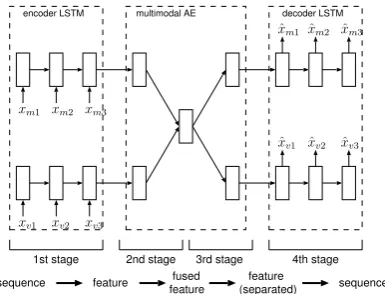
For multimodal learning, we use encoder and decoder LSTMs for each modality. The modalities are integrated by a mul-timodal autoencoder, which consists of three layers, i.e., in-put, hidden, and output layers. The schematic view of our proposed model is shown in Fig. 3. Our model consists of en-coder part and deen-coder part similar to vanilla autoenen-coder. The advantages of the multimodal autoencoder are as fol-lows. One is that memorized patterns can be reconstructed from incomplete or single modality information. Another is that the multimodal encoder can be naturally combined with the encoder and decoder LSTMs and the whole structure can be learned with the simple gradient descent method. We call our model multimodal LSTM autoencoder.
The multimodal LSTM autoencoder can encode the sequen-tial inputs of multiple modalities to a fused feature vector and decode the vector to the separated sequential outputs of each modality. There are four stages of encoding or decod-ing in the multimodal LSTM autoencoder. The first stage is encoding the sequence to fixed range feature vector by the encoder LSTM for each modality. The feature vectors are combined and converted to a fused feature vector once in the multimodal autoencoder as the second stage. The mul-timodal autoencoder also decode the fused feature vector to the two separated feature vectors which are sent to the decoder LSTMs at the third stage. At the last stage, the de-coder LSTM reproduces the original input sequences from the feature vectors for each modality.
The training procedure of our model has three stages to train the encoder and decoder LSTMs and multimodal encoder in a separate and integrated ways. Firstly, the encoder and decoder LSTMs are trained to be able to encode an input sequence to a feature vector and to decode the feature vec-tor to the input sequence in a usual way of LSTM learning. Secondly, only multimodal autoencoder is trained to encode the feature vectors of two modalities, which is passed by the encoder LSTMs, to the fused feature vector and decode the vector to the original vectors of two modalities. By the sec-ond stage, the encoder and decoder LSTMs and multimodal autoencoder can be used as a multimodal LSTM coder if learning of both LSTMs and multimodal coder is perfect. However, because the multimodal autoen-coder cannot completely recall the feature vectors, recalling ability of simply connected LSTMs and multimodal autoen-coder becomes poor. Therefore, the enautoen-coder and deautoen-coder
xm1 encoder LSTM
xm2 xm3
decoder LSTM multimodal AE
xv1 xv2 xv3
ˆ
xm1 xˆm2 xˆm3
ˆ
xv1 xˆv2 xˆv3
1st stage 2nd stage 3rd stage 4th stage
sequence feature
(separated) feature fused
feature sequence
Figure 3: Multimodal LSTM autoencoder.
LSTMs and the multimodal autoencoder are trained as a whole network as the third stage. Although training entire network in a single stage is possible in principle, the training is more difficult and slower than the three stages training in practice.
After training, it is expected that the fused feature vector encoded by the multimodal autoencoder contains informa-tion of multiple modalities in a mixed form. However, in case that the number of units in the hidden layer of multimodal autoencoder is same as the sum of each modality’s or more, the vector might be merely identical mapping of modalities, and that ends up result that we get no benefit of using mul-timodal integration approach. By reducing the number of nodes in the hidden layer of multimodal autoencoder less than the sum of each modality’s, we can force the output to be mixed.
3.
EXPERIMENTS
In order to evaluate our proposed method, it is applied to crossmodal recalling and recognition between motion and vision.
3.1
Dataset
clavicle(2)
humerus(3)
radius(1)
wrist(1)
hand(1)
fingers(1)
thumb(2) head(3) upperneck(3)
lowerneck(3)
thorax(3)
toes(1) foot(2) tibia(1) femur(3) upperback(3)
lowerback(3)
locked
rotation_x -1.96 rotation_y 19.66 rotation_z -12.47 head_x 4.12
lfoot_x -196.74 lfoot_y 194.26 ltoes 4.67
x
m
1
x
v
1
create manuallyby a software
64 pixel 59 dim
64 pixel
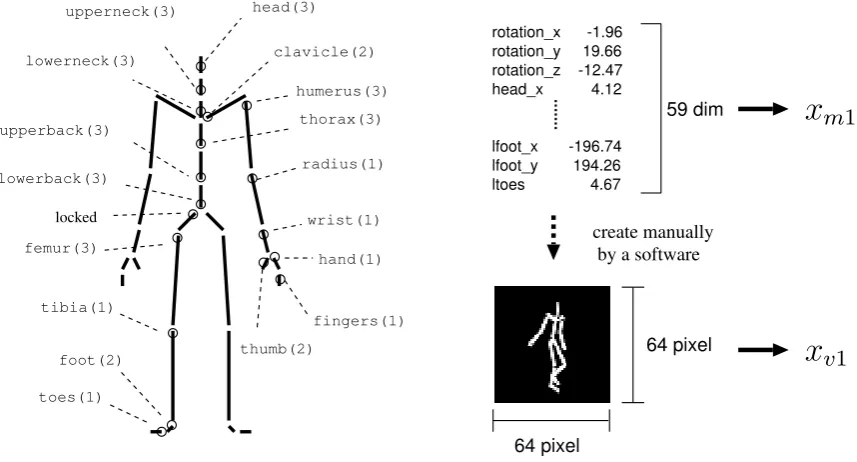
Figure 4: Left: Joints and degrees of freedom of the body skeleton in the motion patterns. Right: Example of 1-shot motion and visual data (denoted byxm1 andxv1 respectively). The motion and visual image sequences consist of multiple data of this.
subjects number. We used data of subject #1 for training our model. The data contains 14 trials. One trial is composed of a continuous motion sequence that possibly contains more than two kinds of motion. Data have been captured in 120 fps. In the original fps data, the differences between suc-ceeded visual images or motions are often so small that the data are downsampled to 8 fps for input visual and motion data. The total number of frames in downsampled data is about 3,600 frames. The length of the recalled data is set to 10, which corresponds to 1.125 sec. Finally, we obtain 360 input data sequences of vision and motion for training.
3.2
Memorizing and Recalling Visual Images
At the first stage of training our model, we train the encoder and decoder LSTMs that receive and recall visual images. As described before, the activation function of eq. (6) for the visual images is a sigmoid activation function. For the learning, we used stochastic gradient descent with learning rate of 0.7. To compute the gradient, the reconstruction error is computed by cross entropy loss function. The size of inputs for the LSTM is 4096, and we set the number of hidden units of the LSTM to 1024. The parameters are updated on mini-batch method, and the size of mini-mini-batch is 10.
Figure 5 shows the recall error of the output patterns to the target input patterns. The all errors gradually decrease and converge by 250 epochs1
. The LSTM recalls the last-input visual image first and the fist-input in the end (reverse or-der). That is why the error of the first recalling output be-come the smallest. Figure 6 (the second row from the top) shows the visual images recalled by the best trained LSTM
1In one epoch, a network is trained on each data in training set once.
0 0.02 0.04 0.06 0.08 0.1 0.12 0.14 0.16
0 50 100 150 200 250 10th output
5th output
1st output
Training Epochs
Recall Error
Figure 5: Recall errors during training of visual LSTM autoencoder.
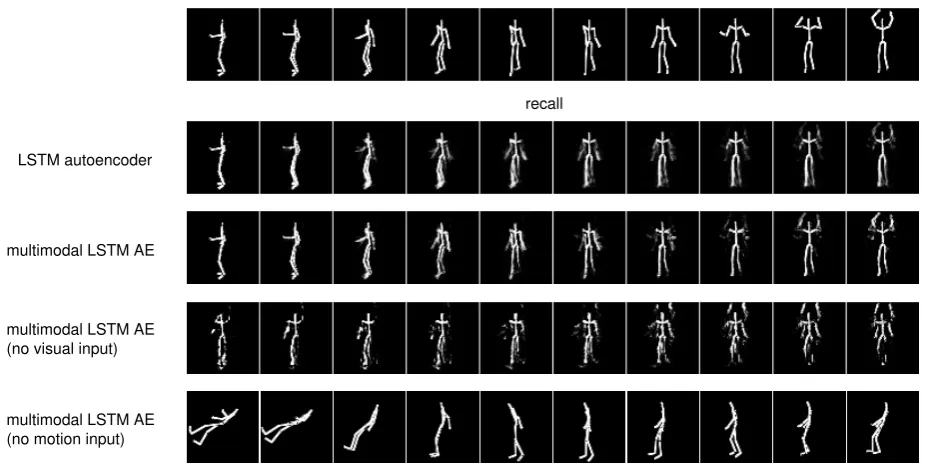
at 250 epochs. The left and right most images are the first and last outputs of LSTM, respectively. In the opposite di-rection, the left most of the target is the last input. It is remarkable that the images of recalled outputs are similar to the target even the middle recalled images are blurry. It means that the training has been reasonably successful and the LSTM can recall the sequential visual information.
3.3
Memorizing and Recalling Motion Data
target
LSTM autoencoder
multimodal LSTM AE
multimodal LSTM AE (no motion input)
recall
multimodal LSTM AE (no visual input)
Figure 6: Examples of the target sequence, recalled visual images by LSTM autoencoder (AE) and multimodal LSTM AE, visual images recalled from only motion, and visualized motion sequences recalled from only vision (See the main text for the details).
learning rate is 0.7 for the weights that direct inward. For the weights of outward connections (i.e. the connections to the linear activation layer), the learning rate is 0.007. That is because the linear activation has no limit in their values and updating the parameters should be performed carefully. The size of inputs for the LSTM is 59, and the number of hidden units is 512. Although the number of hidden units is rela-tively large to the input size, the parameter is determined to balance between vision and motion at the multimodal integration stage. If the number of hidden units of motion LSTM is much less than that of vision LSTM, motion modal-ity might not be able to contribute the fused representation in multimodal autoencoder efficiently.
Figure 7 shows recall error as training epochs, and it shows that the training has been done successfully. All errors be-come very small and the training has been done successfully. Though it is possible to visualize recalled motion data in the same way as creating video data, almost no difference can be seen between the images of target and recall, and the visualization is not shown.
3.4
Experiment on Multimodal Integration
The trained visual and motion LSTMs are integrated by a multimodal autoencoder. Firstly, the multimodal autoen-coder is trained to receive and reconstruct the feature vec-tors which is the output from the trained encoder LSTM. In this stage, the parameters of the only multimodal autoen-coder are updated to reconstruct the feature vectors. Af-ter that, the trained multimodal autoencoder is connected to the encoder and decoder LSTMs (also trained in previ-ous section), and we train them as a whole network. These
0 0.005 0.01 0.015 0.02 0.025 0.03
0 500 1000 1500 2000 1st output
Recall Error
5th output 10th output
Training Epochs
Figure 7: Recall errors during training of motion LSTM autoencoder.
greedy layer-wise training process is the practical way of the learning on deep network. The number of nodes at the hidden layer of the multimodal autoencoder is 256. For the multimodal autoencoder, the learning rate is 0.7. For the encoder and decoder LSTMs, the learning rate is also 0.7 except for the linear output layer of the decoder LSTM for motion described in the above section, and we decrease the rate linearly 0.7 to 0.1 after the monitoring errors looks con-verged.
0 0.02 0.04 0.06 0.08 0.1 0.12
0 100 200 300 400 500 600 700 0 1e-04 2e-04 3e-04 4e-04 5e-04
motion 1st
video 1st
motion last
video last
Training Epochs
Recall Error of Vision
Recall Error of Motion
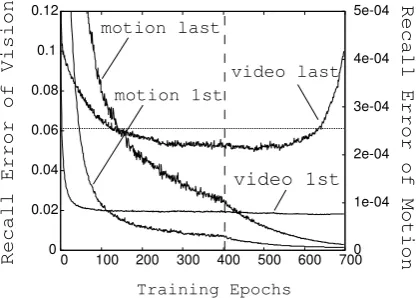
Figure 8: Recall errors during training of multi-modal LSTM autoencoder. The vertical dashed line indicates the epoch when learning rate annealing starts. The horizontal dashed line indicates the best recall error of the LSTM autoencoder for visual im-ages.
of the motion sequence becomes higher. While the error of motion sequence is decreasing after annealing the learning rate, that of video sequence is increasing. We discuss about the reason of this in Section 4.
3.4.1
Recalling from multiple modalities
For the evaluation of the multimodal recall, we use the trained model at 550 epoch which is the time before the error of visual images start increasing. In Fig. 6, the third row shows the recalled visual images of multimodal LSTM autoencoder when the motion and visual images are given at the same time. The recall by the multimodal LSTM au-toencoder is clearer than the recall of the single modal in-formation by the encoder and decoder LSTM. The details of the arms and legs in the human figure are recalled better. These results show that the two modalities are integrated by the hidden unit of the multimodal autoencoder and the mo-tion input sequences contribute to disambiguate the recalled visual image sequences.
3.4.2
Recalling of Both Vision and Motion from
Ei-ther Modality
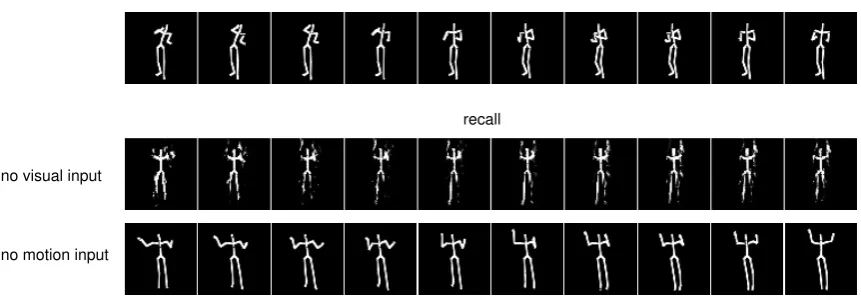
The multimodal LSTM autoencoder can be also used to generate missing inputs. For example, even if the input se-quences of visual images are not given, the visual images can be recalled from the only motion sequences. However, recall obtained with missing input is much noisy and not similar to the target. To make the noisy output clear to some ex-tent, we can use the output as the input which is absent. By iteratively inputting the output to the missing modality, the output become more closer to the target in some cases. It should be noted that there are some cases that the output is still far from the target.
The forth and fifth row in Fig. 6 show the results of recalling from a single modal information, i.e., visual images recalled from motion sequences and motion sequences recalled from visual image sequences, respectively. The results of motion sequences are visualized in the same way as creating visual
images from mocap data. Although the recall from only mo-tion input (the forth row in Fig. 6) is very blurry and noisy, the feature of the target can be observed (hands-up in the recalled images). In the case of recall from only visual im-ages (the fifth row in Fig. 6), while the facing direction in the recalled visual images is correct however it fails to recall the features of hands-up and turning on the way. Figure 9 shows another example of recall from missing visual images. The facing direction of the visual images recalled from the motion is wrong, however, it is interesting that the images of hands-up is successfully recalled. This is probably because the distance between turning away and turning front is far in the feature space. As the first recall is noisy and some-times close to another training input rather than the target, once the feature is trapped in unfavorable subspace, which is far from where the target is, it is difficult to escape from there. Figure 10 shows changes of the recall errors of the vi-sual images and motion while obtaining the result shown in Fig. 9 when the recalled outputs are fed back into the input of the multimodal LSTM autoencoder repeatedly. While the errors of the motion become nearly zero, that of visual im-ages increased rather than decreased. This is caused due to the same reason described just before.
3.5
Generalization Capability of Trained Model
In this section, we test generalization capability of trained model. We prepare extra data for the test from data of sub-ject #2 in CMU database, on which the model is not trained. Although the test data is unknown visual images and mo-tion patterns, if the trained model has high generalizamo-tion ability, the model can output the visual images from only motion patterns or motion patterns from only visual image inputs. Figure 11 shows the recall of visual images without input visual images and visualization of motion sequences without input motion sequences. The recalled sequence cap-tures at most one feature of target, and the feature appears in quite different style. The sample shown in the Fig.11 is one of the most successful sample, and the other recall is not good. It show that generalization ability of our model is fairly low.
4.
DISCUSSION
Our results showed that the proposed model can integrate the temporal multimodal sequences and can recall missing sequential information from either modality. However, there is an asymmetric ability of recalling between vision and mo-tion. The recalling from motion to vision is better.
fea-target
recall
no motion input no visual input
Figure 9: Another example of visual images recalled from the only motion sequence and visualized motion sequence recalled from the only visual image sequence.
0 0.1 0.2 0.3 0.4 0.5 0.6 0.7 0.8
0 10 20 30 40 50 60 70 80 90 100
Recall Error
Update Iterations
1st output
10th output
0 0.01 0.02 0.03 0.04 0.05 0.06 0.07 0.08 0.09
0 10 20 30 40 50 60 70 80 90 100
Recall Error
1st output 10th output
Update Iterations
Figure 10: Recall errors of the visual images (left) and motion sequences (right) when the recalled outputs are fed back into the input of the multimodal LSTM autoencoder repeatedly, and the obtainend result is shown in Fig. 9.
target
recall
no visual input
no motion input
ture vectors of each modality would be vague. When the only motion sequences are given and the visual images are reconstructed, the feature vectors of the motion sequences are clearly separated, and the fused feature vectors and re-constructed feature vectors of each modality would approach to the original trained feature vectors during repetition of recalling while compensating the missing modality. However, when the only visual image sequences are given, the feature vectors are not so clearly separated that the repeated recall-ing in multimodal autoencoder would not improve. That is because there is an asymmetricity between vision and mo-tion. It might be related to the multimodal processes of hu-man. It is relatively easy to imagine how we have moved dur-ing motion, but it is usually difficult to imitate the other’s motion after looking.
When the LSTM autoencoder is trained with only vision, the recall error could not be small enough to show sharp mo-tion figures. It might be because the feature vectors of vision encoded by LSTM were not separated among different in-put sequences in the feature space as described above. The errors of vision were slightly improved in the multimodal training (Fig. 8). The motion sequences help to classify the feature vectors to be separated. However, the motion errors were improved and not for vision in the end when the learning rate was set to the smaller values. This might be because the classification of fused feature vectors in the multimodal autoencoder was specialized too much for the motion, which broke down the decoded feature vectors of vision in the multimodal autoencoder and it also breaks the trained structure of the decoded LSTM autoencoder of vi-sion. The fused feature vectors should be classified in the feature space properly for both vision and motion. This bal-ancing problem can be overcome by a deep LSTM model because the deep LSTM model can build up high level rep-resentation in deep layers ([3]) and multimodal integration using the high level representation which has no statistical deviation depending on input modality is easier than using low level representation [10].
The current generalization ability of our model is not good enough as shown in Section 3.5. The possible reasons ex-cept for deficiency of LSTM are that the number of trained samples is too small and that our model is not a proba-bilistic model such as Boltzmann machine. A probaproba-bilistic version of autoencoder has been proposed, which is called variational autoencoder[5] and it is compatible with LSTM because it can be trained by backpropagation. One of our future works is to introduce the variational autoencoder to our multimodal LSTM model to obtain high generalization ability among modalities and apply it to imitation.
5.
CONCLUSION
We proposed an architecture of neural network that can learn and integrate sequential multimodal information using LSTM. Our model consists of encoder and decoder LSTMs and multimodal autoencoder. Each LSTM deal with sequen-tial information and multimodal autoencoder integrates mul-timodal information. We tested our proposed model by recall tasks on the visual and motion sequence. The experimen-tal results have shown that our model has ability to learn and remember the sequential multimodal inputs, and even decrease the ambiguity generated at the learning stage of
LSTMs using integrated multimodal information. Our model can also recall the visual sequences from the only motion se-quences and vice versa. However, generalization ability for unknown input of our model is fairly low, therefore improv-ing the ability is our future work.
Although we used two modalities, vision and motion, for multimodal information in this paper, our model can also deal with more than two modalities, for example vision, mo-tion and sound. It is expected that addimo-tional modalities contribute to decrease the ambiguity of fused information. It is another future work to test our model on additional modalities.
6.
ACKNOWLEDGMENTS
The data used in this project was obtained from mocap.cs.cmu.edu. The database was created with funding from NSF EIA-0196217.
7.
REFERENCES
[1] A. Graves.Supervised sequence labelling with recurrent neural networks. PhD thesis, M¨unchen, Techn. Univ., Diss., 2008, 2008.
[2] A. Graves. Generating sequences with recurrent neural networks.arXiv preprint arXiv:1308.0850, pages 1–43, 2013.
[3] A. Graves, A. Mohamed, and G. Hinton. Speech recognition with deep recurrent neural networks. In
Acoustics, Speech and Signal Processing (ICASSP), 2013 IEEE International Conference on, pages 6645–6649. IEEE, 2013.
[4] S. Hochreiter and J. Schmidhuber. Long short-term memory.Neural computation, 9(8):1735–1780, 1997. [5] D. P. Kingma and M. Welling. Auto-encoding
variational bayes.arXiv preprint arXiv:1312.6114, 2013.
[6] J. Ngiam, A. Khosla, M. Kim, J. Nam, H. Lee, and A. Y. Ng. Multimodal Deep Learning.Proceedings of The 28th International Conference on Machine Learning (ICML), pages 689–696, 2011.
[7] K. Noda, H. Arie, Y. Suga, and T. Ogata. Multimodal integration learning of robot behavior using deep neural networks.Robotics and Autonomous Systems, 62(6):721–736, 2014.
[8] A. J. Robinson and F. Fallside. The utility driven dynamic error propagation network.Technical Report CUED/F-INFENG/TR.1, 1987.
[9] N. Srivastava, E. Mansimov, and R. Salakhutdinov. Unsupervised learning of video representations using lstms.arXiv preprint arXiv:1502.04681, 2015. [10] N. Srivastava and R. R. Salakhutdinov. Multimodal
learning with deep boltzmann machines. InAdvances in neural information processing systems, pages 2222–2230, 2012.
[11] I. Sutskever, O. Vinyals, and Q. V. Le. Sequence to sequence learning with neural networks. InAdvances in neural information processing systems, pages 3104–3112, 2014.
[12] R. J. Williams and D. Zipser. Gradient-based learning algorithms for recurrent networks and their
![Figure 1: LSTM unit [2].](https://thumb-us.123doks.com/thumbv2/123dok_us/8429500.1697262/2.595.75.272.54.211/figure-lstm-unit.webp)