R E S E A R C H
Open Access
Space-efficient and exact de Bruijn graph
representation based on a Bloom filter
Rayan Chikhi
1*and Guillaume Rizk
2Abstract
Background: The de Bruijn graph data structure is widely used in next-generation sequencing (NGS). Many programs, e.g.de novoassemblers, rely on in-memory representation of this graph. However, current techniques for representing the de Bruijn graph of a human genome require a large amount of memory (≥30 GB).
Results: We propose a new encoding of the de Bruijn graph, which occupies an order of magnitude less space than current representations. The encoding is based on a Bloom filter, with an additional structure to remove critical false positives.
Conclusions: An assembly software implementing this structure, Minia, performed a completede novoassembly of human genome short reads using 5.7 GB of memory in 23 hours.
Keywords: de novo assembly, de Bruijn graph, Bloom filter
Background
The de Bruijn graph of a set of DNA or RNA sequences is a data structure which plays an increasingly impor-tant role in next-generation sequencing applications. It was first introduced to perform de novo assembly of DNA sequences [1]. It has recently been used in a wider set of applications:de novomRNA [2] and metagenome [3] assembly, genomic variants detection [4,5] and de novoalternative splicing calling [6]. However, an impor-tant practical issue of this structure is its high memory footprint for large organisms. For instance, the straight-forward encoding of the de Bruijn graph for the human genome (n≈2.4·109,k-mer sizek=27) requires 15 GB (n·k/4 bytes) of memory to store the nodes sequences alone. Graphs for much larger genomes and metagenomes cannot be constructed on a typical lab cluster, because of the prohibitive memory usage.
Recent research on de Bruijn graphs has been targeted on designing more lightweight data structures. Li et al.
pioneered minimum-information de Bruijn graphs, by not recording read locations and paired-end information [7].
*Correspondence: [email protected]
1Computer Science department, ENS Cachan / IRISA / INRIA, Rennes 35042, France
Full list of author information is available at the end of the article
Simpsonet al.implemented a distributed de Bruijn graph to reduce the memory usage per node [8]. Conway and Bromage applied sparse bit array structures to store an implicit, immutable graph representation [9]. Targeted methods compute local assemblies around sequences of interest, using negligible memory, with greedy extensions [10] or portions of the de Bruijn graph [11]. Ye et al.
recently showed that a graph roughly equivalent to the de Bruijn graph can be obtained by storing only one out ofg
nodes (10≤g≤25) [12].
Conway and Bromage observed that the
self-information of the edges is a lower bound for exactly encoding the de Bruijn graph [9]:
log2(
4k+1
|E|
)bits,
wherek+1 is the length of the sequence that uniquely defines an edge, and |E|is the number of edges. In this article, we will consider for simplicity that a de Bruijn graph is fully defined by its nodes. A similar lower bound can then be derived from the self-information of the nodes. For a human genome graph, the self-information of|N| ≈2.4·109nodes is log2(|4Nk|)≈6.8GB fork=27, i.e.≈24 bits per node.
A recent article [13] from Pell et al. introduced the
probabilistic de Bruijn graph, which is a de Bruijn graph stored as a Bloom filter (described in the next section). It is shown that the graph can be encoded with as lit-tle as 4 bits per node. An important drawback of this representation is that the Bloom filter introduces false nodes and false branching. However, they observe that the global structure of the graph is approximately pre-served, up to a certain false positive rate. Pellet al.did not perform assembly directly by traversing the probabilistic graph. Instead, they use the graph to partition the set of reads into smaller sets, which are then assembled in turns using a classical assembler. In the arXiv version of [13] (Dec 2011), it is unclear how much memory is required by the partitioning algorithm.
In this article, we focus on encoding an exact represen-tation of the de Bruijn graph that efficiently implements the following operations:
1. For any node, enumerate its neighbors 2. Sequentially enumerate all the nodes
The first operation requires random access, hence is supported by a structure stored in memory. Specifically, we show in this article that a probabilistic de Bruijn graph can be used to perform the first operation exactly, by recording a set of troublesome false positives. The second operation can be done with sequential access to the list of nodes stored on disk. One highlight of our scheme is that the resulting memory usage is approximated by
1.44 log2(16k
2.08)+2.08 bits/k-mer.
For the human genome example above and k = 27, the size of the structure is 3.7 GB, i.e. 13.2 bits per node. This is effectively below the self-information of the nodes. While this may appear surprising, this structure does not store the precise set of nodes in memory. In fact, com-pared to a classical de Bruijn graph, the membership of an arbitrary node cannot be efficiently answered by this representation. However, for the purpose of many appli-cations (e.g. assembly), these membership queries are not needed.
We apply this representation to performde novo assem-bly by traversing the graph. In our context, we refer by traversal to any algorithm which visits all the nodes of the graph exactly once (e.g. a depth-first search algo-rithm). Thus, a mechanism is needed to mark which nodes have already been visited. However, nodes of a probabilis-tic de Bruijn graph cannot store additional information. We show that recording only the visited complex nodes (those with in-degree or out-degree different than one) is a space-efficient solution. The combination of (i) the
prob-abilistic de Bruijn graph along with the set of critical false positives, and (ii) the marking scheme, enables to perform very low-memoryde novoassembly.
In the first Section, the notions of de Bruijn graphs and Bloom filters are formally defined. Section “Remov-ing critical false positives” describes our scheme for exactly encoding the de Bruijn graph using a Bloom filter. Section “Additional marking structure for graph traversal” presents a solution for traversing our representation of the de Bruijn graph. Section “Results and discussion” presents two experimental results: (i) an evaluation of the useful-ness of removing false positives and (ii) an assembly of a real human dataset using an implementation of the struc-ture. A comparison is made with other recent assemblers based on de Bruijn graphs.
de Bruijn graphs and Bloom filters
Thede Bruijn graph[1], for a set of stringsS, is a directed graph. For simplicity, we adopt a node-centric definition. The nodes are all the k-length substrings (also called
k-mers) of each string inS. An edges1 →s2is present if
the(k−1)-length suffix ofs1is also a prefix ofs2.
Through-out this article, we will indifferently refer to a node and its
k-mer sequence as the same object.
A more popular, edge-centric definition of de Bruijn graphs requires that edges reflect consecutive nodes. For
k-mer nodes, an edges1 →s2is present if there exists a (k+1)-mer in a string ofScontainings1as a prefix ands2
as a suffix. The node-centric and edge-centric definitions are essentially equivalent whenk=k−1 (although in the former, nodes have lengthk, andk−1 in the latter).
The Bloom filter [14] is a space efficient hash-based data structure, designed to test whether an element is in a set. It consists of a bit array ofmbits, initialized with zeros, andhhash functions. To insert or test the member-ship of an element,hhash values are computed, yieldingh
array positions. The insert operation corresponds to set-ting all these positions to 1. The membership operation returnsyesif and only if all of the bits at these positions are 1. Anoanswer means the element is definitely not in the set. A yesanswer indicates that the element may or may not be in the set. Hence, the Bloom filter has one-sided errors. The probability of false positives increases with the number of elements inserted in the Bloom filter. When considering hash functions that yield equally likely positions in the bit array, and for large enough array sizem
and number of inserted elementsn, the false positive rate
Fis [14]:
F ≈ 1−e−hn/mh=1−e−h/rh (1)
F is approximately 0.6185r. Solving Equation 1 for m, assuming thathis the optimal number of hash function, yieldsm≈1.44 log2(F1)n.
The probabilistic de Bruijn graph is obtained by inserting all the nodes of a de Bruijn graph (i.e allk-mers) in a Bloom filter [13]. Edges are implicitly deduced by querying the Bloom filter for the membership of all pos-sible extensions of ak-mer. Specifically, anextensionof a
k-mervis the concatenation of either (i) thek−1 suffix ofvwith one of the four possible nucleotides, or (ii) one of the four nucleotides with thek−1 prefix ofv.
The probabilistic de Bruijn graph holds an over-approximation of the original de Bruijn graph. Querying the Bloom filter for the existence of an arbitrary node may return a false positive answer (but never a false negative). This introduces false branching between original and false positive nodes.
Removing critical false positives
ThecFPstructure
Our contribution is a mechanism that avoids false branch-ing. Specifically, we propose to detect and store false positive elements which are responsible for false branch-ing, in a separate structure. To this end, we introduce thecFPstructure ofcritical False Positives k-mers, imple-mented with a standard set allowing fast membership test. Each query to the Bloom filter is modified such that theyes
answer is returned if and only if the Bloom filter answers
yesand the element is not incFP.
Naturally, if cFP contained all the false positives ele-ments, the benefits of using a Bloom filter for memory efficiency would be lost. The key observation is that the
k-mers which will be queried when traversing the graph are notallpossiblek-mers. LetS be the set of true pos-itive nodes, andEbe the set of extensions of nodes from
S. Assuming we only traverse the graph by starting from a node inS, false positives that do not belong toEwill never be queried. Therefore, the setcFPwill be a subset ofE. Let
Pbe the set of all elements ofEfor which the Bloom filter answersyes. Theset of critical false positivescFPis then formally defined ascFP=P\S.
Figure 1 shows a simple graph with the setSof correct nodes in regular circles andcFPin dashed rectangles. The exact representation of the graph is therefore made of two data structures: the Bloom filter, and the setcFPof criti-cal false positives. Algorithm 1 describes how to construct
cFPusing a fixed amount of memory. The setPis created on disk, from whichcFPis then gradually constructed by iteratively filteringP with partitions ofS((Di)i≥0) loaded
in a hash-table. The setsS,P, and(Di)i≥0are stored on
the hard disk. The sets (Pi)i≥0 reside in RAM, and are
dimensioned to occupy as much space as the Bloom filter (which was freed at Step 4). Note that I/O to the disk are always sequential.
Algorithm 1Constant-memory enumeration of critical false positives
1: Input:The setSof all nodes in the graph, the Bloom filter constructed fromS, the maximum numberM
of elements in each partition (determines memory usage)
2: Output:The set cFP
3: Store on disk the setP of extensions ofS for which
the Bloom filter answersyes 4: Free the Bloom filter from memory
5: D0←P 6: i←0
7: whileend ofSis not reacheddo 8: Pi← ∅
9: while|Pi|<Mdo
10: Pi←Pi∪{nextk-mer inS} 11: foreachk-merminDido 12: ifm∈/Pithen
13: Di+1←Di+1∪ {m} 14: DeleteDi,Pi
15: i←i+1 16: cFP←Di
Dimensioning the Bloom filter for minimal memory usage
The setcFPgrows with the number of false positives. To optimize memory usage, a trade-off between the sizes of the Bloom filter andcFPis studied here.
Using the same notations as in the definition of the Bloom filter, given thatn= |S|, the size of the filtermand the false positive rateF are related through Equation 1. The expected size ofcFPis 8n·F, since each node only has eight possible extensions, which might be false posi-tives. In the encoding ofcFP, eachk-mer occupies 2·k
bits. Recall that for a given false positive rate F, the expected optimal Bloom filter size is 1.44nlog2(F1). The total structure size is thus expected to be
1.44nlog2
1
F
Bloom filter
+(16·Fnk)
cFP
bits (2)
The size is minimal for F ≈ (16k/2.08)−1. Thus, the minimal number of bits required to store the Bloom filter and the setcFPis approximately
n·(1.44 log2(16k
2.08)+2.08). (3)
For illustration, Figure 2-(a) shows the size of the struc-ture for various Bloom filter sizes andk = 27. For this value ofk, the optimal size of the Bloom filter is 11.1 bits perk-mer, and the total structure occupies 13.2 bits per
influ-(a)
(c)
(d)
(b)
Figure 1A complete example of removing false positives in the probabilistic de Bruijn graph.(a)showsS, an example de Bruijn graph (the 7 non-dashed nodes), andB, its probabilistic representation from a Bloom filter (taking the union of all nodes). Dashed rectangular nodes (in red in the electronic version) are immediate neighbors ofSinB. These nodes are the critical false positives. Dashed circular nodes (in green) are all the other nodes ofB;(b)shows a sample of the hash values associates to the nodes ofS(a toy hash function is used);(c)shows the complete Bloom filter associated toS; incidentally, the nodes ofBare exactly those to which the Bloom filter answers positively;(d)describes the lower bound for exactly encoding the nodes ofS(self-information) and the space required to encode our structure (Bloom filter, 10 bits, and 3 critical false positives, 6 bits per 3-mer).
ence on the optimal structure size. Note that the size of thecFPstructure is in fact independent ofk.
In comparison, a Bloom filter with virtually no critical false positives would require F ·8n < 1, i.e. r > 1.44 log2(8n). For a human genome (n=2.4·109),rwould be greater than 49.2, yielding a Bloom filter of size 13.7 GB.
0 5 10 15 20 25 30
0
2
04
06
08
0
1
0
0
Structure size per k−mer, k=27
Size of the Bloom filter (bits / k−mer)
Str
ucture siz
e (bits/k−mer)
Total = Bloom Filter + cFP Bloom Filter
cFP
Optimal Size
11.1
13.2
(a)
0 20 40 60 80 100
0
5
10
15
20
25
Optimal structure size per k−mer
k−mer size
Str
ucture siz
e (bits/k−mer)
Total = Bloom Filter + cFP Bloom Filter
cFP
(b)
Figure 2Optimal data structure size for the parameterr, then for the parameterk.(a)Structure size (Bloom filter, critical false positives) in function of the number of bits perk-mer allocated to the Bloom filter (also called ratior) fork=27. The trade-off that optimizes the total size is shown in dashed lines.(b)Optimal size of the structure for different values ofk.
is immutable) nor (ii) traversals (as the Bloom filter can-not store an additional visited bit per node). To address the former issue, we argue that the simplification step can be avoided by designing a slightly more complex traversal procedure [16].
We introduce a novel, lightweight mechanism to record which portions of the graph have already been visited. The idea behind this mechanism is that not every node needs to be marked. Specifically, nodes that are inside simple paths (i.e nodes having an in-degree of 1 and an out-degree of 1) will either be all marked or all unmarked. We will refer to nodes having their in-degree or out-degree different to 1 ascomplex nodes. We pro-pose to store marking information of complex nodes, by explicitly storing complex nodes in a separate hash table. In de Bruijn graphs of genomes, the complete set of nodes dwarfs the set of complex nodes, however the ratio depends on the genome complexity [17]. The mem-ory usage of the marking structure is ncC, where nc
is the number of complex nodes in the graph and C
is the memory usage of each entry in the hash table (C≈2k+8).
Implementation
The de Bruijn graph structure described in this article was implemented in a newde novoassembly software: Miniaa. An important preliminary step is to retrieve the list of dis-tinctk-mers that appear in the reads, i.e. true graph nodes.
To discard likely sequencing errors, only thek-mers which appear at leastdtimes are kept (solid k-mers). We exper-imentally setdto 3. Classical methods that retrieve solid
k-mers are based on hash tables [18], and their memory usage scale linearly with the number of distinctk-mers. To deal with reverse-complementation,k-mers are identified to their reverse-complements.
k-mer counting
To avoid using more memory than the whole structure, we implemented a novel, constant-memoryk-mer counting procedure. The multi-set of allk-mers present in the reads is partitioned and partitions are saved to disk. Then, each partition is separately loaded in memory in a temporary hash table. Thek-mer counts are returned by traversing each hash table. Low-abundancek-mers are filtered. This approach permits to count allk-mers of a human genome dataset using only a fixed amount of memory and disk space. The algorithm is explicitly described and evaluated in another article [19].
Graph traversal
is performed to traverse short, locally complex regions. Specifically, the traversal ignores tips (dead-end paths) shorter than 2k+1 nodes. It chooses a single path (con-sistently but arbitrarily), among all possible paths that traverse graph regions of breadth ≤ 20, provided these regions end with a single node of depth ≤ 500. These regions are assumed to be sequencing errors, short vari-ants or short repetitions of length≤500 bp. The breadth limit prevents combinatorial blowup. Note that paired-end reads information is not taken into account in this traversal. In a typical assembly pipeline (e.g. [8]), a sepa-rate program (scaffolder) can be used to link contigs using pairing information. Also, a gap-filling step (e.g. Gap-Closer in SOAPdenovo [7]) is typically used to fill the gaps between contigs in scaffolds.
Results and discussion
Throughout the Results section, we will refer to the N50 metric of an assembly (resp. NG50) as the longest contig size, such that half the assembly (resp. half the reference) is contained in contigs longer than this size.
On the usefulness of removing critical false positives
To test whether the combination of the Bloom filter and thecFPstructure offers an advantage over a plain prob-abilistic de Bruijn graph, we compared both structures in terms of memory usage and assembly consistency. We retrieved 20 million E. coli short reads from the Short Read Archive (SRX000429), and discarded pairing infor-mation. Using this dataset, we constructed the proba-bilistic de Bruijn graph, thecFP structure, and marking structure, for various Bloom filter sizes (ranging from 5
to 19 bits perk-mer) andk = 23 (yielding 4.7 M solid
k-mers).
We measured the memory usage of both structures. For each, we performed an assembly using Minia with exactly the same traversal procedure. The assemblies were compared to a reference assembly (using MUMmer), made with an exact graph. The percentage of nucleotides in contigs which aligned to the reference assembly was recorded.
Figure 3 shows that both the probabilistic de Bruijn graph and our structure have the same optimal Bloom fil-ter size (11 bits perk-mer, total structure size of 13.82 bits and 13.62 perk-mer respectively). In the case of the prob-abilistic de Bruijn graph, the marking structure is promi-nent. This is because the graph has a significant amount of complexk-mers, most of them are linked to false posi-tive nodes. For the graph equipped with thecFPstructure, the marking structure only records the actual complex nodes; it occupies consistently 0.49 bits perk-mer. Both structures have comparable memory usage.
However, Figure 3 shows that the probabilistic de Bruijn graph produces assemblies which strongly depend on the Bloom filter size. Even for large sizes, the probabilistic graph assemblies differ by more than 3 kbp to the ref-erence assembly. We observed that the majority of these differences were due to missing regions in the proba-bilistic graph assemblies. This is likely caused by extra branching, which shortens the lengths of some contigs (contigs shorter than 100 bp are discarded).
Below≈9 bits perk-mer, probabilistic graph assemblies significantly deteriorate. This is consistent with another article [13], which observed that when the false positive
rate is over 18% (i.e., the Bloom filter occupies≤ 4 bits per k-mer), distant nodes in the original graph become connected in the probabilistic de Bruijn graph. To sum up, assemblies produced by the probabilistic de Bruijn graph are prone to randomness, while those produced by our structure are exact.
de novoassembly
Complete human genome
We assembled a complete human genome (NA18507, SRA:SRX016231, 142.3 Gbp of unfiltered reads of length
≈100 bp, representing 47x coverage) using Minia. After
k-mer counting, 2,712,827,800 solidk-mers (d=3) were inserted in a Bloom filter dimensioned to 11.1 bits per solid k-mer. The cFP structure contained 78,762,871
k-mers, which were stored as a sorted list of 64 bits inte-gers, representing 1.86 bits per solid k-mer. A total of 166,649,498 complexk-mers (6% of the solidk-mers) were stored in the marking structure using 4.42 bits per solid
k-mer (implementation uses 832k bytes per k-mer). Table 1 shows the time and memory usage required for each step in Minia.
We compared our results with assemblies reported by the authors of ABySS [8], SOAPdenovo [7], and the pro-totype assembler from Conway and Bromage [9]. Table 2 shows the results for four classical assembly quality met-rics, and the time and peak memory usage of the com-pared programs. We note that Minia has the lowest memory usage (5.7 GB), seconded by the assembler from Conway and Bromage (32 GB). The wall-clock execution time of Minia (23 h) is comparable to the other assem-blers; note that it is the only single-threaded assembler. The N50 metric of our assembly (1.2 kbp) is slightly above that of the other assemblies (seconded by SOAPdenovo, 0.9 kbp). All the programs except one assembled 2.1 Gbp of sequences.
We furthermore assessed the accuracy of our assem-bly by aligning the contigs produced by Minia to the GRCh37 human reference using GASSST [20]. Out of the 2,090,828,207 nucleotides assembled, 1,978,520,767
Table 1 Details of steps implemented in Minia
Step Time (h) Memory (Gb)
k-mer counting 11.1 Constant (set to 4.0)
Enumerating positive extensions 2.8 3.6 (Bloom filter)
ConstructingcFP 2.9 Constant (set to 4.0)
Assembly 6.4 5.7 (Bloom f.+cFP
+ mark. struct.)
Overall 23.2 5.7
Details of steps implemented in Minia, with wall-clock time and memory usage for the human genome assembly. For constant-memory steps, memory usage was automatically set to an estimation of the final memory size. In all steps, only one CPU core was used.
Table 2 de novo human genome (NA18507) assemblies
Method Minia C. & B. ABySS SOAPdenovo
Value ofkchosen 27 27 27 25
Number of contigs (M) 3.49 7.69 4.35
-Longest contig (kbp) 18.6 22.0 15.9
-Contig N50 (bp) 1156 250 870 886
Sum (Gbp) 2.09 1.72 2.10 2.08
Nb of nodes/cores 1/1 1/8 21/168 1/16
Time (wall-clock, h) 23 50 15 33
Memory (sum 5.7 32 336 140
of nodes, GB)
de novohuman genome (NA18507) assemblies reported by our assembler (Minia), Conway and Bromage assembler [9], ABySS [8], and SOAPdenovo [7]. Contigs shorter than 100 bp were discarded. Assemblies were made without any pairing information.
nucleotides (94.6%) were contained in contigs having a full-length alignment to the reference, with at least 98% sequence identity. For comparison, 94.2% of the contigs assembled by ABySS aligned full-length to the reference with 95% identity [8].
To evaluate another recent assembler, SparseAssembler [12], the authors assembled another dataset (NA12878), using much larger effective k values. SparseAssembler stores an approximation of the de Bruijn graph, which can be compared to a classical graph fork = k+g, where
g is the sparseness factor. The reported assembly of the NA12878 individual by SparseAssembler (k+ g = 56) has a N50 value of 2.1 kbp and was assembled using 26 GB of memory, in a day. As an attempt to perform a fair comparison, we increased the value ofkfrom 27 to 51 for the assembly done in Table 2 (k = 56 showed worse contiguity). The N50 obtained by Minia (2.0 kbp) was computed with respect to the size of SparseAssembler assembly. Minia assembled this dataset using 6.1 GB of memory in 27 h, a 4.2×memory improvement compared to SparseAssembler.
Chromosome 14 of the human genome
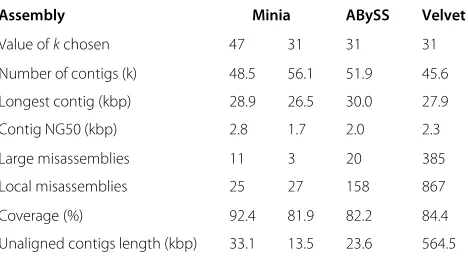
In order to evaluate the quality of the results produced by Minia more accurately, we assembled the human chro-mosome 14 (88 Mbp ungapped) separately. The Illumina dataset is from the GAGE benchmark [21] (100 bp reads, all short paired-end libraries). Pairing information was not used in Minia. To establish a fair comparison with Minia, we selected two assemblies from GAGE (made with ABySS and Velvet, downloaded from the GAGE web-site) for which contigs were constructed without using pairing information. All the assemblies were done with a
QUAST v1.3 was executed with the --gage option to evaluate the quality of the contigs of each assembly. Table 3 shows several contiguity, coverage and quality metrics computed using the same reference genome and QUAST command-line for the three assemblies. The large misassemblies row shows the number of positions in the assembled contigs for which the left and right flanking sequences align either over 1 kbp away from each other, or on different strands or chromosomes. The local mis-assemblies row shows the number of positions in the assembled contigs for which the left and right flanking sequences are distant from each other by 90 bp to 1 kbp.
On this dataset, Minia withk=31 produced an assem-bly of lower contiguity and better accuracy to ABySS and Velvet. Minia with k = 47 produced a better assem-bler over all metrics than the other assemassem-blers run with
k = 31. Overall, the quality of assemblies produced with Minia can be considered satisfactory with respect to contigs made from state of the art assemblers. It should be noted that in the GAGE benchmark, other methods (e.g. SOAPdenovo, Allpaths, etc..) produced assemblies of much higher contiguity. These methods performed post-processing steps (scaffolding and gap-filling), usually after completing an initial contigs construction phase with a classical de Bruijn graph.
Conclusions
This article introduces a new, space-efficient represen-tation of the de Bruijn graph. The graph is implicitly encoded as a Bloom filter. A subset of false positives, those which introduce false branching from true posi-tive nodes, are recorded in a separate structure. A new marking structure is introduced, in order for any traversal algorithm to mark which nodes have already been vis-ited. The marking structure is also space-efficient, as it only stores information for a subset ofk-mers. Combining the Bloom filter, the critical false positives structure and
Table 3de novohuman genome chromosome 14 assemblies
Assembly Minia ABySS Velvet
Value ofkchosen 47 31 31 31
Number of contigs (k) 48.5 56.1 51.9 45.6
Longest contig (kbp) 28.9 26.5 30.0 27.9
Contig NG50 (kbp) 2.8 1.7 2.0 2.3
Large misassemblies 11 3 20 385
Local misassemblies 25 27 158 867
Coverage (%) 92.4 81.9 82.2 84.4
Unaligned contigs length (kbp) 33.1 13.5 23.6 564.5
de novohuman genome chromosome 14 assemblies reported by our assembler (Minia), compared to Velvet and ABySS assemblies from the GAGE benchmark. QUAST was used to evaluate all three assemblers.
the marking structure, we implemented a new memory-efficient method forde novoassembly (Minia).
To the best of our knowledge, Minia is the first method that can create contigs for a complete human genome on a desktop computer. Our method improves the memory usage of de Bruijn graphs by two orders of magnitude compared to ABySS and SOAPdenovo, and by roughly one order of magnitude compared to succinct and sparse de Bruijn graph constructions. Furthermore, the current implementation completes the assembly in 1 day using a single CPU thread.
De Bruijn graphs have more NGS applications than just
de novoassembly. We plan to port our structure to replace the more expensive graph representations in two pipelines for reference-free alternative splicing detection, and SNP detection [4,6]. We wish to highlight three directions for improvement. First, some steps of Minia could be imple-mented in parallel, e.g. graph traversal. Second, a more succinct structure can be used to mark complexk-mers. Two candidates are Bloomier filters [22] and minimal perfect hashing.
Third, the set of critical false positives could be reduced, by exploiting the nature of the traversal algorithm used in Minia. The traversal ignores short tips, and in gen-eral, graph regions that are eventually unconnected. One could then define n-th order critical false positives (n-cFP) as follows. An extension of a true positive graph node is an-cFPif and only if a breadth-first search from the true positive node, in the direction of the extension, has at least one node of depth n + 1. In other words, false positive neighbors of the original graph which are part of tips, and generally local dead-end graph structures, will not be flagged as critical false positives. This is an extension of the method presented in this article which, in this notation, only detects 0-th order critical false positives.
Simultaneously and independently of the present work, Boweet al.[23] have proposed a de Bruijn graph repre-sentation using 4+o(1)bits per edge. Their data structure is more succinct than ours, and at the same time more complex and difficult to implement. Since their structure has not been fully implemented yet, it is not possible to compare the practical performance with Minia. However, this new advance is very interesting and raises the ques-tion of whether their structure is the most succinct way to represent a de Bruijn graph.
Endnote
aSource code available at http://minia.genouest.org/. Competing interests
Both authors declare that they have no competing interests.
Authors’ contributions
Acknowledgements
The authors are grateful to Dominique Lavenier for helpful discussions and advice, and to Aurélien Rizk for proof-reading the manuscript. This work benefited from the ANR grants associated with the MAPPI project (ANR-10-COSI-0004) and the GATB project (ANR-12-EMMA-0019).
Author details
1Computer Science department, ENS Cachan / IRISA / INRIA, Rennes 35042, France.2Algorizk, Paris 75013, France.
Received: 19 December 2012 Accepted: 29 June 2013 Published: 16 September 2013
References
1. Idury RM, Waterman MS:A new algorithm for DNA sequence
assembly.J Comput Biol1995,2(2):291–306.
2. Grabherr MG:Full-length transcriptome assembly from RNA-Seq
data without a reference genome.Nat Biotech2011,29(7):644–652.
[http://dx.doi.org/10.1038/nbt.1883]
3. Peng Y, Leung HCM, Yiu SM, Chin FYL:Meta-IDBA: a de Novo
assembler for metagenomic data.Bioinformatics2011,27(13):i94–i101.
4. Peterlongo P, Schnel N, Pisanti N, Sagot MF, Lacroix V:Identifying SNPs
without a reference genome by comparing raw reads.InString
Processing and Information Retrieval. Berlin, Heidelberg: Springer; 2010:147–158.
5. Iqbal Z, Caccamo M, Turner I, Flicek P, McVean G:De novo assembly and
genotyping of variants using colored de Bruijn graphs.Nat Genet
2012,44:226–232.
6. Sacomoto G, Kielbassa J, Chikhi R, Uricaru R, Antoniou P, Sagot M, Peterlongo P, Lacroix V:KISSPLICE: de-novo calling alternative
splicing events from RNA-seq data.BMC Bioinformatics2012,
13(Suppl 6):S5. [http://www.biomedcentral.com/1471-2105/13/S6/S5] 7. Li R, Zhu H, Ruan J, Qian W, Fang X, Shi Z, Li Y, Li S, Shan G, Kristiansen K:
De novo assembly of human genomes with massively parallel short
read sequencing.Genome Res2010,20(2):265.
8. Simpson JT, Wong K, Jackman SD, Schein JE, Jones SJM, Birol I:ABySS: A
parallel assembler for short read sequence data.Genome Res2009,
19(6):1117–1123. [http://genome.cshlp.org/content/19/6/1117.abstract] 9. Conway TC, Bromage AJ:Succinct data structures for assembling
large genomes.Bioinformatics2011,27(4):479.
10. Warren RL, Holt RA:Targeted assembly of short sequence reads.PloS One2011,6(5):e19816.
11. Peterlongo P, Chikhi R:Mapsembler, targeted and micro assembly of
large NGS datasets on a desktop computer.BMC Bioinformatics2012,
13:48.
12. Ye C, Ma Z, Cannon C, Pop M, Yu D:Exploiting sparseness in de novo
genome assembly.BMC Bioinformatics2012,13(Suppl 6):S1.
[http://www.biomedcentral.com/1471-2105/13/S6/S1]
13. Pell J, Hintze A, Canino-Koning R, Howe A, Tiedje JM, Brown CT:Scaling metagenome sequence assembly with probabilistic de Bruijn
graphs.Arxiv preprint arXiv:1112.41932011.
14. Kirsch A, Mitzenmacher M:Less hashing, same performance: Building
a better Bloom filter.Algorithms–ESA2006,4168:456–467.
15. Miller JR, Koren S, Sutton G:Assembly algorithms for next-generation
sequencing data.Genomics2010,95(6):315–327.
16. Chikhi R, Lavenier D:Localized genome assembly from reads to
scaffolds: practical traversal of the paired string graph.Algo
Bioinformatics2011,6833:39–48.
17. Kingsford C, Schatz MC, Pop M:Assembly complexity of prokaryotic
genomes using short reads.BMC Bioinformatics2010,11:21.
18. Marçais G, Kingsford C:A fast, lock-free approach for efficient parallel
counting of occurrences of k-mers.Bioinformatics2011,27(6):764–770.
[http://bioinformatics.oxfordjournals.org/content/27/6/764.abstract] 19. Rizk G, Lavenier D, Chikhi R:DSK:k-mer counting with very low
memory usage.Bioinformatics2013,29(5):652–653.
20. Rizk G, Lavenier D:GASSST: global alignment short sequence search
tool.Bioinformatics2010,26(20):2534.
21. Salzberg SL, Phillippy AM, Zimin A, Puiu D, Magoc T, Koren S, Treangen TJ, Schatz MC, Delcher AL, Roberts M, Marçais G, Pop M, Yorke JA:GAGE: A critical evaluation of genome assemblies and assembly algorithms.
Genome Res2012,22(3):557–567. [http://genome.cshlp.org/content/22/ 3/557.abstract]
22. Chazelle B, Kilian J, Rubinfeld R, Tal A:The Bloomier filter: an efficient
data structure for static support lookup tables.InProceedings of the
Fifteenth Annual ACM-SIAM Symposium on Discrete Algorithms. Philadelphia: SIAM; 2004:30–39.
23. Bowe A, Onodera T, Sadakane K, Shibuya T:Succinct de Bruijn Graphs. InAlgorithms in Bioinformatics, Volume 7534 of Lecture Notes in Computer Science. Edited by Raphael B, Tang J. Berlin, Heidelberg: Springer; 2012:225–235. [http://dx.doi.org/10.1007/978-3-642-33122-0_18]
doi:10.1186/1748-7188-8-22
Cite this article as:Chikhi and Rizk:Space-efficient and exact de Bruijn graph representation based on a Bloom filter.Algorithms for Molecular Biology20138:22.
Submit your next manuscript to BioMed Central and take full advantage of:
• Convenient online submission
• Thorough peer review
• No space constraints or color figure charges
• Immediate publication on acceptance
• Inclusion in PubMed, CAS, Scopus and Google Scholar
• Research which is freely available for redistribution