M E T H O D O L O G Y
Open Access
Meta-analytic support vector machine for
integrating multiple omics data
SungHwan Kim
1,2, Jae-Hwan Jhong
1, JungJun Lee
1and Ja-Yong Koo
1**Correspondence: [email protected]
1Department of Statistics, Korea
University, Anam-dong, 136-701 Seoul, South Korea
Full list of author information is available at the end of the article
Abstract
Background: Of late, high-throughput microarray and sequencing data have been extensively used to monitor biomarkers and biological processes related to many diseases. Under this circumstance, the support vector machine (SVM) has been popularly used and been successful for gene selection in many applications. Despite surpassing benefits of the SVMs, single data analysis using small- and mid-size of data inevitably runs into the problem of low reproducibility and statistical power. To address this problem, we propose a meta-analytic support vector machine (Meta-SVM) that can accommodate multiple omics data, making it possible to detect consensus genes associated with diseases across studies.
Results: Experimental studies show that the Meta-SVM is superior to the existing meta-analysis method in detecting true signal genes. In real data applications, diverse omics data of breast cancer (TCGA) and mRNA expression data of lung disease (idiopathic pulmonary fibrosis; IPF) were applied. As a result, we identified gene sets consistently associated with the diseases across studies. In particular, the ascertained gene set of TCGA omics data was found to be significantly enriched in the ABC transporters pathways well known as critical for the breast cancer mechanism.
Conclusion: The Meta-SVM effectively achieves the purpose of meta-analysis as jointly leveraging multiple omics data, and facilitates identifying potential biomarkers and elucidating the disease process.
Keywords: Support vector machine, Meta-analysis, Data integration, TCGA
Introduction
Over the last decade, the technologies of microarray and massively parallel sequencing generate multiple omics sources from a large cohort at an unprecedented rate. Besides, since the experimental costs have dropped, a huge amount of data sets have been accu-mulated in public data repositories (e.g., Gene Expression Omnibus (GEO) and Sequence Read Archive (SRA)). And yet low reproducibility has been a chronic concern due to mid-and-small size of each individual experimental unit (e.g., 40–100) and low signal-to-noise ratios of genomic expression data [24, 26, 27]. In an effort to tackling these challenges, effective data integration methods have been widely spotlighted in biomedical research [2]. The traditional meta-analysis integrates significance levels or effect sizes of similar data sets (similar design or biological hypothesis), and has proven to be effective in dis-covering significant biomarkers [14, 37]. Multi-study data integration is also known as
“horizontal meta-analysis” that combines multiple homogeneous omics data [38]. More-over, many large consortia such as the Cancer Genome Atlas (TCGA) and Lung Genomics Research Consortium (LGRC) have generated different types of omics data (e.g., mRNA, methylation, CNV and so on) using samples from a single cohort. Datasets are aligned ver-tically by samples, and thus integration of such multi-omics data is called “vertical omics integrative analysis” [38]. Jointly leveraging multi-layers of omics data, vertical omics inte-gration facilitates deciphering biological processes, capturing the interplay of multi-level genomic features, and elucidating how a priori knowledge of biological information (e.g., pathway database) functions within the framework of systems biology.
has proved its practical utility and has become commonplace to identify key regulators of cancer. Thus, many have paid attention to credible validation strategies that build on multiple studies [7, 35]. Besides, meta-analysis essentially aids to adjust tissue specific effects possibly distorting the analysis of individual datasets [21]. The optimization strat-egy to estimate, therefore, focuses on how to maneuver these two terms (L1-lasso and group lasso) in the formula. To overcome some of known traditional optimization rules (e.g., linear and quadratic programming), which mostly entails heavy computing tasks, we propose an approximation method to relax computational complexity in favor of con-cise implementation. The idea is to approximate the hinge loss including but not limited to penalty terms by a quadratic form, and thereby we can apply the classical coordinate descent algorithm to optimize the whole objective function.
The paper is outlined as follows. In Methods section, we introduce the meta-analytic method that builds on the support vector machine (Meta-SVM) and its implementation strategy at length. Simulation studies section shows experimental studies to benchmark performance of feature detection under various experimental scenarios. In Applications to real genomic data section, we demonstrate the advantages of Meta-SVM in two real data applications using publicly available omics data, and concluding remarks are pre-sented in Concluding remark section. An R package “metaSVM” is publicly available online at author’s github page (https://sites.google.com/site/sunghwanshome/).
Methods
Meta-analytic support vector machine (Meta-SVM)
ConsiderMindependent studies, consisting ofn(m)subjects ofm-th study for 1 ≤m≤
M. Lety(im)be a scalar of binary phenotypes andx(im)=x(i1m),. . .,x(ipm)be a vector, each containingpcommon variables of thei-th subject for 1 ≤ i ≤ n(m)and 1 ≤ m ≤ M. We consider an objective function of theL1support vector machine using the singlem-th data set
Qλ
β(m)=n (m)
i=1
1−y(im)f
x(im);β(m)
++λ
p
j=1
|β(m)
j |, (1)
whereλ > 0,f
x(im);β(m)
= β(m)
0 +
p
j=1x( m) ij β(
m)
j for 1 ≤ i ≤ n(m) andβ(m) =
β(m) 0 ,. . .,β
(m) p
∈Rp+1. Due to the linearity offx(m) i ;β(m)
, this is typically known as the linear support vector machine. And our major interest is to estimate the solution of β(m)that minimizes (1). By extension, in pursuit of integrating theMstudies to a unified model, we propose the meta-analytic support vector machine that builds on multiple data via both group lasso andL1lasso (a.k.a sparse group lasso):
Qλ1,λ2(β)= M
m=1 n(m)
i=1
1−y(im)fx(im);β(m)
++λ1
p
j=1
M
m=1
β(m) j
2
+λ2 M
m=1 p
j=1
|β(m) j |,
(2)
whereλ1,λ2>0,β =
with meta-analytic feature selection even when heterogeneous studies are present in anal-ysis, since the sparse group lasso allows to accommodate both common effects across all studies and study specific effects simultaneously. Let
ˆ
β(m)= argmin β(m)∈Rp+1
Qλ1,λ2β(m)
be the sparse group lasso estimator of the meta-analytic support vector machine form-th study for 1≤m≤M.
Implementation strategy
For estimatingβ, the SVM traditionally exploits the linear or quadratic programming well-suited to SVM’s dual problem. To our best knowledge, no coordinate descent-type optimization has yet been proposed to address the sparse group lasso problem despite the coordinate-type approach’s utility for implementation. The coordinate descent algo-rithm is one of the most popular algoalgo-rithms that are built on the convexity assumption. To apply this algorithm to (2), an approximation to the smooth objective function is required on account of the non-differential property of the hinge loss and the group lasso penalty. With a little of algebraic trick, the group lasso penalty can be made twice-differentiable. Precisely, we add some sufficiently small constant inside the square root, in the way that the first and second derivative of theL1-lasso and group lasso penalty terms can be made at βj(m) = 0. When it comes to the non-differential hinge loss, Zhang et al. [48] pro-posed the successive quadratic algorithm (SQA): a generalization of Newton’s method for unconstrained optimization such that it finds a step away from the current point of iteration by minimizing a quadratic approximation of the problem. Taken together, the objective function (2) can be approximated to
˜
Qλ1,λ2(β)= M
m=1
⎡
⎣1
2− 1 2n(m)
n(m)
i=1
yi(m)f(xi(m);β(m))+ 1 4n(m)
n(m)
i=1
|y(im)−f(xi(m);β(m)∗)|
+ 1 4n(m)
n(m)
i=1
[y(im)−f(xi(m);β(m))]2
|y(im)−f(xi(m);β(m)∗)|
⎤
⎦+λ1p
j=1
M
m=1
β(m) j
2
+λ2 M
m=1 p
j=1
|β(m)
j |, (3)
where β(m)∗is an estimated coefficient vector at the current point for 1 ≤ m ≤ M. Contrary to (2),Q˜λ1,λ2(β)is differentiable with respect toβ, convex and separable with respect to all of variables so that we can apply the coordinate descent algorithm by means of Newton’s method. Update
β(m)(t+1)
j ←β (m)(t)
j −
∇ ˜Qλ1,λ2
β(m)(t+1) 0 ,. . .,β(
m)(t+1)
j−1 ,β( m)(t)
j ,. . .,β( m)(t)
p
j+1
∇2Q˜λ1,λ2
β(m)(t+1)
0 ,. . .,β(m) (t+1)
j−1 ,β(m) (t)
j ,. . .,β(m)
(t)
p
j+1,j+1 (4)
and iterate for 1≤j≤pand 1≤m≤Muntil convergence. More details are provided in Appendix.
Simulation studies
effect sizes as follows: Simulate gene correlation structure forP = 30 genes,N = 20 samples in each study, andM = 3. In each study, 10 out of 30 genes belong toC = 2 independent clusters.
Step 1: Randomly sample gene cluster labels of 30 genes (Cp∈ {0, 1, 2}and1≤p≤P),
such thatC=2clusters each containing 5 genes are generated
(P
p=11(Cp=c)=5,1≤c≤C=2)and the remaining 20 genes are unclustered
genes (pP=11(Cp=0)=20).
Step 2: For any clusterc (1≤c≤C) in studym (1≤m≤M), sample
(m) c
∗
∼W−1(ψ, 60), whereψ=0.5I5×5+0.5J5×5,W−1denotes the inverse Wishart distribution,I is the identity matrix and J is the matrix with all the entries being 1. Set vectorσc(m)as the square roots of the diagonal elements in (m)
c
∗
. Calculatec(m)such thatσc(m)c(m)σc(m)
=(m) c
∗
.
Step 3: Denote byp(1c),· · ·,p(5c)as the indices for genes in clusterc. In other words, Cp(c)
j =
c, where1≤c≤2and1≤j≤5. Sample expression of clustered genes
byX(m)
p(1c)n,· · ·,X (m) p(5c)n)
∼MVN(0,R(m)
c ), where1≤n≤N=20,1≤m≤M
andR is an arbitrary constant for adjusting of total variance (R=1as default). Sample expression for unclustered genesXpn(m)∼N(0,R)for1≤n≤Nand
1≤m≤MifCp=0.
Step 4: To simulate differential expression pattern, sample effect sizesμ(pm)from
Unif(0.1, 0.5)for1≤p≤10as differential expression (DE) genes and set
μ(m)
p =0for11≤p≤Pas non-DE genes.
Step 5: For the first 10 control samples,Ypn(m)=Xpn(m)(1≤p≤P, 1≤n≤N/2=10, 1≤m≤M). For cases,
Yp((mn)+10)=Xp(m(n)+10)+μp(m)(1≤p≤P, 1≤n≤N/2=10, 1≤m≤M).
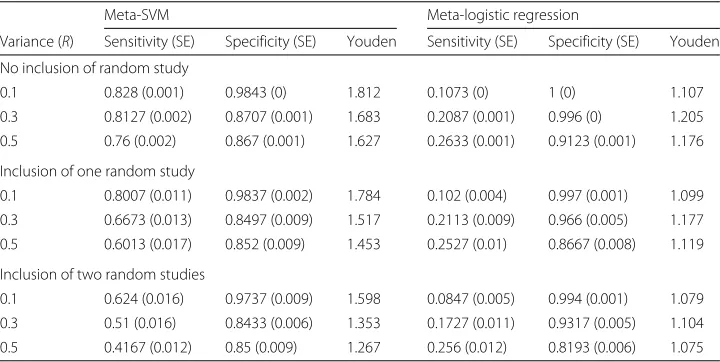
All tuning parameters (λ1andλ2) are chosen by cross-validation, and the simulations were repeated 50 times. Table 1 summarizes the results of all simulation studies. It is note-worthy that the Meta-SVM achieves higher Youden index (=sensitivity + specificity−1) compare to the meta-logistic regression model across all experimental scenarios (i.e.,
Table 1Shown are the results of experimental studies to compare the meta-logistic model with the
meta-analytic SVM
Meta-SVM Meta-logistic regression
Variance (R) Sensitivity (SE) Specificity (SE) Youden Sensitivity (SE) Specificity (SE) Youden No inclusion of random study
0.1 0.828 (0.001) 0.9843 (0) 1.812 0.1073 (0) 1 (0) 1.107
0.3 0.8127 (0.002) 0.8707 (0.001) 1.683 0.2087 (0.001) 0.996 (0) 1.205
0.5 0.76 (0.002) 0.867 (0.001) 1.627 0.2633 (0.001) 0.9123 (0.001) 1.176
Inclusion of one random study
0.1 0.8007 (0.011) 0.9837 (0.002) 1.784 0.102 (0.004) 0.997 (0.001) 1.099
0.3 0.6673 (0.013) 0.8497 (0.009) 1.517 0.2113 (0.009) 0.966 (0.005) 1.177
0.5 0.6013 (0.017) 0.852 (0.009) 1.453 0.2527 (0.01) 0.8667 (0.008) 1.119
Inclusion of two random studies
0.1 0.624 (0.016) 0.9737 (0.009) 1.598 0.0847 (0.005) 0.994 (0.001) 1.079
0.3 0.51 (0.016) 0.8433 (0.006) 1.353 0.1727 (0.011) 0.9317 (0.005) 1.104
R=0.1, 0.3 and 0.5), and thus this suggests the Meta-SVM performs better in identifying the true signal features. Given that the meta-logistics model results in low sensitivity, the meta-logistic model has a tendency to overly penalize the effect size of features. In con-trast, when data are sampled with low variance (R= 0.1), specificity of the meta-logistic model is shown to be a little higher than that of the Meta-SVM (e.g., 1, 0.997 and 0.994 for the Meta-logistic, and 0.9843, 0.9837 and 0.9737 for the Meta-SVM), and yet the meta-logistic model still suffers low sensitivity at the expense of high specificity. Inspired by the simulation design introduced by meta-analysis of rth ordered p-value (rOP) [41], we also designed simulation schemes such that only a few studies provide major signals that differentiate binary outcomes like real data. To this end, we replaced signal genes of one or two studies with complete random noise (i.e., sampled fromN(0,R); no signal genes). This leads to only one or two signal genes, respectively, among three data sets. Under this simulation scenario, the Meta-SVM still performs better as in Table 1, presenting higher Youden index than the meta-logistic model no matter how many random noises are imposed.
Applications to real genomic data
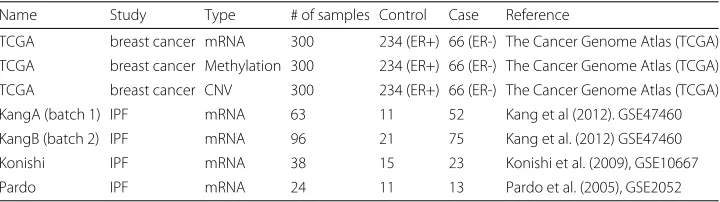
In this section, we apply the Meta-SVM methods to two real examples of idiopathic pulmonary fibrosis expression profiles (IPF; 221 samples in four studies of binary out-come (i.e., case and control)) and breast cancer expression profiles provided by The Cancer Genome Atlas (TCGA) including mRNA, copy number variation (CNV) and epigenetic DNA methylation (http://cancergenome.nih.gov/; 300 samples of estrogen receptor binary outcome (i.e., ER+ and ER-)). It should be noticed that we integrate in the first application (IPF) four homogeneous studies in a fashion of horizontal integra-tion, whereas we align in the second application (breast cancer) three genomic data by the common cohort in the context of vertical integration. Integrating multilevel-omics data is reasonable, in that inter-regulation flows in systems biology are present from CNV to mRNA and from DNA methylation to mRNA [16]. Therefore, these inter-omics features aligned on identical protein coding regions can be jointly estimated in the group lasso. Table 2 outlines the data descriptions, for a total of seven data sets and source references. In the pre-processing stage, genes and DNA methylation probes were matched across homogeneous studies and multi-omics data, and centered with scaling. Non-expressed and/or non-informative genes were filtered according to the rank sum of mean intensities and variances across studies. Importantly noted is that this filtering procedure has been used in a previous meta-analysis work [47] and this filtering step is unbiased since class labels are not involved in the process. This generated 110 common genes in IPF study
Table 2Shown are the brief descriptions of the eight microarray datasets of disease-related binary
phenotypes (e.g., case and control). All datasets are publicly available
Name Study Type # of samples Control Case Reference
TCGA breast cancer mRNA 300 234 (ER+) 66 (ER-) The Cancer Genome Atlas (TCGA)
TCGA breast cancer Methylation 300 234 (ER+) 66 (ER-) The Cancer Genome Atlas (TCGA)
TCGA breast cancer CNV 300 234 (ER+) 66 (ER-) The Cancer Genome Atlas (TCGA)
KangA (batch 1) IPF mRNA 63 11 52 Kang et al (2012). GSE47460
KangB (batch 2) IPF mRNA 96 21 75 Kang et al. (2012) GSE47460
Konishi IPF mRNA 38 15 23 Konishi et al. (2009), GSE10667
and 108 common genes and matched methylation probes in TCGA for down-stream prediction analysis.
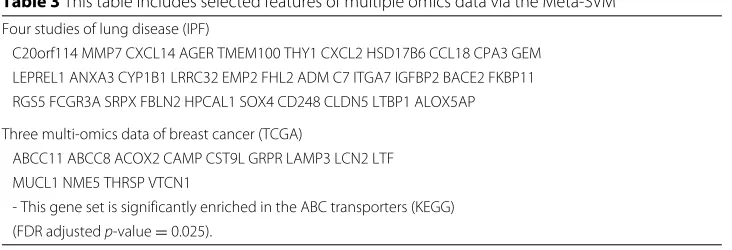
We applied gene set enrichment analysis to TCGA breast cancer data to figure out if our identified gene sets are in line with underlying biological pathways from the KEGG database [12]. It is notable that the identified gene set of the TCGA multiple omics data in Table 3 is significantly enriched in the ABC transporters pathways, which is already well-known to be correlated to breast cancer mechanisms, particularly related to estro-gen receptor and drug resistance [8, 28]. To our surprise, the ABC transporters pathway is considerably relevant to breast cancer mechanisms in many ways. For instance, breast cancer resistance protein (BCRP) is an ATP-binding cassette (ABC) transporter known as a molecular cause of multidrug resistance (MDR) in diverse cancer cells [46]. Besides Nakanishi et al. [28] discovered that up-regulation of BCRP mRNA expression was shown in estrogen receptor (ER)-positive breast cancer. This identified pathway has been con-sistently verified as critical for cancer outcomes and sensitivity to therapeutic treatments [8, 19]. In previous study under the similar design [10], ABCC8 and ABCC11 in Table 3 are believed to be modifiers of progression and response to the chemotherapy of breast cancer.
Generally idiopathic pulmonary fibrosis (IPF) is one of fatal lung diseases with a poor prognosis. Thus, it is quite imperative to monitor potential predictors of outcome. The original studies in Table 2 [17, 32] posed a hypothesis on molecular biomarkers associ-ated with IPF, and presented differentially expressed (DE) genes that distinguish IPF and control patients. For instance, Konishi et al. [17] identified in qRT-PCR microarray exper-iments MMP7, AGER and MMP7 are significantly higher and AGER is significantly lower in IPF. Pardo et al. [32] also pointed out that MMP7 is more significantly overexpressed compared with control lungs. Note that Meta-SVM is shown to be consistent with known evidence as detecting AGER and MMP7. Our findings in Table 3 also include CCL18. Importantly, it has been repeatedly reported that expression of CCL18 relates to course of pulmonary function parameters in patients with pulmonary fibrosis [33, 34]. However, there was a little discrepancy regarding the roles of CCL18 according to the previous stud-ies [31, 33]. And yet, since the Meta-SVM incorporates multiple data together, we can still give more credence to CCL18 as a molecular biomarker to predict IPF.
Of the 33 identified genes of IPF data (See Table 3 and Additional file 1: Table S1), we further reduce the number of genes for post-hoc analysis by exploring significant gene modules, equivalently gene-gene interaction, via Netbox [6]. NetBox is an analytic software well-suited to detect connecting genes to a network, identifying statistically sig-nificant “linker” genes on the basis of four public data sources: NCI-Nature Pathway
Table 3This table includes selected features of multiple omics data via the Meta-SVM
Four studies of lung disease (IPF)
C20orf114 MMP7 CXCL14 AGER TMEM100 THY1 CXCL2 HSD17B6 CCL18 CPA3 GEM LEPREL1 ANXA3 CYP1B1 LRRC32 EMP2 FHL2 ADM C7 ITGA7 IGFBP2 BACE2 FKBP11 RGS5 FCGR3A SRPX FBLN2 HPCAL1 SOX4 CD248 CLDN5 LTBP1 ALOX5AP
Three multi-omics data of breast cancer (TCGA)
ABCC11 ABCC8 ACOX2 CAMP CST9L GRPR LAMP3 LCN2 LTF MUCL1 NME5 THRSP VTCN1
- This gene set is significantly enriched in the ABC transporters (KEGG)
Interaction Database [40], Human Protein Reference Database [13], MSKCC Cancer Cell Map (http://www.mskcc.org/), and Reactome [11]. We implemented gene-gene interac-tion analysis, and successfully detected four gene modules, each of which constitutes mutually correlated genes. Additional file 1: Figure S1 displays the structure of combined networks based on four distinct gene modules. Focusing on the genes that belong to the four modules, we examine on MMP7 [32, 44, 50] , LTBP1 [20] , FHL2 [1] , CXCL2 [42], THY1 [39] and AGER [17] to confirm whether or not these are associated with IPF (See Additional file 1: Table S3). MMP7 is traditionally thought of as the predictive signature since MMP7 of IPF patients is among the molecules that are more significantly overex-pressed compared with control lungs [32]. More interestingly, Bauer et al. [1] identified a novel set of 12 disease-relevant translational gene markers including FHL2, MMP7 that are able to separate almost all patients with IPF from control subjects in multiple large-scale cohorts. Related to CXCL2, [42] investigated the pathogenesis of pulmonary fibrosis relevant to the imbalance in the expression of these angiogenic and angiostatic CXC chemokines. This study demonstrates in the bleomycin model that the amount of CXCL2 is found positively correlated with measures of fibrosis. When it comes to novel therapeutic targets, profiling DNA methylation changes to fibrosis has been increasingly spotlighted by observing hypomethylation of oncogene promoters. In doing so, Sanders et al. [39] reported that hypermethylation epigenetically decreases THY1 (See Additional file 1: Table S3) in IPF fibroblasts as IPF suppressor genes. Taken together, the Meta-SVM is found to be efficient in identifying potential biomarkers that facilitate elucidating the disease process.
Concluding remark
In this article, we introduce a meta-analytic framework using the support vector machine. The objective function of Meta-SVM applies the hinge loss and the sparse group lasso, and so we also develop a novel strategy for implementing the sparse group lasso in the context of Newton’s method. More importantly, the proposed Meta-SVM shows many advantages in discovering the underlying true signals and in detecting gene sets enriched for cancer disease process validated as biologically significant. Putting all things together, we conclude that the proposed meta-SVM is a reasonable choice to effectively achieve the common aims of meta-analysis. This is not that surprising given that the Meta-SVM takes advantages of the meta-analytic design that jointly leverages multiple omics data. For future study, we may improve computational speed via low-level programming lan-guages (e.g., C/C++ or Fortran) since coordinate descent algorithm sometimes leads to heavy computation due to slow convergence at the exchange of the straightforward algo-rithm structure. Usage of diverse kernels (e.g., quadratic and radial basis kernels) can be a possible choice to improve performance of feature discovery, and prediction accuracy. Moreover, it is worthwhile to impose interaction terms in the model, making it possible to account for the complex association among genomic features. We leave these ideas for future tasks.
Appendix
Optimization of a penalized univariate quadratic function Univariate Lasso problem
q(z)= b
2(z−c)
2+d forz∈R,
whereb>0 andc,d∈R. Letqλbe a penalized quadratic function given as
qλ(z)=q(z)+λ|z| forz∈R
and denote
zλ=argmin z∈R
qλ(z).
Note thatb=q (z) ∀z∈Randc=argminz∈Rq(z)sincecis the solution toq(z)=0. Theorem 1The minimizer zλof qλis given by
zλ=ST
c,λ
b
, (5)
where the soft-thresholding operator is defined by
ST(y,λ)=
⎧ ⎪ ⎪ ⎨ ⎪ ⎪ ⎩
y−λ if y> λ
y+λ if y<−λ
0 if y≤λ
for y∈Randλ >0.
Univariate Sparse group lasso problem
Let
qλ1,λ2(z)= b 2(z−c)
2+λ 1
z2+d+λ2|z| forz∈R, (6)
whereb >0,d≥0 andc∈R. Ifd=0, then the univariate sparse group lasso problem becomes the univariate lasso problem. Equivalently,
qλ1,λ2(z)= b 2(z−c)
2+(λ
1+λ2)|z| forz∈R
and we have
zλ1,λ2 =ST(c,(λ
1+λ2)/b).
Consider the univariate sparse group lasso problem withd > 0. LetFs(z)be the form of the cdf of the logistic distribution with a scale parameters>0, which is given by
Fs(z)=2
exp(z/s)
1+exp(z/s)
−1.
An approximation toqλ1,λ2 is
˜
qλ1,λ2(z)= b 2(z−c)
2+λ 1
z2+d+λ 2
z
−∞Fs(u)du forz∈R.
Whensis sufficiently small,˜zλ1,λ2 =argmin
z∈Rq˜λ1,λ2(z)is close to
zλ1,λ2 =argmin z∈R q
λ1,λ2(z).
Using the Newton-Raphson method, we can findz˜λ1,λ2. Note
dq˜λ1,λ2(z)
dz =b(z−c)+λ1 z
√
and
d2q˜λ1,λ2(z)
dz2 =b+λ1 d
(√z2+d)3+λ2ws(z) forz∈R where
ws(z)= 1
2sFs(z) (1+Fs(z)).
Starting from an initial valuez(0), we iterate
z(t+1)=z(t)− dq˜
λ1,λ2(z(t))/dz
d2q˜λ1,λ2(z(t))/dz2.
Implementation for the meta-analytic SVM
In order to estimate the solution ofβ(m), we approximate (3) to the univariate quadratic function, and then apply the Newton-Raphson method. To derive the quadratic form, we revisit the successive quadratics algorithm [48]. For each 1≤i ≤n(m)and 1≤m≤M, we havey(im)2=1 and
1−y(im)fxi(m);β(m)
+=
1−y(im)f
x(im);β(m)
2 +
y(im)−f
x(im);β(m)
2 (7)
Assumeβ(m)∗ is given, we consider the local quadratic approximation for the second term in (7):
y(im)−f
x(im);β(m)≈ 1 2
y(im)−f
x(im);β(m)
2
y(im)−fxi(m);β(m)∗ +
1 2
y(im)−f
x(im);β(m)∗,
whereβ(m)∗is an estimated coefficient vector at the current point. The quadratic form approximated to the entire objective function (3).
Given β˜(m) = β˜(m) 0 ,. . .,β˜
(m) p
∈ Rp+1, the function Q˜λ1,λ2
˜ β(m)
0 ,. . .,β˜ (m) j−1,
β(m)
j ,β˜j(+m1),. . .,β˜p(m)
is an univariate sparse group quadratic function of the form (6)
with argument z = βj(m) with suitable b,c,d. We update βj(m) by the minimizer of ˜
Qλ1,λ2
˜ β(m)
0 ,. . .,β˜ (m) j−1,β
(m) j ,β˜
(m) j+1,. . .,β˜
(m) p
for 0≤j≤pand 1≤m≤M. Let
X(m)= ⎡ ⎢ ⎢ ⎣
1 x(11m) . . . x(1mp)
..
. ... . .. ... 1 x(nm(m))1 . . . x(nm(m))p
⎤ ⎥ ⎥
⎦∈Rn(
m)×(p+1)
, y(m)= ⎡ ⎢ ⎢ ⎣
y(1m)
.. .
y(nm(m))
⎤ ⎥ ⎥
⎦∈Rn(
m)
,
Z(m)= ⎡ ⎢ ⎢ ⎣
y1(m) y(1m)x11(m) . . . y(1m)x(1mp)
..
. ... . .. ...
yn(m) yn(m(m))x(nm(m))1 . . . y(nm(m))x(nm(m))p
⎤ ⎥ ⎥
⎦∈Rn(
m)×(p+1)
and
W(m)=diagw1(m),. . .,w(nm(m))
= ⎡ ⎢ ⎢ ⎣
w(1m)
. ..
w(nm(m))
⎤ ⎥ ⎥
⎦∈Rn(
m)×n(m)
,
where
Observe
n(m)
i=1
y(im)f(x(im);β(m))=1Z(m)β(m) for1= ⎡ ⎢ ⎢ ⎣ 1 .. . 1 ⎤ ⎥ ⎥ ⎦∈Rn(m)
and
n
i=1
yi(m)−f(xi(m);β(m))2
y(im)−f(xi(m);β(m)∗)
= y(m)−X(m)β(m)
W(m)
y(m)−X(m)β(m)
= y(m)W(m)y(m)−2β(m)X(m)W(m)y(m)+β(m)X(m)W(m)X(m)β(m). Combining these, we obtain
˜
Qλ1,λ2β(m)= − 1
2n(m)1Z(m)β(m)
+ 1
4n(m)
y(m)W(m)y(m)−2β(m)X(m)W(m)y(m)
+β(m)X(m)W(m)X(m)β(m)
+λ1 p
j=1
M
m=1
β(m) j
2+λ
2 M
m=1 p
j=1
β(m)
j . (8)
The gradient and the Hessian matrix ofQ˜λ1,λ2are, respectively, given as
∇ ˜Qλ1,λ2
β(m)= − 1 2n(m)
X(m)W(m)
y(m)−X(m)β(m)
+Z(m)1+λ1B1+λ2B2, (9) and
∇2Q˜λ1,λ2
β(m)= 1 2n(m)X
(m)W(m)X(m)+λ 1B
1+λ2B
2, (10)
where
B1=
⎡ ⎢ ⎢ ⎢ ⎢ ⎢ ⎢ ⎢ ⎢ ⎣ 0 β(m)
1
β(m)2 1 +d1+
.. . β(m)
p
β(m)2
p +dp+ ⎤ ⎥ ⎥ ⎥ ⎥ ⎥ ⎥ ⎥ ⎥ ⎦
,B 1= ⎡ ⎢ ⎢ ⎢ ⎢ ⎢ ⎢ ⎢ ⎢ ⎢ ⎣ 0 d1
β(m)2 1 +d1+
3
.. . dp
β(m)2
p +dp+ 3 ⎤ ⎥ ⎥ ⎥ ⎥ ⎥ ⎥ ⎥ ⎥ ⎥ ⎦ ,
B2=
⎡ ⎢ ⎢ ⎢ ⎢ ⎢ ⎣ 0 Fs
β(m) 1 .. . Fs
β(m) p ⎤ ⎥ ⎥ ⎥ ⎥ ⎥ ⎦
, B 2= ⎡ ⎢ ⎢ ⎢ ⎢ ⎢ ⎣ 0 ws
β(m) 1 .. . ws
β(m) p ⎤ ⎥ ⎥ ⎥ ⎥ ⎥ ⎦ ,
dj = k=jβ(m) 2
Table 4An algorithm for the meta-analytic SVM via Newton’s method
Step 1: For 1≤m≤M, set the initial valueβ(m)(0) .
Step 2: Sett=0 and minimizeQ˜λ1,λ2β(m) j
via Newton’s method:
β(m)(t+1) j ←β(
m)(t) j −
∇ ˜Qλ1 ,λ2
β(m)(t+1) 0 ,...,β(m)(
t+1)
j−1 ,β(m)(
t) j ,...,β(m)(
t) p
j+1 ∇2Q˜λ1 ,λ2
β(m)(t+1) 0 ,...,β
(m)(t+1)
j−1 ,β
(m)(t)
j ,...,β
(m)(t) p
j+1,j+1 for 0≤j≤pand 1≤m≤M.
Step 3: Updatet=t+1 and go to Step 2 until convergence.
Additional file
Additional file 1: Table S1.The Meta-SVM’s coefficient of lung disease mRNA data.Table S2.The Meta-SVM’s coefficient of TCGA breast cancer multi-level omics data.Table S3.Gene-gene interaction analysis using 33 identified genes of IPF mRNA data.Figure S1.Gene networks that display the relationships among significant genes. The orange nodes are the selected linker genes out of 33 genes in Table 3. The blue nodes indicate linker genes not presented in the original input list, but are significantly connected to members of the input list. (DOCX 187 kb) Acknowledgements
The authors would like to thank the AE and reviewers. Funding
The authors are supported by the Basic Science Research Program through the National Research Foundation of Korea (NRF) funded by the Ministry of Education, Science and Technology (NRF-2015R1D1A1A01057747 and
2016R1A6A3A01009142). Availability of data and materials
All of data sets were publicly available at the GEO (http://www.ncbi.nlm.nih.gov/geo/;GSE47460, GSE10667 and GSE2052) and TCGA data portal (http://cancergenome.nih.gov; See Table 2 for details).
Authors’ contributions
SH and J-Y contributed to method development, study design, paper writing, implementing codes and interpretations. JJ and J-H contributed to data preparation and paper writing. All authors read and approved the final manuscript. Competing interests
The authors declare that they have no competing interests. Consent for publication
Not applicable.
Ethics approval and consent to participate
The results of the pan-cancer and interstitial pulmonary fibrosis (IPF) were based on microarray data downloaded from TCGA Research Network and Gene Expression Omnibus (GEO), which precluded the need for Institutional Review Board (IRB) approval and written informed consents.
Author details
1Department of Statistics, Korea University, Anam-dong, 136-701 Seoul, South Korea.2Department of Statistics,
Keimyung University, Dalseoku 42601, Daegu, South Korea. Received: 1 August 2016 Accepted: 11 January 2017
References
1. Bauer Y, Tedrow J, de Bernard S, Birker-Robaczewska M, Gibson K, et al. A novel genomic signature with translational significance for human idiopathic pulmonary fibrosis. Am J Respir Cell Mol Biol. 2015;52(2):217–31. 2. Begum F, Ghosh D, Tseng G, Feingold E. Comprehensive literature review and statistical considerations for gwas
meta-analysis. 2012. 40(9):3777–84.
3. Ben-Hur A, Ong C, Sonnenburg S, Schölkopf B, Rätsch G. Support vector machines and kernels for computational biology. PLoS Comput Biol. 2008;4(10):000173.
4. Bhattacharya S, Mariani T. Array of hope: expression profiling identifies disease biomarkers and mechanism. Biochem Soc Trans. 2009;37(4):855–62.
5. Brown M, Grundy W, Lin D, Christianini N, Sugnet C, et al. Support vector machine classification of microarray gene expression data. Technical-Report University of California, Santa Cruz. 1999.
6. Cerami E, Demir E, Schultz N, Taylor B, Sander C. Automated network analysis identifies core pathways in glioblastoma. PLoS ONE. 2010;12:e8918.
8. Fletcher J, Haber M, Henderson M, Norris M. ABC transporters in cancer: more than just drug efflux pumps. Nat Rev. 2010;10(2):147–56.
9. Guyon I, Weston J, Barnhill S. Gene selection for cancer classification using support vector machines. Mach Learn. 2002;46:389–422.
10. Hlavac V, Brynychova V, Vaclavikova R, Ehrlichova M, Vrana D, et al. The expression profile of ATP-binding cassette transporter genes in breast carcinoma. Pharmacogenomics. 2013;14(5):515–29.
11. Joshi-Tope G, Gillespie M, Vastrik I, D’Eustachio P, Schmidt E, et al. Reactome: A knowledgebase of biological pathways. Nucleic Acids Res. 2005;33:428–32.
12. Kanehisa M, Goto S. Kyoto Encyclopedia of Genes and Genomes (KEGG). Nucleic Acids Res. 2000;28:27–30. 13. Keshava T, Goel R, Kandasamy K, Keerthikumar S, Kuar S, et al. Human protein reference database-2009 update.
Nucleic Acids Res. 2009;37(Database issue):767–72.
14. Kim S. MetaKTSP: a meta-analytic top scoring pair method for robust cross-study validation of omics prediction analysis. Bioinformatics. 2016;32(13):1966–73.
15. Kim S. Weighted K-means support vector machine for cancer prediction. Springerplus. 2016;5(1):1162. 16. Kim S, Oesterreich S, Kim S, Park Y, Tseng G. Integrative clustering of multi-level omics data for disease subtype
discovery using sequential double regularization. Biostatistics. 2016. doi:10.1093/biostatistics/kxw039. 17. Konishi K, Gibson K, Lindell K, Richards T, Zhang Y, et al. Gene expression profiles of acute exacerbations of
idiopathic pulmonary fibrosis. Am J Respir Crit Care Med. 2009;180(2):167–75.
18. Kwon MS, Kim Y, Lee S, Namkung J, Yun T, et al. Integrative analysis of multi-omics data for identifying multi-markers for diagnosing pancreatic cancer. BMC Genomics. 2015;16(Suppl 9):S4.
19. Leonard G, Fojo T, Bates S. The Role of ABC Transporters in Clinical Practice. The Oncologist. 2003;8:411–24. 20. Lepparanta O, Sens C, Salmenkivi K, Kinnula V, Keski-Oja J, et al. Regulation of TGF-beta storage and activation in
the human idiopathic pulmonary fibrosis lung. Cell Tissue Res. 2012;3:491–503.
21. Li J, Tseng G. An adaptively weighted statistic for detecting differential gene expression when combining multiple transcriptomic studies. Ann Appl Stat. 2011;5(2A):994–1019.
22. Li Q, Wang S, Huang C, Yu M, Shao J. Meta-analysis based variable selection for gene expression data. Biometrics. 2014;70:872–80.
23. Ma X, Wang Z, Ryan P, Isakoff S, Barmettler A, et al. A two-gene expression ratio predicts clinical outcome in breast cancer patients treated with tamoxifen. Cancer Cell. 2004;5:607–16.
24. Ma S, Sung J, Magis A, Wang Y, Geman D, et al. Measuring the effect of inter-study variability on estimating prediction error. PLoS ONE. 2014;9(10):110840.
25. Madhavan S, Gusev Y, Natarajan T, Song L, Bhuvaneshwar K, et al. Genome-wide multi-omics profiling of colorectal cancer identifies immune determinants strongly associated with relapse. Front Genet. 2013;4:236. 26. MAQC Consortium. The microarray quality control (maqc) project shows inter- and intraplatform reproducibility of
gene expression measurements. Nat Biotechnol. 2006;24(9):1151–61.
27. Marchionni L, Afsari B, Geman D, Leek J. A simple and reproducible breast cancer prognostic test. BioMed Central Genomics. 2013;14:336.
28. Nakanishi T, Ross D. Breast cancer resistance protein (BCRP/ABCG2): its role in multidrug resistance and regulation of its gene expression. Chin J Cancer. 2012;31(2):73–99.
29. Noble W. Support vector machine applications in computational biology, Kernel Methods in Computational Biology. Cambridge: MIT Press; 2004, pp. 71–92.
30. Paik S, Shak S, Tang G, Kim C, Baker J, et al. A multigene assay to predict recurrence of tamoxifen-treated, node-negative breast cancer. N Engl J Med. 2004;351(27):2817–26.
31. Pardo A, Smith K, Abrams J, Coffman R, Bustos M, et al. CCL18/DC-CK-1/PARC up-regulation in hypersensitivity pneumonitis. J Leukoc Biol. 2004;70:610–6.
32. Pardo A, Selman M. Role of matrix metaloproteases in idiopathic pulmonary fibrosis. Fibrogenesis Tissue Repair. 2012;5(Suppl 1):S9.
33. Prasse A, Pechkovsky D, Toews G, Jungraithmayr W, Kollert F, et al. A vicious circle of alveolar macrophages and fibroblasts perpetuates pulmonary fibrosis via CCL18. Am J Respir Crit Care Med. 2006;173:781–92.
34. Prasse A, Pechkovsky D, Toews G, Schafer M, Eggeling S, et al. CCL18 as an indicator of pulmonary fibrotic activity in idiopathic interstitial pneumonias and systemic sclerosis. Arthristis & Rheumatism. 2007;56(5):1685–93. 35. Rajamani D, Bhasin M. Identification of key regulators of pancreatic cancer progression through multidimensional
systems-level analysis. Genome Med. 2016;8:38.
36. Ramaswamy S, Tamayo P, Rifkin R, Mukherjee S, Yeang C, et al. Multiclass cancer diagnosis using tumor gene expression signatures. Proc Natl Acad Sci. 2001;98(26):15149–54.
37. Rhodes D, Barrette T, Rubin M, Ghosh D, Chinnaiyan A. Meta-analysis of microarrays: Interstudy validation of gene expression profiles reveals pathway dysregulation in prostate cancer. Cancer Res. 2002;62:4427–33.
38. Richardson S, Tseng G, Sun W. Statistical methods in integrative genomics. Annu Rev Stat Its Appl. 2016;3(1): 181–209.
39. Sanders Y, Ambalavanan N, Halloran B, Zhang X, Liu H, et al. Altered DNA Methylation Profile in Idiopathic Pulmonary. Fibrosis Am J Respir Crit Care Med. 2012;186(6):525–35.
40. Schaefer C, Anthony K, Krupa S, Buchoff J, Day M, Hannay T, Buetow K. PID: The pathway interaction database. Nucleic Acids Res. 2009;37(Database issue):674–9.
41. Song C, Tseng G. Hypothesis setting and order statistic for robust genomic meta-analysis. Ann Appl Stat. 2014;8(2): 777–800.
42. Strieter R, Gomperts B, Keane M. The role of CXC chemokines in pulmonary fibrosis. J Clin Invest. 2007;117(3):549–56. 43. Veer L, Dai H, Vijver M, He Y, Hart A, et al. Gene expression profilng predicts clinical outcome of breast cance.
Nature. 2002;415:530–6.
44. Vij R, Noth I. Peripheral Blood Biomarkers in Idiopathic Pulmonary Fibrosis. Transl Res. 2012;159(4):218–27. 45. Vijver M, He Y, Veer L, Dai H, Hart A, et al. A gene-expression signature as a predictor of survival in breast cancer. N
46. Wang H, Zhou L, Gupta A, Vethanayagam R, Zhang Y, et al. Regulation of BCRP/ABCG2 expression by progesterone and beta-estradiol in human placental BeWo cells. Am J Physiol Endocrinol Metab. 2006;290(5):E798–807. 47. Wang X, Lin Y, Song C, Sibille E, Tseng G. Detecting disease-associated genes with confounding variable
adjustment and the impact on genomic meta-analysis: With application to major depressive disorder. BioMed Central Bioinformatics. 2012;13:52.
48. Zhang H, Ahn J, Lin X, Park C. Gene selection using support vector machines with non-convex penalty. Bioinformatics. 2006;22(1):88–95.
49. Zhang Y, Schnabel C, Schroeder B, Jerevall P, Jankowitz R, et al. Breast cancer index identifies early-stage estrogen receptor–positive breast cancer patients at risk for early- and late-distant recurrence. Clin Cancer Res. 2013;19(15): 4196–205.
50. Zuo F, Kaminski N, Eugui E, Allard J, Yakhini Z, et al. Gene expression analysis reveals matrilysin as a key regulator of pulmonary fibrosis in mice and humans. Proc Natl Acad Sci. 2002;99(9):6292–7.
• We accept pre-submission inquiries
• Our selector tool helps you to find the most relevant journal • We provide round the clock customer support
• Convenient online submission • Thorough peer review
• Inclusion in PubMed and all major indexing services • Maximum visibility for your research
Submit your manuscript at www.biomedcentral.com/submit