TOWARDS THE HIGH PROFILE OF HIGHER EDUCATION INSTITUTIONS Juha Kettunen
Turku University of Applied Sciences, Joukahaisekatu 30, FI-20520 Turku, Finland
Abstract
The study investigates Finnish education policy to develop higher education institutions to create an internationally recognized high profile. The study presents the empirical evidence of the profiles and focal areas of higher education institutions. The profile of higher education institutions is studied using the competitive strategies of focusing, differentiation and cost-efficiency and the Balanced Scorecard approach, which has been developed to communicate and implement strategic plans. Finnish education policy stresses the focus and differentiation strategies. Higher education institutions are encouraged to reallocate resources to achieve a high profile and differentiate activities to meet regional needs. New added value is created with the renewal of legislation and structures and reallocation of resources and activities to growth areas and closing down of unnecessary activities.
Key words: education policy, strategic management, balanced scorecard, higher education
1. INTRODUCTION
Education policy at the national level and strategic planning at the institutional level refer to the manner and style in which education, research and development and support services are planned and implemented to create a better future. The Finnish Ministry of Education and Culture and the Research and Innovation Council are involved in the shaping of education policy, which is used as a basis of institutional strategic plans and actions. Education policy has been interpreted to lead higher education institutions into a situation that involves more than marginal adjustments to changing circumstances (Maassen and Stensaker, 2011). Each higher education institution decides on its strategic plan, profiles and focal areas of higher education institutions, taking into account education policy and the regional demand for skilled labour and development needs.
An important choice in education policy is the decision whether the national outlines can be created and translated into more localized planning in higher education institutions or whether education policy is an amalgam of institutional strategic plans. Education policy cannot be only a collection of institutional plans, even though it takes into account the realities of institutions. There is a need for the national education policy, which takes into account international policies such as the Bologna Process (Kettunen and Kantola, 2006; Heinze and Knill, 2008; Lindberg, 2014) and provides broad guidelines for local decision makers. Education policy and even stipulations are not necessarily efficient at the local level, because the higher education institutions are autonomous and can restrict the implementation of education policy.
The purpose of this study is to investigate how education policy influences the profiles and focal areas of Finnish higher education institutions. In this context, the profile refers to how higher education institutions create an internationally recognized reputation. Empirical evidence is collected from the performance agreements of the higher education institutions with the Ministry of Education and Culture during the years 2013–2016. The results of this study indicate that Finnish universities have focused on internationalisation and research to achieve internationally recognized high profiles, but the universities of applied sciences primarily profile themselves with education. The results of the study also indicate that primarily universities of applied sciences but also universities in general have differentiated themselves to promote regional development.
This study emphasizes that education policy has encouraged higher education institutions to develop their strategic plan to achieve the regional vision. The scattered locations of higher education institutions favour strategic plans which are different from each other, depending not only on education policy but also the requirements and wishes of regional bodies. Education policy is trying to
create an ensemble of higher education institutions which achieve an internationally recognized high profile. Strategic planning within the institution requires the ability to integrate different aspects of the higher education institution to ensure the best possible profile and focal areas to meet the needs of their community.
The generic competitive strategies have been developed for business companies, but they can also be used in higher education institutions (Porter, 1990; Kettunen, 2002; Ortega, 2010). The focus, differentiation and cost-efficiency comprise the competitive strategies. This study analyses how these strategies fit into education policy and its aim of profiling higher education institutions. It is likely to be a range of constraints imposed by national policy, local stakeholders and the competitiveness from neighbouring institutions. These constraints include the imposition of financial regimes and stipulations, which relate to the ambiguous position of educational institutions in operating with public funding in a competitive business environment.
The remainder of this study is set up as follows. The next section analyses the generic competitive strategies and their applicability to the profiling of higher education institutions. The third section presents education policy by the Finnish Ministry of Education and Culture and the Research and Innovation Council to profile higher education institutions. Next, the fourth section provides empirical evidence about the profiles and focal areas of the Finnish higher education institutions. The next chapters discuss and conclude this study.
2. COMPETITIVE STRATEGIES IN HIGHER EDUCATION
Strategic planning is a matter of bridge building or mapping a route between the perceived present situation and the desired future situation (West-Burnham, 1994). Similarly education policy strives for a better future. The Finnish Ministry of Education and Culture and the Research and Innovation Council holistically develop guidelines for higher education and demand the integration of education policy with the strategic plans of higher education institutions. Education policy defines the objectives for the planning period, requires development projects and provides financial resources to achieve the objectives of education policy.
This section of the study describes the competitive strategies and analyses how applicable they are to the analysis of education policy and strategic plans in higher education institutions. The best strategy of a higher education institution is ultimately a unique construction which reflects legislation, education policy and the particular local circumstances. The competitive strategies can be used singly or in combination to create a strong position in higher education in the long run. The generic competitive strategies are
• focus
• differentiation • cost-efficiency
The organisation following the focus strategy should select whether it offers products and services for the whole market or a selected market segment. It must also develop the strategy and take steps to differentiate itself to achieve some uniqueness, or alternatively, it must achieve cost-efficiency, which involves aggressive measures to develop the processes and structures. Business literature indicates that the organisation failing to develop its strategy, in at least one of the three directions, is in an extremely poor strategic situation and is almost guaranteed to have low competitiveness and quality (Porter, 1990).
The focus strategy indicates the development of restricted production to achieve high-quality products or services. It is assumed that the focused organisation can serve the narrow target market more effectively than the institutions which are operating broadly. On the other hand, the focus strategy should be parallel with the profile of students (Cancela and Ayán, 2010; Germeijs et al., 2012). The narrow production implies limitations on the overall market share. The focus strategy leaves markets for other operators and approaches the concept of cooperation (Brody, 1995). The focus strategy
inevitably differentiates products and services to meet the needs of target markets or leads to lower costs, even though they are not the primary aims of the focus strategy.
The functional policy of focusing on the focal areas of higher education institutions refers to selected faculties, degree programmes or subjects that serve particular professional groups with a high profile. A large higher education institution can have several focal areas that meet the needs of target markets. An organisation unit or a combination of several units can form a collaborating focal area for the institution. It is obvious that large institutions may have many focal areas. The focus strategy indicates a trade-off between high quality and broad operation. On the other hand, the policy of focus has increased the importance of strategic partnerships in Finnish higher education to serve the local needs of skilled labour.
The differentiation strategy refers to the achievement of something perceived as unique among customers. Differentiation can be realized by meeting the specific needs of the region, good customer relationships, the brand image or other means which make the organisation superior to others. The differentiation strategy creates a defensible position for coping with the competition. Good customer relationships and uniqueness provide entry barriers for the competition. Cost-efficiency is also relevant in this strategy, but it is not the primary strategic aim.
Differentiation is a viable strategy for higher education institutions, because the mission of universities of applied sciences is to serve the development needs of the region, and the universities have been established in various parts of the country. Students acknowledge the superiority of the differentiated education, which is based on regional needs and employment opportunities. Differentiated education includes, among other things, maritime education in southwestern Finland, Russian knowledge in eastern Finland and arctic knowledge in the northern parts of the country. Unlike the focus strategy, the differentiation strategy is locally adored because it serves the regional customer needs.
The cost-efficiency strategy is appropriate in activities in which the price level is relatively low due to a hard competition in the market or defined by the authorities of the public sector. The strategy of cost-efficiency is achieved through policies aiming to improve processes and structures to achieve a low-cost position. Cost-efficiency refers to the least costs to achieve given objectives, but effectiveness means matching results with objectives. The funding system which emphasizes the management of input encourages organisations to develop cost-efficiency and resource management, but the system which emphasizes the outcome leads performance with a focus on effectiveness.
Cost-efficient education does not refer to programmes that are significantly better than others but have sufficient quality. The Finnish Ministry of Education and Culture has urged the Finnish universities of applied sciences to close down the small branches since the end of the 1990s. These institutions also had remarkable budget cuts during 2013–2015, which led to the closing of many degree programmes. The institutions have made structural changes and developed their processes by integrating research and development into education (Kettunen, 2011a; Kantola and Kettunen, 2012). An earlier study on schools by Simkins (1994) suggests that cost-efficiency strategy cannot lead as effectively as the output strategies, which also aim to increase resources. The legislation of the Finnish higher education institutions was changed to output based during 2013–2014. The funding model of the legislation encourages higher education institutions to improve external funding for research and development.
3. EDUCATION POLICY
The Government Programme, created during government negotiations in 2011, includes the aim of profiling higher education institutions on their strengths. This programme is supported by the change of the financing system to create incentives for achieving the aims of education, such as the shorter length of study, faster movement to the labour market, the intensification of administration and the improvement of the quality of education and research. The Finnish higher education has a dual system of the universities of applied sciences and universities. The Government Programme aims to increase the research collaboration between these institutions to support their divergent profiles (Valtioneuvoston kanslia, 2011).
The aim of the Finnish Ministry of Education and Culture is a better, more efficient and international university system with a stronger impact and a better-defined profile. This aim is supported by the financing of the central government. The profile is seen to be manifold including the focus on the strengths and the differentiation according to the regional needs. The profile of higher education institutions can focus on research and development, education, lifelong learning, artistic activities, innovations or regional development (Ministry of Education and Culture, 2011). Based on the strategic planning, the institutions made proposals about their profiles and focal areas. The performance agreement for the years 2013–2016 includes the profiles and focal areas.
The Research and Innovation Council (Tutkimus- ja innovaationeuvosto, 2014) analysed the Finnish system using the strengths, weaknesses, opportunities and threats (SWOT) analysis in 2014. The well-known SWOT analysis was developed by Albert S. Humphrey at the Stanford Research Institute from 1960 to 1970 (Chang and Huang, 2006; Ghazinoory et al., 2007; Shinno et al., 2006). The analysis is a useful tool for understanding the internal and external factors of the innovation system and analysing its circumstances in the environment.
The strengths of the Finnish higher education institutions include the active collaboration with public and private partners and the generous basic research funding. Also, these institutions demonstrate a higher number of research personnel and scientific articles published than the average within the Organisation for Economic Co-operation and Development (OECD). The weakness of the universities of applied sciences and universities is that they have not profiled themselves with the strong focal areas to have a high profile in the international context. The recourses of the institutions are scattered in small units, and the external funding from the frame programmes and Horizon 2020 of the European Union are small.
The opportunities of the Finnish higher education institutions are to improve quality, pioneering and risk taking in research and development. The education and research organisations should emphasize choices and priorities. They should allocate their resources more focused on the focal areas and continue the renewal of structures and activities. One opportunity is also to develop education and research careers so that they take into account the skills needed in working life. One existing opportunity is also to specialize in knowledge-intensive growth areas such as environment, energy, clean technology, security and well-being. The threats of higher education institutions include the lowering of knowledge and knowledge-based well-being. Another threat is the weakening position in science and economic life compared with competing countries.
The Research and Innovation Council presents outlines for the research and innovation policy for 2015–2020. Finnish higher education institutions must create a globally high profile for themselves. They must choose what to do, where to invest and what to sacrifice. At the same time, they must collect internationally attractive knowledge centres and put into practice public and private development activities that serve this aim. Higher education institutions and research institutes are scattered, and resources are used ineffectively. The aim of the global high profile means that higher education institutions should specialize in their focal areas. Each university should have more than one focal area of research in order to rise above the international average.
The Research and Innovation Council states that an internationally higher profile is necessary for higher education institutions. Such a position presumes the improvement of effectiveness and remarkable allocation of resources to sharpen focal areas by investing in new growth areas and closing down unnecessary activities. The Ministry of Education and Culture supports the renewal with the strategic funding. The legal obstacles to the collaboration and joint organisational units of higher education institutions should be eliminated to facilitate regional experiments in which the universities of applied sciences and universities collect administration, support services and education to joint organisational units. An essential structural question is to develop the present dual model or merge the two sectors of higher education.
4. THE PROFILE AND FOCAL AREAS
The profile of higher education institutions is analysed in this section using the perspectives of the balanced scorecard approach, which has been developed to implement and communicate the strategic plans (Kaplan and Norton, 2001, 2004). Even though the balanced scorecard approach has been developed for business companies, it has widely been used in analysing the strategic plans of higher education institutions (Kettunen, 2008, 2011b). The balanced scorecard approach includes in this study the perspectives of the external impact, financing, processes and structures and learning and growth.
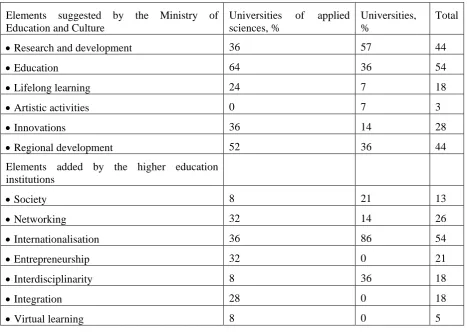
Table 1 depicts the profiles of Finnish higher education institutions during the period of performance agreements from 2013–2016. The elements of the profile have been collected from the textual data of performance agreements into the table following the suggestions by the Ministry of Education and Culture and suggestions by the higher education institutions. The data have been collected separately for the universities of applied sciences and universities because the stipulations and tasks of these two sectors differ from each other. The law of the universities of applied sciences defines the mission of these institutions to support workplaces and regional development, taking into account the regional economic structure. The law of the universities stipulates their mission to serve society.
The external impact perspective of higher education institutions refers to their effect on the region and society. The empirical data about the external impact in performance agreements indicate that regional development is more important for universities of applied sciences than other universities. Most of the universities of applied sciences have notable regional orientation, because 52% of them mention regional development in their written profiles and only 8% mention the importance to all of society. It is noteworthy that the profile of traditional research universities also emphasizes the importance of regional development, because 36% of them mention regional development and only 21% mention the societal importance.
The financial perspective has no reference in the official profiles, even though financing is very important in education policy and the management of higher education institutions. Universities of applied sciences have made plenty of structural changes and closed down small branches, because the central government made budget cuts of nearly 20% in 2013–2015. Universities have been able to keep their small branches and have even established new ones. Universities have made only minor changes and have kept their financial situations relatively stable. The Ministry of Education and Culture has funded projects which aim to make structural changes.
The processes and structures perspective includes the most important profile factors for both sectors of higher education. Education is a profile factor mentioned among 64% of the universities of applied sciences, but research and development (36%), innovations (36%) and internationalization (36%) are also of notable importance. Universities of applied sciences have the wide spectrums of elements in their profiles. They also emphasize the importance of lifelong learning (24%), networking (32%) and entrepreneurship (32%). The integration of research and development into education has been mentioned by 28% of the universities of applied sciences. This is a new educational innovation which enables students to participate in real research and development projects and create skills for participating in development work after graduation. An example of such integration is given as follows: “The profile of the Turku University of Applied Sciences is innovation pedagogy based on interdisciplinarity, where entrepreneurship, applied research and development and internationalisation are integrated into education to support the innovations utilized in the workplaces of Southwest Finland.”
Universities clearly profile themselves with reference to internationalisation, because 86% of them mention it in their performance agreements. Research is mentioned by 57% of the universities, but the share of education is only referenced by 36%. Universities emphasize the importance of interdisciplinarity (36%), which is related to the greater size of universities and their profiles in regional development. A typical profile of universities is given by the University of Helsinki: “The university is an interdisciplinary research university, which strengthens its position among the best
research universities in the world.” Universities emphasize the importance of interdisciplinarity, which is related to the greater size of universities and their profile in regional development.
The learning and growth perspective is related to research and development but also education and other activities. This perspective must be aligned with the profiles of teachers (Ellerani and Mendiza, 2013; Greculescu and Todorescu, 2014). Universities appreciate more research than education merits, which is also typical of research universities in other countries (Drennan, 2001). Universities of applied sciences have more references to education than research and development, even though the role of applied research and development and the amount of doctors have remarkably increased since the establishment of these institutions in the early 1990s.
Elements suggested by the Ministry of Education and Culture
Universities of applied sciences, %
Universities, %
Total
•Research and development 36 57 44
•Education 64 36 54
•Lifelong learning 24 7 18
•Artistic activities 0 7 3
•Innovations 36 14 28
•Regional development 52 36 44
Elements added by the higher education institutions
•Society 8 21 13
•Networking 32 14 26
•Internationalisation 36 86 54
•Entrepreneurship 32 0 21
•Interdisciplinarity 8 36 18
•Integration 28 0 18
•Virtual learning 8 0 5
Table 1. The profiles of Finnish higher education institutions 2013–2016
Figure 1 depicts the frequency of focal areas of the Finnish higher education institutions described in the performance agreements of the period 2013–2016. The Finnish education policy has tried to sharpen the focal areas of institutions to raise the level of research and knowledge. The focus depends on the decision of higher education institutions, which has not led to the desired effects, because the higher education institutions want to serve their regions. There has been a tendency to start new degree programmes and subjects based on each one’s regional needs.
Most of the higher education institutions have from three to six focal areas. Two large universities have exceptionally many focal areas. The Ministry of Education and Culture has advised that the number of focal areas should be relatively low. Even though the institutions have defined low numbers of focal areas, such an awareness has not led to remarkable changes in the number of degree programmes and subjects as desired from the viewpoint of education policy. The weakness of the definition of the focal areas is that they can be defined to consist of only a few focal areas without any structural changes in education and research.
Figure 1. The frequency of focal areas of Finnish higher education institutions 2013–2016
5. DISCUSSION
The Research and Innovation Council initiated the discussion regarding the need to increase remarkably the collaboration of universities of applied sciences and universities. The first alternative is the reform in the legislation so that the laws of the universities of applied sciences and universities should be unified and changes should also be made in other stipulations. The second alternative is to abandon the dual system and merge the universities of applied sciences and universities. Both of these alternatives would constitute large changes which require a lot of evaluation before changes take place.
The changes in legislation and the unification of the missions would not change the regional orientation of higher education institutions, because both sectors have notable regional orientation in their profiles. If the financial regulations of these sectors were unified, there would be positive impacts on the universities of applied sciences, because the output-based funding could not allow budget cuts only for the universities of applied sciences. Unified legislation would improve the distribution of work and cost-efficiency, because there is similar education in both sectors. The competence
0 1 2 3 4 5 6 7 8 9 10
2 3 4 5 6 7
Num
be
r
of
ins
tit
ut
io
ns
Number of focal areas
Universities of applied sciences
0 1 2 3 4
3 4 5 6 7 8 9 10
Num
be
r
of
ins
tit
ut
io
ns
Number of focal areas Universities
requirements of the staff at the universities of applied sciences would increase, because the unified legislation would induce professorships to the universities of applied sciences.
Even more dramatic change would be to abandon the dual model, merge both sectors of higher education and create new regional universities. The regional orientation of these institutions would be strong, while the cost-efficiency of the new universities would be stronger, because they could make better changes in the local premises and improve their processes. On the other hand, the allocation of financial resources between scientific and professional education and research would become controversial, because the scientific side would probably tend to take a larger share. On the other hand, the professional side could have better opportunities to earn external funding for research and development and continuing education due to the increased collaboration. The development would improve the innovation chain from basic research to applied research and development and finally to the business and public sectors to serve the region. The integration of research into education could become a topical matter to consider also in the current research universities. The unified competence requirements of the personnel would increase the labour mobility between the scientific and professional personnel of the present institutions.
As a result, the suggestions by the Research and Innovation Council would not threaten the regional orientation of higher education institutions. There would not be remarkable effects on the financial income of institutions. The possible problems of internal allocation of resources can be avoided by applying the principle of the earnings-related allocation of funding to various activities. The unification of legislation and mergers would improve the cost-efficiency, but the mergers could improve cost-efficiency more than the unification of legislation. Both the unification of legislation and mergers would have positive effects on the processes and structures of institutions. The mergers would lead to stronger and more focused organisational units which could improve the possibilities to reach the internationally recognized high profile. Both of the changes would also bring positive effects to the competence requirements and labour mobility of academic personnel.
6. CONCLUSIONS
This study investigated the effect of education policy on the strategic plans, profiles and focal areas of higher education institutions. Three generic competitive strategies were used in the investigation. The focus strategy is primarily related to the number of focal areas which refers to the combination of faculties and degree programmes or subjects. The focus strategy emphasizes the role of strategic networks of higher education institutions, because the focused institution cannot provide a wide spectrum of degrees. The focus strategy has been relevant to the universities of applied sciences which have given up degree programmes but also for universities which emphasize internationally recognized research. Differentiation is relevant to the higher education institutions which predominantly profile themselves in regional development to meet the needs of local stakeholders. The universities of applied sciences have an especially strong regional profile. Cost-efficiency is relevant in the focus and differentiation strategies, but it is not the primary strategic target for Finnish higher education institutions.
The Finnish education policy has emphasized the development of higher education institutions and the specification of their focal areas to achieve an internationally recognized high profile. The Finnish Ministry of Education and Culture and the Research and Innovation Council encourage higher education institutions to focus their activities and define their focal areas of research and education so that more than one focal areas of research rise above the international average. The central government and the Ministry of Education and Culture support the renewal of structures with strategic funding. Education policy emphasizes the focus strategy by investing in growth areas and closing down activities to create an internationally high profile. Education policy has also encouraged higher education institutions to differentiate themselves in regional development. The Ministry of Education and Culture is able to give the broad outlines of education policy but cannot make the structural changes at the local level. The heads of institutions are expected to think and act strategically and
implement education policy on the strategic plans, but they still face challenges focusing on activities to achieve an internationally recognized high profile.
The empirical results indicate that universities strongly value internationalisation and research that supports the argument that achievement of an internationally recognized high profile is more important for universities than the universities of applied sciences. Universities value research more than education. Universities also value interdisciplinarity, which is due to the fact that they are larger organisations than the universities of applied sciences, and they respond to the interdisciplinary development needs of their community. The empirical results indicate that universities of applied sciences especially but also other universities are regionally oriented higher education institutions which pay attention to the local stakeholders, their strategies and viewpoints when institutions define their strategic plans, profiles and focal areas. Therefore, the closing down of activities and focusing to the focal areas is challenging for institutions. Universities of applied sciences do not focus their activities as sharply as universities, because they value a broader set of operations such as lifelong learning, innovations, networking, internationalisation, entrepreneurship and integration of research and development into education. They also appreciate more education than research and development. The number of focal areas are typically from three to six for both sectors of higher education.
Education policy stated by the Government Programme and the Ministry of Education and Culture encourages higher education institutions to focus their activities to amplify their strengths and improve the collaboration of the universities of applied sciences and universities to support their differentiation strategies for meeting the regional needs. The new challenges stated by the Research and Innovation Council include the removal of legal obstacles to the collaboration of higher education institutions. It also states that the main structural changes include the development or abandonment of the dual model of higher education. These changes would generally have positive effects on the Finnish higher education system. The unification of legislation and mergers would improve the structures and the cost-efficiency of the institutions. The mergers would help create stronger and more focused organisational units which would lead to an internationally recognized high profile.
REFERENCES
Brody, CM 1995, ‘Collaboration or cooperative learning? Complimentary practices for instructional reform’, The Journal of Staff, Program and Organizational development, vol. 12, no. 33, pp. 133-143.
Cancela, JM & Ayán, C 2010, ‘Profile and working expectations of Spanish physical education university students’, Procedia - Social and Behavioral Sciences, vol. 2, no. 2, pp. 2487-2491.
Chang, HH & Huang, WC 2006, ‘Application of a quantification SWOT analytical method’,
Mathematical and Computer Modelling, vol. 43, no. 1-2, pp. 158-169.
Drennan, LT 2001, ‘Quality assessment and the tension between teaching and research’, Quality in Higher Education, vol. 7, no. 3, pp. 167-178.
Ellerani, P & Mendoza, MJG 2013, ‘A participatory process to build and improve the competence profile of teachers using e-portfolio: A case study in an higher education network’, Procedia - Social and Behavioral Sciences, vol. 83, pp. 659-666.
Germeijs, V, Luyckx, K, Notelaers, G, Goossens, L & Verschueren, K 2012, ‘Choosing a major in higher education: Profiles of students’ decision-making process’, Contemporary Educational Psychology, vol. 37, no. 3, pp. 229-239.
Ghazinoory, S, Zadeh, AE & Memariani, A 2007, ‘Fuzzy SWOT analysis’, Journal of Intelligent & Fuzzy Systems: Applications in Engineering and Technology, vol. 18, no. 1, pp. 99-108.
Greculescu, A & Todorescu, LL 2014, ‘Quality assurance and the English teacher’s profile in Romanian technical higher education’, Procedia - Social and Behavioral Sciences, vol. 143, no. 1, pp. 698-702.
Heinze, T & Knill, C 2008, ‘Analysing the differential impact of the Bologna Process: Theoretical considerations on national conditions for international policy convergence’, Higher Education, vol. 56, no. 4, pp. 493-510.
Kaplan, R & Norton, D 2001, The strategy-focused organisation: How Balanced Scorecard companies thrive in the new business environment, Harvard Business School Press, Boston, MA.
Kaplan, R & Norton, D 2004, Strategy maps: Converting intangible assets into tangible outcomes, Harvard Business School Press, Boston, MA.
Kantola, M & Kettunen, J 2012, ’Integration of education with research and development and the export of higher education’, On the Horizon, vol. 20, no. 1, pp. 7-16.
Kettunen, J 2002, ‘Competitive strategies in higher education’, Journal of Institutional Research, vol. 11, no. 2, pp. 38-47.
Kettunen, J 2008, ‘A conceptual framework to help evaluate the quality of institutional performance’,
Quality Assurance in Education, vol. 16, no. 4, pp. 322-332.
Kettunen, J 2011a, ‘Innovation pedagogy for universities of applied sciences’, Creative Education, vol. 2, no. 1, pp. 56-62.
Kettunen, J 2011b, ‘Strategy and quality maps in higher education’, US-China Education Review, vol. 8, no. 2, pp. 149-156.
Kettunen, J & Kantola, M 2006, ‘The implementation of the Bologna Process’, Tertiary Education and Management, vol. 12, no. 3, pp. 257-267.
Lindberg, M 2014, ‘Implications of the Bologna Process for throughput in the higher education sector: An empirical illustration based on a Finnish-British comparison’, European Journal of Education, vol. 49, no. 2, pp. 259-271.
Maassen, P & Stensaker, B 2011, ‘The knowledge triangle: European higher education policy logics and policy implications’, Higher Education, vol. 61, no. 6, pp. 757-769.
Ministry of Education and Culture 2011, Committee reforming the university financing model, Reports of the Ministry of Education and Culture, Finland 2011:26.
Ortega, MJR 2010, ‘Competitive strategies and firm performance: Technological capabilities’ moderating roles’, Journal of Business Research, vol. 63, no. 12, pp. 1273-1281.
Porter, ME 1990, The competitive advantage of nations, Macmillan, London.
Simkins, T 1994, ‘Efficiency, effectiveness and the local management of schools’, Journal of Education Policy, vol. 9, no. 1, pp. 15-33.
Shinno, H, Yoshioka, S, Marpaung, S & Hachiga, S 2006, ‘Qualitative SWOT analysis on the global competiveness of machine tool industry’, Journal of Engineering Design, vol. 17, no. 3, pp. 251-258.
Tutkimus- ja innovaationeuvosto 2014, Uudistuva Suomi: tutkimus- ja innovaatiopolitiikan suunta 2015–2020, Tutkimus- ja innovaationeuvoston 5.11.2014 hyväksymä asiakirja.
Valtioneuvoston kanslia 2011, Pääministeri Jyrki Kataisen hallitusohjelma, 22.6.2011.
West-Burnham, J 1994, ‘Strategy, policy and planning’, in T Bush & J West-Burnham (eds.), The principles of educational management,Longman, Harlow, pp. 77-99.