Page 273
THE EFFECTIVENESS OF TRADITIONAL TREATMENT OF ARTICULATION DISORDERS IN PRESCHOOL CHILDREN
Andreas Bessas, Nikolaos Trimmis
Technological Educational Institute of Western Greece, Department of Speech Language Therapy, M. Alexandrou 1 - Koukouli, 26334, Patra, Greece
Abstract
The aim of the present study was to identify the effectiveness of the traditional approach to speech therapy in children with functional speech-sound disorders. Four preschool-aged children with functional articulation disorders received a three-month traditional intervention program with one-hour sessions twice a week. Evaluation of speech-sounds was presented pre- and post-therapy. Data analysis revealed that the traditional therapeutic approach is effective for this age group. Overall, all four children demonstrated an improvement in phoneme accuracy.
Key words: functional articulation disorder, speech-sound disorder, speech therapy
1. INTRODUCTION
In speech therapy practice, there are many implications for the results of articulation therapy at various age groups. The most common concern of researchers is the diversity of individual speech-sound disorders (SSD) and of the complex symptoms noted in both, preschool- and school-aged children. The therapy goals and sub goals that are to be found in all articulation therapeutic methods are the awareness of the characteristics of the standard phonemes, the correct production of them, the stabilization and strengthening of the use of standard phonemes in isolation, in syllables and in words, phrases and sentences (Van Riper & Erickson, 1996). As Van der Gaag & Reid (1998) state, the speech therapists are part of a multi-disciplinary team, they inform and get informed regarding relevant factors during the intervention period as the intervention may be carried directly or indirectly (facilitated by the therapist and carried out by parents, classroom assistants or significant others). Van Riper and Erickson (1996) have proposed a therapy method divided into three phases, with each phase representing a different stage that the child may achieve. In the first phase (acoustic exercise) the target-phoneme is identified, isolated, stimulated and discriminated (sensory/perceptual training). In the second phase, the phoneme is reproduced by imitation, stabilised and produced automatically in isolation. Finally, in the third stage of treatment, the phoneme is transferred in spontaneous speech in all communicative contexts. The mastering of a new sound may be viewed in terms of four successive levels: 1) Isolated sound level, 2) The sound in syllable, 3) The sound in a word, and 4) the sound in a meaningful sentence. Each level contains the three phases of therapy, thus structuring a twelve step therapeutic program.
Page 274
efficiency: 1) number of trials required to complete the program, 2) improvement on an articulation test after each phase of the program, and 3) improvement in spontaneous speech after each phase of the program. Results indicated that the pattern approach was more efficient in all areas. It is evident that the pattern approach seems to predominate, although the clinical details of children that seem to improve their phonological system after a specific intervention are not clear.
A more recent study informs us that the effectiveness of two treatment approaches (phonological therapy and articulation therapy) for treatment of 14 children, aged 4:0-6:7 years, with a phonologically based SSD, has been previously analysed with severity outcome measures (percentage of consonants correct score, percentage of phonological processes and phonetic inventory). It is known that the ultimate goal of intervention for children with phonologically based SSDs is to improve intelligibility; for this purpose, the reason why intervention studies focusing on children's phonology do not routinely use intelligibility as an outcome measure seems interesting, although it is extremely important to study the impact of interventions on speech intelligibility. In a study of Lousada et al. (2014) the effectiveness of the two treatment approaches (phonological therapy and articulation therapy) using intelligibility measures was studied, both in single words and in continuous speech. The results showed that significant improvements were noted in both, single words and in continuous speech, but no differences emerged for those receiving the articulation therapy; intelligibility measures were sensitive enough to show changes in the phonological therapy group but not in the articulation therapy group. This study suggests how important is the role of using intelligibility as an outcome measure to complement the results obtained with other severity measures when exploring the effectiveness of speech intervention. It presents new evidence for the effectiveness of phonological therapy in improving intelligibility in children with SSDs (Lousada et al. 2014).
For speech therapists, the accuracy of methods used in each case is of utmost importance. According to Fey (1992) it is interesting that with the progress of scientific research in the field of communication disorders and the launch of new terms in the study of disorders, confusion was created among clinical speech therapists, while new clinical techniques should differ radically from the old ones. This study shows that adopting a phonological approach to dealing with a SSD does not necessitate rejection of the well-established principles underlying traditional approaches to articulation disorders; articulation must be recognized as a critical aspect of speech sound development under any theory. Phonological principles should be viewed as adding new dimensions and a new perspective to an old problem, not simply as refuting established principles. It does not contribute, however, any new information to the basic question of whether phonological approaches consist of promising rehabilitation techniques, as it is mentioned (Fey, 1992). Probably this is due to the diversity of communication disorders, in particular of SSDs, as stated by Crosbie, Holm & Dodda (2005). More specifically they state that children with a SSD are a heterogeneous group (e.g. in terms of severity, types of errors and underlying causal factors), while much research has ignored this heterogeneity, giving rise to contradictory intervention study findings. This situation provides clinical motivation to identify the deficits in the speech‐processing chain that underlie different subgroups of developmental speech disorders. Intervention, targeting different deficits should result in a differential response to intervention across these subgroups. They also report results from a study aiming to evaluate the effect of two different types of therapy on speech accuracy and consistency of word production in children with consistent and inconsistent SSDs. The results show that all children have increased their competences, but the most important thing is the fact that the results provide evidence that treatment targeting the speech‐processing deficit underlying a child's SSD will result in efficient system‐wide change (Crosbie, Holm & Dodda, 2005).
Page 275
Comparing the two approaches in children with multiple SSDs, a group received evaluation and therapy based on a traditional paradigm and another received phonologically based evaluation and treatment procedures, Klein (1996) indicated that children in the phonological group showed significantly greater improvement in a significantly shorter period of time than children in the traditional group (Klein, 1996).
The need to further study the therapy methods used by speech therapists is clearly demonstrated when looking into the respective literature, especially in Greece, where no similar studies have been carried out. It is important for clinical speech therapists to know the potential of each therapy method and cases of disorders which seem to be effective, and also propose improvements to already known therapeutic methods, if application of them is found to be disrupted.
2. METHODS 2.1. Subjects
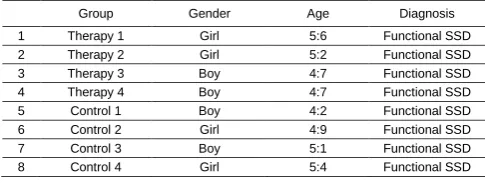
Eight children participated in this study, four boys and four girls, aged 4:2 to 5:1 years with a diagnosis of a functional SSD. Four of them attended a tree month articulation program and four of them served as a control group. All eight children did not feature any structural or motor disorder, mental retardation, neurological impairment, psychiatric or sensory impairment or any other developmental impairment. The children's main difficulty was their inadequacy to acoustically discriminate phonemes and to respectively reproduce them. The children's native language was Modern Greek and all of them were mainstreamed.
Table 1. Subjects of the study.
2.2. Evaluation
This particular study evaluated the verbal system of children using the Phonetic and Phonological Development Test (PPDT) of the Panhellenic Association of Logopedics (1995). This tool uses 70 simple and 2 composite black and white images for naming; the speech-sounds and the phonological simplification processes produced by each child were recorded. The goals of therapy were set by analysis of the errors. The above tool was used both pre- and post-treatment, while the results were compared and analysed. For this particular study, only the first seventy (70) simple images were used for naming, as they include the majority of the phonemes of Modern Greek language in different positions, and therefore the result can be considered reliable. Before initiation of the treatment program, the children were evaluated using PPDT in a speech therapy room; the examiner explained the test details and provided the necessary instructions. The child's answers were recorded in pre-drafted form. After completion of the treatment program, the above evaluation was repeated in the same manner.
Group Gender Age Diagnosis
1 Therapy 1 Girl 5:6 Functional SSD
2 Therapy 2 Girl 5:2 Functional SSD
3 Therapy 3 Boy 4:7 Functional SSD
4 Therapy 4 Boy 4:7 Functional SSD
5 Control 1 Boy 4:2 Functional SSD
6 Control 2 Girl 4:9 Functional SSD
7 Control 3 Boy 5:1 Functional SSD
Page 276 2.3. Therapeutic process
Therapeutic intervention lasted three months, during which one-hour sessions twice a week of individualised rehabilitation took place. The intervention program was designed for each child individually, depending on the errors exhibited during evaluation of articulating speech sounds. The treatment program was based on the traditional Van Riper approach, which is a type of articulation treatment for SSDs. In the first stage of treatment, the target sound is determined and is differentiated from the rest. In this stage, this method includes an individual discrimination of the sound and focusing of the child's attention to its distinctive characteristics. The second stage involves the reproduction of speech sounds in all contexts. It includes learning to reproduce the target-sound individually in CV syllables, in CVCV and VCV nonsense words, in real bisyllabic, trisyllabic and polysyllabic words in the initial, middle and (where possible) final position. In the final stage, the sound already mastered is strengthened and stabilised in small phrases, sentences and spontaneous speech. Visual material (pictures, objects, illustrated stories) were used for the purposes of this study. Given the diversity of articulation and phonological disorders, the target-sound was different for each child.
3. RESULTS
3.1. Treatment Group
3.1.1. Case 1 - A.T., Girl, 5:6 years old
The clinical picture of this child in its first evaluation involved fronting the phoneme /s/, which was vocalised as /θ/, exhibiting a dental-alveolar realisation at a percentage of 96.55% for all errors, i.e. a total of 30 errors. Further simplifications involve the replacement of /ʎ/ with /ʝ/ in only one case. The phonological errors of the child seemed to be constant.
The treatment program included restoring articulation of the /s/ sound in accordance with the above Van Riper methodology. All sessions ran smoothly and were completed in full.
After completion of the three-month treatment program, the child was re-evaluated and the results showed an improvement in articulation of the target-sound. The child had a total of fourteen frontings, i.e. 51.72% less than in initial evaluation.
Table 2. Initial evaluation, A.T., 5:6 years old.
These errors are part of the child's clinical picture. Words that are not presented relate to fronting of the phoneme /s/. Re-evaluation of the child follows at the end of the therapy program.
Phonological model
Phonotactic structure
Phonetic recording
Phonotactic
recording Errors 1 maˈçeɾi cvˈcvcv maˈθeɾi cvˈcvcv /ç/-[θ] - fronting
2 ˈzoni ˈcvcv ˈðoni ˈcvcv /z/-[ð] - fronting
3 aʝeˈlaða vcvˈcvcv azeˈlaða vcvˈcvcv /ʝ/-[z] - fronting 4 ˈaɟelos ˈvcvcvc ˈaɟeloθ ˈvcvcvc /s/-[θ] - fronting 5 aɾiθ.ˈmos vcvccˈcvc aɾiθ.ˈmoθ vcvccˈcvc /s/-[θ] - fronting 6 ʎoˈdaɾi cvˈcvcv ʝoˈdaɾi cvˈcvcv /ʎ/-[ʝ] – other errors 7 ˈðɾakos ˈccvcvc ˈðɾakoθ ˈccvcvc /s/-[θ] - fronting 8 ˈnaftis ˈcvccvc ˈnaftiθ ˈcvccvc /s/-[θ] - fronting 9 çeˈlona cvˈcvcv θeˈlona cvˈcvcv /ç/-[θ] - fronting
10 ˈiʎos ˈvcvc ˈiʎoθ ˈvcvc /s/-[θ] - fronting
Page 277
Table 3. Final evaluation, A.T., 5:6 years old.
Table 4. Comparison of Initial and Final evaluation, A.T., 5:6 years old.
The table above demonstrates that the child failed to eliminate its phonology error during the three-month therapy program. The high percentage compared to the total errors of the re-evaluation shows that fronting remains the child's dominant error. Improvement, however, is clearly evident leading to the conclusion that the application of traditional articulatory treatment in this case can be considered successful.
3.1.2. Case 2 - K.A., Girl, 5:2 years old
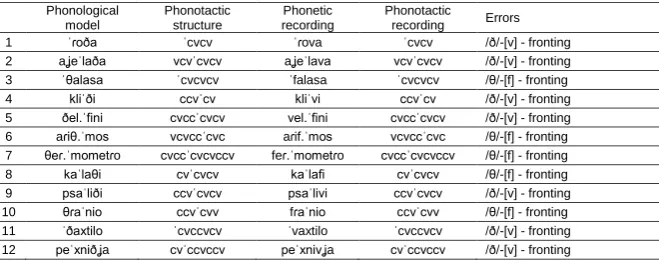
The clinical picture of the child in its first evaluation involved fronting the dental consonants, namely labial articulation of dental consonants expressed by replacing the /θ/ with the /f/ sound and /ð/ with the /v/ sound. These replacements are all the errors that the child presented, i.e. a total of 12 errors. The phonological errors of the child seemed to be constant.
The treatment program included restoration of articulating the /ð/ sound in accordance with the above methodology. It was considered appropriate to restore the /θ/ sound after having achieved the /ð/ sound. All sessions ran smoothly and were completed in full.
Table 5. Initial evaluation, K.A., Girl, 5:2 years old.
Phonological model
Phonotactic structure
Phonetic recording
Phonotactic
recording Errors 1 maˈçeɾi cvˈcvcv maˈθeɾi cvˈcvcv /s/-[θ] - fronting
2 ˈzoni ˈcvcv ˈðoni ˈcvcv /z/-[ð] - fronting
3 aʝeˈlaða vcvˈcvcv azeˈlaða vcvˈcvcv /ʝ/-[z] - fronting 4 ˈaɟelos ˈvcvcvc ˈaɟeloθ ˈvcvcvc /s/-[θ] - fronting 5 aɾiθ.ˈmos vcvccˈcvc aɾiθ.ˈmoθ vcvccˈcvc /s/-[θ] - fronting 6 ʎoˈdaɾi cvˈcvcv ʝoˈdaɾi cvˈcvcv /ʎ/-[ʝ] – other errors 7 ˈðɾakos ˈccvcvc ˈðɾakoθ ˈccvcvc /s/-[θ] - fronting 8 ˈnaftis ˈcvccvc ˈnaftiθ ˈcvccvc /s/-[θ] - fronting 9 çeˈlona cvˈcvcv θeˈlona cvˈcvcv /ç/-[θ] - fronting
10 ˈiʎos ˈvcvc ˈiʎoθ ˈvcvc /s/-[θ] - fronting
11 kaˈfes cvˈcvc kaˈfeθ cvˈcvc /s/-[θ] - fronting 12 ˈfadazma ˈcvcvccv ˈfadaðma ˈcvcvccv /z/-[ð] - fronting 13 kaˈpnos cvˈccvc kaˈpnoθ cvˈccvc /s/-[θ] - fronting 14 vɾoˈçi ccvˈcv vɾoˈθi ccvˈcv /ç/-[θ] - fronting 15 ˈciknos ˈcvccvc ˈciknoθ ˈcvccvc /s/-[θ] - fronting
Initial evaluation Final evaluation
Errors Ν % Ν %
Fronting 30 96.77 14 93.33
Other errors 1 3.23 1 6.66
Total 31 100.00 15 100.00
Phonological model
Phonotactic structure
Phonetic recording
Phonotactic
recording Errors
1 ˈɾoða ˈcvcv ˈɾova ˈcvcv /ð/-[v] - fronting
Page 278
These errors comprised the entire clinical picture of the child. Re-evaluation of the child followed at the end of the therapy program.
Table 6. Final evaluation, K.A., Girl, 5:2 years old.
We noted from the re-evaluation that the child restored the reproduction of the /ð/ sound in all cases, as shown in the table below, since the only errors the child produced concerned fronting the /θ/ sound. Interestingly enough, although the two sounds are articulated in the same manner and place (dental and fricative consonants), the child failed to widely apply proper reproduction of the resonant sound by correcting the reproduction of the corresponding soundless one. This is an interesting detail, which however needs to be further investigated.
Table 7. Comparison of Initial and Final evaluation, K.A., Girl, 5:2 years old.
3.1.3. Case 3 - M.K., Boy, 4:7 years old
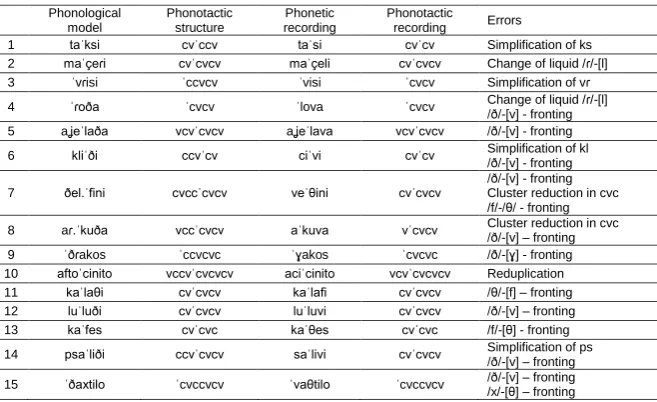
The clinical picture of the present child included 21 cluster simplifications in 20 of the testing words of the test, five cluster reductions in CVC syllables, one syllable reduction, one syllable reduplication, seven backings of labial sounds and articulation thereof as dental ones, 13 replacements of liquid trill /ɾ/ with the liquid lateral /l/, it expressed labial articulation of dental consonants nine times and changed palatal consonants once. The phonological errors of the child do not seem to be constant. The treatment program included restoration of articulating the /ð/ sound in accordance with the above traditional methodology. Although errors in pronunciating the /ɾ/ sound are quite frequent, the sound itself is achieved by children with Greek as their native language by the age of six years, unlike with dental consonants that are achieved earlier. It was considered appropriate to restore the /θ/ sound after having achieved the /ð/ sound. All sessions ran smoothly and were completed in full.
Phonological model
Phonotactic structure
Phonetic recording
Phonotactic
recording Errors 1 ˈθalasa ˈcvcvcv ˈfalasa ˈcvcvcv /θ/-[f] - fronting 2 aɾiθ.ˈmos vcvccˈcvc aɾif.ˈmos vcvccˈcvc /θ/-[f] - fronting 3 θeɾ.ˈmometɾo cvccˈcvcvccv feɾ.ˈmometɾo cvccˈcvcvccv /θ/-[f] - fronting 4 kaˈlaθi cvˈcvcv kaˈlafi cvˈcvcv /θ/-[f] - fronting 5 θɾaˈnio ccvˈcvv fɾaˈnio ccvˈcvv /θ/-[f] - fronting
Initial evaluation Final evaluation
Errors Ν % Ν %
/ð/-[v] - fronting 7 58.33 0 0.00
/θ/-[f] - fronting 5 41.66 5 100.00
Page 279
Table 8. Initial evaluation, M.K., Boy, 4:7 years old.
These errors are part of the child's clinical picture. Words that are not presented involve the same error patterns. Re-evaluation of the child followed at the end of the therapy program
Table 9. Final evaluation, M.K., Boy, 4:7 years old.
When re-evaluated, the child had significantly improved the articulation of the target-sound, since its only fronting was noted in the pronunciation of the /θ/ sound. The result of the treatment program is pretty clear, although it appears to be lacking a wide application of the achieved ability to articulate dental consonants. The rest of the child's phonological errors did not seem to have been reduced.
Phonological model
Phonotactic structure
Phonetic recording
Phonotactic
recording Errors
1 taˈksi cvˈccv taˈsi cvˈcv Simplification of ks
2 maˈçeɾi cvˈcvcv maˈçeli cvˈcvcv Change of liquid /ɾ/-[l]
3 ˈvɾisi ˈccvcv ˈvisi ˈcvcv Simplification of vɾ
4 ˈɾoða ˈcvcv ˈlova ˈcvcv Change of liquid /ɾ/-[l] /ð/-[v] - fronting 5 aʝeˈlaða vcvˈcvcv aʝeˈlava vcvˈcvcv /ð/-[v] - fronting 6 kliˈði ccvˈcv ciˈvi cvˈcv Simplification of kl /ð/-[v] - fronting
7 ðel.ˈfini cvccˈcvcv veˈθini cvˈcvcv /ð/-[v] - fronting Cluster reduction in cvc /f/-/θ/ - fronting 8 aɾ.ˈkuða vccˈcvcv aˈkuva vˈcvcv Cluster reduction in cvc /ð/-[v] – fronting 9 ˈðɾakos ˈccvcvc ˈɣakos ˈcvcvc /ð/-[ɣ] - fronting 10 aftoˈcinito vccvˈcvcvcv aciˈcinito vcvˈcvcvcv Reduplication 11 kaˈlaθi cvˈcvcv kaˈlafi cvˈcvcv /θ/-[f] – fronting 12 luˈluði cvˈcvcv luˈluvi cvˈcvcv /ð/-[v] – fronting 13 kaˈfes cvˈcvc kaˈθes cvˈcvc /f/-[θ] - fronting 14 psaˈliði ccvˈcvcv saˈlivi cvˈcvcv Simplification of ps /ð/-[v] – fronting
15 ˈðaxtilo ˈcvccvcv ˈvaθtilo ˈcvccvcv /ð/-[v] – fronting /x/-[θ] – fronting
Phonological model
Phonotactic structure
Phonetic recording
Phonotactic
recording Errors
1 taˈksi cvˈccv taˈsi cvˈcv Simplification of ks
2 maˈçeɾi cvˈcvcv maˈçeli cvˈcvcv Change of liquid /ɾ/-[l]
3 ˈvɾisi ˈccvcv ˈvisi ˈcvcv Simplification of vɾ
4 ˈɾoða ˈcvcv ˈloða ˈcvcv Change of liquid /ɾ/-[l]
5 aʝeˈlaða vcvˈcvcv aʝeˈlaða vcvˈcvcv -
6 kliˈði ccvˈcv ciˈði cvˈcv Simplification of kl
7 ðel.ˈfini cvccˈcvcv ðeˈθini cvˈcvcv Cluster reduction in cvc /f/-/θ/ - fronting 8 aɾ.ˈkuða vccˈcvcv aˈkuða vˈcvcv Cluster reduction in cvc 9 ˈðɾakos ˈccvcvc ˈðakos ˈcvcvc Simplification of ðɾ 10 aftoˈcinito vccvˈcvcvcv aciˈcinito vcvˈcvcvcv Reduplication 11 kaˈlaθi cvˈcvcv kaˈlafi cvˈcvcv /θ/-[f] – fronting
12 luˈluði cvˈcvcv luˈluði cvˈcvcv -
Page 280
Table 10. Comparison of Initial and Final evaluation, MK, Boy, 4:7 years old.
3.1.4. Case 4 - M.H., Boy, 4:7 years old
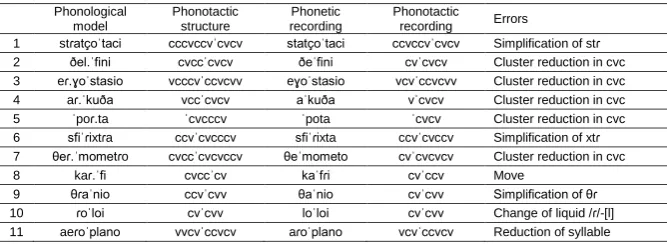
The clinical picture of the child included three cluster simplifications, five closed CVC syllable sounds reduction, one transfer and one replacement of liquid consonants /ɾ/-/l/, one sound transfer and one reduction of syllable. The phonological errors of the child seemed to be constant, as most errors were noted in syllables containing the /ɾ/ sound.
The treatment program included restoring articulation of the /ɾ/ sound in closed CVC syllables and sound clusters, according to the above methodology. All sessions ran smoothly and were completed in full.
Table 11. Initial evaluation, M.H., Boy, 4:6 years old.
These errors comprised the entire clinical picture of the child. Re-evaluation of the child followed at the end of the therapy program.
Table 12. Final evaluation, M.H., Boy, 4:6 years old.
Initial evaluation Final evaluation
Errors Ν % Ν %
Simplifications of
complexes 21 36.21 19 37.26
Cluster reduction in
cvc 5 8.62 6 11.76
Reduction of
syllable 1 1.72 1 1.96
Reduplication 1 1.72 1 1.96
Backing 7 12.07 8 15.69
Change of /ɾ/- [l] 13 22.41 14 27.45
Fronting 9 15.52 1 1.96
Change of palatal
consonants 1 1.72 1 1.96
Total 58 100.00 51 100.00
Phonological model
Phonotactic structure
Phonetic recording
Phonotactic
recording Errors
1 stɾatçoˈtaci cccvccvˈcvcv statçoˈtaci ccvccvˈcvcv Simplification of stɾ 2 ðel.ˈfini cvccˈcvcv ðeˈfini cvˈcvcv Cluster reduction in cvc 3 eɾ.ɣoˈstasio vcccvˈccvcvv eɣoˈstasio vcvˈccvcvv Cluster reduction in cvc 4 aɾ.ˈkuða vccˈcvcv aˈkuða vˈcvcv Cluster reduction in cvc 5 ˈpoɾ.ta ˈcvcccv ˈpota ˈcvcv Cluster reduction in cvc 6 sfiˈɾixtɾa ccvˈcvcccv sfiˈɾixta ccvˈcvccv Simplification of xtɾ 7 θeɾ.ˈmometɾo cvccˈcvcvccv θeˈmometo cvˈcvcvcv Cluster reduction in cvc
8 kaɾ.ˈfi cvccˈcv kaˈfɾi cvˈccv Move
9 θɾaˈnio ccvˈcvv θaˈnio cvˈcvv Simplification of θɾ 10 ɾoˈloi cvˈcvv loˈloi cvˈcvv Change of liquid /ɾ/-[l] 11 aeɾoˈplano vvcvˈccvcv aɾoˈplano vcvˈccvcv Reduction of syllable
Phonological model
Phonotactic structure
Phonetic recording
Phonotactic
recording Errors 1 stɾatçoˈtaci cccvccvˈcvcv stɾatçoˈtaci cccvccvˈcvcv -
2 ðel.ˈfini cvccˈcvcv ðeˈfini cvˈcvcv Cluster reduction in cvc 3 eɾ.ɣoˈstasio vcccvˈccvcvv eɾ.ɣoˈstasio vcccvˈccvcvv -
4 aɾ.ˈkuða vccˈcvcv aɾ.ˈkuða vccˈcvcv -
5 ˈpoɾ.ta ˈcvcccv ˈpoɾ.ta ˈcvcccv -
6 sfiˈɾixtɾa ccvˈcvcccv sfiˈɾixtɾa ccvˈcvcccv - 7 θeɾ.ˈmometɾo cvccˈcvcvccv θeɾ.ˈmometɾo cvccˈcvcvccv -
8 kaɾ.ˈfi cvccˈcv kaɾ.ˈfi cvccˈcv -
9 θɾaˈnio ccvˈcvv θɾaˈnio ccvˈcvv -
10 ɾoˈloi cvˈcvv ɾoˈloi cvˈcvv -
Page 281
When re-evaluated, the child had improved the articulation of the target-sound both in closed syllables, and in clusters, since the only closed syllable sound reduction noted was when pronunciating the /l/ sound. The result of the treatment program was pretty clear, although it appeared to be lacking a wide application of the achieved ability to articulate liquid consonants.
Table 13. Comparison of Initial and Final evaluation, M.H., Boy, 4:6 years old.
3.2. Control Group
3.2.1. Control Case 1 – Μ.Μ., Boy, 4:2 years old
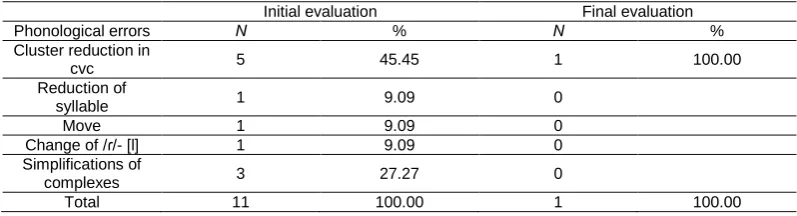
The clinical picture of the child included two cluster simplifications, two cluster reductions in CVC syllables, one reduction of syllable and 1 fronting of /ð/. The phonological errors of the child seemed to be constant. Examination of the orofacial mechanism revealed no structural abnormality or motor difficulties.
Table 14. Initial and Final evaluation, Μ.Μ., Boy, 4:2 years old.
Re-evaluation of the child followed at the end of the therapy program. The clinical picture of the child after the three-month period was identical to the initial evaluation, indicating that there was no improvement in child’s production.
Table 15. Comparison of Initial and Final evaluation, Μ.Μ., Boy, 4:2 years old.
Initial evaluation Final evaluation
Phonological errors Ν % Ν %
Cluster reduction in
cvc 5 45.45 1 100.00
Reduction of
syllable 1 9.09 0
Move 1 9.09 0
Change of /ɾ/- [l] 1 9.09 0
Simplifications of
complexes 3 27.27 0
Total 11 100.00 1 100.00
Phonological model
Phonotactic structure
Phonetic recording
Phonotactic
recording Errors
1 stɾaˈtçotis cccvˈccvcvc taˈtçotis cvˈccvcvc Simplification of stɾ 2 aˈftça vˈcccv aˈfta vˈccv Simplification of ftç 3 eɾ.ɣoˈstasio vc.cvˈccvcvv eɣoˈstasio vc.cvˈccvcvv Cluster reduction in cvc 4 ˈpoɾ.ta ˈcvc.cv ˈpota ˈcvc.cv Cluster reduction in cvc 5 ˈðaxtilo ˈcvccvcv ˈvaxtilo ˈcvccvcv /ð/-[v] - fronting 6 aeɾoˈplano vvcvˈccvcv aɾoˈplano vcvˈccvcv Reduction of syllable
Initial evaluation Final evaluation
Phonological errors Ν % Ν %
Simplifications of
complexes 2 33.33 2 33.33
Cluster reduction in
cvc 2 33.33 2 33.33
Fronting 1 16.67 1 16.67
Reduction of
syllable 1 16.67 1 16.67
Page 282 3.2.2. Control Case 2 – E.P., Girl, 4:9 years old
The clinical picture of the child involved fronting the dental consonants, namely labial articulation of dental consonants expressed by the replacing /θ/ with the /f/ sound and /ð/ with the /v/ sound. The phonological errors of the child seemed to be constant. Examination of the orofacial mechanism revealed no structural abnormality or motor difficulties.
Table 16. Initial and Final evaluation, E.P., Girl, 4:9 years old.
Re-evaluation of the child followed at the end of the therapy program. The clinical picture of the child after the three-month period was identical to the initial evaluation, indicating that there was no improvement in child’s production.
Table 17. Comparison of Initial and Final evaluation, E.P., Girl, 4:9 years old.
3.2.3. Control Case 3 – G.B., Boy, 5:1 years old
The clinical picture of the child involved five cluster simplifications in complexes and one cluster reduction in CVC syllables. The phonological errors of the child seemed to be constant.
Table 18. Initial evaluation, G.B., Boy, 5:1 years old.
Re-evaluation of the child followed at the end of the therapy program. The clinical picture of the child after the three-month period was almost identical to the initial evaluation, except for the cluster reduction in CVC syllables, indicating that there was no improvement in child’s production.
Phonological model
Phonotactic structure
Phonetic recording
Phonotactic
recording Errors
1 aʝeˈlaða vcvˈcvcv aʝeˈlava vcvˈcvcv /ð/-[v] - fronting 2 ðel.ˈfini cvccˈcvcv vel.ˈfini cvccˈcvcv /ð/-[v] - fronting 3 θeɾ.ˈmometɾo cvccˈcvcvccv feɾ.ˈmometɾo cvccˈcvcvccv /θ/-[f] - fronting 4 ˈðaxtilo ˈcvccvcv ˈvaxtilo ˈcvccvcv /ð/-[v] - fronting 5 peˈxniðʝa cvˈccvccv peˈxnivʝa cvˈccvccv /ð/-[v] - fronting
Initial evaluation Final evaluation
Phonological errors Ν % Ν %
Fronting 5 100.00 5 100.00
Total 5 100.00 5 100.00
Phonological model
Phonotactic structure
Phonetic recording
Phonotactic
recording Errors
1 taˈksi cvˈccv taˈsi cvˈcv Simplification of ks
2 ˈvɾisi ˈccvcv ˈvisi ˈcvcv Simplification of vɾ
3 kliˈði ccvˈcv ciˈði cvˈcv Simplification of kl
Page 283
Table 19. Final evaluation, G.B., Boy, 5:1 years old.
Table 20. Comparison of Initial and Final evaluation, G.B., Boy, 5:1 years old
3.2.4. Control Case 4 – E.P., Girl, 5:4 years old
The clinical picture of the child involved five cluster simplifications in complexes and one cluster reduction in CVC syllables. The phonological errors of the child seemed to be constant.
Table 21. Initial evaluation, E.P., Girl, 5:4 years old.
Re-evaluation of the child followed at the end of the therapy program. The clinical picture of the child after the three-month period was identical to the initial evaluation, indicating that there was no improvement in child’s production.
Table 22. Comparison of Initial and Final evaluation, E.P., Girl, 5:4 years old.
Phonological model
Phonotactic structure
Phonetic recording
Phonotactic
recording Errors
1 taˈksi cvˈccv taˈsi cvˈcv Simplification of ks
2 ˈvɾisi ˈccvcv ˈvisi ˈcvcv Simplification of vɾ
3 kliˈði ccvˈcv ciˈði cvˈcv Simplification of kl
4 aɾ.ˈkuða vccˈcvcv aɾ.ˈkuða vccˈcvcv -
5 ˈðɾakos ˈccvcvc ˈðakos ˈcvcvc Simplification of ðɾ 6 aftoˈcinito vccvˈcvcvcv afoˈcinito vcvˈcvcvcv Simplification of ft
Initial evaluation Final evaluation
Phonological errors Ν % Ν %
Simplification of
complexes 5 83.33 5 100.00
Cluster reduction in
cvc 1 16.67 0 0.00
Total 6 100.00 5 100.00
Phonological model
Phonotactic structure
Phonetic recording
Phonotactic
recording Phonological errors 2 ðel.ˈfini cvccˈcvcv ðeˈfini cvˈcvcv Cluster reduction in cvc 3 eɾ.ɣoˈstasio vcccvˈccvcvv eɣoˈstasio vcvˈccvcvv Cluster reduction in cvc 4 aɾ.ˈkuða vccˈcvcv aˈkuða vˈcvcv Cluster reduction in cvc 5 ˈpoɾ.ta ˈcvcccv ˈpota ˈcvcv Cluster reduction in cvc 7 θeɾ.ˈmometɾo cvccˈcvcvccv θeˈmometo cvˈcvcvcv Cluster reduction in cvc 8 kaɾ.ˈfi cvcˈcv kaˈfi cvcˈcv Cluster reduction in cvc 11 aeɾoˈplano vvcvˈccvcv aɾoˈplano vcvˈccvcv Reduction of syllable
Initial evaluation Final evaluation
Phonological errors Ν % Ν %
Cluster reduction in
cvc 6 85.71 6 85.71
Reduction of
syllable 1 14.29 1 14.29
Page 284 4. DISCUSSION
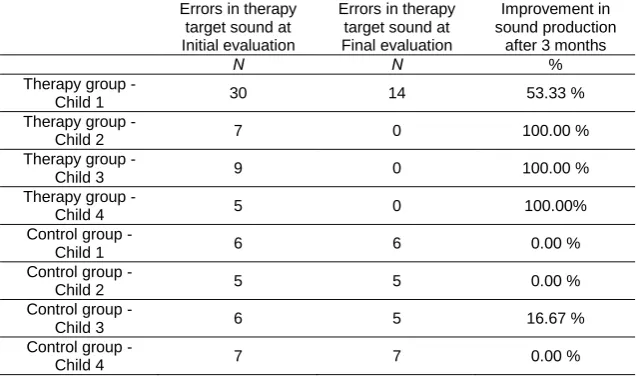
The above results revealed that the articulation of the target-sound was restored in all cases, in three of which erroneous articulation was eliminated at 100.00%. In the first case, although there was an improvement in the ability to articulate the target-sound, however, complete restoration was not possible in the time frame determined by the therapeutic program.
Table 23. Summary of results.
The clinical pictures of children before treatment showed that in all three cases the errors were constant, one of which concerning the child that failed to fully achieve the ability to articulate the target-sound. In the latter case with the non-constant errors in sound articulation, the achievement was complete. This shows that regardless of the type of errors in articulating sounds, the traditional approach for treatment of the disorders studied in this paper can be considered effective, although the time frame to reach the final result depends on different factors that should be investigated.
However, a wide application of the results to associated categories of sounds (such as the two dental fricatives /θ/ and /ð/, or the alveolar fricatives /s/ and /z/) does not seem possible with the use of this method. This means that each sound not properly articulated, should be restored separately, a point suggesting that in phonological disorders with a complex clinical picture a full treatment program is expected to require considerable time and effort.
Results confirm the statements of Ruder & Bunce (1981) that traditional sound-level approaches for remediation of multiple speech-sound errors in children have several limitations, as the approaches which focus on remediation of patterns of errors may be more effective in such cases. Our differences in the results of Case one in relation to the other cases confirm that. However, our results did not confirm the results of Crary & Hunt (1982) research, which stated that the pattern approach was more efficient in all areas, as in our study the traditional articulation approach was successful. It is related with the findings of Fey`s (1992) study, which states that a phonological approach to dealing with SSDs does not necessitate rejection of the well-established principles underlying traditional approaches to articulation disorders. Finally, the statement of Crosbie, Holm & Dodda (2005) that treatment targeting the speech‐processing deficit underlying a child's SSD will result in efficient system‐wide change, could not be confirmed by the results of the present study, since other aspects of children’s language are not tested.
Errors in therapy target sound at Initial evaluation
Errors in therapy target sound at Final evaluation
Improvement in sound production
after 3 months
Ν Ν %
Therapy group -
Child 1 30 14 53.33 %
Therapy group -
Child 2 7 0 100.00 %
Therapy group -
Child 3 9 0 100.00 %
Therapy group -
Child 4 5 0 100.00%
Control group -
Child 1 6 6 0.00 %
Control group -
Child 2 5 5 0.00 %
Control group -
Child 3 6 5 16.67 %
Control group -
Page 285
Chart 1. Summary of results
5. RECOMMENDATIONS
The traditional approach for treatment of articulation disorders is undeniably successful, but this study raises new questions on the treatment of articulation disorders.
Perhaps the most important of them is the question on the difference between complete success in three of the cases in this study, and on the reason why in the first case the treatment failed to restore the incorrect output of the child, but only partial success was noted. The clinical picture cannot give us any additional information, since an unstable clinical picture with various errors could justify this partial failure. It is considered necessary to repeat the study aiming to investigate this observation. It is also suggested to repeat the study in combination with other therapeutic methods, as proposed in the relevant literature, in order to reveal the dynamics of rehabilitation in several cases of children with phonological disorders. The lack of relevant data precludes generalisation of findings in all possible cases.
REFERENCES
Crary, MA & Hunt, TL 1982, Sounds Vs. Patterns: A Case Comparison of Approaches for Articulation Therapy, Australian Journal of Human Communication Disorders, vol. 10, no. 2, pp.15-22
Crosbie, S, Holm, A & Dodda B 2005, Intervention for children with severe speech disorder: A comparison of two approaches, International Journal of Language & Communication Disorders, vol. 40, no. 4, pp.467-491
Fey, ME 1992, Articulation and Phonology: Inextricable Constructs in Speech Pathology, Language, Speech, and Hearing Services in Schools, vol. 23, pp.225-232
Grunwell, P & Dive, D 1988, Treating 'cleft palate speech': combining phonological techniques with traditional articulation therapy, Child Language Teaching and Therapy, vol. 4, no. 2, pp.193-210
Page 286
Lousada, M, Jesus, LM, Hall, A & Joffe, V 2014, Intelligibility as a clinical outcome measure following intervention with children with phonologically based speech-sound disorders, International journal of language & communication disorders, vol. 49, no. 5, pp.584-601
Mowrer, DE 1971, Transfer of Training in Articulation Therapy, Journal of Speech and Hearing Disorders, vol. 36, no. 4, pp.427-446
Panhellinic Association of Logopedics 1995, Phonetic and Phonological Development Test (PPDT), Athens: PAL
Ruder, KF & Bunce, BH 1981, Articulation Therapy Using Distinctive Feature Analysis to Structure the Training Program, Journal of Speech and Hearing Disorders, vol. 46, pp. 59-65
Van der Gaag, A & Reid, D 1998, Clinical guidelines by consensus for speech and language therapists, Royal College of Speech and Language Therapists