Commerce Division
Discussion Paper No. 74
An Analysis of Financial
Performance of Malaysian-
Based Multinational
Enterprises
Professor F. Laswad*
Dr. P.B. Oyelere
#September 1999
Commerce Division PO Box 84 Lincoln University
CANTERBURY
Telephone No: (64) (3) 325 2811 Fax No: (64) (3) 325 3847 E-mail: [email protected]
* We gratefully acknowledge the research assistance of Kouscelya Tay and Sylvia Tan in collecting the data used for this study.
#
Abstract
Multinational enterprises (MNEs) have a major influence on contemporary world trade and
business. Their dominance is predicted to grow in the future, as greater convergence and
integration is achieved in world economies. Generating evidence that further our
understanding of their behaviour is, therefore, considered to be an important research
priority. This paper examines various aspects of the reported financial performance of
Malaysian-based MNEs with emphasis on profitability. The aim is to provide empirical
evidence on the nature and magnitude of their reported profitability. It compares the
performances of foreign-controlled firms with those of Malaysian-controlled firms, and also
examines inter-industrial differentials in profitability. Data on sampled firms were collected
from their annual reports. Statistical analyses were conducted, on three-year average and
annual profitability figures of the firms, using exploratory data analytical (EDA) techniques.
Formal non-parametric statistical tests were then carried out to establish whether there were
differences in the performances of foreign-controlled and locally-controlled firms. Results
indicate significant differences in the average performances reported by different groups of
Malaysian-based MNEs, both in terms of location of control and industrial affiliation. The
findings suggest that MNEs' performances could be explained, using a number of
Contents
List of Tables i
1. Introduction 1
2. Related Literature 2
2.1 Theories of Multinational Foreign Direct Investment 2
2.2 Reported Performances of Multinational Enterprises 8
3. Research Design and Methodology 11
3.1 Sample Selection 11
3.2 Data Collection 12
3.3 Data Analysis 13
4. Results and Findings 14
5. Summary and Conclusion 22
List of Tables
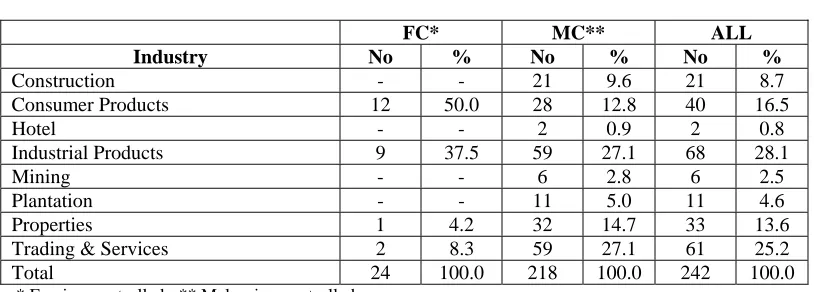
1. Industrial Affiliation and Control Location of Sampled Firms 12
2. Definition of Research Variables and Ratios 13
3. Descriptive Statistics of the Size and Performances of Sampled Companies 15
4. Descriptive Statistics on Year-by-Year Performances of Sampled Companies 18
5. Mann-Whitney U Test of Differences in Mean Performances of FC and
MC Companies (3-year average) 19
6. Kruskal-Wallis H Test of Differences in Inter-Industrial Mean Performance
(3-year average) 20
7. Friedman Test of Inter-Annual Variability of Mean Performances of
1. Introduction
Multinational Enterprises (MNEs) have become a dominant force in the world of
international trade and business today. Their dominance is predicted to grow in the future, as
greater convergence and integration is achieved in world economies. The growing influence
of MNEs necessitates greater understanding of various aspects of their operations and results.
There is an opportunity for MNEs to use the multi-jurisdictional location of their assets to
shift income from one country to another. The reported profitability of MNEs have therefore
been a subject of considerable research interest in recent times. Majority of such studies have,
however been based on the performances of MNEs in developed Western economies. Little
attention is directed to profitability of MNEs based in developing and emerging economies.
The current study examines various aspects of the reported financial performance of
Malaysian-based MNEs with emphasis on profitability. The aim is to provide empirical
evidence on the nature and magnitude of their reported profitability, given their size, industry
and location of control.
Data were collected from the annual reports of MNEs over a three-year period. Statistical
analyses were carried out using both exploratory data analytical techniques and
non-parametric statistical tests. The results of the analyses indicate that, given a number of
homogenetical grouping characteristics such as location of control and industrial affiliation,
statistically significant differences can be found in the financial performances of
Malaysian-based MNEs.
The remainder of the paper is organised as follows. Related literature is reviewed in the next
section. The literature review covers theories of MNE growth and development and studies of
their financial performance. This is followed by a discussion of the research design and
methodology including sample selection, data collection and analysis. The results of the study
are then discussed. Summaries and conclusions, including potential limitations and areas for
2. Related
Literature
The literature covering various aspects of multinational foreign direct investment (FDI) is
considerable. MNEs and FDIs play a significant role in international trade and business. FDI1 involves the ownership (in part or whole) and management of a foreign operation established
through investment in production resources in a country other than base country. These
transferred resources are formed as foreign subsidiaries which may come into existence either
through the acquisition of existing local firms or in the form of greenfield ventures.
Multinationality evolves from the sustained capability of a firm to originate and continuously
perpetrate FDIs in more than one national jurisdiction.2 In this section, we review some theories of multinational FDI and studies that examined their financial performances.
2.1 Theories of Multinational Foreign Direct Investment
A number of theories attempt to explain the evolution and growth of this form of
international business involvement. The approaches of these proponents differ widely. Hood
and Young (1979) identified them to include:
• political approaches; including the neo-imperialist (Leninist) explanation for
the growth of MN firms;3
• socio-psychological (or behavioural) approach; centering on the expansionist
moods and aspirations of groups and/or individuals within a firm, as a provider
of the necessary elixir for FDI. An inversion of Maslow’s (1970) Theory of
Need is relevant here. When the inverted model is visualised in a geographic
context, we can see a firm moving to “conquer” wider geographic areas as
soon as its immediate environmental needs are satisfied. The spirit of conquest,
which is a necessary “virtue” in the psychological make-up of all great
entrepreneurs is also inferred here; and
1
The US Department of Commerce defined FDI as including “all foreign business organisations in which a US person, organisation or affiliated group owns an interest of 10% or more”, and/or “a foreign business organisation in which 50% or more of the voting stock is owned by US residents even though no single US group owns as much as 10%” US Department of Commerce (1970).
2
The exact number of foreign locations of production that qualifies a firm to be regarded as an MNE is still a subject of academic debate (Rugman et al, 1985).
3
• historical approaches; viewing the FDI phenomena as a bye-product of
monumental twentieth century developments in transport, communication and
other infrastructural technology.4
However, the most significant and robust explanatory theories of FDI are derived from the
economic literature. Neo-classical economists view investments as a function of interest rate,
with capital moving from locations of abundance to high interest locations where capital is
relatively scarce. This persists until a state of equilibrium is attained.
Ricardian (1817) and (later) Heckscher-Ohlin (1933) theories of comparative advantage
considered factor (of production) endowment to be the most important variable that
determines international trade patterns. Nations are better off exporting those products whose
production process employs relatively more of the input resources that are most abundantly
available to them. International trade in this respect is therefore viewed as being more or less
(input) supply-induced. These theories could be logically applied to explain trade pattern
between developed economies and most developing and emerging economies such as
Malaysia.
Nonetheless, international business in a world based on this theory would only require a
knowledge of international trade (exporting, in particular) and international capital
movement, with no involvement of other forms of international business involvement, such
as licensing, for example (Rugman et al, 1985). The occurrence of these other modes is a
reality largely because of the natural and unnatural barriers that impede the realisation of free
and perfect economic market concepts. The neo-classical position, therefore, does not fully
explain the FDI phenomenon in dynamic economies such as Malaysia. It fails, in particular,
to predict the substantial amount of capital flow from Malaysia to other nations of developed,
dynamic and less developed status. The presence of barriers to capital, trade and investment
flows is by far more prominent in developing economies. This provides a context for
observing a number of relevant FDI literature.
Hymer (1960) perhaps contributed most to the emergence of the coherent body of literature
that is today referred to as FDI theory. Proceeding from a logical criticism of the
4
classical position, he - and later Kindleberger (1969) - submits that national and, more
especially, international product and factor markets are rife with imperfections, and these
provide the major impetus for FDI. The sources of such imperfections may include
technology, interference in competition by governments or firms with separate markets
(Kindleberger, 1969). Market inefficiencies result in higher transaction costs that make other
trade options, such as exporting, unattractive. And with the market for technology and
expertise highly imperfect, the obvious solution is for the firm to move its capital across
boundary in order to maintain control over, and be able to exploit its special advantage on an
international scale. This will only be attractive if the economic rent accruing from the
exploitation of the advantage can be enhanced by foreign production. The dynamic
economies of Asia provided more than adequate return on most forms of foreign investment
up to the period of the 1997 economic crisis, hence they were able to attract even greater
amount of FDI.5 Hymer's theory however failed to explicitly dissect and explain the nature of the advantages that lead to FDI; that is, which firms are likely to invest what asset and in
which country.
Vernon's (1966; 1971 and 1977) product life cycle theory of FDI views overseas investment
in parallel with the natural life cycle of a product from it's initial launch, through maturity to
its eventual decline. The theory ". . . provides a systematic explanation of how the exporting,
importing and manufacturing location of a product changes over time . . . (and) how firms
respond to changing competitive conditions, as domestic and foreign markets for the product
grow, mature and decline" (Giddy, 1978; p.90). Vernon’s (1966) model typifies the rate and
direction of growth of US MNEs in the first twenty years that followed the second world war.
A number of empirical studies within this period proved its validity when applied to post-war
US FDIs. Vernon’s contribution was significant especially when viewed in terms of the
barriers to entry and evolution of competition, and in relation to the initial price elasticity of
demand for a new product (Giddy). The theory was of even greater relevance in situations of
changing market conditions over time and between countries (Rugman et al). However, it
cannot be usefully applied to explain some aspects of trade and investment flows to the
dynamic economies of South East Asia. Some of the developments that cannot be explained
by the theory include: the innovation and development of products specifically targeted at
foreign markets by MNEs; FDIs undertaken from the onset to produce goods and/or services
already being manufactured by local firms in the host nation; and the acquisition of local
5
firms in host countries as a means of accessing certain advantages that are unavailable to the
MNE (Niosi, 1985). The predictive abilities of the product life cycle theory has been eroded
by time, to the extent that it could, at best, only “take its place as . . . one facet of the more
general phenomenon of large international firms successfully applying a diversity of
monopolistic advantages across national boundaries in order to internalise imperfectly
competitive factor markets” (Giddy).
Knickerbocker (1974) explained FDI away as an outcome of the “follow-the-leader”
reactions of oligopolistic rivals. In this sense, FDI is viewed as a necessary defensive strategy
by rival firms when a member of the oligopolistic industry breaks rank to invest abroad. The
necessity of the action arises from the need to forestall continued loss of export (as the
outputs of FDI fills the export market gap) and counter the leader’s potential for acquiring
new capabilities such as financial buoyancy as a result of the income generated from its FDI.
Knickerbocker’s work, which is based on post second world war FDI of American firms,
goes a long way in explaining the industrial distribution of these investments, predicting
stronger oligopolistic reactions in highly concentrated industries (Niosi). To the extent that
the theory has little relevance with respect to the FDI activities of the “leader”, however, its
usefulness is limited in the Malaysian context where the growing stock of outward FDIs are
by such "leader" firms, with, in most cases, strong governmental support and encouragement.
A “follow-the-leader” strategy is not an optimal one at all times, especially in an oligopolistic
industry where the strategy may be unprofitable to the leader (Buckley and Casson, 1991).
The answer to the question of “why the leader broke rank in the first place”, raised by
Knickerbocker’s theory is partly provided by Magee’s (1977) appropriability theory. It
proposed that FDI developed as a result of the desire of the firm to derive full appropriability
of the returns for its investment in the production of unique special advantages. This is
necessary because of the public good nature of these advantages, which renders them
untradeable in private markets. By organising transactions within the firm across national
boundaries, as a means of sidestepping the inefficiencies in the market therefore, the firm
ensures greater appropriability of the private returns to its investment in special advantages.
In other words, by internalising the information or knowledge that makes up their unique and
special advantages, firms are able to derive adequate appropriability of returns for the efforts
involved in innovating them. Additional resources are ploughed by firms into trying to
imitations by rival firms. These protective efforts have not been very successful in some
Asian countries, especially with high-tech products. Substantial dissipation of firms'
proprietary special advantages have resulted in widespread pirating and imitative practices.
Magee failed to disclose specific actions that MNEs may undertake to facilitate greater
appropriability of their returns in such situations (Hood and Young, 1979) The theory
however provides a useful ‘missing link’ when viewed in the context of Knickerbocker’s
oligopolistic reaction theory. Appropriability theory drew heavily on the ideas enshrined in
the work of Hymer (1960) and Kindleberger (1969). It further relied on the concept of
internalisation, which has been developed into a full-blown theory of FDI by Buckley and
Casson (1976; 1991), Rugman (1980) and Rugman et al (1985).
Internalisation, which has been suggested in one form or the other as an underlying reason
for FDI, was developed into a full theory by Buckley and Casson (1976). The theory depends
on the assumption of profit-maximisation, emphasises very general forms of imperfect
competition stemming from the costs of organising markets, and concentrates on
imperfections in intermediate product markets rather than in the final product markets. Before
FDI can proceed at all, the firm must possess some unique advantages obtained as “the
rewards for past investments in (1) R&D facilities . . . (2) the creation of an integrated team
of skills, . . . and (3) the creation of an information transmission network which not only
allows the benefits of (1) and (2) to be transmitted at low cost within the organisation, but
also protects such information . . . from outsiders.” (Buckley and Casson, 1976; p.69.) The
ability specified in (3) above is very crucial for the establishment of FDI and is the major
difference between this theory and earlier similar approaches in the Hymer-Kindleberger
tradition. In essence, a firm must not only possess unique advantages but must also be
convinced in its economic calculations that it will be able to profitably exploit those
advantages with minimal risk of dissipation.
Rugman’s (1980) and Rugman et al’s (1985) approach are very similar to Buckley and
Casson’s. Progressing from a free trade assumption, they introduced market imperfection into
the discussion and observed that MNEs are replacements for free trade when trade is impeded
by market imperfections. Two sets of factors that account for FDI strategy were then
identified as location-specific factors (environmental variables) and firm-specific factors
Location-specific factors are the economic and non-economic variables in a country’s
aggregate production function and also include its political, cultural and social systems.
Careful analysis of these factors is required for firms locating in high-risk-high-return
economies of South East Asia. Firm-specific advantages (FSAs), on the other hand, are those
unique internal advantages (such as knowledge, management, marketing, R&D and strategic
planning skills) possessed by MNEs which gives them a relative advantage over other firms.
The MNE then needs to exercise proprietary rights over its FSAs to maximise its worldwide
income with minimal dissipation of this invaluable asset. This it does through internalisation,
that is, the creation of an internal market that allows the firm to appropriate the returns from
the advantage it generates. Internalisation therefore is a rational response to market
imperfections in the pricing of MNEs’ unique advantages. It is an economically efficient
internal response to exogenous impediments to free trade and is a superior device to other
potential solutions such as licensing or patent rights because it gives the MNE the additional
benefit of self-regulation and monitoring of its advantages. The internalisation theory
provides valuable explanations on why a firm might prefer to set up a subsidiary, rather than
transact directly with the market. Buckley and Casson were able to synthesise most previous
FDI theories and explain them relative to their own position, thereby establishing a link
between the current major explanations of the FDI phenomenon.
From the above review, it can be concluded that market imperfections, both in intermediate
and final product markets, the result of natural and unnatural barriers to trade, play an
important role in the origin of MNEs. Unnatural barriers such as government interventions
through laws, regulations, etc, for example, have for long been identified as the most
dominant type of these imperfections in developing countries. Proponents of free trade prefer
complete removal of these barriers. The net cost-benefit of such removal for these countries
may be hard to estimate. Perhaps more significantly, the 1997 economic crisis appear to
suggest that dynamic emerging economies such as Malaysia are yet structurally,
institutionally or informationally primed for the complete removal of such barriers (Hansen
and Stride, 1998).
The high risks associated with operating in these markets also bear promises of potential high
returns. Both foreign and locally-owned business operations in a country like Malaysia are
therefore expected to be highly profitable. The current study examines the nature and extent
2.2 Reported Performances of Multinational Enterprises
The reported performance of MNEs is a subject of interest to a broad range of stakeholders
and users of financial statements. Current and potential investors, for example, need the
results for their investment-making decisions. Because of the multi-jurisdictional location of
these investments, however, the reported performance of MNEs assume even greater
significance. The significance is not lost on governments in different nations, since the
financial behaviour of MNEs, among other things, impacts upon their revenue base.
Studies have been carried out to explore the reported performance of MNEs especially with
regards to differences between foreign- and locally-controlled firms. Various accounting
measures of performance were used in these studies. Most of them, however, have been
based on the results on MNEs in developed western economies especially the US. Wheeler
(1988; 1990) studied the profitability performance of US-based firms. He compared the rate
of return of foreign-owned firms with those of US-owned companies and found that the
return on assets of all US-owned corporations was six times larger than those of
foreign-owned US subsidiaries. Wheeler reported illogical trends in the financial measures of
capability and performance of foreign-owned US subsidiaries between 1983 and 1987. While
their capabilities (total assets) grew from $530,334million in 1983 to $959,400million in
1987, their performance (return on assets) remained under 1 per cent.
Kim and Lyn's (1990) study also examined the profitability of US-based firms. They
compared five performance ratios (earnings per share, return on equity before tax, return on
equity after tax, gross profit margin and operating profit margin) of foreign-owned firms to
those of US-owned ones for the years 1980 to 1984. Their results reveal that foreign firms
operating in the US earn lower profits than American firms. They also found that US-owned
firms, contrary to popular belief, are more efficient than foreign-owned ones6.
Crain and Stitts (1994) used gross profit margin (GPM) as a measure of performance and
compared foreign firms operating in the US to US-owned firms on this basis. Their findings
indicate that foreign-controlled firms reported significantly lower GPMs than US-controlled
firms.
6
Nitsch et al (1995) studied the characteristics and performances of Japanese FDIs located in
seven Western European countries. From their selected sample of 118 firms, they found
statistically significant differences in inter-country performances, industry, mode and reasons
for making investment. On a three-point scale of loss (1), breakeven (2) and gain (3), the
firms returned an average performance of 2.36. This average was exactly the same as that
reported by UK-based Japanese firms; better than the French (2.12) average; but less than the
German (2.43) average. Industry-wise, the best performance in the UK was recorded in the
industrial equipment industry (2.75), while the worst was in transportation equipment (1.80).
Greenfield operation (2.55) was the best mode of entry into the UK for the sampled Japanese
firms. It compares to joint-ventureship (2.29) and acquisition (2.00), which was found to be a
generally poor mode of entry into Europe for Japanese investment.
Oyelere & Emmanuel (1996) conducted a preliminary study into the performances (and
post-performance distributions) of based FODCs. They matched 36 FODCs with 36
UK-owned firms on the basis of size (total assets) and compared their profitability and
distributions as reported in their annual reports and accounts in 1992 and 1993. Their findings
revealed that foreign-owned firms' performances were significantly lower than those of
UK-owned firms.
Munday and Peel (1997) undertook extensive study of the performance and efficiency of
Japanese owned manufacturing firms operating in the UK. They compared them to
owned investments and found that Japanese-owned firms significantly under-performed
UK-owned ones with respect to profitability, asset efficiency, stock efficiency and credit risks.
Oyelere and Emmanuel (1998) also reported on the performance of a sample of UK-based
assets. Matching a sample of foreign- to UK-controlled firms on the basis of capability, their
logistic regression analysis revealed that a firm is more likely to be foreign-controlled if it
reports lower performance and higher post-performance distribution. They confirmed
evidence of significant income-shifting out of foreign-controlled assets and found the claim
that ITP is the key mechanism for such shifts difficult to dismiss.
Compared to studies on the financial performances of MNEs in developed western economies
as reviewed above, empirical studies on MNE firms in developing and emerging economies
dynamic economies of South East Asia over the last two decades as evidenced by significant
growth in their GNP and manufacturing outputs. One of the few notable studies of firm
performances in this region is Lecraw (1983) who studied the performance determinants of
153 MNEs in five ASEAN countries (Indonesia, Malaysia, Philippines, Singapore and
Thailand). His study was based on profit performance in six light manufacturing industries.
He reported an average return on equity of about 20 per cent for the MNEs in his sample.
This rate of return far outstrips those reported in studies of MNEs in developed economies
reported above and confirms the expectations of higher returns usually associated with
investments in riskier assets or locations. Lecraw found significant positive correlation
between the performance of the firms and a number of variables including firm's market
share, advertising and R&D intensity. His results also revealed a negative relationship
between reduced profitability and variables such as import penetration, number of home
countries of MNEs and growth in firm's sales.
It is surprising that more efforts have not been invested in studies of the performances of
MNE assets in developing and emerging economies, in general and Malaysia, in particular.
Despite restrictive investment policies in most of these countries, FDI have grown
significantly in recent times. The flow of investment, which quintupled from 1990 to 1995,
exceeded $100 billion in 1996 (IFC, 1997). Malaysia receives a significant proportion of
these flow of FDIs. According to the World Bank Debtor Reporting System (cited in IFC,
1997), Malaysia was the fourth largest developing-country recipient of FDI in two successive
ten-year periods from 1970-79 and 1980-89. It has since moved into third place behind China
and Mexico for the period 1990-96. During this period, FDI inflows into Malaysia totaled
US$30,293 million, making the country the 13th largest FDI recipient nation worldwide
(OECD, 1998). The country was one of only six LDCs, whose FDI flows was greater than 5
per cent of their GNP. Indeed, as at the end of 1996, more than half (RM33.2 out of RM66.3
billion) of the total fixed asset of Malaysian companies are foreign-owned (Asia Business,
1998).
The flow of investment has, however, not been one-way; Malaysian MNEs have become
aggressive in their pursuit of global investment opportunities. Increasing competition has
been cited as one of the reasons for the acceleration of outward investment, with Malaysia
companies venturing as far as Croatia and Uzbekistan (Soledad, 1996). Outward investments
in Singapore and other South Asian countries. African countries, notably South Africa and
Zimbabwe, are also receiving increasing proportions of Malaysian outward investments
(Astbury, 1994; Marriott, 1997).
From all indications, MNEs are a dominant force in the economy of Malaysia. A study of
their characteristics and financial behaviour should therefore shed some light on economic
events such as the recent Asian crisis. The current study explores the reported financial
accounting performance of Malaysian-based MNEs. The research methodology employed is
described next.
3.
Research Design and Methodology
3.1 Sample Selection
Sampled companies for this study were selected from the KLSE index. The key criterion for
inclusion was multinationality; that is, whether the company is foreign-controlled or it is
Malaysian-controlled, and owns direct investments outside Malaysia. A company is classified
as foreign-controlled if more than 50 per cent of its shareholding are owned outside Malaysia.
Companies from the investment and financial services and related industries were excluded
from our sample. A total of 242 MNEs for which performance data are accessible were
included in the sample for this study. Information on the control location and industrial
Table 1
Industrial Affiliation and Control Location of Sampled Firms
FC* MC** ALL
Industry No % No % No %
Construction - - 21 9.6 21 8.7 Consumer Products 12 50.0 28 12.8 40 16.5
Hotel - - 2 0.9 2 0.8
Industrial Products 9 37.5 59 27.1 68 28.1
Mining - - 6 2.8 6 2.5
Plantation - - 11 5.0 11 4.6 Properties 1 4.2 32 14.7 33 13.6 Trading & Services 2 8.3 59 27.1 61 25.2 Total 24 100.0 218 100.0 242 100.0
* Foreign-controlled; ** Malaysian-controlled
Sampled companies are spread across six of the twelve industrial groupings on the KLSE.
The highest number (68; about 28%) of companies in the sample are from the Industrial
products sector. This is followed by the Trading and services sector with 61 (about 25%) of
the sample. The Hotels industry has the least representation (2 companies). About ten per
cent (24) of the companies included in the sample are foreign-controlled (FCs), while the
remaining 218 are Malaysian-controlled (MCs).
3.2 Data Collection
This study is aimed at exploring the nature and magnitude of the reported profitability of
Malaysian based multinationals relative to a number of attributes such as size, industry and
location of control. To achieve this aim, data were extracted from the annual reports of
sampled companies as displayed on the KLSE-RIS website (http://www.klse-ris.com.my/) for
the three-year period, 1995 t0 1997. The website provides, among other things, financial
information and news on most of the companies on the KLSE. The data extracted for the
purpose of this research are coded and defined in Table 2 (Panel A). The performance data
were further normalised into a number of performance ratios - operating expenses to sales
(OEXS), return on capital employed (ROCE), return on total assets (ROTA) and return on
Table 2
Definition of Research Variables and Ratios
Panel A: Performance variables
VARIABLES RESEARCH CODE
DEFINITION
Operating expenses OPEX The total operating expenses of the company.
Profit before tax PBTX Total profit for the year before tax but after income from associated companies and other investments, interest receivable, interest payable, amounts written off investments and exceptional items.
Profit after tax PATX Total profit for the year after tax but before after-tax items, extraordinary items and dividends.
Panel B: Performance ratios
RATIOS RESEARCH CODE
DEFINITION
Operating expenses to sales OEXS Operating expenses x 100 Sales (to 3rd parties only) Return on capital employed ROCE Profit before tax x 100
Capital employed Return on total asset ROTA Profit before tax x 100
Total assets Return on turnover ROTO Profit after tax x 100
Sales
3.3 Data Analysis
A two-step analytical approach was employed in this study whereby exploratory data analysis
(EDA) was first carried out before formal statistical testing. EDA exposes the most
illuminating features of the dataset, which are likely to be overlooked during formal statistical
analysis. The results are reported in the next section. Statistical tests are then carried out on
the performance variables at the univariate level on annual and three-year average bases.
Specifically, because of the non-normal distribution of collected data, the nonparametric
Mann-Whitney U (M-WU), Kruskal-Wallis H (K-WH) and Friedman tests were employed to
investigate the presence or otherwise of any systematic differences between the performances
4. Results
and
Findings
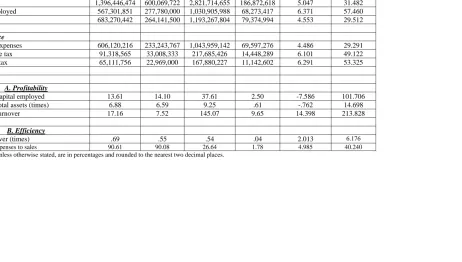
EDA results reveal that the 242 firms had an average total asset of RM1,396.45million over
the three-year period covered by this study (Table 3). The average sales figure for the same
period was RM683.27million. Capital employed by all the firms averaged RM567.3million.
MCs, despite their apparent size advantage, as indicated by their higher mean total asset and
capital employed, recorded a lower average turnover of RM658.51million as compared to
FCs’ RM901.77. Consequently, their mean asset turnover, a measure of efficient use of assets
Table 3
Descriptive Statistics of the Size and Performances of Sampled Companies
Panel A: All companies (n = 242)
Variables Mean Median Std Deviation SE of Mean Skewness Kurtosis
Size
Total assets 1,396,446,474 600,069,722 2,821,714,655 186,872,618 5.047 31.482
Capital employed 567,301,851 277,780,000 1,030,905,988 68,273,417 6.371 57.460
Sales 683,270,442 264,141,500 1,193,267,804 79,374,994 4.553 29.512
Performance
Operating expenses 606,120,216 233,243,767 1,043,959,142 69,597,276 4.486 29.291
Profit before tax 91,318,565 33,008,333 217,685,426 14,448,289 6.101 49.122
Profit after tax 65,111,756 22,969,000 167,880,227 11,142,602 6.291 53.325
Ratios*
A. Profitability
Return on capital employed 13.61 14.10 37.61 2.50 -7.586 101.706
Return on total assets (times) 6.88 6.59 9.25 .61 -.762 14.698
Return on turnover 17.16 7.52 145.07 9.65 14.398 213.828
B. Efficiency
Asset turnover (times) .69 .55 .54 .04 2.013 6.176
Operating expenses to sales 90.61 90.08 26.64 1.78 4.985 40.240
Panel B: Foreign-controlled companies (n = 24)
Variables Mean Median Std Deviation SE of Mean Skewness Kurtosis
Size
Total assets 903,328,657 879,053,061 808,969,479 168,681,797 1.869 3.668
Capital employed 391,928,168 319,459,333 291,230,074 60,725,668 1.580 2.518
Sales 901,770,499 574,467,000 752,414,210 156,889,208 .879 -.808
Performance
Operating expenses 804,675,918 494,861,667 712,210,499 148,506,155 1.054 -.344
Profit before tax 100,073,009 69,750,333 108,869,383 22,700,836 2.487 7.898
Profit after tax 78,583,572 51,768,000 81,459,357 16,985,450 2.117 5.661
Ratios*
A. Profitability
Return on capital employed 28.22 20.64 30.19 6.30 3.330 13.128
Return on total assets (times) 13.52 10.01 11.96 2.49 1.957 4.472
Return on turnover 9.68 9.29 6.12 1.28 .763 -.381
B. Efficiency
Asset turnover (times) 1.15 .95 .59 .12 .281 -1.322
Operating expenses to sales 87.66 91.09 8.62 1.80 -.975 .050
Panel C: Malaysian-controlled companies (n = 218)
Variables Mean Median Std Deviation SE of Mean Skewness Kurtosis
Size
Total assets 1,451,771,888 590,840,667 2,959,508,542 206,701,043 4.817 28.423
Capital employed 586,977,923 267,418,856 1,081,473,813 75,533,407 6.092 52.251
Sales 658,514,278 243,932,116 1,232,195,035 86,483,137 4.629 29.264
Performance
Operating expenses 583,512,388 212,702,833 1,074,251,297 75,584,057 4.598 29.496
Profit before tax 90,331,544 27,696,167 226,851,790 15,882,802 5.990 46.394
Profit after tax 63,592,875 20,062,691 175,028,548 12,254,449 6.186 50.401
Ratios*
A. Profitability
Return on capital employed 11.97 13.43 38.06 2.66 -8.274 106.055
Return on total assets (times) 6.13 6.17 8.62 .60 -1.851 17.634
Return on turnover 18.01 7.31 153.07 10.74 13.649 192.125
B. Efficiency
Asset turnover (times) .63 .52 .51 .04 2.453 9.609
Operating expenses to sales 90.95 89.83 27.96 1.97 4.781 36.598
Table 4
Descriptive Statistics on Year-by-Year Performances of Sampled Companies
All companies (n = 242) Mean Std Deviation Skewness
Performance Variables 1995 1996 1997 1995 1996 1997 1995 1996 1997
Operating expenses 706,049,531 602,196,241 553,321,133 1,223,849,506 1,059,416,350.39 932,106,699.20 4.609 4.333 4.248
Profit before tax 90,244,067 99,222,668 93,067,799 268,765,199 231,675,865.74 189,278,978.67 4.784 5.611 6.124
Profit after tax 59,983,034 72,433,193 69,374,775 210,327,456 181,018,328.63 148,341,089.86 4.310 5.406 6.576
Return on capital employed 6.6200 20.5929 18.1113 70.6678 51.9341 19.7678 -11.780 12.263 2.268
Return on total assets 3.7780 112.5360 116.4489 19.4397 1566.5059 1278.2975 -7.290 14.966 13.365
Return on turnover 26.9932 18.8771 16.1265 358.8466 90.5950 342.0365 14.696 10.174 2.878
Asset turnover (times) .6592 .7056 3.7506 .5394 .5536 42.5138 1.912 1.685 14.207
Performance-wise, the average reported PBTX for all the companies in the sample over the
three-year period of this study was RM91.32million. FCs’ average PBTX of
RM100.07million was higher than that of MCs. This resulted in higher ROCE and ROTA
reportage by FCs. MCs, however, reported higher ROTO and EPS. Generally, the
profitability ratios indicate healthy performance levels when compared with MNE
performances in other countries.7 The stability of these performances may be observed by looking at the extent of year-to-year variability of the performance variables. These are
reported in Table 4 above.
The statistics, as reported in Table 4, indicate high level of variability in the year-to-year
performances of the MNEs in our sample. A typical example is the ROTA, which varied
from 3.8 per cent in Year 1 to 116 per cent in Year 3. More importantly, from a
methodological perspective, the EDA results suggest that the samples in this study may not
be from a normal distribution. As a result, nonparametric statistical tests were applied.
The M-WU test was employed to test for systematic differentials in performances in relation
to differences in the location of control of sampled MNEs. The results of the tests are
presented in Table 5.
Table 5
Mann-Whitney U Test of Differences in Mean Performances of FC and MC Companies (3-year average)
MEAN RANK TEST STATISTICS
Research Variable FC* MC* U W Z Sig. (p) OPEX 154.83 108.24 1361.00 21864.00 -3.252 .001a PBTX 148.61 110.10 1550.00 22460.00 -2.666 .008 a PATX 152.43 109.67 1462.00 22372.00 -2.961 .003 a OEXS 113.30 112.97 2316.00 22819.00 -0.024 .981 ROCE 150.04 109.94 1517.00 22427.00 -2.777 .005 a ROTA 153.83 109.51 1430.00 22340.00 -3.068 .002 a ROTO 120.35 112.72 2177.00 22883.00 -0.530 .596
(a) indicates that differences are significant at the 1% level.
The results of the test, as presented in Table 5, indicate that there are statistically significant
differences in the performances of the two homogenetically distinct groups of MNEs.
Differences in OPEX, PBTX, PATX, ROCE and ROTA are all significant at the 1% level.
The interesting aspects of these results is the higher mean ranking of the performances of FC
MNEs, which indicate that, they, on average, outperformed MCs. This result contradicts the
findings of a number of previous studies (Kim and Lyn, 1990; Crain and Stitts, 1994;
7
Munday and Peel, 1997; Oyelere and Emmanuel, 1998; Emmanuel and Oyelere, 1999; for
example) which were carried out in developed economies. It appears therefore that the
assumption of higher appropriable returns implicit in a number of post-Hymer FDI theories
(Magee, 1977; Buckley and Casson, 1991) still holds in the case of the Malaysian business
environment. This could partly explain the increasing stock of FDI in the country.
Another interesting finding is the significantly higher trading expenditure (OPEX) reported
by FCs. OPEX is an important variable when the performances of foreign- and
domestically-controlled companies are being compared, the main reason being the potential distortionary
effect of ITP on reported figures. The higher mean ranking of OPEX by FCs, for example,
may indicate that ITP is being used to inflate OPEX and shift income out of Malaysia by FCs.
Findings in this regard are however inconclusively, given the insignificant difference between
the two sets of companies when OPEX was normalised by sales (OEXS). Further studies
incorporating ITP variables with those explored in the current study, may provide additional
insight in this regard.
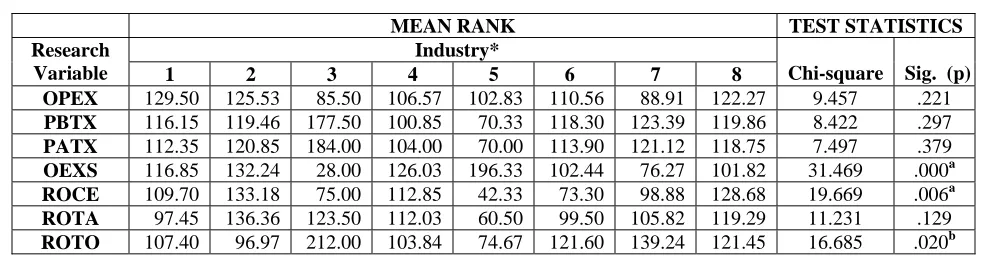
The K-WH test was employed to test for differences in performance that may result from
industrial affiliation. Results, as indicated in Table 6, show that there are statistically
significant differences in the inter-industrial performances of sampled firms.
Table 6
Kruskal-Wallis H Test of Differences in Inter-Industrial Mean Performances (3-year average)
MEAN RANK TEST STATISTICS
Industry* Research
Variable 1 2 3 4 5 6 7 8 Chi-square Sig. (p) OPEX 129.50 125.53 85.50 106.57 102.83 110.56 88.91 122.27 9.457 .221 PBTX 116.15 119.46 177.50 100.85 70.33 118.30 123.39 119.86 8.422 .297 PATX 112.35 120.85 184.00 104.00 70.00 113.90 121.12 118.75 7.497 .379 OEXS 116.85 132.24 28.00 126.03 196.33 102.44 76.27 101.82 31.469 .000a ROCE 109.70 133.18 75.00 112.85 42.33 73.30 98.88 128.68 19.669 .006a ROTA 97.45 136.36 123.50 112.03 60.50 99.50 105.82 119.29 11.231 .129 ROTO 107.40 96.97 212.00 103.84 74.67 121.60 139.24 121.45 16.685 .020b
* 1 = Construction; 2 = Consumer Products; 3 = Hotel; 4 = Industrial Products; 5 = Mining; 6 = Plantation; 7 = Properties; 8 = Trading & Services
(a) indicates that differences are significant at the 1% level and (b) at 5%.
Significant differences were found in three normalised inter-industrial performance variables.
Differences in OEXS and ROCE were statistically significant at the 1% level while ROTO is
significant at the 5% level. The ROCE of MNEs operating mainly in the Consumer Products
and Trading and Services industries were significantly greater than those obtained in other
were relatively lower. The significant difference in ROCE between the industries could be
explained by the scale of dynamic asset (capital employed, for example) required to operate
in the respective industries. There is likely to be greater requirement for these assets relative
to return in industries such as Mining and Plantation than for Trading and Services and
Consumer Products operations.
When taxation is taken into consideration and returns are denominated by turnover (ROTO),
however, MNEs in the Hotels industry significantly outperformed all other MNEs. ROTO in
the Mining industry remained significantly low, possibly as a result of the significantly high
OEXS ratio of the industry. Conversely, the high ROTO performance of the Hotels industry
is traceable to low OEXS.
The Friedman test was used to test for inter-annual differences in the performances of
Malaysian-based MNEs. Results of the test are presented in Table 7.
Table 7
Friedman Test of Inter-Annual Variability of Mean Performances of Malaysian-based MNEs
MEAN RANK TEST STATISTICS
Research Variable 1995 1996 1997 Chi-square Sig. (p)
OPEX 2.67 2.01 1.33 172.010 .000a
PBTX 1.95 2.19 1.85 12.030 .002a
PATX 1.94 2.20 1.86 12.030 .002a
OEXS 2.33 1.88 1.80 31.594 .000a
ROCE 1.63 2.12 2.25 41.739 .000a
ROTA 1.51 2.10 2.39 79.085 .000a
ROTO 1.64 2.08 2.28 41.582 .000a
(a) indicates that differences are significant at the 1% level.
The results clearly show that there are statistically significant inter-annual variations in the
performances of Malaysian-based MNEs. Year-to-year differences were significant at the 1%
level for all the variables considered in this study. The mean ranking pattern shows that
progressive fall in OPEX and OEXS between 1995 and 1997 resulted in progressive
increases in profitability ratios (ROCE, ROTA and ROTO). PBTX and PATX however
reveal a different pattern, peaking in 1996 and regressing to least ranking the following year.
The inter-annual variability in OPEX is highly significant and will require additional
investigation, given the stated importance of this variable from ITP perspective. It is possible
that MNEs are actively engaging in income-shifting practices, using the opportunities
Generally, the results in Table 7 confirm the notion of high volatility associated with
emerging markets. Volatility also portends risks and events such as the Asian economic crisis
could possibly be forecasted from trends of the pooled performances of all firms if such
performances are viewed as expected returns in a risk-return model.
5. Summary
and
Conclusion
This study investigated the performances of Malaysian-based MNEs listed on KLSE, using
the reported financial accounting figures for the pre-Asian crisis years of 1995 to 1997. The
study was considered necessary given the domineering influence of MNEs on global
economies especially with respect to emerging economies such as Malaysia. Economic
meltdowns are sometimes directly traceable to the activities of MNEs.
The study used accounting numbers as disclosed in the annual reports of Malaysian-based
MNEs. Accounting numbers may not reflect all aspects of firms' economic performances. In
addition, accounting policy choices of firms may influence reported earnings. While
profitability, as reported in firms' annual reports, provide globally recognised signals of
performances with direct impact on corporate value, future researchers may consider using
other economic models to explore the performances of Malaysian MNEs. Further refinement
of this study should adjust for possible differences in accounting policies.
The results of the study confirmed that there was a high level of volatility in the performances
of Malaysian-based MNEs over the three years covered by the study. While this, in itself, is
not uncommon in emerging economies, it portends a high level of risk and investors need to
consider whether the appropriable returns are adequate to compensate them for undertaking
such risks.
The study also found differences in performance ratios between the eight industrial sectors
represented. The inverse relationship between OEXS and profitability was clearly reflected in
the performances of the MNEs studied. Profit performance ratios in the Hotels industry
ranked highest, while the Mining industry ranked lowest. Inter-industrial differences in
performance should be a matter of interest to a broad range of parties including potential
investors and Malaysian policy makers in the areas of tax and investment. Potential investors
studies in this area should explore these patterns to ascertain distribution policies especially
with regards to dividend and taxation.
Perhaps most significantly, FCs in this study out-performed MCs. Although this finding
contradicts a number of previous studies, it is supported by a number of post-Hymer FDI
theories. Higher returns are required on FDIs to compensate for the implicit transaction costs
of cross-border investments. The finding could also be an indication of the superior
technology and efficiency levels in FCs. We conclude that Malaysia is a profitable
environment for FDI. Whether this conclusion will still hold after the Asian crisis is an issue
worth investigating in the near future.
References
Asian Business (1998) Economic Statistics: Malaysia, Asian Business, April, 31-32.
Astbury, S. (1994) Firms feel pull overseas, Asian Business, April: 31.
Buckley, P. J. and M. C. Casson (1976) The Future of the Multinational Enterprise,London: Macmillan.
Buckley, P. J. and M. C. Casson (1991) The Future of the Multinational Enterprise,London: Macmillan.
Chandler, A.J. (1962) Strategy and Structure: Chapters in the History of the American Industrial Experience,Cambridge, Mass. MIT Press.
Crain, T.L and R.H. Stitts (1994) A comparison of gross profit margins between foreign-controlled domestic corporations and comparable US-foreign-controlled domestic corporations, Journal of International Accounting, Auditing and Taxation, 3(1): 85-101.
Emmanuel, C.R and P.B. Oyelere (1999) Differences in the performances of foreign-controlled and domestically-foreign-controlled firms: Some UK evidence, Lincoln University Working Paper Series No. 71/3.
Giddy, I. H. (1978) The Demise of the Product Cycle Model in International Business Theory, Columbia Journal of World Business. Spring: 90-7.
Hansen, M. and R. Stride (1998) Asia's Ring of Fire, Asian Business, April: 38-40.
Hymer, S. H. (1960) The International Operation of National Firms: A Study of Direct Foreign Investment. Cambridge, Mass.: MIT Press (revised edition, 1976).
International Finance Corporation (1997) Foreign Direct Investment, Washington, D.C.: IFC and Foreign Investment Advisory Service.
Kim, W.S. and E.O. Lyn (1990) FDI theories and the performance of foreign multinationals operating in the US, Journal of International Business Studies (First Quarter): 41-54.
Kindleberger, C. P. (1969) American Business Abroad. New Haven: Yale University Press.
Knickerbocker, F. T. (1974) Oligopolistic Reaction and Multinational Enterprise.
Cambridge, Mass.: Harvard Business School, Division of Research.
Lecraw, D. J. (1983) Performance of Transnational Corporations in Less-Developed Countries Journal of International Business Studies, Spring/Summer: 15-33.
Lenin, V.I. (1966) Imperialism, the Highest Stage of Capitalism: A Popular Outline, 13th edition, Moscow: Progress Publishers.
Magee, S. P. (1977) Information and Multinational Enterprises: An Appropriability Theory of Direct Foreign Investment, in J. N. Bhagwati (ed) The New International Economic Order, pp.317-40. Cambridge, Mass.: MIT Press.
Marriott, C. (1997) Malaysia's expansionist multinationals go on a shopping spree, Global Finance, June: 38-42.
Maslow, A.H. (1970) Motivation and Personality, 2nd edition New York: Harper & Row.
Munday, M. and M.J. Peel (1997) The Japanese manufacturing sector in the UK: A performance appraisal, Accounting and Business Research (Winter) 28(1): 19-39.
Nitsch, D., P. Beamish and S. Makino (1995) Characteristics and performance of Japanese foreign direct investment in Europe, European Management Journal 13(3): 276-285.
OECD (1998) Recent Trends in Foreign Direct Investment Financial Market Trends, June (No. 70), available on OECD website (www.oecd.org).
Ohlin, B. (1933) Interregional and International Trade, Cambridge, Mass.: Harvard University Press.
Oyelere P.B. and C.R. Emmanuel (1996) Seeking evidence of international transfer pricing abuse, Glasgow University Working Paper Series No. 96/3.
Oyelere P.B. and C.R. Emmanuel (1998) International transfer pricing and income shifting: Evidence from the UK, European Accounting Review 7(4): 623-635.
Ricardo, D. (1817) Principles of Political Economy and Taxation, Cambridge: Cambridge University Press.
Rugman, A. M., D. J. Lecraw and L. D. Booth (1985) International Business: Firm and Environment, New York: McGraw-Hill.
Soledad, G. (1996) Competition drives companies offshore, Asiamoney, October: 76.
Vernon, R. (1966) International Investment and International Trade in the Product Cycle,
Quarterly Journal of Economics, May: 190-207.
Vernon, R. (1971) Sovereignty at Bay: The Multinational Spread of US Enterprises. New York: Basil Books.
Vernon, R. (1977) Storm Over the Multinationals - The Real Issues. Cambridge, Mass.: Harvard University Press.
Wheeler, J.E. (1988) An academic look at transfer pricing in a global economy, Tax Notes
(July 4): 87-96.