Molecular, Cellular and Biomedical Sciences
Scholarship
Molecular, Cellular and Biomedical Sciences
12-3-2010
Simple sequence repeat variation in the Daphnia
pulex genome
Way Sung
University of New Hampshire
Abraham Tucker
University of New Hampshire
R. Daniel Bergeron
University of New Hampshire
Michael Lynch
Indiana University - Bloomington
W. Kelley Thomas
University of New Hampshire
Follow this and additional works at:
https://scholars.unh.edu/mcbs_facpub
Part of the
Genetics and Genomics Commons
This Article is brought to you for free and open access by the Molecular, Cellular and Biomedical Sciences at University of New Hampshire Scholars' Repository. It has been accepted for inclusion in Molecular, Cellular and Biomedical Sciences Scholarship by an authorized administrator of University of New Hampshire Scholars' Repository. For more information, please [email protected].
Recommended Citation
R E S E A R C H A R T I C L E
Open Access
Simple sequence repeat variation in the
Daphnia
pulex
genome
Way Sung
1*, Abraham Tucker
1,3, R Daniel Bergeron
2, Michael Lynch
3, W Kelley Thomas
1Abstract
Background:Simple sequence repeats (SSRs) are highly variable features of all genomes. Their rapid evolution makes them useful for tracing the evolutionary history of populations and investigating patterns of selection and mutation across gnomes. The recently sequencedDaphnia pulexgenome provides us with a valuable data set to study the mode and tempo of SSR evolution, without the inherent biases that accompany marker selection. Results:Here we catalogue SSR loci in theDaphnia pulexgenome with repeated motif sizes of 1-100 nucleotides with a minimum of 3 perfect repeats. We then used whole genome shotgun reads to determine the average heterozygosity of each SSR type and the relationship that it has to repeat number, motif size, motif sequence, and distribution of SSR loci. We find that SSR heterozygosity is motif specific, and positively correlated with repeat number as well as motif size. For non-repeat unit polymorphisms, we identify a motif-dependent end-nucleotide polymorphism bias that may contribute to the patterns of abundance for specific homopolymers, dimers, and trimers. Our observations confirm the high frequency of multiple unit variation (multistep) at large microsatellite loci, and further show that the occurrence of multiple unit variation is dependent on both repeat number and motif size. Using theDaphnia pulexgenetic map, we show a positive correlation between dimer and trimer frequency and recombination.
Conclusions:This genome-wide analysis of SSR variation inDaphnia pulex indicates that several aspects of SSR variation are motif dependent and suggests that a combination of unit length variation and end repeat biased base substitution contribute to the unique spectrum of SSR repeat loci.
Background
Tandem arrays of DNA nucleotides, known as simple sequence repeats (SSR), are extremely dynamic parts of the genome. These tandem repeats vary in motif sequence, length, and repeat number. The most com-mon SSR loci are homopolymers (repeated single nucleotide), dimers (repeated nucleotide pair), and tri-mers (repeated nucleotide triplet). The highly poly-morphic nature of SSRs makes them desirable for use in both genotyping and population-level evolutionary stu-dies. Simple sequence repeats may influence the fitness of the organism [1], and in specific cases are known to be causal of human disease [1].
A high mutation rate at SSRs has been well documen-ted in a number of organisms using microsatellite
constructs, pedigree analyses, and mutation accumula-tion (MA) experiments [2-4]. The high mutaaccumula-tion rate in SSRs is due to a propensity for DNA misalignment dur-ing replication [5], regulated primarily by the universal mismatch repair system (MMR). MMR knockout experi-ments show dramatic increases (up to 100 fold greater) in the rate of simple sequence variation [6,7]; and sug-gest that surveillance by MMR may vary across the gen-ome [8]. Although the MMR system has been well-categorized in certain species, the components of MMR may vary from species to species, which may result in lineage specific patterns of SSR repair, and consequently lineage specific patterns of SSR variation [9]. In addition to MMR fidelity; repeat number, motif sequence, motif size, local rates of recombination and genomic location can influence rates of SSR variation [8,10,11]. Genome wide analysis of SSR variation in well-characterized sys-tems will facilitate a greater understanding of the * Correspondence: [email protected]
1
Hubbard Center for Genome Studies, University of New Hampshire, Durham, NH 03824, USA
Full list of author information is available at the end of the article
relationship between MMR evolution, and the abun-dance of SSR and levels of variation at these loci.
Daphnia pulex(water flea), crustacean represents a particularly useful platform for the study of SSR evolu-tion. TheDaphnia pulexlineage is distinct from the two model organisms Caenorhabditis elegans (nematode) and Drosophila melanogaster(fruit fly), both of which have well characterized simple sequence repeat variation [2,12]. The genome sequence ofD. pulex is based on a single heterozygous genotype sampled from a natural population with minimal inbreeding [13]. The hetero-zygosity within the genome sequence can be assayed by analysis of the raw sequence reads (8 × coverage) allow-ing a nearly genome-wide analysis of the variation at SSR loci.
There are two main goals of this study. The first is to provide a detailed catalog of SSR loci and their distribu-tion within the genome of Daphnia pulex. The second goal is to assay SSR heterozygosity on a genome wide scale to test for motif specific rates and patterns of SSR evolution.
Results and Discussion
Catalog and Distribution of SSR loci
In order to enumerate all types of SSRs in theDaphnia pulex genome, we first identified all SSR loci in the lar-gest 100 scaffolds (Daphnia pulex assembly 9/01/2006; N50 = 103) with repeat motifs from 1 to 100 nucleo-tides, repeated perfectly three or more times. Motif size is defined by the length of the set of nucleotides that are repeated, while repeat number reflects the number of times that set is repeated. For example, the nucleo-tides ATATAT have a motif size of 2 (AT) and the number of repeats is 3. Under these criteria, we identi-fied a total of 7,229,342 perfect SSRs, spanning 48.4 Mbp (21.3%) of the Daphnia pulexgenome (Figure 1). As with all prior studies, the abundance of all SSR types exceeds random expectations based on nucleotide com-position [14]. Homopolymeric repeats (HPs) make up 93% of all SSRs (6726771 loci), followed distantly by dimers (4.8%; 347288 loci) and trimers (1.8%; 133428 loci). The remaining SSRs with motifs larger than 3 base pairs constitute a much smaller fraction of the genome. The distribution of SSR in the Daphnia pulexgenome most closely resembles the SSR distribution in Caenor-habditis elegans (93% HP, 5.3% dimers, 1.3% trimers) (Figure 2).
The number of simple sequence repeats follows an exponential decay with increasing motif size (Figure 1). The motifs with the size class of 24, 36, 42, 54, and 60 deviating from the regression line (Red in Figure 1). Closer analysis of these motif classes using D. pulex
genome annotations [15] reveals that the overrepre-sented motifs are protein coding sequences of tandemly
repeated amino acid motifs found in multiple copies that are spread across the genome. For example, the 24mers are multiple copies of an 8 amino acid repeat found in the largest subunit of DNA-directed RNA poly-merase II. This inflates the count of these motifs, all of which are necessarily divisible by one codon unit.
Abundance of Specific SSR Motif Types
The number of A/T homopolymers (5,276,283) vastly exceeds the number of G/C homopolymers (1,450,489). The ratio of A/T to G/C homopolymers is not predicted by theDaphnia pulexbase composition (A/T 59%, G/C 41%, p = 0). The overabundance of A/T homopolymer
Figure 1 Genome-wide Daphnia pulex count for simple sequence repeats for motif size 1-100. Each simple sequence repeat has a minimum repeat size of 3, red points contains repeated amino acid motifs (r2= 0.957, p < 1e-10).
tracts may reflect unique origins of the A/T homopoly-mers from A/T rich transposable elements [16,17] or base specific mutational patterns in repetitive sequence motifs [14,17].
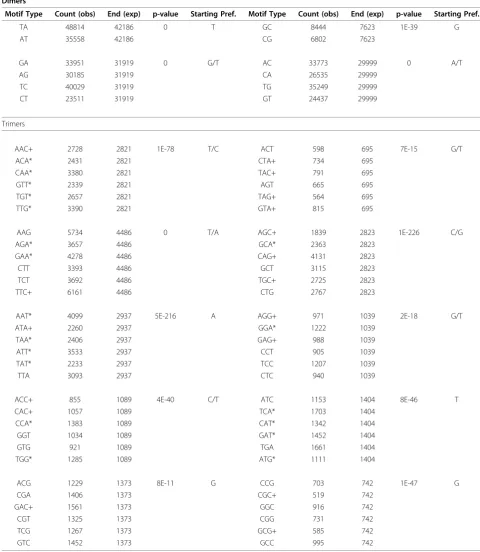
When studying SSR loci, genome-wide annotations commonly combine repeat motifs into complementary and overlapping DNA pairings [4], such that CA = AC = GT = TG, GA = AG = CT = TC, AT = TA, and GC = CG. In each case, the first two motifs of each set (e.g. CA/ AC) represent cases where the longest perfect repeat begins with each of the two bases and the second pair of motifs (e.g. GT/TG) are the complementary base. Our approach counts each of the 12 dimer motifs indepen-dently and determines the maximum size of a perfect microsatellite repeat regardless of the starting base. Using these criteria, we observe a bias in the starting (and end-ing) nucleotide of dimer repeat loci. While the number of repeats from each of the two strands is necessarily equiva-lent, the starting base for each motif is significantly biased in all cases for both dimers and trimers (Table 1). For tri-mers, we examined the overall codon usage forDaphnia pulex, and did not see any correlation between motif class representation and codon usage (Table 1).
One explanation for the unexpected count differential between motifs in a similar grouping is the existence of a motif specific pattern of end base substitution, a phe-nomenon that has been previously observed in chicken microsatellites [18]. These observations may be informa-tive with regard to the origin, or maintenance of SSR loci. To explore these patterns further, we analyzed var-iation at all SSR loci within theD. pulexgenome assem-bly involving repeat number, incomplete insertion deletion events (indels), and base substitutions.
SSR heterozygosity
Multiple models have been developed to explain the pattern of SSRvariation, such as the stepwise mutation model (SMM) [19], and more recent models that focus on a balance between the rate and pattern of length var-iation and base substitutions [20]. To evaluate the rela-tive levels of these two processes, we analyzed the number of loci that were heterozygous for motif unit-length variation and non-repeat unit polymorphism (NRUPs). First, we identified all SSR loci that showed significant evidence of repeat length variation in the raw sequence data from which the genome was assembled (see methods). InDaphnia pulex, we were able to assay 6,062,268 of the 7,229,342 total SSRs for heterozygosity, of which 23,360 of the SSRs varied in length by at least one perfect repeat. Although smaller scaffolds may con-tain additional repeats, there is a increased possibility that these smaller scaffolds are either contaminated sequences or paralogous sequences, therefore we excluded them from the heterozygosity analysis.
For the five most abundant SSR motif sizes (1-5bp), we observe either an exponential or linear increase in repeat length heterozygosity as repeat number increases (Figure 3). Repeats with motif size greater than 5 were analyzed, however, due to the limited sample of large motifs, we were unable to discern any distinguishable pattern. The pattern observed in D. pulex for motifs with size 1-5bp is consistent with the previous observa-tion in yeast and humans that mutaobserva-tion rate increases are correlated with increasing repeat number [7,17,21-23]. The observed pattern is unlikely to reflect SSR sequencing errors because while the frequency of sequencing errors does increase with the number of repeats, it is unlikely that the error will result in the var-iation of a perfect repeat unit.
We then further dissect repeat length heterozygosity, focusing on potential differences in heterozygosity among specific motif types. Due to the lack of heterozy-gotes in motifs longer than dimers, this analysis is lim-ited to the two homopolymer and four dimer repeat motifs (Figure 4a and 4b). Homopolymers inDaphnia pulex exhibit increased repeat heterozygosity with increasing repeat number reaching a maximal rate of increase between 6 and 12 repeats (A/T r2= 0.925, G/C r2= 0.899). The G/C motif achieves a much higher fre-quency of heterozygosity (>20%) than A/T loci (~10%). The higher level of heterozygosity in G/C loci is consis-tent with direct estimates of the mutation rate using
Caenorhabditis elegans mutation accumulation lines, where the G/C homopolymer mutation rate was ~20 fold greater than that for A/T HP loci [6], and consis-tent with previous experiments on E. coli, human, and yeast HPs which show a higher mutation rate of G/C HPs attributed to possible differences in base stacking properties during replication [24]. While it is possible that G/C loci with large numbers of repeats are being selectively excluded due to higher sequencing error rates, the fact that the A/T loci with lower levels of het-erozygosity also show this plateau suggests that it may not simply be a sampling bias. If we assume that replica-tion errors increase proporreplica-tionately with an increase in repeat number, a plateau of A/T and G/C loci suggest that there may be a length threshold for differential repair activity, length-dependent counter mutation, or selection.
Table 1 Abundance and Starting Nucleotide Preference for homopolymer and dimer loci in D. pulex
Dimers
Motif Type Count (obs) End (exp) p-value Starting Pref. Motif Type Count (obs) End (exp) p-value Starting Pref.
TA 48814 42186 0 T GC 8444 7623 1E-39 G
AT 35558 42186 CG 6802 7623
GA 33951 31919 0 G/T AC 33773 29999 0 A/T
AG 30185 31919 CA 26535 29999
TC 40029 31919 TG 35249 29999
CT 23511 31919 GT 24437 29999
Trimers
AAC+ 2728 2821 1E-78 T/C ACT 598 695 7E-15 G/T
ACA* 2431 2821 CTA+ 734 695
CAA* 3380 2821 TAC+ 791 695
GTT* 2339 2821 AGT 665 695
TGT* 2657 2821 TAG+ 564 695
TTG* 3390 2821 GTA+ 815 695
AAG 5734 4486 0 T/A AGC+ 1839 2823 1E-226 C/G
AGA* 3657 4486 GCA* 2363 2823
GAA* 4278 4486 CAG+ 4131 2823
CTT 3393 4486 GCT 3115 2823
TCT 3692 4486 TGC+ 2725 2823
TTC+ 6161 4486 CTG 2767 2823
AAT* 4099 2937 5E-216 A AGG+ 971 1039 2E-18 G/T
ATA+ 2260 2937 GGA* 1222 1039
TAA* 2406 2937 GAG+ 988 1039
ATT* 3533 2937 CCT 905 1039
TAT* 2233 2937 TCC 1207 1039
TTA 3093 2937 CTC 940 1039
ACC+ 855 1089 4E-40 C/T ATC 1153 1404 8E-46 T
CAC+ 1057 1089 TCA* 1703 1404
CCA* 1383 1089 CAT* 1342 1404
GGT 1034 1089 GAT* 1452 1404
GTG 921 1089 TGA 1661 1404
TGG* 1285 1089 ATG* 1111 1404
ACG 1229 1373 8E-11 G CCG 703 742 1E-47 G
CGA 1406 1373 CGC+ 519 742
GAC+ 1561 1373 GGC 916 742
CGT 1325 1373 CGG 731 742
TCG 1267 1373 GCG+ 585 742
GTC 1452 1373 GCC 995 742
This table shows nonrandom starting nucleotides in both dimers and trimers. Motif type indicates largest possible repeat identified for each staggered SSR set. P-value calculated using Pearson’s chi-square test for random expectation based upon observed and expected frequencies.
repeats were shown to vary in repeat size at ~3-fold and ~1.5-fold more than AT repeats, with GC repeats not surveyed [12]. All other things being equal, both Daph-nia pulexandDrosophila melanogasterhave similar pat-terns of repeat variation such that the order of variation by motif sequence is AC/AG > AT > GC.
Studies in yeast and C. elegans have shown that the homopolymer mutation rate is ~100-fold greater than the mutation rate at dimer loci [3,7]. On a per locus basis, the percent heterozygosity of homopolymer repeats and dimer repeats are nearly identical in Daph-nia pulex(+/- 0.5%), with the largest differences occur-ring at large repeats. Together, these observations suggest that the homopolymer and dimer mutation rates may be more similar in the Daphniagenome or that selection severely limits variation at homopolymer loci.
Non-repeat Unit Polymorphisms
Non-repeat unit polymorphisms (NRUPs) are base sub-stitutions or indels that interrupt the continuity of SSR locus and can shape the observed abundance of each repeat class (eg. CACATCACA is an interruption of a CA dimer with a T). It is extremely complicated to define and compare imperfect repeats, so for our analy-sis we identified SSR loci that are perfect repeats in the assembly, and subsequently looked for the existence of NRUPs in the reads aligned to each locus.
Examination of the NRUPs at HP loci (Figure 4c) reveals that as repeat number increases, the proportion of polymorphisms per nucleotide increases (C/G r2 =
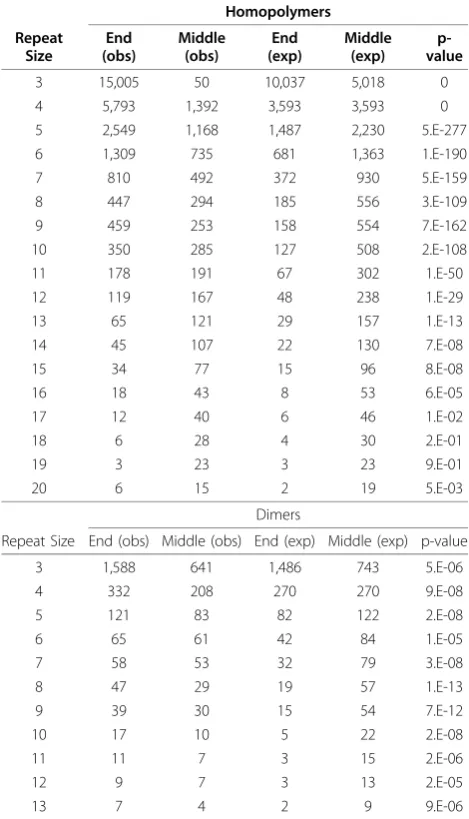
0.905, p < 1e-12; A/T r2 = 0.446, p < .01). The rate of increase is particularly pronounced between 6 and 12 bases at HPs. We further evaluated the positions of NRUPs in a locus by comparing the site of polymorph-ism to the random expectation (Table 2). The result shows that at HP loci, point mutations occur at the beginning or end nucleotides at a higher frequency than expected, and the proportion increases with increasing repeat number, effectively shortening or lengthening the HP loci by a single unit. At smaller and more abundant repeat numbers (from 3-12 nucleotides), the number of end-point polymorphisms is substantial when compared to length variation, and point mutations may have a sig-nificant influence on homopolymer equilibrium.
Similar to homopolymers, a significant end bias is found for NRUPs within dimer repeats (Table 2). At dimer loci with few repeats (less than 5), NRUPs out-number unit length indels, while at loci with 6 or more repeats, unit length indels contribute to the majority of variation (Table 2). This pattern matches results found in a microsatellite study of the chicken genome, which also shows an end bias NRUP distribution within repeat arrays [18]. The propensity for end nucleotide poly-morphisms at short repeats can lead to a SSR distribu-tion characterized by species-specific mutadistribu-tion biases. Our analysis does not allow us to distinguish which of the heterozygous alleles is ancestral or derived and it would be interesting to understand if the rate of single nucleotide gains and losses are equivalent. A genome-wide SSR study involving two closely related populations with a recent out group would be required to determine how NRUPs effect the equilibrium of SSR length distri-bution in an organism.
For at least chicken and D. pulex, these observations suggest that the specific abundance of specific types of microsatellites within a genome reflects a dynamic bal-ance between changes in repeat number and base sub-stitution. When combined with unequal patterns of base substitution, these observations can explain the overa-bundance of specific starting and ending nucleotides in SSR loci (Table 1).
Multi-step variation
Recent human microsatellite studies suggest that multi-step variation is a significant component of variation at larger SSR loci [25], deviating from the SSM model. Furthermore, researchers have shown that the direction-ality of multi-step mutations is length-dependent with a critical repeat number at which contractions are more frequent than expansions [26], while others suggest that a critical number does not exist [27]. In this experiment, we required that each multistep variant displayed a minimum of at least two full perfect repeats. Our analy-sis revealed two patterns. First, for all motif sizes, the
Figure 3Percent repeat heterozygosity for each motif size in
proportion of heterozygotes that are multi-step increases with the number of repeats at a locus (Figure 5). Sec-ond, the rate of multi-step variation increases with increased motif size. Further analysis of individual homopolymer motif types showed that the fraction of multistep variation at A/T HP is much lower (12.14% or 2129/17544) than that of G/C HPs (27.4% or 972/3547) (Figure 5). Dimer loci also show a high frequency (~21.3% or 288/1353) of multistep polymorphisms, with AC motif showing the highest proportion multistep increase (0.0423) followed by AG (0.036) and AT (0.0301) (Figure 5). Direct estimates of dimer SSR loci in D. pulex andC. elegansshow that 73% (173 of 237) of the variation at AC and AG loci larger than 13
repeats was multi-step variants [26]. A similar partition of our data reveals that 52% (12/23) of AC and AG dimer loci with greater than 13 repeats are multi-step differences. Although the experiments described above show that most of these multi-step changes are repeat length increases, our method of analysis does not allow us to polarize the differences between alleles. In any event, there appears to be a motif dependant correlation between repeat length and multi-step mutation change for SSR loci.
Density of SSR Loci
Although the factors that affect the density of SSR loci within a genome remain to be clearly defined, the
Figure 4Repeat heterozygosity, point mutation heterozygosity and raw counts for homopolymers (A, C, E) and dimers (B, D, F). Black lines and squares correspond to A/T homopolymers, red lines and squares correspond to C/G homopolymers. Colors corresponding to the dimers are green:AC/CA/GT/TG, blue:AG/GA/CT/TC, grey:AT/TA, magenta:CG/GC. (A) Percent repeat heterozygosity for homopolymers A/T (r2=
0.925, p < 1e-11) and C/G (r2= 0.899, p < 1e-10) with increases in heterozygosity highest between 7-11 repeats. C/G heterozygosity is
approximately 3-fold higher than A/T heterozygosity. (B) Percent repeat heterozygosity for dimers with AC> AG> AT > CG (r2= 0.862, p < 1e-5;
r2= 0.891, p < 1e-5; r2= 0.736, p < .01; r2= 0.539, p < .2). (C) Point mutation per nucleotide for homopolymers C/G (r2= 0.905, p < 1e-12) and
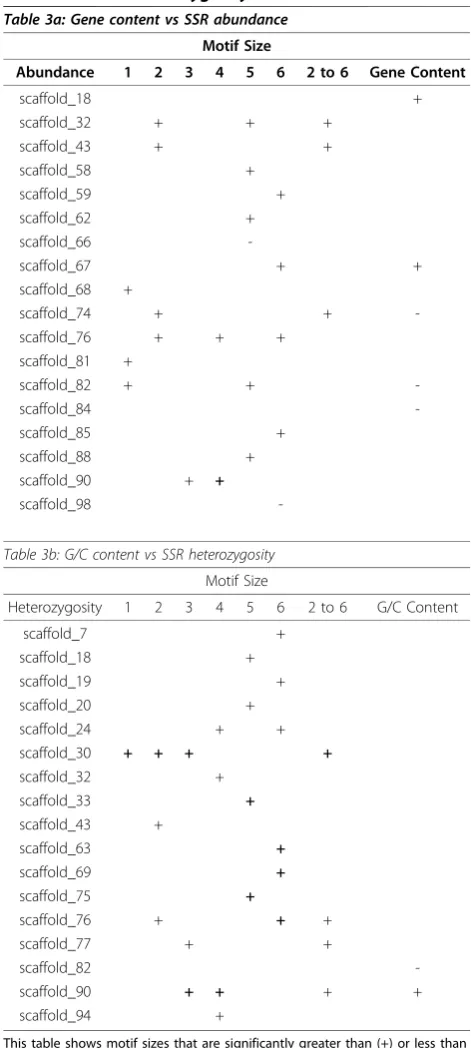
density of SSRs within genomes has been positively cor-related with regional rates of recombination in Droso-phila melanogaster [27],Saccharomyces cerevisiae [28], and C. elegans[2]. To evaluate the density of SSR loci in theDaphnia genome, we ranked the density of SSRs in each of the top 100 scaffolds ranging in size from 4.19 Mb to 0.47 Mb (Table 3a). Several scaffolds (68, 81, 83, 89) show a dearth of HP loci and scaffolds 66 and 98 have a paucity of SSRs with five and six base motifs respectively. While no scaffolds showed an overabun-dance of homopolymers, several scaffolds showed signif-icantly high numbers of SSRs, in particular scaffolds 43,
74, and 76, which have an overabundance of repeats of motif sizes greater than 1 bp. Simple sequence repeats have been shown to play a role in gene regulation [1] and consequently would be in close proximity to genes. To test if these patterns are correlated with gene den-sity, we compared SSR scaffold abundance to Daphnia
gene predictions [15], and show that none of the overa-bundant scaffolds listed previously are either gene poor or gene rich (Table 3a). Results found inC. elegans [6] also show little correlation between gene density and SSR density.
We then used a preliminary genetic map for Daphnia pulex[29] to test for correlations between SSR density and heterozygosity with rates of recombination within scaffolds. Based on 61 intervals in the genetic map that could be assigned to physical intervals in the top 100 scaffolds, we find that the density of microsatellite loci with motif sizes greater than 1bp show a significant positive correlation with the rate of recombination (Fig-ure 6). This result is consistent with a yeast study show-ing a high frequency of microsatellite repeats near meiotic hotspots [28], and further supports role for SSR loci in the regulation of recombination. Both microsatel-lite repeats (repeats of motif size 2-6), and homopoly-mer repeats (single nucleotide repeats) correlate positively with recombination rate (Figure 7). Homopo-lymers have array sizes that are considerably larger than microsatellites, giving them properties that may influ-ence recombination frequency.
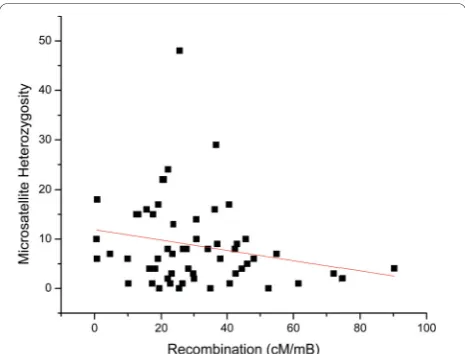
Within the same intervals, no correlation was observed between microsatellite heterozygosity and recombination inDaphnia pulex(Figure 8). A previous microsatellite survey in humans [30] also showed no sig-nificant correlation between microsatellite heterozygosity
Table 2 Position of the interruption in imperfect SSR.
Homopolymers Repeat
Size
End (obs)
Middle (obs)
End (exp)
Middle (exp)
p-value
3 15,005 50 10,037 5,018 0
4 5,793 1,392 3,593 3,593 0
5 2,549 1,168 1,487 2,230 5.E-277
6 1,309 735 681 1,363 1.E-190
7 810 492 372 930 5.E-159
8 447 294 185 556 3.E-109
9 459 253 158 554 7.E-162
10 350 285 127 508 2.E-108
11 178 191 67 302 1.E-50
12 119 167 48 238 1.E-29
13 65 121 29 157 1.E-13
14 45 107 22 130 7.E-08
15 34 77 15 96 8.E-08
16 18 43 8 53 6.E-05
17 12 40 6 46 1.E-02
18 6 28 4 30 2.E-01
19 3 23 3 23 9.E-01
20 6 15 2 19 5.E-03
Dimers
Repeat Size End (obs) Middle (obs) End (exp) Middle (exp) p-value
3 1,588 641 1,486 743 5.E-06
4 332 208 270 270 9.E-08
5 121 83 82 122 2.E-08
6 65 61 42 84 1.E-05
7 58 53 32 79 3.E-08
8 47 29 19 57 1.E-13
9 39 30 15 54 7.E-12
10 17 10 5 22 2.E-08
11 11 7 3 15 2.E-06
12 9 7 3 13 2.E-05
13 7 4 2 9 9.E-06
This table shows the position of interruptions in simple sequence repeats. “End”indicates polymorphism at beginning or end of SSR loci, while middle variation indicates polymorphism occurs at interior positions (eg.
Homopolymer with repeat length of three has two possible end nucleotide positions and one possible middle position. P-value is determined using Pearson’s chi-square test for random expectation.
Figure 5Percentage of repeat heterozygosity that involves more than a single unit. Homopolymers r2= 0.896, p < 1e-8;
and recombination rate, however, the scale of the recombination intervals and their measurement often make such observations difficult. Although SSRs of all
types are correlated with recombination rates, the level of SSR heterozygosity seems uninfluenced by recombination.
The distribution of heterozygosity at SSR loci can be shaped by selective sweeps, background selection and locus-specific differences in mutation rates. Many of these patterns may themselves be correlated. Based on our analysis, scaffolds 24, 30, 76, and 90 have multiple motif classes that are significantly more heterozygous than expected (Table 3b). Scaffold 90 also shows signifi-cantly higher G/C content (44%; average G/C = 41%), which is contradictory to suggestions of an evolved effi-ciency of MMR in G/C rich regions of eukaryotes [31].
Table 3 Gene content vs SSR abundance, and G/C content vs SSR heterozygosity
Table 3a: Gene content vs SSR abundance
Motif Size
Abundance 1 2 3 4 5 6 2 to 6 Gene Content
scaffold_18 +
scaffold_32 + + +
scaffold_43 + +
scaffold_58 +
scaffold_59 +
scaffold_62 +
scaffold_66
-scaffold_67 + +
scaffold_68 +
scaffold_74 + +
-scaffold_76 + + +
scaffold_81 +
scaffold_82 + +
-scaffold_84
-scaffold_85 +
scaffold_88 +
scaffold_90 + +
scaffold_98
-Table 3b: G/C content vs SSR heterozygosity
Motif Size
Heterozygosity 1 2 3 4 5 6 2 to 6 G/C Content
scaffold_7 +
scaffold_18 +
scaffold_19 +
scaffold_20 +
scaffold_24 + +
scaffold_30 + + + +
scaffold_32 +
scaffold_33 +
scaffold_43 +
scaffold_63 +
scaffold_69 +
scaffold_75 +
scaffold_76 + + +
scaffold_77 + +
scaffold_82
-scaffold_90 + + + +
scaffold_94 +
This table shows motif sizes that are significantly greater than (+) or less than (-) the overall scaffold mean.
Motif Sizes that are significantly different (2 standard deviations) from the overall scaffold mean using Generalized Extreme Studentized Deviate (ESD) are bolded (p < 0.05, df = 98). Column 2 to 6 is the cumulative sum of motif sizes 2 to 6 (homopolymers excluded).
Figure 6Positive correlation between recombination (cM/mB) and microsatellite density per Mb. 95% prediction interval represent the blue line, 95% confidence interval represent the green line (r2= 0.376, p < 1e-6).
Conclusions
TheDaphnia pulexgenome sequence provides us with a unique opportunity to study genome-wide SSR patterns using whole genome shotgun reads. Although recent sequencing technologies have greatly improved sequen-cing throughput, these new technologies introduce mul-tiple errors that are absent from WGS sequencing. Furthermore, the large read size of WGS sequencing allows for alignment to larger motif types that smaller read lengths cannot span. Daphnia pulexhas undergone a minimal amount of inbreeding prior to sequencing, retaining high relative levels of assayable SSR heterozyg-osity that may be removed from heavily inbred genome sequencing projects.
SSRs, primarily microsatellites, are used commonly as genetic markers for population level studies. Our results show that inDaphnia pulex, levels of genome-wide SSR heterozygosity can not only vary with the length of motifs, but also by motif type in agreement with the stu-dies of other organisms [18,22,27]. Our genome-wide results show that microsatellite loci with less than 6 repeats accumulate non-repeat unit polymorphisms at a greater rate than repeat length differences. In addition, AC/AG microsatellites accumulate repeat length differ-ences at a greater rate than AT/GC microsatellites. Taken together, forDaphnia pulex, AC/AG repeats with a minimum of 6 repeats will provide the most resolution when used as genetic markers inDaphnia specific popu-lation level studies. Although the two available genome-wide microsatellite studies of fruit-fly [27] and chicken [18] display similar patterns of heterozygosity (highest AC/AG heterozygosity), microsatellites studies from additional taxa must be made before a broad
recommendation for genetic marker motif type and repeat length can be made.
In our analysis of SSR loci in the genome of Daphnia pulexwe describe both the catalogue of SSR sequences and several aspects of abundance and variation that are motif specific. Patterns that are motif specific include levels of heterozygosity, motif specific rates of repeat length variation, and motif specific patterns of NRUPs. Current models of simple sequence repeat evolution suggest that the abundance and variation at SSRs results from a balance of two opposing mutational forces. SSRs have a repeat number dependant rate of evolution resulting in the loss and gain of perfect repeat units. By contrast NRUPs disrupt repeat patterns and break down larger repeats into smaller ones. We also find a propen-sity for end nucleotide base substitution in SSRs, which was also reported in the chicken genome [18], suggest-ing that end nucleotide base substitution shapes the spe-cific patterns of SSR abundance in multiple genomes. In addition to nucleotide end bias, we identify a significant difference in nucleotide starting preference for dimer and trimer classes.
Methods
Sequence data
The fasta sequences used in this study are from the
Daphnia pulexgenome project. The DOE Joint Genome Institute (JGI) and theDaphnia Genome Consortium (DGC) have sequenced 2,729,325 shotgun clones that result in 8.7 × coverage of the Daphnia pulexgenome. This sequence has been assembled using the JAZZ assembler, and consists of 9,080 scaffolds, containing a total of 1,591,853 reads, and 227.1 Mb. In this assembly, 103 scaffolds represent the N50. The sequences can be downloaded at JGI http://www.jgi.doe.gov/Daphnia/) and the DGC http://wfleabase.org/. The fasta sequences used in Figure 2 were taken from http://www.flybase.org (Drosophila melanogaster), http://www.wormbase.org (Caenorhabditis elegans), and http://www.yeastgenome. org (Saccharomyces cerevisiae).
Detection of simple sequence repeats
Programs written in PERL (available upon request) are used to count the number, length, location, and motif of all repeating motif size 1-100 bps in theDaphnian50 scaffolds, with a minimum repeat number of 3 repeats. A greedy algorithm is applied to finding the repeats. Once the first repeat is found, the location is noted and back matching of the repeat is used to determine the length of the repeated motif. The program allows for no mismatches (all repeats are perfect repeats). Only the smallest motif in the repeat is counted, larger nested motifs are counted as the lowest common repeating motif (eg. GAGAGAGA is counted as 4 repeats of GA,
not one repeat of GAGAGAGA or two repeats of GAGA). Each motif is defined by the first occurrence of a repeating nucleotide (eg. GA and AG are unique motifs). Because this is a greedy algorithm, motifs of the largest size are identified, regardless of sequence identity (eg. AAAGAGAAAGAG is counted as two repeats of AAAGAG, not two homopolymeric runs of AAA).
Measuring Heterozygosity
To assay variation at SSR loci we used the AMOS refer-ence assembler [32] to assemble the 8.7 × sequrefer-ences (average read length = 774) to the JAZZ assembly at 90% identity to allow for an estimated 2-4% average sequence heterozygosity. This allows for heterozygous differences of between 6-8% (46-62 nucleotides). In order to remove paralogy, coverage depth at each posi-tion was limited to a maximum of 16 and a minimum of 4 inclusive. Loci that met these criteria through the entire repeat were extracted from the AMOS output and analyzed for indels of perfect repeats and point mutations. Variants that are greater than 1 repeat unit in length were categorized as multi-step variations. In order to make a heterozygous call, we required a mini-mum of 2 consensus reads showing the variation. There were 966758 sites that only had one variant read for repeat differences and 1675976 sites that only had one variant read for SNP differences. The total number of reads covering these sites were 9468378 and 15642919 reads respectively, leading to a read error rate of ~0.1 for both types. Loci that had more than two alleles were thrown out of the analysis. There were 1220 loci that displayed two or more heterozygotes SNP calls, and 277 loci that displayed more than two or more heterozygous repeat calls. (1497/6,062,268). The estimated frequency of paralogous loci in the dataset is 2.47e^-4.
Acknowledgements
The sequencing and portions of the analyses were performed at the DOE Joint Genome Institute under the auspices of the U.S. Department of Energy’s Office of Science, Biological and Environmental Research Program, and by the University of California, Lawrence Livermore National Laboratory under Contract No. W-7405-Eng-48, Lawrence Berkeley National Laboratory under Contract No. DE-AC02-05CH11231, Los Alamos National Laboratory under Contract No. W-7405-ENG-36 and in collaboration with the Daphnia Genomics Consortium (DGC) http://daphnia.cgb.indiana.edu. Additional analyses were performed by wFleaBase, developed at the Genome Informatics Lab of Indiana University with support to Don Gilbert from the National Science Foundation and the National Institutes of Health. Coordination infrastructure for the DGC is provided by The Center for Genomics and Bioinformatics at Indiana University, which is supported in part by the METACyt Initiative of Indiana University, funded in part through a major grant from the Lilly Endowment, Inc. Our work benefits from, and contributes to the Daphnia Genomics Consortium.
Author details
1Hubbard Center for Genome Studies, University of New Hampshire,
Durham, NH 03824, USA.2Department of Computer Science, University of New Hampshire, Durham, NH 03824, USA.3Department of Biology, Indiana
University, Bloomington, IN 47405, USA.
Authors’contributions
WS wrote the manuscript. AT, WS analyzed and interpreted data. AT, WS, RDB, WKT contributed to conception and design. ML and WKT participated in critical manuscript revision. All authors read and approved the final manuscript.
Received: 24 May 2010 Accepted: 3 December 2010 Published: 3 December 2010
References
1. Kashi Y, King D:Simple sequence repeats as advantageous mutators in evolution.Trends in Genetics2006,22(5):253-259.
2. Denver D, Morris K, Kewalramani A, Harris K, Chow A, Estes S, Lynch M, Thomas WK:Abundance, Distribution, and Mutation Rates of Homopolymeric Nucleotide Runs in the Genome ofCaenorhabditis elegans.J Mol Evol2004,58:584-595.
3. Lynch M, Sung W, Morris K, Crown N, Landry C, Dopman E, Dickinson WJ, Okamoto K, Kulkarni S, Thomas WK:A Genome-wide View of the Spectrum of Spontaneous Mutations in Yeast.Proc Natl Acad Sci USA
105(27):9272-7.
4. Toth G, Gaspari Z, Jurka J:Microsatellites in different eukaryotic genomes: survey and analysis.Genome Res2000,10:967-981.
5. Kruglyak S, Durett R, Schug M, Aquadro CF:Distribution and abundance of microsatellites in the yeast genome can be explained by a balance between slippage events and point mutations.Mol Biol Evol2000,
17:1210-1219.
6. Denver D, Feinberg S, Estes S, Thomas WK, Lynch M:Mutation Rates, Spectra and Hotspots in Mismatch Repair-DeficientCaenorhabditis elegans.Genetics2005,170:108-113.
7. Sia EA, Kokoska R, Dominska M, Greenwell P, Petes T:Microsatellite Instability in Yeast: Dependence on Repeat Unit Size and DNA Mismatch Repair Genes.Mol Cell Bio1997,17(5):2851-2858.
8. Hawk J, Stefanovic L, Boyer J, Petes T, Farber R:Variation in efficiency of DNA mismatch repair at different sites in the yeast genome.Proc Natl Acad Sci USA2005,102:8639-8643.
9. Eisen J:A phylogenomic study of the MutS family of proteins.Nucleic Acids Res1998,26(18):4291-4300.
10. Gragg H, Harfe B, Robertson SJ:Base composition of mononucleotide runs affects DNA polymerase slippage and removal of frameshift intermediates by mismatch repair inSaccharomyces cerevisiae.Mol Cell Bio2002,22(24):8756-8762.
11. Schlötterer C:Evolutionary dynamics of microsatellite DNA.Chromosoma
2000,109:365-371.
12. Bachtrog D, Agis M, Imhof M, Schlötterer C:Microsatellite Variability Differs Between Dinucleotide Repeat Motifs-Evidence fromDrosophila melanogaster.Mol Biol Evol2000,17(9):1227-1285.
13. wFleaBase.[http://wFleaBase.org/].
14. Zhou Y, Bizzaro J, Marx K:Homopolymer tract lengths dependent enrichments in functional regions of 27 eukaryotes and their novel dependence on the organism DNA (G+C)% composition.BMC Genomics
2004,5:95.
15. JGI Genome Portal.[http://www.jgi.doe.gov/Daphnia/].
16. Nadir E, Margalit H, Gallily T, Bensasson SA:Microsatellite spreading in the human genome: Evolutionary mechanisms and structural implications.
Proceedings of the National Academy of Sciences1996,93:6470-6475. 17. Kelkar YD, Tyekucheva S, Chiaromonte F, Makova KD:The genome-wide
determinants of human and chimpanzee microsatellite evolution.
Genome Res2008,18:30-38.
18. Brandstrom M, Ellegren H:Genome-wide analysis of microsatellite polymorphism in chicken cirvumventing the ascertainment bias.Genome research2008.
19. Ohta T, Kimura M:A model of mutation appropriate to estimate the number of electrophoretically detectable alleles in a finite population.
Genet Res1973,22:201-204.
20. Kruglyak S, Durett R, Schug M, Aquadro CF:Equilibrium distributions of microsatellite repeat length resulting from a balance between slippage events and point mutations.Proc Natl Acad Sci USA1998,95:10774-10778. 21. Lai Y, Sun F:The relationship between microsatellite slippage mutation
rate and the number of repeat units.Mol Biol Evol20:2123-2131. 22. Ellegren H:Heterogeneous mutation processes in human microsatellite
23. Rose O, Falush D:A Threshold Size for Microsatellite Expansion.Mol Biol Evol15(5):613-615.
24. Ellegren H:Microsatellites: Simple sequences with complex evolution.
Nature Review Genetics2004,5:435-444.
25. Xu X, Peng M, Fang Z:The direction of microsatellite mutations is dependent upon allele length.Nature Genet2000,24:396-399. 26. Seyfert A, Cristescu M, Frisse L, Schaack S, Thomas WK, Lynch M:The rate
and spectrum of microsatellite mutation inCaenorhabditis elegansand
Daphnia pulex.Genetics2008,178:2113-2121.
27. Schug M, Hutter C, Noor M, Aquadro C:Mutation and evolution of microsatellites inDrosophila melanogaster.Genetica1998,
102(103):359-367.
28. Bagshaw A, Pitt J, Gemmell N:High frequency of microsatellites in S. cerevisiae meiotic recombination hotspots.BMC Genomics2008,9:49. 29. Cristescu M, Colbourne J, Radivojac J, Lynch M:A microsatellite-based
genetic linkage map of the waterflea,Daphnia pulex: On the prospect of crustacean genomics.Genomics2006,88:415-430.
30. Payseur B, Nachman M:Microsatellite Variation and Recombination Rate in the Human Genome.Genetics2000,156:1285-1298.
31. Birdsell J:Integrating genomics, Bioinformatics, and Classical Genetics to Study the Effects of Recombination on Genome Evolution.Mol Bio Evol
19(7):1181-1197.
32. AMOS:A Modular Open-Source Assembler[http://amos.sourceforge.net/].
doi:10.1186/1471-2164-11-691
Cite this article as:Sunget al.:Simple sequence repeat variation in the
Daphnia pulexgenome.BMC Genomics201011:691.
Submit your next manuscript to BioMed Central and take full advantage of:
• Convenient online submission
• Thorough peer review
• No space constraints or color figure charges
• Immediate publication on acceptance
• Inclusion in PubMed, CAS, Scopus and Google Scholar
• Research which is freely available for redistribution