AN IMPROVED LEAST-LAXITY-FIRST
SCHEDULING ALGORITHM FOR
REAL-TIME TASKS
H.S Behera, Satyajit Khuntia & Soumyashree Nayak,
Department of Computer Science & Engineering
Veer Surendra Sai University of Technology (VSSUT), Burla, Odisha, India
email : [email protected], [email protected], [email protected] Abstract :
Scheduling algorithms play an important role in design of real time systems. Least Laxity First (LLF) is a well -known and extensively applied dynamic Scheduling algorithm which has been proved to be optimal on uniprocessor systems. The Least-Laxity-First (LLF) Scheduling algorithm assigns priority based on the slack time of a process. Its most common use is in embedded systems, especially those with multiple processors. The algorithm is impractical to implement because laxity tie results in the frequent context switches among the tasks. The least switch and laxity first scheduling algorithm is proposed in the paper, which improves the least laxity first algorithm for periodic task by searching out an appropriate common divisor along with Modified Least Laxity First (MLLF).In this paper, we present an Improved Least-Laxity-First Algorithm (ILLF) which eliminates the disadvantages of MLLF Scheduling algorithm with intelligence time slice and prove its optimally Keywords: Processes; laxity value; scheduling algorithm; real-time system; greatest common divisor
1. Introduction
LLF (Least Laxity First) is one of the classic dynamic priority scheduling algorithms in which the scheduling priority of a task is determined based on its precise slack time. Operating System overhead reduces the performance of a computer system especially for real-time system where task must complete prior to a given deadline. Among the Real-Time Scheduling algorithms, the algorithm based on the priority of tasks is very common which is a kind of dynamic-priority scheduling algorithm and has widespread application in the above real-time systems.
Real-time system is required to complete its work and deliver its services on the basis of time. The results of real time systems are judged based on the time at which the results are produced in addition to the logical result of computations.
With the LLF scheduling algorithm, however, if two or more tasks have same laxities, laxity-tie occurs. Once laxity-tie occurs, context switches takes place every scheduling point until the tie breaks. The laxity-tie in the LLF scheduling algorithm results in the poor system performance due to the frequent context switches
In this paper, we propose an Improved Least Laxity First Scheduling Algorithm with intelligence time-slice to solve the frequent context switches problem of the LLF Scheduling algorithm. This is an optimal approach to solve the no of context switching. This Improved-Least-Laxity-First Scheduling algorithm , however is better than that of the LLF Scheduling algorithm as well as MLLF(Modified-Least-Laxity-First) Scheduling algorithm.
2. Related Works
concepts of the least slack time scheduling algo for real time system. In [8-9], Abbott R. and Dertouzos ML, et al. suggested the Least Slack First algorithm, which assigns a priority to a task according to its urgent degree for being executed. The less the idle time of a task is, the sooner it will be executed. So, the most urgent tasks (the tasks that may not be the earliest deadline) will have the highest priority to be executed. Along with the system action, the idle time of the task is unaltered in executing state, but the idle time of the waiting task is strictly decreasing. The exigent degree of the waiting tasks will become higher when time elapses. So in the action period of the system, the task which waits long has the opportunity to get the resource of the processor at a moment. When the urgent of the tasks is close, it will author described a periodic task scheduling algorithm lead to serious frequent switches or thrashing phenomenon among the tasks.
3. Proposed Approach
3.1. Pseudo Code of the Proposed Algorithm
1. I/P : Process(Pi), Execution Time (Ei), Dead Line (Di);
O/P: Context Switch (CS), number of times laxity calculated (N)
2. Initialize Ready Queue=0 ;
goto 3;
3. /*Calculation of the Time Quantum using GCD of the execution time of all the processes*/ TQ=GCD(E1to En); //where i varies from 1 to n
goto 4; 4. if(Ei==0)
{ Remove Pi; n=n-1; i=i-1; if(n==0)
{ Stop and Exit; } Else
goto 4; else
Li=Di-Ei;}
goto 5;
5. if(i<n) { i=i+1; goto 4;}
else
goto 6;
6. Sort P1 to Pn according to laxity in ascending order
goto 7;
7. if(Lj==Lj+1)
goto 8;
else
{ Execute Pj for TQ time; for(k=0;k<n;k++) { Dk=Dk – TQ;}
Ej=Ej-TQ; goto 4; } 8. if(Ej>=Ej+1)
goto 9;
else
{ Execute Pj+1 till completion for(k=0;k<n;k++) {Dk=Dk-Ej+1; Ej+1=0;goto 4;} 9. Execute Pj till completion for(k=0;k<n;k++) {
Dk=Dk-Ej; }
3.2. Flowchart of the Proposed Algorithm yes no yes no no yes No yes no yes no yes
s
tartInitialize processes in ready Queue
i=1, j=0,TQ=GCD(Eito En
)
Ei == 0
Li=Di-Ei
i < n
Ej>=Ej+1 Lj == Lj+1
Execute Pj till completion For k = 0 to n Dk = Dk – Ej;
Ej = 0;
Remove Pi
n=n-1 and i=i+1
n==0
s
tarts
topi=i+1
Execute Pj for TQ time E j= Ej - TQ; For k = 0 to n Dk = Dk - TQ;
Execute Pj+1 till completion Ej = Ej – TQ; For k = 0 to n Dk = Dk – TQ;
Sort Processes according to laxity in ascending order
4. Experimental Analysis of the Proposed Algorithm
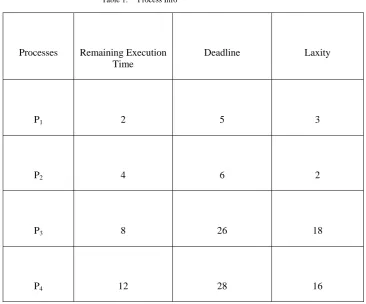
Let there are four periodic tasks namely P1,P2,P3 and P4. Suppose that they arrive at the same time, their execution time is 2,4,8,12 respectively and deadline is 5,6,26,28 respectively.
Table 1. Process Info
Gantt Chart of MLLF algorithm is described below
Figure 1. Gantt Chart as well as Context Switching of MLLF Scheduling Algorithm
P2 P1 P2 P4 P3 P4
0 1 3 6 8 16 26
Here the Context Switching point is indicated by downward arrows. Five Context Switching occur in MLLF Scheduling Algorithm as shown in the above figure 1. Here the time quantum is 1milli sec
.
Gantt Chart of Proposed ILLF Scheduling Algorithm is described below
Figure 2. Gantt Chart as well as Context Switching of the Proposed ILLF Algorithm
P2 P1 P2 P4 P4 P3
Processes Remaining Execution Time
Deadline Laxity
P1 2 5 3
P2 4 6 2
P3 8 26 18
Here the Context Switching point is indicated by downward arrow. Four Context Switching occur in ILLF Scheduling algorithm as shown in figure 2.
5. Performance Evaluation
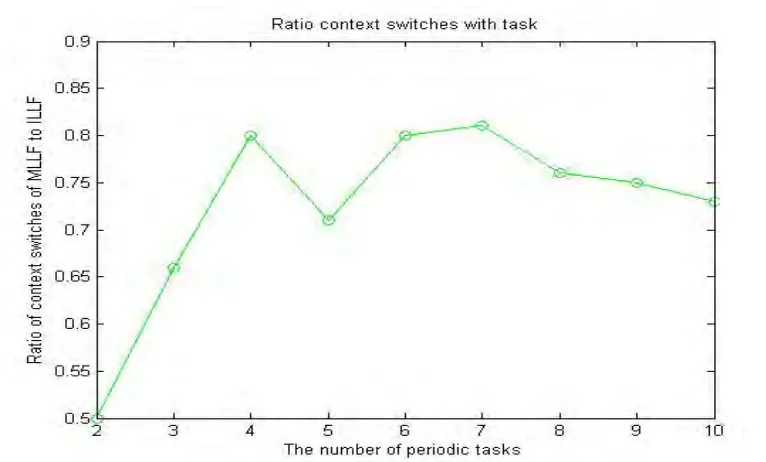
In this section, MLLF and ILLF scheduling algorithm are tested and its performance is calculated. The result shows that the number of context switching in MLLF Scheduling Algorithm is more than our proposed ILLF Scheduling Algorithm. As context switching decreases the performance of the processor, hence our proposed ILLF scheduling algorithm shows better performance over MMLF scheduling algorithm.
Figure 3. Comparison of number of context switches in both the algorithms
Figure 5. Global performance ratio with task = 10 and 20
In figure 3 and 4 the performance based upon context switches is analyzed. This shows that our proposed algorithm has less number of context switching and the ratio of the context switching of MMLF algorithm to our proposed ILLF algorithm is always less than equal to one. For that reason our proposed ILLF Scheduling algorithm is better compared to that of MLLF Scheduling Algorithm.
Our proposed algorithm is based on an intelligence time slice which is the Greatest Common Divisor of the execution time of all processes.
Hence our proposed ILLF scheduling algorithm is more efficient than Modified Least Laxity First (MLLF) Scheduling algorithm.
6. Conclusion
In this research, we proposed An Improved Least Laxity First (ILLF) Scheduling Algorithm with intelligence time slice that removes the drawbacks of the Least Laxity First(LLF) Scheduling Algorithm and Modified Least Laxity First (MLLF) Scheduling Algorithm. Here the performance evaluation shows that in case of MLLF Scheduling Algorithm the no of Switching is more as compared to our proposed ILLF Scheduling Algorithm, which is a overhead to the system and reduces the system performance. Thus this is an efficient dynamic priority based scheduling Algorithm for Real-Time systems
References
[1] Sung -Huen Oh ; Seung-Min Yang : A Modified Least-Laxity-First Scheduling Algorithm for Real- Time-Tasks
[2] Wang Ji-young,Lin Tao ; Wang Jin-dong, et al : Research on preemptions of preemptive EDF and improvement on its performance , Acta Electronica Sinica, 2004, 1: 64-68
[3] Michael B. Jones ; Joseph S. Barrea III ; Alessandro Foorin, ; Paul J. Leach ; Daniela Rosu ; Marcel-Catalin Rosu : An Overview of the Rialto Real-Time Architecture.
[4] G.C. Buttazzo ; Hard Real-Time Computing Systems : Predictable Scheduling Algorithms and Applications, Kluwer Academic Publishers, 1997
[5] M.L. Dertouzos : “Control Robotics: the Procedural Control of Physical Processes,” Information Processing 74, North-Holland Publishing Company,1974
[6] E. D. Jensen ; C. D. Locke ; H. Toduda : A time-driven scheduling model for real-time operating systems [A], Proceedings of the 6th IEEE Real-Time Systems Symposium [C], San Diego, California: IEEE Computer Society, 1985: 112-122
[7] Jin Hong ; Wang Hong-An ; Wang Qiang ; Dai Guo Zhong : An improved least-slack first scheduling algorithm, Journal of software
[8] Abbott R.; Garcia-Molina H.: Scheduling real-time transactions: A performance evaluation
AUTHORS BIOGRAPHY
1. Dr H.S.Behera is currently working as faculty in Dept. of Computer Science and Engineering in Veer Surendra Sai University of Technology (VSSUT), Burla, Odisha, India. His areas of interest include Operating Systems, Data Mining, Softcomputing and Distributed Systems.