Generating Face Features by Palm Scan: Recognizing a
Person Uniquely
Apoorva
Chitravanshi
B.Tech. Pre-final year, Abes Engg.College, GhaziabadAnju Singh
B.Tech. Pre-final Year Abes Engg.College, GhaziabadShobha
Solanki
B.Tech. Pre-final Year, Abes Engg. College, GhaziabadAmit Kumar
B.Tech.Pre-final year, Abes Engg.College, GhaziabadRashmi
Sharma
Department of Information Technology, AbesEngg.Coll ege,GhaziabadABSTRACT
The paper presents a system based on biometrics that generates the person‟s face by scanning of the palm. It does the recognition of an unknown person which is not enrolled in the database before. A new approach is introduced using Biometrics where high security tasks like criminal identification and investigation, along with various other applications like extracting the person‟s detail from the universal database of a country/place, recognizing the face of the person who met with some casualties, checking out the last person who attended the ATM machine ,etc. The study shows that there is a relationship between palm and face. Just by the palm scan the proposed system will generate eyes, nose, eyebrows and lips of new person. And by recognition of the person by the generated face features further investigation can be done by central database of the country/place.
Keywords
Biometrics, Artificial Neural Network (ANN), BackPropagation Algorithm (BPN), Face Geometry, Palm Features.
1.
INTRODUCTION
In today‟s era, where security is the major area of concern, a tremendous technology biometric is used. Wherever there is a word like Biometrics, the very first thing comes to mind is safety and security.
Biometrics is a methodology which provides authentication, verification and identification of a person with high accuracy. The prominent and magnified benefits of this technology which makes it different from pin numbers, passwords, punch cards and many others are its uniqueness and universal property that is characteristics varies from person to person. But to give a new direction to the biometric application a new challenging application like recognizing a person and then generating all the details is endeavor approach. The proposed system generates the outline of the face parts of a person including eyes, ears, nose, lips and eyebrows without any acquaintance of the person before. This would be done by scanning the palm and thus all the details of the person will be generated correspondingly.
The details of that new person need connectivity with central universal database of a country. This is Palm to Face (P2F) recognition technique without any knowledge about the person before. This AI system will automatically make intelligent output by the knowledge (of “what exists in system”) by training it. The system will be trained by ANN
technique [1][2]. ANN helps the system in modeling complex networks.
This new application can help in various new investigation aspects like determining all the details of a person by recognizing the face by the palm scan in case of casualties. The casualties can be meeting with an accident, or may get burnt accidentally, or was the last person to access the ATM or any secured information system. This new challenging idea can help cops in various investigation processes.
This paper is divided into many modules explaining various features related to [3] methodology used - Biometrics [1] technique used – ANN [2] Training methodology [4] Features extraction.
2.
BIOMETRICS
Fig 1: Training of proposed system
Fig 2: Recognizing a person
3.
ARTIFICIAL NEURAL NETWORK
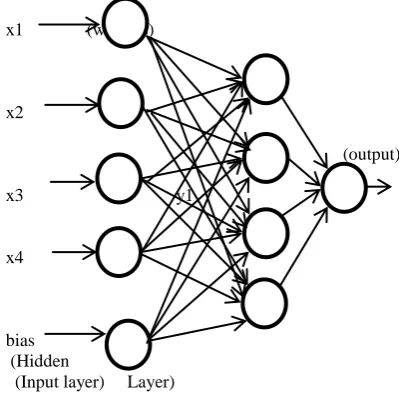
ANN is a computational mathematical model which is inspired by the biological neural network and is composed of artificial neurons [2][4]. It has some fascinating features like learning, generalization, fast computation, less data requirements, ease of implementation and software and hardware availability. Artificial neural networks may either be used to gain an understanding of biological neural networks, or for solving artificial intelligence problems without creating a model of a real biological system. It is a decision making tool and can also be used to model complex relationship between inputs and outputs or to find patterns in the data. Multi-layered perceptron (MLP) is an ANN architecture that can be trained by many learning algorithms [1][2][4].The MLP has input, output and hidden layers in its structure. Hidden layers can be more than one. It utilizes a supervised technique known BACKPROPOGATION (BPN) [1][4]. The input layer represents the raw information that is fed into the system. The neurons in the input layer may be treated as buffers and input signal will be distributed to the neurons of the hidden layer. The output of each neuron in the hidden layer is obtained from the sum of the multiplication of all input signals. The sum can be calculated in the form of function. This function can be of various types a sigmoid function, a signum function, a simple threshold function or a hyperbolic tangent function [3].
The output of neurons can be calculated in the same way. The weights are adapted with the help of learning algorithm to be used to train the system [5]. The errors can be computed by subtracting ANN outputs from the desired outputs. MLPs might be trained with many different learning algorithms [2][3][4]. There are many different algorithms that can be used to train the system.
x1 (weights)
x2
(output) x3 y1
x4
bias (Hidden
(Input layer) Layer)
Fig 3: ANN technique (system training)
4.
LITERATUREREVIEW
S. Sagiroglu, N. Ozkaya,Member, IEEE, 2012 [6][7], have shown a close relationships between fingerprints and faces. Improvement in the proposed system is still sustained for the purpose of analysing and modelling of this relationship for the future developments in biometrics and security applications. S,eref SA˘GIRO˘GLU, Necla ¨O ZKAYA [8] in their paper proposed system that has a number of modules including two feature enrolment modules for acquiring the fingerprints and faces into the system. This system has an ANN module that was configured with Taguchi‟s design method for establishing relationships among the biometric features. This system consists of a face reconstruction for building up face features from the results of the system and a test module for testing the result of the system. The results shows that the face features can be successfully generated from the finger prints only. Jain, A.K, Ross, A. and Pankanti, S. [9][10] in their paper used and enrolment phase and a feature extraction phase, used to acquire the biometric data of the person and then extracting the feature set from the acquired biometric data. These extracted features are stored in database. Later, when the user wants to authenticate, the measurement of same biometric is taken and the same feature extraction procedure is applied and then comparison is done with stored database values. If the measures are in threshold range then the user is considered as authentic.
The study of the paper encouraged that a training system using ANN or FBPN can be used to outline the face of the person automatically. The person is unknown to the system then the face of the person is generated. Thus, there can be asystem that may be used not only to authenticate and verify
Take
unknown
Input
Feature
extraction
Generate
face
features
Person
recognition
Extract information
from universal
database
Enrolment
phase
Extract face
and palm
features
Yes
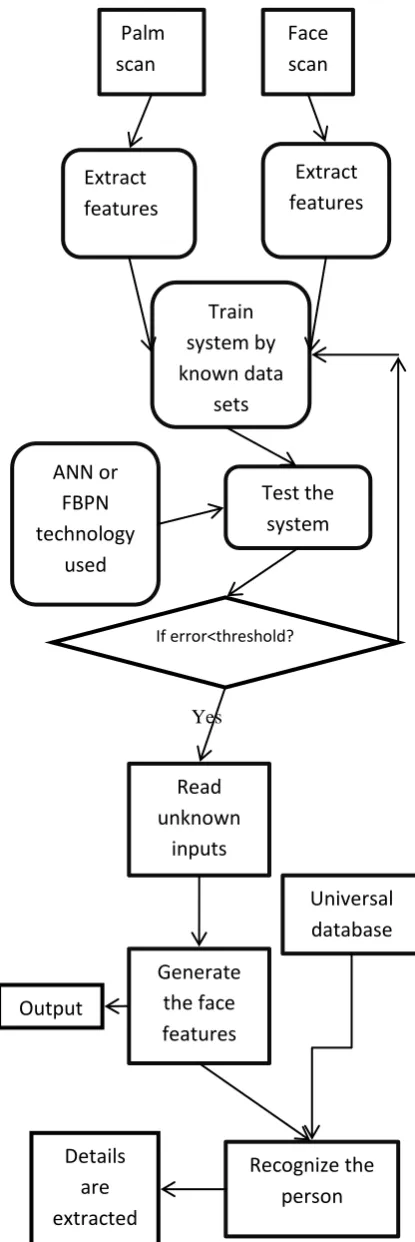
Fig 4: Flowchart of proposed Biometric system
5.
METHODOLOGY USED
1. Data is collected by extracting features (geometry) of palm as a set of inputs to the system.
2. Corresponding to the particular palm, corresponding face features will also be extracted.
3. The face features are stored as templates in database. 4. Train the system by ANN (back propagation algorithm), more training patterns are required to increase the accuracy of the biometric system.
5. Training of the system will be done by known and directly correlated parameters.
6. Errors are calculated comparing the calculated output and the target output.
7. Based on the studied patterns output will be generated for new input data.
8. Further when a new input is taken in the system it will generate its face features as output.
9. After face recognition, all the details of the person will be extracted from universal database of a place/country.
6.
STEPWISE DETAILS
6.1
Palm- feature extraction
6.1.1 Scan the palm through scanner. Convert the palm image to binary value (fig.5). [11][12]
6.1.2 Draw the outline of hand image using 8-connected pixel algorithm [11].
6.1.3 Determine the wrist centre „Wc‟ [13][14] and retrain for the known input patterns.
Fig 5: Palm to gray scale
6.1.4 Find the four-finger web points (Xfw1, Yfw1) (Xfw2, Yfw2) (Xfw3, Yfw3) (Xfw4, Yfw4), and store them in a finger web vector [2x4] (fig.5) [11].
Output
Recognize the
person
Read
unknown
inputs
Generate
the face
features
Universal
database
Test the
system
If error<threshold?
Extract
features
Extract
features
Palm
scan
Face
scan
Train
system by
known data
sets
ANN or
FBPN
technology
used
Fig 6: Outlining and locating valley points 6.1.5 Calculate the minimum distance from each finger web points to the opposite-front boundary pixel positions and for the last finger web point calculate minimum distance in both front and backward pixel positions and store the distances in a vector called minimum distance vector [1x5] (fig.6).
Fig 7: Minimum distance measurement
6.1.6 To extract the region of interest (ROI)[15] trace along the outline of the image until minimum distance pixel is encountered from Wc.
6.1.7 Repeat the above step moving in a clockwise direction until the starting point „Wc‟ is encountered (fig.8).
Fig 8: Extracted palm
6.1.8 Detect the minutiae points and geometry of palm. [16][17] (fig.9).
6.1.9Enhance and improve the image of palm to filter the
Fig 9: Palm geometry
6.2
Face-feature extraction
6.2.1 Scan the face samples.6.2.2 Convert the image in grey level representation.
6.2.3 Draw the contour points to have different directions [18] and will develop the face outline (fig.10)
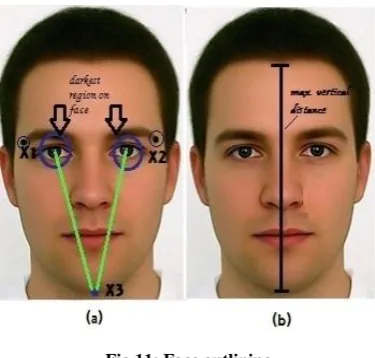
Fig 10: Detecting eyes and vertical distance 6.2.4 Find the maximum vertical distance in the face outline and select one of the end points as reference point „X3‟ (fig.11-b)
Fig 11: Face outlining
6.2.6Then the mouth center will be detected [18], a triangle will be made by the three point eye centers and mouth center [18]. The triangle represents the area in which nose lies (fig.12).
Fig 12: Locating nose
6.2.7 Draw the horizontal line to the end point (darkest region) of mouth (maximum contrast) using an integral projection by yang at el [19].
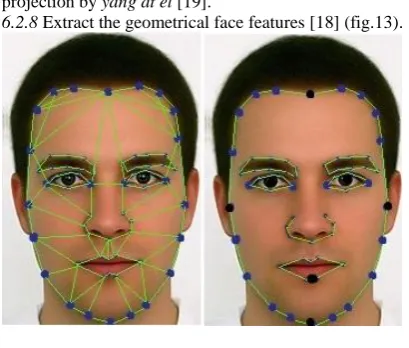
6.2.8 Extract the geometrical face features [18] (fig.13).
Fig.13 Face formation
6.3
Prepare database
6.3.1By extracting the face features and palm features, store them as data sets [17].
6.3.2 These data sets are used for training the biometric system.
6.4
Training
6.4.1 Large training patterns will increase the accuracy of the system.
6.4.2 The known input patterns will be used for training. 6.4.3 The testing will show the error by comparing calculated output by target output.
6.4.4 The step 6.4.3 will be repeated unless the error is minimized.
6.5
Connectivity with universal database
6.5.1 Input a new palm and the same algorithm is applied. 6.5.2The face less than threshold value features will be generated and the person will be recognized.6.5.3 After recognizing the person all the details will be fetched by the central database.
7.
CONCLUSION
This paper contains the module for the training of biometric system by ANN. The training requires data sets that are extracted features of palm and face. And the trained system will therefore generate the face features including eyes, lips, nose, and eyebrows of a new person. Hence it proves that there is a relationship between two biometric features- palm and face. The study will give a new area of application of Biometrics and the advanced approach to be used in security and other measures.
So it will have significant impact on security as well as, it will be useful in investigation procedure. The investigation area involves recognizing an individual in casualties by the palm scan and hence later on details can be fetched from the universal database of the country/place.
8.
REFERENCES
[1] Artificial Intelligence- A system approach, M. Tim Jones by Laxmi Publication, 2008 edition, pp. 265- 275, 171-179.
[2] Artificial Intelligence- A modern approach, Stuart Russell, Peter Nervig by Laxmi Publication,2008 edition, pp. 29-33,50-56
[3] Biometrics study and analysis Nina Godbole by john willey publications.
[4] Neural Networks in Computer in Intelligence, Limin FU, by Tata McGraw Hill Publication, pp. 80-91,169-180. [5] Yang, M.H., Kriegman, D.J. and Ahuja, N.: Detecting
faces in images: a survey, IEEE Trans. on Pattern Analysis and Machine Intelli. (24), No. 1, pp. 34-58 (2002)
[6] S. Sagiroglu, N. Ozkaya “Artificial Neural Network Based Automatic Face Parts Prediction system from Only Fingerprints”IEEE (2010).
[7] Necla Ozkaya and Seref Sagiroglu,: Generating One Biometric Feature from Another: Faces from Fingerprints, sensors international journals (2010). [8] Seref SA˘GIRO˘GLU, Necla ¨O ZKAYA:An intelligent
face features generation system from fingerprints, Turk J Elec Eng& Comp Sci, Vol.17, No.2, (2009).
[9] Jain, A.K, Ross, A. and Pankanti, S.: Biometrics: a tool for information security, IEEE Trans. on Information Forensics and Security, vol. 1, no. 2, pp. 125-143” [10] N. Duta, A. K. Jain, K. V. Mardia,: Matching of
palmprint, Pattern Recognition Letters 23, 2001, pp.477-485.
[11] Bhawani Sankar Panigrahi, Hari Narayan Pratihari, Dr. Gayatri Devi, Satyabrata Dash “A Palm print Feature Extraction and Pattern Classification Based on Hybrid PSO-K-Means Clustering”, IJCST Vol. 2, Issue 2, June 2011.
[13] Wei Li, Lei Zhang, David Zhang and Jingqi Yan, “PRINCIPAL LINE BASED ICP ALIGNMENT FOR PALMPRINT VERIFICATION”, ICIP 2009.
[14] X. Wu, David Zhang, K. Wang, Bo Huang,” Palmprint classification using principal lines”, Pattern Recognition 37, 2004, pp.1987- 1998.
[15] Edward WONG KieYih, G. Sainarayanan, Ali Chekima. Palmprint Based Biometric System: A Comparative Study on Discrete Cosine Transform Energy, Wavelet Transform Energy and Sobel Code Methods, Biomedical Soft Computing and Human Sciences, Vol.14, No.1, pp.11-19 (2009).
[16] A. Kumar, D.C.M. Wong, H.C. Shen and A.K. Jain: “Personal Verification using Palmprint and Hand Geometry”, Proceedings of Fourth International Conference on Audio- and Video-Based Biometric Person Authentication (AVBPA), pp 668-678 (2003). [17] C.C. Han, H.L. Cheng, C.L. Lin and K.C. Fan: “Personal
Authentication using Palm-print features”, Pattern Recognition, vol. 36, issue 2, (2003),pp.371-381,. [18] Aysegul Gunduz, Hamid Krim “FACIAL FEATURE
EXTRACTION USING TOPOLOGICAL METHODS”, ICIP-2003.
[19] Dewi Yanti Liliana, Eries Tri Utaminingsih:“The combination of palm print and hand geometry for
biometrics palm recognition”, International Journal of Video & Image Processing and Network Security IJVIPNS-IJENS Vol: 12 No: 01, (2012).
[20] D. Zhang, A.W.K. Kong, J. You, and M. Wong, “On-line palm print identification,” IEEE Transactions on Pattern Analysis and Machine Intelligence, vol. 25, no. 9, pp. 1041-1050, 2003.
[21] Sutcu, Y., Li, Q. and Memon, N.: “Protecting Biometric Templates with Sketch: Theory and Practice”, IEEE Trans. on Information Forensics and Security, vol. 2, no. 3, pp. 503-512
[22] T. Connie, A. T. B. Jin, M. G. K. Ong, and D. N. C. Ling, “An automated palmprint recognition system,” Image and Vision Computing, vol. 23, Issue 5, pp. 501-515, 2005.
[23] M. G. K. Ong, T. Connie, and T. A. B. Jin, “Touch-less palm print biometrics: Novel design and implementation,” Image and Vision Computing, vol. 26, Issue 12, pp. 1551-1560, Dec. 2008.