AGE INVARIANT FACE RECOGNITION USING FUZZY LOCAL
BINARY PATTERN AND ARTIFICIAL NEURAL NETWORK
CLASSIFIER
Ojo John Adedapo1, Joseph OluwaseunOladunni2
1. INTRODUCTION
Aging in human can be referred to a multidimensional process of physical, psychological, and social change (Bronikowski and Flatt, 2010). With growth and maturity, the human face changes most of its enduring properties (such as shape of cranium, texture, and appearance of the facial skin), acquires new shape and appearance with wrinkles, folds, pouches, discoloration, becomes rougher, leatherier and darker. These physical changes of the face, marks the aging of the face (Bronikowski and Flatt, 2010), and consequently poses a serious challenge in designing facial recognition system that is age invariant. This has led to the development of age invariant face recognition (AIFR) system.
Age related face recognition research has gained attention recently because of its practical applications in authentication and authorization. There are two major approaches to AIFR, which are holistic model based approach (Global approach) and local features based approach (Juefei-Xu, Luu, Savvide, Bui and Suen, 2011). However, most available algorithms are based on age estimation and aging simulation (Ali, Asirvadam, Malik and Aziz, 2013; Park, Tang and Jain, 2011; Ramanathan and Chellapa, 2009). The holistic (global approach) methods to AIFR have shown to be effective thoughwith some drawbacks, while local feature based approach have been gaining attention in recent times (Gong, Li, Lin, Liu and Tang, 2013).
The challenging problem of AIFR is the large intra subjects’ variations due to aging (Li, Park and Jain, 2011), such as aging, pose, illumination, and facial expression.In addition, AIFR systems that are based on age estimation and aging simulation have other limitations such as need for normal illumination and neutral facial expressions. Therefore, there is a need for robust approach that can handle these variations and retain high accuracy. A robust feature extraction technique may be useful in handling these variations. This work therefore aimed at developing an age invariant face recognition system using Local Feature Based Approach for feature extraction and neural network for classification.
2. LITERATURE REVIEW
Age-related face recognition methods can be categorized into two: local approaches and holistic (global) approaches. Most holistic approaches try to generate face aging models and build aging functions to simulate or compensate for the aging process (Lanitis, Taylor and Cootes, 1999; Geng, Zhou and Smith-Miles, 2007,Guo, Fu, Dyer and Huang, 2008, Kambhamettu and Mahalingam, 2010).Ali, Asirvadam, Malik and Aziz (2013) proposed a geometrical model based on multiple triangular features for handling the challenge of face age variations that affect the process of face recognition. The system aimed to serve in real time applications where the test images are usually taken in random scales that may not be of the same scale as the probe image, along with orientation, lighting, illumination, and pose variations. Multiple mathematical equations were developed and used in the process of forming distinct subject clusters. The system achieved a maximum classification accuracy of above 99% when the system was tested over the entire FG-NET database.
1 Department of Electronic and Electrical Engineering, LadokeAkintola University of Technology, P. M. B. 4000,
Ogbomoso, Oyo State, Nigeria.
2 Department of Electronic and Electrical Engineering, LadokeAkintola University of Technology, P. M. B. 4000,
Ogbomoso, Oyo State, Nigeria.
DOI: http://dx.doi.org/10.21172/1.114.11
e-ISSN:2278-621X
Abstract- Several attempts have been made on Age-Invariant Face Recognition (AIFR), but most available algorithms are based on age estimation and aging simulation, which have several limitations; such as lack of robust discriminative features that are stable across ages, need for normal illumination and neutral facial expressions. Hence, there is a need for the development of an improved AIFR system that can handle these shortcomings. In this work, an AIFR system using local-feature based approach was developed. It uses Fuzzy Local Binary Pattern (FLBP) algorithm for local-feature extraction and Artificial Neural Network (ANN) for classification. Face and Gesture Recognition Research Network (FG-NET) database was used for testing, while Recognition performance was evaluated using recognition accuracy, sensitivity and specificity. Performance evaluation results of the developed system gave 89.44%, 49.80% and 49.77% recognition accuracy, sensitivity and specificity respectively. The system can be deployed in biometric identification systems and surveillance applications where age variations are pervasive.
Local based approaches for age invariant face recognition have not been well explored. Contrary to holistic face interpretation, most of these local feature based methods are proposed to solve the age estimation problem. These approaches have been reported to overcome the shortcomings of sensitivity, illumination variations and image occlusions. Moreover, age features are usually encoded by local information such as wrinkles on the forehead or at the eye corners (Ling, Soatto, Ramanathanan and Jacob, 2007; Biswas, Aggarwal and Chellappa, 2008; Hasegawa-Johnson, Huang, Liu, Yan, & Zhou,2008;Fu and Huang, 2008; Li, Park and Jain, 2011.Juefei-Xu, Luu, Savvide, Bui and Suen (2011) investigated age invariant face recognition in FG-NET aging database using unsupervised discriminant projection (UDP) method of subspace learning techniques based on periocular biometrics. In this method, Juefei-Xu et al. (2011) applied preprocessing schemes like pose correction, illumination normalization using Anisotropic Diffusion Model and periocular normalization to obtain age invariant features which uses a fusion of Walsh-Hadamard Transform and Local Binary Pattern to generate local features also used normalized cosine distance measurement, a Nearest Neighbor (NN) classifier as the classifier.Fazli and Ali Heidarloo (2012) proposed discrete wavelet transform and combination wavelet sub-band coefficients and gradient orientation of coefficients for feature representation. Gradient orientation (GO) was proposed for face verification across age progression and has been shown to be insensitive to aging process. Principal Component Analysis (PCA) was applied for feature dimensionality reduction and Euclidean distance was used for recognition. Experimentalresults show that the proposed method is efficient and it achieved better recognition performance.
3. METHODOLOGY
Our approach uses Fuzzy Local Binary Pattern for facial features extraction and Neural Network for classification.The flowchart for the developed age invariant face recognition system is as shown in Figure 1 and the methodology for the implementation of the developed system is as discussed in the following subsections. All the processes involved were implemented using MATLAB(R) 8.1.0.604 (R2013a) version on a 1.65 GHz, 4.00GB RAM, Windows 7, Asus Personal Computer. Performance of the developed AIFR system was evaluated using accuracy, sensitivity and specificity.
Start
Input face images
Extract Periocular Region
Illumination normalization
Feature Extraction using FLBP
Feature Dimensionality Reduction using PCA
Classification using ANN
Performance Evaluation
Stop
Figure 1. Flowchart of the Age-invariant Recognition System
3.1 Database
60-69 years. For the training stage, three out of the six images were used for training and the remaining three images were used for testing.
Preprocessing (Periocular Region Extraction and Image Normalization)
The preprocessing stage includes the extraction of the periocular region of the face. The periocular region is believed to be relatively unchanging despite aging. The periocular part of the face images was extracted through cropping and resized to
pixels in PNG (Portable Network Graphics) format(PNG format was used to retain quality after editing). Figure 2 shows examples of extracted periocular regions from two subjects in the database. Illumination normalization comprises three steps: Gamma correction, Difference of Gaussian and Equalization of variation.GammaCorrection is the name of a nonlinear operation used to encode and decode luminance or tristimulusvalues in video or stillimage systems. Gamma correction is, in the simplest cases, defined by the following power-law expression:
(1)
V out = A V in γ {\displaystyle V_{\text{out}}=A{V_{\text{in}}}^In Equation (1), the non-negative real input value isV in {\displaystyle V_{\text{in}}} is raised to the power γ {\displaystyle \gamma } and multiplied by the constant A, to get the
output value V out {\displaystyle V_{\text{out}}} ... In the common case of A = 1, inputs and outputs are typically in the range 0–1.
A gamma value γ< 1 is sometimes called an encoding gamma, and the process of encoding with this compressive power-law nonlinearity is called gamma compression; conversely a gamma value γ> 1 is called a decoding gamma and the application of the expansive power-law nonlinearity is called gamma expansion.In this work, an encoding gamma was adopted.
Figure 2: Extracted periocular images for two different subjects with three images each
Illumination normalization was done using preprocessing sequence (PS) approach because it gives better results with reduced aliasing effect. The PS approach consists of three preprocessing steps namely: Gamma Correction of the input image, Difference of Gaussian (DOG) filtering and Equalization of Variation.
(2)
where DoG is the Difference of Gaussian, represent the position of the image, and is the Gausian of variance of the image and the narrower portion of the image respectively.
Then, the two-stage contrast equalization employed to re-normalize the image intensities and standardize the overall contrast are given by Equations (3) and (4).
(3)
(4)
where are constants, refers to the pixel in position of the image I.
A hyperbolic tangent function in Equation (5) is applied to suppress the extreme values and limit the pixel values in
(5)
3.2 Feature Extraction
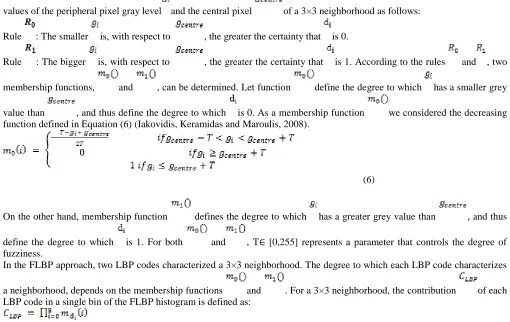
The Fuzzy Local Binary Pattern was adopted for feature representation on each of the periocular face images. Original LBP operator a single LBP code characterizes a 3×3 neighborhood, in the adopted FLBP approach, a neighborhood can be characterized by more than one LBP code. Using the FLBP approach, where two LBP codes characterize a 3×3 neighborhood.
The fuzzification of the LBP approach includes the transformation of the input variables to respective fuzzy variables, according to a set of fuzzy rules. To that direction, two fuzzy rules is introduced to describe the relation between the intensity
values of the peripheral pixel gray level and the central pixel of a 3×3 neighborhood as follows:
Rule : The smaller is, with respect to , the greater the certainty that is 0.
Rule : The bigger is, with respect to , the greater the certainty that is 1. According to the rules and , two
membership functions, and , can be determined. Let function define the degree to which has a smaller grey
value than , and thus define the degree to which is 0. As a membership function we considered the decreasing function defined in Equation (6) (Iakovidis, Keramidas and Maroulis, 2008).
(6)
On the other hand, membership function defines the degree to which has a greater grey value than , and thus
define the degree to which is 1. For both and , T∈ [0,255] represents a parameter that controls the degree of fuzziness.
In the FLBP approach, two LBP codes characterized a 3×3 neighborhood. The degree to which each LBP code characterizes
a neighborhood, depends on the membership functions and . For a 3×3 neighborhood, the contribution of each LBP code in a single bin of the FLBP histogram is defined as:
(7)
∈ {0,1}, and the LBP code can be obtained. For each peripheral pixel, can be either 0 or 1, with a grade of or
respectively, forming different LBP codes with different contributions in Equation (7). Thus, each 3×3neighborhood contributes to more than one bin of the FLBP histogram. The totalcontribution of a 3×3 neighborhood to the bins of an FLBP histogram is:
Figure 4: Original Periocular Image and the Corresponding FLBP Feature
3.3 Feature Reduction
For better performance of the face recognition system and to solve the problem of high dimensionality of feature space, PCA was employed for feature reduction. Ten features from the FLBP extracted were selected and fed into the ANN classifier.
3.4 Feature Classification
Back-propagation Artificial Neural Network (BANN) was used for classification. The back-propagation neural network used is divided into two steps – feed-forward and back-propagation. The selected featureswere allocated classes (training and test data). The test data was also separated into two groups; clients and impostors for verification.The classification was performed using a similarity based approach. Euclidean distance measurement for classificationwas used to compute the similarity matrix. Euclidean distance measurement for an i-dimension space is given as:
(10) where x and y are the feature vectors that is the training and test features respectively.
The output of the system was used to estimate the confusion matrix and the similarity matrix. The following performance metrics were then estimated: accuracy, sensitivity and specificity were estimated.
Performance Evaluation of the Developed System
The following Performance Evaluation method was used to validate the developed system Sensitivity (Se) measures the proportion of actual position which is correctly identified.
(11) Specificity measures the proportion of negatives which are correctly identified.
(12) The measurement of delineation accuracy, Acc.
(13) where TP, TN, FP and FN stand for true positives, true negatives, false positives and false negatives respectively.
4. RESULTS AND DISCUSSION
4.1 Performance Evaluation
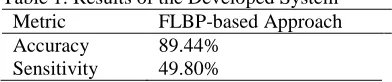
Table 1 shows the recognition accuracy, system sensitivity and the system specificity of the developed system. The developed system gave 89.44% recognition accuracy, sensitivity of 49.80% and the system specificity of 49.77%. This is a better performance compared to other method, Discrete Wavelet Transform (DWT) - Gradient Orientation (GO) and Scale Invariant Feature Transform (SIFT), which gave 59.09% and 65.3% recognition accuracy respectively. Figure 5 shows the statistical evaluation of the AIFR methods with their recognition performances. The improved recognition of the developed system can be attributed to the use of FLBP for feature extraction and the fact that only periocular regions of the faces were used for recognition.
Table 1: Results of the Developed System
Metric FLBP-based Approach
Accuracy 89.44%
Specificity 49.77%
Figure 5. Recognition Accuracy of the Developed System
5. CONCLUSION AND RECOMMENDATION
5.1 Conclusion
In this work, an improved system for Age Invariant Face Recognition using Local-Feature Based Approach (LFBA) and back-propagation Artificial Neural Network classifier was developed. Face and Gesture Recognition Research Network (FG-NET) datasets were adopted for testing, while the system was implemented using Matrix Laboratory 8.1.0.604 (R2013a) version. Performance evaluation gave 89.44% accuracy, which is some improvement over existing methods.
5.2 Recommendation
In the nearest future, an improvement can be made on this work by improving on the feature extraction technique, for example, a hybrid feature extraction technique can be adopted.
6. REFERENCES
[1] Ali, A. S., Asirvadam, V. S., Malik, A. S. and Aziz, A. (2013). “A Geometrical approach to age invariant face recognition”. Proceeding IVIC 2013 Third International Visual Informatics Conference on Advances in Visual Informatics, vol. 8237, pp 81-96.
[2] Biswas, S., Aggarwal, G. and Chellappa, R. (2008). “A non-generative approach for face recognition across aging,” In IEEE Second International Conference on Biometrics: Theory, Application and Systems.
[3] Fazli, S. and Ali Heidarloo, L. (2012). “Wavelet Based Age Invariant Face Recognition using Gradient Orientation”,International Conference on Advances in Computer and Electrical Engineering, (ICACEE'2012), Manila (Philippines)
[4] Fg-net aging database: Face and gesture recognition working group, http ://www-prima.inrialpesfr/FGnet/.
[5] Fu, Y. and Huang, T. (June 2008). “Human age estimation with regression on discriminative aging manifold”. IEEE Trans. Multimedia, vol. 10, no.4, pp. 578-584.
[6] Geng, X., Zhou, Z. and Smith-Miles, K. (2007). Automatic age estimation based on facial aging patterns,” IEEE Trans. Pattern Analysis and Machine Intelligence, 29(12), pp. 2234-2240.
[7] Gong, D., Li, Z., Lin, D., Liu, J. and Tang, X. (2013). “Hidden Factor Analysis for Age Invariant Face Recognition” In Proceedings of the 2013 IEEE International Conference on Computer Vision, pp. 2872-2879
[8] Hasegawa-Johnson, M., Huang, T.S., Liu, M., Yan, S., & Zhou, X. (2008). Regression from patch-kernel. 2008 IEEE Conference on Computer Vision and Pattern Recognition, pp. 1-8.
[9] Iakovidis, D., Keramidas, E. and Maroulis, D. (2008). “Fuzzy local binary patterns for ultrasound texture characterization”. In Proceedings International Conference on Image Analysis and Recognition, pp. 750–759.
[10] Juefei-Xu, F., Luu, K., Savvide, M., Bui, T. and Suen, C. (2011). “Investigating age invariant face recognition based on periocular biometrics”. In Proceedings of the 2011 International Joint Conference on Biometrics, pp. 1-7.
[11] Lanitis, A.,Taylor, C. and Cootes, T. (1999). “Modelling the process of aging in face images”. In the Proceedings of Seventh IEEE Int’l Conference on Computer Vision (ICCV), Kerkyra,vol.1, pages 131-136.
[12] Kambhamettu, C., &Mahalingam, G. (2010). Age invariant face recognition using graph matching. 2010 Fourth IEEE International Conference on Biometrics: Theory, Applications and Systems (BTAS), 1-7.
[13] Park, U., Jillela, R., Ross, A. and Jain, A.K. (2011) “Periocular biometrics in the visible spectrum feasibility”. Information Forensics and Security, IEEE Transaction on Biometrics Compendium, Vol. 1, Issue 1, pp. 96–106.
[14] Ramanathan, N. and Chellappa, R. (June 2006). “Modeling age progression in young faces’, In IEEE Conference on Computer Vision and Pattern Recognition, vol. 1, New York, U.S.A, pp. 387–394.
[15] Ramanathan, N. and Chellapa, R. (2009). “Computational methods for modeling facial aging: A survey,” J. Visual Languages and Computing, 20(3), pp. 131-144.