Dynamics in the Development of Social Interest among Incarcerated Persons in the
Learning Environment at Correctional Facilities
Prof. Zhaneta Stoykova Dobreva, PhD
Trakia University Stara Zagora
Faculty of Education
Bulgaria
Abstract
This study involving incarcerated men and women was conducted within the paradigm of Individual Psychology and Alfred Adler’s belief in the innate human potentiality for the development of social interest. It explores the dynamics of social interest among incarcerated persons in the learning environment present at correctional facilities. The goal of this study is to determine whether the factor of the learning environment at correctional facilities has an impact on the development of social interest among incarcerated persons.The results of the research show statistically significant differences between the values of the criteria of social interest among student and non-student incarcerated persons of both sexes. Gender-based differences concerning the impact of the learning environment are also noted.
Keywords:
social interest, incarcerated persons, learning environment, correctional facilities1. Introduction:
One of the key concepts in Alfred Adler’s Individual Psychology is the belief in the innate human potentialities for social interest, which develop to a greater or lesser extent depending on the environment. According to Adler, social interest is a form of community feeling which produces the need and desire of the human being to “belong” to society. The impact of the environment, expressed in the upbringing, as well as in a number of subsequent, but equally important factors, contributes to its evolution. “Individual Psychology regards and examines the individual as socially embedded. We refuse to recognize and examine an isolated human being.” (Adler, 1956, p.2)The concept of social interest within the theory of Individual Psychology reflects Adler’s deep conviction that people are social beings. He believes that if they want to understand themselves better, they ought to explore their relationships with others, as well as the socio-cultural context in which they exit. (Adler based on Walton & Stoykova, 2009, p.10)This concept encompasses to a significant degree Adler’s ideas about the powerful driving force that lies at the foundation of all human strivings. The expression “social interest” originates from the German neologism Gemeinschafttsgefuеhl and the full meaning of this term cannot be translated into another language using a simple word or phrase. It denotes ideas that could be described with expressions like “social feeling”, “communal feeling” or “sense of solidarity”. It also incorporates the sense of belonging to the human community, the feeling of identification with humankind and essential similarity to all representatives of the human races. Social interest is a broad concept referring to the traditional psychological categories and intertwined with values, motivation, relationships, feelings and behavior. (Dreikurs, 1989, p.4)Alfred Adler believes that the capacity for the development of social interest is innate. Like other innate propensities, social interest does not arise automatically, but requires conscious nurturing.
Despite the significance of the notion of “social interest” and its links with criminal behavior, this field has undergone practically no empirical exploration and examination. This was one of the fundamental motives for carrying out the present study on social interest in incarcerated persons. Another motive is connected with Adler’s belief that social interest is formed in preschool years (until the fifth year of a child’s life) under the influence of the family environment and remains virtually unchanged throughout a person’s later life. Under the assumption that knowledge and social conditions have the power to change a person, an experimental study was carried out focusing on the impact of a well-organized learning process on the enhancement of social interest. This research with the participation of university students was conducted in 2010-2011 and it supported Alfred Adler’s ideas. Its results showed that the academic learning process that offers the acquisition of useful knowledge can change the students’ motivation for achievement, but does not have the power to change their level of social interest (Stoykova, 2013, pp.286-290). Despite the results obtained in this study, there is a still a hypothesis that it may be possible to organize such training and educational activities that combine knowledge acquisition and adoption of social values and rules, which in turn can lead to improvement in the level of social interest. In the learning and educational environment outside the family under the right circumstances a person may learn to cooperate, to be well-meaning, to follow rules, to take responsibility, to feel empathy, i.e. to develop his/her social interest. Alfred Adler proved in practice that this is possible through the establishment of child guidance centers in Vienna, which were focused not solely on academic learning, but mostly on the training of interpersonal skills, their goal being to assist in the prevention of misbehavior. Based on these theoretical and practical foundations, the question we explored was whether such a learning and educational environment can be set upin correctional facilities and whether it can create the necessary conditions for personality change and in particular for the development of social interest.
2. Goals, tasks, hypotheses
The goal of the study is to determine to what extent the factor of the learning environment at correctional facilities has an impact on the development of social interest in incarcerated persons.The mains tasks of the study are the followings:
1. To perform comparative analysis between the assessment and self-assessment of social interest in incarcerated persons.
2. To perform comparative analysis between the level of social interest of offenders who are pursuing additional education and those who are not studying, and to analyze the presence or lack of a relationship between the level of social interest and the learning environment.
3. Based on the comparative analysis, conclusions are drawn concerning the dynamics in the development of social interest among incarcerated persons and the factors that determine this process.
- Hypothesis 1. On the basis of the literature on the study of social interest, it is hypothesized that incarcerated persons have a low level of social interest, primarily expressed in violation of the rules and norms of society, leading to criminal offences, domination of personal interests as a source of motivation, non-compliance with social rules, lack of responsibility and cooperation.
- Hypothesis 2. It is hypothesized that the educational approach in correctional work applied in correctional facilities can lead to increase in the offenders’ level of social interest and contribute to their successful social inclusion.
- Hypothesis 3. It is hypothesized that the level of social interest and the dynamics of its development can serve as a predictor of social integration and future social inclusion.
3. Study participants
489 persons took part in the study, distributed into the following categories: A) 420 incarcerated persons, of which 90 were female and 330 were male.
B) A total of 47 individuals served as assessors of the social interest of the incarcerated persons (35 teachers, 12 social activity and correctional work inspectors)
C) 10 experts – pedagogues and psychologists.
The study covered incarcerated men from the prisons in Stara Zagora, Cherna Gora and Pazardzhik and incarcerated women from the prison in Sliven in the Republic of Bulgaria.
- 270 Male students; - 60 Male non-students.
B) The incarcerated women were also divided into two groups: - 48 female students;
- 42 female non-students.
4. Methods of the study
For the purposes of the study, two types of Questionnaires on social interest were designed – one for external assessment and one for self-assessment. The Questionnaires were drawn up on the basis of parameters corresponding to the criteria for the assessment of social interest. They contain 14 questions each, corresponding to 11 criteria of social interest, namely “sense of belonging”, “cooperation”, “conformity with rules”, “compromise”, “responsibility”, “need for recognition”, “caution”, “helpfulness”, “generosity”, “participation”, “respect”. The validity and the objectivity of the questionnaires were verified in advance.
5. Study procedure
The procedure covers a series of studies that took place over the course of two school years: 2015-2016 and 2016-2017. The incarcerated persons filled in the social interest Questionnaire for the purpose of self-assessment, and at a later date educators and social activity and correctional work inspectors assessed them based on the same criteria.
6. Mathematical and statistical processing of the information
For the purposes of the mathematical and statistical processing of the information, the statistics tool IBM SPSS– Statistics Trial Software was used. The method of the Z-test was used with a standard deviation α = 0.05.
7. Results
7.1 Male participant results
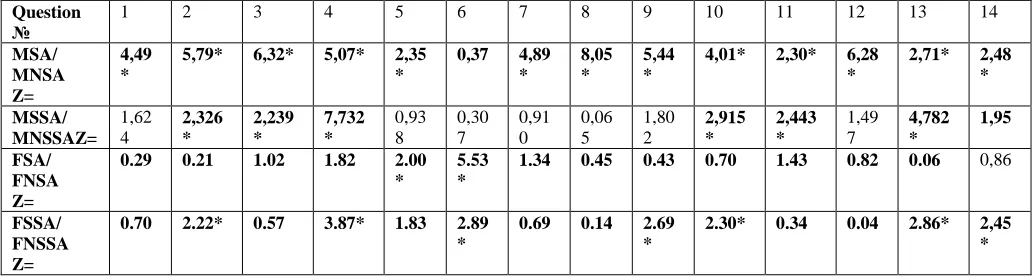
When comparing the social interest Assessment of the incarcerated male students with those of the incarcerated male non-students, the results obtained show that there IS a statistically significant difference between the two samples of individuals on all criteria of social interest, with the sole partial exception being the criterion “responsibility”. Statistically significant differences were noted with regard to the Self-Assessment of student and non-student incarcerated men on the following criteria of social interest: “cooperation”, “conformity with rules”, “compromise”, “helpfulness”, “generosity” and “participation. There are NO statistically significant differences in the Self-Assessment of student and non-student incarcerated men on the following criteria: “sense of belonging”, “responsibility”, “need for recognition” and “respect”.
7.2 Female participant results
The results obtained in the study show that when comparing the social interest Assessment of the incarcerated female students with those of the incarcerated female non-students, there IS a statistically significant difference on the criterion “responsibility”. For the other criteria of social interest, NO statistically significant differences are noted among the incarcerated women who took part in this study. However, there ARE statistically significant differences in the Self-Assessment of student and non-student incarcerated women on the following criteria of social interest: “cooperation” (partially, only based on question No.13), “compromise”, “helpfulness”, “generosity “and “responsibility”(partially, only based on question No.6).It was determined that there are NO significant differences in the Self-Assessment of student and non-student incarcerated women in regard to the following criteria: “sense of belonging”, “responsibility” (partially, only based on Question No.5), “need for recognition”, “caution”, “helpfulness”, “respect”, “conformity with rules”, “participation”.
8. Discussion
Gender differences can also be noted in regard to the impact of the learning environment on the Self-Assessment on the criteria of social interest. In men the statistically significant differences in Self-Assessment between students and non-students can be seen for the criteria “cooperation”, “conformity with rules”, “compromise”, “helpfulness”, “generosity” and “participation”. In women the statistically significant differences in Self-Assessment between students and non-students are present on the following criteria: “cooperation” (partially), “compromise”, helpfulness”, “generosity” and “responsibility” (partially).Among the men, the learning environment played a more significant role in the development of the criteria of social interest compared to the women who took part in the study. (Compare the profiles in Graph №1 and Graph №2)
Table No.1 Values of Z showing the differences in the Assessment and Self-Assessment based on the criteria of social interest among male and female student and non-student incarcerated populations.
Question №
1 2 3 4 5 6 7 8 9 10 11 12 13 14
MSA/ MNSA Z=
4,49 *
5,79* 6,32* 5,07* 2,35 * 0,37 4,89 * 8,05 * 5,44 *
4,01* 2,30* 6,28 * 2,71* 2,48 * MSSA/ MNSSAZ= 1,62 4 2,326 * 2,239 * 7,732 * 0,93 8 0,30 7 0,91 0 0,06 5 1,80 2 2,915 * 2,443 * 1,49 7 4,782 * 1,95 FSA/ FNSA Z=
0.29 0.21 1.02 1.82 2.00
*
5.53 *
1.34 0.45 0.43 0.70 1.43 0.82 0.06 0,86
FSSA/ FNSSA Z=
0.70 2.22* 0.57 3.87* 1.83 2.89 *
0.69 0.14 2.69 *
2.30* 0.34 0.04 2.86* 2,45 *
Acronyms used in the table: MSA- male student assessment MNSA- male non-student assessment MSSA- male student self-assessment MNSSA-male non-student self-assessment FSA- female student assessment
FNSA- female non-student assessment FSSA- female student self-assessment FNSSA- female non-student self-assessment
Graph №2. Social interest profiles of incarcerated female students and non-students
9. Conclusion
The overall conclusion that can drawn on the basis of the results obtained in the study is that the factor of the learning environment at correctional facilities can influence the level of social interest in a positive way, which in turn may afford the opportunity for more active social inclusion and compliance with the law among formerly incarcerated offenders. Gender differences concerning the development of social interest in the learning environment at correctional facilities are also observed.
References
Adler, A. (1956) The Individual psychology of Alfred Adler: A systematic presentation of selection from his writings. H.l.&R.R. Ansbacher (Eds.) New York: BasisBooks.
Dreikurs, R. (1989) Fundamentals of Adlerian Psychology. Chicago, Illinois: Adler School of Professional Psychology. (Original work published in 1950)
Stoykova, Zh.(2013) Social Interest and Motivation. In: Trakia Journal of Sciences. Volume 11 Number 3, pp.286-290.