e-ISSN: 2278-7461, p-ISSN: 2319-6491
Volume 6, Issue 10 [October. 2017] PP: 62-76
Effect of Lateral Loads Resisting Systems on Response of
Buildings Subjected to Dynamic Loads
Arafa Elhelloty
Associated Professor of Structures, Department of Civil Engineering, Al-Azhar University, Egypt. Corresponding Author: Arafa Elhelloty
Abstract:
In this paper, the modal and transient analysis are carried out to study the effect of lateral loadsresisting systems on response of buildings subjected to dynamic loads. Three and five stories steel frame
buildings without and with three lateral loads resisting systems which are steel plate shear walls, steel bracings and laminated composite plate shear walls subjected to dynamic loads are investigated with respect to natural frequencies, mode shapes and time history graphs for total displacement and equivalent stresses. Comparative study is conducted to evaluate the effect of lateral loads resisting systems on the performance of buildings subjected to dynamic loads using the finite element system ANSYS16.
Keywords
: Composite plate, laminated, modal analysis, steel frame building, shear wall, steel plate, steel bracing, transient analysis.--- --- Date of Submission: 28-08-2017 Date of acceptance: 09-11-2017
---
---I.
INTRODUCTION
Structures can be subjected to dynamic loads that it are due to wind, waves, traffic, earthquake, and blasts and dynamic analysis is used to find dynamic displacements, time history, natural frequencies and mode shapes. Lateral forces on buildings such as wind, earthquake and blast forces can be produced critical stresses in the buildings that it cause excessive lateral sway of the buildings and undesirable stresses and vibrations in the buildings. Design and structural evaluation of the building systems subjected to lateral loads form the important task of the present generation and the designers are faced with problems of providing adequate strength and stability of buildings against lateral loads. Different lateral loads resisting systems are used in high-rise building as the lateral loads due to earthquakes are a matter of concern. Steel plate shear walls system and steel bracings system are used in steel structures buildings and their effect shows unequal variations and behavior against seismic loads. Recently, laminated composite plate shear walls are used as a lateral loads resisting system where the laminated composite plates are used as infill plate in shear walls. The laminated composite plates are created by constructing plates of two or more thin bonded layers of materials and it can be either cross-ply laminates or angle-ply laminates [1].
lateral loads. Linear and nonlinear analysis procedures were adopted and the effect of shear wall location on storey drift, storey shear, deflection and reinforcement requirement in columns was investigated. A. Gottala et al. [8] studied the effect of earthquake load on a multi-storied framed structure. Linear seismic analysis was done for the building by static and dynamic methods and a comparison was carried out between the static and dynamic analysis. The results that are bending moment, nodal displacements and mode shapes were observed, compared and summarized for beams, columns and structure as a whole during both analysis. N. Dileep and R. Renjith [9] investigated the effect of different positions of the internal tube in tube structure during the seismic loading. Equivalent static, response spectrum and time history analysis were done with 3D models. The results of models were evaluated and a comparative study of their seismic performance were carried out. V. Rekha et al. [10] demonstrated the effect of outriggers, tube in tube and bundled systems on performance of reinforced concrete moment resisting frame buildings subjected to seismic loads. The building models were analyzed using nonlinear time history analysis and storey drifts, base shear and modal periods of buildings were evaluated. A. P. Gadkari and N. G. Gore [11] studied the behavior of outrigger structural system on performance of high rise buildings subjected to seismic and wind loads. Behavior of outrigger structural system on high rise reinforced concrete buildings, high rise steel and composite buildings and vertically irregular structures were investigated. A. Ahmed [12] performed a nonlinear time history analysis of storey RCC building frame using time history of El Centro earthquake 1940. The main parameters of the seismic analysis of structures which are load carrying capacity, ductility, stiffness, damping and mass were considered. The various response parameters which are base shear, storey drift, storey displacements were calculated. Vikneshvaran et al. [13] conducted numerical study on vibration of a three floor height building structure. The simulation was done to study the displacement, acceleration and mode shape of the building subjected to random excitation and the effect of vibration on building was studied through the numerical analysis.
Therefore, the aim of this paper is to investigate the effect of lateral loads resisting systems on response of buildings subjected to dynamic loads. Three and five stories steel frame buildings without and with three lateral loads resisting systems which are steel plate shear walls, steel bracings and laminated composite plate shear walls subjected to dynamic loads are considered. The modal analysis and transient analysis due to impulsive load are carried out for steel frame buildings without and with different lateral loads resisting systems using the finite element system ANSYS16.
II.
NUMERICAL
EXAMPLE.
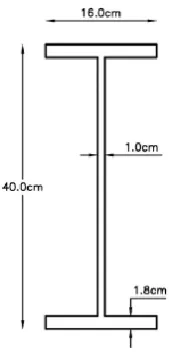
To investigate the effect of lateral loads resisting systems on response of buildings subjected to dynamic loads, three and five stories steel frame buildings are considered with dimension as shown in Fig. (1). The buildings consists of steel frames and concrete slabs and the high of story is 3.0 m. For steel frames, all columns and beams are steel I-beam section with dimensions as shown in Fig. (2). Concrete slabs connect the different cross sections with thickness 150.0 mm and the base of all columns is fixed supported. In this study, modal and transient analysis of steel frame buildings with three lateral loads resisting systems which are steel bracings system in two directions, steel plate shear walls system in two directions and laminated composite plate shear walls system in two directions are considered to show the effect of lateral loads resisting system on response of buildings subjected to dynamic loads as shown in Fig. (3). The steel bracings system consist of equal steel angle with dimensions 100 x 100 x 10 mm and the thickness of steel and laminated composite plate shear walls is 12.0 mm.
Laminates are composite plates consisting of four orthotropic plies of the same material and equal thickness with the overall thickness kept constant and symmetric cross-ply laminates arrangements are considered. A Epoxy/ Carbon composite material (UD 395 Gpa Prepreg) from ANSYS16 composite materials library is used for infill laminated composite plate and the materials properties are given as E1 = 209 GPa, E2 = 9.45 GPa, E3 = 9.45 GPa, G12 = 5.5 GPa, G13= 5.0 GPa, G23 = 3.9 GPa, ν12= 0.27, ν13= 0.27 , ν23= 0.4 and ρ = 1540 kg/m3 for Young’s modulus, shear modulus, Poisson’s ratio and density respectively. The materials properties of steel frames, equal steel angle and infill steel plate are given as E = 200 GPa, ν= 0.3 and ρ = 7850 kg/m3 for Young’s modulus, Poisson’s ratio and density respectively. The materials properties of concrete slabs are given as E = 300 GPa, ν= 0.18 and ρ = 2300 kg/m3 for Young’s modulus, Poisson’s ratio and density respectively.
Fig. (1) Three and five stories steel frame buildings.
Three stories building with steel bracings system. Three stories building with SPSW system.
Three stories building with LCPSW system. Five stories building with steel bracings system.
Five stories building with SPSW system. Five stories building with LCPSW system.
SPSW = Steel plate shear wall.
LCPSW = Laminated composite plate shear wall.
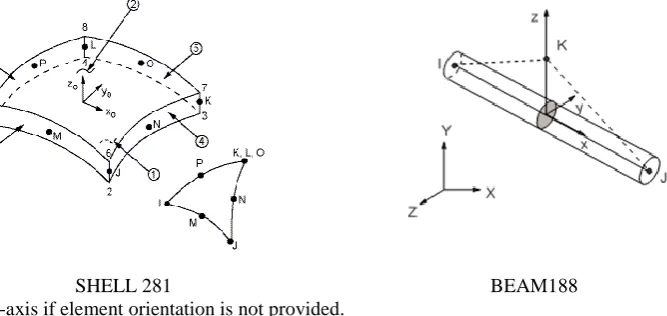
The geometry of steel frame building is a combination of surface and line bodies. The modal and transient analysis have been done by 8-node SHELL281 element for surface bodies and BEAM188 element for line bodies in finite element system ANSYS16. The SHELL281 as shown in Fig. (4), is a eight-node element with six degrees of freedom at each node that are translations in the x, y, and z axes, and rotations about the x, y, and z-axes. The element is suitable for analyzing thin to moderately- thick shell structures and it is appropriate for linear, large rotation and/ or large strain nonlinear applications. SHELL281 may be used for layered applications for modeling laminated composite shells or sandwich construction and the accuracy in modeling composite shells is governed by the first order shear deformation theory. The BEAM188 as shown in Fig. (4), is a three-node element with six degrees of freedom at each node that are translations in the x, y, and z axes, and rotations about the x, y, and z-axes. The element is suitable for analyzing linear, large rotation, and/or large strain nonlinear applications.
SHELL 281 BEAM188 xo = Element x-axis if element orientation is not provided.
x = Element x-axis if element orientation is provided.
Fig. (4) 8-node SHELL281 and 3- node BEAM188 elements.
3-1 Modal analysis of buildings.
The modal analysis is used to determine the vibration characteristics of a structure which it are natural frequencies and mode shapes while it is being designed. It also can be a starting point for another dynamic analysis such as a transient dynamic analysis, a harmonic response analysis, or a spectrum analysis. In general, the equation of motion for a linear dynamic system is [1]:
(1) Where:
[M] = mass matrix, [C] = damping matrix, [K] = stiffness matrix, {F(t)} = time varying load vector, = nodal acceleration vector, = nodal velocity vector and = nodal displacement vector. For free
vibration the equation (1) becomes:
(2)
For a problem of n degrees of freedom, it has at most n solutions that it are denoted by {Di }, and i = 1,2,...,n . These solutions are called mode shapes of the structure. Each mode shape {Di } can be excited by an external excitation of frequency ωi , that it is called the natural frequency of the mode. In a modal analysis, since we are usually interested only in the natural frequencies and the shapes of the vibration modes, the damping effect is usually neglected to simplify the calculation and the equation (2) reduces to:
(3)
The modal analysis has been carried out and the five natural frequencies values and mode shapes for buildings without and with lateral loads resisting systems are obtained. To investigate the effect of lateral loads resisting systems on free vibration response of buildings, the results obtained are analyzed. For simplicity, the results are presented by charts as follows:
Building without lateral loads resisting system. Building with steel bracings system.
Building with SPSW system. Building with LCPSW system. SPSW = Steel plate shear wall.
LCPSW = Laminated composite plate shear wall.
Fig. (5) Mode shapes 1 for three stories steel frame buildings without and with lateral loads resisting systems.
Building with SPSW system. Building with LCPSW system. SPSW = Steel plate shear wall.
LCPSW = Laminated composite plate shear wall.
Fig. (6) Mode shapes 4 for five stories steel frame buildings without and with lateral loads resisting systems.
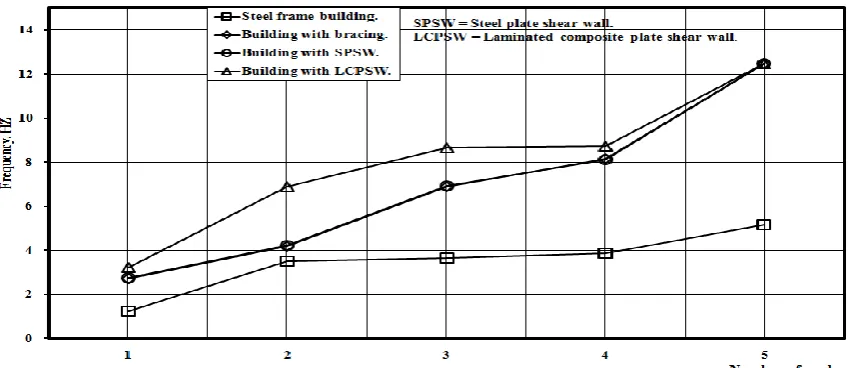
Fig. (7) Effect of lateral loads resisting systems on the performance of the frequency of three stories buildings.
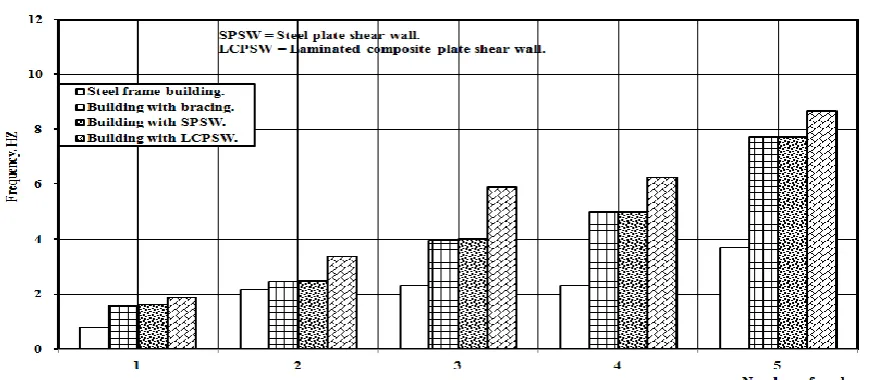
Fig. (9) Effect of lateral loads resisting systems on the performance of the frequency of five stories buildings.
Fig. (10) Comparison of lateral loads resisting systems on the frequency of five stories buildings.
From the previous figures, it is noticed that:
In generally, for different number of stories, there is an increase in the natural frequency for buildings with lateral loads resisting systems when it is compared with buildings without lateral loads resisting systems with the increase of the number of modes. For lateral load resisting systems, the natural frequency of buildings has the biggest values with laminated composite plate shear walls system and it has the lowest values with steel bracings and steel plate shear walls systems for different number of stories with the increase of the number of modes. For different number of stories, there is no much variation in the natural frequency of buildings for steel bracings and steel plate shear walls system with the increase of the number of modes.
3-2 Transient analysis of buildings.
To study the effect of lateral loads resisting systems on dynamic response of buildings, the transient dynamic analysis of buildings subjected to impulsive pressure loading is considered. The buildings are subjected to triangular impulsive pressure loading with peak value = 0.1 MPa and load duration is 0.1 sec on the first floor of three and five stories buildings as shown in Fig. (11). For transient dynamic analysis, The equation (1) is solved by a transient dynamic analysis that it is:
(1)
∆t = 0.01 sec and end time step = 0.5 sec and The governing equations of forced vibration are solved using the Newmark direct integration method.
Fig. (11) Triangular impulsive pressure load.
The transient dynamic analysis has been carried out and to study the effect of lateral loads resisting systems on the dynamic response of buildings subjected to impulsive load, the results obtained by the transient dynamic analysis are analyzed. For simplicity, the results are presented by charts as follows:
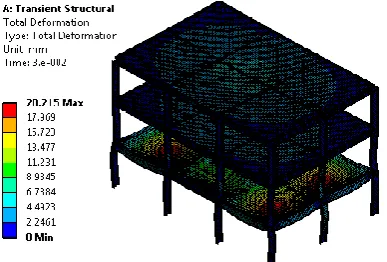
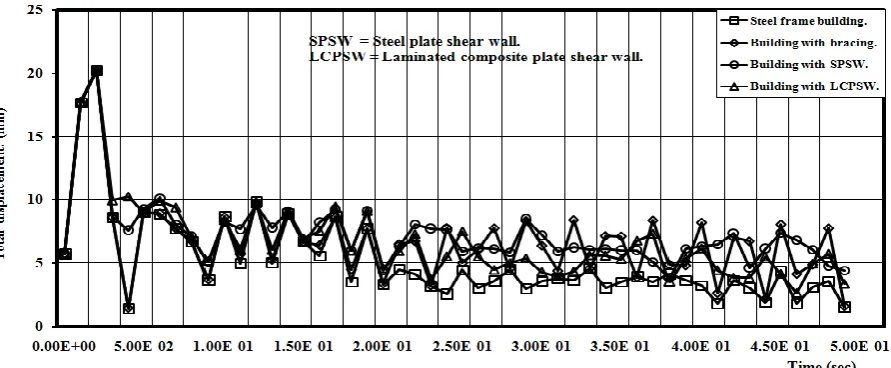
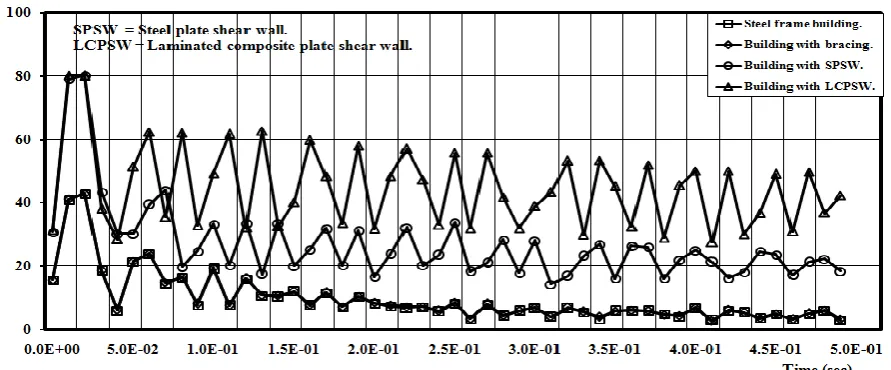
Fig. (12) and Fig. (13) present the total displacement and the equivalent stress distributions respectively of three stories buildings without and with lateral loads resisting systems at time = 0.03 sec. Fig. (14) and Fig. (15) present the total displacement and the equivalent stress distributions respectively of five stories buildings without and with lateral loads resisting systems at time = 0.03 sec. Fig. (16) and Fig. (17) present time-displacement response for total time-displacement and time-stress response for equivalent stress respectively of three stories buildings without and with lateral loads resisting systems. Fig. (18) and Fig. (19) present time-displacement responses for total time-displacement and time-stress response for equivalent stress respectively of five stories buildings without and with lateral loads resisting systems. Fig. (20) to Fig. (23) present comparison of lateral loads resisting systems on the total displacement and the equivalent stresses for three and five stories buildings respectively at times 0.01, 0.02 and 0.03 sec.
Building without lateral loads resisting system. Building with steel bracings system.
Building with SPSW system. Building with LCPSW system. SPSW = Steel plate shear wall.
LCPSW = Laminated composite plate shear wall.
Building without lateral loads resisting system. Building with steel bracings system.
Building with SPSW system. Building with LCPSW system. SPSW = Steel plate shear wall.
LCPSW = Laminated composite plate shear wall.
Fig. (13) Equivalent stress distribution of three stories steel frame buildings without and with lateral loads resisting systems at time 0.03 sec.
Building with SPSW system. Building with LCPSW system. SPSW = Steel plate shear wall.
LCPSW = Laminated composite plate shear wall.
Fig. (14) Total displacement distribution of five stories steel frame buildings without and with lateral loads resisting systems at time 0.03 sec.
Building without lateral loads resisting system. Building with steel bracings system.
Building with SPSW system. Building with LCPSW system. SPSW = Steel plate shear wall.
LCPSW = Laminated composite plate shear wall.
Fig. (16) Time-displacement response for total displacement of three stories buildings without and with lateral loads resisting systems.
Fig. (17) Time-stress response for equivalent stress of three stories buildings without and with lateral loads resisting systems.
Fig. (19) Time-stress response for equivalent stress of five stories buildings without and with lateral loads resisting systems.
Fig. (20) Comparison of lateral loads resisting systems on the total displacement of three stories buildings at times 0.01, 0.02 and 0.03 sec
Fig. (22) Comparison of lateral loads resisting systems on the total displacement of five stories buildings at times 0.01, 0.02 and 0.03 sec.
Fig.(23) Comparison of lateral loads resisting systems on the equivalent stresses of five stories buildings at times 0.01, 0.02 and 0.03 sec.
From the previous figures, it is noticed that:
III.
CONCLUSIONS
In this paper, the modal and transient analysis of steel frame buildings without and with lateral loads resisting systems have been done to investigate the effect of lateral loads resisting systems on dynamic response of buildings. From the results reported herein, the following conclusions are obtained:
1- Using lateral load resisting systems in buildings increases the stiffness of buildings and the buildings form efficient under dynamic loads.
2- Lateral loads resisting systems have important effects on dynamic response of buildings that it should be considered in design of buildings subjected to dynamic loads.
3- Lateral loads resisting systems improve the free vibration response of buildings for different number of stories.
4- The natural frequency of buildings with laminated composite plate shear walls system is higher than that with steel bracings and steel plate shear walls systems with the increase of the number of modes and number of stories.
5- There is no much variation in the total displacement for buildings subjected to impulsive load without and with lateral loads resisting systems with the increase of the number of stories.
6- The equivalent stresses for buildings with laminated composite plate shear walls system are higher than that for buildings with steel bracings and steel plate shear walls systems with the increase of the number of stories.
REFERENCES
[1] A. Elhelloty. Free vibration response of laminated composite plate shear walls, International Journal of Engineering Research and Development, August 2017, Vol. 13, Issue 9, pp. 28-38.
[2] J. Ji, W. Zhang, W. Zhao, C. Yuan and Y. Liu. Research of seismic testing and dynamic character of high-rise building structure based on ANSYS, International Journal of Digital Content Technology and its Applications(JDCTA) , May 2012, Vol. 6, No. 8.
[3] N. Nainan and T. V. Alice. Dynamic response of seismoresistant building frames, International Journal of Engineering Science and Technology (IJEST), May 2012, Vol. 4 No. 5.
[4] K. Kamath, N. Divya and A. U. Rao. A study on static and dynamic behavior of outrigger structural system for tall buildings, Bonfring International Journal of Industrial Engineering and Management Science, December 2012 , Vol. 2, No. 4.
[5] S. J. Sardar and U. N. Karadi. Effect of change in shear wall location on storey drift of multistorey building subjected to lateral loads, International Journal of Innovative Research in Science Engineering and Technology, September 2013, Vol. 2, Issue 9.
[6] K. R. Raju, M.I. Shereef, N. R. Iyer and S. Gopalakrishnan. Analysis and design of RC tall building subjected to wind and earthquake loads, The Eighth Asia-Pacific Conference on Wind Engineering, December 2013, Chennai, India.
[7] J. Ramanujan, K.O. Lakshmi, , B. Sunil, L. Kottallil, M. J.Poweth. Effect of shear wall location in buildings subjected to seismic loads, ISOI Journal of Engineering and Computer science, 2014, Vol. 1, Issue 1, pp. 07-17.
[8] A. Gottala, K. S. N. Kishore and S. Yajdhani. Comparative study of static and dynamic seismic analysis of a multistoried building, IJSTE - International Journal of Science Technology & Engineering, July 2015, Vol. 2, Issue 01.
[9] N. Dileep and R. Renjith. Analytical investigation on the performance of tube-in-tube structures subjected to lateral loads, International Journal of Technical Research and Applications, July-August 2015, Vol. 3, Issue4, PP. 284-288.
[10] V. Rekha, V. G. Ghorpade and S Rao. Performance of lateral systems on tall buildings, International Journal of Civil Engineering and Technology (IJCIET), November-December 2016, Vol. 7, Issue 6, , pp. 550–557.
[11] A. P. Gadkari and N. G. Gore. Review on behaviour of outrigger structural system in high-rise building, International Journal of Engineering Development and Research, 2016 IJEDR, Vol. 4, Issue 2.
[12] A. Ahmed. Dynamic analysis of multi-storey RCC building frames, International Conference on Inter Disciplinary Research in Engineering and Technology 2016, (ICIDRET 2016).
[13] vikneshvaran, A. Aminnudin, h. U. Alyaa, w. N. Fathiah, S. D. Shakirah and A. Afham. Study on numerical analysis of high rise building, Proceedings of Academicsera 3rd International Conference, Jakarta, Indonesia, March 2017.