JETIR1505059 Journal of Emerging Technologies and Innovative Research (JETIR) www.jetir.org 1663
Single Image Super-resolution using
Regularization based on DCT Fusion Technique
1Nidhi B.Patel, 2Krupa N. Jariwala
1M.E. - GTU PG School, 2Assistant Professor – SVNIT - Surat 1CO - Wireless and Mobile Computing
1GTU, Ahmedabad, India
Abstract- Super-resolution (SR) is the most popular area in Image processing and it was obtaining a high-resolution image from Low-resolution blurry/noisy, motion blur image, multi-focused images, etc. Regularization is use in SR for making the image sharp and smooth without noise. Single image SR using Regularization with fusion proposed for multi-focused images and noisy images. A proposed system is present combination of two different approaches to solving noise, ill-posed and unfocused problem of images. Regularization based SR completed in three steps are Registration, interpolation, and Regularization and it will improve quality, reduce time-complexity. In this paper the experimental results describe feasibility and effectiveness of proposed approach. It will increase peak signal ratio, remove artifacts, work for the whole area of the image and increased a quality of an image for the human visualization purpose. Based on performance analysis and experimental results, we can prove that our proposed methodology efficient and reliable for improving performance than the other Super-resolution methods.
Index Terms- Regularization, Blur metric, Likelihood estimation, Fusion, Interpolation, Super-resolution.
1. INTRODUCTION
Resolution is the process of obtaining one or more high-quality images from one or more low-resolution images. Super-resolution has many applications which are used in real-world. These applications are biometrics, satellite, medical image processing and analysis of text, read license plates [1] [14] Methods for the Super-resolution are classified into Frequency Domain and Spatial Domain. These two methods are classified into different methods. Frequency domain totally based on mathematics and spatial domain method deal with pixels, blur estimation. The Spatial domain has two types are: Multiple and Single images Super-resolution. In our proposed approach, single image Super-resolution combines with multi-focused image fusion technique. In our proposed methodology used fusion concept for making a focused image from unfocused images. Should single image generated from the set of images and frame image fusion a maximum of information, who exercise for human and machine [2].
It can improve reliability and capability of image [2]. The resultant fusion image was complete from input or low-resolution images and more information content than does the input. Fusion can remove the unfocused area of the image and fused the original multi-focused image. The optical lens has limited depth; it is not possible to get all relevant information of objects in images or focus. Overcome the limitation we used fusion process. It can obtain every object in the focus of the image and the fusion process fused image for a better view of human perception [2]. There are important requirements for image fusion process [3]:
The fused image should preserve all relevant information from the input images.
Image fusion should not introduce artifacts which can lead to wrong diagnosis.
JETIR1505059 Journal of Emerging Technologies and Innovative Research (JETIR) www.jetir.org 1664 Previous existing methods for single image super-resolution explain by Sultan et al. [6] And Lin Li et al. [9], that used the total variation regularization and the fusion concept to do single image SR. Also, these approaches used in our proposed method and analysis of the method performance with them.
1.1 Motivation and Justification of proposed approach
The conventional technique of the SR resolution used the different principle to do image reconstruction. It can used fusion, regularization, sparse domain method, etc., but we can use two concepts together to reconstruct a low-resolution image. Single image Super-resolution was used the different principle to do the improvement of the image. It has fusion principle [6], regularization, sparse representation, etc. There are many issues with this method and we try to solve some of the issues among it. In [6] used fusion, but there is used Discrete Wavelet transformation (DWT) fusion and curvelet fusion, but there is one problem with DWT. The Problem is large number of coefficients in all scales in accordance with the edges of the image [6] [7]. Because of this problem Single image Super-resolution has some artifacts present in the image.
Overcome or decreased the problem in our proposed approach used discrete cosine transformation (DCT) and after DCT variance’s output used in Single image SR to do regularization with the bicubic method. Single image Super-resolution with fusion approach, it has first multi-focused images and then after reconstruct the single focused image. The objective of the fusion and single image super-resolution are to reconstruct the image and make it sharp and smooth terms of quality.
Michal et al. [10] SR approach deal with the problem of scale-up in an image using the sparse modeling representation system to recover the image. Still, there is a problem occurs ill-posed, it is required to overcome this problem to regularize it. In our proposed system regularization steps to do E-intra or E-inter to set the pixel size and reconstruct the high-quality image using DCT variance [11] fusion concept. It may be time to reduce complexity as to compare SR with sparse domain selection process [12] are, bicubic and compare other Super-resolution technique.
Justify our proposed approach to increasing the quality of image with fused low-resolution image. Where lead bicubic interpolation and estimation of the probability to do zoom for resizing and after regularization apply in the same size high clear picture as input image size. The proposed approach can do DCT variance fusion for the multi-focused image and it is getting an output of single image focused image and generate low-resolution single image used for the SR implementation input and then after applying interpolation, regularization to reconstruct image and increase fidelity of the original input image. It is used to eliminate artifacts, blurring and reduced ill-posed problem, reduce motion effect at a certain level. Here, we can also calculate mean squared error (MSE) for the image and other Single image SR methods are calculated only calculated PSNR and SSIM.
1.2 Outline of the approach
The pre - processing technique to make a fused image and arrange "all- in-one" focused. Divided 8 × 8 blocks during the merge process in the image and apply DCT variance. After this stored image as a low-resolution image fusion. Our system can calculate the parameter to compare with an increased ratio with other and this parameter are: PSNR, SSIM, MSE and blur metric.
1.3 Organization of the paper
This paper organized as follows: Section 2 describes proposed Single image SR based on the fusion of multi-focused images in detail. Section 3 shows the algorithm for proposed SR. Section 4 presents the experimental result and performance analysis. Sections 5 display the conclusion of the proposed approach and future work. Section 6 display acknowledgement.
2. SINGLE IMAGE SUPER-RESOLUTION WITH DCT VARIANCE FUSION BASED METHOD
Here, Single image Super-resolution for Multi-focused low-resolution Images. In this paper, we propose Super-resolution with fusion concept and it is used DCT variance algorithm for fusion. After fusion, we can apply Super-resolution algorithm and it is divided in steps are:
Direct Register fused Low-resolution (LR) image.
Interpolation (cubic/bicubic)
JETIR1505059 Journal of Emerging Technologies and Innovative Research (JETIR) www.jetir.org 1665
Figure-1: Block diagram of proposed system.
In figure 1 shows that actual process of Single image Super-resolution with fusion. There are multi-focused images uses as input and divided into 8*8 blocks to do the same size of each image. After the process of dividing blocks apply DCT variance method to make images in one focus. Now, we apply our proposed algorithm to make an image in the high resolution from multi- focused images.
In our algorithm, we used Interpolation, Inpaint method to do interpolate or extrapolate the holes during interpolation process, finally used regularization for making smooth, sharp image. End of the process we get an output as the high-resolution image in visual based.
3. ALGORITHM FOR SINGLE IMAGE SUPER-RESOLUTION BASED ON REGULARIZATION
JETIR1505059 Journal of Emerging Technologies and Innovative Research (JETIR) www.jetir.org 1666 Figure 2 shows algorithm used for making high-accurate image from multi-focused low-resolution images. Description of given figure 2 algorithm follows are:
Description: Applying Multi-focused image fusion method on input and image divide into blocks. After that Applying DCT Fusion
method and get an output of the single image. This output image used as input of the SR (Super-Resolution) algorithm and apply Interpolation and Regularization for the Reconstruction of the image.
Proposed system divided into two phase:
Phase-1 can fuse multi-focused image and
Phase-2 can apply Super-resolution method on fuse image to get high- quality image.
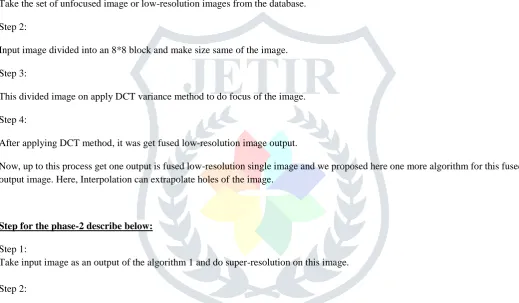
Following steps describe scenario of Phase-1:
Step 1:
Take the set of unfocused image or low-resolution images from the database.
Step 2:
Input image divided into an 8*8 block and make size same of the image.
Step 3:
This divided image on apply DCT variance method to do focus of the image.
Step 4:
After applying DCT method, it was get fused low-resolution image output.
Now, up to this process get one output is fused low-resolution single image and we proposed here one more algorithm for this fused output image. Here, Interpolation can extrapolate holes of the image.
Step for the phase-2 describe below:
Step 1:
Take input image as an output of the algorithm 1 and do super-resolution on this image.
Step 2:
Select R.O.I for the SR and resize image up to two times large. Then the create filter for the point spread function (PSF).
Step 3:
After that completion of the initial stage, we can do interpolation for enlarging the image and make up-sampling or down sampling with input.
Step 4:
In this step, we will use regularization for the final output process and estimate bur metric and error of the image. Finally, reconstruct the high-resolution image from the low-resolution image
4. EXPERIMENTAL RESULTS AND PERFORMANCE ANALYSIS
4.1 Performance Parameter for Single image Super-resolution
In order to evaluate the feasibility and effectiveness of the proposed model, covering Low-resolution images under various conditions including: multi-focused, noisy, and blurry. The experiments were conducted on different databases like Berkeley Super-resolution and Deblurring Dataset, Multi-focused Sensor Dataset. Here, performance measure on different kind of parameter to describe the quality of an image.
The Peak Signal Noise Ratio (PSNR) is calculated by:
PSNR (db.) = 10𝑙𝑜𝑔10𝑝𝑒𝑎𝑘𝑣𝑎𝑙2
JETIR1505059 Journal of Emerging Technologies and Innovative Research (JETIR) www.jetir.org 1667 Blur Metric is calculated by:
Blur = max (blur_F_Ver, blur_F_Hor) (2)
4.2 Database Description
The proposed method used database for simulation is Multi-focused images and blurry images to improve the quality of images. It is used images from Multi-Sensor Database, blurry/noisy images (flicker.com) and unfocused images available at
(
http://dsp.etfbl.net/mif/ [13]
).The database has images size are 512*512, 128*128 etc., pixels. In proposed method, we use one reference image for our better simulation result. This dataset has gray scale images and color images are present and it can use for simulation purpose. Our proposed method used both type images and results get in multi-focused gray-scale for a better view of the smooth image. It is helpful in the sensor type algorithm.
4.3 Experimental Results
Now, experimental results of our proposed method show in different phases are described the situation of an image in various view like map view, estimation of likelihood, error phase, masked view, reconstruction of an input image. Figure 3 show simulation results of Image 3 with PSNR, SSIM, and blur metric.
(a)
(b)
(c) (d)
(e) (f) (g) (h)
Figure-3: Simulation Results (a) Input Focused low-resolution large image (b) Estimated image of likelihood (c) regularied image by interpolation (d) delta view of interpolate image (e) masked view of input image (f) map view for smoothing image (g) calculate error of image (h) final output reconstruct high-resolution image (PSNR= 28.29 db., SSIM= 0.851, blur metric= 0.33db.)
Testing proposed method on different images and get results with PSNR, SSIM, Blur metric and Timing parameters. This tested result show below in Table-1:
JETIR1505059 Journal of Emerging Technologies and Innovative Research (JETIR) www.jetir.org 1668
IMAGES PARAMETER
PSNR SSIM BLUR METRIC TOTAL TIME
Book 26.27 0.81 0.36 15.023 s
Leaves 26.853 0.845 0.77 29.807 s
Girl 34.831 0.863 0.40 37.005 s
Hat 31.340 0.861 0.41 32.925 s
Peppers 29.910 0.869 0.47 30.958 s
Butterfly 27.051 0.831 0.60 33.944 s
Image1 28.95 0.831 0.38 12.078 s
Image 2 35.57 0.96 0.52 33.270 s
Image 3 28.29 0.84 0.33 36.740 s
Table-1: Proposed method Simulated Results of different images with its parameter’s value.
4.4 performance analysis
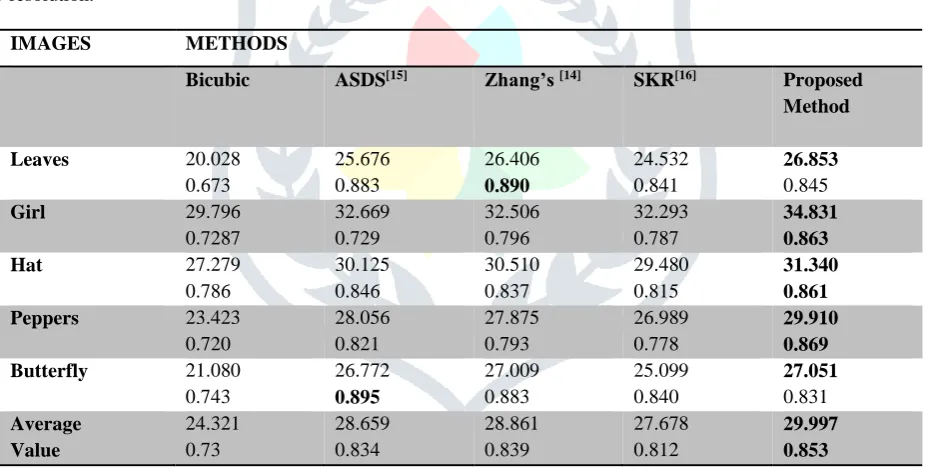
In performance analysis, we compare our method with existing methods of Single image Super-resolution based on the parameter. There are two parameter PSNR and SSIM use for comparison. In Table-2 shows Comparison of a different method which is related to Super-resolution.
IMAGES METHODS
Bicubic ASDS[15] Zhang’s [14] SKR[16] Proposed
Method Leaves 20.028 0.673 25.676 0.883 26.406 0.890 24.532 0.841 26.853 0.845 Girl 29.796 0.7287 32.669 0.729 32.506 0.796 32.293 0.787 34.831 0.863 Hat 27.279 0.786 30.125 0.846 30.510 0.837 29.480 0.815 31.340 0.861 Peppers 23.423 0.720 28.056 0.821 27.875 0.793 26.989 0.778 29.910 0.869 Butterfly 21.080 0.743 26.772 0.895 27.009 0.883 25.099 0.840 27.051 0.831 Average Value 24.321 0.73 28.659 0.834 28.861 0.839 27.678 0.812 29.997 0.853
Table 2: Compare proposed method with existing methods with PSNR and SSIM value.
Table-2 show different methods compare with our proposed method and in table highlighted value show best results in terms of PSNR (Peak-signal noise ratio) and SSIM (Structural similarity index measurement). In table-2 we can prove that our proposed system work better than the other methods and we calculate the average ratio of all compared method for better visualization. Table 2 show Performance analyzed and plotted in the form of a standard chart of each method.
JETIR1505059 Journal of Emerging Technologies and Innovative Research (JETIR) www.jetir.org 1669 Now, we derived graph for the Analysis table. Given below figure s4 shows the results in graph.
(a)
(b)
(c)
(d)
(e)
(f)
Figure-4: Graph for image with PSNR and SSIM value of different methods (a) Leaves image graph (b) Girl image (c) Hat image (d) peppers image (e) Butterfly image (f) final average of all methods and values of PSNR & SSIM with images.
5. CONCLUSION
JETIR1505059 Journal of Emerging Technologies and Innovative Research (JETIR) www.jetir.org 1670 technique to the made image sharp and smooth. It can successfully remove motion blur and slightly reduce the ill-posed problem of image. The proposed method has one advantage that decreased time-complexity than existing methods. Our approach calculates blur metric parameter which unique from the other methods.
In future work, proposed works for more improve edges quality of image and try for reduce the ill-posed problem from the image. Also, it is used in video single frame to increase smoothness, peak signal ratio.
6. AKNOWLEDGEMENT
I take this opportunity to express my sincere gratitude to my guide Mrs. Krupa N. Jariwala, Assistant Professor, SVNIT, Surat for the invaluable guidance and moral support rendered by her in the fulfillment of my Paper work. I am thankful to her for constant constructive criticism and invaluable suggestions, which benefited me a lot while doing my research. Without her encouragement and guidance this research work would not have been materialized. I am also thankful to all my friends who supported me during the preparation of my work.
REFERENCES
[1] "Super-resolution: A comprehensive survey" Kamal Nasrollahi Thomas B. Moeslund, Machine Vision and Applications (2014) 25:1423–1468 DOI 10.1007/s00138-014-0623-4, Received: 31 July 2013 / Revised: 24 January 2014 / Accepted: 13 May 2014 / Published online: 14 June 2014,© Springer-Verlag Berlin Heidelberg 2014.
[2] "Different Image Fusion Techniques –A Critical Review", Deepak Kumar Sahu, M.P.Parsai (Department of Electronics & Communication Engineering, Jabalpur Engineering College, Jabalpur MP, India), International Journal of Modern Engineering Research (IJMER), Vol. 2, Issue. 5, Sep.-Oct. 2012 pp-4298-4301 ISSN: 2249-6645.
[3] "Comparative Study of Image Fusion Techniques based on Spatial and Transform Domain", Sweta K. Shah, Prof. D.U. Shah, International Journal of Innovative Research in Science, Engineering and Technology (An ISO 3297: 2007 Certified Organization) Vol. 3, Issue 3, March 2014.
[4] Shrivsubramani Krishnamoorthy, K P Soman,“ Implementation and Comparative Study of Image Fusion Algorithms” .International Journal of Computer Applications (0975 – 8887) Volume 9– No.2, November 2010.
[5] K. I. Kim and Y. Kwon, “Example-based learning for single-image super-resolution”, in Proc. DAGM, pp. 456—465, 2008.
[6] "Single Image Super Resolution Using Sparse Representation with Image Fusion Principle",Eman A. Sultan , Said E. El-Khamy, EL-Sayed El-Rabie,Nawal A. El-Fishawy, Fathi E. Abd El-Samie,International Journal Of Engineering And Computer Science ISSN:2319-7242,Volume 3 Issue 4 April, 2014 Page No. 5210-5215.
[7] "Different Image Fusion Techniques –A Critical Review", Deepak Kumar Sahu, M.P.Parsai (Department of Electronics & Communication Engineering, Jabalpur Engineering College, Jabalpur MP, India), International Journal of Modern Engineering Research (IJMER), Vol. 2, Issue. 5, Sep.-Oct. 2012 pp-4298-4301 ISSN: 2249-6645.
[8] Yang, J., Wright, J., Huang, T., Ma, Y.: Image superresolution via sparse representation IEEE ICIP, 2010.
[9] "Single image super-resolution using combined total variation regularization by split Bregman Iteration",Lin Li,YuanXie,WenruiHu,WenshengZhang, Neurocomputing142(2014)551–560.
[10] R. Zeyde, M. Elad, and M. Protter, “On single image scaleup using sparse-representations, ” curves and curfaces 2011, LNCS 6920, pp. 711-730, 2011, Springer-Verlag Berlin Heidelberg 2011.
[11] "Multi-focus image fusion for visual sensor networks in DCT domain",Mohammad Bagher Akbari Haghighat a, Ali Aghagolzadeh, Hadi Seyedarabi, Computers and Electrical Engineering 37 (2011) 789–797.
[12] “Image Deblurring and Super-resolution by Adaptive Sparse Domain Selection and Adaptive Regularization”, Weisheng Donga,b, Lei Zhangb,1, Member, IEEE, Guangming Shia, Senior Member, IEEE, and Xiaolin Wuc, Senior Member, IEEE,2011.
[13] http://dsp.etfbl.net/mif/