AUSTRALIAN JOURNAL OF BASIC AND
APPLIED SCIENCES
ISSN:1991-8178 EISSN: 2309-8414 Journal home page: www.ajbasweb.com
Open Access Journal
Published BY AENSI Publication
© 2016 AENSI Publisher All rights reserved
This work is licensed under the Creative Commons Attribution International License (CC BY). http://creativecommons.org/licenses/by/4.0/
To Cite This Article: Dr. Mary Joan S and Daphne I., Disease Information Extraction from Healthcare Records using CTA Matrix. Aust. J. Basic & Appl. Sci., 10(1): 477-481, 2016
Fusion Of Multi Focus Gray-Scale Images Using Generic Multi Resolution
Fusion Scheme
1Dr. Mary Joan S and 2Daphne I
1,2Department of Electronics and Communication Engineering Velammal Institute of Technology Chennai
Address For Correspondence:
Dr. Mary Joan S, Department of Electronics and Communication Engineering Velammal Institute of Technology Chennai E-mail: [email protected]
A R T I C L E I N F O A B S T R A C T Article history:
Received 10 December 2015 Accepted 28 January 2016 Available online 10 February 2016
Keywords:
Image Fusion; Multi Resoution; fmi;
Wireless sensor networks are also applied to visual sensors. This is a major field which employs image fusion which is a process of fusing two or more images. The new image thus obtained contains better description of the scene when compared to the individual source images. The proposed model utilizes the Generic Multi Resolution Fusion Scheme of image fusion done by stationary wavelet transform (SWT). The corresponding coefficients of the decomposed image are compared and the maximum value is selected. Down sampling of the pixels is avoided using this methods hence the edge details are preserved during the reconstruction of the image. It also reduces the problems like blocking, ringing artifacts that occur due to the application DCT and DWT on the image during the fusion mechanism. The performance of the technique is evaluated and compared with existing schemes.
INTRODUCTION
When multiple image sensors deployed to capture a scene, parts of the scene may not be focused perfectly. This gives rise to images being blurred at certain areas. Some other sensor may have captured the same part of the scene with better quality. Thus there arises a need for a scheme to combine these individual images to form a fused image that has a clearer description of the scene. This fusion be performed at various levels. Here we focus on the pixel level fusion. Here a composite image is built from several input images by taking into account each pixel in the individual source images. Though image fusion has a wide range of applications it is predominantly used in the fusion of low light visible TV images with forward looking infrared images which are two individual images obtained by different types of imaging sensors fixed on aircrafts which are designed to assist a pilot to navigate through tough weather conditions.
Existing methods of Image Fusion schemes concentrate on two transforms namely, 1. DCT and 2. DWT. These transforms may act stand-alone or maybe implemented along with several Image Enhancement techniques. This is done in an attempt to improve the quality of the image both in terms of subjective and objective evaluation. Few such Image Enhancement techniques are Averaging, Contrast Adjustment, Variance Adjustment etc,.
In (Egfin Nirmala, D., et al., 2013), a novel method specially for surveillance images was presented. It uses Compressive sensing which is efficient for sparse signals. Contourlet Transform captures and represents images with smooth boundaries. The images are compressed during the sampling process.
The visual quality of the fused image is improved in (Shreyamsha Kumar, B.K., 2012). This method also reduces the number of computations required at the cost of poor performance. Whereas Image fusion by convolution-based methods give better performance. However these methods pose high computational complexity.
In (Shah, P., et al., 2011) wavelet domain is used for fusion in combination with weighted averaging of pixels. The properties of the neighborhood pixels are analyzed statistically based on which the weights are determined. Thus more importance is given to pixels in sharper neighborhood.
The model proposed in (Haghighat, M.B.A., et al., Zhang, Q .and B.-L. Guo, 2006) also employed NSCT. The low pass coefficients are subjected to selecting and averaging. In (Rahman, S.M.M., et al., 2010) a fusion technique specifically for noisy images was proposed which used DWT. An image enhancement technique is employed in addition to the transform. The special feature of this method is that the reconstructed image is free of noise. However DWT has a major drawback. It is not time-invariant.
The rest of the paper is structured as follows. The proposed algorithm and the steps and conditions involved in the fusion process are explained in Section II. Section III gives a brief idea about the type of transform employed in the proposed algorithm, that is, Stationary Wavelet Transform. Section IV deals with performance analysis and comparison of proposed system with existing algorithms. Conclusions are drawn in Section V.
Proposed Algorithm:
The proposed system implements Generic multi-resolution fusion scheme of Image Fusion. The central idea of the generic multi resolution fusion scheme is stimulated by the reality that the human visual system has maximum sensitive to edges. The proposed system is implemented as follows:
Step 1: Convert the multi-focus images to grayscale images.
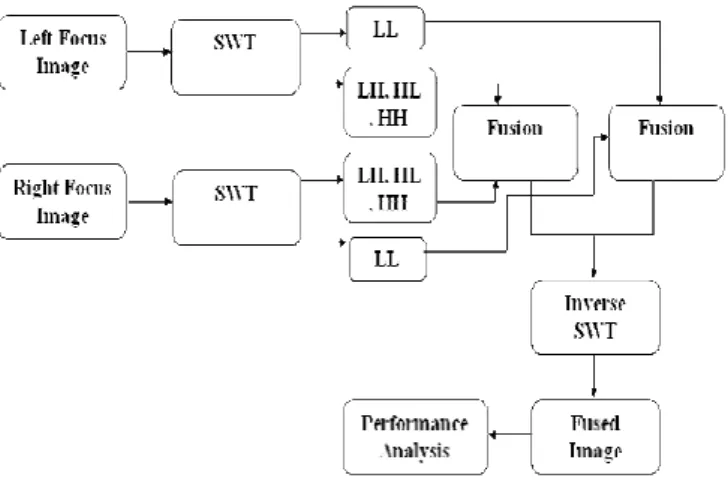
Step 2: Resize both the grayscale images to a standard size say 256*256. Let the two images be (a) and (b). Step 3: Both (a) and (b) are decomposed into their multi scale edge representation using SWT which segments the images into four part as shown in figure 1.
Step 4: The coefficients of a segment, say LL, of image (a) is compared with the coefficients of the same segment of the image (b). The coefficient having the maximum value is selected to be included in the fused image.
Step 5: Repeat step 4 for the other segments.
Step 6: The resultant segments of the comparison process should be combined by apply the inverse transform.
The flow chart of the proposed algorithm is shown in fig1.
Fig. 1: Block Diagram of the Proposed Algorithm
Stationary Wavelet Transform:
represented as φ (x, y) and three two-dimensional wavelets represented as ψH(x, y), ψV(x, y) and ψD(x, y) are required to compute a two dimensional wavelet transform. These are a product of two individual one dimensional functions. Products such as φ(x) ψ(x) produce 1D result and are hence avoided. These wavelets each calculate the variations of the intensity of the image along each direction. ψH gives the horizontal edges, ψV gives the vertical edges and ψD gives the diagonal variations. The basic functions given by (1) and (2):
(1)
(2)
Here the ‘i' represents the direction of the wavelets (H, D and V), ‘j’represents the level of the algorithm and m=n=0 to 2(j-1).The SWT is an algorithm that was designed to eliminate the drawback of DWT. This is accomplished by eliminating the down and up samplers in the DWT. Then the filter coefficients are up sampled by a factor of 2(k-1) in the kth level of the algorithm.
Simulation Result:
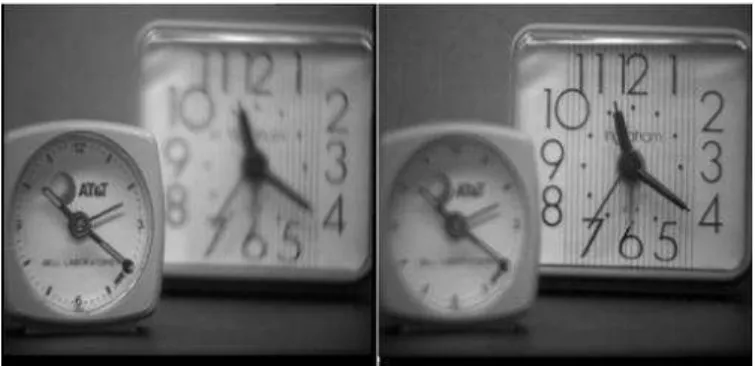
The figure 2 shows the input images which have different focus. The fused image as shown in figure 3 contains features from both the input images thus improving the visual quality of the image.
.
Fig. 2: Multi focus input images
The performance of the scheme is measured by a metric named Feature Mutual Extraction (FMI) (Haghighat, M., M.A. Razian, 2014). It identifies the quantity of details transferred to the fused image from each of the individual images. The higher the value of FMI, better the quality of the fused image. The information contained in an image is generally considered by the features in the image. These features are perfect parameters to measure the performance of image fusion techniques. FMI is an appropriate metric since it exploits the features in an image and estimates the amount of features included in the fused image. These features are represented in the form of 2D signals. Equation 3 gives the formula to calculate FMI.
(3)
Fig. 3: Fused Image
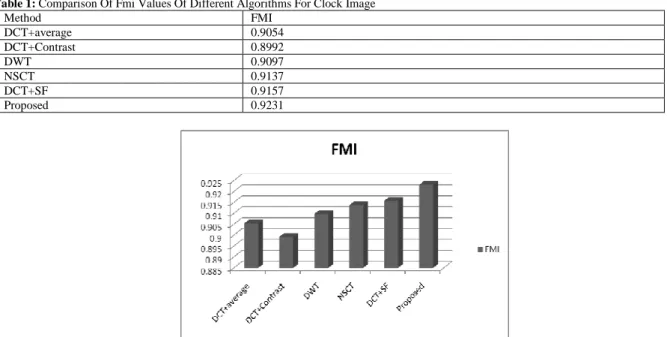
Table 1: Comparison Of Fmi Values Of Different Algorithms For Clock Image
Method FMI
DCT+average 0.9054
DCT+Contrast 0.8992
DWT 0.9097
NSCT 0.9137
DCT+SF 0.9157
Proposed 0.9231
Fig. 4: Comparison graph of FMI values of different algorithms for clock Image
Conclusion:
Image fusion has a wide range of applications. It is predominantly used in the aircrafts, where images are taken from different cameras and are fused to assist pilots to navigate through poor weather conditions. The proposed system implements Generic multi-resolution fusion scheme using SWT. This technique overcomes the down sampling problems that result from using DCT and DWT. As a result the edge details are preserved. The quality of the image can further be enhanced by using some spatial domain image enhancement technique in addition to the transform applied.
REFERENCES
Egfin Nirmala, D., R.K. Vignesh and V. Vaidehi, 2013. “Multimodal image fusion in visual sensor networks,” in 2013 IEEE Int. Conf. Electronics, Computing and Communication Technologies (CONECCT), pp: 1-6.
Haghighat, M., M.A. Razian, 2014. "Fast-FMI: non-reference image fusion metric,"8th International Conference on Application of Information and Communication Technologies (AICT), pp: 1-3.
Haghighat, M.B.A., A. Aghagolzadeh and H. Seyedarabi, 2011. “A non reference image fusion metric based on mutual information of image features”, Comput. Elect. Eng., 37(5): 744-756.
Haghighat, M.B.A., A. Aghagolzadeh and H. Seyedarabi, 2011. “Multi-focus image fusion for visual sensor networks in DCT domain,” Comput. Electr. Eng., 37(5): 789-797.
Rahman, S.M.M., M.O. Ahmad and M.N.S. Swamy, 2010. "Contrast-based Fusion of Noisy Images using Discrete Wavelet Transform," IET Image Process., 4(5): 374-384.
Shah, P., S.N. Merchant and U.B. Desai, 2011. "An Efficient Adaptive Fusion Scheme for Multifocus Images in Wavelet Domain using Statistical Properties of Neighborhood," in Proc. of 14th Int. Conf. on Information Fusion, pp: 1-7.
Shreyamsha Kumar, B.K., 2012. “Multifocus and multispectral image fusion based on pixel significance using discrete cosine harmonic wavelet transform” in Signal, Image and Video Processing, 7(6): 1125-1143.
Shreyamsha Kumar, B.K., M.N.S. Swamy and M. Omair Ahmad, 2013. “Multiresolution DCT decomposition for multifocus image fusion,” in 26th Annu. IEEE Can. Conf. Electrical and Computer Engineering (CCECE), pp: 1-4.