IJIRT 101573
INTERNATIONAL JOURNAL OF INNOVATIVE RESEARCH IN TECHNOLOGY200
Model Predictive Control Of Temperature Process In
Pasteurization
Anjaly Ajay Ghosh1, Hepsiba D.2
1PG Scholar, Department of Electronics and Instrumentation,
2Assistant Professor, Department of Electronics and Instrumentation,
Karunya University, Coimbatore, India.
Abstract- The classical controllers like PI or PID controllers are widely used in process industries because of their structure and their tuning is well known among all industrial operators. But these controllers have so many limitations. These controllers provide better performance only at a particular operating range. The specific control problems associated with the plant operations severely limit the performance of conventional controllers. The increasing complexity of plant operations together with tougher environmental regulations, rigorous safety codes and rapidly changing economic situation demand the need for more sophisticated process controllers. Model predictive controller (MPC) is an important branch in automated control theory. MPC refers to a class of control algorithm in which a process model is used to predict and optimize the process performance. In this project temperature in pasteurization process is controlled using model predictive controller. It show a good performance in keeping both the milk and water temperatures at the desired set points without any oscillation and overshoot.
Index Terms- model predictive control, proportional integral control, pasteurization
I. INTRODUCTION
Milk pasteurization process, a nonlinear process and multivariable interacting system, is difficult to control by the conventional on–off controllers, since the on–off controller can handle the temperature profiles for milk and water oscillating over the plant requirements .The MPC technique for multi-input multi-output (MIMO) system is implemented in this project for application to the milk pasteurization process which is commonly found in the dairy industries. The highly nonlinear dynamic behaviour, multivariable in nature, and interaction between unit processes cause this process to be difficult to control by conventional controllers.
II. SYSTEM DESCRIPTION
Pasteurization is the reason for milk's extended shelf life. High-temperature, short-time (HTST) pasteurized milk typically has refrigerated shelf life of two to three weeks, whereas ultra-pasteurized milk can last much longer, sometimes two to three months. When ultra-heat treatment (UHT) is combined with sterile handling and container technology (such as aseptic packaging), it can even be stored unrefrigerated for up to 9 months.
The pasteurizer used is based on a clip 10-RM plate heat exchanger (PHE) and brazed heat exchanger (BHE). A PHE consists of a pack of stainless steel plates clamped in a frame .The plate are corrugated in a pattern designed to increase the flow turbulent of medium and the product.
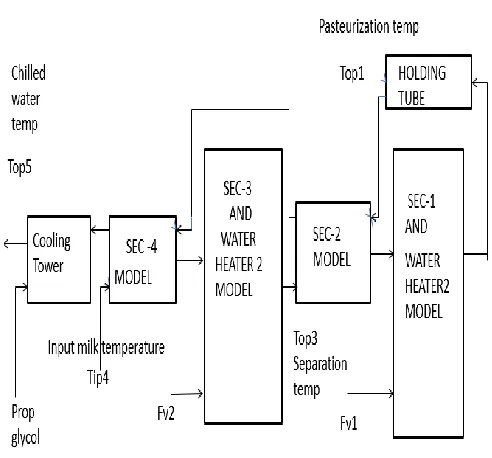
The pasteurizer is divided into five sections, S1 to S5 section S1 and S5 are for regeneration, S1 and S3 for heating and S5 for cooling .The BHE are used to heat the water used as a heating medium in the PHE. The heating surface in a BHE consists of thin corrugated metal plates stacked on top of each other. Channels are formed between the plates and corner ports are arranged so that the flow media flows through alternate channels always in counter-current flow. The pasteurizer operates as follows, the raw milk at a concentration of 4.1% enters the section S4 of the PHE at a temperature of 2.0ᵒ C. It is then preheated to a temperature of 60.5ᵒC by the outgoing pasteurized milk which as a result is reduced to a temperature of 11.5ᵒC.
IJIRT 101573
INTERNATIONAL JOURNAL OF INNOVATIVE RESEARCH IN TECHNOLOGY201
temperature of 72ᵒC using the already pasteurized milk as a medium. The milk is finally bought to the pasteurization temperature in section S1 (75.0ᵒC) using the hot water at around 77.0ᵒC as a medium.
After that the homogenized pasteurized milk is held at the temperature for 15s in the holding tube before being cooled using the incoming cold milk in section S4 and section S2. Finally, the pasteurized milk enters the cooling section (section S5) at the temperature of 11.5ᵒC, where the milk is chilled to a temperature of 1.0ᵒC using propylene glycol as a medium at a temperature of -0.5ᵒC. The water for section S3 and S4 is bought to adequate temperature in steam/water heater. The steam temperature is constant and have a value of 110.0ᵒC. Since milk is an excellent medium for microbial growth .and when stored at ambient temperature bacteria and other pathogens. Diseases which pasteurization can prevent are tuberculosis, brucellosis, diphtheria and scarlet fever. Pasteurization is the reason for the milk’s long life, sometimes two to three weeks.
III. MATHEMATICAL MODELING In this model, the effect of the plate is neglected and the exchange in every channel (between two plates) is described by the differential equation .This leads to an n by n system where n is the number of channels. Consider the differential equation describing heat exchange in every channel (i.e. between the plates) .This leads to a relatively large number of equations (i.e. equal the number of channels).
Figure 1 Pasteurization Process
The thermal evolution of the product (milk) and the medium (milk in preheating sections, or water in heating sections) is evaluated under the following assumptions:
Both medium and product flow in opposite directions (counter-current flow). A thin film of product and medium tends to create at each side along the wall. In the case of heating a product by a medium, the medium temperature decreases both spatially and over time, until reaching virtually the temperature of the medium’s thin film. On the product side, the product temperature increases to reach the temperature of the products thin film. The overall heat flow Q between product and the medium input temperature Tim (ᵒC) and Tip (ᵒC)respectively
Q=AU (Tip –Tim) (1) where,
A is heat exchange area ( )
U is the total heat coefficient (W/ /K) The heat flow between the product input Tip (ᵒC) and the thin film’s temperature on the product side Twp (ᵒC)
Q=AUp (Tip-Twp) (2) Where,
Up is the heat transfer coefficient plate at product (W/ /K)
IJIRT 101573
INTERNATIONAL JOURNAL OF INNOVATIVE RESEARCH IN TECHNOLOGY202
Q =AUm (Twm-Tim) (3) Where,
Um is heat coefficient plate/m (W/ /K) Heat flow across the wall
Q=A
(4)
Where,
Kpa thermal conductivity of the wall (W/ (mk)) Twm is thin film’s temperature on the medium side (ᵒC)
Twp is the thin film’s temperature on the product side(ᵒC)
Sw is thickness of the wall(m)
To obtain the temperature of the films on both sides of the plate compare (1) and (2) as well as (3) and (4) Therefore the steady state temperature Twp and Twm can be written as
(5)
Twm=Tim+
(Tip-Tim) (6)
Considering each section of the PHE as a heat transfer problem between two fluids separated by a plate. The heat transfer evolution can be characterised by the energy balance equation (7) –(8) Considering the product side
\ ρpCpVp
=ᵨpCpFp(Tip (t)-Top (t)) +UpA
(Tpa(t)-Top(t)) (7) Similarily at the medium side
ρmCmVm
=ᵨmCmFm(Tim
(t)-Tom(t))+UmA(Tpa(t)-Tom(t)) (8) Where,
ρ = density in (kg/ )
C= specific heat coefficient in (j/kg/K) V = volume in ( )
F= flow rate ( /h)
Finally, the output temperature of the product Top and
the medium Tom are the found
+Tom(t)= pTip(t)+(1- p)Tim(t)
(9)
+Tom(t)= mTim(t)+(1- m)Tip(t)
(10) Similarly, at BHE , the medium(water) used to heat the milk in section S1 and S3 has to be heated to an appropriate temperature before being routed into
the BHE of type CB76 .The water becomes the product of heat using hot steam at 110.0 ᵒC .Taking the above consideration ,the following energy balance equation is obtained:
+Tim(t)= imTom(t)+(1- m)Tpa(t)
+Tpa(t)= Tim(t)+ pa Fm
By combining equation (9)-(10) the pasteurization model can be then given as following state space equation = +
Where the system output y is the pasteurization temperature Top1, given in
y =
Table 1 The parameter values of process 's p1 =0.2
IJIRT 101573
INTERNATIONAL JOURNAL OF INNOVATIVE RESEARCH IN TECHNOLOGY203
τ' s τp1=30 τim1=30 τim1=30 τp2=15 τpa1=30 IV. CONTROLLER DESIGN (A) .PI CONTROLLER
A PI controller calculates an error value as the difference between a measure process variable and a desired setpoint. The controller attempts to minimize the error by adjusting the process control inputs. A PI controller (proportional –integral controller) is a special case of the PID controller is a special case of the PID controller in which the derivative (D) of the error is not used. For designing a proportional integral control, the parameters to be calculated are proportional gain (Kc) and the integral gain (ki)
=13.0921
(B).MODEL PREDICTIVE CONTROLLER
Model predictive control toolbox in MATLAB provides tools systematically analyzing, designing and tuning model predictive controllers. To design and simulate model predictive controllers using the functions in MATLAB or blocks in Simulink. The predictive model, control and predictive horizons, input and output constraints, and weights can be set and modified.
V. SIMULATION RESULTS (A). PI CONTROLR
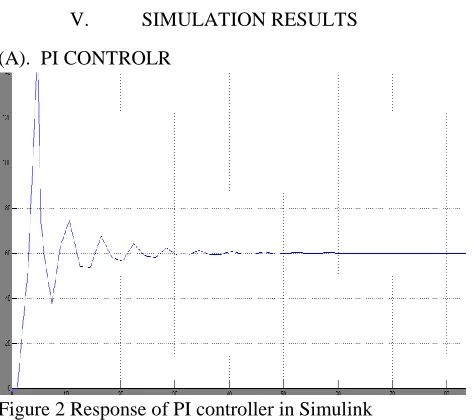
Figure 2 Response of PI controller in Simulink From the response it is found that PI controller does not give a better performance for all
operating region. Also the settling time and the overshoot of the PI controller is very large.
(B). MODEL PREDICTIVE CONTROL
From the response of MPC in Simulink. It shows that Model predictive control gives better performance. When compared to other conventional controller, MPC has less overshoot, oscillation and fast settling time.
Figure 3 Response of MPC in Simulink VI. PERFORMANCE ANALYSIS
A comparison between the performance of MPC and conventional controller was carried out and it was observed that model predictive controller has less overshoot, settling time and oscillation than the conventional PI controller. Thus, Model predictive control has better performance.
Table.2 Comparative Analysis
Controller
Setpoint (ᵒC)
Settling time (sec)
Rise time (sec)
Overshoot (ᵒC)
PI 60 60 2.5 153
IJIRT 101573
INTERNATIONAL JOURNAL OF INNOVATIVE RESEARCH IN TECHNOLOGY204
VII. CONCLUSION
In this project, the milk pasteurization process is multi-variable interacting system, which make it difficult to control by the conventional control system. The Pasteurization process model was derived and analyzed by simulating with the conventional PI controller and MPC controller in MATLAB. MPC controller performed well in keeping the milk temperature and water temperature at the desired set points with less oscillation and overshoot. A comparison between the performance of MPC and conventional controller is carried out and it was observed that model predictive controller has got better performance with less overshoot and less oscillation than the conventional controller.
The accuracy of the Mathematical model is very important in implementation of MPC. Modeling of the system can be improved by using Non-linear methods. Future work of this project can be extended by using Internal Model Control and Nonlinear Model Predictive Control.
REFERENCES
[1] Heidarinejad, M., Liu, J., & Christofides, P. D. State-estimation-based economic model predictive control of nonlinear systems. Systems & Control Letters, 61, 926–935. (2012).
[2] Dones, I., Manenti, F., Preisig, H. A., & Ferraris, G. B. Nonlinear model predictive control: A self-adaptive approach. Industrial and Engineering Chemistry Research, 49, 4782–4791. (2010)
[3] Ibarrola, J. J., Sandoval, J. M., Garcıa-Sanz, M., & Pinzolas, M. Predictive control of a high temperature–short time pasteurisation process. Control Engineering Practice, 10, 713–725. (2002)
[4] Carlos F. Alastruey, Manuel De la Sen and Mario García-Sanz Modelling and identification of a high temperature short time pasteurization process including delays Control and Computing Systems(1999)
[5] Antoine Negiz, Peter Ramanauskas, Ali Qnar, Joseph E. Schlesser and David J. Armstrong Modeling, monitoring and control strategies for high temperature short time pasteurization systems – 2 Lethality-based control food control vol 9,pp 17-28 (1998)
[6] C. Riverol M. V. Pilipovik Tuning a space–time scalable PI controller using thermal parameters 5 November 2004 Springer-Verlag 2004
[7] James B. Rawlings ,Model Predictive Control: Theory and Design Department of Chemical and Biological Engineering Nob Hill Publishing Madison, Wisconsin
[8] J. Prakash , K. Srinivasan .Design of nonlinear PID controller and nonlinear model predictive controller for a continuous stirred tank reactor,