Vol. 1 Issue 3 February 2013 56 ISSN: 2319-6319
CBR Based Performance Comparison of
Routing Protocol Manet
Punit Grewal
M.Tech. Computer Science, B.R.C.M., Bahal
Asst. Prof Amit Nain
Department of Computer Science, B.R.C.M., Bahal
Asst. Prof Ramesh Loar
Department of Computer Science, MRKIET, Rewari
Abstract - In Mobile Ad hoc network (MANETS), no fixed infrastructure is available. Different wireless hosts are free to move from one location to another without any centralized administration, so, the topology changes rapidly or unpredictably. Every node operates as router as well as an end system. Routing in MANETs has been a challenging task ever since the wireless networks came into existence. The major reason for this is continues changes in network topology because of high degree of node mobility. The MANET routing protocols have mainly two classes: Proactive routing (or table-driven routing) protocols and Reactive routing (or on-demand routing) protocols. In this thesis, we have analyzed Random based mobility models: Random Waypoint model using AODV and DSDV protocols in Network Simulator (NS 2.35). The performance comparison of MANET mobility models have been analyzed by varying number of nodes type of traffic (CBR) and maximum speed of nodes. The comparative conclusions are drawn on the basis of various performance metrics such as: Routing Overhead (packets), Packet Delivery Fraction (%), Normalized Routing Load, Average End-to-End Delay (milliseconds) and Packet Loss (%).
Keywords - Mobile Ad hoc, AODV, DSDV, TCP, CBR, routing overhead, packet delivery fraction, End-to-End delay, normalized routing load.
I.INTRODUCTION
Wireless communication between mobile users is becoming more popular than even before. This is due to recent technological advances in laptop computers and wireless data communication devices, such as wireless modems and wireless LANs. This has lead to lower prices and higher data rates, which are the two main reasons why mobile computing continues to enjoy rapid growth. Today we see two kinds of wireless networks. The first one which is a wireless network built on-top of a wired network and thus creates a reliable infrastructure wireless network. The wireless nodes also connected to the wired network and these nodes are connected to base stations. An example of this is the cellular phone networks where a phone connects to the base-station with the best signal quality.
The second type of wireless technology is where no infrastructure [1] exists at all except the participating mobile nodes. This is called an infrastructure less wireless network or an Ad hoc network. The word Ad hoc means something which is not fixed or not organized i.e. dynamic. Recent advancements such as Bluetooth introduced a fresh type of wireless systems which is frequently known as mobile Ad-hoc networks.
A MANET is an autonomous group of mobile users that communicate over reasonably slow wireless links. The network topology may vary rapidly and unpredictably over time because the nodes are mobile. The network is decentralized where all network activity, including discovering the topology and delivering messages must be executed by the nodes themselves. Hence routing functionality will have to be incorporated into the mobile nodes. Mobile ad hoc network is a collection of independent mobile nodes that can communicate to each other via radio waves. The mobile nodes can directly communicate to those nodes that are in radio range of each other, whereas others nodes need the help of intermediate nodes to route their packets. These networks are fully distributed, and can work at any place without the aid of any infrastructure. This property makes these networks highly robust.
Vol. 1 Issue 3 February 2013 57 ISSN: 2319-6319 their respective advantages and disadvantages, but currently there does not exist any standard for ad hoc network routing protocol and the work is still in progress. Therefore, routing is one of the most important issues for an ad hoc network to make their existence in the present world and prove to be divine for generations to come. The area of ad hoc networking has been receiving increasing attention among researchers in recent years. The work presented in this thesis is expected to provide useful input to the routing mechanism in ad hoc Networks.
II.PROTOCOL DESCRIPTIONS
2.1 Ad hoc On Demand Distance Vector (AODV)
AODV routing algorithm is a source initiated, on demand driven, routing protocol. Since the routing is “on demand”, a route is only traced when a source node wants to establish communication with a specific destination. The route remains established as long as it is needed for further communication. Furthermore, another feature of AODV is its use of a “destination sequence number” for every route entry. This number is included in the RREQ (Route Request) of any node that desires to send data. These numbers are used to ensure the “freshness” of routing information. For instance, a requesting node always chooses the route with the greatest sequence number to communicate with its destination node. Once a fresh path is found, a RREP (Route Reply) is sent back to the requesting node. AODV also has the necessary mechanism to inform network nodes of any possible link break that might have occurred in the network.
2.2 Destination Sequenced Distance Vector (DSDV)
The Destination Sequenced distance vector routing protocol is a proactive routing protocol which is a medications of conventional Bellman-Ford routing algorithm. This protocol adds a new attribute, sequence number, to each route table entry at each node. Routing table is maintained at each node and with this table; node transmits the packets to other nodes in the network. This protocol was motivated for the use of data exchange along changing and arbitrary paths of interconnection which may not be close to any base station.
III.SIMULATIONS
Both routing techniques were simulated in the same environment using Network Simulator (ns-2). Both AODV and DSDV were tested by the traffic i.e. CBR. The algorithms were tested using 50 nodes. The simulation area is 1000m by 1000m where the nodes location changes randomly. The connection used at a time is 30. Speed of nodes varies from 1m/s to 50m/s. by using CBR traffic we calculate performance of these two protocols.
IV.SIMULATION RESULT
The results of our simulation will be presented in this section. First we will discuss the results of both AODV & DSDV protocol for different matrices and after that we make the comparison between the two protocols.
4.1 AODV & DSDV Performance Result 4.1.1 Throughput (KB/S)
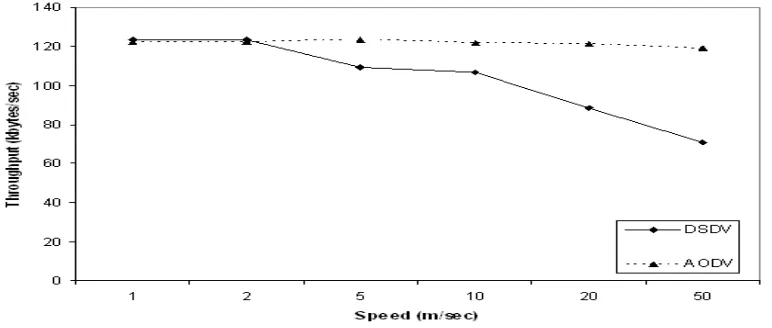
Vol. 1 Issue 3 February 2013 58 ISSN: 2319-6319 For source routing protocol AODV, throughput is independent of change in maximum speed of nodes (Figure 1). Whereas DSDV suffers decrease in the throughput to 70 Kbytes/s at highest speed of 50 m/s because of frequent link changes and connection failures.
4.1.2 Packet Delivery Fraction (%)
Fig 2 Packet Delivery Fraction as a function of maximum speed
It is observed that AODV perform particularly well delivering 100% of the packets irrespective of their node speeds (Figure 2). DSDV delivers 97% of the packets at low speed but indicates drop in packet delivery ratio upto 55% at higher speeds.
4.1.3 Average End to End Delay
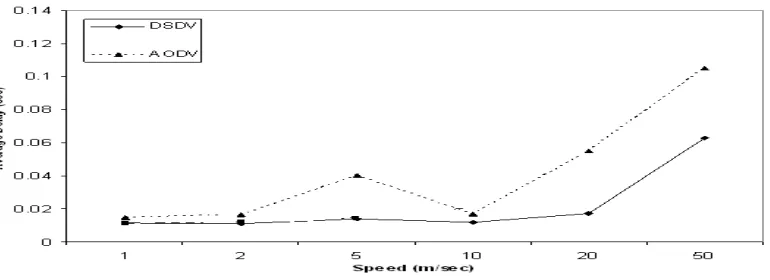
Fig 3 Average end-to-end delay as a function of maximum speed
Figure 3 indicates that increase in node speeds results in significant increase in the average end-to-end delay of all protocols. Delay introduced in DSDV is least of the order of 0.01141 seconds but shows considerable increase up to 0.06296 seconds as the speed approaches 50 m/s. The source routing protocols have a longer delay because their route discovery takes more time as every intermediate node tries to extract information before forwarding the reply. AODV shows delay of 0.0146 seconds at lowest speed of 1m/s and delay increases up to.10512 seconds as the speed approaches 50 m/s.
Vol. 1 Issue 3 February 2013 59 ISSN: 2319-6319
Fig 4 Routing overhead as a function of maximum speed
DSDV presents constant routing overhead regardless of the change in the speed (Figure 4). However, for AODV the routing overhead increases with the increase in speed. AODV experiences maximum overheads, transmitting 6068 packets as the speed approaches 50 m/s.
4.1.5 Packet Loss (%).
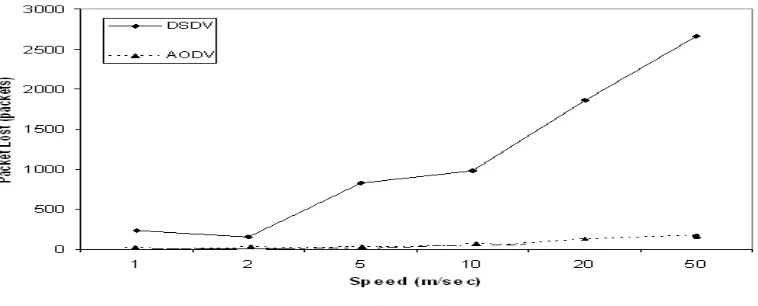
Fig 5 Packets Lost as a function of maximum speed
Source routing protocol AODV shows zero packets lost at lowest speed of 1 m/s but shows increase of approximately 150 packets in the number of packets lost with the increase in speed (Figure 5). DSDV shows drastic increase in the packets lost of the order of 2661 packets as the speed approaches 50 m/s. We observe that even with increased node movement the performance of AODV protocol is quite high and is better in comparison to DSDV.
V.COMPARISON &CONCLUSION
This paper presents simulations results of the comparative investigation of the performance of routing protocols DSDV and AODV for wireless ad hoc networks in a simulated environment against different parameters considering UDP as the transport protocol and CBR as traffic generator. It is evident from the discussions that each of the protocols studied performs well in some cases yet has certain drawbacks in others. Proactive routing protocol DSDV performs well, delivering virtually all data packets when node movement speed are low, and failing to converge as speed of node increases. Hence, performance of DSDV depends on the node speed and is suitable for the low speed scenarios. Results indicate that although reactive protocol AODV performed significantly better than DSDV regardless of the movement speeds, still have certain drawbacks Hence, although AODV is suitable for high speed scenarios.
VI.FUTURE WORK
In this paper we have focused on the two routing protocols but there are still many topics and issues that can be taken into consideration for further research which are as follows:
1. Investigation of other MANET mobility models using different protocols under different types of traffic. 2. Different number of nodes and different node speeds.
Vol. 1 Issue 3 February 2013 60 ISSN: 2319-6319
REFERENCES
[1] Tony Larsson and Nicklas Hedman, “Routing protocols in wireless adhoc networks - A simulation study”, Masters thesis in computer science and engineering, pp. 9, 1998.
[2] IETF Working Group: Mobile Ad hoc Networks (MANET). Available at: http://www.ietf.org/html.charters/manet-charter.html. [3] Andrea Goldsmith; Wireless Communications; Cambridge University Press, 2005.
[4] S.K. Sarkar, T.G. Basawaraju and C Puttamadappa, “Ad hoc Mobile Wireless Networks: Principles, Protocols and Applications”, Auerbach Publications, pp. 1, 2008..
[5] S.K. Sarkar, T.G. Basawaraju and C Puttamadappa; Ad hoc Mobile Wireless Networks: Principles, Protocols and Applications; Auerbach Publications, pp. 1, 2008.
[6] C.E. Perkins, E.M. Royer & S. Das, Ad Hoc On Demand Distance Vector (AODV) Routing, IETFInternet draft, draft-ietf-manet-aodv-08.txt, March 2001
[7] E.M. Royer & C.K. Toh, A Review of Current Routing Protocols for Ad-Hoc Mobile Wireless Networks, IEEE Personal Communications
Magazine, April 1999, pp. 46-55.