
Abstract— In this work, the Fenton-like decolorization of an azo dye, Acid Red 1 (AR1) by Fe–ball clay (Fe–BC) catalyst was studied. The effects of different reaction parameters such as initial iron ions loading on ball clay (BC), catalyst dosage, initial concentration of hydrogen peroxide [H2O2]0 and AR1 [AR1]0,
reaction temperature and initial solution pH on the decolorization of AR1 were assessed. The best reacting conditions were found to be 1.0 wt. % of iron ions loading on BC, catalyst dosage = 5.0 g L-1, initial solution pH = 2.5, [H2O2]0 = 12
mM, [AR1]0 of 50 mg L-1 at temperature 30 °C. Under these
conditions, 99% decolorization efficiency of AR1 was achieved within 180 min of reaction. The results indicated that Fe-BC was a promising catalyst for the heterogeneous Fenton system.
Index Terms— Decolorization, Acid Red 1, Fe–ball clay, Fenton-like, Heterogeneous Fenton
I. INTRODUCTION
Azo dyes, characterized by the presence of one or more azo groups (-N=N-) bound to aromatic rings, are the largest and most important class of synthetic organic dyes. It has been estimated that more than 50% of all dyes in common use are azo dyes because of their chemical stability and versatility [1]. About 10-15% of the synthetic textile dyes used are lost in waste streams during manufacturing or processing operations [2]. The effluents are strongly colored which not only created environmental and aesthetic problems, but also posed a great potential toxic threat to ecological and human health as most of these dyes are toxic and carcinogenic [3]. Azo dyes are not biodegradable by aerobic treatment processes [4]. In addition, under anaerobic condition, they are reduced to potentially carcinogenic aromatic amines which cause long term health concerns [5]. The new environment regulations concerning textile products have banned the discharge of colored waste in natural water bodies [6]. Therefore, an effective and economic treatment of effluents containing diversity of textile dyes has become a necessity for clean production technology for textile industries [7].
Fenton technology is widely studied and reported as an interesting alternative for the treatment of industrial wastewater containing non-biodegradable organic pollutants. However, the homogeneous Fenton process has significant
Manuscript received May 27, 2011.
H. Hassan is with the Faculty of Chemical Engineering, Universiti Teknologi Mara (UiTM) Pulau Pinang, Malaysia. (e-mail: [email protected]).
B.H. Hameed is with the School of Chemical Engineering, Engineering Campus, Universiti of Sains Malaysia, Penang, Malaysia. (e-mail: chbassim@ eng.usm.my).
disadvantages: (i) iron ions have to be separated from the system at the end of the process by precipitation, which is expensive in labor, reagents and time; (ii) it is limited by a narrow pH range (pH 2–3); and (iii) iron ions may be deactivated due to complexion with some iron complexing reagents such as phosphate anions and intermediate oxidation products [8]. To overcome the disadvantages of Fenton type processes, heterogeneous Fenton and Fenton like catalyst have recently received much attention.
In heterogeneous Fenton process, iron salts, were adsorbed onto the surface of supported catalysts, and in a suitable aqueous medium; the reduction-oxidation reactions between Fe(II)/Fe(III) take place in the presence of hydrogen peroxide which promote the formation of reactive components such as (•OH) and hydroperoxyl (•OOH) radicals [9]. The radicals generated by the decomposition of hydrogen peroxide can oxidize organic compounds adsorbed over the catalyst or degrade soluble organic compounds in the vicinity of active iron ions present at both the catalyst surface and in the bulk liquid phase. Thus, the Fe(III)/Fe(II) complex formed on the surface of support can react with H2O2 thus allowing iron
ions to participate in the Fenton catalytic cycle [10]. Being inexpensive and widely available, clays represent an attractive substrate for iron immobilization. Clays are natural minerals with hydrous aluminum phyllosilicates and feature a layered structure composed of silicate (Si2O5) sheets bonded
to aluminum oxide/hydroxide (Al2(OH)4) sheets (also called
gibbsite sheets). The wide usefulness of clay minerals is essentially a result of their high specific surface area, high chemical and mechanical stabilities, and a variety of surface and structural properties [11].
In this work, the decolorization of the non-biodegradable azo dye, Acid Red 1 (AR1) by heterogeneous Fenton-like process using Fe–ball clay (Fe–BC) catalyst were determined. The effects of different initial iron ions loading on ball clay (BC), initial concentration of H2O2 and AR1, catalyst dosage, reaction temperature and initial pH solution on the decolorization efficiency of the process were discussed.
II. EXPERIMENTAL
A. Chemical and Reagents
Azo dye, AR1 and hydrogen peroxide (30%, w/w) was purchased from Sigma-Aldrich (M) Sdn Bhd, Malaysia. The ferrous sulfate (Fe SO4.7H2O) was obtained from Merck,
Germany. The pH of the solution was adjusted by 1.0 M H2SO4 or 0.10 M NaOH. All of chemicals used were
analytical grade without any further purification. Distilled water was used throughout the study.
Fenton-like Oxidation of Acid Red 1 Solutions Using
Heterogeneous Catalyst Based on Ball Clay
B. Preparation of Fe–Ball Clay (Fe–BC)
Ball clay was obtained from School of Material Science Universiti Sains Malaysia, Malaysia and was used as received. The Fe-BC was prepared by the impregnation method [12]. In this process, Fe SO4.7H2O (Merck) was
dissolved in a beaker containing distilled water. Then, ball clay was added to this aqueous solution and was stirred by a glass rod uniformly in the water bath until all water was evaporated. The resulted products were finally dried at 85°C for 12 h and then calcined at 500°C for 4 h in a muffle furnace.
C. Catalyst Characterization
The morphology of the ball clay (BC) and the Fe–BC catalyst was observed using Scanning Electron Microscopy (SEM) (SEM-JEOL-JSM6301-F). The amounts of iron in the original clay and in the catalyst were carried out using Energy Dispersive X-Ray (EDX) (Oxford INCA 400, Germany) linked to the SEM.
D. Catalytic Activity
All experiments were carried out in a 250 mL-stoppered glasses (Erlenmeyer flask) filled with 200 mL diluted solutions (50–100 mg/L). The pH was adjusted to the desired value by using 1.0 M H2SO4 or 1.0 M NaOH which was
followed by the addition of catalyst. The reactions were initiated by adding predetermined amounts of H2O2 solution
to the flask. The flasks were then placed in a thermostated water bath shaker and agitation was provided at 130 rpm. The samples were taken out from the flasks periodically by using disposable syringes and were filtered by using BOECO filter (SFCA-membrane, 0.45 um) for the separation of catalysts from the aqueous solution. The concentrations of dyes were measured using a double beam UV/Vis spectrophotometer (Shimadzu, model UV 1601, Japan) at 532 nm wavelength. At each stage, the samples withdrawn were returned into the conical flask to prevent any loss of contents.
The effect of iron ions loading on BC was studied by varying the iron ions loading range from 0.20 to 1.0 wt. %. Furthermore, the activity of this catalyst to decolorize AR1 was tested by varying other parameters such as pH in the range of 2.0-5.0, initial concentration of H2O2 between
4.0-20 mM, initial concentration of AR1 from 25-50 mg L-1. Similarly, the concentration of catalyst dosage in the range of 1.0-5.0 g L-1 was also studied. The solutions were agitated in a thermostated water bath shaker at 130 rpm and samples were withdrawn for analysis at intervals of time. In all the experimental runs, as described above, other parameters were kept constant and samples were being withdrawn at regular intervals of time for the analysis. The decolorization efficiency of AR1 was defined as follows:
Decolorization efficiency (%) = 100% 0
×
⎟⎟ ⎠ ⎞ ⎜⎜
⎝
⎛ −
C C
Co t (1)
where Co (mg/L) is the initial concentration of AR1 and Ct
(mg/L) is the concentration of AR1 at reaction time, t (min). III. RESULTS AND DISCUSSIONS
A. Catalyst Characterization
The chemical composition of the 1.0 wt. % Fe–BC and
original BC were listed in Table I. The EDX analyses indicated the presence of iron, silica, alumina and oxide as major constituents with different percentages in the catalysts. The results also revealed that the iron concentration of the Fe–BC catalyst is 13.46wt. %, while it is 12.44 wt. % in the original BC. Slight variations were noticed between the expected and determined iron content of the samples, which is due to the high hydration degree of solid at the stages of the preparation procedure, thus making it difficult to obtain the targeted iron contents [13]. Similar result was also reported by Ramirez et al. [14] in their study of Fenton-like oxidation of Orange II solutions using saponite clay as heterogeneous catalyst.
TABLE I:CHEMICAL COMPOSITION OF BC AND 1.0 WT.%FE–BC
DETERMINED BY EDX.
Element Concentration (wt %)
BC 1.0 wt. % Fe–BC
Fe 12.44 13.46
13.44 (Expected value)
Si 21.79 18.60
Al 21.63 21.40
O 44.14 46.54
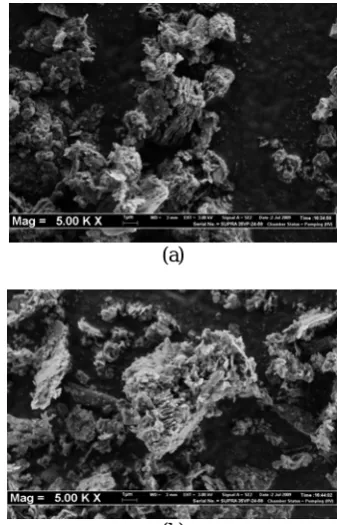
Fig. 1 shows the microscopy image of natural BC and 1.0 wt. % Fe–BC. The BC appeared as dense sheets and flake like crystal with fluffly appearance, revealing its extremely fine platty structure. After impregnation, the clay has become more porous and fluffy. This porous and fluffy appearance probably due to the change in the surface charge of the particle as a result of impregnation process and reduction in certain amorphous phase originally associated with the natural BC [15].
(a)
(b)
Fig.1. SEM images of (a) BC (b) 1.0 wt. % Fe–BC (magnification: 5 kx).
B. Effect of Iron Ions Loading on BC
and the results was shown in Fig. 2. By increasing iron ions loading on the BC, the decolorization rate increasing efficiently and 99% decolorization was achieved for 1.0 wt. % within 180 min. Hence, 1.0 wt. % of iron ions loading was found to be optimum for maximum efficiency. The fact that higher decolorization efficiency achieved at high iron ions concentration was mainly attribute to the higher production of •OH with the increase of iron ions concentration.
Fig. 2 also showed some sorts of delayed establishment of the heterogeneous Fenton oxidation during the initial reaction time followed by rapid oxidation of AR1. An induction period is defined as a period of time during which no measurable reactions occurs or a time before a reaction suddenly increases in rate [16]. Here the induction period probably has two causes. First, it is thought as activation process of surface iron species, which are thus enabled to form complexes with the reactants (AR1) before the oxidation process can occur. Second, it is attributed to the time needed to dissolve enough iron for homogeneous Fenton reaction to take place. The second cause is less likely because, the concentration of dissolved iron was low (1.234 mg L-1) so that the homogeneous Fenton reaction is negligible [17]. Carriazo et al. [18] suggested that the induction period is related to the adsorption of reactant onto the catalyst surface. In the present study the best iron ions loading for the decolorization of AR1 was experimentally determined to be 1.0 wt. %.
0 20 40 60 80 100
0 40 80 120 160 200 240
Ti m e (m i n )
D
ecol
ori
z
at
io
n
E
ff
ic
ie
n
c
y
(
%
)
0.20 wt.% Fe -B C
0.40 wt.% Fe -B C
0.60 wt.% Fe -B C
0.80 wt.% Fe -B C
1.0 wt.% Fe -B C
Fig.2. Effect of iron ions loading on BC on the decolorization of AR1.
Reactions conditions: [AR1]o = 50 mg L-1, [H2O2]o = 4 mM, pH = 2.5,
catalyst = 2.0 g L-1, temperature = 30 °C and 130 rpm.
C. Effect of Catalyst Dosage
The influence of catalyst dosage on AR1 decolorization was studied by varying the catalyst dosage from 1.0 to 5.0 g L-1. The result is presented in Fig. 3. The result indicated that the decolorization of AR1 was significantly influenced by the dosage of catalyst and the optimum dosage was observed at 5.0 g/Lof catalyst with 99% decolorization efficiency. An increase in the amount of catalyst dosage will provide more iron sites on the catalyst surface for accelerating the decomposition of H2O2 which in turn increase the number of
hydroxyl radical significantly. This is in agreement with the results observed by Zhang et al. [19] when Acid Orange 7 was degraded by ultrasound enhanced Fenton-like process using goethite as catalyst.
0 20 40 60 80 100
0 30 60 90 120 150 180
Ti m e (m i n )
D
ec
o
lo
u
riz
a
ti
o
n
E
ffi
c
ie
n
c
y
(%
)
1.0 g/L Fe -BC
2.0 g/L Fe -BC
3.0 g/L Fe -BC
4.0 g/L Fe -BC
5.0 g/L Fe -BC
Fig.3. Effect of catalyst dosage on the decolorization of AR1. Reactions
conditions: [AR1]o = 50 mg L-1, [H2O2]o = 4 mM, pH = 2.5, 1.0 wt.% of
Fe–BC, temperature = 30 °C and 130 rpm.
D. Effect of pH
The effect of initial pH solutions on the decolorization of AR1 was studied in the pH range of 2.0-5.0 and the result was shown in Fig. 4. The results indicated that the decolorization of AR1 was significantly influenced by the pH of the solution. The optimum solution pH for decolorization of AR1 was achieved at pH 3 with 99% decolorization efficiency within 180 min reaction time. At low pH (pH < 2.0), the reaction of hydrogen peroxide with Fe2+ (ferrous ion) could be slowed down because H2O2 can stay stable probably by solvating a
proton to form an oxonium ion (e.g., H3O2+) as presented by
Eq. (2). An oxonium ion (H3O2+) makes H2O2 electrophilic
which enhance the stability and presumably reduce substantially the reactivity with ferrous ion [20].
+
+
→
+
3 22
2
O
H
H
O
H
(2)O
H
e
H
OH
+
+
→
2− + •
(3) At the same time the formed complex species [Fe(H2O)6]2+
and [Fe(H2O)6]3+ also react more slowly with H2O2 . In
addition, the scavenging effect of the ˙OH radical by H+ is severe Eq. (3) [21]. On the other hand, in case of pH>3.00, the oxidation efficiency decreased rapidly due to the stability of H2O2 which starts to rapidly decompose into molecular
oxygen without formation of appreciable amounts of hydroxyl radical. It is expected that the formed O2 is not
capable to efficiently oxidize the organics in the mild operating conditions used [22].
0 20 40 60 80 100
0 30 60 90 120 150 180 Time (min)
D
ecol
o
ri
za
ti
on
E
ff
ici
en
cy (
%
)
pH=2.0
pH=2.5
pH=3.0
pH=4.0
pH=5.0
Fig.4. Effect of pH on the decolorization of AR1. Reactions conditions:
[AR1]o = 50 mg L-1, [H2O2]o = 4 mM, 1.0 wt. % of Fe–BC, catalyst = 5.0 g L-1,
E. Effect of Initial Concentration of H2O2
H2O2 plays the role of an oxidizing agent in this process.
The selection of an optimal H2O2 concentration for the
decolorization of AR1 is important from practical point of view due to the cost of H2O2 [23]. The effect of H2O2 dosage
on the decolorization of AR1 was examined by varying initial concentration of H2O2 from 4 to 20 mM and the result was
shown in Fig. 5. As it can be seen, the effect of increasing initial concentration from 4 to 12 mM was first positive for the decolorization of AR1. This is due to the oxidation power of Fenton-like process which was improved with increasing
•
OH radical amount obtained from the decomposition of increasing H2O2. However, with continuous increasing of
H2O2 concentration more than 12 mM, the decolorization rate
of AR1 was reduced. This may be explained by the fact that the very reactive •OH radical could be consumed by H2O2 and
results in the generation of less reactive •OOH radical which can be expressed by the following reaction [24].
•
•
→
+
+
2 22
2
O
HO
H
O
HO
H
(4)Such reaction reduces the probability of attack of organic molecules by hydroxyl radicals, and causes the decolorization rate to drop. It is important to control the initial concentration of H2O2 since the high concentration
would be adverse to the decolorization of dye and would increase the cost of the wastewater treatment. Hence, 12 mM appears as an optimal initial concentration of H2O2.
0 20 40 60 80 100
0 30 60 90 120 150 180
Ti m e (m i n )
D
eco
lo
r
izat
io
n
E
ff
ic
ie
n
c
y
( %
)
4 m M H2O 2
8 m M H2O 2
12 m M H2O 2
16 m M H2O 2
20 m M H2O 2 H2O2
H2O2
H2O2
H2O2
H2O2
Fig.5. Effect of initial concentration of H2O2 on the decolorization of AR1.
Reactions conditions: [AR1]o = 50 mg L-1, 1.0 wt.% of Fe–BC, catalyst = 5.0
g L-1, pH = 3.0, temperature = 30 °C and 130 rpm
0 20 40 60 80 100
0 30 60 90 120 150 180
Ti m e (m i n )
D
ec
o
lo
ri
za
ti
on
E
ff
ici
en
cy (
%
)
25 m g/L
50 m g/L
75 m g/L
100 m g/L
Fig.6. Effect of initial concentration of AR1 on the decolorization of AR1.
Reactions conditions: [H2O2]o = 4 mM, 1.0 wt.% of Fe–BC, catalyst = 5.0 g
L-1, pH = 3.0, temperature = 30 °C and 130 rpm.
F. Effect of Initial Concentration of AR1
Fig. 6 shows the changes of AR1 concentration with the reaction time. The efficiency of the Fenton-like process as a function of initial concentration of dye was evaluated. The
results indicated that decolorization efficiency increased when the initial dye concentration increased.
Concentration plays a very important role in reactions according to the collision theory of chemical reactions. The collisions theory state that for a chemical reaction to occur, the reacting particles must collide in correct orientation with each other so that the breaking and formation of chemical bonds can occur and they also should possess energy that is equal to or more than the minimum energy called activation energy.
It was two reactants being in a closed container. All the molecules contained within are colliding constantly. By increasing the concentration of one or more reactants, the frequency of collisions between reactants molecules is increased and the frequency of effective collisions that causes a reaction to occur will also be high. The lifetime of hydroxyl radicals is very shorts (only a few nanoseconds) and they can only react where they are formed. Therefore, as increasing the quantity of dyes molecules per volume unit logically enhances the probability of collision between organic matter and oxidizing species, leading to an increase in the decolorization efficiency [13]. Similar result was also reported by Kasiri et al. [25] in their study of degradation of Acid Blue 74 by using Fe-ZSM5 zeolite as heterogeneous photo-Fenton catalyst.
0 20 40 60 80 100
0 30 60 90 120 150 180
Ti m e (m i n )
D
ecol
o
ri
za
ti
on
E
ff
ici
en
cy
(
%
) T = 30 °C
T = 40 °C
T = 50 °C
Fig.7. Effect of temperature on the decolorization of AR1. Reactions
conditions: [AR1]o = 50, [H2O2]o = 4 mM, 1.0 wt.% of Fe–BC, catalyst = 5.0
g L-1, pH = 3.0 and 130 rpm.
G. Effect of Temperature
temperature to carry out the following runs. In addition, the iron leaching was found to be smaller than at 30 °C than at 50 °C and was not very significant after 180 min (< 5.0 mg L-1) below the value of the Environmental Quality (Industrial Effluents) Regulations, 2009.
IV. CONCLUSIONS
Fe–BC has been proved to be an effective heterogeneous catalyst for decolorization of azo dye, (AR1), in an aqueous solution. The optimal operation parameters for the Fenton-like oxidation of AR1 were 1.0 wt. % of iron ions loading on BC, 5.0 g/L of catalyst dosage, and 12 mM of H2O2 for 50 mg/L initial dye concentration at an initial pH of
3.0 with 30 ˚C temperature. Under these conditions, 99% decolorization efficiency of AR1 in aqueous solution was achieved within 180 min.
REFERENCES
[1] M. Neamtu, I. Siminiceanu, A. Yediler, and A. Kettrup, “Kinetics of
decolorization and mineralization of reactive azo dyes in aqueous
solution by the UV/H2O2 oxidation,” Dyes and Pigments, vol. 53, no. 2,
pp. 93-99, May 2002.
[2] L. Gomathi Devi, S. Girish Kumar, K. Mohan Reddy, and C.
Munikrishnappa, “Photo degrdadation of Methyl Orange an azo dye by Advanced Fenton Process using zero valent metallic iron: Influence of
various reaction parameters and its degradation mechanism,” Journal
of Hazardous Materials, vol. 164, no. 2, pp. 459-467, May 2009.
[3] S.-P. Sun, C.-J. Li, J.-H. Sun, S.-H. Shi, M.-H. Fan, and Q. Zhou,
“Decolorization of an azo dye Orange G in aqueous solution by Fenton oxidation process: Effect of system parameters and kinetic study,”
Journal of Hazardous Material, vol. 161, no. 2, pp. 1052-1057,
January 2009.
[4] U. Pagga and D. Drown, “The degradation of dye-stuffs. Part II.
Behaviour of dyestuffs in aerobic biodegradation test,” Chemosphere,
vol. 15, no. 4, pp. 479-491, January 1986.
[5] D. Brown and B. Hamberger, “Degradation of dye stuffs. Part III.
Investigation of their ultimate degradability,” Chemosphere, vol. 16,
no. 7, pp. 1539-1553, May 1987.
[6] C. Maximo, M.T.P. Amorim, and M. Costa- Ferreira,
“Biotransformation of industrial reactive azo dyes by Geotricum sp.
CCMI 1019,” Enzyme and Microbial Technology, vol. 32, no. 1, pp.
145-151, January 2003.
[7] M.S. Khehra, H. S. Saini, D.K. Sharma, B. S. Chadha, and S.S. Chimni,
“Biodegradation of azo dye C.I. Acid Red 88 by an anoxic-aerobic
sequential bioreactor,” Dyes and Pigments, vol. 70, no. 1, pp. 1-7, July
2006.
[8] J. Deng, J. Jiang, Y. Zhang, X. Lin, C. Du, and Y. Xiong, “FeVO4 as a
highly active heterogeneous Fenton-like catalyst towards the
degradation of Orange II,” Applied Catalysis B: Environmental, vol. 84,
no. 3, pp. 468-473, December 2008.
[9] N.K. Daud and B.H. Hameed, “Decolorization of acid red 1 by
Fenton-like process using rice husk ash based catalyst,” Journal of
Hazardous Materials, vol. 176, no. 1, pp. 938-944, April 2010.
[10] O.S.N. Sum, J. Feng, X. Hu, and P.L. Yue, “Novel bimetallic catalyst
for the photoassisted degradation of Acid Black 1 over a broad range of
pH,” Chemical Engineering Science, vol. 62, no. 18, pp. 5150-5153,
September-October 2007.
[11] S.H. Lin, R.S. Juang, and Y.H. Wang, “Adsorption of acid dye from
water onto pristine and acid-activated clays in fixed beds,” Journal of
Hazardous Materials, vol. 113, no. 1, pp. 197-202, September 2004.
[12] Y. Flores, R. Flores, and A.A. Gallegos, “Heterogeneous catalysis in
the Fenton-type system reactive black 5/H2O2,” Journal of Molecular
Catalysis A: Chemical, vol. 281, no. 1, pp. 184–191, February 2008.
[13] M. Kitis and S.S. Kaplan, “Adsorption of natural organic matter from
waters by iron coated pumice,” Chemosphere, vol. 66, no. 1,
pp.130-138, January 2007.
[14] J.H Ramirez, C.A. Costa, L.M. Madeira, G. Mata, M.A. Vicente, M.L.
Rojas-Cervantes, A.J. López-Peinado, and R.M. Martín-Aranda, “Fenton-like oxidation of Orange (II) solutions using heterogeneous
catalyst based on saponite clay,” Applied Catalysis B: Environmental,
vol. 71, no. 1, pp. 44-56, February 2007.
[15] D.I. Guerra, C.A. Airoldi, and K.S. de Sousa, “Adsorption and
thermodynamic studies of Cu(II) and Zn(II) on
organofunctionalized-kaolinite,” Applied Surface Science, vol. 254,
no.16, pp. 5157-5163, June 2008.
[16] M. Lou, D. Bowden, and P. Brimblecombe, “Catalytic property of
Fe-Al pillared clay for Fenton oxidation of phenol by H2O2,” Applied
Catalysis B: Environmental, vol. 85, no. 3-4, pp. 201-206, January
2009.
[17] J. Carriazo, E. Guelou, J. Barrault, J.M. Tatibouet, R. Moilina, and S.
Moreno, “Catalytic wet peroxide oxidation of phenol by pillared clays
containing Al–Ce–Fe,” Water Research, vol. 34, no. 16, pp. 327-333,
October 2005.
[18] J. Carriazo, E. Guelou, J. Barrault, J.M. Tatibouët, and S. Moreno,
“Catalytic wet peroxide oxidation of phenol over Al-Cu or Al-Fe
modified clays,” Applied Clay Science, vol. 22, no. 6, pp. 303-308,
October 2005.
[19] H. Zhang, H. Fu, and D. Zhang, “Degradation of C.I. Acid Orange 7 by
ultrasound enhanced heterogeneous Fenton-like process,” Journal of
Hazardous Materials, vol. 172, no. 2-3, pp. 654-660, December 2009.
[20] B.G. Kwon, D.S. Lee, N. Kang, and J. Yoon, “Characteristics of
ρ-chlorophenol oxidation by Fenton’s reagent,” Water Research, vol.
33, no. 9, pp. 2110-2118, June 1999.
[21] M. Muruganandham and M. Swaminathan, “Decolorisation of reactive
Orange 4 by Fenton and photo-Fenton oxidation technology,” Dyes
and Pigments, vol. 63, no. 3, pp. 315-321, December 2004.
[22] J. Gou and M. Al-Dahhan, “Catalytic wet oxidation of phenol by
hydrogen peroxide over pillared clay catalyst,” Industrial and
Engineering Chemistry Research, vol. 42, no. 12, pp. 2450-2460,
February 2003.
[23] J. H. Sun, S.P. Sun, G. L. Wang, and L.P. Qiao, “Degradation of azo
dye Amido black 10B in aqueous solution by Fenton oxidation
process,” Dyes and Pigment, vol. 74, no. 3, pp. 647-652, June 2006.
[24] N. Kang, D.S. Lee, and J. Yoon, “Kinetic modeling of Fenton oxidation
of phenol and monochlorophenol,” Chemosphere, vol. 47, no. 9, pp.
915-924, June 2002.
[25] M.B. Kasiri, H. Aleboyah, and A. Aleboyah, “Degradation of Acid
Blue 74 using Fe-ZSM5 zeolite as a heterogeneous photo-Fenton
catalyst,” Applied Catalysis B: Environmental, vol. 84, no. 1, pp. 9-15,
October 2008.
[26] H.-y. Xu, M. Prasad, and Y. Liu, “Schorl: A novel catalyst in
mineral-catalyzed Fenton-like system for dyeing wastewater
discoloration,” Journal of Hazardous Materials, vol. 165, no.1, pp.
1186-1192, June 2009.
H. Hassan born in Perlis, Malaysia on May 6th 1984.
The author completed her degree in Chemical Engineering majoring in Petrochemical from Universiti Teknologi Petronas, Malaysia, in 2006. She received her master in Chemical Engineering from Universiti Sains Malaysia, Malaysia in 2011. Now, she is a lecturer at Faculty of Chemical Engineering, Universiti Teknologi Mara, Malaysia. She has published an article in Desalination and Chemical Engineering Journal. Her research interest is reaction engineering and catalysis.
B.H. Hameed received his Ph.D in Chemical
![Fig.3. Effect of catalyst dosage on the decolorization of AR1. Reactions conditions: [AR1]o = 50 mg L-1, [H2O2]o = 4 mM, pH = 2.5, 1.0 wt.% of Fe–BC, temperature = 30 °C and 130 rpm](https://thumb-us.123doks.com/thumbv2/123dok_us/1392039.1650545/3.595.309.543.53.196/fig-effect-catalyst-dosage-decolorization-reactions-conditions-temperature.webp)
![Fig.5. Effect of initial concentration of H2Reactions conditions: [AR1]O2 on the decolorization of AR1](https://thumb-us.123doks.com/thumbv2/123dok_us/1392039.1650545/4.595.54.277.546.682/fig-effect-initial-concentration-reactions-conditions-ar-decolorization.webp)
