Degradation of phenol with using of Fenton-like Processes from water
Ahmad Reza Yazdanbakhsh
1, Hasti Daraei
*1, Masomeh Davoodabadi
21) Department of Environmental Health Engineering, Shahid Beheshti University of Medical Sciences, Tehran, Iran 2) Department of Environmental Health Engineering, Alborz University of Medical Sciences, Karaj, Iran,
*Author for Correspondence: [email protected]
Received: 17 May 2015, Revised: 24 Jun.2015, Accepted: 2 Jul. 2015
ABSTRACT
Phenol is one of the serious pollutants from the chemical and petrochemical industries. This pollutant due to its convoluted structure is resistant to biodegradation. One of the methods that are useful to remove this pollutant is advanced oxidation (AOP.)
A laboratory scale study was done on a synthetic wastewater containing phenol. All experiments were done in batch conditions and effect of variables pH, amount of hydrogen peroxide, iron dosage, contact time and an initial concentration on the phenol removal were tested. The remaining phenol concentration was evaluated using the DR-5000 device. In order to effect of these parameters, the experiment was performance at pH 2 to 6, 5 to 45 ml/ml of peroxide, and time of 5 to 60 minutes with 2 to 15 g/ml iron (Fe˚).
The optimum pH, the ratio of hydrogen, Fe˚and time were 3, 15 ml, 8g and 5 minutes respectively. Chemical oxygen demand (COD) index was chosen as the parameter for evaluation in this study. Result showed that mineralization of phenol was not complete. The COD removal efficiency was obtained 71%.
According to the results of this study, Fenton-like process can be used for conversion organic resistant compounds to other compounds with lower toxicity.
Key word:
Fenton-like, Advance Oxidation, Phenol, Iron Powder
INTRODUCTION
Phenol and its derivatives are aromatic and toxic compounds to the environment, aquatic organisms and human life. This organic substance is a priority pollutant in EPA list and its concentration in drinking water should not surpass the order of µg/L [1]. Phenolic combinations are generated in the oil refineries, pulp and paper, pharmaceutical, pesticide industries and by several other chemical plants [2]. Widely Technologies used for the removal of phenol such as biological methods [3], the manufacture of dyes and plastic [4], adsorption [5] and wet oxidation [6]. Also, advanced oxidation processes (AOPs) such as Fenton and Fenton-like [7] is successfully used for the removal of this compound. Fenton or Fenton-like is solutions of Fe2+/H2O2 or Fe3+ /H2O2 [8]. The Fenton process is a catalytic procedure for the generation of hydroxyl radicals. Fenton and Fenton-like processes are based on electron transmission between hydrogen peroxide (H2O2) and a metallic ion (Fe2+) [9]. These ions are expected to be very stable in an acid environment. Because of the oxidation reactions with H2O2 are not possible for high concentration of pollutants due to its low reaction rate at passable H2O2 concentration. Hence, transition metal salts such as ferrous ions are imperative to activate break up of H2O2 to produce reactive radicals
responsible for compound demolition [10]. Usually, when these compounds are added to the aqueous solution a redox reaction will occur [11]. Hydroxyl radical can attack and demolish the phenol. A complex redox reaction will occur as in:
Fe
2++ H
2O
2→ Fe
3++ OH° + OH
-OH° + H
2O
2→ H
2O + HO
°2Fe
3++ HO
°2→ Fe
2++ H
++ O
2Fe
2++ HO
°2→ Fe
3++ HO
2-Fe
3++ OH
-→Fe
2++ OH°
RHX + OH° → X- + oxidation products
(CO
2+ H
2O)
and reaction time in this process on phenol removal were examined.
MATERIALS AND METHODS
Chemicals
Phenol (with purity 99%) dissolved in distilled water and stored in dingy bottle. Hydrogen peroxide (30%, w/v), ferrous sulfate heptahydrate and other reagents were obtained from Merck Germany. All the experiments were performed at room temperature .
Fenton-like experiments
Fenton’s reagent is a composite of Hydrogen peroxide and ferrous ion. Because H2O2 is a weak acid can be oxidized organic compounds. Nonetheless, for suitable performance, metal ions are needful to activation of H2O2 to generate reactive radicals.
Fenton process was carried out at room temperature (32 ± 2°C) using various iron powder (Fe˚) and Hydrogen peroxide(35%, w/w) dosages at various pH values in order to assess optimum values to yield better results in COD and phenol removal. During the determination of optimum pH value, Fe powder dosages and H2O2 concentrations were fixed at constant value .
Determination of the optimal pH for this reaction was experimented with pH values ranging from 1 to 6 by adding 0.1 M NaOH or 0.1 M HNO3. After we determined the optimal pH, we only used one pH value in all subsequent experiments. Also, for other variables (H2O2 concentration, iron powder, contact time) used this way.
After each step, the samples were centrifuged at 3,000rpm (for 3min) and the residual phenol amount was determined by the 5530 D method mentioned in the Standard Method at 500nm, using a spectrophotometer .
Finally, the phenol concentration was calculated using:
Phenol mg/L = C× D × 1000/E × B
Where C: mg standard phenol solution, D: sample absorbed sorbent, E: absorbed standard phenol solution, B: applied milliliters for main sample
RESULTS AND DISCUSSION
Effect of pH
The pH is a key variable that controlled the Fenton reagent. The solution pH directly and indirectly affects to production of hydroxyl radicals and organic oxidation. This parameter is an agent for the activity of Hydrogen and hydroxyl ions present in the aqueous solution. According to the results, the maximum efficiency for phenol removal was
achieved in pH = 3. Fenton’s reaction will be impeded at upper pH values (e.g., pH> 4) due to the creation of Fe2+complexes, sedimentation of iron oxyhydroxides, and decreased oxidation potential of OH○. In other words, presence of this HO0 is able to exchange phenol into hydroquinone and catechol. Therefore, at high pH values, Fe ions settled at the beginning of the reaction. Thus, the system requires suitable condition for stable production of OH radicals [12, 13]. In other hands, the low efficiency at pH <2 could be ascribed to the permanency of H2O2 via the creation of oxonimum ion H3O2+, reducing its reactivity with ferrous ion [14]. Also, in these pH values the snatching effect of H+ towards OH becomes more visible.
Fig.1: Effect of initial pH on the phenol removal efficiency
(phenol concentration=20 mg/L, t=5-20 min, H2O2
concentration= 15 cc, Fe dose= 4g)
Effect of H
2O
2Concentration
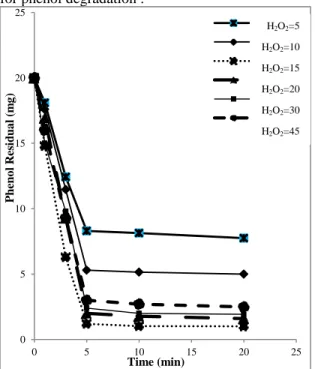
Experiments were performed at a pH of 3.0using the batch dosing mode. It is found from Fig. 2. that the concentrations of phenol decrease with an increase of H2O2concentration to 15cc. This increase in efficiency is due to the availability of sufficiency HOo radical required for the degradation. Maximum phenol degradation of 95% was observed for Fenton process with 15 mL of H2O2. More phenol degradation is due to the addition of hydroxyl radicals. During this process, by increasing of H2O2 concentration, highest amount of Fe2+ions will react with H2O2 to generate a further amount of hydroxyl radicals. However, scavenging effect of H2O2 towards HOo occurs at higher concentrations, but when hydrogen peroxide concentration exceeded the optimum amount, the phenol concentration increase
0 2 4 6 8 10 12 14 16 18 20
0 5 10 15 20 25
Ph
en
o
l
re
sid
u
a
l
(m
g
)
Time (min)
[7]. This decrease in efficiency can be explained by the reaction of hydroxyl radicals and hydrogen peroxide and mixture hydroxyl radicals to compose H2O2 [15]. Also in this reaction, HOOo radicals will be generated that are substantially less reactive than HOo radicals. Thus reduces the reaction rate. Therefore, 15 mL of hydrogen peroxide concentration was determined as the optimum value for phenol degradation .
Fig.2: Effect of H2O2 on the phenol removal efficiency
(phenol concentration =20 mg/L, t=5-20 min, pH=3, Fe dose= 4g/l)
Effect of Fe˚ dosage
Aqueous solution having an initial concentration of phenol 20 mg/L done by Fenton-like process with Fe˚ dosage ranging from 2 to 15 g/ml, the H2O2concentration 15 mg/L at pH 3. Fig. 3 shows that the phenol degradation increased with the increasing dosage of iron ion ,and further increasing Fe dosage could not notice able raise the removal of phenol. This was due to the presence of higher amounts of ferrous ions and reactions between iron and intermediates (hydroquinone and catechol) of degradation in the Fenton reaction [12, 13, 16]. Also, the amount of the phenol degradation at definite intervals of time was monitored. Figures 1 to 3 indicate that, with the increase in time, degradation efficiency of the phenol slightly increases. It can be seen that the degradation efficiency initially increased rapidly, and the equilibrium value was obtained in 5 min. Also, after 5 minutes, HOo values drastically reduced and more iron ions and H2O2 are consumed. Thus, there isn’t a significant change in removal efficiency [16, 17].
Effect of phenol initial concentration
Fig. 5 shows the effect of the initial concentration of phenol in efficiency, it is intelligible that increases of initial concentration don’t have eidetic effect in removal efficiency. At low initial concentration, degradation efficiency is some deal further than the higher concentration. It can be derived that removal is partly favored at lower phenol concentration [7]. In low concentrations, removal is a little more Destruction efficiency is somewhat higher than the concentrations
Fig3: Effect of Fe powder on the phenol removal efficiency
(phenol concentration=20 mg/L, t=5-20 min, pH= 3)
Fig.4: Effect of phenol concentration on the removal
efficiency (H2O2 value=15cc, t=5 min) 2.7 COD
Fig. 5 exhibits changes in COD during Fenton process ¬for phenol degradation.COD parameter was measured with HACH COD ampoules with the colorimetric method. Finally, according to the figure 0
5 10 15 20 25
0 5 10 15 20 25
Pheno
l
R
esi
d
u
a
l
(m
g
)
Time (min)
H2O2=5 H2O2=10 H2O2=15 H2O2=20 H2O2=30 H2O2=45
0 5 10 15 20 25
0 5 10 15 20 25
Pheno
l
R
esi
d
u
a
l
(m
g
)
Time (min)
Fe=2 Fe=4 Fe=6 Fe=8 Fe=10 Fe=15
80 82 84 86 88 90 92 94 96 98
10 20 40 60 80 100
%
R
em
o
v
a
l
E
ff
ic
ie
n
cy
Phenol Concentration (mg/l) H2O2=5
H2O2=10
H2O2=15
H2O2=20
H2O2=30
5, with the high phenol removal, the removal efficiency of COD was about 71%; this indicates incomplete mineralization of organic compounds. Therefore, advanced oxidation processes will not be completely converted organic compounds into mineral compound (CO2 and H2O). Therefore, this process has not been able to complete mineralization of phenol, thus this process can be used as a pre-treatment process for the removal of phenol.
Fig.5: COD removal rate in optimal conditions for phenol
CONCLUSION
The effectiveness of the Fe˚/H2O2 for the degradation of phenol in aqueous solutions was investigated. The results corroborate that Fe˚ can be used as a heterogeneous catalyst for the activation of H2O2 in the process. The results display that a Fenton reagent in the presence of iron powder (Fe˚) is cost-effective (since the iron powder can be obtained as discard material); and easy to operate. Based on the results obtained, the optimal conditions for the Fenton-like process were determined to be [Fe˚] = 8 g, [H2O2] = 15 ml, and pH = 3.0. The Fenton-like process showed 95% removal efficiency under the selected conditions.
ETHICAL ISSUES
Ethical issues have been completely observed by the authors.
COMPETING INTERESTS
Authors have no conflict of interests
AUTHORS’ CONTRIBUTIONS
All authors participated in design and conduct of the study. All authors have made contributions in drafting, revising, and approving of the manuscript.
ACKNOWLEDGEMENT
The authors are most grateful to the laboratory staff of the Department of Environmental Health Engineering, School of Public Health, Alborz University of Medical Sciences, for the financial support and their collaboration in this research.
REFERENCES
[1] Manshouri M, Daraei H, Yazdanbakhsh AR,A feasible study on the application of raw ostrich feather, feather treated with H2O2 and feather ash for removal of phenol from aqueous solution. Desalination and Water Treatment 2012; 41(1-3): 179-85
[2] Daraei H, Mittal A, Noorisepehr M, Daraei F,Kinetic and equilibrium studies of adsorptive removal of phenol onto eggshell waste. Environmental Science and Pollution Research 2013; 20 (7): 4603-11
[3] Fang HP, liang DW, Zhang T, Anaerobic treatment of phenol in wastewater under thermophilic condition. Water Res 2006; 40(3):427–34
[4] Kujawski W, Warszawski A, Ratajczak W, removal of phenol from waste water by different separation techniques, Desalination 2004;163(1-3):287–96
[5] Daraei H, Manshouri M, Yazdanbakhsh AR, Removal of phenol from aqueous solution using ostrich feathers ash. MazandUniv Med Sci 2010; 20 (79): 81-87
[6] Santos A, Yustos P, Gomis S, Reaction network and kinetic modeling of wet oxidation of phenol catalyzed by activated carbon. Chem. Eng. Sci 2006; 61(8): 2457–67
[7] Babuponnusami A, Muthukumar K, Advanced oxidation of phenol: A comparison between Fenton, electro-Fenton, sono-electro-Fenton and photo-electro-Fenton processes, Chemical Engineering Journal 2012; 183: 1– 9
[8] Venny, Gan S, Ng HK, Current status and prospects of Fenton oxidation for the decontamination of persistent organic pollutants (POPs) in soils. Chemical Engineering Journal 2012; 213:295–17
[9] Safarzadeh-Amiri A, Bolten JR, Cater SR, The use of iron in advanced oxidation processes. J. Adv. Oxid. Technol 1996; 1(1):18–26
[10] Argun ME, Karatas SDM, Guru M, Activation of pine cone using Fenton oxidation for Cd(II) and Pb(II) removal. Bioresource Technology 2008; 99(18): 8691–98
[11] San Sebastian N, Fernandez JF, Segura XF, Ferrer AS, Pre-oxidation of an extremely polluted
0 50 100 150 200 250 300
initial COD secendary COD
C
O
D
Co
n
ce
n
tr
a
tio
industrial wastewater by the Fenton’s reagent. J. Hazard. Mater 2003; 101(3): 315–22
[12] Ben W, Qiang Z, Pan X, Chen M, Removal of veterinary antibiotics from sequencing batch reactor (SBR) pretreated swine wastewater by Fenton’s reagent. water research 2009; 43(17): 4392 – 02 [13] Luna AJ, Chiavone-Filho O, Machulek A, De Moraes E, Nascimento SAO, Photo-Fenton oxidation of phenol and organochlorides (2,4-DCP and 2,4-D) in aqueous alkaline medium with high chloride concentration. Journal of Environmental Management 2012; 111(30): 10-17
[14] Aleksic M, Kusic H, Koprivanac N, Leszczynska D, LoncaricBozic A, Heterogeneous Fenton type processes for the degradation of organic dye pollutant in water — The application of zeolite assisted AOPs. Desalination 2010; 257(1-3): 22–29
[15] Xu XR, Li XY, Li XZ, Li HB, Degradation of melatonin by UV, UV/H2O2, Fe2+/H2O2 and UV/Fe2+/H2O2 processes, Sep. Purif. Technol 2009; 68(2):261–66
[16] Daraei H, Kamali H, Experimental Design and Response Surface Modeling for Optimization of 2-Chlorophenol Removal from Water by Nanoscale Iron and Fe Powder. J Environ Anal Toxicol2014; 4 (228): 2161-25