e-ISSN: 2278-067X, p-ISSN: 2278-800X, www.ijerd.com
Volume 10, Issue 6 (June 2014), PP.50-58
Grid Stability Improvement in Deregulated Environment
Using HVDC and Fuzzy Controller
Dr. P. R. Sharma
1,
Anu Garg
2Chairman EE Department1, YMCA University of Science and Technology, Faridabad, India PG Student Power system& 𝑑𝑟𝑖𝑣𝑒𝑠2, YMCA University of Science and Technology, Faridabad, India
Email: [email protected] Email: [email protected]
Abstract- In this paper, two equal areas is considered. This paper deals with the results of dynamic performance of frequency control and tie line. A fuzzy logic controller is proposed for two area power system interconnected via parallel HVAC/HVDC transmission link which is also referred as asynchronous tie lines. The linear model of HVAC/HVDC link is developed and the system responses to sudden load change are studied. For obtaining least deviations we have formed a deregulated system of Wind Turbine Generator for both system and tie line separately. Then these systems are applied to our original systems and tie lines. The deviations have decreased appreciably.
Keywords:- Automatic generation control (AGC) Deregulated environment, Fuzzy logic controller, Generation
rate constraint, Area control error, HVDC Link
I.
INTRODUCTION
II. TWO AREA POWER SYSTEM
The two area power system model identified in the present study has the following configuration; (i) It is a two area interconnected power system consisting of identical single stage turbines.
(ii) The two areas are interconnected via HVAC tie line in parallel with HVDC link. The single line diagram of the model under consideration for two areas is presented in Figure 1.The transmission links are considered as long transmission lines specifically of length greater than break even distance length of HVAC and HVDC transmission lines [5].
Figure1: Single line diagram of two area power system with parallel HVAC/HVDC links
III.
FUZZY LOGIC CONTROLLER
Because of inherent characteristics of the changing loads, complexity and multi-variable conditions of the power system, conventional control methods may not give satisfactory solutions. Artificial intelligence based gain scheduling is an alternative technique commonly used in designing controllers for non-linear systems. Fuzzy system transforms a human knowledge into mathematical formula. Therefore, fuzzy set theory based approach has emerged as a complement tool to mathematical approaches for solving power system problems. Fuzzy set theory and fuzzy logic establish the rules of a nonlinear mapping [6]. Nowadays fuzzy logic is used in almost all sectors of industry and science. One of them is automatic generation control. The main goal of AGC in interconnected power systems is to protect the balance between production and consumption. The fuzzy logic controller designed for the system analysis is shown in Figure 2.
Figure2: Components of fuzzy controller
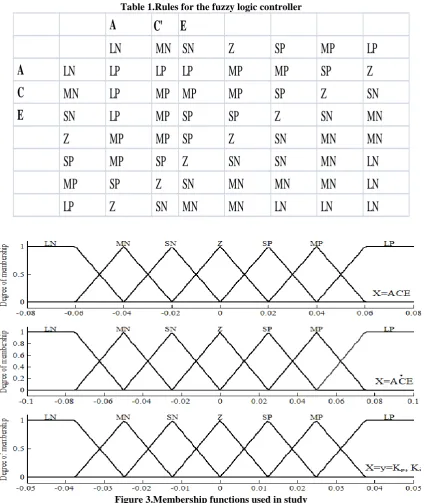
The fuzzy logic controller is comprised of four main components: the fuzzification, the inference engine, the rule base, and the defuzzification, as shown in Figure 4. The fuzzifier transforms the numeric/crisp value into fuzzy sets; therefore this operation is called fuzzification. The main component of the fuzzy logic controller is the inference engine, which performs all logic manipulations in a fuzzy logic controller. The rule base consists of membership functions and control rules. Lastly, the results of the inference process is an output represented by a fuzzy set, however, the output of the fuzzy logic controller should be a numeric/crisp value. Therefore, fuzzy set is transformed into a numeric value by using the defuzzifier. This operation is called defuzzification. For the proposed study, Mamdani [7] fuzzy inference engine is selected and the centroid method is used in defuzzification process.
Table 1.Rules for the fuzzy logic controller
A
C'
E
LN
MN SN
Z
SP
MP
LP
A
LN
LP
LP
LP
MP
MP
SP
Z
C
MN
LP
MP MP
MP
SP
Z
SN
E
SN
LP
MP SP
SP
Z
SN
MN
Z
MP
MP SP
Z
SN
MN
MN
SP
MP
SP
Z
SN
SN
MN
LN
MP
SP
Z
SN
MN
MN
MN
LN
LP
Z
SN MN
MN
LN
LN
LN
Figure 3.Membership functions used in study
IV.
WIND TURBINE GENERATOR AS DEREGULATED SYSTEM
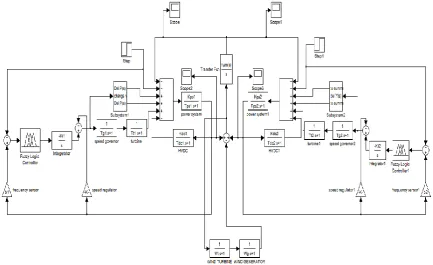
The dynamic modelling of wind power generators (WTG), in order to estimate their impact on the power system dynamic behaviour, is a matter of high interest. The ‘Wind Power Model’ contains the following basic formula to calculate the turbine mechanical power. The two transfer functions are used here for low pass filter and for high wind speed. In the upper part the wind speed is low-pass filtered. This time constant depends on the average wind speed, but is assumed constant for this simplified model. The lower part is used for maintaining high speed of wind and then both are added as shown in figure4.
Figure 4.Wind turbine generator used as deregulated system
V.
WTG AS LINEAR FUNCTION IN TIE LINE
The output of wind turbine generator depends on the wind speed at that instant. The wind turbine system contains several nonlinearities. When a wind turbine uses its pitch controller to counteract utility grid frequency oscillations, its output power varies between maximum, or rated power, and zero power. In general, a necessary condition for a linear system can be determined in terms of an excitation x(t) and a response y(t). Suppose that the system at rest is subjected to an excitation x1(t) and the result is a response y1(t). Also suppose that when subjected to an excitation y1(t) the result is a corresponding response y2(t). For a linear system it is necessary that the excitation x1(t) + x2(t) results in a response y1(t)+ y2(t). This is usually called the principle of superposition. Thus the wind turbine can be simplified to a first order system. The transfer function of the WTG and generator is represented by a first-order lag [11] as
Gt(s) = 1/(1+sWt) Gg(s) = 1/(1+sWg)
The transfer function of two area interconnected system using HVDC and fuzzy controller is shown in figure 5.
V.
SIMULATION RESULTS
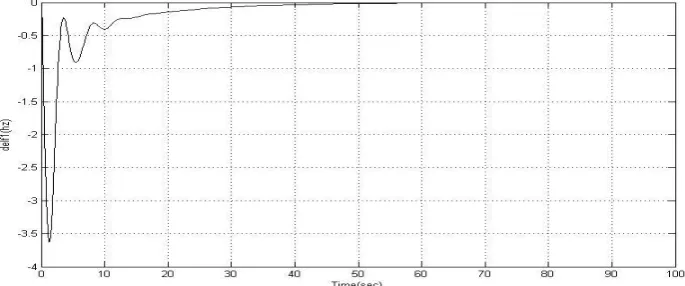
In this paper, a fuzzy logic based proportional integral (pi) controller has been designed and applied to analyze the effect of HVDC link on the AGC of two area interconnected power system. The implementation worked with Matlab-Simulink software. The response plots for variables like frequency deviations in area 1 to area 2 and tie line power deviations for power system model with and without HVDC link and wind turbine system, in the wake of load disturbance of 1% in area 1 are obtained with the implementation of Fuzzy logic controller to analyze the system dynamic performance. Figure 6 shows the frequency deviation responses and Figure 7 shows some tie line power deviation responses .The simulation results of frequency deviations and tie line power deviation with fuzzy controller advocates, the HVDC link’s suitability for AGC schemes.
(I) ΔF1(s) vs. time(s) of the power Subsystem1 model with Fuzzy Conroller only
(ii) ΔF2(s) vs. time(s) of the power Subsystem2 model with Fuzzy Controller only
(iv) ΔF2(s) vs. time(s) of the power Subsystem2 model with Fuzzy Controller And HVDC
(v) ΔF1(s) vs. time(s) of the power Subsystem1 model with Fuzzy Controller, HVDC and WTG
Figure6- Frequency Comparison
(ii) Tie Line Power Deviation of area 2 With Fuzzy Controller only
(iii) Tie Line Power Deviation of area1 With Fuzzy Controller and HVDC
(v) Tie Line Power Deviation of area 1 with Fuzzy Controller, HVDC and WTG
(vi) Tie Line Power Deviation of area2 with Fuzzy Controller, HVDC and WTG
Figure7. Tie Line deviation
VI.
CONCLUSION
In this paper, a new power system model is proposed to improve the dynamic performance of interconnected two area power system by the use of HVDC link in parallel with existing HVAC link. The system dynamic performance in the wake of load disturbance in either area of interconnected power system has been investigated comprehensively. A fuzzy logic control strategy is designed and its feasibility is studied by varying system parameters. It has been observed that responses of the system with parallel HVDC link and WTG are better in terms of dynamic parameters such as peak overshoot and settling time. Simulation results presented justify the incorporation of HVDC transmission link to supply consumers reliable and quality power.
APPENDIX
Nominal parameters of the two area system investigated: Ki1=Ki2=0.09
REFERENCES
[1] Yogendra Arya, Narender Kumar, Hitesh Dutt Mathur, “Automatic Generation Control In Multi Area Interconnected Power System by using HVDC Links” IJEPDS(International Journal of Power Electronics and Drive System)Vol.2,No.1,March2012, pp.67~75, ISSN :2088-8694.
[2] The Grid of Tommorow, http://www.swissgrid.ch/swissgrid/en/home/grid/development.html
[3] I.J. Nagrath and D.P. Kothari, “Modern Power System Analysis” 3rd Edition, Sixteenth reprint 2009, Tata Mc-Graw Hill publication.
[4] Naimul Hasan, “An Overview of AGC Strategies in Power System” IJETAE (International Journal of Emerging Technology and advance Engineering), Vol.2, Issue 8, August 2012 ISSN 2250-2459,pp 56~64.
[5] Ibraheem and P. Kumar, “Study of dynamic performance of power systems with Asynchronous tie line considering parameter uncertainities,” Journal of Institution of Engineers (I)’ vol.85, pp. 35-42’2004. [6] Z.A. Zadeh, “Fuzzy sets,” Information and Control, vol. 8, issue 3, pp. 338-353, June 1965.
[7] S.G. Cao, N.W. Rees and G. Feng, “Mamdani-type fuzzy controllers are universal fuzzy controllers,” Fuzzy sets and systems, vol. 123, issue 3, pp. 359-367, 2001
[8] K.Tomsovic,“ChapterIV-Fuzzy systems applications to power systems,” in Proc. of International conference on intelligent system application to power systems, Brazil: Riode Janeiro, 1999, pp. 1-10. [9] Manuel A. Matos, Eduardo M. Gouveia, “The Fuzzy Power Flow Revisited” IEEE Transactions
onPower Systems, Vol. 23, No. 1, February 2008,pp213~218.
[10] Mrinal K. Pal, “Lecture Notes on Power System Stability” Online Stability book, June 2007. http://www.scribd.com/doc/39610235/Stability-Book//.