Original Research Article
Public knowledge of cardiovascular disease and its risk factors in
Tangail, Bangladesh: a cross-sectional survey
Masuder Rahman*, Shakila Akter, Fatama Tous Zohora, Abu Zaffar Shibly
INTRODUCTION
Cardiovascular diseases (CVD) are group of disorders that involve the heart or blood vessels or both. They include coronary heart disease, manifested by myocardial infarction (MI), angina pectoris, heart failure, and coronary death; cerebrovascular disease, manifested by stroke and transient ischemic attack; peripheral arterial disease, manifested by intermittent claudication; rheumatic heart disease that is characterized by damage to the heart muscle and heart valves from rheumatic fever
that is caused by streptococcal bacteria; congenital heart disease, which is defined as malformations of heart structure existing at birth; and deep vein thrombosis and pulmonary embolism.1 Cardiovascular diseases represent major public health problem and the prominent cause of death worldwide, although the mortality for this cause is falling gradually due to advances in diagnosis and therapy. The mortality rate due to these diseases was 214-455 deaths per 100,000, being lower in developed countries.2 The economic impact of different types of CVD is enormous. Bangladesh is a developing country
ABSTRACT
Background: Cardiovascular Disease (CVD) is a major public health problem throughout the world. In Bangladesh, the reliable data concerning various aspects of CVD is inadequate at present due to lack of national population-based surveys or central administrative health data. Given the rising incidence of CVDs in Bangladesh, an improved understanding of the CVD, symptoms and risk factors is needed. Hence, this study was performed to assess the level of knowledge towards CVD types, warning symptoms of heart attack or stroke, and CVD risk factors.
Methods: A descriptive cross-sectional survey was conducted from May 2018 to June 2018 using standard questionnaire on a sample of 350 randomly selected Bangladeshi individuals. All the data of the study were input in SPSS (Statistical Package for the Social Sciences) version 20.0 software from IBM for windows and the gathered data thus analyzed using SPSS & Microsoft Excel.
Results: The respondents’ knowledge about types of CVD, symptom heart attack, symptom of stroke and the risk factors of CVD are 38.9%, 67.7%, 35.7%, and 92.9% respectively. The most common risk factors of CVD found to be known by around than two-third of respondents were unhealthy diet (66.9%), physical inactivity (64.3), obesity (61.4%), and smoking (58.6%).
Conclusions: The respondents’ knowledge about types of CVD, symptom heart attack, symptom of stroke and the risk factors of CVD are 38.9%, 67.7%, 35.7%, and 92.9% respectively. The most common risk factors of CVD found to be known by around than two-third of respondents were unhealthy diet (66.9%), physical inactivity (64.3), obesity (61.4%), and smoking (58.6%).
Keywords: Cardiovascular disease, Knowledge, Symptoms, Risk factors, Heart attack, Stroke, Bangladesh
Department of Biotechnology and Genetic Engineering, Mawlana Bhashani Science and Technology University, Santosh, Tangail, Bangladesh
Received: 20 February 2019
Accepted: 01 April 2019
*Correspondence:
Dr. Masuder Rahman,
E-mail: [email protected]
Copyright: © the author(s), publisher and licensee Medip Academy. This is an open-access article distributed under the terms of the Creative Commons Attribution Non-Commercial License, which permits unrestricted non-commercial use, distribution, and reproduction in any medium, provided the original work is properly cited.
burdened with communicable diseases. The major causes of death in Bangladesh gradually shifted from acute infection and parasitic disease to non-communicable disease.3 The burden of CVD is increasing at greater rate in South Asia. In India, the prevalence of CVD has been estimated to be nearly 3% in 2000, and upto 10% in recent year.4 Among the non-communicable disease (NCD), CVD is probably the most important cause of mortality and morbidity in Bangladesh. In 2014, NCD was responsible for 59% of the total death and CVD was the single most important contributor being responsible for 17%.5 Heart attacks and strokes are usually acute events and are mainly caused by a blockage that prevents blood from flowing to the heart or brain. The most common reason is a build-up of fatty deposits on the inner walls of the blood vessels. Strokes can be caused by bleeding from a blood vessel in the brain or by blood clots.6 According to the heart disease and stroke statistics- 2016 updated by American Heart Association, heart disease and stroke continue to be the top two killers Worldwide.
The most important risk factors of heart disease and stroke are unhealthy diet, physical inactivity, tobacco use and harmful use of alcohol.6 Cardiovascular disease (CVD) is one of the most preventable causes of death in the world, due to the majority of its risk factors are controllable or preventable, such as hypertension, dyslipidaemia, diabetes, obesity, smoking, lack of physical activity, stress, unhealthy dietary practices and diabetes. The social and environmental causes of coronary heart disease and stroke are well recognized, and enhanced population-based prevention programs could result in a significant decrease in CVD morbidity and mortality.7 Knowledge towards CVD and its variable risk factors is a very important to change the individuals’ health attitudes, behaviors and lifestyle.8,9 Improvement of knowledge to recognize the heart attack and stroke symptoms will lead to quick presentation of the patients to medical care that may result in better outcomes.10-12 Good knowledge about the risk factor of CVD among people will help them to be proactive in decreasing their risk since the majority of the risk factors are modifiable.12-14
The baseline knowledge about CVD among the population has significant public health application as it helps in developing targeted educational programs.12 Knowledge of CVD, its symptoms and risk factors have been studied worldwide in various populations. Yet, little is known about the CVD knowledge in the Bangladesh, where only few study was published. However, there are no published studies to date that comprehensively assess the existing knowledge of CVD among the public in Bangladesh, where CVDs are estimated to cause 17.0% of all mortalities.5 To design effective treatment and prevention strategies, an assessment of the public knowledge about CVD is essential. Knowledge of CVD, its symptoms and risk factors have been studied in various population but there is no published data to date
that comprehensively analyzed the preexisting knowledge about CVD among the people in Bangladesh. Therefore, this study was done to assess the current knowledge about CVD, its symptoms and risk factors among the people of Bangladesh.
METHODS
A descriptive, cross-sectional survey was conducted in Bangladesh. The survey was conducted during the period from April, 2018 to June 30, 2018. The study population consisted of Bangladeshi people from Tangail District. Ethical approval for this study was obtained from the Department of Biotechnology and Genetic Engineering, Mawlana Bhashani Science and Technology University, Bangladesh.
In the present study, sample size consisted of 350 people which were sampled by using purposive sampling technique. Random sampling was used for selection of people from houses, government and private enterprises and university. The individuals were contacted and given an explanation with regard to the purpose of the study. They were free to refuse participation in the study. Data were collected anonymously via self-administered questionnaire. Those who agreed to take part in the study were given the questionnaires, which were completed anonymously and collected after completion. They were assured for confidentiality and gave written consent to participate in the study. Incentives were not offered for completion of the questionnaire. Exclusion criteria were expatriates, age ≤20 years and ≥80 years, and health care professionals and students. Based on the literature search, the study questionnaire was adapted from validated surveys that were previously used in Australia, Pakistan, North Ireland, Canada, Jordan, South Africa and Kuwait.11-18
RESULTS
Demographic characteristics
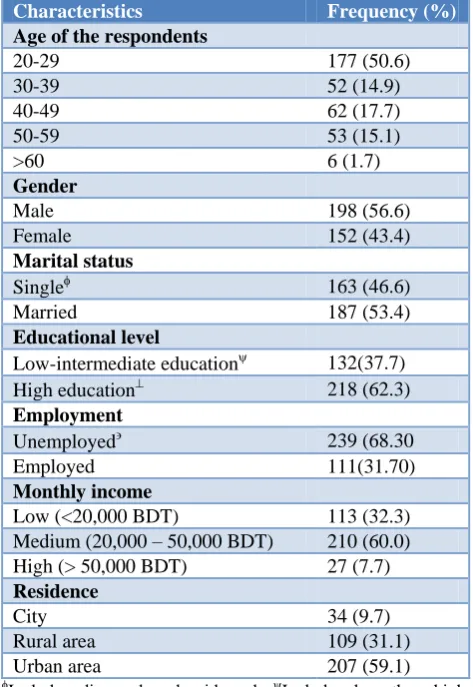
A total of 365 Bangladeshi individuals with several age groups were approached to be included in the study, giving a response rate of 95.9% (n=350). Of the respondents, 43.4% were females, 62.3% had high education, and 60.0% with a medium monthly income ((20,000 - 50,000 BDT). Moreover, 68.3% respondents were unemployed and 59.1% live in urban area. The demographic characteristics of respondents are shown in Table 1.
Table 1: Demographic characteristics of the study respondents (n=350).
Characteristics Frequency (%) Age of the respondents
20-29 177 (50.6)
30-39 52 (14.9)
40-49 62 (17.7)
50-59 53 (15.1)
>60 6 (1.7)
Gender
Male 198 (56.6)
Female 152 (43.4)
Marital status
Single 163 (46.6)
Married 187 (53.4)
Educational level
Low-intermediate education 132(37.7) High education 218 (62.3)
Employment
Unemployed 239 (68.30
Employed 111(31.70)
Monthly income
Low (<20,000 BDT) 113 (32.3) Medium (20,000 – 50,000 BDT) 210 (60.0) High (> 50,000 BDT) 27 (7.7)
Residence
City 34 (9.7)
Rural area 109 (31.1)
Urban area 207 (59.1)
Includes divorced and widowed; Includes less than high school, high school and diploma; Includes University and postgraduate; Includes retired, housewives and students.
Clinical characteristics of respondents
Two hundred forty-nine respondents (71.1%) reported that they had normal body weight; however, 21.4% of them were found to have for overweight or 2% were found to obese. Of the study population, 4.9% reported that they were smokers and 22.3% were currently smokers, 36.0% indicated exercising for 30 minutes more than five times/week, and 72.3% reported eating healthy
food every day. Most of participants (86.3%) indicated to be somewhat stressful.
Table 2: Clinical characteristics of respondents (n=350).
Characteristics Frequency (%) Personal health
Excellent 33 (9.4)
Very Good 66 (18.9)
Good 181 (51.7)
Fair 54 (15.4)
Poor 16 (4.6)
Self-reported weight description
Under weight 19 (5.4)
Normal 249 (71.2)
Over weight 75 (21.4)
Obese 7 (2.0)
Eating healthy food everyday 253 (72.3)
Life style
Very stressful or stressful 193 (55.2) Relatively stressful 109 (31.1) Free from stress 48 (13.7)
Smokers 78 (22.3)
30 Minutes exercise/week
0-2 times 60 (17.1)
3-5 times 164 (46.9)
5 times 126 (36.0)
Family history of CVD 198 (56.6)
Chronic diseaseΦ 118 (33.7)
Hypertension 79 (22.6)
Diabetes 63 (18)
High blood cholesterol level 27 (7.7)
Coronary heart disease (CHD) 21 (6.0)
ΦTotal number exceeds 118 due to multiple responses.
About 22.6% of respondents indicated to have hypertension, 18% diabetes, 7.7% high blood cholesterol level and 6% coronary heart disease (CHD). All respondents with diabetes and CHD reported that they use medications for these diseases. 6.0% of the hypertensive and 52% high blood cholesterol level patients reported that they were not using medications. Of the study population, 21.5%, 79.8% and 59.8% reported that they did not know their recent measures for blood pressure, blood cholesterol and blood glucose, respectively. The clinical characteristics of respondents are shown in Table 2.
Knowledge about cardiovascular disease (CVD)
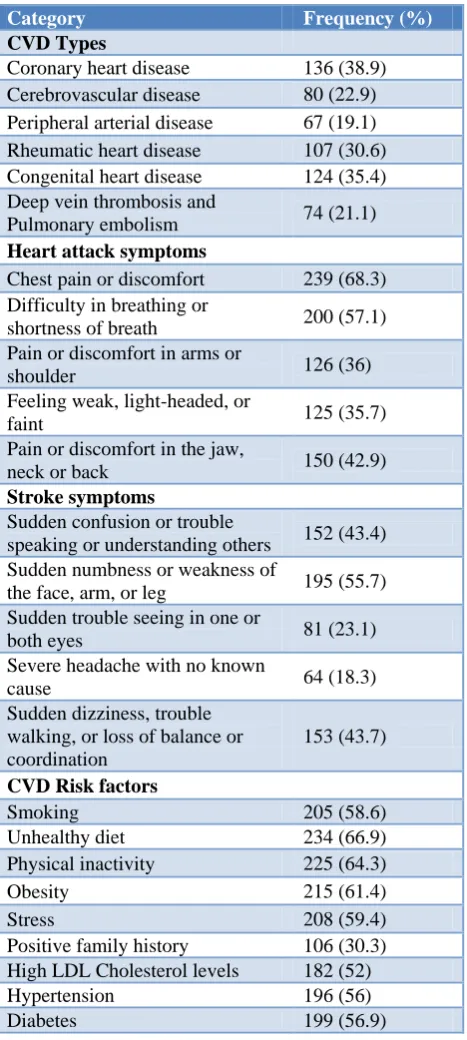
32.3% of the respondents did not recognize any heart attack symptom, whereas 20.6% knew one, 15.4% two, 10.3% three, 13.1% four, and 8.3% five. The commonest heart attack symptom reported was ‘chest pain or discomfort’ (68.3%) followed by ‘difficulty in breathing or shortness of breath’ (57.1%), and ‘pain or discomfort in the jaw, neck or back’ (42.9%).
Table 3: Respondents’ knowledge of CVD types, heart attack and stroke symptoms and CVD risk factors of
(n=350).
Category Frequency (%)
CVD Types
Coronary heart disease 136 (38.9) Cerebrovascular disease 80 (22.9) Peripheral arterial disease 67 (19.1) Rheumatic heart disease 107 (30.6) Congenital heart disease 124 (35.4) Deep vein thrombosis and
Pulmonary embolism 74 (21.1)
Heart attack symptoms
Chest pain or discomfort 239 (68.3) Difficulty in breathing or
shortness of breath 200 (57.1) Pain or discomfort in arms or
shoulder 126 (36)
Feeling weak, light-headed, or
faint 125 (35.7)
Pain or discomfort in the jaw,
neck or back 150 (42.9)
Stroke symptoms
Sudden confusion or trouble
speaking or understanding others 152 (43.4) Sudden numbness or weakness of
the face, arm, or leg 195 (55.7) Sudden trouble seeing in one or
both eyes 81 (23.1)
Severe headache with no known
cause 64 (18.3)
Sudden dizziness, trouble walking, or loss of balance or coordination
153 (43.7)
CVD Risk factors
Smoking 205 (58.6)
Unhealthy diet 234 (66.9) Physical inactivity 225 (64.3)
Obesity 215 (61.4)
Stress 208 (59.4)
Positive family history 106 (30.3) High LDL Cholesterol levels 182 (52) Hypertension 196 (56)
Diabetes 199 (56.9)
64.3% did not know any stroke symptom, whereas 16.6% identified one, 5.1% two, 2.3% three, 5.7% four, and
6.0% five. The most common stroke symptoms indicated by participants were ‘sudden numbness or weakness of the face, arm, or leg (55.7%), followed by ‘sudden dizziness, trouble walking, or loss of balance or coordination’ (43.7%), and ‘sudden confusion or trouble speaking or understanding others’ (43.4%).
7.1% did not know any CVD risk factor, whereas 19.1% indicated one to four, 28.6% five to seven, and 45.2% identified eight or nine risk factors. The commonest risk factors identified by about two-third of respondents were unhealthy diet, physical inactivity, obesity, and smoking.
DISCUSSION
Although there are several studies on the prevalence of CVD in Bangladesh but the best of our knowledge this is the first known study to be conducted in Bangladesh to comprehensively demonstrate the current level of public knowledge about types of CVD, warning symptoms of heart attack or stroke and CVD risk factors. Approximately two-third of the participants were not aware of any type of CVD and any stroke symptoms, one-third were not aware of any heart attack symptom. Despite the lower level of knowledge about types of CVD and its symptoms, respondents had much better knowledge of CVD risk factors. These findings would provide the quantitative measurement of the CVD knowledge among the community and identifying specific knowledge gap.
The public needs to have good knowledge about CVD and its risk factors, and this will aid them to be proactive in decreasing their risk since the majority of the risk factors are modifiable. The general knowledge about CVD and its types is deficient in Bangladesh. The same applies to Jordan, South Africa, and North Ireland.14,19,20 Since all of them have poor knowledge about CVD. In all countries, the knowledge of CVD is better in higher education levels, higher socioeconomic levels and in people who exercise regularly, with positive family history, and who have a healthy diet. However, in Bangladesh a better knowledge is found only in people who are higher educated and on healthy diet or a positive family history of CVD. The low level of CVD knowledge might be due to lack of media publication, lack of proper education about CVD. Especially in the rural area most of the people completely unaware about the disease so the increase of awareness is necessary by media publication.
CONCLUSION
regarding CVD by ascertaining more wide-spread and effective educational interventions.
ACKNOWLEDGEMENTS
The authors are thankful to the department of Biotechnology and Genetic Engineering of MBSTU for giving permission to conduct the study. We are grateful to the respondents who participated to the interview and giving their valuable time to conduct the study.
Funding: No funding sources Conflict of interest: None declared
Ethical approval: The study was approved by the Department of Biotechnology and Genetic Engineering (BGE) of Mawlana Bhashani Science and Technology University (MBSTU), Bangladesh
REFERENCES
1. World Health Organization: Cardiovascular diseases, 2012. http://www.euro.who. int/en/health- topics/noncommunicable-diseases/cardiovascular-diseases/ cardiovascular-diseases2/definition-of-cardiovascular-diseases. Accessed on 2 February 2017.
2. Soler EP, Ruiz VC. Epidemiology and risk factors of cerebral ischemia and ischemic heart diseases: similarities and differences. Curr Cardiol Rev 2010;6(3):138-49.
3. Bleich SN, Koehlmoos TL, Rashid M, Peters DH, Anderson G. Noncommunicable chronic disease in Bangladesh: overview of existing programs and priorities going forward. Health Policy. 2011;100(2-3):282-9.
4. Gupta R, Joshi P, Mohan V, Reddy KS, Yusuf S. Epidemiology and causation of coronary heart disease and stroke in India. Heart 2008;94(1):16-26. 5. World Health Organization: Cardiovascular diseases
2014. Available at: https://www.who.int/nmh/ publications/ ncd_report_chapter1.pdf.
6. World Health Organization: Cardiovascular diseases, 2012. Available at: https://www.who. int/news-room/fact-sheets/detail/cardiovascular-diseases-(cvds). Accessed on 17 May 2017.
7. Pearson TA, Palaniappan LP, Artinian NT, Carnethon MR, Criqui MH, Daniels SR, et al. American Heart Association Guide for Improving Cardiovascular Health at the Community Level, 2013 update: a scientific statement for public health practitioners, healthcare providers, and health policy makers. Circulation. 2013;127(16):1730-53.
8. Becker MH, Maiman LA, Kirscht JP, Haefner DP, Drachman RH. The Health Belief Model and prediction of dietary compliance: a field experiment. J Health Soc Behav. 1977;18(4):348-66.
9. Ford ES, Jones DH. Cardiovascular health knowledge in the United States: findings from the
National Health Interview Survey, 1985. Prev Med 1991;20(6):725-36.
10. McKinley S, Dracup K, Moser DK, Ball C, Yamasaki K, Kim CJ, et al. International comparison of factors associated with delay in presentation for AMI treatment. Eur J Cardiovasc Nurs 2004;3(3):225-30.
11. Sug Yoon S, Heller RF, Levi C, Wiggers J, Fitzgerald PE: Knowledge of stroke risk factors, warning symptoms, and treatment among an Australian urban population. Stroke. 2001;32:1926–30.
12. Jafary FH, Aslam F, Mahmud H, Waheed A, Shakir M, Afzal A, Qayyum MA, et al. Cardiovascular health knowledge and behavior in patient attendants at four tertiary care hospitals in Pakistan– a cause for concern. BMC Public Health. 2005;5:124. 13. Perk J, De Backer G, Gohlke H, Graham I, Reiner
Z, Verschuren WM, et al. European Guidelines on cardiovascular disease prevention in clinical practice (version 2012). The Fifth Joint Task Force of the European Society of Cardiology and Other Societies on Cardiovascular Disease Prevention in Clinical Practice (constituted by representatives of nine societies and by invited experts). Eur J Prev Cardiol. 2012;19:585-667.
14. Al Hamarneh YN, Crealey GE, McElnay JC: Coronary heart disease: health knowledge and behaviour. Int J Clin Pharm. 2011;33:111-23. 15. Gill R, Chow CM. Knowledge of heart disease and
stroke among cardiology inpatients and outpatients in a Canadian inner-city urban hospital. Can J Cardiol. 2010:26:537–40.
16. Mukattash TL, Shara M, Jarab AS, Al-Azzam SI, Almaaytah A, Al Hamarneh YN. Public knowledge and awareness of cardiovascular disease and its risk factors: a cross-sectional study of 1000 Jordanians. Int J Pharm Pract 2012;20:367–76.
17. Li YQ, Wright SC. Risk factors for cardiovascular disease in the Ga-Rankuwa community. Curationis 2007;30:79–87.
18. Awad A, Al-Nafisi H. Public knowledge of cardiovascular disease and its risk factors in Kuwait: a cross-sectional survey. BMC Public Health. 2014,14:1131.
19. Mukattash TL, Shara M, Jarab AS, Al-Azzam SI, Almaaytah A, Al Hamarneh YN: Public knowledge and awareness of cardiovascular disease and its risk factors: a cross-sectional study of 1000 Jordanians. Int J Pharm Pract. 2012;20:367–76.
20. Li YQ, Wright SC. Risk factors for cardiovascular disease in the Ga-Rankuwa community. Curationis 2007;30:79–87.