Original Research Article
Pattern of utilization of antenatal care services in a rural area
of Tamil Nadu: a community based cross-sectional study
Arun Sugumaran
1*, Rajkumar Subramanian
2*, Muthukumar Tharumaraj
3,
Saravanan Vaithiyalingam
4INTRODUCTION
Every pregnancy is special and every pregnant woman must receive good care. Every day, nearly 830 women die due to preventable causes related to pregnancy and childbirth and most of deaths occurs in developing countries.1 In 2015 Low and middle income countries had an estimated death of 3,03,000 from pregnancy related cause.2 With proper antenatal care majority maternal and neonatal adverse outcomes can be prevented. India has
reduced the maternal mortality rate from 212 deaths per 100,000 live births in 2007 to 174 in 2015. Even though India has made significant progress in reducing its maternal mortality rate, India accounts nearly 17 per cent of total maternal deaths in the world. As a part of Sustainable Development Agenda, the target is to reduce the global maternal mortality ratio to less than 70 per one lakh live birth. This target to be achieved by proper antenatal care which would reduce the maternal mortality. Despite many initiatives schemes like JSY,
ABSTRACT
Background: In India, 17 per cent or nearly 50,000 of 2.89 lakh women died as result of complication due to pregnancy in 2013. In past decade, many studies have revealed low utilization of health services by different segments of society for varying reasons. This study was conducted to assess the utilization pattern of ANC services by the pregnant women in a rural area. The objectives of the study were to assess the pattern of utilization of ANC services by pregnant and recently delivered women; to study the association between socio-demographic factors and utilization pattern among recently delivered women.
Methods: A community based cross-sectional study conducted at the rural health training centre in Kancheepuram district, Tamil Nadu among pregnant women and recently delivered women using pre-designed and pre-tested questionnaire. The entire registered pregnant mothers were included for the study and survey was done through house to house visit and the analysis was done using SPSS 21.
Results: Out of 170 study participants, majority 132 (77.6%) of them had their antenatal check-up at primary health centre, 138 (81.2%) have received the IFA tablets and 139 (81.8%) had early antenatal registration. And most of the study participants 108 (63.5%) did not utilize anganwadi for health education and supplementary nutrition. Number of IFA tablets consumption by mothers was significantly associated with literacy and socio-economic status of the mother with p value of 0.03 and 0.002 respectively.
Conclusions: Our study results showed that better ANC services utilization pattern in our study area except anganwadi utilization.
Keywords: ANC services, Utilization, Recently delivered women
Department of Community Medicine, 1Mahatma Gandhi Medical College, Sri Balaji Vidyapeeth University, Pondicherry, 2Dhanalakshmi Srinivasan Medical College and Hospital, Tamil Nadu, 3Shri Sathya Sai Medical College,
4Pondicherry Institute of Medical Sciences, Pondicherry, India
Received: 17 March 2019
Accepted: 03 April 2019
*Correspondence:
Dr. Rajkumar S.,
E-mail: [email protected]
Copyright: © the author(s), publisher and licensee Medip Academy. This is an open-access article distributed under the terms of the Creative Commons Attribution Non-Commercial License, which permits unrestricted non-commercial use, distribution, and reproduction in any medium, provided the original work is properly cited.
JSSK by government of India the MMR is not decreased significantly. The trends in the antenatal care in Low and middle income countries by global network Maternal and New born registry showed that there is increase in antenatal care utilization but there are variations in utilization of antenatal care mostly due to socio-economic constraints and accessibility and quality of health facilities.2,3 Antenatal care is defined as care provided by skilled health-care professional to pregnant women in order to ensure best health conditions for both the mother and the baby during pregnancy.4 Antenatal care provides risk identification, prevention and management of pregnancy-related or concurrent diseases; and health education and health promotion and moreover it is also a critical element for reducing the maternal mortality.5 ANC is one of the most important pillar of safe motherhood, other components are essential obstetric care, safe delivery and family planning. ANC services include minimum of at least 4 antenatal visits including early registration in the first trimester along with clinical examination, Hb estimation and urine examination; 2 doses of TT immunization and consumption of iron and folic acid (IFA) tablets.6 The important objective of antenatal care is to ensure healthy mother and baby. National health mission has taken many initiatives to reduce the maternal mortality rate through RMNCH+A health program. This study was conducted to study the pattern of utilization of antenatal care services and factors influencing them in rural area of Tamil Nadu.
Objectives
To assess the pattern of utilization of ANC services by pregnant women and recently delivered women. To study the association between socio-demographic
factors and utilization pattern among recently delivered women.
METHODS
A community based cross sectional study was conducted in a rural area of Kancheepuram district, Tamil Nadu. The study area is the field practice area of rural health training center, Department of community medicine, Pondicherry Institute of Medical Sciences which is located at Cheyyur taluk of Kancheepuram district, Tamil Nadu. The study was conducted from November 2015-July 2016 among pregnant and recently delivered women after obtaining the consent from Institute ethical committee. List of the pregnant women and recently delivered women (RDW) was obtained from anganwadi center in the study area. House to house visit was done to obtain the complete information about the antenatal care utilization and the factors influencing it, using predesigned and pretested questionnaire after obtaining the consent from pregnant mothers. The pregnant and recently delivered mothers who were not present during survey, second attempt were made to include in the study
after obtaining written informed consent from the study participants. Study variables included place of check-up, time of antenatal registration, intake of IFA tablets, TT immunization status and utilization of ICDS services through anganwadi center for supplementary nutrition and health education. All the pregnant and the recently delivered women between the age group 15-45 were included in the study. Data was entered in Excel 2010 and analysis was done using SPSS v.21 software. Using the data, frequency and proportions were calculated and chi square test was used to find the p value. P<0.05 was considered to be statistically significant.
RESULTS
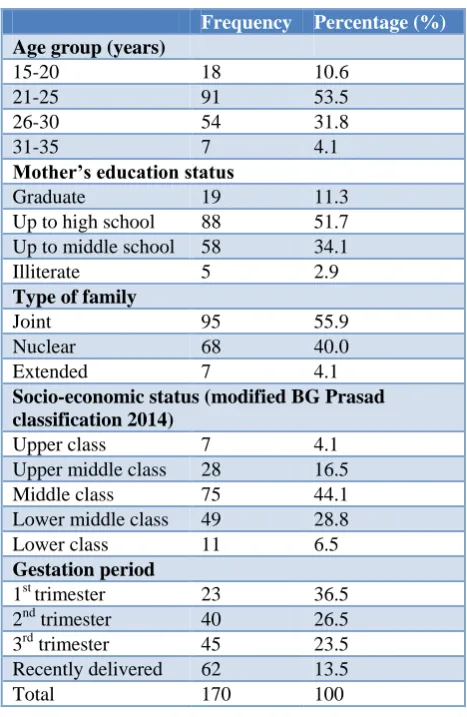
Among 170 study participants, majority of them 107 (62.9%) belonged to the age group of 21-25years. Most of the study participants 88 (51.7%) had high school education and 95 (55.9%) were living in a joint family. Majority 75 (44.1%) belonged to class 3 socio-economic status. Out of 170, 45 participants belonged to third trimester and 62 mothers were recently delivered (RDW).
Table 1: Distribution of study participants based on demographic details (n=170).
Frequency Percentage (%)
Age group (years)
15-20 18 10.6
21-25 91 53.5
26-30 54 31.8
31-35 7 4.1
Mother’s education status
Graduate 19 11.3
Up to high school 88 51.7 Up to middle school 58 34.1
Illiterate 5 2.9
Type of family
Joint 95 55.9
Nuclear 68 40.0
Extended 7 4.1
Socio-economic status (modified BG Prasad classification 2014)
Upper class 7 4.1
Upper middle class 28 16.5
Middle class 75 44.1
Lower middle class 49 28.8
Lower class 11 6.5
Gestation period
1st trimester 23 36.5
2nd trimester 40 26.5
3rd trimester 45 23.5
Recently delivered 62 13.5
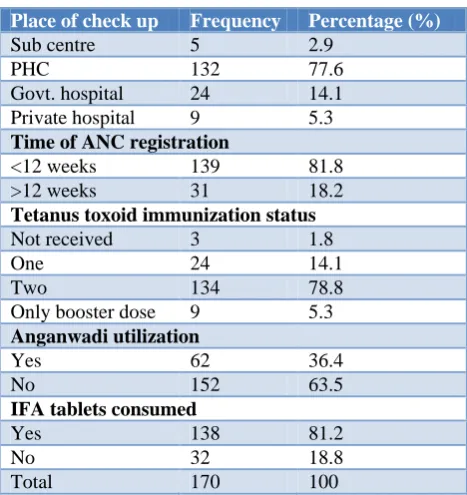
of them 108 (63.5%) did not utilize the anganwadi for supplementary nutrition and health education.
Only three participants did not receive tetanus toxoid injection. While 18.8% of them did not receive IFA tablets. In this study, the association was studied between the socio-demographic characteristics, number of antenatal visits, number of IFA tablets consumption and time of registration. It revealed that mothers who took more than 100 IFA tablets increased gradually as the education status of the mother increased which was statistically significant. In Table 3 association between mother’s age with time of registration, number of antenatal visits and IFA consumed was checked using chi-square test and proved all the three factors were not associated. In Table 4, association between mother’s education status with time of registration, number of antenatal visits and IFA consumed was checked using chi-square test and proved intake of iron and folic acid tables was optimal those who had higher education status (p=0.03). And the number of antenatal visits and number of iron folic acid tablets consumption was associated with socio-economic status whereas the association with time of registration was not statistically significant (Table 5).
Table 2: Distribution of study participants based on utilization of health facility for antenatal services
(n=170).
Place of check up Frequency Percentage (%)
Sub centre 5 2.9
PHC 132 77.6
Govt. hospital 24 14.1
Private hospital 9 5.3
Time of ANC registration
<12 weeks 139 81.8
>12 weeks 31 18.2
Tetanus toxoid immunization status
Not received 3 1.8
One 24 14.1
Two 134 78.8
Only booster dose 9 5.3
Anganwadi utilization
Yes 62 36.4
No 152 63.5
IFA tablets consumed
Yes 138 81.2
No 32 18.8
Total 170 100
Table 3: Association of mother’s age and time of registration, antenatal visits and IFA tablets consumption (n=62 recently delivered women).
Mother’s age category (in years)
Time of registration No. of antenatal visits IFA consumption
<12 weeks >12 weeks Total <4 >4 Total <100 >100 Total
N (%) N (%) N (%) N (%) N (%) N (%) N (%) N (%) N (%)
21-25 10 (30.3) 23 (69.7) 33 (100.0) 9 (27.3) 24 (72.7) 33 (100.0) 9 (27.3) 24 (72.7) 33 (100.0)
26-30 3 (12.5) 21 (87.5) 24 (100.0) 2 (8.3) 22 (91.7) 24 (100.0) 8 (33.3) 16 (66.7) 24 (100.0)
>30 1 (20.0) 4 (80.0) 5 (100.0) 1 (20.0) 4 (80.0) 5 (100.0) 1 (20.0) 4 (80.0) 5 (100.0)
Total 14 (22.6) 48 (77.4) 62 (100.0) 12 (19.4) 50 (80.6) 62 (100.0) 18 (29.0) 44 (71.0) 62 (100.0)
P=0.28 P=0.2 P=0.79
Table 4: Association of literacy status and time of registration, antenatal visits and IFA tablets consumption for recently delivered women (n=62).
Mother’s education
Time of registration No. of antenatal visits IFA consumption
<12 weeks >12 weeks Total (%) <4 >4 Total <100 >100 Total
N (%) N (%) N (%) N (%) N (%) N (%) N (%) N (%) N (%)
Illiterate 1 (25.0) 3 (75.0) 4 (100.0) 1 (25.0) 3 (75.0) 4 (100.0) 3 (75.0) 1 (25.0) 4 (100.0)
Upto middle school
6 (25.0) 18 (75.0) 24 (100.0) 7 (29.2) 17 (70.8) 24 (100.0) 9 (37.5) 15 (62.5) 24 (100.0)
High school and above
7 (20.6) 27 (79.4) 34 (100.0) 4 (11.8) 30 (88.2) 34 (100.0) 6 (17.6) 28 (82.4) 34 (100.0)
Total 14 (22.6) 48 (77.4) 62 (100.0) 12 (19.4) 50 (80.6) 62 (100.0) 18 (29.0) 44 (71.0) 62 (100.0)
Table 5: Association of socio-economic status (SES) and time of registration, antenatal visits and IFA tablets consumption for recently delivered women (n=62).
SES status
Time of registration No. of antenatal visits IFA consumption
<12 weeks >12 weeks Total <4 >4 Total <100 >100 Total
N (%) N (%) N (%) N (%) N (%) N (%) N (%) N (%) N (%)
Upper
class 1 (25.0) 3 (75.0) 4 (100.0) 3 (75.0) 1 (25.0) 4 (100.0) 4 (100.0) 0 (0) 4 (100.0) Middle
class 8 (22.2) 28 (77.8) 36 (100.0) 4 (11.1) 32 (88.9) 36 (100.0) 11 (30.6) 25 (69.4) 36 (100.0) Lower
class 5 (22.7) 17 (77.3) 22 (100.0) 5 (22.7) 17 (77.3) 22 (100.0) 3 (13.6) 18 (86.4) 22 (100.0) Total 14 (22.6) 48 (77.4) 62 (100.0) 12 (19.4) 50 (80.6) 62 (100.0) 18 (29.0) 44 (71.0) 62 (100.0)
P=0.94 P=0.008 P=0.002
DISCUSSION
The present study was conducted among in a rural area of Kanchipuram district Tamil Nadu. In this study, 81.8% of the study participants had their ANC registration during first trimester and 77.6% of them had their check up at primary health care whereas 5.3% of the study participants had their check up at private health care. And only 36.4% of the participants utilized anganwadi for supplementary nutrition and health education. There was statistical association between mother’s education and socio-economic status with antenatal care utilization. According to NFHS-4 survey in Kancheepuram district, Tamil Nadu 59.2 per cent of pregnant woman were registered in the first trimester but whereas in our study population.7 ANC registration in the first trimester was 81.8 per cent which was higher when compared with NFHS-4 data. In other studies conducted by Metgud et al and Mumbare et al where 56.5 and 63.8 per cent respectively had registered in the first trimester.8,9 This shows that our study population had good knowledge about antenatal registration in first trimester compared to the other studies. In our study majority 132 (77.6%) of antenatal mothers had their check up at primary health care and 9 (5.3%) antenatal mothers at private hospital whereas in other study conducted in rural area of Aligarh, 78% of mothers registered at primary health care center and 6.8% mothers at private hospitals which was almost in accordance with our result.10 This shows the accessibility of health care facility and health workers is good in our population. In our study only 36.4 per cent utilized anganwadi for supplementary nutrition and health education as most of the women were not aware of the services which led to poor utilization of anganwadi services. So, knowledge and awareness about the services about anganwadi has to be improved in our study population. Majority 138 (81.2%) of the mothers received at least 100 iron and folic acid tablets during pregnancy in our study setting whereas study done by Ansari et al in rural area of Aligarh revealed that 75.3 cent did not receive the iron and folic acid tablets.11 In our study 98.2
In this study, (Table 4 and 5) shows determinants of antenatal care. Percentage of mothers who registered in first trimester, who had three or more visits increased gradually as literacy status of the mother increased but it was not statistically significant whereas proportion the mothers who consumed more than 100 tablets of IFA increased as literacy status of the mother increased and it was statistically significant. Similar studies done by Yadav et al, Sahu et al and Metgud et al revealed that the association between the literacy status of the mother and utilization of ANC services was statistically significant.8,13,14 This shows that education plays vital role in utilization of antenatal services and hence health education should be advocated for all antenatal mothers.
In this study socio-economic status was significantly associated with mothers who had more than three visits and mothers who consumed more than 100 IFA tablets with p value 0.008 and 0.002 respectively Table 5. While a study done Agarwal et al revealed that there was statistically significant association between socio-economic status and early antenatal registration.15
Strength
We have included all the eligible study participants in our study area.
Limitations
Recall bias is one of the limitations of this study as this is cross-sectional study.
CONCLUSION
ACKNOWLEDGEMENTS
The authors thank Medical Social Workers of Department of Community Medicine, Pondicherry Institute of Medical Sciences who assisted in the research work during the survey.
Funding: No funding sources Conflict of interest: None declared
Ethical approval: The study was approved by the Institutional Ethics Committee, Pondicherry Institute of Medical Sciences
REFERENCES
1. World Health Organization. Maternal mortality. Geneva: World Health Organization; 2010. Available at: www.who.int/mediacentre/factsheets/ fs348/en/. Accessed on 30 January 2019.
2. Alkema L, Chou D, Hogan D, Zhang S, Moller A-B, Gemmill A, et al. Global, regional, and national levels and trends in maternal mortality between 1990 and 2015, with scenario-based projections to 2030: a systematic analysis by the UN Maternal Mortality Estimation Inter-Agency Group. Lancet. 2016;387(10017):462–74.
3. Panda. Practices related to delivery and antenatal care among females in rural block of Haryana, India. Available at: http://www.mjmsr.net/article. asp?issn=0975727;year=2014;volume=5;issue=1;sp age=39;epage=42;aulast=Panda. Accessed on 25 March 2019.
4. World Health Organization. WHO recommendations on antenatal care for a positive pregnancy experience. Geneva: World Health Organization; 2016. Available at: http://apps. who.int/iris/bitstream/10665/250796/1/9789241549 912-eng.pdf?ua=1 Accessed on 30 January 2019. 5. Jani YK, Shukla AA, Bala D. Practices Related to
pregnancy and child birth: a cross sectional study among women of Ahmedabad district. Parity. 2013;30:10.
6. National Rural Health Mission. SBA Trainers Guide for ANMs LHVs and SNs. 2010. Available at:
http://nrhm.gov.in/nrhm-components/rmnch-a/maternal-health/background.html. Accessed on 30 January 2019.
7. Ministry of Health and Family Welfare. National Family Health Survey-4. 2016. Available at http://rchiips.org/nfhs/pdf/NFHS4/TN_FactSheet.pd f. Accessed on 30 January 2019.
8. Metgud C, Katti S, Mallapur M, Wantamutte A. Utilization patterns of antenatal services among pregnant women: A longitudinal study in rural area of north Karnataka. Al Ameen J Med Sci. 2009;2:58-62.
9. Mumbare SS, Rege R. Ante natal care services utilization, delivery practices and factors affecting them in tribal area of North Maharashtra. Indian J Community Med. 2011;36:287.
10. Raigan Das A, Pradesh WU. Utilization and coverage of services by women of Jawan block in Aligarh. Indian J Community Med. 2001;26(2):94. 11. Ansari MA, Khan Z. Antenatal care services in rural
areas of Aligarh, India: A cross-sectional study. J Public Health Epidemiol. 2011;3:210-6.
12. Javali R, Wantamutte A, Mallapur M. Socio-demographic factors influencing utilization of Antenatal Health Care Services in a rural area-A cross sectional study. Int J Med Sci Public Health. 2014;3:308-12.
13. Yadav R, Singh P. Immunisation status of children and mothers in the state of Madhya Pradesh. Indian J Community Med. 2004;29:5.
14. Sahu D, Kushwah S. Factors influencing maternal health in Rewa town. Indian Community Med. 2007;32:148.
15. Agarwal P, Singh M, Garg S. Maternal health-care utilization among women in an urban slum in Delhi. Indian J Community Med. 2007;32:203.
Cite this article as: Sugumaran A, Subramanian R, Tharumaraj M, Vaithiyalingam S. Pattern of