Automatic Facial Expression Recognition using Convolutional
Neural Network (CNN)
Eftekhar Ahmed*, Tasnim Azad Abir, Jinat Ara Siraji
Department of Electronics and Communication Engineering, Khulna University of Engineering & Technology, Khulna, Bangladesh
ABSTRACT
Facial Expression Recognition is has been widely used in Artificial Intelligence, Human-Computer Interaction,
and Security Monitoring. Convolution neural network (CNN) works as a depth learning architecture and it can
extract the essential features of the image. In the case of large changes in shooting conditions, CNN’s effect is
better than the methods of Support Vector Machines (SVM) and Principal Component Analysis (PCA).
Therefore, we are proposing a method based on CNN. The purpose is to classify each facial image as one of the
seven facial expressions considered here. A new convolution neural network structure has been designed
according to the characteristics of facial expression recognition. To extract implicit features convolution kernel
is being used and max-pooling is being used to reduce the dimensions of the extracted implicit features. In
comparison to AlexNet network, we can improve the recognition accuracy about on the FER and CK+ facial
expression database with the help of Batch Normalization (BN) layer to our network. A facial expression
recognition system is constructed for the convenience of application, and all the experimental results show that
the system can reach the real-time needs.
Keywords: Convolutional Neural Network, Distributed Neural Network, Support Vector Machine, Principle
Component Analysis
I.
INTRODUCTIONFace provides a wide range of information about the
identity, age, sex, race as well as the emotional and
mental state. Facial expressions play a crucial role in
social interactions and commonly used in the
behavioral interpretation of emotions. Human
expression recognition is influenced by certain
context. When a subject is being investigated, the
investigator might be diverted by the subject’s voice
tone or argument and may forget to keep track of the
facial expressions. Automatic facial expression
recognition systems are exempt from such contextual
interference [1]. Such systems can be beneficial in
interrogations, psychiatry, animations etc. We want
to improve a CNN architecture which will be able to
detect the meaning of the human facial expression.
Convolution Neural Network (CNN) is a new type of
neural networks, it is a combination of traditional
artificial neural network and deep learning
technology [2]. With the development of deep
learning, applying convolution neural network into a
classification problem has attained impressive success.
Critical and unforeseen features are extracted by deep
learning methods through iterative weight update by
backpropagation and error optimization [3-4].
When we talk face to face we can easily understand
the facial expression of others. But still now it
remains challenging for machines to understand the
meaning of human’s facial expression. The main
objectives of our works are the improvement of face
detection algorithm and implementation of the
feature extraction technology. We also want to get
better effect of classification than before and build a
perfect architecture of convolution neural network.
To train machine about how to understand the
meaning of the human’s facial expression accurately
there are still many problems, such as low precision,
slow identification, etc. [5]. This work will develop an
improved technique to detect the face expression by
feature extraction technology.
II.
METHODS AND MATERIALA. Deep Learning and Artificial Neural Network
Deep learning is basically a branch of machine
learning. It is a technique which can directly extract
features from data like text, image, or sound and
learn the task by itself [6]. Deep learning methods can
perform object recognition and classification much
accurately than human [7]. Using Graphical
Processing Unit (GPU) large deep network can
complete the task of learning easily within a very
short period of time. For very much effective learning
we need sufficient quality data and the library has
already been very much enriched with a great
amount of dataset by different services. As most of
the deep learning method follows the neural network
architecture, deep learning models are often
mentioned as the deep neural network [8]. A very
much popular deep learning model is convolution
neural network (CNN) which deals with image data.
When a neural network is designed with multiple
layers it is known as the deep neural network. The
number of layers can be two to hundreds [9].
B. Artificial Neural Network
Artificial Neural Network (ANN) simulate and
processes data in a similar fashion the human brain
analyzes and processes information [10]. It is based on
the idea that working of human brain can be imitated
by making the right connections of silicon and wires
as living neurons and dendrites. Neurons are
connected to other cells by Axons. Dendrites create
electric impulses in response to stimuli from external
environment or inputs from the sensory organs [11].
A neuron sends the stimuli to other neuron to handle
the issue. In this way these impulses travel through
the whole neural network. The Multiple nodes that
compose ANN. Connected through links, neurons can
interact with each other. The nodes can take input
data and perform simple operations on the data. The
result of these operations is passed to other neurons
called its activation or node value [12]. There is a
weight associated with each link. By altering weight
values, the ANNs are capable of learning. The ANN is
based on a collection of artificial neurons. Each
connection between artificial neurons can transmit a
signal from one to another. The artificial neuron can
process the signals and transmit the signal to the
artificial neurons connected to it [13].
C. Convolutional Neural Network
A multilayer neural network with one or more
convolutional layers and one or more fully connected
layers is known as a convolutional neural network
(CNN) [14]. The architecture of a CNN is designed to
take advantage of the 2D structure of an input signal
and it is easier to train and have many fewer
parameters than fully connected networks having the
same number of hidden layers. The convolutional
layer’s parameters consist of a set of learnable filters
which are spatially small but extends through the full
depth of the input volume [15]. At the time of
forward pass each filters calculate the dot products
between the entries of the filter and the input sliding
across the width and height of the input volume. At
every spatial position, the response of the filter is
made by sliding over the width and height of the
input volume producing a 2-dimensional activation
map [16]. We will have an entire set of filters in each
convolutional layer and each of them will produce a
separate 2-dimensional activation map. These
activation maps along the depth dimension will be
stacked and produce the output volume. Dealing with
high-dimensional inputs it is practical to connect each
neuron to only a local region of the input volume [17].
The spatial extent of this connectivity called the
receptive field of the neuron and the extent of the
connectivity along the depth axis is always equal to
the depth of the input volume. The connections are
local in space but always full along the entire depth of
the input volume.
It is common to periodically insert a pooling layer
in-between successive convolutional layers in a
convolutional network architecture [7]. By
progressively reducing the spatial size of the
representation, it reduces the amount of parameters
and computation time in the network. Hence, also
controls over fitting. In addition to max pooling, the
pooling units can also perform other functions, such
as average pooling or even L2-norm pooling [18].
It is common to keep track of the index of the max
activation at the time of forward pass of a pooling
layer so that gradient routing is efficient during back
propagation [19]. In a fully connected layer neurons
have full connections to all activations in the previous
layer. Their activations then can be computed with a
matrix multiplication followed by a bias offset. CNN
use little pre-processing compared to other image
III.
S
IMULATIONT
OOLS ANDA
LGORITHMSA new CNN structure is proposed for facial expression
recognition. Two publicly available databases FER
and CK+ are used to carry out the experiments [15].
In order to remove non-expression feature of a facial
image, we need to carry out the pre-process of face
image, which includes face detection and face image
cropping. The faces are detected and cropped using
OpenCV library. Then, the facial expressions features
are extracted using our convolution neural network
which works under deep learning framework. Finally,
the training model is used to classify each facial image
as one of the seven facial expressions: angry, disgust,
neutral, sad, fear, surprise and happy.
A. Network Architecture
Figure.1 Facial expression recognition network
structure.
Figure.2 Facial expression recognition network
structure using softmax pooling.
Figure.1 shows the facial expression recognition
network. The entire network includes four
convolution layers, two pooling layers and two fully
connection layers. The convolution layer is the
feature extraction layer. The convolution operation is
performed on the training convolution kernel and the
previous layer of all the feature maps. The output of
the activation function forms the neurons of the
current layer, thus forming the characteristic map of
the current convolution layer. Figure. 2 shows the
facial expression recognition network structure using
softmax pooling. The calculation is as follows [17]:
∑
( )
Where represents the weighted input of layer l.
is the characteristic map of the output of the l-1
layer. denotes a convolution kernel matrix, it
represent the connection weight between neurons.
denotes the offset term of the jth feature map. In the
experiment, set = 0, can improve the speed of
network training, while reducing the learning
parameters. is the j feature graph of the
convolution l layer. F() represents the activation
function. This model uses 96 filters with the size of
11×11×4.This layer extracts the low-level edge
features. The original image is randomly cropped to
the size of 227×227, after the first convolution of the
image size becomes 55×55. To increase the nonlinear
properties of network, we use ReLU(Rectified Linear
Units) as the activation function. For any given input
value x, ReLU is defined by:
( ) ( )
Where x is the input to the neuron. Using the ReLU
activation function allows us to avoid the vanishing
functions. Increasing the number of convolution
layers the feature dimension increases rapidly [12]. In
order to avoid such a large dimension we used the
pooling layer to reduce the dimension. The
sampling is performed by Max-pooling. The
down-sampling process does not change the number of
feature graphs. It reduces the number of parameters
by removing unnecessary information from each
feature map. The models are trained and tested on the
database from FER Kaggle [15]. The dataset has
grayscale images of faces of the size 48x48 pixel. The
faces have been automatically registered so that the
face is more or less centered and occupies about the
same amount of space in each image. We have
classified each face based on the emotion in the facial
expression in to one of seven categories: 0=Angry,
1=Disgust, 2=Fear, 3=Happy, 4=Sad, 5=Surprise,
6=Neutral. The training set consists of 28,709
examples. The public test set used for the leaderboard
consists of 3,589 examples. The final test set consists
of another 3,589 examples.
For cross validation we used extend Cohn-Kanaded
database (CK+) which includes 327 video sequences
acted out by 118 participants [15]. Each sequence
which consists of approximately 10 to 30 frames is
labeled with one of seven expressions categories:
angry, disgust, neutral, sad, fear, surprise, happy.
Every sequence starts with the neutral emotion and
then the frame depicts the emotion which is for the
corresponding label. We selected images of human
faces with obvious facial expressions to recognize
facial expression. All 327 sequences of the CK+
database are used for evaluating the proposed model.
C. Python Development Environment
As python development environment we have used
Spyder which is the scientific python development
environment. It may also be used as a library
providing powerful console-related widgets for
PyQt-based applications.
D. AlexNet
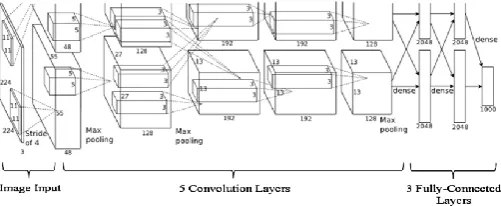
AlexNet network used a relatively simple layout,
compared to modern architectures [18]. The network
was made up of 5 convolutional layers, max-pooling
layers, dropout layers, and 3 fully connected layers as
shown in figure. 3. The network was used for
classification with 1000 possible categories.
Figure. 3 AlexNet Architecture
The neural network developed for AlexNet was the
coming out party for CNNs in the computer vision
community. Tensor Flow mainly designed for deep
neural network models is a tool for machine learning
IV.
RESULTS AND DISCUSSIONS
We trained and tested the model on the database
from FER Kaggle. The data consists of 48x48 pixel
grayscale images of faces. The faces have been
automatically registered so that the face is more or
less centered and occupies about the same amount of
space in each image. Training contains two columns,
emotion and pixels. The emotion column contains a
numeric code ranging from 0 to 6 for the emotion
that is present in the facial expression image. The
pixels column contains a string surrounded in quotes
for each image. The contents of this string a
space-separated pixel values in row major order. Testing
contains only the pixels column and your task is to
predict the emotion column. For cross validation we
used extend Cohn-Kanaded database (CK+) which
includes 327 video sequences acted out by 118
participants. Each sequence which consists of
approximately 10 to 30 frames is labeled with one of
seven expressions categories: angry, disgust, neutral,
sad, fear, surprise, happy. Every sequence starts with
the neutral emotion and then the frame depicts the
emotion which is for the corresponding label. We
selected images of human faces with obvious facial
expressions to recognize facial expression. All 327
sequences of the CK+ database are used for evaluating
the proposed model. Figure. 4. Shows the confusion
matrix of the test datasets. Figure 5 and 6 presents the
real time view of facial expression classification using
DCNN and SVM respectively.
Figure. 4 Confusion Matrix
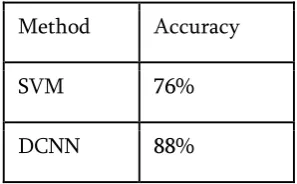
Table I Comparison of the accuracy of the network
structures under two different methods
Table I presents the comparison between accuracy of
facial expression classification using SVM and DCNN.
It is evident that DCNN provides better classification
accuracy. From Figure. 4 we can see the confusion
matrix. It shows that the accuracy is good enough.
We can see the observations. Wit5h two methods we
made real time facial expression detection and found
that the DCNN method is better than SVM. Method Accuracy
SVM 76%
Figure.5 Real time facial expression for DCNN
method
Figure.6 Real time facial expression for SVM method
V.
C
ONCLUSIONThe purpose of this work is to classify each facial
image as one of the seven facial expressions: angry,
disgust, neutral, sad, fear, surprise and happy. A new
convolution neural network structure has been
designed according to the characteristics of facial
expression recognition. To extract implicit features
convolution kernel is being used and max-pooling is
being used to reduce the dimensions of the extracted
implicit features. We built the structure of the neural
network model. The purpose is to detect the meaning
facial expression automatically. We trained the model,
imported datasets, and test set. We made the
comparison. We determined accuracy for train set
FER and Test set FER. We used two methods which
are SVM and DCNN. We found that the DCNN was
the better one.
VI.
REFERENCES1. J. Yin “Face Festure Extraction Based on
Principle Discriminant Information Analysis”
,IEEE International Conference on Automation
and Logistics, 2007, pp. 1580-1584.
2. M Pantic and L.J.Rothkrantz “Automatic
analysis of facial expressions: The state of the
art. Pattern Analysis and Machine Intelligence”,
IEEE Transactions on, 2000, pp. 1424-1445.
3. Ian J. Goodfellow “Challenges in representation
learning: A report on three machine learning
contests” , Neural information processing .2013,
pp. 117-124.
4. ZYu and C.Zhang “Image based static facial
expression recognition with multiple deep
network learning”, the 2015 ACM on
International Conference on Multimodal
Interaction.2015, pp. 435-442.
5. SE.Kahou “Combining modality specific deep
neural networks for emotion recognition in
video” , the 15th ACM on International
conference on multimodal interaction. 2013, pp.
6. SMinchul “Baseline CNN structure analysis for
facial expression recognition”, 25th IEEE
International Symposium on Robot and Human
Interactive Communication (RO-MAN) 2016,
pp. 26-31.
7. PEkman and W.V.Friesen “Facial Action
Coding System: A Technique for the
Measurement of Facial Movement”, Palo Alto:
Consulting Psychologists Press, 1978.
8. TKanade “Recognizing action units for facial
expression analysis”, IEEE Transactions on
Pattern Analysis and Machine
Intelligence.2001, pp. 97-115.
9. MS. Bartlett “Fully automatic facial action
recognition in spontaneous behavior”, IEEE
Conference on Automatic Facial and Gesture
Recognition, 2006, pp. 223-230.
10. C.Ira “Evaluation of expression recognition
techniques.”, Image and Video Retrieval.
Springer Berlin Heidelberg, 2003, pp. 184-195.
11. M.Liu “Deeply learning deformable facial action
parts model for dynamic expression analysis”
,Computer Vision–ACCV. Springer
International Publishing.2004, pp. 143-157.
12. P.Burkert “DeXpression:Deep Convolutional
Neural Network for Expression
Recognition”,IEEE 2015.
13. G.Ali “Boosted NNE collections for
multicultural facial expression recognition.
Pattern Recognition”, 2016, pp.14–27.
14. P.Lucey “The Extended Cohn-Kanade Dataset
(CK+): A complete dataset for action unit and
emotion-specified expression”, Computer Vision
and Pattern Recognition Workshops (CVPRW),
2010 IEEE Computer Society Conference on
IEEE.2010, pp. 94–101.
15. M.Lyons “Coding facial expressions with gabor
wavelets. Proceedings of the Third IEEE
International Conference on Automatic Face
and Gesture Recognition”,1998,pp. 200–205.
16. A.Krizhevsky “Imagenet classification with
deep convolutional neural networks” Advances
in neural information processing systems, 2012,
pp . 1097–1105.
17. Y.Jia “Caffe: Convolutional architecture for fast
feature embedding”, Eprint Arxiv.2014,pp.
675-678.
18. K.Alex “Imagenet classification with deep
convolutional neural networks”, International
Conference on Neural Information Processing