Organizational Learning and Knowledge 5th International Conference
Friday, 30thMay – Monday, 2nd June, 2003
KNOWLEDGE MANAGEMENT AND
ORGANIZATIONAL LEARNING: STRATEGIES AND
PRACTICES FOR INNOVATION
Theme:
Strategy, Competitiveness and Learning
Matthews, Judy H.
National Graduate School of Management Australian National University Contact author: Dr Judy Matthews National Graduate School of Management
Australian National University Sir Roland Wilson Building
McCoy Circuit Acton Canberra ACT Australia 0200 Telephone: INT 61 2 6125 9833 E-mail: [email protected]
Abstract
In a globalised competitive world, organisations are looking for ways to gain or maintain a competitive advantage in the marketplace. Of the important challenges facing firms and organizations three are of prime importance: (1) for organizations to know what they know and maximise the transfer of this knowledge throughout their organisation; (2) finding ways of working which assist in maintaining their competitive advantage and finding new ways of gaining competitive advantage often through innovation, and (3) continuously learning through the exploitation of existing resources and capabilities and the exploration of new resources and capabilities to improve their performance. These challenges are interrelated. This paper investigates some of the extensive literature on innovation and knowledge management and suggests propositions for future research.
Introduction
The changing nature of the market, the demands of ongoing change, and the emergence of a knowledge society require a continuing focus on innovation. The need for innovation arises from our understanding that the competence, skills, knowledge, product services and structure of the present will not be adequate over time (Drucker, 1992). Innovation implies improving on existing products and processes, finding new ways and also abandoning the old. Drucker suggests that organisations should conduct a ‘zero-based audit’ and every three years systematically put every aspect of the company on trial: every product, service, technology, market, and distribution channel, particularly in the service sector (Drucker, 1992).
In a knowledge based economy, both knowledge and innovation are sources of competitive sustainable advantage. Of particular importance then, are the strategies and practices that firms develop in managing for knowledge and innovation. For the purposes of precision we will discuss these processes separately, although in reality, there is a large degree of overlap. The focus on innovative and entrepreneurial behaviour requires competencies in organizational leadership, and in managing for innovation, commitment and knowledge generation. We first discuss separately, common understandings of innovation and knowledge, and then review some research on knowledge used in innovation. Innovation here includes the development of new products, new processes, new services or a combination of these as well as new organisational structures. Innovation is differentiated from invention and involves application or commercialisation of the created product, process or production on a scale larger than one item.
Innovation
Innovation has been defined as incremental improvements to existing products or processes as well as more radical processes that involve new ideas, developing or adapting new technology, or new ways of doing business. However, innovation is becoming a catchcry and for the last decade or so, organisations have been encouraged to be part of the ‘innovation explosion’ (Quinn et al, 1997) and ‘innovate or die’ (Peters, 1990). Innovation can be described from a variety of perspectives, from a broad inclusive definition such as a ‘process of bringing any new, problem-solving idea into use’ (Kanter, 1983), to a more outcome-based approach, where ‘innovation is the process whereby new ideas are transformed through economic activity, into sustainable value-creating outcomes’ (Livingstone, 2000).
Indeed, innovation is a complex process (Kline & Rosenberg, 1986) and the ability of an organisation to recognise the potential of an innovation is itself not a simple process. This recognition depends on multiple factors including how “an organisation collects and processes information, the nature of the innovation, as well as the organisation’s structure, systems, people, local environment and managerial dominant logic” (Afuah 1998: 92). We argue that a key factor in the management of innovation is the management of knowledge creating and knowledge sharing practices internal and external to the firm.
Organizational innovation defined as the adoption of an idea or behaviour that is new to the organisation, where “the innovation can be a new product, a new service, a new technology or a new administrative practice” (Hage, 1999: 599). Organisational innovation is not a straightforward linear process and the relationship between an organisation’s management and its performance on innovation is complex. Managing for innovation is intrinsic to the strategy, positioning and competitiveness of the organization, not additional to an organisation’s strategy. Innovation can certainly be encouraged but cannot be directly created. Research on innovation has found that the most successful innovation is found to be based on strategy, is dependant on effective internal and external linkages and requires enabling mechanisms for making change happen, in a supporting organizational context (Tidd et al., 1997).
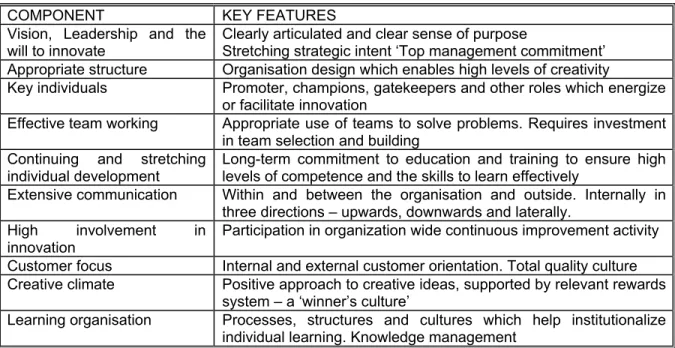
Table 1. Components of the Innovative Organization
COMPONENT KEY FEATURES
Vision, Leadership and the
will to innovate Clearly articulated and clear sense of purpose Stretching strategic intent ‘Top management commitment’ Appropriate structure Organisation design which enables high levels of creativity
Key individuals Promoter, champions, gatekeepers and other roles which energize or facilitate innovation
Effective team working Appropriate use of teams to solve problems. Requires investment in team selection and building
Continuing and stretching individual development
Long-term commitment to education and training to ensure high levels of competence and the skills to learn effectively
Extensive communication Within and between the organisation and outside. Internally in three directions – upwards, downwards and laterally.
High involvement in
innovation Participation in organization wide continuous improvement activity Customer focus Internal and external customer orientation. Total quality culture Creative climate Positive approach to creative ideas, supported by relevant rewards
system – a ‘winner’s culture’
Learning organisation Processes, structures and cultures which help institutionalize individual learning. Knowledge management
Source: (Tidd et al., 1997: 314)
Organisational theorists contend that, for a mature organisation to develop the capacity for sustained innovation, it must successfully make these ‘innovation-to-organization connections in three key areas: 1) make resources available for new products; 2) provide
collaborative structures and processes to solve problems creatively and connect innovations
with existing businesses and 3) incorporate innovation as a meaningful component of the
organization’s strategy’ (Dougherty & Hardy 1996, 1122). These connections also build in knowledge management and organisational learning strategies and practices most explicitly
described in providing collaborative structures and processes to solve problems creatively
and connect innovations with existing businesses.
Environments in which innovation is likely to occur contain an atmosphere of continuous renewal and a climate for experimentation. Organisations that find ways of preventing their core competencies from becoming core rigidities and promote continuous learning from successes as well as failures are likely to succeed (Leonard, 1995).
There is general agreement that innovation often occurs through the application of knowledge gained in one area to a new discipline. The importance of knowledge, both codified or explicit knowledge as well as more tacit knowledge, is well known (Polanyi, 1962, Nonaka & Takeuchi, 1995). The conversion of tacit to explicit and explicit to tacit knowledge and its contribution to knowledge creation has been well researched (Nonaka & Takeuchi, 1995). Gibbons and Johnston (1974) and Faulkner (2001) studied knowledge required for innovation. Faulkner developed a composite typology of knowledge used in innovation defined in the following five areas: knowledge related to experimental R&D, knowledge related to final product, knowledge related to the natural world, knowledge related to design practice and knowledge of knowledge itself.
Faulkner also differentiates between knowledge as understanding, knowledge as holding information, knowing as holding skills. These dimensions include: understanding versus information versus skills, from tacit to articulated knowledge, complex versus simple knowledge, local versus universal knowledge and specific/contingent versus general/meta-level knowledge. Faulkner argues that knowledge in innovation hence includes specific types of knowledge (the typology), the object or activities with which they are associated (such as products, and R&D) and broad distinctions in the character of knowledge (tacit, specific etc.) Organisations are located within a context of a larger network of firms where inter-firm relationships often based on relationships between individuals are crucial to success. The management of innovation is an organizational problem. It includes the architecture of an organisation and its formal structure, the job competencies and career structure, where culture and power determines its capacity to nurture sustain and exploit innovation. Successful innovators require expertise at managing linkages and interfaces between organizations (Tushman & Anderson, 1997).
Managing knowledge
Knowledge has been described as “justified true belief” (Nonaka and Takeuchi, 1995). However, more generally knowledge is about beliefs and commitment, and about action and meaning” (Nonaka and Takeuchi, 1995). Knowledge can be understood as an individual resource and also as an organisational resource. Our interest in knowledge in organisations is in terms of the knowledge of individuals and the importance of each organisation knowing what their employees know and to applying this knowledge for the benefit of the organization. Knowledge creation is important in the creation of new products and processes and a theory of organisational knowledge creation where the individual’s internal knowledge was used to address problem situations.
A well known definition is describes knowledge as “a mix of experience, values, contextual information, expert insight that provides a framework for evaluating and incorporating new experiences and information, often becomes embedded in documents, org routines, processes, practices norms”(Davenport & Prusak, 1998). These authors contend that the best outcome for knowledge management processes is that knowledge management should become part of everything an organisation does and it should be everyone’s job.
Knowledge contributes to and is generated from innovation as products, processes, services, relationships, new markets and new segments. Knowledge can be defined at the individual and collective level in each institution. Senior executives from many organisations acknowledge that there is a lot of useful knowledge that is not coordinated and is often recreated in costly inefficient ways rather than being available for reuse. Demands of ‘if only we knew what we know’ (O’Dell & Grayson, 1998) and the knowledge based view of the firm with a ‘knowledge-based’ analysis of coordination within the firm (Grant, 1996) have largely emerged in response.
Knowledge has also been described as the meaningful links people make in their minds, between information and application in action in a specific setting (Dixon, 2000). Dixon (2000) builds a detailed picture of a range of knowledge processes, the creation of organisational knowledge, the ways in which this knowledge can be effectively shared, and why ‘knowledge transfer’ systems work the way do.
In particular, different types of common knowledge and communication processes may be required to fulfill different roles in knowledge integration. Examples of these might include “i) a common language, ii) other symbolic communication, iii) a commonality of specialized knowledge, iv) shared meaning where tacit knowledge can be communicated through the shared understanding between individual, such as the role of common cognitive schema and frameworks, metaphor and analogy, and stories, as vehicles for molding integrating and reconciling different understandings, and v) recognition of individual knowledge domains, where each is aware of everyone else’s knowledge repertoire” (Grant, 1996: 116).
Similar processes are found in communities of practice, where largely self-organised groups, generally initiated by employees, communicate with one another because they share common work practices, interests or aims (Brown & Duigood, 1991). These processes generate reciprocal or group interdependence, where coordination processes are agreed by mutual adjustment and where each team member recognizes the abilities of other team members (Grant, 1996).
The core message of knowledge management from research on 25 companies, is that the only sustainable advantage a firm has comes from what it collectively knows, how efficiently it uses what it knows, and how readily it acquires new knowledge (Davenport & Prusak, 1997). The challenges and possibilities of knowledge vary with the firm and its strategic position as well as the industry sector. Knowledge as a sustainable competitive advantage the way an organisation manages its knowledge is strongly related to its business strategy (Zack, 1999). Organisations may have a range of knowledge processes that they use both to exploit their knowledge and to explore and extend their knowledge, using both internal and external (Zack, 1999).
Knowledge management and innovation
There are many similarities between the management of innovation and the management of knowledge. For example, one successful way to increase knowledge and its transfer in organisations, is to “hire smart people and let them talk to each other” (Davenport and Prusak, 1998: 88). A similar prescription is provided for innovation. Here the important ingredients are clever people and the processes are the interaction, context and a culture of knowledge sharing, or finding effective ways to let people talk and listen to one another (Quinn et al, 1996).
Some writers describe the importance of the generation of knowledge in more detail. Skyrme (1999) describes two processes. First, knowing what you know i.e. having better awareness, sharing and application of existing knowledge including that which originates outside the organisation. Second, faster and better innovation i.e. more effective conversion of ideas into products and processes (Skyrme, 1999).
Innovation is found as a set of interacting knowledge processes (Skyrme, 1999). These processes include the absorption of existing knowledge from the external environment, the
creation of new knowledge through creative thinking and interchange of ideas, the rapid
diffusion of ideas and insights through knowledge networking; the validation, refining and
managing of innovation knowledge, matching of creative ideas to unmet customer needs and
in solved problems, and encapsulating and codifying knowledge into an appropriate form such as a tangible product, a production of a new internal process, training material for a new service a marketable design, patent” (Skyrme, 1999:51).
Each of these diverse sources of knowledge present different challenges and often requires different knowledge processes. They range from knowledge which comes from customers to knowledge that is embedded in products and services. The forms of knowledge and knowledge processes are summarised in Table 1. These diverse sources of knowledge would also be useful for innovation practices.
Table 1. Forms of Knowledge and Processes.
FORMS OF KNOWLEDGE KNOWLEDGE PROCESSES
Customer knowledge Developing deep knowledge through customer relationships, and using it to enhance customer success through improved products and services
Knowledge in products and services
Embedding knowledge in products and surrounding them with knowledge-intensive services
Knowledge in people Developing human competencies and nurturing an innovative culture where learning is valued and knowledge is shared.
Knowledge in processes Embedding knowledge into business processes, and giving access to expertise at critical points
Organizational memory Recording existing experience for future use, both in the form of explicit knowledge repositories and developing pointers to expertise Knowledge in relationships Improving knowledge flows across boundaries: with suppliers,
customers and employees etc.
Knowledge assets Measuring intellectual capital and managing its development and exploitation.
Source: Developed from Skyrme (1999).
Large companies such as 3M, Hewlett Packard and Glaxo-Wellcome recognise the contribution of knowledge to their continued success (Skyrme, 1999). These benefits include
the avoidance of costly mistakes, through sharing what has been learned in previous situations, and well as the sharing of best practices, well exemplified in Chevron. In addition, faster problem solving such as the video-conferencing used by BP-Amoco where offshore oil platforms can tap into expertise elsewhere. Other examples include faster development times through learning networks and linking customer problems to an ideas database, and better customer solutions. A well-known example is the sales and support staff at Buckman Labs who use their knowledge repository K’Netix to gain access to best expertise and develop innovative solutions to tricky customer problems. Benefits obtained from knowledge management practices include gaining new business, improved customer service and reduction of risk (Skyrme, 1999).
Innovative success in small and medium-sized firms appears to be largely determined by the presence of organizational, technological and marketing competencies and if these competencies are jointly present, firms are more likely to innovate successfully (Cobbenhagen, 2000). This study did not specify knowledge practices per se, but the combination of a strong knowledge base, proactive management of innovations and management of the relationship with the environment were major factors in the success of these firms.
Knowledge management processes in innovative firms
Processes for managing knowledge in innovative firms are both internally and externally generated. These processes benefit from processes involving reflections on practices such as After Action Review (Baird et al., 1997) as well as search processes to identify possible opportunities emerging form new technologies of competitors. After Action Review develops and implements a method for capturing learning, for converting individual experience to group learning and consolidating individual learning to create organizational learning. In research and development, the focus on knowledge involves both the creation of knowledge and the reuse of knowledge. Many of these processes are driven by problem solving behaviour, often in collaboration with customers or other experts.
An analysis of innovative firms found that the common underlying capacities for innovation include an organisation’s vision and strategy, a sound competency base, creativity and idea management, organisation and process, culture and climate and intelligence (AD Little, 2001). Little’s study grouped multiple notions of knowledge and knowledge management under the heading of organisational intelligence. This notion described knowledge management as the generation, protection and stewardship of technology & technological knowledge, acquisition and development of knowledge from outside or absorptive capacity. Also included were knowledge articulation and deployment, awareness of own performance and limitations, commitment to understanding the customer - both current and future (unarticulated) needs, structured thinking about the future/scanning the horizon, recognition, screening and selection of new ideas and understanding and using networks for intelligence. The AD Little study of innovative firms had a particular measure named ‘Intelligence’. Under this label, measures were used to gain indicators of a range of practices related to the ‘management’ of knowledge, such as the generation, protection and stewardship of technology & technological knowledge; the acquisition and development of knowledge from outside; absorptive capacity, the knowledge articulation and deployment; recognition,
screening and selection of new ideas and understanding and using networks for intelligence. The measures also included awareness of the firm’s own performance and limitations, commitment to understanding the customer - both current and future (unarticulated) needs, and engaging in structured thinking about the future, and scanning the horizon.
In addition, firms were found to be innovating at different rates. Firms were classified along a continuum as static, innovative, learning and self-generating firm based on whether or not they were involved in systematic innovation, whether the firm could extend to new markets, had an ability to adapt to changing environmental conditions, or an ability to strategically reposition in the industry. These criteria are summarised in Table 2. A firm can of course be at different levels with respect to different innovative capacities. Further elaboration of levels of innovativeness and discussion of possible forms of organizational learning (AD Little, 2001).
Table 2. Levels of Innovation in Firms
LEVELS OF
INNOVATIVENESS FIRM DESCRIPTORS
Level 0 - The static firm Organisation not involved in systematic innovation, but may have a stable market position while present conditions persist.
Level 1 - The innovating
firm Able to produce innovations serving known markets efficiently and effectively. Level 2 - The learning firm Adapting to a changing environment; being able to question existing
routines and norms and develop new ones; double-loop learning. Level 3 - The self
regenerating firm
Displays strategic re-positioning: able to question, change/re-shape the industry it is in; triple loop learning. Visionary leadership and long-term commitment are key.
Source: (AD Little, 2001)
A study of innovation in global firms found that successful innovations are characterised by the correct anticipation of customer needs, detailed knowledge of the supply chains, and intelligent application of external technology, where all the internal and external resources of a company, have to be integrated (Boutellier et al., 1999).
In this study, the benefits gained through knowledge management in innovative firms include the not only the identification of technical competencies which are key to success (technical core competencies), but also the ability to communicate technical core competencies throughout the management of the whole company (R&D and marketing), as well as the identification of technical core competencies with an opportunity to focus on issues of
protection, exploitation and enhancement of competencies (Boutellier et al., 1999).
Particular activities in certain situations could improve knowledge management practices were identified in the study. Knowledge processes, which form the basis of these practices, have been identified and included in Table 3.
Table 3. Knowledge processes relevant to activities in differing contexts for innovation.
CONTEXTS/ SITUATION
ACTIVITIES KNOWLEDGE PROCESSES
Informal links
and networks Visiting scientists programs Informal meetings and conferences
Job rotation
Multimedia technology/ICT
Increased pool of knowledge sources with New connections outside day to day practice
Increased interactive processes to build trust and increase sharing of explicit and tacit knowledge Building embodied knowledge, networks and gaining tacit knowledge
Broader access to explicit knowledge increase “richness” of knowledge
Projects and
Processes Cross-functional teams Intercultural project managers
HIP- High impact projects Shared databases
Breadth of paradigms, learn from diverse approaches and technologies
Diversity of experiences and challenges High visibility – new ideas diffused
Common knowledge captured and accessible Hierarchical
and functional Functional specialists Multi-functional prototyping
Dual career ladders Technology Agents
High experience processes with deep expertise
Rich disciplinary source of ideas, multiple approaches
Reward depth and range of experience Diffusion of technology
Regional and
Local Face-to face meetings Expatriates Local recruiting International dispatchments
Making connections and sharing tacit knowledge Expertise from head office with local situational knowledge
Increase potential for learning from diverse situations and challenges
Source: Developed from Boutellier et al. (1999).
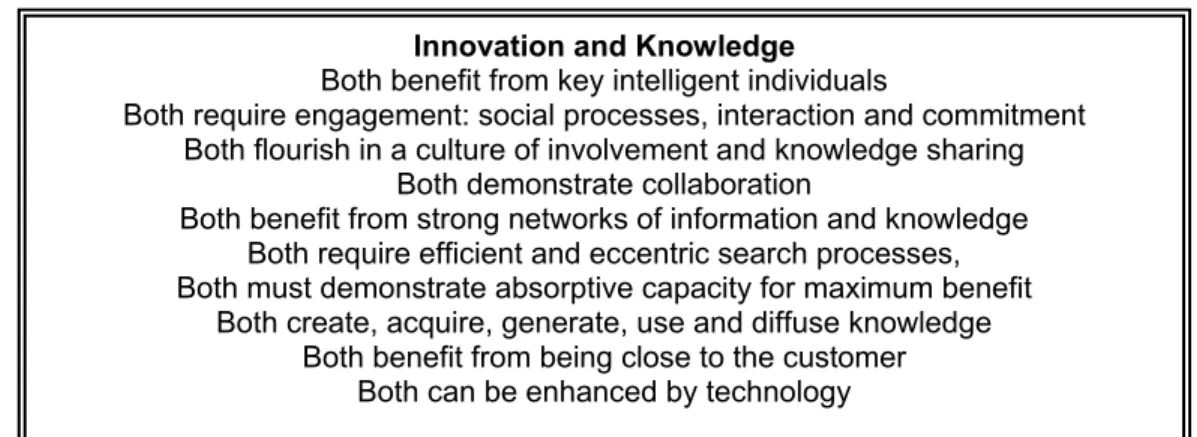
From this brief overview of innovation and knowledge, it is apparent that there are some commonalities in the management of knowledge and management for innovation. Some of these are summarised below in Figure 1.
Figure 1. Commonalities between knowledge and Innovation
On the basis of this research, we can develop the following propositions.
Proposition 1: Knowledge management practices contribute to innovation in large and small firms.
Proposition 2: Organizational learning practices contribute to the management of knowledge innovation.
Innovation and Knowledge
Both benefit from key intelligent individuals
Both require engagement: social processes, interaction and commitment Both flourish in a culture of involvement and knowledge sharing
Both demonstrate collaboration
Both benefit from strong networks of information and knowledge Both require efficient and eccentric search processes, Both must demonstrate absorptive capacity for maximum benefit
Both create, acquire, generate, use and diffuse knowledge Both benefit from being close to the customer
It is clear that good practices for managing knowledge can support innovation. It is also apparent that firms found to be innovative have factors other than knowledge management contribute to innovation. These include a culture that encourages experimentation and a tolerance of mistakes, appropriate structure for innovation, high involvement in innovation, effective team working and a creative climate (Tidd et a., 2001).
Proposition 3: Organisations encouraging innovation require more than knowledge management practices.
These propositions are currently being investigated in a research project involving knowledge management and innovation in small ICT firms.
Conclusions
The dynamic globalised knowledge economy has created many challenges to firms to find and sustain sources of competitive advantage. The challenge to organisations to innovate includes a challenge to improve and extend their practices for managing knowledge. Small and large companies have developed successful strategies for such involvement in managing for knowledge and for innovation. Future research will examine knowledge and innovation practices in specific industry settings
Building on this range of notions regarding knowledge and its forms, we articulate specific research propositions and investigate them through interviews with managers in the ICT services context. Preliminary findings show variable use of the notions and we conclude with further suggestions of knowledge management and organisational learning strategies and practices that contribute to innovation.
Bibliography
Afuah, A. (1998) Innovation management: Strategies, implementation and profits. New York: Oxford University Press.
Arthur D Little (2001) The innovative company: Using policy to promote the development of
capacities for innovation. Final Report to participating governments. Cambridge, UK.
Available on http://www.environment-risk.com/articles/pdf/innovative.pdf
Baird, L., Henderson, J. C. and Watts, S. (1997) Learning from Action: an analysis of the Center for Army Lessons Learned (CALL), Human Resource Management, Winter, 36, 4, Pp. 385–395.
Boutellier, R., Gassman, O. and von Zedtwitz, M. (1999) Managing Global Innovation: Uncovering the Secrets of Future Competitiveness. Springer-Verlag, Berlin.
Brown, J.S. and Duigood, P. (1991) Organizational Learning and Communities of Practice: Towards a unified view of Working, Learning and Innovation, Organization Science, 1, 40-57.
Burns, T. and Stalker, G.M. (1994) The management of innovation. Oxford: Oxford University Press.
Cobbenhagen, J. (2000) Successful Innovation: Towards a New Theory for the Management of Small and Medium-sized Enterprises, New Horizons in the Economics of Innovation Series, Edward Elgar, Cheltenham, UK.
Davenport, T. & Prusak, L. (1998) Working Knowledge: How Organizations Manage What They Know. Harvard Business School Press. Boston, Massachusetts.
Dixon, N.M. (2000) Common Knowledge: How Companies thrive by sharing what they know, Harvard Business School Press, Boston, Massachusetts.
Dougherty, D. and Hardy, C. (1996) Sustained product innovation in large mature organizations: Overcoming innovation-to organization problems. Academy of Management Journal 39, 5: 1120–53.
Drucker, P. (1992) Managing for the future. Oxford, England: Butterworth-Heinemann. Faulkner, W. (1998) Knowledge Flows in Innovation. In R Williams, W Faulkner & J Fleck (eds) Exploring Expertise: Issues and Perspectives, London: MacMillan, 173-96.
Gibbons, M. and Johnston, R. (1974) 'The roles of science in technological innovation', Research Policy, 3, 3: 220-42.
Grant, R. M. (1996) Toward a knowledge-based view of the firm. Strategic Management Journal, 17, 109-122.
Hage, J. T. (1999) Organizational Innovation and Organizational Change, Annual Review of
Sociology, 25, 597-622.
Hamel, G. (2000) Leading the revolution. Boston : Harvard Business School Press.
Kanter, R.M. (1983) The change masters: Corporate entrepreneurs at work. London: Routledge.
Kline, S. J. and Rosenberg, N. (1986) An Overview of Innovation. In The Positive Sum Strategy: Harnessing Technology for Economic Growth.
Leonard-Barton, D. (1995) Wellsprings of knowledge: Building and sustaining the sources of innovation. Boston: Harvard Business School Press.
Livingstone, C. (2000) Innovation lecture, Warren Centre, April, Sydney.
O’Dell, C. and Grayson, C.J. (1998) If only we knew what we know: The transfer of internal knowledge and best practice. The Free Press. New York, 1998.
Polanyi, M. (1962) The Tacit Dimension, London: Routledge and Kegan Paul.
Quinn, J.B., Jordan B. J., Zien, K. A. (1997) Innovation explosion: using intellect and software to revolutionize growth strategies. New York: Free Press.
Skyrme, D. J. (1999) Knowledge Networking: Creating the Collaborative Enterprise,
Butterworth Heinemann, Oxford University Press.
Roberts, Ed B. and Fusfield, A.R. (1997) Critical functions: Needed roles in the innovation process. In The human side of managing technological innovation: a collection of readings, ed. Robert Katz. New York: Oxford University Press.
Tidd, J., Bessant, J. and Pavitt, K. (1997) Managing innovation: Integrating technological, market and organizational change. Chichester, UK: John Wiley and Sons.
Tushman, M.L. & Anderson, P. (1997) Management Strategic Innovation and Change: A Collection of Readings. New York: Oxford University Press.
Zack, M. H. (1999) Developing a Knowledge Strategy, California Management Review, 41, 3, Spring, 125-145.