Original Research Article
Failure contraception in Indonesia: IDHS 2012 data analysis
Chamy Rahmatiqa
1*, Siswanto Agus Wilopo
2, Shinta Prawitasari
2INTRODUCTION
According to the WHO 2010 in developing countries and developed countries the users of contraception in outline is women who have a reason to use contraception, as an excuse biological, individual and social, avoid pregnancy outside of marriage or premarital as well as prevent pregnancy is not desired after reaching the number of
children desired family.1 According to Huang (2014), the
success of family planning programs from year to year seen in the increased of CPR and the average decrease in
the number of TFR.2 According to Bowers, the failure of
contraception led to around 20 million unwanted
pregnancies in developing countries each year. This has consequences for the women and children of their
responsibility in terms of health and other.3 Women in
Indonesia to obtain contraception after childbirth is usually obtained from a wide variety of health facilities and different types of provider as in the hospital with a
doctor or at the maternity clinic with a midwife.4 IDHS
2012 mention that the failure rate of contraceptives that women who wear this type of contraception calenders (28.9%), coittus interuptus (24.6%) condoms (14.5 percent) and pills (10.9 percent). Failure rate of contraception can be seen from the figure the effectiveness of the use of contraceptives but
ABSTRACT
Background: Contraception prevalence rate (CPR) increased from the year 1991 is 50% to 62% in 2012 but Totak fertility rate (TFR) was little changed at data IDHS 2002-2003, 2007, and 2012 that is 2.6. Of IDHS 2007, the failure of contraception reflects the result in the unwanted pregnancies that can result in high maternal mortality and morbidity of the baby in the year 2012. The research aims to assess the failure of the contraceptive couples of childbearing age in Indonesia.
Methods: Research was the observational study design with a cohort-retrospective. Researchers analyzed longitudinal data using calendar data IDHS 2012. The sample was 10.250 women of childbearing age ever married aged 15-49 years and the use of contraceptives. The analysis of contraceptive failure based on the predictor performed with the cox proportional hazard model by using curves Kaplan-Meier.
Results: The most effective contraceptives found that the Implant (0.56) and the IUD (0.75) this was a modern contraceptive. The failure rate of the most high was neither disconnected (8.93) and periodic abstinence (7.32) this is the traditional contraception. The injectable and the pill was the choice of the majority of the respondents. The failure rate of the most high according to modern methods of contraception was injectables (35.67%), while the traditional method is neither disconnected (15.34%).
Conclusions: The traditional method was the potential of failure compared to modern methods of contraception that may increase the unwanted pregnancy.
Keywords: Contraception, Failure, Method
Department of Public Health, 1Institute of Health Science, Syedza Saintika, Padang, 2Faculty of Medicine, University
of Gadjah Mada, Yogyakarta, Indonesia
Received: 15 March 2019
Accepted: 08 May 2019
*Correspondence:
Dr. Chamy Rahmatiqa,
E-mail: [email protected]
Copyright: © the author(s), publisher and licensee Medip Academy. This is an open-access article distributed under the terms of the Creative Commons Attribution Non-Commercial License, which permits unrestricted non-commercial use, distribution, and reproduction in any medium, provided the original work is properly cited.
unfortunately in Indonesia there has been no research
about the effectiveness of the use of contraception.5
Contraceptive failure is one obstacle to the success of family planning programs. Trussell reveal reveal that in the United States, users of proven experience contraceptive failure average do not use the method correctly and consistently, al this resulted in an unwanted
pregnancy be quite high.6 The success of the KB is not
only measured from the increase in the prevalence of CPR and TFR because of the influence of demographic use of contraception but also the effectiveness and
duration of contraceptive use.7 Brunie revealed the failure
of contraception is one reflection of that lack of quality family planning services, because some of the analysis of the longitudinal has shown that pregnancy is not desired rather than being influenced by people who do not want to use contraception but also the failure of the use of
contraceptives.8
Huang revealed the selection of usage of contraception which wills itself by prospective users of contraception after childbirth is one indication of where the user is using contraception is good, consistent, and correct so that the failure rate of contraceptives to be relatively low. Many alternative contraceptives that can be used in accordance with the requirements, but users must be selective because not all contraceptives are suitable for all people. Inconsistency in using contraception, the use of which is not good and actually produces unwanted
pregnancy.9 On the research Septalia explained that the
selection of contraceptives because in accordance with the conditions and needs at that time. Couples of childbearing age that the only condition adequate to the traditional contraceptives then the pair wearing only
traditional contraception only and vice-versa.10
Birth control the uncontrollable impact on the numbers of TFR is also not controlled indirectly and directly are the numbers of pregnancy is not desirable to be
uncontrolled.11 According to Leticee, these events also
have an impact on the problem on the health of mother and child. Women who have the condition can do with acts such as abortion which is not safe, does not maintain the health of the prospective baby as well as childbirth is not using the health officer. The number of impact caused by both of these factors so that the impact on the improvement of MMR and IMR as well as the amount of
uncontrolled population.12 The problem is counseling the
KB is not good enough on pregnant women and childbirth in Indonesia so many considerations that occur on the selection of contraception. This study bertujuam to examine the failure of the contraceptive couples of childbearing age in Indonesia according to data from IDHS.
METHODS
This study is an observational study using data from IDHS of the year 2012 which was conducted with cross
sectional design was analyzed in a retrospective cohort. Researchers using the calendar data that record the use of contraception during the past 5 years before the year of the survey. Research was conducted according to the research areas IDHS 2012, namely in the 33 provinces of Indonesia. Samples that woman never married ever wear that is recorded in the calendar during the period of observation (3-62 months before the survey) a number of 10. 250 woman.
The source of the data, namely the calendar data which includes a history of reproductive and contraceptive use women for 5 years, covering types of contraception and longer use of contraception. Event in this study is the incidence of pregnant (failure method of contraception) when the wear of contraception that is experiencing a pregnancy while using contraception. Analysis using the Cox Proportional Hazard model by using Kappler Meier Curves.
RESULTS
Analyze the failure rate of each method based on the time. On the table is seen the level of effectiveness in the use of the first 12 months compared with the united states on research Trussell. The pregnancy rate per 100 women in users of implants in the United States is much higher compared to the level of the pregnancy the first 12 months on the results of this study. In the United States, of 100 women who use the contraceptive implant for 1 year first only experience the pregnancy of 0.05 while in Indonesia of 100 women who use the contraceptive implant and are experiencing pregnancy 0.56 than 12 months of first use. Different with implant contraceptive, contraceptive pills are also higher achievement numbers keefektifitasannya compared to the results of the research presented by Trussell so also with the contraceptive IUD. The results of this study show the 100 women on the pill in the first 12 months as well as experience the pregnancy as much as 4 and in the United States own 8 women who experience pregnancy of 100 women using the pill in the first year (Table 1).
Table 1: The effectiveness of contraception the first 12 months of usage based on the failure of contraception.
a: Figure most of the United states6; b: Source: processing of data IDHS 2012, the data is not weighed.
*: 0-0.9=very effective; **: 1-9=effective; #: 10-25=middle effective; $: 26-32=less effective.
In the seventh method different accounts for the failure rate of contraception. Look that in women who use contraceptive intercourse is disconnected from the first year to the fifth year higher level of contraceptive failure compared with implants. Concluded that women who use contraceptive intercourse is interrupted in the first year up to fifth year have the highest risk level of failure of contraceptives compared to other contraceptives. Such a conclusion is too rough to generalize the failure rate of contraception on all methods of contraception.
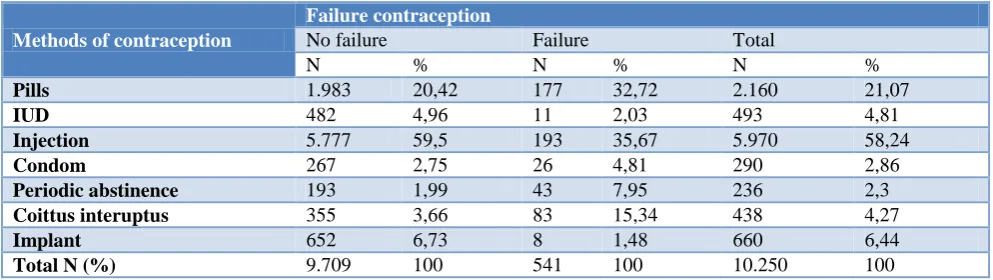
See more about this method of contraception with a failure of contraception there is a failure in any of the methods is different. About one-third of respondents who experience failure of contraceptive methods are pills and injection. Method of contraception is coitus interrupted has a percentage of 15.3% of all respondents, this is the failure of most after contraceptive methods are pills and injection. Contraceptive failure by contraceptive method (Table 2).
Figure 1: The curve of Kaplan-Meier function of the sustainability of contraceptive use according to method of contraception.
Table 2 : Distribution of contraceptive failure according to the method of contraception.
Methods of contraception
Failure contraception
No failure Failure Total
N % N % N %
Pills 1.983 20,42 177 32,72 2.160 21,07
IUD 482 4,96 11 2,03 493 4,81
Injection 5.777 59,5 193 35,67 5.970 58,24
Condom 267 2,75 26 4,81 290 2,86
Periodic abstinence 193 1,99 43 7,95 236 2,3
Coittus interuptus 355 3,66 83 15,34 438 4,27
Implant 652 6,73 8 1,48 660 6,44
Total N (%) 9.709 100 541 100 10.250 100
Source : processing of data IDHS 2012, the data is not weighed.
0.00 0.20 0.40 0.60 0.80 1.00
Pro
ba
bi
lit
as
Ke
la
n
gs
un
ga
n
Pe
ng
gu
na
an
Ko
n
tra
se
p
si
0 5 10 15 20 25 30 35 40 45 50 55 60
durasi penggunaan kontrasepsi (bulan) pil
IUD suntik Kondom Pantang Berkala Senggama Terputus Implan
The pregnancy rate per 100 women
Methods of contraception
Pregnancy rates first year (Trussell)a
Pregnancy rate the first 12 monthsb
Implant 0.05* 0.56*
IUD 0.8* 0.75*
Male sterilization 0.15*
Woman sterilization 0.2*
Injection 3** 1.28**
Pills 8** 4**
Male condoms 15# 7.26**
Woman condoms 21#
diaphragm 16#
Periodic abstinence 25# 7.32#
There are significant differences between methods of contraception contribute to the failure of contraception as shown in Table 2 and Figure 1. The difference is caused by the natural behavior of each method of contraception donated by the failure of a contraceptive that is clearly different between the pill, IUD, injectable, condom, intercourse interrupted, periodic abstinence, and implants. Methods that do not required the help of most family planning services tend to be more high-failure contraceptives as a method of traditional contraception such as periodic abstinence and coitus interrupted as well as condoms and pills. While IUDS and implants which requires medical procedures in the use or release of contraception, so they tend to lower the failure rate of
contraception.13 Therefore for the analysis is then
performed with the stratification method of contraception at random.
DISCUSSION
The results of this study showed the failure rate of contraceptives in one of the methods of contraception method of contraception implants is high compared with the failure rate of contraception in the United States. Trussell 2009 suggested that the numbers this failure occurs because the women who wear contraception do
not correctly and consistently.6 Naturally, all methods of
contraception work in the body with different reactions
and for the use of each method are also different.14 The
results of this study indicate the use of contraception is highest in that using the method of the syringe and after it is the pills. The use of injectable methods in Indonesia the failure rate is low compared with the United States and the methods of contraceptive pill also is low. The dominance of the use how KB by the method of a pill and the injectable is not the only way to assess the success of
family planning services.15 According to Winner et al
2012 argue that that the use of contraceptives has many obstacles, namely the availability of skilled labor and
unequal facilities services required.7 In developing
countries, according to Trussell, the most capable of doing of contraception is to use a method of
contraception a small amount.16
The quality of family planning services is not maximized known with the officers of the family planning services that focused on one area and not evenly distributed. Contraceptive failure in implants is much higher above the standard obtained by the Trussell using data that
exists in the United States.6 This happens due to the use
of contraceptive implants in Indonesia is still in a quality that is inadequate. IDHS 2012 mention that the use of the implant more on the economic level of the poor and very poor on the methods of long-term contraception instead
of use of contraceptive methods IUD.5 Be aware that the
implant also has a price that is quite economical compared to the IUD as well as the number of program use implants free on every region in Indonesia. Concluded that implants wear at a rate to the poor economy and where the economic level of the poor
located in many places that many have not yet had the officers family planning services quality as one of the causes of occurrence of a failure rate that high on the implants. On distribution has not been evenly distributed as well as counseling pre and post actions as one of the assessment of the quality of services has not yet reached the standard maximum also be a reason where occurrence of the failure rate high on the implants. This condition is exacerbated with the minimum of health facilities so that the use of contraceptives is very little and is not maximized in the results of this study so that the failure rate of contraception is also high.
CONCLUSION
Failure rate of contraceptives is highest in contraceptive intercourse is interrupted and the most effective contraceptive is a contraceptive method impalan. On a figure of this failure can be determine the approach the provider in menyelanggarajan family planning services quality by lowering the failure rate of contraception led to an unwanted pregnancy.
Funding: No funding sources Conflict of interest: None declared
Ethical approval: The study was approved by the Institutional Ethics Committee
REFERENCES
1. WHO U, Mathers C. Global strategy for women's,
children's and adolescents' health (2016-2030). Organization. 2017;2016(9).
2. Huang Y, Merkatz R, Zhu H, Roberts K,
Sitruk-Ware R, Cheng L, et al. The free
perinatal/postpartum contraceptive services project for migrant women in Shanghai: effects on the incidence of unintended pregnancy. Contraception. 2014;89(6):521-7.
3. Bowers RC, Hatfield Kresch M, Roy A, Lancaster
D, Yoost JL. Failure of effective contraception in opioid addicted mothers: a disparity in planned and actual usage. Marshall J Med. 2019;5(1):7.
4. Saptarini I, Suparmi S. determinan kehamilan tidak
diinginkan di Indonesia (analisis data sekunder riskesdas 2013). Indonesian J Reprod Health. 2016;7(1):15-24.
5. BKKBN. Survey demografi dan kesehatan
Indonesia (SDKI) 2012. Jakarta: BKKBN. 2013.
6. Trussell J. Contraceptive failure in the United
States. Contraception. 2004;70(2):89-96.
7. Winner B, Peipert JF, Zhao Q, Buckel C, Madden T,
Allsworth JE, et al. Effectiveness of long-acting reversible contraception. New England J Med. 2012;366(21):1998-2007.
8. Brunie A, Tolley EE, Ngabo F, Wesson J, Chen M.
9. Huang Y-M, Merkatz R, Kang J-Z. Postpartum unintended pregnancy and contraception practice among rural-to-urban migrant women in Shanghai. Contraception. 2012;86(6):731-8.
10. Septalia R, Puspitasari N. Faktor yang memengaruhi
pemilihan metode kontrasepsi. J Biometrika dan Kependudukan. 2017;5(2):91-8.
11. Sagheer N, Ullah S, Latif N, Zaman T. Improving
Design and Delivery Of Family Planning Services To Meet The Unmet Need For Contraception In Quetta Balochistan. Pakistan J Public Health. 2018;8(4):213-8.
12. Leticee N, Viard J-P, Yamgnane A, Karmochkine
M, Benachi A. Contraceptive failure of etonogestrel implant in patients treated with antiretrovirals including efavirenz. Contraception. 2012;85(4):425-7.
13. Koser K. The ART of couple satisfaction. JMU
Scholarly Commons. 2018.
14. Ningrum N, Mahdiyah D, Sari D. Effectiveness of
Relaxation Techniques to Decrease Handheld
Finger Pain Intensity Post Cesarean Section at Dr. H. Moch. Ansari Saleh Hospital in Banjarmasin. Adv Health Sci Res. 2017;6:188-95.
15. Simavli S, Kaygusuz I, Gumus I, Usluogulları B,
Yildirim M, Kafali H. Effect of music therapy during vaginal delivery on postpartum pain relief
and mental health. J Affective Disorders.
2014;156:194-9.
16. Trussell J. Understanding contraceptive failure. Best
Pract Res Clin Obstetr Gynaecol. 2009;23(2):199-209.
Cite this article as: Rahmatiqa C, Wilopo SA,
Prawitasari S.Failure contraception in Indonesia: