Original Research Article
Happiness level among medical students of a medical college
Surendra Kulkarni, Chincholikar Sanjeev*
INTRODUCTION
In psychology, happiness is recognized as “emotion”. Emotion is divided into “negative emotion” and “positive emotion”. Happiness has important effect on the success of people. Happy people have optimistic attitude to the events and instead of negative attitudes to the events, they try to use these events. Happy people are responsible and good citizens.1 Medical studies are considered very intensive and students often feel overburdened with their academic commitments. The exhaustive medical courses and the pressure of doing well in exams contribute to
general stress and anxiety among students.2,3 Psychologists believe that three main components of happiness are as follows: The relative existence of positive emotion, the lack of negative emotions and life satisfaction.4,5 Medical field is one of the fields that due to the clinical period and the pressures of hospitals and stressful environment have considerable effects on happiness and their job performance. Various studies showed that age, gender, education, income, marital status and relation with other are effective on positive emotions and happiness level.6-11 Happiness is one of the issues in positive psychology, which is considered an
ABSTRACT
Background: In psychology, happiness is recognized as “emotion”. Emotion is divided into “negative emotion” and “positive emotion”. Psychologists believe that three main components of happiness are as follows: The relative existence of positive emotion, the lack of negative emotions and life satisfaction. Medical field is one of the fields that due to the clinical period and the pressures of hospitals and stressful environment have considerable effects on happiness and their job performance. Medical students are the future healers of the society. Happiness level of the students has effects on their performance. Hence the present study is an attempt to assess the happiness level of medical students.
Methods: A cross-sectional study was carried out among medical students of a private medical college in Maharashtra. The participants in the study were medical students of all academic years enrolled in a private medical college. Happiness was measured by using Oxford Happiness Questionnaire.
Results: It can be observed that happiness level of medical students is 70%. Female students are slightly more happy than male students. It was found that 49% study participants are unhappy as they are having insufficient pocket money.
Conclusions: The level of happiness among students does not depend on their number of attempts in previous examinations. It was evident that percentage of happiness is much more in students living with their family. It was also observed Percentage of happiness is much more in students having some hobby. The study also revealed that level of happiness decreases marginally as the academic year progresses.
Keywords: Happiness, Family, Habits, Attempts, Medical students
Department of Community Medicine, MIMER Medical College Talegaon Dabhade, Pune, Maharashtra, India
Received: 21 April 2019 Revised: 04 June 2019 Accepted: 05 June 2019
*Correspondence: Dr. Chincholikar Sanjeev, E-mail: [email protected]
Copyright: © the author(s), publisher and licensee Medip Academy. This is an open-access article distributed under the terms of the Creative Commons Attribution Non-Commercial License, which permits unrestricted non-commercial use, distribution, and reproduction in any medium, provided the original work is properly cited.
important part of quality of life and is above all the wealth.12 In the new literature, happiness has been defined as the combination of positive affect and lack of negative affect and life satisfaction.13 Medical students are the future healers of the society. Happiness level of the students has effects on their performance. Hence the present study is an attempt to assess the happiness level of medical students.
The aims and objectives are: to study happiness level among medical students, to find out the association of some socio-demographic factors with happiness and to compare happiness in medical students.
METHODS
A cross-sectional study was carried out among medical students of a private medical college in Maharashtra. The participants in the study were medical students of all academic years enrolled in a private medical college. The data was collected from all the students which were present in the class and who had given consent to participate in the study. The study was carried out in students of a Medical college from December 2017 to June 2018.
The data was collected using a pretested questionnaire. The questionnaire was in two parts. The first part of the questionnaire consisted of questions related to social, demographic variables. The second part of the questionnaire was a validated Oxford Happiness Questionnaire. Happiness was measured by using Oxford Happiness Questionnaire (OHQ) (18), which consists of 29 statements for which responses are measured on Likert scale ranging from 1 to 6, where 1 means “strongly disagree” and 6 means “strongly agree”. Final score is calculated by adding scores of 29 questions and dividing it by 29. According to this tool higher scores indicate higher happiness. Score of 4 means somewhat happy or moderately, satisfied. This is what the average person scores. So the scores below 4 were considered as unhappy and scores above 4 were considered as happy.14,15
Ethical approval was obtained from ethical institutional committee. Statistical analysis was carried out by using appropriate statistical tests like chi square test.
RESULTS
This was a cross sectional study carried out to study the level of happiness among medical students. Total 399 students from all academic years participated in the study.
Attempts were made to correlate level of happiness with gender of the student, the type of local residence, sufficiency of pocket money, number of attempts in previous examinations and hobby (Table 1).
Table 1: Level of happiness compared with gender of the student.
Gender Unhappy Happy Total
N (%) N (%)
Male 48 (31.16 ) 106 (68.83) 154 Female 72 ( 29.38) 173 ( 70.61) 245
Total 120 279 399
χ2
=0.143; DF=1 and P=0.70.
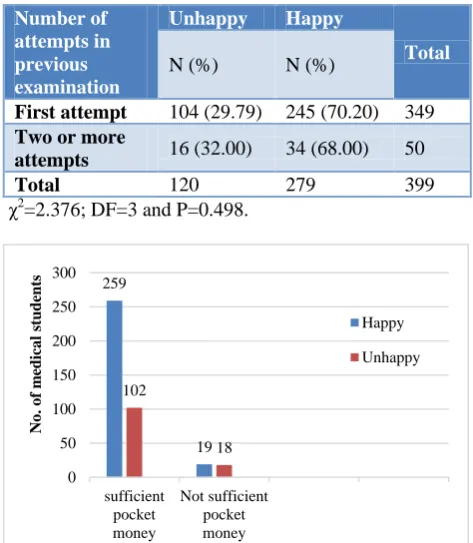
Table 2: Level of happiness compared with number of attempts in previous examinations.
Number of attempts in previous examination
Unhappy Happy
Total
N (%) N (%)
First attempt 104 (29.79) 245 (70.20) 349 Two or more
attempts 16 (32.00) 34 (68.00) 50
Total 120 279 399
χ2=2.376; DF=3 and P=0.498.
Figure 1: Level of happiness compared with sufficiency of pocket money. χ2
=6.628; DF=1 and p=0.01.
Figure 2: Level of happiness compared with local residence of the students.
χ2
=3.963; DF=1 and p=0.04.
259
19 102
18 0
50 100 150 200 250 300
sufficient pocket money
Not sufficient pocket money
No
.
o
f
m
edica
l
students Happy
Unhappy
9 41
111
238
0 50 100 150 200 250
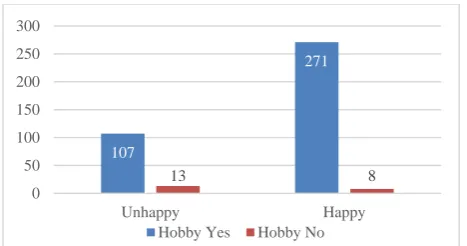
Figure 3: Level of happiness compared with hobby of the participants.
χ2=10.67; DF=1 and p=0.001.
Table 3: Level of happiness based on academic year of the students.
Academic year
Unhappy Happy
Total
N (%) N (%)
I MBBS 27 (26.47) 75 (73.53) 102 II/I MBBS 37 (28.91) 91 (71.09) 128 III/I MBBS 24 (29.63) 57 (70.37) 81 III Major 32 (36.36) 56 (63.64) 88
Total 120 279 399
χ2
=2.376; DF=3 and p=0.498.
It can be observed that happiness level of medical students is 70%. Female students are slightly more happy than male students. However after applying chi square test, this difference was not found statistically significant.
Table 2 depicts the level of happiness among students depending on their number of attempts in previous examinations. It can be found that almost 30% students are unhappy either with first attempt or more attempts for exam. After applying chi square test, the difference was not found significant.
Figure 1 reveals the relationship between level of happiness and sufficiency of pocket money. 398 students responded to this question. Out of these 398 students, 361 (90.70%) students feel that their pocket money is sufficient for them and only 37 (9.29%) students fill their pocket money is not sufficient. 49% study participants are unhappy as they are having insufficient pocket money. After applying chi square test, it was observed that the difference was found statistically significant at p=0.01.
It means that adequate money is essential for medical student to be happy.
From Figure 2 it is evident that percentage of happiness is much more in students living with their family. Out of total 120 unhappy students, majority of them are staying away from family. However there are quite a few number of happy students staying away from family also. Statistical significance was tested by applying chi square
test. The difference was found statistically significant at p=0.04.
Relationship of happiness with the hobby of the students was also evaluated. Figure 3 shows that out of 399 students 378 (94.73%) students were having some hobby such as music, sports, reading etc. Percentage of happiness is much more in students having some hobby. At the same time it can be seen from the table that percentage of unhappiness is more in students who are not having any hobby. After applying chi square test, the difference was found significant with p=0.001.
From the Table 3, it appears that level of happiness decreases marginally as the academic year progresses. However after applying chi square test, the difference was not found significant.
DISCUSSION
It was observed that happiness level of medical students is 70%. Female students are slightly more happy than male students. Similar are the observations found in another study conducted by Shekhar et al.16
Some studies have found significant differences between men and women, with women obtaining higher scores in happiness.17 In another study also It was found that male students (51.4%) were happier than females (48.6%).18
It was observed from Table 2 that level of happiness among students does not depend on their number of attempts in previous examination.
Research with adolescents and university students has underlined that happiness is positively related to academic success.19 However we could not find more studies to validate our findings.
Figure 1 reveals the relationship between level of happiness and sufficiency of pocket money. 398 students responded to this question. Out of these 398 students 361 (90.70%) students fill that their pocket money is sufficient for them and only 37 (9.29%) students fill their pocket money is not sufficient. However still among these 361 students who fill their pocket money is sufficient, 102 (28.25%) students are not happy with their amount of pocket money. On the contrary 19 (51.35%) students who fill their pocket money is not sufficient are still happy. On applying Chi square test the difference was found statistically significant at p=0.01. 49% study participants are unhappy as they are having insufficient pocket money.
In one study, all participants mentioned that the main source of happiness is money. Good relationship with friends and family is the second source of happiness among university students. Some of the students mentioned that the stability of life and good health are 107
271
13 8
0 50 100 150 200 250 300
Unhappy Happy
causes of happiness. Few participants mentioned that success in life is one of the causes of the happiness.20
In another study it was observed that socioeconomic status was related to happiness.21
Figure 2 reveals that percentage of happiness is much more in students living with their family. It is 82.00% in students living with family and 68.19% in students living away from their family. Statistical significance was tested by applying chi square test. The difference was found statistically significant at p=0.04. In another study it was observed that the students who live with their families at their home are happier than the students living in dormitory. There was a significant difference between happiness level of the students and gender (girls are happier than boys), marriage (married students are happier than single students) and living status (the students who live with their families at their home are happier than the students living in dormitory.22
It was observed from Figure 3 that percentage of happiness is much more in students having some hobby. Those who had higher levels of internet addiction showed reduced subjective happiness. Thus, those who experience decreased subjective happiness without overt psychological disturbances are still prone to have addictive patterns. This should be considered during screening for addictive behaviors.
However, gender, cigarette smoking, hookah smoking and body mass index were not significantly correlated with happiness.21
Table 3 depicts that happiness level decreases marginally year wise. Similar results were obtained in Taif university medical students where they found out that the 2nd and 3rd year groups were more likely to be happy (p=0.106).23
CONCLUSION
It can be observed that happiness level of medical students is 70%. Female students are slightly more happy than male students. 49% study participants are unhappy as they were having insufficient pocket money. The level of happiness among students does not depend on their number of attempts in previous examinations. It was evident that percentage of happiness is much more in students living with their family. It was also observed Percentage of happiness is much more in students having some hobby. The study also revealed that level of happiness decreases marginally as the academic year progresses.
Recommendations
The present study has brought out few important causes of happiness and unhappiness in medical students. More studies on a larger sample size need to be conducted to
focus into these phenomena. More causes of happiness need to be studied including self-esteem, anxiety, health status, perfectionism and depression and identify their correlates. Unhappiness may have serious detrimental effects on the mental health of students which in turn, can halt their academic progress.
ACKNOWLEDGEMENTS
We sincerely thank all the study participants for their kind help.
Funding: No funding sources Conflict of interest: None declared
Ethical approval: The study was approved by the Institutional Ethics Committee
REFERENCES
1. Boehm JK, Lyubomirsky S. Does happiness promote career success? Journal of career assessment. 2008;16(1):101-16.
2. Hashmat S, Hashmat M, Amanullah F, Aziz S. Factors causing exam anxiety in medical students. J Pak Med Assoc. 2008;58(4):167-70.
3. Shah SIA, Ahmed M. Medical student’s anxiety on beginning clinical studies. Al-Ameen J Med Sci. 2013;6:195-201.
4. Alipour A, Nor-bala A. Introductory survey of reliability and validity of Oxford Happiness Questionnaire in Tehran Universities. Journal of Thought and Behavior. 1999;5:55-63.
5. Hills P, Argyle M. Happiness, introversion– extraversion and happy introverts. Personality and Individual Differences. 2001;30(4):595-608. 6. Haring MJ, Stock WA, Okun MA. A research
synthesis of gender and social class as correlates of subjective well-being. Human Relations. 1984;37(8):645-57.
7. Easterlin RA. Will raising the incomes of all increase the happiness of all? J Econ Behav Organ. 1995;27(1):35-47.
8. Koivumaa- Honkanen H, Koskenvuo M, Honkanen R, Viinamäki H, Heikkilä K, Kaprio J. Life dissatisfaction and subsequent work disability in an 11-year follow-up. Psychological medicine. 2004;34(02):221-8.
9. Mookerjee R, Beron K. Gender, religion and happiness. Journal of SocioEconomics. 2005;34(5):674-85.
10. Lelkes O. Tasting freedom: Happiness, religion and economic transition. J Econ Behav Organ. 2006;59(2):173-94.
11. Dehejia R, DeLeire T, Luttmer EFP. Insuring consumption and happiness through religious organizations. Journal of Public Economics. 2007;91(1):259-79.
university [in Persian]. Iranian J Psychiatr Clin Psychol. 2006;12:95–100.
13. Argyle M, Martin M, Lu L. Testing for stress and happiness: The role of social and cognitive factors. Stress and Emotion. 1995;15:173–87.
14. Hills P, Argyle M. The Oxford Happiness Questionnaire: a compact scale for the measurement ofpsychological wellbeing. Personality and Individual Differences, 2002;33:1073–82.
15. Available at: http://www.meaningand-happiness.com/oxford‐happiness‐questionnaire/214. Accessed on 2 January 2019.
16. Shekhar C, Jamwal A, Sharma S. Happiness and forgiveness among college students. Indian J Psychological Sci. 2017;7(1):88-93.
17. Aldous J, Ganey RF. Family life and the pursuit of happiness: the influence of gender and race. J Fam. 1999;20:155–80.
18. Kamthan S, Sharma S, Rahul B, Bhawna P, Parul S, Shivakshi C, et al. Happiness among second year MBBS students and its correlates using Oxford Happiness Questionnaire. J Oral Biol Craniofacial Res. 2019;9(2):190-6.
19. Rigby K, Cox I, Black G. Cooperativeness and Bully/Victim problems among australian schoolchildren. J. Soc. Psychol. 1997;137:357–68. 20. Naggar RAA, Al-Jashamy KA, Yun LW, Isa ZM,
Alsaror MI, Al-Naggar AA. Perceptions And Opinion Of Happiness Among University Students In A Malaysian University. ASEAN Journal of Psychiatry, 2010;11(2).
21. Sahraian A, Vakili SM. Studying the happiness level among medical students of Shiraz Medical Sciences University in 2010. Shiraz E Med J. 2012;13(4):179-86.
22. Alshehri AA, Althobaiti SM, Alsaadi HD, Alnemari AK, Alyami H, Alyami M, et al. Subjective Happiness Assessment among Taif University Medical Students. Am J Educ Res. 2016;4(1):111-14.