Original Research Article
Knowledge of newborn care practices among caregivers attending
immunization clinic at a tertiary care centre of Lucknow:
a cross-sectional study
Sujata Singh
1, Kriti Yadav
2*, Ranjana Choudhary
3INTRODUCTION
In the course of a lifetime, an individual encounters the greatest risk of mortality during birth and the first 28 days of life (the neonatal period).1 Thus, Essential Newborn Care (ENC) is very important. It provides for an opportunity to assess the infant’s growth and development and counsel mothers regarding proper
newborn care (e.g. counselling on breast feeding, keeping the baby warm, hygienic cord and eye care, immunization, danger signs in the newborn and care seeking illness) which are crucial for both the mother and the infant.2 Effective ENC is also about recognising any deviation from expected recovery after birth, and evaluating and intervening appropriately in a timely fashion.
ABSTRACT
Background: Essential newborn care (ENC) provides for an opportunity to assess the infant’s growth and development and counsel mothers regarding proper newborn care. Acquainting the caregivers with knowledge pertaining to dangers signs, hygienic practices, feeding, weaning, health and nutrition including growth and behaviour of children, might affect the rearing of their children. Therefore the present study aims to study the knowledge of caregivers in relation to newborn care.
Methods: A descriptive cross sectional study was conducted among the caregivers attending the immunization clinic in a tertiary care centre (King George's Medical University) in Lucknow between January- March, 2016. A pretested and structured interview questionnaire was used to collect data and analysis was done using SPSS ver 16.0.
Results: In Majority (75%) of the caregivers the knowledge regarding ENC was found to be average. Only 4% of the caregivers had good knowledge of ENC. Among the variables the association of knowledge of ENC and age of the caregiver< 30 years, general caste, level of education of the caregiver of high School and above, middle socioeconomic status, female sex of the newborn, birth order of 2 or more, >4 ANC visits and new born care not discussed in the VHND being conducted in the area were found to be statistically significantly.
Conclusions: On the whole, the results of our study indicated that most of the caregivers were having unsatisfactory knowledge of child care practices. The present scenario can be improved through enhancing information education and counselling activities, training of health workers and mothers focusing on newborn health care practices.
Keywords: Caregivers, Immunization clinic, Knowledge, Lucknow, Newborn care
1
Department of Community Medicine and Public Health, King George's Medical University, Lucknow, Uttar Pradesh, India
2
Department of Community and Family Medicine, AIIMS, Bhopal, Madhya Pradesh, India
3
Department of Microbiology, AIIMS, Rishikesh, Uttarakhand, India
Received: 09 April 2019
Accepted: 17 May 2019
*Correspondence:
Dr. Kriti Yadav,
E-mail: [email protected]
Copyright: © the author(s), publisher and licensee Medip Academy. This is an open-access article distributed under the terms of the Creative Commons Attribution Non-Commercial License, which permits unrestricted non-commercial use, distribution, and reproduction in any medium, provided the original work is properly cited.
Newborn mortality is one of the world's most neglected health problems.3 Each year, nearly 4 million newborns die during the neonatal period throughout the world.2 Three quarters of these deaths take place within 1 week of birth, 1–2 million die during the first day following birth, and most of these deaths occur at home.2 Each year, of the 26 million infants born in India, nearly 1.2 million die during the neonatal period, before completing 4 weeks of life, amounting to one quarter of all the neonatal deaths in the world.4 The neonatal mortality rate in Uttar Pradesh is 50.5 Although there is a decrease in infant and child mortality rates, but there is no significant difference in neonatal mortality rates which could be attributed to the unavailability of quality care to all.6
There is scope for improvement by providing better care and health education for caregivers.7 Acquainting the caregivers with knowledge pertaining to dangers signs, hygienic practices, feeding, weaning, health and nutrition including growth and behaviour of children, might affect the rearing of their children.8 Providing timely education in the form of intervention to the caregivers could fill these gaps in knowledge of child care.8
Under the programs run by the government provisions have been made to provide for most of the basic neonatal care at homes through primary care in a highly cost-effective manner.9 ASHA has been given the responsibility of independently visiting the postnatal mothers and the neonate to promote optimal newborn care practices in domestic settings and ensuring proper referral of only those neonates who cannot be managed at home.9
Despite of all these measures there has been relatively little change in neonatal mortality rate (NMR).10 Studies
on newborn care in some communities show that the knowledge and practice of basic newborn care for instance prevention of hypothermia, feeding of colostrum and exclusive breast-feeding are lacking; even awareness regarding care seeking on the identification of life threatening signs has been found to be very low.8
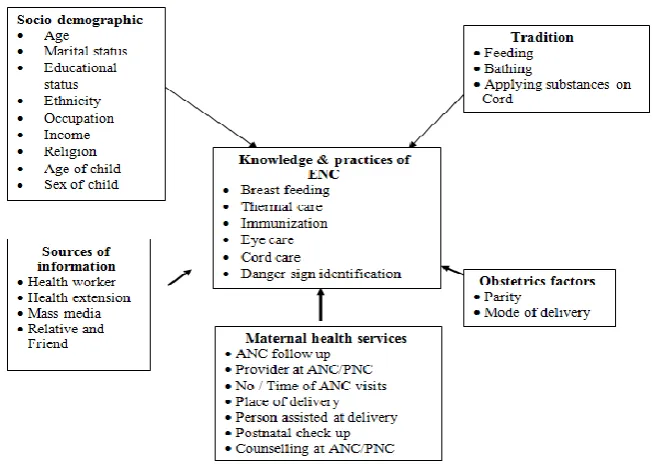
The present study thus aims to study the knowledge of caregivers in relation to newborn care viz. prevention of hypothermia, colostrum feeding, early initiation of breast feeding, pre-lacteal feeding, cord and eye care, immunization, identification of danger signs and seeking proper referral and the impact of ASHA’s visit on the caregiver’s knowledge so as to find the reason behind this discrepancy.
Research question
What is the level of knowledge of Newborn Care Practices among caregivers attending immunization clinic at a tertiary care centre of Lucknow?
Objectives
To assess the level of knowledge of Newborn Care Practices among caregivers attending immunization clinic at a tertiary care centre of Lucknow.
To give suitable recommendations for the gaps identified during the study.
METHODS
Study design:Descriptive cross sectional study.
Study period:January - March, 2016.
Study area: Immunization clinic in a tertiary care centre (King George's Medical University) in Lucknow.
Study population: All caregivers who visited the immunization clinics at KGMU during the study period.
Sample size and sampling method determination
Purposive sampling method was used and a sample size of 100 caregivers fulfilling the inclusion criteria was taken.
Inclusion criteria
Caregivers who gave informed consent and were cooperative.
Data collection procedure
The data collection was carried out by the investigator. After recruiting the study subjects, pretested structured interview questionnaire was used to collect data. The questionnaire was prepared in english and consists of questions addressing the following:
Newborn‘s and parents socio-demographic data.
Antenatal and birth history of the newborn.
Caregiver‘s knowledgeon the WHO ENC practices.
Data was also collected regarding provision of information by health workers and perception of available newborn care.
Operational definition
Essential newborn care (ENC)2: ENC is a comprehensive strategy designed to improve the health of newborns through interventions before conception, during pregnancy, at and soon after birth, and in the postnatal period. The World Health Organization guidelines for essential newborn care encompass cleanliness, thermal protection, initiation of breathing, early and exclusive breast feeding, eye care, immunization, management of illness and care of low birth weight infants. It is applicable to all those who deal with newborns- parents, relatives, birth attendants etc and should be practiced accordingly.
Data processing and analysis
The collected data were then coded, verified and analysed using the Statistical Package for Social Sciences computer version 16.0 software. A total of 18 questions were asked to assess knowledge on various aspects of newborn care. The results were then tabulated in form of frequency tables. Statistical testing was done using Chi square tests for categorical data during analysis of factors associated with knowledge on Essential Newborn Care. Data was then presented using pie charts, histograms and tables.
RESULTS
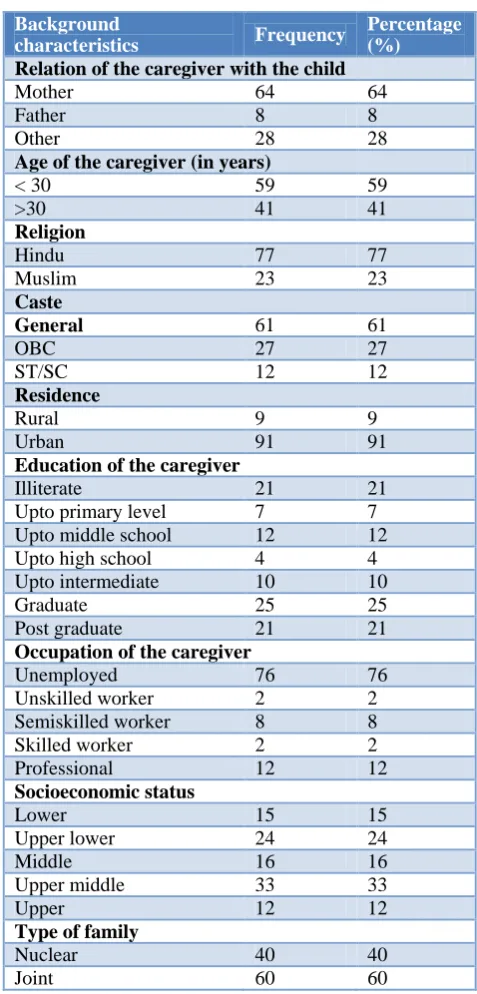
Amongst the 100 infants studied, approximately two-third (64%) of the infants had mother as their caregiver and 59% of the caregivers had their ages >30 years. Among the caregivers of the infants more than three-fourth (77%) were Hindu and 61% belonged to general social class. Majority (91%) of the caregivers were residing in urban areas. One-fourth (25%) of the caregivers were graduate and more than three-fourth
(76%) of the caregivers were unemployed.
Approximately one-third (33%) of the caregivers belonged to upper middle socioeconomic social class and 60% had joint families (Table 1).
Table 1: Socio-demographic characteristics of the study population (n=100).
Background
characteristics Frequency
Percentage (%)
Relation of the caregiver with the child
Mother 64 64
Father 8 8
Other 28 28
Age of the caregiver (in years)
< 30 59 59
>30 41 41
Religion
Hindu 77 77
Muslim 23 23
Caste
General 61 61
OBC 27 27
ST/SC 12 12
Residence
Rural 9 9
Urban 91 91
Education of the caregiver
Illiterate 21 21
Upto primary level 7 7
Upto middle school 12 12
Upto high school 4 4
Upto intermediate 10 10
Graduate 25 25
Post graduate 21 21
Occupation of the caregiver
Unemployed 76 76
Unskilled worker 2 2
Semiskilled worker 8 8
Skilled worker 2 2
Professional 12 12
Socioeconomic status
Lower 15 15
Upper lower 24 24
Middle 16 16
Upper middle 33 33
Upper 12 12
Type of family
Nuclear 40 40
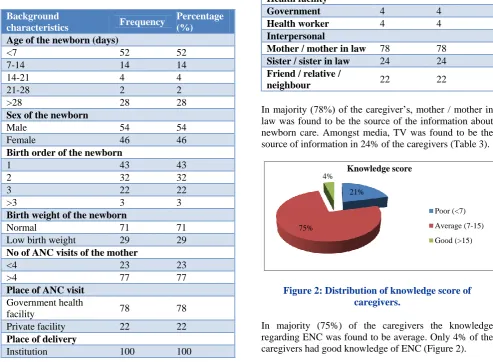
More than half (52%) of the infants were aged less than 7 days and 43% of the infants had birth order of one. The sex distribution of the infants was homogenous with 54% males and 46% females. Approximately three-fourth (71%) of the infants had birth weight >2.5 kg. ANC visits >4 were made in majority (77%) of the infants and government health facility was found to be the place of ANC visit in more than three-fourth (78%) of the infants. All the infants had Institutional deliveries (Table 2).
Table 2: Characteristics of the newborn (n=100).
Background
characteristics Frequency
Percentage (%)
Age of the newborn (days)
<7 52 52
7-14 14 14
14-21 4 4
21-28 2 2
>28 28 28
Sex of the newborn
Male 54 54
Female 46 46
Birth order of the newborn
1 43 43
2 32 32
3 22 22
>3 3 3
Birth weight of the newborn
Normal 71 71
Low birth weight 29 29
No of ANC visits of the mother
<4 23 23
>4 77 77
Place of ANC visit
Government health
facility 78 78
Private facility 22 22
Place of delivery
Institution 100 100
Table 3: Source of information about newborn care (n=100).
Source of information Frequency Percentage (%)
Media
Radio 10 10
TV 24 24
Newspaper 2 2
Magazine / book 6 6
Health facility
Government 4 4
Health worker 4 4
Interpersonal
Mother / mother in law 78 78
Sister / sister in law 24 24
Friend / relative /
neighbour 22 22
In majority (78%) of the caregiver’s, mother / mother in law was found to be the source of the information about newborn care. Amongst media, TV was found to be the source of information in 24% of the caregivers (Table 3).
Figure 2: Distribution of knowledge score of caregivers.
In majority (75%) of the caregivers the knowledge regarding ENC was found to be average. Only 4% of the caregivers had good knowledge of ENC (Figure 2).
Table 4: Factors influencing Knowledge of caregivers about ENC.
21%
75%
4% Knowledge score
Poor (<7) Average (7-15) Good (>15)
Background characteristics Poor knowledge Average knowledge Good knowledge P value
N (%) N (%) N (%)
Relation of the caregiver with the child
Mother 10 (15.6) 52 (81.3) 2 (3.1)
0.156
Other 11 (30.6) 23 (63.1) 2 (5.6)
Age of the caregiver (in years)
<30 6 (10.2) 50 (84.7) 3 (5.1)
0.006**
>30 15 (36.6) 25 (61.0) 1 (2.4)
Religion
Hindu 17 (22.1) 56 (72.7) 4 (5.2)
0.973
Muslim 4 (17.4) 19 (82.6) 0 (0.0)
Caste
General 6 (9.8) 51 (83.6) 4 (6.6)
0.000**
OBC 6 (22.2) 21 (77.8) 0 (0.0)
Background characteristics Poor knowledge Average knowledge Good knowledge P value
N (%) N (%) N (%)
Residence
Rural 1 (11.1) 8 (88.9) 0 (0.0)
0.574
Urban 20 (22.0) 67 (73.6) 4 (4.4)
Education of the caregiver
Illiterate 10 (47.6) 11 (52.4) 0 (0.0)
0.004**
Upto primary level 2 (28.6) 5 (71.4) 0 (0.0)
Upto high school 2 (7.7) 21 (80.7) 3 (11.5)
Upto intermediate 7 (15.2) 38 (82.6) 1 (2.2)
Occupation of the caregiver
Unemployed 18 (23.7) 56 (73.7) 2 (2.6)
0.267
Employed 3 (12.5) 19 (79.2) 2 (8.3)
Socioeconomic status
Lower 10 (23.8) 32 (76.2) 0 (0.0)
0.001**
Upper lower 11 (23.9) 34 (73.9) 1 (2.2)
Middle 0 (0.0) 9 (75.0) 3 (25.0)
Type of family
Nuclear 7 (17.5) 30 (75.0) 3 (7.5)
0.297
Joint 14 (23.3) 45 (75.0) 1 (1.7)
Age of the newborn
< 7 days 10 (19.2) 42 (80.8) 0 (0.0)
0.076
> 7 days 11 (22.9) 33 (68.7) 4 (8.3)
Sex of the newborn
Male 14 (25.9) 40 (74.1) 0 (0.0)
0.048*
Female 7 (15.2) 35 (76.1) 4 (8.7)
Birth order of the newborn
1 15 (34.9) 28 (65.1) 0 (0.0)
0.025*
2 4 (12.5) 26 (81.3) 2 (6.3)
≥3 2 (8.0) 21 (84.0) 2 (8.0)
Birth weight of the newborn
Normal 12 (16.9) 55 (77.5) 4 (5.6)
0.150
Low birth weight 9 (31.0) 20 (69.0) 0 (0.0)
No of ANC visits
<4 10 (43.5) 13 (56.5) 0 (0.0)
0.008**
>4 11 (14.3) 62 (80.5) 4 (5.2)
Place of ANC visit
Government health facility 17 (22.1) 57 (74.0) 3 (3.9)
0.921
Private facility 4 (18.2) 17 (77.3) 1 (4.5)
Child vaccinated at birth
Yes 20 (22.0) 67 (73.6) 4 (4.4)
0.574
No 1 (11.1) 8 (88.9) 0 (0.0)
Aware that health worker is supposed to counsel regarding newborn care
Yes 0 (0.0) 2 (100.0) 0 (0.0)
0.575
No 21 (21.4) 73 (74.5) 4 (4.1)
Home visit by health worker after birth of the child
Yes 2 (11.1) 16 (88.9) 0 (0.0)
0.600
No 19 (23.2) 59 (71.9) 4 (4.9)
Health worker taught / counselled regarding newborn care
Yes 2 (16.7) 10 (83.3) 0 (0.0)
0.534
No 19 (21.6) 65 (73.9) 4 (4.5)
New born care discussed the VHND being conducted in the area
Yes 2 (100.0) 0 (0.0) 0 (0.0)
0.012*
No 19 (19.4) 75 (76.5) 4 (4.1)
Satisfied with the newborn care services being provided
Yes 12 (19.4) 46 (74.2) 4 (6.5)
0.262
Among the variables the association of knowledge of Essential Newborn Care and age of the caregiver< 30 years, general caste, level of education of the caregiver of high school and above, middle socioeconomic status,
female sex of the newborn, birth order of2 or more, >4 ANC visits and new born care not discussed in the VHND being conducted in the area were found to be statistically significantly (Table 4).
DISCUSSION
The present study was conducted with an aim to assess the level of knowledge of respondents regarding ENC. This study was carried out in a tertiary care centre in Lucknow district of Uttar Pradesh, India for a period of three months. Respondents who attended the Immunization clinic during the study period were included into the study after taking their verbal consent. Regardless of the various demographic profiles of participants, it was found that participants had a low level of knowledge on newborn care practices.
WHO recommends that babies be bathed after 24 hours of birth and not earlier to avoid hypothermia2. The present study showed that 20% of newborn were given a bath immediately after birth which was much less than that observed by Gupta et al, Singh and Kumar et al.4,11 Some components of good thermal protection like wrapping the baby in multiple layers of cloth were practiced by majority of the participants which is different from the findings of improper wrapping of the newborn as reported in previous studies.
Most of the respondents did not have any knowledge of skin to skin care or KMC and did not practice it. KMC has been shown to reduce neonatal mortality among low birth weight and preterm babies and reduce severe morbidity.
In this study, poor practices were found regarding cord care. Moran et al from Bangladesh and Agarwal et al from India reported the application of substances like mustard oil, coconut oil, warm ghee, boric powder and talcum powder to the cord stump till it dries up.12,13 A variety of substances were applied on the cord such as oil, powder, spirit and ointment as reported in others settings. Malpractice that consisted of, application of traditional substances on cord could be explained because of cultural beliefs as reported by 77% of mothers in India.
Mothers were not aware of proper eye care practices and application of kajal to the eyes of babies was seen in 41% of the participants which is similar to the findings of study conducted by previous studies.
Out of total studied children, only 14% were put on breast feeding within an hour of birth, which is quite similar to that reported in national surveys like DLHS-3 and NFHS-3 (15.4% in Uttar Pradesh and 23.4% in India respectively).14 A study conducted by Gupta, et al in
urban slums of Lucknow reported quite similar findings.4 However the figures were much lower than those reported in other studies. Similar to the present study, other studies also reported maternal factors as negative factor for early initiation of breastfeeding. Colostrum was given to 83% of the children which was similar to that observed in other studies. Pre-lacteal feeds were given by 54% of the mothers, which was similar to that reported in other studies. Exclusive breastfeeding for at least six months was done by 44% of the mothers, which was lower to that reported as per DLHS-3 for Uttar Pradesh and NFHS-3 at national level.14,15 About 54% of children were started on complementary feeding at 6 months of age. This is similar to that reported in DLHS-3 and NFHS-3.14,15
With regards to immunization, the respondents had adequate knowledge on various aspects of immunization. Even though 91% of the babies were completely immunized as of date most of the respondents were not
aware of the names of the individual
vaccines/supplements given for the newborn babies. This is an area of great concern since level of immunization coverage is good, but the awareness about which vaccine is given is poor. Awareness regarding the immunization schedule was also found to be low. In an earlier study16 conducted in Kancheepuram district, it is found that only 71.9% of the children were fully immunized while 27.6% were partially immunized.10. It is also similar to the findings of a study conducted by Rama et al.17
The knowledge on different important neonatal danger signs was found to be satisfactory. Most of them identified fever, respiratory and diarrhoeal diseases as the important diseases to be looked for getting treated. In contrast, a study conducted in Mangalore found that only (62%) of the mothers had good knowledge, 36% of the samples had average knowledge while 1% each of the samples had excellent and poor knowledge respectively.17 A study done by Awasthi et al showed that 91.5% of the participants showed similar knowledge levels.18
More than half of the sick newborns were taken to the private doctors/hospitals with the expectation of rapid cure of sick newborn’s illness. Although free newborn care services were provided by the civil hospital, first preference for medical advice was the private practitioner. Studies on a few urban slums have indicated that despite availability of public hospitals, late recognition of neonatal illnesses and delay in seeking medical help were responsible for increased neonatal mortality. A focused ethnographic study in urban slum of Delhi found that maternal recognition of danger signs was not a limiting factor in the use of health care services.19 Mothers were not able to discriminate many sources of health care available in the setting and finally accessed unqualified private providers.
community and the health facility. Studies conducted in Bangladesh, India and Pakistan have shown that home visits can improve coverage of key newborn care practices in the home.20-24
This study result shows that the overall picture of the awareness and level of knowledge regarding the RCH services rendered has not sufficiently reached the target group. The service utilization particularly the antenatal care, institutional delivery and immunization coverage have improved to a highly significant level. But understanding of the very purpose of utilizing such services is limited and ignorance is still persisting among the target group. This is indicated by the low level of knowledge among mothers particularly regarding provision of essential new born care and various components and purpose of the immunization schedule.
Strengths of study
The findings of this study provide valuable information for improving the quality of programs to educate mothers on ENC practices. This is possible by enabling the identification of knowledge gaps and negative attitude towards newborn care. This study, being cross sectional, provided a relative quick way to obtain information on newborn care as there was no need for follow up.
Study limitations
The study was based on reported rather than observed knowledge and attitude towards newborn care practices. There was therefore a risk that mothers may report what was expected of them but their actual practices may be different. Lack of a universal census on definition of good or poor knowledge and attitude posed a challenge in the study. As the study was carried out among attendees of Immunization Clinic at a tertiary hospital in Lucknow, findings may not be generalized to the whole country.
CONCLUSION
On the whole, the results of our study indicated that most of the caregivers were having unsatisfactory knowledge of child care practices. Practices like giving bath to the baby after one week, skin to skin contact, non-application of substances on the cord / in the eye, early initiation of breastfeeding, no pre-lacteal feeds, exclusive breast feeding, knowledge about various vaccines, immunization schedule and danger signs are less prevalent in our study. Knowledge about proper wrapping, giving colostrum, demand feeding, age of initiation of complimentary feeding, immunization and health seeking behaviour was found to be satisfactory. Health workers role in provision of newborn care services was found to be highly unsatisfactory. Despite the fact that 100% of the deliveries were institutional it was found that the knowledge about newborn care practices was very poor. This reflects a significant gap in the health care delivery system regarding proper counselling which
should be strengthened to reduce the missed opportunities. The present scenario can be improved through enhancing Information Education and Counselling activities, training of health workers and mothers focusing on newborn health care practices. Special emphasis needs to be placed when educating vulnerable groups including those who failed to fully attend antenatal clinic visits. Additional survey on factors associated with maternal knowledge and attitude should be done. Self-mentoring, supervisions and revising, on education of mothers for health care providers should be done by regional and zonal health sectors.
ACKNOWLEDGEMENTS
I would like to thank my dear friend Arti Pandey for her unconditional love and support and her valuable inputs during the course of the study.
Funding: No funding sources Conflict of interest: None declared
Ethical approval: The study was approved by the Institutional Ethics Committee
REFERENCES
1. Tesfahun F, Worku W, Mazengiya F, Kifle M. Knowledge, Perception and Utilization of Postnatal Care of Mothers in Gondar Zuria District, Ethiopia: A Cross-Sectional Study. Maternal Child Health J. 2014;18(10):2341-51.
2. 2005 World Health Report: Make Every Mother and Child Count (WHO) and The Lancet’s Newborn Survival Series (2005) and UNICEF (2008). 3. Parlato RP, Darmstadt GL, Tinker A. Saving
newborn lives, Initiative. Washington, D.C. 2005. 4. Gupta P, Srivastava V, Kumar V, Jain S, Masood J,
Ahmad N, et al. Newborn care practices in urban slums of Lucknow city, UP. Indian J Community Med. 2010;35(1):82.
5. Vital Statistics Division, Office of the Registrar General & Census Commissioner. Annual Health Survey, 2012-13, Fact Sheet, Uttar Pradesh. New Delhi: Office of the Registrar General & Census Commissioner, India;2013. Available from website: www.censusindia.gov.in. Accessed on 3 May 2019. 6. Kumar V, Kumar A, Darmstadt GL. Behavior
change for newborn survival in resource-poor community settings: bridging the Gap between
evidence and impact. Semin Perinatol
2010;34(6):446–61.
7. Padiyath MA, Vishnu Bhat B, Ekambaram M, Knowledge attitiude and practice of neonatal care among postnatal mothers. Current Pediatr. 2009;14(2):1-10.
8. Sharma S, Nagar S. Impact of educational intervention on knowledge of mothers regarding childcare and nutrition in Himachal Pradesh. J Social Sci. 2006;12(2):139-42.
Deliveries among Urban Slums of Meerut, UP India. J Community Med Health Educ. 2012;2:171 10. Dwivedi SBL. Newborn care practices: A case study
of tribal women, Gujarat. Health. 2013;05(08):29-40.
11. Singh P, Rai R, Kumar C. Equity in maternal, newborn, and child health care coverage in India. Global Health Action. 2013;6(1):22217.
12. Moran A, Choudhury N, UzZaman Khan N, AhsanKarar Z, Wahed T, Faiz Rashid S, et al. Newborn care practices among slum dwellers in Dhaka, Bangladesh: a quantitative and qualitative exploratory study. BMC Pregnancy and Childbirth. 2009;9(1):1.
13. Agarwal S, Srivastava K, Sethi V. Maternal and Newborn Care Practices Among the Urban Poor in Indore, India: Gaps, Reasons and Possible Program Options. Urban Health Resource Center (New Delhi), 2007.
14. International Institute for Population Sciences (IIPS), 2010. District Level Household and Facility Survey (DLHS-3), 2007-08: India. Uttar Pradesh: Mumbai: IIPS, 2010.
15. International Institute for Population Sciences (IIPS) and Macro International. 2007. National Family Health Survey (NFHS-3), 2005–06: India: Volume II. Mumbai: IIPS.
16. Rama R, Gopalakrishnan S, Udayshankar PM. Assessment of knowledge regarding new-born care among mothers in Kancheepuram district, Tamil Nadu. Int J Community Med Public Health. 2014;1(1):58.
17. Reshma, Sujatha R. Cultural practices and beliefs on newborn care among mothers in a selected hospital of mangaloretaluk. Nitte University J Health Sci. 2014;4(2):21-6.
18. Srivastava N, Awasthi S, Mishra R. Neonatal Morbidity and Care-seeking Behavior in Urban Lucknow. Indian Pediatr. 2008;15.
19. Rahi M, Taneja D, Misra A, Mathur N, Badhan S. Newborn care practices in an urban slum of Delhi. Indian J Med Sci. 2006;60(12):506.
20. Baqui AH, Ahmed S, El Arifeen S, Darmstadt G, Rosencrans AM, Mannan I, et al. Effect of timing of first postnatal care home visit on neonatal mortality in Bangladesh: a observational cohort study. BMJ. 2009;339:2826.
21. Darmstadt GL, Choi Y, Arifeen SE, Bari S, Rahman SM, Mannan I, et al. Evaluation of a cluster– randomized controlled trial of a package of
community–based maternal and newborn
interventions in Mirzapur, Bangladesh. PLoS ONE. 2010;5:e9696.
22. Kumar V, Mohanty S, Kumar A, Misra RP, Santosham M, Awasthi S, et al. Effect of community– based behaviour change management on neonatal mortality in Shivgarh, Uttar Pradesh, India: a cluster–randomised controlled trial. Lancet. 2008;372:1151–62.
23. Agrawal P, Agrawal S, Ahmed S, Darmstadt G, Williams E, Rosen H et al. Effect of knowledge of community health workers on essential newborn health care: a study from rural India. Health Policy Planning. 2011;27(2):115-26.
24. Aboubaker S, Qazi S, Wolfheim C, Oyegoke A, Bahl R. Community health workers: A crucial role in newborn health care and survival. J Global Health. 2014;4(2):1.