R E S E A R C H A R T I C L E
Open Access
The quantity and quality of complementary
and alternative medicine clinical practice
guidelines on herbal medicines,
acupuncture and spinal manipulation:
systematic review and assessment using
AGREE II
Jeremy Y. Ng, Laurel Liang and Anna R. Gagliardi
*Abstract
Background:Complementary and alternative medicine (CAM) use is often not disclosed by patients, and can be unfamiliar to health care professionals. This may lead to underuse of beneficial CAM therapies, and overuse of other CAM therapies with little proven benefit or known contraindications. No prior research has thoroughly evaluated the credibility of knowledge-based resources. The purpose of this research was to assess the quantity and quality of CAM guidelines.
Methods: A systematic review was conducted to identify CAM guidelines. MEDLINE, EMBASE and CINAHL were searched in January 2016 from 2003 to 2015. The National Guideline Clearinghouse, National Center for Complementary and Integrative Health web site, and two CAM journals were also searched. Eligible guidelines published in English language by non-profit agencies on herbal medicine, acupuncture, or spinal manipulation for adults with any condition were assessed with the Appraisal of Guidelines, Research and Evaluation II (AGREE II) instrument.
Results: From 3,126 unique search results, 17 guidelines (two herbal medicine, three acupuncture, four spinal manipulation, eight mixed CAM therapies) published in 2003 or later and relevant to several clinical conditions were eligible. Scaled domain percentages from highest to lowest were clarity of presentation (85.3 %), scope and purpose (83.3 %), rigour of development (61.2 %), editorial independence (60.1 %), stakeholder involvement (52.0 %) and applicability (20.7 %). Quality varied within and across guidelines. None of the 17 guidelines were recommended by both appraisers; 14 were recommended as Yes or Yes with modifications.
Conclusions: Guidelines that scored well could be used by patients and health care professionals as the basis for discussion about the use of these CAM therapies. In future updates, guidelines that achieved variable or lower scores could be improved according to specifications in the AGREE II instrument, and with insight from a large number of resources that are available to support guideline development and implementation. Future research should identify CAM therapies other than those reviewed here for which guidelines are available. Research is also needed on the safety and effectiveness of CAM therapies.
Keywords: Complementary and alternative medicine, Integrative medicine, Systematic review, AGREE II, Clinical practice guideline
* Correspondence:[email protected]
Toronto General Hospital Research Institute, University Health Network, Toronto, Ontario, Canada
Background
It is currently estimated that more than 70 % of North Americans have tried at least one form of complemen-tary and alternative medicine (CAM), [1–3] collectively spending billions of dollars annually on these therapies [4, 5]. CAM has been defined as “a group of diverse medical and health care interventions, practices, pro-ducts or disciplines that are not generally considered part of conventional medicine” [6]. The National Center for Complementary and Integrative Health (NCCIH) further defines a non-mainstream practice used together with conventional medicine as “complementary”, a non-mainstream practice used in place ofconventional medi-cine as “alternative”, and the coordinated delivery or use of conventional and complementary approaches as
“integrative”[6]. This study henceforth refers to therapies that fall into all of these categories as CAM.
The past several decades have seen a sharp increase in research on CAM given the strong patient-driven market [7]. Examples of well-studied CAM therapies that show potential benefit include chiropractic spinal manipulation for low back pain and headaches [8–12], and acupuncture for different types of pain [13–18]. Recognizing such benefits, academic institutions are increasingly incorpora-ting CAM into medical education, research and practice [11]. However, a variety of factors appear to influence whether and how CAM is used. Patients may not discuss their use of CAM with health care professionals out of fear of being judged or not seeing this as important to disclose, potentially leading to contraindications with other treatment [19–22]. Many health care professionals were not exposed to CAM in their medical training [23], are unfamiliar with CAM therapies, and find it challenging to discuss use or disuse of CAM with their patients [24, 25]. This is exacerbated by the fact that CAM is com-prised of many different and unrelated types of therapies and schools of thought about their use [26]; and the reli-ability of evidence about safety and effectiveness varies between CAM therapies [27–29]. Given all of these fac-tors, concerns have been raised about legal and ethical is-sues pertaining to the recommendations that health care professionals offer their patients about using or not using CAM therapies [24, 30]. Hence, patients and health care professionals may benefit from credible, knowledge-based resources upon which to base discus-sions and decidiscus-sions about use of CAM.
Health care professionals often rely on evidence-informed clinical practice guidelines to understand whether use of a given therapy is recommended, and as a basis for informed and shared decision-making with patients about associated risks and benefits [31]. Research on a variety of clinical topics has identified that overuse, underuse or misuse of therapies may be asso-ciated with guidelines that are of poor quality [32], and
the quality of guidelines has been proven to vary consi-derably [33]. Few studies have examined CAM guidelines. Content analysis of 10 guidelines on cardiovascular dis-ease and type II diabetes revealed that CAM-relevant information was brief, in some cases unclear, inconclusive and lacking in direction for health care professionals [34]. Analysis of 65 National Institute for Health and Clinical Excellence guidelines available in 2009 found that, among 17 guidelines that mentioned CAM, it was not clinically relevant to most; in 14 of 48 guidelines that did not mention CAM, available evidence on the safety and effectiveness of relevant CAM therapies had not been included [35]. Therefore, no research has thoroughly evaluated the credibility of CAM guidelines. An under-standing of the nature of CAM guidelines available to support informed and shared decision-making among patients and providers would help to identify whether such resources are absent and thus needed, or how they could be improved, thereby guiding future guideline development and associated research. The purpose of this study was to assess the quantity and quality of CAM guidelines.
Methods
Approach
A systematic review was conducted to identify CAM guidelines using standard methods [36] and Preferred Reporting Items for Systematic Reviews and Meta-Analyses (PRISMA) criteria [37]. A protocol was not registered. Eligible guidelines were assessed with the widely used and validated Appraisal of Guidelines, Research and Evaluation II (AGREE II) instrument [38]. AGREE II is a tool that assesses the methodological rigour and transparency in which a guideline is developed, and is the international “gold standard” for the assessment of guidelines. Detailed information is available on the AGREE web site [www.agreetrust.org]. It consists of 23 items grouped in six domains: scope and purpose, stakeholder involvement, rigor of development, clarity and presentation, applicability, and editorial independence.
Eligibility criteria
chiropractic or osteopathic manipulation [39]. For this study, guidelines were eligible if they specifically focused on any of these CAM therapies (category 1 – CAM-specific), or were general CAM guidelines that included at least one recommendation (for or against) at least of these CAM therapies (category 2 – CAM-general). We excluded general guidelines, which includes many hundreds and perhaps thousands, as it would have been challenging to search for and screen them for potential mention of CAM.Comparisonspertained to the assessed quality of CAM guidelines. Outcomes were AGREE II scores which reflect guideline content and format. The following conditions were also applied to define eligible guidelines: developed by non-profit organizations inclu-ding academic institutions, government agencies, disease-specific foundations, or professional associations or societies; published in 2003 or later, which corresponds to the publication of AGREE II which provides deve-lopers with criteria for developing high-quality guide-lines; English language; and either publicly available or could be ordered through our library system. Publica-tions in the form of consensus statements, protocols, abstracts, conference proceedings, letters or editorials; based on primary studies that evaluated CAM therapies; or focused on CAM curriculum, education, training, research, professional certification or performance were not eligible.
Searching and screening
MEDLINE, EMBASE and CINAHL were searched on January 28, 2016 from 2003 to 2015 inclusive. The search strategy (Additional file 1) included Medical Subject Headings and keywords that reflect terms commonly used in the literature to refer to CAM [7]. We also searched the National Guideline Clearinghouse, a publicly available repository of guidelines [http://www.gui deline.gov/] using keyword searches restricted based on the eligibility criteria including “acupressure”, “ acupunc-ture”, “Chinese medicine”, “chiropractic”, “chiropractor”,
“herbal medicine”, “herbal supplement”, “herbal therapy”,
“osteopath”, “phytotherapy”, “plant extract” and “spinal manipulation”. Next, we searched the NCCIH web site which contained a single list of CAM guidelines [https:// nccih.nih.gov/health/providers/clinicalpractice.htm]; and the tables of contents of two CAM journals with the highest impact factors: BMC Complementary and Alter-native Medicine [https://bmccomplementalternmed.bio medcentral.com/] and theJournal of Complementary and Alternative Medicine [http://www.liebertpub.com/over view/journal-of-alternative-and-complementary-medicine-the/26/] from January 2011 and December 2015. All three authors independently screened the titles and abstracts recovered from MEDLINE to standardize screening by discussing and resolving selection differences. Following
this, JYN and LL screened titles and abstracts from all other sources. JYN and ARG screened full-text items to confirm eligibility.
Data extraction and analysis
The following data were extracted from each guideline and summarized: date of publication, country of first author; type of organization that published the guideline (academic institutions, government agencies, disease-spe-cific foundations, or professional associations or soci-eties); topic category 1 (CAM-specific) or category 2 (CAM-general); and guideline topic including type of CAM therapy and disease or condition. Most data were available in the guideline; to assess applicability, the web site of each developer was browsed and searched for any associated knowledge-based resources in support of implementation.
Guideline quality assessment
Results
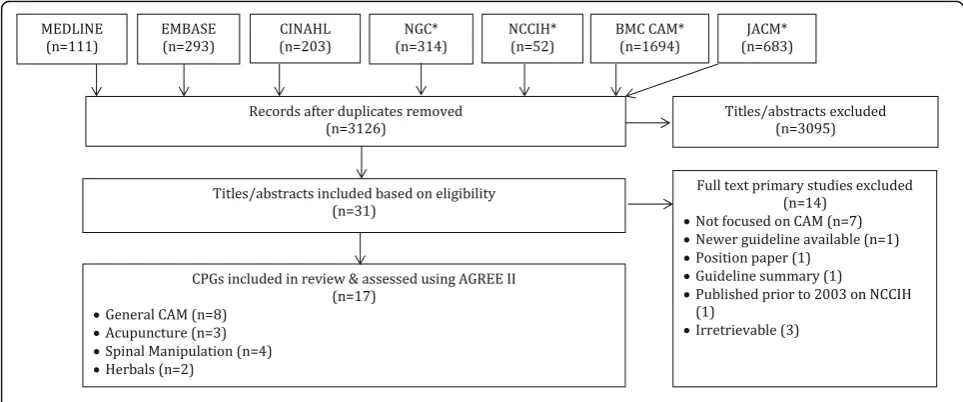
Search results (Fig. 1)
Searches retrieved 3,350 items, 3,126 were unique, and 3,095 titles and abstracts were eliminated, leaving 31 full-text guidelines that were considered. Of those, 14 were not eligible, primarily because they were not focused on CAM (7), they could not be retrieved (3), or did not meet other eligibility criteria (4), leaving 17 guidelines eligible for review.
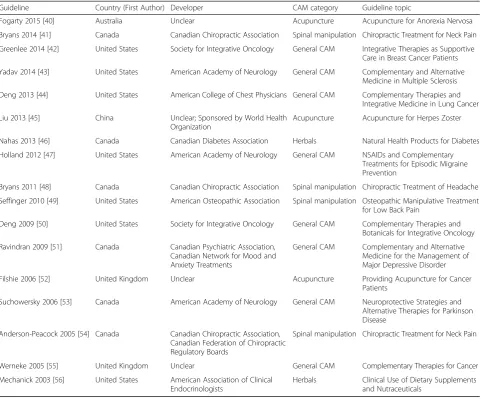
Guideline characteristics (Table 1)
Eligible guidelines were published in 2003 or later in Canada, the United States, United Kingdom, China, and Australia [40–56]. The guidelines were funded and/or developed by professional associations or societies (13), academic (3), and an international agency (1). Nine guidelines were CAM-specific (2 herbal medicine, three acupuncture, four spinal manipulation) and 8 were CAM-general. Clinical topics included anorexia nervosa, breast cancer, cancer (general) diabetes, headache, herpes zoster, low back pain, lung cancer, major depressive disorder, migraine, multiple sclerosis, neck pain, and Parkinson’s disease.
Average appraisal scores, average overall assessments and recommendations regarding use of guidelines
Average appraisal scores, average overall assessments, and recommendation regarding use for each guideline are shown in Additional file 2. The average appraisal scores for each of the 17 guidelines ranged from 3.3 to 5.5 on the seven-point Likert scale (where seven equals strongly agree that the item is met); 14 guidelines
achieved or exceeded an average appraisal score of 4.0, and seven guidelines achieved or exceeded an average appraisal score of 5.0. Average overall assessments for the 17 guidelines ranged between 3.0 (lowest) and 5.5 (highest), including 14 guidelines equalling or exceeding a score of 4.0, and 7 guidelines equalling or exceeding a score of 5.0.
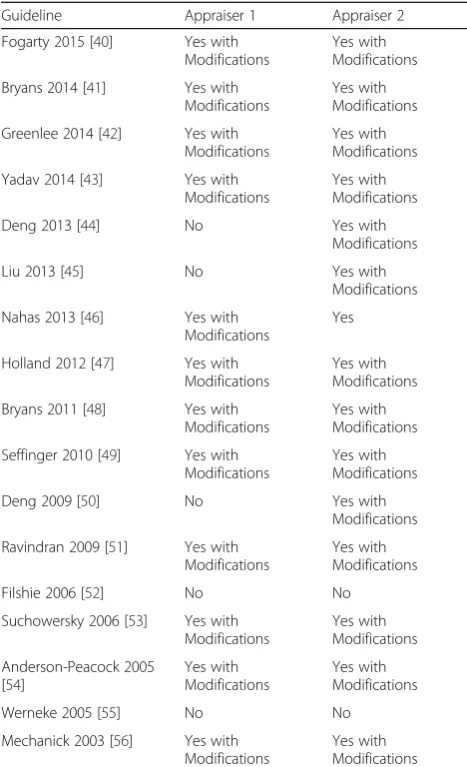
Overall recommendations (Table 2)
[image:4.595.56.538.481.682.2]None of the 17 guidelines were recommended by both appraisers. Appraisers agreed in their overall recommen-dation for 13 of 17 guidelines including 2 No [52, 55], and 11 Yes with modifications [40–43, 47–49, 51, 53, 54, 56]. Of the remaining four guidelines, three were rated by the two appraisers as No and Yes with modifications [44, 45, 50], while 1 guideline was rated at Yes and Yes with modifications [46].
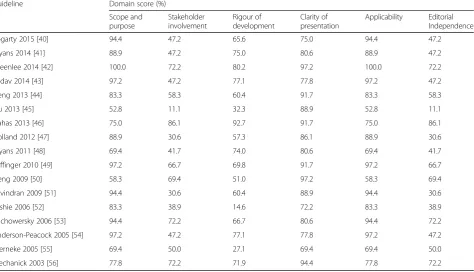
Scaled domain percentage quality assessment (Table 3)
With regards to scaled domain percentages, scope and purpose scores were 52.8 to 100.0 %, stakeholder involvement scores were 11.1 to 86.1 %, rigor-of-development scores were 14.6 to 92.7 %, clarity-of-presentation scores ranged from 69.4 to 97.2 %, applicability scores were 0.00 to 60.42 %, and editorial independence scores ranged from 0.0 to 95.8 %.
Scope and purpose
The overall objectives and health questions were gene-rally well-defined in all but one guideline [45]. Authors provided the goal of the guideline, the types of CAM they sought to assess, and the disease or condition that
was the target of CAM therapy or therapies. The popu-lation to whom the guideline was meant to apply was sometimes less detailed. For example, two guidelines referred to the intended population as“patients”[46, 48].
Stakeholder involvement
Most guidelines thoroughly in detailed the characteris-tics of the members of the guideline development group, typically including degrees held by, and institutional affiliation of each member, in addition to some of the following: subject discipline, geographical location, and description of member’s role in the group [41–44, 46– 49, 53–56]. Some guidelines detailed the views and preferences of the target population [44, 46, 53, 56] while most did not [40–43, 45, 47–52, 54, 55]. Target users of the guideline were typically inconsistently defined. Some guidelines offered clear descriptions, for example, type of practitioner, specialty [40, 46, 49, 50, 52, 53, 56], while
other guidelines offered few details about target users [43, 45, 47, 50, 54, 55].
Rigor of development
[image:5.595.58.540.98.497.2]Systematic methods were almost always used to search for evidence and the criteria for selecting the evidence were almost always clearly described [40–44, 46–51, 53, 54, 56], with the exception of a few guidelines [45, 52, 55]. The strengths and limitations of the body of evidence were clearly described in all guidelines except for one [45]. The methods for formulating the recommendations varied; while some guidelines provided a fair amount of detail on how consensus was reached [40, 42, 46, 48, 49, 53, 54, 56], other guidelines provided minimal information if not none at all [40, 41, 45, 47, 51, 55]. All authors considered some health benefits, side effects, and/or risks in formulating their recommendations, with the exception of one [52]. Nearly all guidelines provided an explicit link between their recommendations and the supporting
Table 1Characteristics of eligible guidelines
Guideline Country (First Author) Developer CAM category Guideline topic
Fogarty 2015 [40] Australia Unclear Acupuncture Acupuncture for Anorexia Nervosa
Bryans 2014 [41] Canada Canadian Chiropractic Association Spinal manipulation Chiropractic Treatment for Neck Pain Greenlee 2014 [42] United States Society for Integrative Oncology General CAM Integrative Therapies as Supportive
Care in Breast Cancer Patients Yadav 2014 [43] United States American Academy of Neurology General CAM Complementary and Alternative
Medicine in Multiple Sclerosis Deng 2013 [44] United States American College of Chest Physicians General CAM Complementary Therapies and
Integrative Medicine in Lung Cancer
Liu 2013 [45] China Unclear; Sponsored by World Health
Organization
Acupuncture Acupuncture for Herpes Zoster
Nahas 2013 [46] Canada Canadian Diabetes Association Herbals Natural Health Products for Diabetes Holland 2012 [47] United States American Academy of Neurology General CAM NSAIDs and Complementary
Treatments for Episodic Migraine Prevention
Bryans 2011 [48] Canada Canadian Chiropractic Association Spinal manipulation Chiropractic Treatment of Headache Seffinger 2010 [49] United States American Osteopathic Association Spinal manipulation Osteopathic Manipulative Treatment
for Low Back Pain
Deng 2009 [50] United States Society for Integrative Oncology General CAM Complementary Therapies and Botanicals for Integrative Oncology Ravindran 2009 [51] Canada Canadian Psychiatric Association,
Canadian Network for Mood and Anxiety Treatments
General CAM Complementary and Alternative Medicine for the Management of Major Depressive Disorder
Filshie 2006 [52] United Kingdom Unclear Acupuncture Providing Acupuncture for Cancer
Patients
Suchowersky 2006 [53] Canada American Academy of Neurology General CAM Neuroprotective Strategies and Alternative Therapies for Parkinson Disease
Anderson-Peacock 2005 [54] Canada Canadian Chiropractic Association, Canadian Federation of Chiropractic Regulatory Boards
Spinal manipulation Chiropractic Treatment for Neck Pain
Werneke 2005 [55] United Kingdom Unclear General CAM Complementary Therapies for Cancer
Mechanick 2003 [56] United States American Association of Clinical Endocrinologists
evidence with the exception of two guidelines in which this was inconsistent [49, 52]. While some guidelines explicitly stated that they were externally reviewed by experts prior to publication [41, 46, 54, 56], many did not [42–44, 47, 48, 52, 55]. Some guidelines failed to mention the purpose and intent for, or the methods employed for the external review [40, 45, 49–51, 53]. Most guidelines did not include a procedure for updating the guideline [42, 44, 45, 47, 48, 50–56] and, among those that did, one guideline provided a detailed methodology [46].
Clarity of presentation
Generally, all guidelines offered specific and unambi-guous recommendations. However, many typically lacked one or more of the following details: identification of the intent/purpose, relevant population, or caveats. All 17 guidelines scored highly in presenting different options for the management of the condition or health issue, thus
contributing to this high scaled domain percentage [40–56]. Key recommendations were also generally very easily identifiable.
Applicability
One guideline discussed facilitators and barriers to implementation of the recommendations [49]. Three guidelines included advice and/or tools to support implementation of the recommendations [49, 54, 56]. No guidelines addressed the resource implications of implementing the recommendations. Two guidelines provided monitoring and auditing criteria, while 14 guidelines contained little to no such information.
Editorial independence
Guidelines varied in reporting of the funding source or competing interests of the members of the guideline development panel. Several guidelines that declared a funding source did not state whether funding source influ-enced the content of the guideline [41, 42, 48, 53, 54, 56].
No guidelines explicitly stated that no funding sup-ported their development. Guidelines also varied in reporting of competing interests. Several guidelines did not address competing interests [45, 51, 52, 55, 56]. While remaining guidelines did so, two did not spe-cify how potential competing interests were identified or considered, or how they may have influenced the guideline development process or issuing of recom-mendations [50, 53].
Discussion
[image:6.595.56.290.109.493.2]To identify credible, knowledge-based resources upon which patients and health care professionals can base discussions and decisions about use of CAM, the pur-pose of this research was to assess the quantity and quality of CAM guidelines. This study identified 17 guidelines (nine specific CAM therapy, eight mixed CAM therapies) published in 2003 or later that were relevant to a variety of conditions and diseases. Quality as assessed by the 23-item AGREE II instrument varied widely across guidelines overall and by domain; two guidelines scored 5.0 or higher in both average appraisal score and average overall assessment [46, 49], and three guidelines scored 3.5 or lower in both of these metrics [45, 52, 55] (1 = strongly disagree; 7 = strongly agree that criteria are met).
To our knowledge, no previous studies have assessed the quantity and quality of guidelines on CAM therapies. Thus, we believe that this is the first study to assess the credibility and nature of CAM guidelines. The findings are similar to those of guidelines on other clinical topics. In this study of CAM guidelines, the scaled domain percentages from highest to lowest were clarity of presentation (85.3 %), scope and purpose
Table 2Overall recommendations for use of appraised guidelines
Guideline Appraiser 1 Appraiser 2
Fogarty 2015 [40] Yes with Modifications
Yes with Modifications Bryans 2014 [41] Yes with
Modifications
Yes with Modifications Greenlee 2014 [42] Yes with
Modifications
Yes with Modifications Yadav 2014 [43] Yes with
Modifications
Yes with Modifications
Deng 2013 [44] No Yes with
Modifications
Liu 2013 [45] No Yes with
Modifications Nahas 2013 [46] Yes with
Modifications
Yes
Holland 2012 [47] Yes with Modifications
Yes with Modifications Bryans 2011 [48] Yes with
Modifications
Yes with Modifications Seffinger 2010 [49] Yes with
Modifications
Yes with Modifications
Deng 2009 [50] No Yes with
Modifications Ravindran 2009 [51] Yes with
Modifications
Yes with Modifications
Filshie 2006 [52] No No
Suchowersky 2006 [53] Yes with Modifications
Yes with Modifications Anderson-Peacock 2005
[54]
Yes with Modifications
Yes with Modifications
Werneke 2005 [55] No No
Mechanick 2003 [56] Yes with Modifications
(83.3 %), rigour of development (61.2 %), editorial inde-pendence (60.1 %), stakeholder involvement (52.0 %) and applicability (20.7 %). In a previous study we found that, among 137 guidelines on a wide variety of clinical topics published from 2008 to 2013, the scaled domain percentages were ordered in similar fashion from highest (clarity of presentation 76.3 %) to lowest (applicability 43.6 %) [33]. Previous studies that examined a total of 654 guidelines published from 1980 to 2007 [57, 58], and 1,046 guidelines produced between 2005 and 2013 by 130 Australian guideline developers [59] also reported similar findings. Therefore the variable and sub-optimal quality of guidelines is not a unique phenomenon.
Notable strengths of this study included the use of a comprehensive systematic review to identify eligible CAM guidelines and the use of the validated AGREE II instrument by which to assess their quality, which is the internationally-accepted gold standard for appraising guidelines [38]. The interpretation of these findings may be limited by the fact that guidelines were independently assessed by two appraisers instead of four as recom-mended by the AGREE II instrument to optimize reli-ability. To mitigate this and standardize scoring, ARG, JYN and LL conducted an initial pilot-test during which they independently appraised the same two guidelines, then discussed the results and achieved consensus on how to apply the AGREE II instrument. Following appraisal of the 17 guidelines, ARG met with JYN and LL to discuss and resolve any uncertainties without
unduly modifying legitimate discrepancies. This review does not address all CAM therapies; three therapies were chosen (herbal medicine, acupuncture, chiropractic or osteopathic manipulation) because they were identi-fied as having the largest evidence base, and were therefore considered more likely to be the subject of guidelines [39]. We may not have identified all guide-lines that included these three types of CAM therapy because, to establish a feasible scope, we did not search for guidelines on specific clinical topics and then peruse them for CAM-related content, and we did not search all CAM journals or the Guidelines International Network guideline library. We included CAM topics for which there was likely to be available evidence such as guidelines. Many patients use CAM lacking supporting evidence, therefore, it may be useful to examine guidelines on a broader range of CAM topics to evaluate the basis for recommending those therapies.
By describing the quantity and quality of CAM guidelines, this study revealed that few CAM guilines are available to support informed and shared
de-cision-making among patients and health care
[image:7.595.64.539.102.374.2]professionals. This likely reflects the lack of research on CAM therapies. Others have identified numerous factors that challenge CAM research including negative attitudes about CAM therapies [60–65] and a lack of targeted funding [66–69]. However, this is expected to change given that CAM therapies continue to be used by more than 40 % of the population in some regions of the world
Table 3Scaled domain percentages for appraisers of each guideline
Guideline Domain score (%)
Scope and purpose
Stakeholder involvement
Rigour of development
Clarity of presentation
Applicability Editorial Independence
Fogarty 2015 [40] 94.4 47.2 65.6 75.0 94.4 47.2
Bryans 2014 [41] 88.9 47.2 75.0 80.6 88.9 47.2
Greenlee 2014 [42] 100.0 72.2 80.2 97.2 100.0 72.2
Yadav 2014 [43] 97.2 47.2 77.1 77.8 97.2 47.2
Deng 2013 [44] 83.3 58.3 60.4 91.7 83.3 58.3
Liu 2013 [45] 52.8 11.1 32.3 88.9 52.8 11.1
Nahas 2013 [46] 75.0 86.1 92.7 91.7 75.0 86.1
Holland 2012 [47] 88.9 30.6 57.3 86.1 88.9 30.6
Bryans 2011 [48] 69.4 41.7 74.0 80.6 69.4 41.7
Seffinger 2010 [49] 97.2 66.7 69.8 91.7 97.2 66.7
Deng 2009 [50] 58.3 69.4 51.0 97.2 58.3 69.4
Ravindran 2009 [51] 94.4 30.6 60.4 88.9 94.4 30.6
Filshie 2006 [52] 83.3 38.9 14.6 72.2 83.3 38.9
Suchowersky 2006 [53] 94.4 72.2 66.7 80.6 94.4 72.2
Anderson-Peacock 2005 [54] 97.2 47.2 77.1 77.8 97.2 47.2
Werneke 2005 [55] 69.4 50.0 27.1 69.4 69.4 50.0
[70, 71]; and patients continue to use CAM despite documented risks associated with some CAM therapies [22, 70–75]. As research emerges, so too will guidelines that focus on CAM therapies [10].
This study also revealed that the quality of CAM guidelines varied across domains within individual guidelines, and across different guidelines. This finding is relevant to those who will produce CAM guidelines in the future, and to developers of existing CAM guidelines that, when updated, could be improved. Apart from the AGREE II instrument, numerous principles, frameworks, criteria and checklists are available to help guideline developers, including CAM guideline developers, to generate the highest-quality products [76–81].
Conclusions
This study identified 17 guidelines published since 2003 on CAM therapies including herbal medicines, acupuncture, and chiropractic or osteopathic manipula-tion. Appraisal of these guidelines with the AGREE II instrument revealed that quality varied within and across guidelines. Some of these guidelines that achieved higher AGREE II scores and favourable overall recommendations could be used by patients and health care professionals as the basis for discussion about the use of these CAM therapies. In future updates, guidelines that achieved variable or lower scaled domain percentage and overall recommendations could be improved according to speci-fications in the AGREE II instrument, and with insight from a large number of resources that are available to support guideline development and implementation [75–80]. However, the fact that few CAM guidelines are available to support informed and shared decision-making between patients and health care professionals may con-tinue to foster underuse of beneficial CAM therapies, and overuse or contraindicated use of other CAM for which there is no proven benefit or potential associated risks. This finding justifies the need for greater research on the safety and effectiveness of CAM therapies. Future research should also identify CAM therapies other than those reviewed here which are supported by sufficient evidence to serve as the basis for guideline development.
Additional files
Additional file 1:MEDLINE Search Strategy for CAM guidelines executed Jan 28, 2016. (DOCX 33 kb)
Additional file 2:Average appraisal scores and average overall assessments of each guideline. (DOCX 37 kb)
Abbreviations
AGREE II:Appraisal of guidelines for research & evaluation II; BMC CAM: BioMedCentral complementary and alternative medicine; CAM: Complementary and alternative medicine; JACM: Journal of complementary and alternative medicine; NCCIH: National Center for
Complementary and Integrative Health; NGC: National Guideline Clearinghouse; PICO: Patients, intervention, comparison and outcomes; PRISMA: Preferred reporting items for systematic reviews and meta-analyses
Acknowledgements Not applicable.
Funding Not applicable.
Availability of data and materials
All relevant data are included in this manuscript.
Authors’contributions
JYN: made contributions to the design of the study, collected and analysed data, drafted the manuscript, and gave final approval of the version to be published. LL: contributed to study design and planning, assisted with the collection and analysis of data, and gave final approval of the version to be published. ARG: made substantial contributions to the design of the study, the collection of data as well as interpretation and analysis of the data, revised the manuscript critically, and gave final approval of the version to be published.
Competing interests
The authors declare that they have no competing interests.
Consent for publication
All authors consent to this manuscript’s publication.
Ethics approval and consent to participate
This study involved a systematic review of peer-reviewed literature only; it did not require ethics approval or consent to participate.
Received: 6 July 2016 Accepted: 20 October 2016
References
1. Public Health Agency of Canada. Complementary and alternative health. http://www.phac-aspc.gc.ca/chn-rcs/cah-acps-eng.php. (2008). Accessed 28 Jan 2016.
2. Barnes PM, Powell-Griner E, McFann K, Nahin RL. Complementary and alternative medicine use among adults: United States, 2002. Semin Integr Med. 2004;2(2):54–71.
3. Eisenberg DM, Davis RB, Ettner SL, Appel S, Wilkey S, Van Rompay M, Kessler RC. Trends in alternative medicine use in the United States, 1990-1997: Results of a follow-up national survey. JAMA. 1998;280(18):1569–75. 4. Nahin RL, Barnes PM, Stussman BJ, Bloom B. Costs of complementary and
alternative medicine (CAM) and frequency of visits to CAM practitioners: US 2007. Hyattsville: Diane Publishing; 2010.
5. Esmail N. Complementary and alternative medicine in Canada: trends in use and public attitudes, 1997-2006. Vancouver: Fraser Institute; 2007. 6. National Institutes of Health, National Centre for Complementary and
Integrative Health (NCCIH). Complementary, alternative, or integrative health: What’s in a name? https://nccih.nih.gov/health/integrative-health (2016). Accessed 28 Jan 2016.
7. Ng JY, Boon HS, Thompson AK, Whitehead CR. Making sense of
“alternative”,“complementary”,“unconventional”and“integrative”medicine: exploring the terms and meanings through a textual analysis.
BMC Complement Altern Med. 2016;16(134):1.
8. Chaibi A, Tuchin PJ, Russell MB. Manual therapies for migraine: a systematic review. J Headache Pain. 2011;12(2):127–33.
9. Walker BF, French SD, Grant W, Green S. A Cochrane review of combined chiropractic interventions for low-back pain. Spine J. 2011;36(3):230–42. 10. Bronfort G, Haas M, Evans R, Leininger B, Triano J. Effectiveness of manual
therapies: the UK evidence report. Chiropr Man Therap. 2010;18(1):3. 11. Bronfort G, Assendelft WJ, Evans R, Haas M, Bouter L. Efficacy of spinal
manipulation for chronic headache: a systematic review. J Manipulative Physiol Ther. 2001;24(7):457–66.
13. Liu L, Skinner M, McDonough S, Mabire L, Baxter GD. Acupuncture for low back pain: an overview of systematic reviews. Evid Based Complement Alternat Med. 2015;2015:328196.
14. Manyanga T, Froese M, Zarychanski R, Abou-Setta A, Friesen C, Tennenhouse M, Shay BL. Pain management with acupuncture in osteoarthritis: a systematic review and meta-analysis. BMC Complement Altern Med. 2014;14(1):312.
15. Vickers AJ, Cronin AM, Maschino AC, Lewith G, MacPherson H, Foster NE, Sherman KJ, Witt CM, Linde K. Acupuncture for chronic pain: individual patient data meta-analysis. Arch Intern Med. 2012;172(19):1444–53. 16. Cherkin DC, Sherman KJ, Avins AL, Erro JH, Ichikawa L, Barlow WE, Delaney
K, Hawkes R, Hamilton L, Pressman A, Khalsa PS. A randomized trial comparing acupuncture, simulated acupuncture, and usual care for chronic low back pain. Arch Intern Med. 2009;169(9):858–66.
17. Yuan J, Purepong N, Kerr DP, Park J, Bradbury I, McDonough S. Effectiveness of acupuncture for low back pain: a systematic review. Spine J.
2008;33(23):E887–900.
18. Witt CM, Jena S, Brinkhaus B, Liecker B, Wegscheider K, Willich SN. Acupuncture for patients with chronic neck pain. Pain. 2006;125(1):98–106. 19. Ventola CL. Current issues regarding complementary and alternative
medicine (CAM) in the United States: Part 1: The widespread use of CAM and the need for better-informed health care professionals to provide patient counseling. Pharmacol Ther. 2010;35(8):461.
20. Barraco D, Valencia G, Riba AL, Nareddy S, Draus CB, Schwartz SM. Complementary and alternative medicine (CAM) use patterns and disclosure to physicians in acute coronary syndromes patients. Complement Ther Med. 2005;13(1):34–40.
21. Coulter ID, Willis EM. The rise and rise of complementary and alternative medicine: a sociological perspective. Med J Aust. 2004;180(11):587. 22. Tsai HH, Lin HW, Simon Pickard A, Tsai HY, Mahady GB. Evaluation of
documented drug interactions and contraindications associated with herbs and dietary supplements: A systematic literature review. Int J Clin Pract. 2012;66(11):1056–78.
23. Cowen VS, Cyr V. Complementary and alternative medicine in US medical schools. Adv Med Educ Pract. 2015;6:113–7.
24. Adams KE, Cohen MH, Eisenberg D, Jonsen AR. Ethical considerations of complementary and alternative medical therapies in conventional medical settings. Ann Intern Med. 2002;137(8):660–4.
25. Wilkinson S, Gomella LG, Smith JA, Brawer MK, Dawson NA, Wajsman Z, Dai L, Chodak GW. Attitudes and use of complementary medicine in men with prostate cancer. J Urol. 2002;168(6):2505–9.
26. Fisher P, Ward A. Complementary medicine in Europe. BMJ. 1994;309(6947):107.
27. Pearson NJ, Chesney MA. The CAM education program of the national center for complementary and alternative medicine: an overview. Acad Med. 2007;82(10):921–6.
28. Kroll DJ. ASHP statement on the use of dietary supplements. Am J Health Syst Pharm. 2004;61(16):1707–11.
29. Halcón LL, Chlan LL, Kreitzer MJ, Leonard BJ. Complementary therapies and healing practices: faculty/student beliefs and attitudes and the implications for nursing education. J Prof Nurs. 2003;19(6):387–97.
30. Weir M. Legal issues for medical doctors in the provision of complementary and alternative medicine. Med Law. 2007;26(4):817–28.
31. Shekelle P, Woolf S, Grimshaw JM, Schunemann H, Eccles MP. Developing clinical practice guidelines: reviewing, reporting, and publishing guidelines; updating guidelines; and the emerging issues of enhancing guideline implementability and accounting for comorbid conditions in guideline development. Implement Sci. 2012;7:62.
32. Mickan S, Burls A, Glasziou P. Patterns of“leakage”in the utilization of clinical guidelines: a systematic review. Postgrad Med J.
2011;87(1032):670–9.
33. Gagliardi AR, Brouwers MC. Do guidelines offer implementation advice to target users? A systematic review of guideline applicability. BMJ Open. 2015;5(2):e007047.
34. Team V, Canaway R, Manderson L. Integration of complementary and alternative medicine information and advice in chronic disease management guidelines. Aust J Prim Health. 2011;17(2):142–9. 35. Ernst E. Assessments of complementary and alternative medicine: the
clinical guidelines from NICE. Int J Clin Pract. 2010;64(10):1350–8.
36. Higgins JPT, Green S, editors. Cochrane Handbook for Systematic Reviews of Interventions Version 5.1.0. London: The Cochrane Collaboration; 2011.
37. Moher D, Liberati A, Tetzlaff J, Altman DG. Preferred reporting items for systematic reviews and meta-analyses: the PRISMA statement. Ann Intern Med. 2009;151(4):264–9.
38. Brouwers MC, Kho ME, Browman GP, Burgers JS, Cluzeau F, Feder G, Fervers B, Graham ID, Grimshaw J, Hanna SE, Littlejohns P. AGREE II: advancing guideline development, reporting and evaluation in health care. Can Med Assoc J. 2010;182(18):E839–42.
39. Wieland LS, Manheimer E, Sampson M, Barnabas JP, Bouter LM, Cho K, Lee MS, Li X, Liu J, Moher D, Okabe T. Bibliometric and content analysis of the Cochrane complementary medicine field specialized register of controlled trials. Syst Rev. 2013;2:51.
40. Fogarty S, Ramjan LM. Practice guidelines for acupuncturists using acupuncture as an adjunctive treatment for anorexia nervosa. Complement Ther Med. 2015;23(1):14–22.
41. Greenlee H, Balneaves LG, Carlson LE, Cohen M, Deng G, Hershman D, Mumber M, Perlmutter J, Seely D, Sen A, Zick SM. Clinical practice guidelines on the use of integrative therapies as supportive care in patients treated for breast cancer. J Natl Cancer Inst Monogr. 2014;50(2014):346–58. 42. Bryans R, Decina P, Descarreaux M, Duranleau M, Marcoux H, Potter B,
Ruegg RP, Shaw L, Watkin R, White E. Evidence-based guidelines for the chiropractic treatment of adults with neck pain. J Manipulative Physiol Ther. 2014;37(1):42–63.
43. Yadav V, Bever C, Bowen J, Bowling A, Weinstock-Guttman B, Cameron M, Bourdette D, Gronseth GS, Narayanaswami P. Summary of evidence-based guideline: complementary and alternative medicine in multiple sclerosis. J Neurol. 2014;82(12):1083–92.
44. Deng GE, Rausch SM, Jones LW, Gulati A, Kumar NB, Greenlee H, Pietanza MC, Cassileth BR. Complementary therapies and integrative medicine in lung cancer: diagnosis and management of lung cancer: American College of Chest Physicians evidence-based clinical practice guidelines. Chest. 2013;143 Suppl 5:e420S–36.
45. Liu ZS, Peng WN, Liu BY, Wang J, Wang Y, Mao M, Deng YH, Yu JN, Liaw Y, Mu Y, Luo Y. Clinical practice guideline of acupuncture for herpes zoster. Chin J Integr Med. 2013;19(1):58–67.
46. Nahas R, Goguen J. Natural health products. Can J Diabetes. 2013;37 Suppl 1:S97–9.
47. Holland S, Silberstein SD, Freitag F, Dodick DW, Argoff C, Ashman E. Evidence-based guideline update: NSAIDs and other complementary treatments for episodic migraine prevention in adults Report of the Quality Standards Subcommittee of the American Academy of Neurology and the American Headache Society. Neurology. 2012;78(17):1346–53.
48. Bryans R, Descarreaux M, Duranleau M, Marcoux H, Potter B, Ruegg R, Shaw L, Watkin R, White E. Evidence-based guidelines for the chiropractic treatment of adults with headache. J Manipulative Physiol Ther. 2011;34(5):274–89.
49. Seffinger MA, Buser BR, Licciardone JC. American Osteopathic Association guidelines for osteopathic manipulative treatment (OMT) for patients with low back pain. Clinical guideline subcommittee on low back pain. J Am Osteopath Assoc. 2010;110(11):653–66.
50. Ravindran AV, Lam RW, Filteau MJ, Lespérance F, Kennedy SH, Parikh SV, Patten SB. Canadian Network for Mood and Anxiety Treatments (CANMAT) Clinical guidelines for the management of major depressive disorder in adults.: V. Complementary and alternative medicine treatments. J Affect Disord. 2009;117 Suppl 1:S54–64.
51. Deng GE, Frenkel M, Cohen L, Cassileth BR, Abrams DI, Capodice JL, Courneya KS, Dryden T, Hanser S, Kumar N, Labriola D. Evidence-based clinical practice guidelines for integrative oncology: complementary therapies and botanicals. J Soc Integr Oncol. 2009;7(3):85.
52. Filshie J, Hester J. Guidelines for providing acupuncture treatment for cancer patients–a peer-reviewed sample policy document. Acupunct Med. 2006;24(4):172–82.
53. Suchowersky O, Gronseth G, Perlmutter J, Reich S, Zesiewicz T, Weiner WJ. Practice Parameter: Neuroprotective strategies and alternative therapies for Parkinson disease (an evidence-based review) Report of the quality standards subcommittee of the American Academy of Neurology. J Neurol. 2006;66(7):976–82.
54. Anderson-Peacock E, Blouin JS, Bryans R, Danis N. Chiropractic clinical practice guideline: evidence-based treatment of adult neck pain not due to whiplash. J Can Chiropr Assoc. 2005;49(3):158.
56. Mechanick JI, Brett EM, Chausmer AB, Dickey RA, Wallach S, Bergman DA, Garber JR, Hamilton CR, Handelsman Y, Holdy KE, Kukora JS. American Association of Clinical Endocrinologists medical guidelines for the clinical use of dietary supplements and nutraceuticals. Endocr Pract. 2003;9(5):417–70.
57. Alonso-Coello P, Irfan A, Solà I, Gich I, Delgado-Noguera M, Rigau D, Tort S, Bonfill X, Burgers J, Schunemann H. The quality of clinical practice guidelines over the last two decades: a systematic review of guideline appraisal studies. Qual Saf Health Care. 2010;19(6):1–7.
58. Knai C, Brusamento S, Legido-Quigley H, Saliba V, Panteli D, Turk E, Car J, McKee M, Busse R. Systematic review of the methodological quality of clinical guideline development for the management of chronic disease in Europe. Health Policy. 2012;107(2):157–67.
59. National Health and Medical Research Council (NHMRC). Annual report on Australian clinical practice guidelines. Canberra: National Health and Medical Research Council; 2014.
60. Weisleder P. Unethical prescriptions: alternative therapies for children with cerebral palsy. Clin Pediatr. 2010;49(1):7–11.
61. Singh S, Ernst E. Trick or treatment: the undeniable facts about alternative medicine. New York: WW Norton & Company; 2008.
62. Chatfield K, Partington H, Duckworth J. The place of the university in the provision of CAM education. Aust J Homeopathic Med. 2012;24(1):16–20.
63. Colquhoun D. Science degrees without the science. Nature. 2007;446(7134):373–4.
64. Offit PA. Studying complementary and alternative therapies. JAMA. 2012; 307(17):1803–4.
65. Colquhoun D. Should NICE evaluate complementary and alternative medicines. BMJ. 2007;334:506–7.
66. Fischer FH, Lewith G, Witt CM, Linde K, von Ammon K, Cardini F, Falkenberg T, Fønnebø V, Johannessen H, Reiter B, Uehleke B. High prevalence but limited evidence in complementary and alternative medicine: guidelines for future research. BMC Complement Altern Med. 2014;14(1):1.
67. Ernst E, Cohen MH, Stone J. Ethical problems arising in evidence based complementary and alternative medicine. J Med Ethics. 2004;30(2):156–9. 68. Ernst E. Obstacles to research in complementary and alternative medicine.
Med J Aust. 2003;179(6):279–80.
69. Nissen N, Manderson L. Researching alternative and complementary therapies: mapping the field. Med Anthropol. 2013;32(1):1–7.
70. Clarke TC, Black LI, Stussman BJ, Barnes PM, Nahin RL. Trends in the use of complementary health approaches among adults: United States, 2002–2012. Natl Health Stat Report. 2015;10(79):1–16.
71. Harris PE, Cooper KL, Relton C, Thomas KJ. Prevalence of complementary and alternative medicine (CAM) use by the general population: a systematic review and update. Int J Clin Pract. 2012;66(10):924–39.
72. Werneke U, Earl J, Seydel C, Horn O, Crichton P, Fannon D. Potential health risks of complementary alternative medicines in cancer patients. Br J Cancer. 2004;90(2):408–13.
73. Ernst E. Harmless herbs? A review of the recent literature. Am J Med. 1998;104(2):170–8.
74. Patel DN, Low WL, Tan LL, Tan MM, Zhang Q, Low MY, Chan CL, Koh HL. Adverse events associated with the use of complementary medicine and health supplements: An analysis of reports in the Singapore
Pharmacovigilance database from 1998 to 2009. Clin Toxicol. 2012;50(6):481–9.
75. Angell M, Kassirer JP. Alternative medicine-the risks of untested and unregulated remedies. N Engl J Med. 1998;339(12):839–40. 76. Schünemann HJ, Oxman AD, Brozek J, Glasziou P, Bossuyt P, Chang S,
Muti P, Jaeschke R, Guyatt GH. GRADE: assessing the quality of evidence for diagnostic recommendations. Evid Based Med. 2008;13(6):162–3. 77. Shiffman RN, Dixon J, Brandt C, Essaihi A, Hsiao A, Michel G, O’Connell R.
The GuideLine Implementability Appraisal (GLIA): development of an instrument to identify obstacles to guideline implementation. BMC Med Inform Decis Mak. 2005;5(1):23.
78. Schünemann HJ, Wiercioch W, Etxeandia I, Falavigna M, Santesso N, Mustafa R, Ventresca M, Brignardello-Petersen R, Laisaar KT, Kowalski S, Baldeh T. Guidelines 2.0: systematic development of a comprehensive checklist for a successful guideline enterprise. Can Med Assoc J. 2014;186(3):E123–42. 79. Gagliardi AR, Brouwers MC, Bhattacharyya O. A framework of the desirable
features of guideline implementation tools (GItools): Delphi survey and assessment of GItools. Implement Sci. 2014;9:98.
80. Gagliardi AR, Brouwers MC, Bhattacharyya OK. The development of guideline implementation tools: a qualitative study. CMAJ Open. 2015;3(1):e127–33.
81. Gagliardi AR, Marshall C, Huckson S, James R, Moore V. Developing a checklist for guideline implementation planning: A review and synthesis of guideline development and implementation advice. Implement Sci. 2015;10:19.
• We accept pre-submission inquiries
• Our selector tool helps you to find the most relevant journal • We provide round the clock customer support
• Convenient online submission • Thorough peer review
• Inclusion in PubMed and all major indexing services • Maximum visibility for your research
Submit your manuscript at www.biomedcentral.com/submit