Original Research Article
Awareness, attitude, participation and use of technology in birth
preparedness and complication readiness among husbands of women
availing obstetric care at a rural maternity hospital in South Karnataka
Jacob D. Kalliath, Avita R. Johnson*, Priya Pinto, Nidhi James, Victoria Sebastian
INTRODUCTION
Maternal mortality rate (MMR) in India is 130 per 1,00,000 live births and the neonatal mortality rate (NMR) is 24 per 1000 live births.1 More than a fourthof maternal deaths and more than a third of neonatal deaths occur during labour or within 24 hours post-partum due to lack of birth preparedness.2,3 Birth preparedness and
complication readiness (BPCR) is an evidence-based strategy to reduce MMR and NMR. Components of BPCR includes knowledge of danger signs during pregnancy, delivery, post-partum and in the newborn, identifying mode of transport, blood donor and skilled provider/ hospital and saving money for the delivery.4 Husbands have a role to play in birth preparedness, as in many families, husbands are the head of family or the
ABSTRACT
Background: Birth preparedness and complication readiness (BPCR) is an evidence-based strategy to reduce
maternal mortality. Husbands have an important role to play in birth preparedness. There is paucity of data regarding husband’s participation and the use of technology in BPCR. The objective is to assess awareness, attitudes and the use of mass media and technology in BPCR among husbands of women availing obstetric care at a rural maternity hospital.
Methods: A cross-sectional study was conducted in a rural maternity hospital in Ramanagara district, Karnataka. Husbands of women of more than 28 weeks of gestation, or postnatal mothers up to 6 weeks after delivery were included in the study.
Results: Of the 133 participants, only 37.6% of the husbands had adequate awareness of BPCR, 62.4% had adequate
participation in BPCR. Husbands’ participation was highest in saving money for delivery (75.9%), and lowest for arranging a blood donor (27.8%). Commonest source of information regarding BPCR was mobile phone (30.8%). Husbands awareness of BPCR was associate with reading MCP card OR=5.36 (2.47-11.63), seeing BPCR- related posters in hospital OR=6.59 (1.32-33.13) and using mobile phone for accessing BPCR-related information OR=2.28 (1.07-4.85). Husbands participation in BPCR was associated with awareness of BPCR OR=3.72 (1.65-8.41) and accompanying wife for antenatal visits OR=2.84 (2.25-3.59). Only one third of husbands felt it necessary to accompany their wife for antenatal visits or delivery.
Conclusions: The MCP card and mobile phone technology may be further tapped to improve husband’s awareness
and participation in BPCR, besides encouraging men to accompany their wife for antenatal visits.
Keywords: Awareness, Participation, Birth preparedness, BPCR, Husband, Male involvement
Department of Community Health, St. Johns Medical College, Bangalore, Karnataka, India
Received: 22 May 2019
Revised: 15 July 2019
Accepted: 16 July 2019
*Correspondence: Dr. Avita R. Johnson,
E-mail: [email protected]
Copyright: © the author(s), publisher and licensee Medip Academy. This is an open-access article distributed under
the terms of the Creative Commons Attribution Non-Commercial License, which permits unrestricted non-commercial use, distribution, and reproduction in any medium, provided the original work is properly cited.
chief decision maker. Husbands participation and involvement can improve BPCR.5,6 While providing maternal and child care in India, technology has been used in the form of health messages and reminders via mobile phones (mother and child tracking system or MCTS). Mobile phones and mass media can be used to improve BPCR. There is little or no data regarding husbands participation and the use of technology in BPCR in rural India.
This study was conducted with the aim of determining awareness, attitude and use of mass media and technology in BPCR among husbands of women availing obstetric care at a rural hospital in Karnataka.
METHODS
This was a cross-sectional study done at Snehalaya hospital (a rural missionary-run maternity hospital) in Ramanagara district, Karnataka. The study was done from March to May (2018) and was conducted among husbands of women availing obstetric care services in the hospital. Husbands of women of more than 28 weeks gestation and of post-natal mothers up to 6 weeks after delivery were included for the study. Based on a previous study, where 56.3% of husbands had helped arrange for transport before delivery, with an absolute precision of 10%, the sample size was calculated as 94.7 Sampling unit was the husband of a woman of more than 28 weeks of gestation or post-natal mother up to 6 weeks. The study subjects were consecutively sampled.
A face-validated, pre-tested, structured interview schedule was used, adapted from the JHPIEGO birth preparedness and complication readiness monitoring tool8 with a section added on socio-demographic and obstetric details, as well as the use of various mass media and technology, including mobile phones and computers for
accessing information regarding BPCR or preparing for birth. The interview schedule was administered in the local language (Kannada), after obtaining written informed consent and permission from the hospital authorities. Institutional Ethics Committee approval was obtained prior to the commencement of the study. The data was entered in Microsoft Excel and was analysed using statistical software SPSS version 16 for Windows. Variables were described using frequencies, percentages, mean, standard deviation etc. Normality of the continuous study variables were checked by using Shapiro-Wilk test. The husband was considered to have adequate knowledge of danger signs in pregnancy if he could correctly state any three danger signs. He was considered to be aware about BPCR if he could state at least three of the components of BPCR: arranging transport, saving money, identifying blood donor and identifying place of delivery. Husband’s participation in BPCR was considered adequate if he had helped in any three of these components of BPCR. Husband’s awareness and participation in BPCR was associated with the use of media and technology and other socio-demographic variables using chi square test and Fischer’s exact test wherever applicable.
RESULTS
A total of 133 husbands of antenatal women were included in the study. Majority 71 (53.4%) of the husbands were in the age group of 26 to 30 yearswith a mean age of 29.15±4.06 years. Majority (92.5%) were Hindus, 51% belong to joint or a 3-generation family and 55.6% were either farm owners or salaried employee. Majority (41.4%) belonged to upper or upper middle-class socioeconomic status according to modified B G Prasad classification (Table 1).
Figure1: Husband’s awareness and participation regarding BPCR.
44.4
75.2
23.3
61.7
37.6 75.2 75.9
27.8
66.2
62.4
0 10 20 30 40 50 60 70 80 90 100
Arrange tranport Save money Arrange Blood donor Identify place of
delivery
Overall
Percen
ta
ge
Husband's awareness of BPCR Husband's participation in BPCR
Table 1: Socio-demographic profile of the study participants (n=133).
Variable Category Total
N (%)
Age (years)
≤25 23 (17.3)
26-30 71 (53.4)
>30 39 (29.3) Religion
Hindu 122 (91.7)
Muslim 8 (6.0)
Others 3 (2.3)
Occupation
Daily-wage labourer 26 (19.6) Farm owner 27 (20.3) Salaried employee 47 (35.3) Business 33 (24.8)
Socio-economic status
Upper/upper middle 55 (41.4) Middle 36 (27.1) Lower middle/lower 42 (31.5)
Table 2: Use of technology and mass media by the study subjects (n=133).
Media and technology
Used at least once a week N (%)
Ever used for information on BPCR
N (%)
Newspaper 111 (83.5) 28 (21.1)
Magazine 102 (76.7) 2 (1.5)
TV 118 (88.7) 19 (14.3)
Radio 109 (82.0) 19 (14.3)
Mobile phone 124 (93.2) 41 (30.8)
Computer 53 (39.8) 4 (3.0)
Only 35 (26.3%) of the husbands were aware of at least three danger signs in pregnancy. Only 50 (37.6%) were found to be aware of BPCR (could state at least three components of BPCR) (Figure 1). The most commonly stated components of BPCR were saving money for the delivery (75.2%) and identifying a skilled provider for the delivery (61.7%). Awareness regarding arranging for
a blood donor in advance was low (23.3%). 83 (62.4%) of the husbands had participated adequately in BPCR. The most common areas of participation were saving money for the delivery (75.9%) and arranging for transport (75.2%). Participation in arranging for a blood donor in advance was low (27.8%).
Most commonly used technology to obtain information regarding BPCR or to help prepare for the birth were mobile phones (30.8%), followed by newspaper (21.1%) (Table 2). Mobile phone was available at 93.2% of households, of which 95.1% were smart phones. Even though 118 (88.7%) of the husbands watched television regularly, and 109 (82%) listened to the radio regularly, only 19 (14.3%) received information regarding BPCR from these sources. 87 (65.4%) of the husbands had not read any of the information provided in the MCP card (mother and child protection card provided by the government health system) even though all the antenatal and postnatal mothers were in possession of MCP card. 124 (93.2%) had not seen any posters pertaining to BPCR in the hospital or health facility.
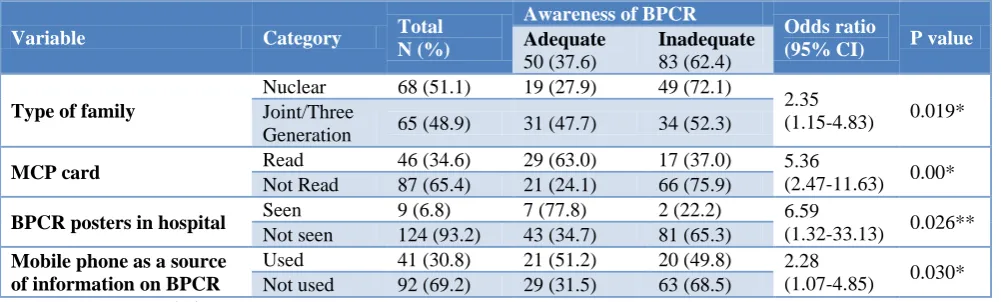
Husband’s awareness regarding BPCR was significantly associated with living in a joint family, having read the MCP card, seen posters in hospital regarding birth preparedness, and use of the mobile phone as a source of information on BPCR (Table 3). Subjects belonging to a joint family were twice likely to have adequate awareness of BPCR as compared to those from nuclear families. Those who had read the MCP card were five times more likely to be aware of BPCR as compared to those who had not, while those who had read posters on BPCR displayed in the hospital were more than six times likely to have adequate awareness of BPCR as compared to those who did not. While mass media and technology were not used for accessing information on BPCR by a large proportion of the study subjects, those who had used mobile phones to access information on BPCR were twice likely to have adequate awareness of BPCR as compared to those who did not use their mobiles for this purpose.
Table 3: Factors associated with husband’s awareness of BPCR (n=133).
Variable Category Total
N (%)
Awareness of BPCR
Odds ratio
(95% CI) P value
Adequate 50 (37.6)
Inadequate 83 (62.4) Type of family
Nuclear 68 (51.1) 19 (27.9) 49 (72.1)
2.35
(1.15-4.83) 0.019* Joint/Three
Generation 65 (48.9) 31 (47.7) 34 (52.3)
MCP card Read 46 (34.6) 29 (63.0) 17 (37.0) 5.36
(2.47-11.63) 0.00* Not Read 87 (65.4) 21 (24.1) 66 (75.9)
BPCR posters in hospital Seen 9 (6.8) 7 (77.8) 2 (22.2) 6.59
(1.32-33.13) 0.026** Not seen 124 (93.2) 43 (34.7) 81 (65.3)
Mobile phone as a source of information on BPCR
Used 41 (30.8) 21 (51.2) 20 (49.8) 2.28
(1.07-4.85) 0.030* Not used 92 (69.2) 29 (31.5) 63 (68.5)
Table 4: Factors associated with husband’s participation in BPCR (n=133).
Variable Category Total
N (%)
Participation in BPCR
Odds ratio
(95% CI) P value
Adequate 83 (62.4)
Inadequate 50 (37.6) Accompanied wife
for ANC
Yes 128 (96.2) 83 (64.8) 45 (35.2) 2.84
(2.25-3.59) 0.912*
No 5 (3.8) 0 (0) 5 (100)
Awareness regarding BPCR
Adequate 50 (37.6) 40 (80.0) 10 (20.0) 3.72
(1.65-8.41) 0.002* Inadequate 83 (37.6) 43 (51.8) 40 (48.2)
*: Chi-square test.
Figure 2: Husband’s attitude regarding birth preparedness (n=133).
Husband’s participation in BPCR was significantly associated with accompanying wife during antenatal check-ups and his own awareness regarding BPCR (Table 4). Study subjects who had accompanied their wife for antenatal check-up at least once during pregnancy were 2.84 times more likely to have adequate participation in BPCR as compared to those who did not. Husbands who had adequate awareness of BPCR were 3.72 times more likely to have participated in BPCR as compared to those husbands with inadequate awareness. Age, religion, occupation and socio-economic status were not significantly associated with either awareness or practice of BPCR.
Majority of the husbands believed that it is important to plan the place of delivery (93.2%) and arrange transportation (88%) in advance (Figure 2). However, a smaller proportion believed that the husbands themselves
should be involved in these tasks. Only 32.3% of husbands are of the attitude that it is necessary to accompany the wife for antenatal check-ups and only 34.6% feel they should accompany the wife for delivery.
DISCUSSION
In the present study, only 37.4% of husbands of women availing obstetric services at a rural maternity hospital were aware of BPCR. While poor awareness regarding BPCR can be explained by the lack of visibility of BPCR-related health education through mass media, it also has a socio-cultural context, where antenatal care is still considered the responsibility of the woman and her family. There are important public health implications of these findings; in Indian rural society, husbands are the chief decision makers in the family, hence their awareness regarding BPCR is crucial in preparing for birth. This was demonstrated by the present study, where
34.6 32.3
89.5 93.2 29.3
32.3
74.0 74.4
78.2 88
0 10 20 30 40 50 60 70 80 90 100
Husbands should accompany wife for delivery Husbands should accompany wife for antenatal check ups Husbands should plan place of delivery It is important to plan place of delivery Husbands should arrange a blood donor It is important to identify blood donor Husbands should arrange money It is important to arrange money Husbands should arrange tranport It is important to arrange transport
husbands who were aware of BPCR, were 3.72 times more likely to participate in BPCR. This has also been seen in other parts of the world like Ethiopia, where men who were aware of BPCR participated more in BPCR, OR=13.9 (7.01-27.4).9
It is important to include men in antenatal care and this has been shown in India, in evidence from three states – UP, West Bengal and Maharashtra, where participation of men in antenatal care was significantly associated with institutional deliveries.10 A study in Nepal showed that including men in antenatal care made them twice more likely to be prepared for birth, OR=1.99 (1.10-3.59).11 This was similarly found in the present study, where men who accompanied their wives had 2.84 times greater chance of being adequately prepared for birth. It is evident that male attendance at antenatal visits is an important link with improved knowledge of pregnancy-related care. This has been shown clearly in a study in Uganda, where men who accompanied their wives for ANC visits had significantly higher knowledge of antenatal care.12
A study in North Ethiopia, found that majority of husbands were aware of components of BPCR such as identifying transport (65.4%), identifying place of delivery (62.2%) and saving money for delivery (76.3%), while only few identified a blood donor in advance (17.3%), which was also found in a study in South Ethiopia.9,13 The proportion of husbands aware of the individual components of BPCR match those of our study, except for identifying transport in advance, which was higher in our study. This could be due to the socio-economic difference in the two populations, where the present study population, though rural, has access to their own private vehicles as transport, and therefore did not actually have to make additional specific emergency transport arrangements, as was the case in rural Bhadohi district of Uttar Pradesh.7 While awareness of BPCR was low in our study, 62.5% of husbands had adequate participation. This was due to the fact that while husbands actually contributed in terms of arranging for transport and saving money, they were unable to specifically list these as components of BPCR, due to lack of knowledge of BPCR. Husband’s participation in BPCR was found to be poor in rural Tanzaniawhere only 10.2% identified transport, 0.8% identified place of delivery and only 0.1% identified a blood donor in advance. 14 In rural Tigray region of Ethiopia15 too, participation in these components were found to be low (21.8%, 55.3% and 4.3% respectively). These findings were much higher in our study (75.2%, 66.2% and 27.8% respectively). This could be due to the improved access to communication and technology in rural Karnataka and better use of technology like mobile phones to access information on BPCR, which was shown to be significantly associated with husband’s participation in BPCR in our study.
Another factor found to be associated with preparing for birth is the type of family. In a study done in Nalgonda in Telangana, India, it was found that belonging to a joint family had significant association with BPCR.16 In our study too it was found that belonging to a joint family was significantly associated with better awareness regarding BPCR.
When comparing the use of mass media and technology in preparing for birth, in South Ethiopia about half of the husbands in the study (51.4%) had heard about BPCR from the radio, 43.9% from television and 28.0% from newspapers.13 However, in our study, the most common source of information regarding birth preparedness was found to be mobile phones (30.8%) and much lower proportion used newspaper (21.1%), television (14.3%) and radio (14.3%) as sources of information on BPCR. This is due to the widespread rural penetration of mobile phones and the availability, and affordability of smart phones.
The use of modern technology does not automatically translate into erosion of traditional social mores and cultural practices. Our study found that attitude of husbands toward their own involvement in their wife’s antenatal care remains paternalistic. While they feel that it is important to make arrangements like transportation and money, only 32.3% of husbands are of a participatory attitude that it is necessary to accompany the wife for antenatal check-ups and only 34.6% feel they should accompany the wife for delivery. This is in contrast to men in rural Rwanda, where 88.6% felt that husband should accompany his wife for antenatal visits and 79.4% felt that he should accompany her for the delivery.17 This participatory attitude probably stems from the fact that Rwanda is listed among the top ten countries with gender equality while in India women, especially in the rural areas, continue to reside in a male-dominated society with poor economic participation and decision- making.18-20
It is interesting to note that the mother and child protection card can be a tool for learning, not just for the antenatal woman as has been shown in Odisha, but also for the husband, as shown in the present study, where subjects who read the MCP card were five times more likely to have adequate awareness of BPCR, than those who had not.21 Traditional methods of health education through posters displayed in common areas of hospitals, was also found to be effective in this study with those who had read the posters on BPCR having six times greater chance of being aware of BPCR than those who had not.
for antenatal check-up visits and delivery. The MCP card can be used as a tool for educating both husband and wife. Health messages on mobile phone can be included for the husband along with the antenatal mother. Posters on birth preparedness, in health care facilities should be prominently displayed in the waiting areas. With the widespread use of mobile phones, this technology may be further tapped to improve awareness and participation in BPCR.
CONCLUSION
Overall participation in BPCR was adequate among husbands (62.5%), but lowest participation was for arranging a blood donor in advance (27.8%). While the use of various media and mobile technology was high, but only a small proportion actually used these to access information on BPCR. Higher level of awareness of BPCR among husbands was significantly associated with joint family, having read the MCP card, seen BPCR posters in hospital, and using the mobile phone for accessing information on BPCR. Participation among husbands in BPCR was significantly associated with better awareness of BPCR and accompanying wife for ANC visits. While most husbands had a positive attitude to making arrangements for the delivery like saving money and arranging transport, only one third of husbands thought it necessary to accompany their wife for antenatal visits or delivery. Besides using MCP card and posters, mobile phone technology may be further tapped to improve husband’s awareness and participation in BPCR.
Funding: No funding sources Conflict of interest: None declared
Ethical approval: The study was approved by the Institutional Ethics Committee
REFERENCES
1. Sample Registration System (Registrar General of India), Special Bulletin on Maternal Mortality in India 2014-16. New Delhi: Office of the Registrar General of India; 2018. Available: http://www. censusindia.gov.in/vital_statistics/SRS_Bulletins/M MR%. Last Accessed on 18 July 2019.
2. Sankar MJ, Neogi SB, Sharma J, State of newborn health in India. J Perinatol. 2016;36:S3–S8.
3. Merdad L, Ali M. Timing of maternal death: levels, trends, and ecological correlates using sibling data from 34 sub-Saharan African countries. PLoS One. 2018;13.
4. Moran AC, Sangli G, Dineen R, Rawlins B, Yaméogo M, Baya B. Birth-preparedness for maternal Health: findings from Koupéla District. Burkina Faso. J health Population Nutr. 2006;24(4):489–97. Available from: https://www. ncbi.nlm.nih.gov/pmc/articles/PMC3001153/.
5. Essendi H, Mills S, Fotso JC. Barriers to formal emergency obstetric care services’ utilization. J Urban Health. 2011;88(2):S356-69.
6. Mullany BC, Hindin MJ, Becker. Can women’s autonomy impede male involvement in pregnancy health in Katmandu. Nepal Soc Sci Med. 2005;61:1993-2006.
7. Kumar K. Birth Preparedness and Complication Readiness in Uttar Pradesh, India. Health. 2016;8:605-614.
8. JHPIEGO Monitoring birth preparedness and complication readiness: Tools and Indicators for maternal and newborn health. Available from: http://reprolineplus.org/system/files/resources/bpcr_ monitoringtools.pdf. Last Accessed on 18 July 2019.
9. Gebrehiwot H. Determinant factors of male involvement in birth preparedness and complication readiness at Mekelle town; a community-based study. Sci J Public Health. 2015;3(2):175-180. 10. Chattopadhyay A. Men in maternal care: evidence
from India; J Biosoc Sci. 2012;44(2):129-53. 11. Mullany BC, Becker S, Hindin MJ. The impact of
including husbands in antenatal health education services on maternal health practices in urban Nepal: results from a randomized controlled trial. Health Educ Res. 2007;22(2):166-76.
12. Tweheyo R, Kondelule J, Tumwesigye NM, Sekandi J. Male partner attendance of skilled antenatal care in peri-urban Gulu district, Northern Uganda. BMC Preg Childbirth. 2010;10:53.
13. Tadesse M, Boltena AT, Asamoah BO. Husbands’ participation in birth preparedness and complication readiness and associated factors in Wolaita Sodo town, Southern Ethiopia. Afr J Prm Health Care Fam Med. 2018;10(1):147.
14. August F, Pembe AB, Mpembeni R, Axemo P, Darj E. Men’s Knowledge of Obstetric Danger Signs, Birth Preparedness and Complication Readiness in Rural Tanzania. PLoS ONE. 2015;10(5):1-12. 15. Gebrehiwot H, Gebregziabher W, Gidey G.
Assessment of Husbands’ Participation on Birth Preparedness in Enderta Woreda, Tigray Region, Ethiopia. J Women’s Health Care. 2013;3:1. 16. Chajhlana SP, Prathyusha TV, Bhumi MA,
Mahabhashyam RK, Varaprasada MM. Status of birth preparedness and complication readiness among pregnant women in rural areas. Int J Community Med Public Health. 2018;5(1):284-8. 17. Kalisa R, Malande O. Birth preparedness and male
partner involvement for obstetric emergencies in rural Rwanda. Pan Afr Med J. 2016;25:9.
18. Global Gender Gap Report 2016. World Economic Forum. Available from: http://reports.weforum. org/global-gender-gap-report-2016/rankings/. Last Accessed on 18 July 2019.
20. Banerjee A. Status of women and gender discrimination in India: A statewise analysis. Int J Develop Res. 2013;3(12):57-64.
21. Jena D, Sabat S, Tripathy RM, Mahapatra DK. Utilization of MCP card for enrichment of knowledge on antenatal care by mothers attending immunization clinic: a hospital based cross-sectional study. Int J Adv Med. 2017;4(5):1466-72.
Cite this article as: Kalliath JD, Johnson AR, Pinto P,
James N, Sebastian V.Awareness, attitude, participation and use of technology in birth preparedness and complication readiness among husbands of women availing obstetric care at a rural maternity hospital in South Karnataka. Int J