Original Research Article
A study to assess the association of various factors of adherence to
treatment on the tuberculosis treatment outcome among new sputum
smear positive pulmonary tuberculosis patients under Revised National
Tuberculosis Control Programme in Bengaluru area
Ramya M. S.
1*, Jyothi Jadhav
2, Ranganath T. S.
2ABSTRACT
Background: Tuberculosis (TB) is a top infectious disease killer worldwide. In India although Revised National Tuberculosis Control Programme (RNTCP) has seen significant success in TB treatment, patient non-adherence or lost to follow up continue to persist and are influenced by various factors. The present study aims to know the influence of adherence factors on TB treatment outcome among new sputum smear positive (NSSP) pulmonary TB patients under RNTCP. The objectives of the present study were to describe the distribution of socio-demographic factors, outcome patterns among NSSP patients and to assess the association of various adherence factors on TB-treatment outcome among NSSP patients.
Methods: A prospective longitudinal study among 149 NSSP patients from selected TU’s of Bengaluru.
Results: Among the 149 NSSP patients 107 (72%) were males and 42 (28%) were females. Treatment outcome is
categorized as cured (120) and other treatment outcomes (defaulted-17 or treatment failure-3 or died-9). Among the various socio-demographic and adherence-factors: age >50years, illiteracy, male-gender, Hindu-religion, lower socioeconomic-status, poor-patient knowledge about TB, disbelief in TB-treatment, unwillingness to continue treatment with subsiding symptoms, smoking, alcohol intake, presence of diabetes or hypertension or COPD or HIV, patient’s un-satisfaction with treatment-availability or accessibility or contact-timings, no-encouragement from family members, other marital status and absence of stigma showed lower cure rates. Of these factors illiteracy, lower socioeconomic-status, poor patient’s knowledge on tuberculosis, smoking, alcohol intake, HIV positive status, un-satisfaction with TB-treatment availability and other marital-status showed statistical significance on the TB treatment outcome.
Conclusions: With the observed associations of the above factors on TB-treatment outcome, Further measures like
improving patient’s knowledge on tuberculosis, health-services and patient-provider relationship; appropriate TB-HIV care and encouragement to quit smoking or alcohol intake, could improve TB-treatment cure rates.
Keywords: Pulmonary tuberculosis, Adherence factors, Treatment outcome
Department of Community Medicine, 1East Point College of Medical Sciences and Research Center, 2Bangalore Medical College and Research Institute,Bengaluru, Karnataka, India
Received: 15 July 2019
Revised: 05 September 2019
Accepted: 06 September 2019
*Correspondence: Dr. Ramya M. S.,
E-mail: [email protected]
Copyright: © the author(s), publisher and licensee Medip Academy. This is an open-access article distributed under
the terms of the Creative Commons Attribution Non-Commercial License, which permits unrestricted non-commercial use, distribution, and reproduction in any medium, provided the original work is properly cited.
INTRODUCTION
Tuberculosis caused by Mycobacterium tuberculosis
affects the lungs causing pulmonary TB.1 TB is a top infectious disease killer worldwide. Ending the TB epidemic by 2030 is among the health targets of the sustainable development goals.2 The global plan to end TB 2016-2020 targets 90-90-90 reach 90% who need TB treatment, including 90% of people in key populations and achieve 90% treatment success.3 Tuberculosis has a large scale impact on morbidity, mortality and disability.4 Global incidence of TB is9.6 million (176/lakh/year) and a TB mortality of 1.1 million (21/lakh/year). In India the incidence of TB is 2.2 million (167/lakh/year) and a TB mortality of 2.2 lakhs (17/lakh/year), were India accounts to about 1/4th of the global TB incident cases.5 In India under Revised National Tuberculosis Control Programme (RNTCP) new cases of drug-susceptible TB are treated with isoniazid, rifampicin, ethambutol and pyrazinamide.6 The treatment success rate is >85%.7 Treatment for drug resistant (DR) TB requires expensive and toxic drugs and treatment success rates are much lower.6 Adherence to treatment is defined as the extent to which the patient's therapeutic drug-taking coincides with the prescribed treatment. Poor adherence may lead to incomplete anti-tuberculosis treatment (ATT) which may result in treatment failure, relapse and contribute to increase in duration and cost of treatment, morbidity or mortality and further increasing drug resistance both at individual and community level.8 The adherence to TB treatment is influenced by various factors:
Social and economic factors
TB usually affects people lacking social support networks, unemployed, poor and homeless.
Patient related factors
Patient’s knowledge about TB treatment, perception of benefits from therapy, demographic characteristics such as age, race, gender, education and SES.
Provider characteristics
Training of health care provider and patient-provider relationship.
Pattern of health care delivery
Organization of clinical services, expertise, links with patient support system and flexibility in hours of operation.8
Characteristics of treatment
Number of medications, duration or complexity of regimen, toxicity and other side effects.
Disease characteristics
Non adherence is common with resolution of symptoms following treatment.9
In India although RNTCP programme has seen significant success, treatment non-adherence and lost to follow up continue to persist. This increases the risk of conversion of drug sensitive TB to drug resistant TB (rifampicin resistant TB or MDRTB or XDR or TDRTB), further with each progressing levels the chances of survival gets slimmer and cost of medication increases. The association of adherence factors on the TB treatment outcome helps to understand, the role of health services and patient-care in improving the treatment outcome. Thus this study aims at understanding these adherence factors on treatment outcome.
METHODS
This study is a hospital based (TU’s) time bound prospective longitudinal study, after obtaining clearance from the Institutional Ethics Committee and permissions from State and BBMP TB authorities the data collection was started.
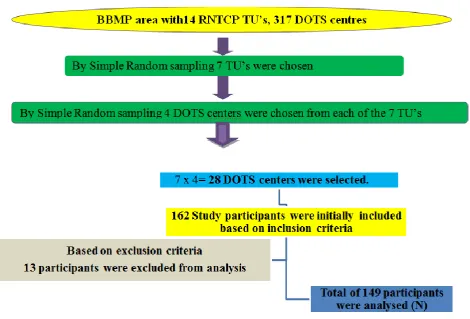
By multistage random sampling technique the DOTS center’s and study participants were selected in the BBMP (Bruhat Bengaluru Mahanagar Pallike) area as shown in Figure 1.
Figure 1: Sampling of study participants.
RESULTS
In the present study out of a total of 149 NSSP pulmonary TB patients’, age-wise distribution is shown in Table 1.
Table 1: Age wise distribution of the study participants.
Age group Number %
18-20 12 8.05
21-30 40 26.84
31-40 40 26.84
41-50 33 22.14
51-60 16 10.73
61-70 5 3.35
>70 3 2.01
Total 149
Distribution of participants based on gender majority were males 107 (71.81%) and 42 (28.18%) were females. Based on religion the participants were distributed as Hindus 120 (80.53%), Muslims 27 (18.12%) and Christians 2 (1.34%). Based on family type majority 102 (68.45%) were from nuclear family, 33 (22.14%) from three generation family, 8 (5.36%) were from joint family and 6 (4.02%) were living alone (who had either lost or were separated from their family members). Based on current habits during the study period majority 86
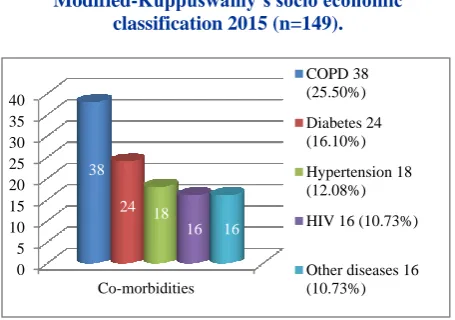
(57.71%) were smoking tobacco (any form), 55 (36.91%) of them consumed alcohol and 14 (9.39%) of them chewed tobacco. Based on marital status 94 (63.08%) were married, 41 (27.51%) were unmarried, 12 (8.05%) were separated and 2 (1.34%) were divorced. Distribution of participants based on literacy status is shown in Figure 2, occupation is shown in Figure 3, socio-economic classification (as per Modified-Kuppuswamy’s scale 2015) is shown in Figure 4 and the presence of co-morbidities is shown in Figure 5.The treatment outcome pattern among the 149 new sputum smear positive pulmonary tuberculosis patients-120 (80.53%) were cured, 17 (11.40%) had defaulted, 3 (2.01%) had treatment failure and 9 (6.04%) had died during the treatment course.
Figure 2: Distribution of study subjects based on education (n=149).
0 10 20 30 40 50
Education 5 9
36
12 47
40
Graduates 5 (3.35%)
Intermediate or post high school diploma 9 (6.04%) High school 36 (24.16%)
Middle school 12 (8.05%)
Primary school 47 (31.54%)
Figure 3: Distribution of study subjects based on their occupation (n=149).
Figure 4: Distribution of study subjects based on Modified-Kuppuswamy’s socio economic
classification 2015 (n=149).
Figure 5: Distribution of study subjects based on the presence of co-morbidities (n=149).
Others diseases included thyroid disorder (10) or coronary artery disease (3), epilepsy (2) or carcinoma (1), a few participants had multiple responses for the co-morbidities.
The relationship between factors and treatment outcome are depicted from Tables 2-4. The treatment outcomes are categorised as cured and other treatment outcomes. The study variables under each category of adherence factors are grouped as group E and O and their epidemiological
association is assessed as incidence of cure rates in each group as Ie and Io, Risk-ratio or Relative risk (RR), risk difference or attributable risk, attributable fraction in exposed (AFe) are calculated. The statistical association is calculated by using square test and based on Chi-square value, p value they are interpreted as S for significant (p<0.05) and NS for Not significant (p>0.05).
Relationship between socio-demographic factors and treatment outcome is shown in Table 2. Those aging>50 years had a lower cure rate (70.83%) with an attributable fraction of 14.07%, illiterates had a lower cure rate (70%) with an attributable fraction of 17.06%, males had a lower cure rate (77.57%) with an attributable fraction of 11.94%, Hindus had a lower cure rate (76.66%) and an attributable fraction of 20.60%, patients of lower socioeconomic class (upper-lower and lower class) had a lower cure rate (74.25%) with an attributable fraction of 20.8%. By applying the chi square test literacy status, religion and socio-economic class showed statistical significance on TB treatment outcome.
Relationship between adherence factors (patient related factors-a) and treatment outcome is shown in Table 3. The patient’s knowledge was assessed based on their awareness about TB, its mode of spread, its curability, treatment duration and importance of completing the TB Treatment. The scoring was 1 for correct and 0 for incorrect answers the scores varied between 0 and 5. Further total scores were categorised as poor for 0, 1 and 2 score’s and good for 3, 4 and 5 score’s. A poor patient knowledge on TB treatment had a lower cure rate (65.85%) with an attributable fraction of 23.52%. Patients who did not believe that the TB treatment can cure the disease had a lower cure rate (75.8%) with an attributable fraction of 9.65%. Patients unwilling to continue treatment with improvement of symptoms had a lower cure rate (75%) with an attributable fraction of 8.59%. By applying Chi-square test poor patient knowledge on TB showed statistical significance on the TB treatment outcome.
Relationship between adherence factors (patient related factors-b) and treatment outcome is shown in Table 3. Smokers had a lesser cure rate (73.25%) and smoking has an attributable fraction of 19.03%. Alcoholics had a lesser cure rate (67.27%) and alcohol intake has an attributable fraction of 23.80%. Diabetics had a lesser cure rate (75%) and diabetic status has an attributable fraction of 8.08%. Hypertensive’s had a lesser cure rate (77.77%) and hypertensive status has an attributable fraction of 3.88%. Patients with COPD had a lesser cure rate (71.05%) with an attributable fraction of 15.19%. Patients with HIV had a lesser cure rate (50%) and an attributable fraction of 40.61%. By applying Chi-square test smoking, alcohol intake, HIV status showed statistical significance on TB treatment outcome.
Relationship between adherence factors (health care related factors) and treatment outcome is depicted in 2
14 38
9 50
36
0 10 20 30 40 50 60
Occupation
Semi professional 2 (1.34%)
Clerical, shop owner 14 (9.39%)
Skilled 38 (25.5%)
Semi skilled 9 (6.04%)
Unskilled 50 (33.55%)
Unemployed 36 (24.16%)
0
50
100 24
77 32
16
Upper (0)
Upper middle 16 (10.73%)
Lower middle 32 (21.47%)
Upper lower 77 (51.67%)
Lower 24 (16.10%) Socio economic class
0 5 10 15 20 25 30 35 40
Co-morbidities
38 24 18
16 16
COPD 38 (25.50%)
Diabetes 24 (16.10%)
Hypertension 18 (12.08%)
HIV 16 (10.73%)
Table 4. Patients who were unsatisfied with the available TB treatment health services had a lower cure rate (63.63%) and an attributable fraction of 23.75%. Patients
who did not have appropriate access to DOTS center or provider had a lower cure rate (70.96%) and an attributable fraction of 14.55%.
Table 2: Relationship between socio-demographic factors and treatment outcome.
Study variables
Treatment Outcome Cure rate (%)
Risk ratio (relative risk)*
Risk
difference or attributable risk
Attributabl e fraction in exposed**
(in %)
Chi-square
value P value
Cured (n=120)
Other treatment outcomes (n=29) Age (in years)
>50e (24) 17 7 70.83
0.85 11.6 14.07 1.72
df=1
0.189 (NS) <50o (125) 103 22 82.4
Literacy status
Illiteratee (40) 28 12 70
0.82 14.4 17.06 3.87
df=1
0.049 (S) Literateo (109) 92 17 84.4
Sex
Malee (107) 83 24 77.57
0.88 10.52 11.94 2.13
df=1
0.144 (NS)
Femaleo (42) 37 5 88.09
Religion
Hindue (120) 92 28 76.66
0.79 19.89 20.60 5.89
df=1
0.015 (S) Muslim and
Christiano (29) 28 1 96.55
Socio economic class Lower class and upper lowere (101)
75 26 74.25
0.79 19.5 20.8 7.89
df=1
0.004 (S) Lower middle and
upper middleo (48)
45 3 93.75
*: RR<1 indicates that exposure reduces the cure rates;**: AFe is the % of reduced cure rate in the exposed that is attributed to the exposure.
Table 3: Relationship between adherence factors and treatment outcome patient related factors (a and b).
Study variables
Treatment outcome
Cure rate (%)
Risk ratio (relative risk)* Ie/ Io
Risk
Difference or attributable risk Ie–Io
Attributable fraction in exposed **
(in %)
Chi-square
value P value
Cured (n=120)
Other treatment outcomes (n=29)
Patients knowledge about TB treatment
Poore (41) 27 14 65.85
0.76 20.26 23.52 7.78
df=1
0.0053 (S) Goodo (108) 93 15 86.11
Patients belief that the TB treatment can cure their disease
Noe (62) 47 15 75.8
0.9 8.1 9.65 1.52
df=1
0.21 (NS) Yeso (87) 73 14 83.90
Patients willingness to continue treatment even after the symptoms subsides Not willinge (32) 24 8 75
0.91 7.05 8.59 0.8
df=1
0.37 (NS) Yeso (117) 96 21 82.05
Smoker (currently smoker or who had smoked any form of tobacco for >1 year) Yese (86) 63 23 73.25
0.80 17.22 19.03 6.88
df=1
0.008 (S) Noo (63) 57 6 90.47
Alcoholic (currently alcoholic or who had consumed alcohol for >1 year) Yese (55) 37 18 67.27
0.76 21.02 23.80 9.79
df=1
0.001 (S) Noo (94) 83 11 88.29
Diabetic
Yese (24) 18 6 75
0.91 6.6 8.08 0.56
df =1
Study variables
Treatment outcome
Cure rate (%)
Risk ratio (relative risk)* Ie/ Io
Risk
difference or attributable risk Ie–Io
Attributable fraction in exposed **
(in %)
Chi-square
value P value
Cured (120)
Other treatment outcomes (29) Hypertensive
Yese (18) 14 4 77.77
0.96 3.14 3.88 0.1
df =1
0.75 (NS) Noo (131) 106 25 80.91
Chronic obstructive pulmonary disease (COPD) Yese (38) 27 11 71.05
0.84 12.73 15.19 2.93
df =1
0.086 (NS) Noo (111) 93 18 83.78
HIV status
Yese (16) 8 8 50
0.59 34.2 40.61 10.66
df =1
0.0011 (S) Noo (133) 112 21 84.2
*: RR<1 indicates that exposure reduces the cure rates; **: AFe is the % of reduced cure rate in the exposed that is attributed to the exposure.
Table 4: Relationship between adherence factors and treatment outcome: health care related factors and social factors.
Study variables
Treatment outcome
Cure rate (%)
Risk ratio (relative risk)*
Risk difference or attribute able risk
Attributable fraction in exposed **
(in %)
Chi-square value
P value
Cured (120)
Other treatment outcomes (29)
Health care related factors
Patients response for availability of TB treatment health services Unsatisfactorye (22) 14 8 63.63
0. 76 19.83 23.75 4.7
df=1
0.030 (S) Satisfactoryo (127) 106 21 83.46
Patients response for access to DOTS center or provider
Not accessiblee (31) 22 9 70.96
0.85 12.09 14.55 2.29
df=1
0.130 (NS)
Accessibleo (118) 98 20 83.05
Patients response about contact timings with the health services
Unsatisfactorye (44) 33 11 75
0.90 7.85 9.47 1.22
df=1
0.269 (NS)
Satisfactoryo (105) 87 18 82.85
Social factors
Encouragement from family members to continue treatment
Noe (32) 24 8 75.0
0.91 7.05 8.59 0.8
df=1
0.371 (NS) Yeso (117) 96 21 82.05
Patients marital status
Other marital statuse(55) 39 16 70.9
0.82 15.27 17.72 5.16
df=1
0.023 (S)
Marriedo (94) 81 13 86.17
Patients response to have experienced some form of stigma due to TB (being avoided or isolated by family or friends)
Noe (111) 89 22 80.18
0.98 1.39 1.69 0.04
df=1
0.84 (NS)
Yeso (38) 31 7 81.57
*: RR<1 indicates that exposure reduces the cure rates; **: AFe is the % of reduced cure rate in the exposed that is attributed to the exposure.
Patients who were unsatisfied with the contact timings of the health facility had a lower cure rate (75%) and an attributable fraction of 9.47%. By applying Chi-square test availability of TB treatment health services showed statistical significance on the treatment outcome.
Relationship between adherence factors (social factors) with treatment outcome is shown in Table 4. Patients who had no encouragement from family members to continue
DISCUSSION
A prospective study assessing various factors of adherence to treatment on TB-treatment outcome among NSSP pulmonary TB patients showed a male: female ratio of 2.5:1 and of ages 18-60 years, similar to a study done by Gajbhare et al were majority of the TB patients were males and belonged to 15-44 years age.10 This distribution among males and economically productive age group can have an impact on the economic status of the family.
Majority of the study participants in this study belonged to upper lower class similar to a study done by Sadana et al were majority were of upper lower class indicating a major distribution of TB in lower socio economic stratum (SES).11
Socio-demographic factors
Age >50 years, illiteracy, male gender and lower SES and Hindu religion attributed to lesser cure rates among the study subjects, of these factors further illiteracy, Hindu religion and Lower SES showed a statistically significant association with TB treatment outcome. In a study by Sadana et al statistically significant association was seen for gender, literacy status (p=0.03) but SES (p=0.639) showed no statistical significance with the treatment outcome.11
Adherence to treatment factors
Patient related factors
Patient’s- poor knowledge about TB, disbelief in TB treatment, unwillingness to continue treatment with subsiding symptoms, habits like smoking and alcohol intake, presence of diabetes, hypertension, COPD and HIV attributed to lesser cure rates, Of these factors poor patient’s knowledge on TB, smoking, alcohol intake and HIV positive status showed a statistically significant association with TB treatment outcome.A study done by Sunil et al showed significant association between smoking and alcoholism with treatment outcome.12 A systematic review also shows an increased risk of TB disease and mortality among smokers.13 According to a study done by Vijay et al there was a significantly higher proportion of treatment failures among TB-DM patients than TB non-DM patients (p=0.04).14 A study done by Vijay et al showed a lesser treatment success rate (62%) among TBHIV patients in comparison with TB non-HIV patients.15
Health care related factors
Patient’s unsatisfactory response for availability of TB treatment, contact timings with health facility and accessibility to the DOTS center or provider attributed to lower cure rates. Of these factors patient’s unsatisfaction with the TB treatment services showed a statistically
significant association with TB treatment outcome and the most common reason for unsatisfaction was inadequate on-time care to TB treatment side effects.
Social factors
No encouragement from family members to continue treatment, other marital status (excluding married) and no stigma due to TB attributed to lower cure rates. Of these further patients other marital status showed a statistically significant association with TB treatment outcome.
CONCLUSION
Among the factors showing statistically significant association with TB-treatment outcome, by improving patient’s knowledge on TB treatment, encouraging them to quit smoking and alcohol intake, appropriate TB-HIV treatment and improvement in health services as specified in the recommendations could contribute to better cure rates.
Recommendations
Among the factors showing association with treatment outcome the ones which can be addressed are poor patients knowledge on TB-treatment can be addressed by appropriate patient education through IEC materials, counselling at the DOTS center regarding treatment duration and regimen, complications the patients might have to face if the treatment is not taken completely like retreatment, drug resistance at different levels which is further associated with longer treatment durations and complex regimens, this could further reinforce the patients to adhere to the treatment. Habits like smoking and alcohol intake can be addressed by supportive counselling to quit such habits. Patient’s un-satisfaction with the TB treatment services due to lack of on-time care to the side effects of TB drugs, ART drugs (those with TB-HIV) can be addressed by appropriate strengthening of referral and clinical services, motivational support and nutritional advice to the patients by effective counselling. The health care workers need to be educated regarding the same to improve the patient provider relationship. 38 patients had experienced social stigma due to TB, although it did not show statistical association with treatment outcome. In order to counter the social stigma and myths associated with the disease were awareness can be created about TB in general population as a curable disease through posters and mass media usage, an efficient social support system can be created by providing motivational services from the patients cured of TB, to the patients and their family members currently under treatment.
ACKNOWLEDGEMENTS
Medical officer’s, staff and study subjects at the DOTS centre’s for their co-operation during the study.
Funding: RNTCP (BBMP TB unit) Conflict of interest: None declared
Ethical approval: The study was approved by the Institutional Ethics Committee
REFERENCES
1. Park K. Park’s textbook of preventive and social medicine. 23rd ed. Jabalpur, India: M/s Banarsidas Bhanot; 2015;176-202:427-30.
2. WHO. Tuberculosis fact sheets, 2016 March; Available at: http://www.who.int/mediacentre/factsh eets/fs104/en/. Accessed on 9 August 2016.
3. The Global Plan to End TB 2016-2020, 2015. Available at: http://www.stoptb.org/global/plan/plan 2/. Accessed on 27 August 2016.
4. Gupta I, Guin P. Communicable diseases in South-East Asia region of the World Health Organisation: towards a more effective response. Bull World Health Organ. 2010;88:199-205.
5. RNTCP Technical and Operational Guidelines for Tuberculosis Control in India, 2016. Available at: http://www.tbcindia.nic.in/index1.php?lang=1andle vel=2andsublinkid=4573andlid=3177. Accessed on 4 September 2016.
6. Global Tuberculosis report 2015, 2015. Available at: http://www.who.int/tb/publications/global_ report/gtbr2015_executive_summary.pdf. Accessed on 28 August 2016.
7. Central TB Division. TB INDIA 2016 Annual status report, 2016. Available at http://www.tbcindia. nic.in/WriteReadData/l892s/3608495828TB%20Ind ia%202016_Part1.pdf. Accessed 8 August 2016. 8. WHO. Adherence to long-term therapies, 2003.
Available at: http://apps.who.int/iris/bitstream/ 10665/42682/1/9241545992.pdf. Accessed on 27 August 2016.
9. Adherence to treatment for latent tuberculosis infection: a manual for health care providers, 2005. Available at: http://dph.georgia.gov/sites/dph.georgI a.gov/files/TBLTBI_TreatmentManuaHarlem.pdf. Accessed on 12 August 2016.
10. Gajbhare D, Bedre R, Solanki H. A study of socio-demographic profile and treatment outcome of tuberculosis patients in an urban slum of Mumbai. Indian J Basic Appl Med Res. 2014;4(1):50-7. 11. Sadana P, Singh T, Deepti SS. Socio demographic
factors affecting the treatment outcome in patients of tuberculosis. Nat J Community Med. 2015;6(4):609-13.
12. Sunil MS, Rahul RB. Socio-demographic profile of patients registered under revised national tuberculosis control programme in Pune city. Int J Biomed Res. 2014;5(3):168-71.
13. Detels R, Gulliford M, Karim Q, Tan C. Oxford Textbook of Global Public Health. 6th ed. Great Clarendon Street, Oxford: Oxford University Press; 2016: 1144-1160.
14. Vijay V, Vigneswari A, Selvan K, Satyavani K, Rajeswari R, Kapur A. Effect of diabetes on treatment outcome of smear-positive pulmonary tuberculosis- a report from South India. J Diabet Complicat. 2014;28(2):162-5.
15. Vijay S, Kumar P, Chauhan LS, Narayan Rao SV, Vaidyanathan P. Treatment outcome and mortality at one and half year follow-up of HIV infected TB Patients Under TB Control Programme in a District of South India. PLoS ONE. 2011;6(7):e21008.
Cite this article as: Ramya MS, Jadhav J, Ranganath