Original Research Article
A study on the major risk factors of stillbirth in the rural areas of
Dharwad district: a prospective study
Vinolia R.*, Dattatreya D. Bant
INTRODUCTION
According to the WHO for international comparison, Stillbirth is defined as a baby born with no signs of life at or after 28 weeks’ gestation.1
Stillbirth rate refers to the number of stillbirths per thousand live-births and stillbirths during the year.
The loss of a baby due to stillbirth remains a sad reality for many families and takes a serious toll on families’ health and well-being.2 Absent from the Millennium Development Goals and still missing in the Sustainable Development Goals, stillbirths remain a neglected issue, invisible in policies and programs, underfinanced and in urgent need of attention.
Stillbirth is broadly categorized into two types. ie. pre-partum stillbirth and intra-pre-partum stillbirth. Pre-pre-partum stillbirths are those which are occurring before labour, may reflect genetic or gestation conditions, including maternal nutritional status and exposure to infection and toxins during pregnancy. Intra-partum deaths, those occurring during the birth process, can reflect the circumstances of the birth (including position of the foetus, multiple births, premature delivery, placenta previa, pelvic deformations and accidents due to interference).3
WHO first published national, regional, and worldwide estimates of stillbirths in 2011, highlighting the large global burden of stillbirths, with an estimated 2·6 million
ABSTRACT
Background: As per the WHO recommendation for international comparison, stillbirth is defined as a baby born with no signs of life at or after 28 weeks of gestation. It is estimated that 2.6 million stillbirths occur annually in the world with more than 7300 stillbirths happening every day. More than 2/3rd of these stillbirths are identified to be from the South-east Asian countries and Africa. This study is aimed at obtaining key learning points for future implications. The objectives of the study were to study the risk factors associated with stillbirth and to assess the most common and preventable risk factor(s).
Methods: The study was conducted in randomly selected villages of Dharwad district chosen equally from all the taluks of the district. 378 of the registered pregnant women with period of gestation <12 weeks from the selected villages, aged 18 to 35 years were studied.
Results: Women with <1 year of birth spacing had higher risk of stillbirth with (X2=242.096 and p<0.05). Women with medical conditions like severe anaemia and hypertension had higher risk of stillbirth (p<0.05).
Conclusions: The findings in the study suggest that marital and obstetric factors such as early pregnancies and lack of adequate spacing between pregnancies can have an impact on the normal course of pregnancy leading to adverse events like stillbirth but general factors such as women’s education status do not affect the birth outcome.
Keywords: Stillbirth, Ante-natal, Pregnancies, Anaemia
Department of Community Medicine, Karnataka Institute of Medical Sciences, Hubli, Karnataka, India
Received: 23 February 2018
Accepted: 21 March 2018
*Correspondence:
Dr. Vinolia R.,
E-mail: [email protected]
Copyright: © the author(s), publisher and licensee Medip Academy. This is an open-access article distributed under the terms of the Creative Commons Attribution Non-Commercial License, which permits unrestricted non-commercial use, distribution, and reproduction in any medium, provided the original work is properly cited.
women and families affected in 2009. This process also showed the dearth of reliable data in the regions where most stillbirths occur. In 2015 there were 2.6 million stillbirths globally, with more than 7178 deaths a day. The majority of these deaths occurred in developing countries. Ninety-eight percent occurred in low- and middle-income countries. About half of all stillbirths occur in the intra-partum period, representing the greatest time of risk. Estimated proportion of stillbirths that are intra-partum varies from 10% in developed regions to 59% in south Asia. Three-fourths of the stillbirths occurred in south Asia and sub-Saharan Africa and 60% occurred in rural families from these areas.4 This reflects a similar distribution of maternal deaths and correlates with areas of low-skilled health professional attendants at birth. The stillbirth rate in sub-Saharan Africa is approximately 10 times that of developed countries (29 vs. 3 per 1000 births). The majority of stillbirths are preventable, evidenced by the regional variation across the world. The rates correlate with access to maternal healthcare. The every newborn action plan (ENAP) to end preventable deaths has a set stillbirth target of 12 per 1000 births or less by 2030.5 Global ARR needs to be more than double the present ARR of 2% to accomplish this target for reduction in stillbirth.6
Not to deny, India is said to be one of the countries with the highest number of stillbirths in the world with 22/1000 live births. But the stillbirth rate in the country varies widely within different states from 22 to 66/1000 live births.7 In contrast, the SBR as reported by sample registration system for year 2010 was 7 per 1000 births. Karnataka is stated as one among the states with a high stillbirth rate of 28/1000 live births in rural areas of the district.
Though there are many studies conducted internationally and within the country to assist in the control of stillbirths, still little is known for the reason behind the high recorded still birth rate in Dharwad-Hubballi twin cities. This brings the need for a study on stillbirths to identify the major risk factors in this region. As noted, more than 60% of the stillbirths occur in rural areas worldwide and also in the country. So, the study is focused on the rural areas of Dharwad district. This study is aimed to study the prevalence and the most common risk factor(s) of stillbirth.
METHODS
Study design
A community-based prospective study was conducted from 2016-2017. The study was conducted in randomly selected villages of Dharwad district chosen equally from all the taluks of the district namely, Dharwad, Hubli, Kalghatgi, Kundgol and Navalgund. All registered pregnant women with period of gestation <12 weeks (first trimester) from selected villages of Dharwad district, aged 18 years to 35 year were included in the study.
Study procedure
Data collection was started after obtaining clearance from the respective authorities. Registered pregnant women with period of gestation <12 weeks in the selected villages were enrolled in the study. The study participants were explained about the study and a written informed consent was obtained before the start of the study. The study participants were visited in their houses individually and a structured questionnaire was used to obtain the general information about the subject’s residence, education, occupation and socio-economic station. Whether the subject is a BPL card holder was also noted. The information on previous pregnancies and a detailed marital and obstetric history was taken. Evaluation was done the risk factors in relation to the pre-conception and inter pre-conception period. General physical examination and systemic examination was done on all subjects. All significant findings were carefully observed and noted as per the protocol. A detailed environmental assessment was done during the house visits. Other details with respect to health and welfare schemes and accessibility to the health care system was carefully noted.
Sample size
As per the Government of Karnataka, Annual Report on the registration of births and deaths act, the registered number of stillbirths in Dharwad district was 791 for 39537 live births.
SBR = 28/1000 in rural areas of Dharwad district Confidence Interval = 95%
Power = 80% Sample error = 5% Prevalence = 1.3%
The sample size was calculated to be 378.
Sampling technique
Simple random sampling with the following confounding factors as age, parity and socio-economic status.
Ethical consideration
Ethical clearance was obtained from the Institutional Ethical Committee (IEC) of Karnataka Institute of Medical Sciences. Written informed consent was taken from the study participants before the start of the study after explaining about the purpose of the study and procedure.
Statistical analysis
RESULTS
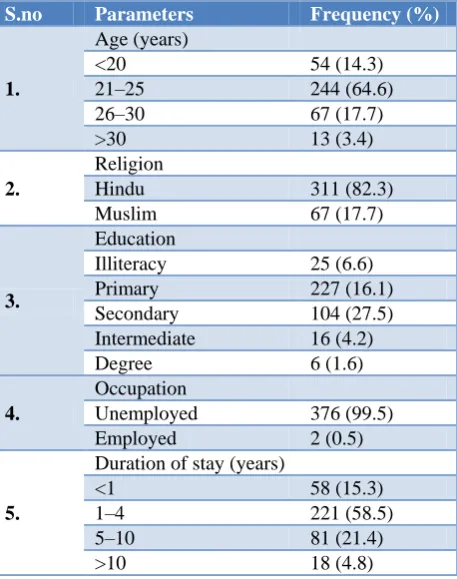
The Community-based prospective study was conducted among Antenatal women in Dharwad district in randomly selected villages of all the 5 taluks namely, Hubli, Dharwad, Navalgund, Kalghatgi and Kundgol. The study participants were 378 in number. The study participants were aged between 18 to 35 years with majority of the antenatal women belonging to the age group of 21 to 25 years i.e. 64.6% (244). Majority of the study participants were Hindu i.e. 82.3% (311) and were educated up to secondary level i.e. 27.5% (104). As shown in Table 1, almost all the antenatal women in the study were housewives.
Table 1: Distribution of demographic data.
S.no Parameters Frequency (%)
1.
Age (years)
<20 54 (14.3)
21–25 244 (64.6)
26–30 67 (17.7)
>30 13 (3.4)
2.
Religion
Hindu 311 (82.3)
Muslim 67 (17.7)
3.
Education
Illiteracy 25 (6.6)
Primary 227 (16.1)
Secondary 104 (27.5)
Intermediate 16 (4.2)
Degree 6 (1.6)
4.
Occupation
Unemployed 376 (99.5)
Employed 2 (0.5)
5.
Duration of stay (years)
<1 58 (15.3)
1–4 221 (58.5)
5–10 81 (21.4)
>10 18 (4.8)
A detailed study on the marital and obstetric history of the antenatal women was done. Table 2 shows the distribution of various significant factors in marital history and obstetric history of the study participants. Consanguineous marriage was seen among very few study participants i.e. 1.1%. 3.7% i.e. 14 of the antenatal women had previous history of stillbirth. Majority of the women in the study were married at less than 25 years of age i.e. 289 (76.4%). Table 3 shows the distribution of various environmental factors in the study population.
The study shows that the educational status of the women is not significantly associated with the birth outcome (X2 is 1.067 with 95% CI), Table 4. The age of the women at first conception and previous history of stillbirth have a significant association with the birth outcome ie. Women who conceived first at less than 20 years of age and had a
stillbirth in the past had higher risk of having stillbirth in their subsequent pregnancies (X2 is 61.06 with 95% CI and X2 is 41.3 with 95% CI respectively).
Table 2: Distribution of data on marital and obstetric factors.
S.NO Parameters Frequency
(%)
1.
Type of marriage
Consanguineous 4 (1.1)
Non-consanguineous 374 (98.9)
2.
Age at marriage (years)
<25 289 (76.4)
>25 89 (23.5)
3.
Age at first conception (years)
<20 190 (50.3)
21 – 25 176 (46.6)
26 – 30 11 (2.9)
>30 1 (0.3)
4.
History of stillbirth
Present 14 (3.7)
Absent 364 (96.3)
5.
Spacing between pregnancies (years)
<1 30 (8)
1 147 (38.9)
2 107 (28.3)
3 48 (12.7)
>3 46 (12.2)
6.
Parity
0 158 (41.8)
1 146 (38.6)
2 61 (16.1)
3 13 (3.4)
More than 3 0
Table 3: Distribution of environmental factors
S. no Parameters Frequency
(%)
1. Mosquito breed 7 (1.9)
2. Cattle shed 97 (25.7)
3. Open drain 299 (79.1)
4. Overcrowding 63 (16.7)
5. Open defecation 77 (20.4)
Table 4: Comparison of educational qualification with birth outcome.
S.
No Education
Live
Birth Stillbirth Test
1 Illiterate 25 6
X2=1.067 p>0.05
2 Primary 227 7
3 Secondary 104 12
4 Intermediate 16 0
DISCUSSION
In the study, 244 (64.6%) of the Antenatal women were aged between 21 to 25 years and 54 (14.3%) were under 20 years of age. In a similar study conducted by Onadeko, Avokey and Lawoyin in Nigeria, out of 4,649 pregnant mothers followed up in an antenatal clinic of a general hospital, 704 (15.1%) were below 20 years of age.8 The highest frequency of adverse pregnancy outcome was recorded amongst these teenage mothers; so also was anaemia.. In addition, the number of stillbirths and the incidence of low birth-weight babies were found high in early pregnancy. The study participants belonged predominantly to Hindu religion 311 (82.3%) and Muslims 67 (17.7%). 25 study participants i.e. 6.6% were illiterates.
Most of the study participants were educated up to primary level i.e. 227 (60.1%). The study shows that the educational qualification of the Antenatal women does not affect the birth outcome. The study also shows that the age at first conception has a significant effect on the Birth outcome. Antenatal women with early marriage and first conception had a significantly higher risk of having a stillbirth. The study shows that a history of previous stillbirth increases the risk of having stillbirth in subsequent pregnancies. The study shows that majority of the study participants with adverse birth outcome ie. Stillbirths were severely anaemic. In a similar study conducted in Nigeria, observations of stillbirths, birth weight and maternal haemoglobin in teenage pregnancy in Ibadan, Nigeria by Onadeko, Avokey and Lawoyin it is found that the number of stillbirths and the incidence of low birth-weight babies were found to increase with decreasing maternal haemoglobin level.9 As a result of the identified risk factors associated with teenage pregnancy, it is suggested that teenage pregnant mothers be given more specialised supervision during antenatal period and at delivery.10 The study participants with a history of Hypertension i.e. PIH/Chronic hypertension in the present pregnancy had an increased risk of having a stillbirth.11 A similar study shows on pregnancy outcome after previous stillbirth by Heinonen and Kirkinen shows that Stillbirth in an earlier pregnancy was associated with a significantly higher (p<0.001) frequency of placental abruption in subsequent pregnancy (5.4% vs. 0.7%). A history of stillbirth was predictive of preterm delivery (OR=2.25) and low-birth weight infants (OR=2.70).12 The study supports the fact that environmental factors do affect the pregnancy outcome. The antenatal women in the houses that use smokeletting choola showed a significant risk of having a stillbirth. The following study was done by Tomashek, Ananth and Cogswell on the risk of stillbirth in relation to maternal haemoglobin
concentration during pregnancy.13 The authors
determined the association between maternal
haemoglobin concentration measured at <28 weeks' gestation and late fetal death at >or=28 weeks' gestation (stillbirth). Stillbirth was not associated with mild anaemia or high haemoglobin in either the first or second
trimester of pregnancy. Moderate anaemia measured before 28 weeks' gestation was significantly associated with an increased risk of stillbirth among non-black women (adjusted HR: 4.4; 95% CI: 1.02, 19.01).14 Moderate anaemia was not associated with stillbirths among black women. In a study conducted by Aminu, Unkels, Mdegela, Utz, Adaji and Van den Broek on the causes and factors associated with stillbirth in low and middle income countries shows that the factors reported to be associated with stillbirth include poverty and lack of education, maternal age (>35 or <20 years), parity (1, ≥5), lack of antenatal care, prematurity, low birthweight, and previous stillbirth.15 The most frequently reported cause of stillbirth was maternal factors (8-50%) including syphilis, positive HIV status with low CD4 count, malaria and diabetes. Congenital anomalies are reported to account for 2.1-33.3% of stillbirths, placental causes (7.4-42%), asphyxia and birth trauma (3.1-25%), umbilical problems (2.9-33.3%), and amniotic and uterine factors (6.5-10.7%). A population based study on the impact of Pregnancy Induced Hypertension on stillbirth states that a substantial burden of stillbirth and neonatal mortality is associated with PIH, especially among multiparas women, which may be due to more severe disease women, or to a higher burden of underlying disease. The increased risk of stillbirth was higher in women having their second or higher order births (OR=2.24, 95% confidence interval (CI)=2.11-2.37) compared with women having their first birth (OR=1.52, 95% CI=1.40-1.64). Patterns were similar for neonatal death (OR=1.30, 95% CI=1.18-1.43 in first and OR=1.64, 95% CI=1.51-1.78 in second or higher order births). Among multiparas, the association between PIH and stillbirth was stronger in Blacks (OR=2.93, 95% CI=2.66-3.22) than Whites (OR=1.98, 95% CI=1.83-2.14).16
CONCLUSION
The findings in the study show a high prevalence of stillbirth in rural areas. It is well established that marital and obstetric factors such as early pregnancies and lack of adequate spacing between pregnancies can have an impact on the normal course of pregnancy leading to adverse events like stillbirth but general factors such as women’s education status do not affect the birth outcome. The findings also suggest that medical conditions like severe anaemia and existing PIH can lead to stillbirth. It is also identified that previous history of stillbirth can increase the risk of stillbirth in the present pregnancy
Funding: No funding sources Conflict of interest: None declared
Ethical approval: The study was approved by the Institutional Ethics Committee
REFERENCES
2. Lawn JE, Blenowe H, Pattinson R, Cousens C, Kumar R, Ibiebele I, et al. Stillbirths: Where? Why? How to make the date count? The Lancet. 2011;377(9775):1448-63.
3. Directorate of Health and Family Welfare Services Annual report 20144-2015.
4. Gardosi J, Madurasinghe V, Williams M, Malik A, Francis A. Maternal and Fetal risk factors for
stillbirth: population based study. BMJ.
2013;346:108.
5. Kristensen J, Vestergaard M, Wisborg K, Kesmodel U, Secher NJ. Pre-pregnancy weight and risk of
stillbirth and neonatal death. BJOG.
2005;112(4):403-8.
6. Ashish KC, Nelin V, Wrammert J, Ewald U,
Vitrakoti R, Baral GN. Riskfactors for antepartum stillbirth: a case-control study in Nepal.BMC Pregnancy and Childbirth. 2015;15:146.
7. Saxena V, Bansal S, Churvedi J, Kaira BP, Chandra V. Investigating cause and factors associated with stillbirth by verbal autopsy in Uttarakhand. Indian J of Community Med. 2007;32(4):259-63.
8. Onadeko MO, Avokey F, Lawoyin TO.
Observations of stillbirths, birthweight and maternal haemoglobin in teenage pregnancy in Ibadan, Nigeria. Afr J Med Med Sci. 1996;25(1):81-6. 9. Stanton C, Lawn J, Rahman H, Ketende KW, Hill
K. Stillbirth rates: Delivering estimates in 190 countries. The Lancet. 2006;367(9521):1487-94.
10. Lawn JE, Blenowe H, Pattinson R, Cousens S, Kumar R, Ibiebele I, et al. Stillbirths: Where? Why? How to make the date count? The Lancet. 2011;377(9775):1448-63.
11. Scantlebury DC, Schwartz GL, Acquah LA, White WM, Moser M, Garovic VD. The Treatment of Hypertension During Pregnancy: When Should Blood Pressure Medications Be Started? Curr Cardiol Rep. 2013;15(11):10.
12. Heinonen S, Kirkinen P. Pregnancy outcome after previous stillbirth resulting from causes other than maternal conditions and fetal abnormalities. Birth. 2000;27(1):33-7.
13. Tomashek KM, Ananth CV, Cogswell ME. Risk of
stillbirth in relation to maternal haemoglobin concentration during pregnancy. Matern Child Nutr. 2006;2(1):19-28.
14. Directorate of Health and Family Welfare Services Annual report 2014-2015.
15. Aminu M, Unkels R, Mdegela M, Utz B, Adaji S, Van den Broek N. Causes of and factors associated with stillbirth in low- and middle-income countries:
a systematic literature review. BJOG.
2014;121(4):141-53.
Cite this article as: Vinolia R, Bant DD.A study on the major risk factors of stillbirth in the rural areas of Dharwad district: a prospective study. Int J