Original Research Article
Malaria and malnutrition co-existence among under-five children of
tribal dense regions of Odisha: a community based study
Ashish Mahapatra
1, Sabyasachi Mohapatra
2, Niloy Mitter
3, Sushree Swagata Dash
4,
Rudra Prasanna Mishra*
5, Durga Madhab Satapathy
5INTRODUCTION
―Malaria and malnutrition frequently co-exist‖.1 In the
months of hunger gap when malnutrition is at its peak often coincides with rainy season then the number of malaria cases shoot up. The disease combines in a vicious circle.2 Children sick with malaria are more likely to become dangerously malnourished.3 Studies at Sub Saharan regions also had similar findings stating that
under nutrition can severely affect the immunity resulting in one’s susceptibility to infectious diseases like malaria.4
The other way round i.e. malaria affects nutritional status and protein energy malnutrition in the earliest stages of life (the first 2 years) especially in the endemic areas.5 It is thought that the presence of malaria can increase the severity of already present malnourishment and PEM.5 Children in the red zone of the MUAC tape i.e. <70% normal weight /height are at increased risk of high
ABSTRACT
Background: ―Malaria and malnutrition are closely related in the months of hunger gap when malnutrition is at its
peak often coincides with rainy season when the number of malaria cases shoot up. The disease combines in a vicious circle. Children sick with malaria are more likely to become dangerously malnourished‖. Severely malnourished children with malaria infection may have no fever, or be hypothermic. Proactive screening for malaria in severely malnourished children is needed even if the child has no symptoms of malaria. The objectives of the study were to estimate prevalence of ―malaria and malnutrition‖ co-existence in under 5 children of tribal dense regions and to determine if any significant difference between this co-existent condition against the disease alone.
Methods: Eight villages were selected based on their inaccessibility and demography spread across Bamnipal and Sukinda region. Malaria testing using antigen based RDK and nutritional assessment using MUAC tapes were conducted in of 6 months to <5 yrs children.
Results: A total of 224 children of under 5 yrs age group were screened. 50.4% of them were suffering from malaria,
38% of the children were at risk or suffering from severe acute malnutrition. Of the 113 children with malaria, 45% were having malnutrition. Out of 86 malnourished children 59% were diagnosed with malaria. 22.7% of children were found to have malaria and malnutrition together.
Conclusions: Malaria and Malnutrition are co-existent and synergistic to each other.
Keywords: Malaria, Malnutrition, Co-existence, Tribal dense regions
1
Tata Steel Rural Development Society Bamnipal, Odisha, India
2Tata Steel Rural Development Society, Sukinda, Odisha, India 3Tata Steel CSR, Jamshedpur, Jharkhand, India
4Department of Pathology, 5Department of Community Medicine, VIMSAR, Burla, Odisha, India
Received: 16 April 2018
Revised: 15 May 2018
Accepted: 17 May 2018
*Correspondence:
Dr. Rudra Prasanna Mishra,
E-mail: [email protected]
Copyright: © the author(s), publisher and licensee Medip Academy. This is an open-access article distributed under
the terms of the Creative Commons Attribution Non-Commercial License, which permits unrestricted non-commercial use, distribution, and reproduction in any medium, provided the original work is properly cited.
parasitemia with few or no signs of malaria resulting in increased risks of mortality and morbidity. Some studies have reported that children with previous exposure to malaria have a higher risk of becoming malnourished, as characterised by either stunting, under- weight or wasting. Other studies have reported a lower risk of under nutrition.6 And some others studies have reported no association between malaria and malnourishment at all.7
Severely malnourished children with malaria infection may have no fever, or be hypothermic. Symptoms of the infection will often show up once the child regains weight. Proactive screening for malaria in severely malnourished children is needed even if the child has no symptoms of malaria. As a routine, all such children must be tested for the presence of malaria parasites at the time they are diagnosed with severe malnutrition and admitted to a nutritional rehabilitation center, and weekly thereafter until discharge. Initial diagnosis can be made using either a rapid diagnostic test (RDT) or microscopy. However, once a patient has tested positive, follow up screening in subsequent weeks (or when malaria symptoms appear) must be made with microscopy to avoid false-positive RDT test results.8
Objectives
To estimate prevalence of ―malaria and malnutrition‖ co-existence in under 5 children of tribal dense regions.
To determine if any significant difference between this co-existent condition against the disease alone.
METHODS
Study design
A cross-sectional Study
Study population
Under 5 children were included in the study of all the Eight villages
Study period
Pre monsoon period i.e. April to June, 2017
Sampling method
Total consecutive Sampling
Sampling size
224
Study team
A team comprising three Medical Officers, two community Physicians, one Pathologist, two pharmacists,
one lab technician and support staffs were utilized for the purpose of study and data collection.
Case definitions
Under 5 children means children belonging to 6 months to 59 months of age. Malnutrition means children exhibiting Yellow and Red Zones in MUAC tapes measurements. Malaria cases are RDT kit test positive P. vivax (pv) or P. falciparum (pf) or both pv and pf.
Methodology
Eight hard to reach villages were randomly identified (from of a list 20 villages) in the study site of Bamnipal and Sukinda, both sites were similar in the socio demography, geographic distribution and socio cultural practices i.e. thick forestation, tribal dense. In the identified villages baseline demographic data collection of the selected villages was done with a basic open ended and brief questionnaire by the Health Team of TSRDS (Tata Steel Rural Development Society). Malaria testing using dual antigen based rapid diagnostic kit and nutritional assessment using MUAC tape was done in under 5 children. Children who tested positive for Malaria were given Artemesnin based combination therapy according to NVBDCP guidelines. Children in the yellow and red zone of the MUAC tape were referred to nearby Nutritional Rehabilitation Center after basic treatment. Follow up of all the malaria positive residents and children in the yellow and red zone of the MUAC tape identified during the camp was done on an monthly basis using mobile medical unit.
Inclusion criteria
All children of willing and consenting resident parents belonging to 6 months to 59 months of age were included in the study.
Exclusion criteria
Children of non-resident of the identified villages i.e. children of residents of the neighbouring villages or migrants or relatives of residents were excluded from the study.
Data analysis
Data entry, data cleaning and data analysis were done through Epi-info 7.2 software. Results were interpreted in the form of Tables and Figures. Chi-square statistical test was applied to find out any significant difference between Malaria with and without malnutrition.
RESULTS
under 5 children were screened for malaria and malnutrition.
Figure 1: Total screened population across villages.
Figure 2: Sex wise distribution of screened population.
Figure 2 shows sex wise distribution of screened population. Female children were 53% (119 in number) and Males were 47% (105 in number).
Figure 3: Malaria RDT kit test results.
Figure 3 shows RDT (rapid diagnostic test) kit results for malaria. Out of 224 screened population, 113 (50.4%) were found to produce positive test results for malaria.
Figure 4 shows Zones of MUAC (mid upper arm circumference) in under 5 children. Out of 224 children, 73 (32%) are at risk of malnutrition (yellow zone), 13 of them (6%) are suffering from malnutrition (red zone).
Figure 4: MUAC zones in under 5 children.
Figure 5: MUAC zones in children with malaria.
Figure 5 shows Zones of MUAC in under 5 children having malaria. Out of 113 kit positive under 5 children, 44 are in yellow zone (39%) and 7 are in red zone (6.2%).
Figure 6: Mal-Mal co-existence pattern in <5 years children.
Figure 6 depicts Malaria and Malnutrition co-existence pattern in under 5 children. Out of total 224 children 113 were test positive for malaria (50.4%), 51 were found to be either at risk of malnutrition or are having acute 17
41 12
47 29
22 21
35
0 10 20 30 40 50
Baghuasahi Gangadhar Kakudia Kankadahudi Nagada Ponganal Rangamatia Khuntapasi
n = 224
47% 53%
Male = 105
Female = 119 n = 224
50.4% 49.6%
RDT Positive = 113
RDT Negative = 111 n = 224
62% 32%
6%
Green Zone = 138 Yellow Zone = 73 Red Zone = 13 n=224
54.8% 39%
6.2%
Green Zone = 62 Yellow Zone = 44 Red Zone = 7 n=113
< 5 Years children 224
Malaria test positive 113 (50.4%)
At Risk + Acute Malnutrition
51 (22.7%)
Acute Malnutrition
malnutrition (22.7%) and 7 were found to be suffering from acute malnutrition (3.1%).
Figure 7: Village wise distribution of Mal-Mal cases.
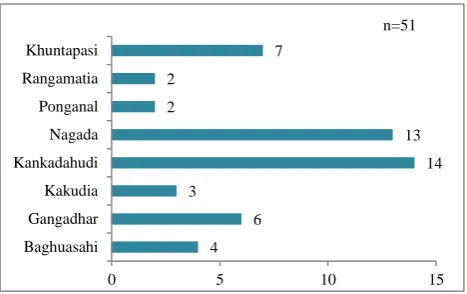
Figure 7 depicts distribution of malaria-malnutrition cases across villages. Highest 14 no. cases out of 51 mal-mal children (27.4%) were found in Kankadahudi village. 13 cases (25.4%) were reported in Nagada village. A lowest of 2 cases each (3.9%) were reported in Rangamatia and Ponganal.
Table 1 shows the co-existence of malaria and malnutrition. 51 children i.e. 45% were suffering from malnutrition out of 113 having malaria. In the other way around 51 children i.e. 59% were suffering from malaria out of 86 having malnutrition. So there exists a significant difference between malaria, with and without malnutrition or malnutrition, with and without malaria (p<0.05). In other words children with malaria have higher odds of having malnutrition and children with malnutrition have higher odds being attacked by malaria (OR=1.78).
Table 1: Co-existence of malaria and malnutrition.
Mal-Mal coexistence At risk (yellow)
+ acute (red) malnutrition
Normal or adequate
nutrition (green) Total Chi square value=4.38
P=0.03 OR=1.78
95% CI=1.03-3.08
MP positive 51 62 113
MP negative 35 76 111
Total 86 138 224
DISCUSSION
Out of 224 under 5 children 50.4%were suffering from malaria, 38% of the children were suffering from or at risk of malnutrition. Of the 113 children with malaria, 45%were having malnutrition. Out of86 malnourished children 59% were diagnosed with malaria. 22.7% of children were found to have Malaria and malnutrition together
The overall prevalence of malnutrition (which include both yellow and red zones of MUAC tape) in 224 children were 38% which is very similar to study conducted by Deribew et al in South- West Ethiopia in which the prevalence of underweight children were 34.2%.7 Malarial Parasitemia was found in 50.4% of under 5 children in comparison to 61.7% in a study conducted by Ehrhardt et al in African children.4 Prevalence of malnutrition in 113 children having malaria in our study was found to be 45%. A similar study was conducted by Shikur et al in Adami Tulu District, south-central Ethiopia to see any association between malaria and malnutrition.9 In that study prevalence of wasting was 17.8% among 107 malaria cases. The difference of findings is mainly attributed to the case-control study design of the above said study. In Our study Malnutrition children had higher odds being attacked by Malaria (OR=1.78, 95% CI=1.03-3.08 ), which is very similar to study conducted by Gone et al in Shashogo district, Southern Ethiopia in which Plasmodium infection was found to be a predictor for the manifestation of
malnutrition in under-five children (OR=1.87, CI=1.11– 3.13).10 Interestingly both the studies were conducted in pre monsoon seasons.
CONCLUSION
Our study was conducted in under 5 children of tribal dense regions of Odisha which gives us the magnitude of the malaria-malnutrition problem in hard to reach areas of Odisha where health care facilities aren’t easily accessible. In this study, 22.7% of under 5 children were found to have Malaria and malnutrition together. Rapid diagnostic test for malaria though isn’t a confirmatory test and some false positive results can’t be ruled out, still basing on the results we can’t go wrong with the statement that ―Malaria and Malnutrition are co-existent and synergistic to each other in under 5 children‖.
Recommendations
Antigen based RDT for malaria in children with malnutrition should be actively carried out in village level and should be confirmed by microscopy if possible. In lines with the recommendation from WHO all malnourished children with malaria should be referred to adjoining NRC of the district headquarters and follow up visits should be carried out. Case-control studies in malnourished children with and without history of malaria is highly recommended in these tribal dense regions to get a more clearer picture on any association between these two conditions.
4 6 3
14 13 2
2
7
0 5 10 15
Baghuasahi Gangadhar Kakudia Kankadahudi Nagada Ponganal Rangamatia Khuntapasi
ACKNOWLEDGEMENTS
Tata Steel Rural Development Society (CSR wing of TATA Steel) works in the most difficult and inhospitable regions of Odisha & Jharkhand. These regions are dense in tribal population and are notoriously known for high incidence of Malaria and Malnutrition. Tata Steel is committed towards the all round development of the population in its operational areas has been the striving force towards the inception and implementation of newer cost effective health care strategies to address the burden of malaria and malnutrition, one such intervention is Mal in Mal camps (malnutrition in malaria camps).
Funding: Tata Steel Rural development Society (CSR Wing)
Conflict of interest: None declared Ethical approval: Not required
REFERENCES
1. World Health Organization (WHO). Guidelines for the treatment of malaria Third edition. Trans R Soc Trop Med Hyg. 2015;85(4):556–7.
2. Niger: Impending Threat Of Deadly Malaria And Malnutrition Combination | MSF India.
3. Jones KDJ, Berkley JA. Severe acute malnutrition and infection. Paediatr Int Child Health. 2014;34(1):1–29.
4. Ehrhardt S, Burchard GD, Mantel C, Cramer JP, Kaiser S, Kubo M, et al. Malaria, Anemia, and
Malnutrition in African Children—Defining
Intervention Priorities. J Infect Dis.
2006;194(1):108–14.
5. Nutrition and Malaria. Available from:
https://www2.shu.ac.uk/PDAN/nutrition_and_malar ia.html. Accessed on 17 March 2018.
6. Biadgilign S, Reda A, Kedir H. Determinants of ownership and utilization of insecticide-treated bed nets for malaria control in Eastern Ethiopia. J Trop Med. 2012;2012.
7. Deribew A, Alemseged F, Tessema F, Sena L, Birhanu Z, Zeynudin A, et al. Malaria and nutrition: A community based study among under-five children at risk of malaria, South-West Ethiopia. PLoS One. 2010;5(5):1–6.
8. WHO/RBM. Malaria and malnutrition. 2005;2000.
9. Shikur B, Deressa W, Lindtjørn B. Association between malaria and malnutrition among children aged under-five years in Adami Tulu District, south-central Ethiopia: A case-control study. BMC Public Health. 2016;16(1):1–8.
10. Gone T, Lemango F, Eliso E, Yohannes S,
Yohannes T. The association between malaria and malnutrition among under-five children in Shashogo District, Southern Ethiopia: A case-control study. Infect Dis Poverty. 2017;6(1):4–11.
Cite this article as: Mahapatra A, Mohapatra S,