NETWORK CLASSIFICATION ON THE BASIS OF FUNCTIONS THEY
PERFORM AND ITS RELATIONSHIP WITH INTERNATIONALIZATION
PROCESS OF SMEs IN DEVELOPING COUNTRIES---exploratory research on
Pakistan
Seerat Fatima (Corresponding Author)
Lecturer, Department of Commerce, Bahauddin Zakariya University, Multan, Pakistan
E-mail: [email protected]
Prof. Dr. Mujahid Ali
Professor, Department of Commerce, Bahauddin Zakariya University, Multan, Pakistan
E-mail: [email protected]
Sheraz Arif
Research Scholar (BS COMMERCE), Department of Commerce Bahauddin Zakariya University, Multan, Pakistan
ABSTRACT
The purpose of this study is to classify the networks according to functions they performed, especially scrutinize their structures. The research concentrates on the influence of these functional networks on the internationalization process of small and medium sized companies (SME) in developing countries. What are the different types of support being provided by network partners? What is the structure of the existing network? The research part is inductive, qualitative and based on case study. The study’s findings illustrate the subtleties of how various network partners interact with entrepreneurs to penetrate, integrate and extend their international markets. Networks can help entrepreneurs expose themselves to new opportunities, obtain knowledge, learn from experiences, and benefit from the synergistic effect of pooled resources. Another contribution of this paper is that it identifies structures of the functional networks, till date networks are classified on the basis of extent of support they provide, not on what support they provide, thus advancing the literature.
Key words: network classification, internationalization process, developing countries, case study, functional network structure, small & medium sized companies, social capital, Pakistan
1. INTRODUCTION
In the start, entrepreneurs mostly worked on attributes of the individual entrepreneurs. This leads many scholars to wonder that how can we only see the person who start business and why not to give attention to the context in which he started working? Since then the concept of embededness in the entrepreneurial process was considered as important (Hoang & Antoncic, 2003). Networks speeded it up the venture creation process (Birley, 1985) and entrepreneurship is seen as part & parcel of networks of continuing social relations (Aldrich and Zimmer, 1986). The networks are considered as an important tool for exploring the creation and expansion of new ventures. Birley (1985) identified the need of more network research that contributed the understanding of the type and usefulness of networks in fostering startups.
2. LITERATURE REVIEW
Lechner and Dowling (2003) and Lechner et al. (2006) focus on the type and benefits of network in various stages of venture development …., while the prominence of networks increases and the importance of social and reputational networks decrease with the passage of time… performance as an outcome variable is relatively ignored (Hoang and Antoncic, 2003). Donckels and Lambrecht (1995) explored the influence of network characteristics on small-business development, Littunen (2000) studied influence of network characteristics on start-up, Havnes and Senneseth (2001) studied the impact of network size on performance and Watson‘s (2007) examined the effect of characteristics of advice network on ROE, survival and growth. This recommends that we have some data to understand and manage the network characteristics and their benefits at specific stages of development.
Greve & Salaff, (2003) examined a unique evaluation of how different stages of formation impact the network. Butler and Hansen (1991) did a survey to evaluate the difference between advice networks especially how they vary across different stages of development of the firm. Steier and Greenwood‘s (2000) suggests to decrease the competitive pressures for developing new firm, there is a need for the entrepreneur to develop a more diverse and dense network.
2.1. The Social Network Literature
The Social network literature has a strong footing in the research work of Simmel‘s (1955) who placed greater emphasis on group composition to comprehend the social life of entrepreneur (Smith- Doerr & Powell, 2005). It also provides the idea of embeddedness (Uzzi, 1996: Granovetter, 1985). It also make out exogenous as well as endogenous influences on firm formation by developing strong relations in an effective manner (Koka, Madhavan, and Prescott, 2006) The SN approach uses the emergence and demise of nodes for measuring how network are changes through structural characteristics such as network size, density, or the position of actors in the network (Owen-Smith, Riccaboni, Pammolli, and Powell, 2002, Ahuja, 2000).
Overall, the Social Network literature generally emphasized the characteristics of tie and network. Also high lights the importance of social networks to compensate overall needed different forms of capital to start and internationalize the venture and termed it as social capital.
2.1.1 Social Capital
Gabbay & Leenders (1999) defined social capital as the set of tangible or in tangible resources that comes through the social structure and facilitates the actors‘ goals (Lin, 1999; Portes, 1999). Entrepreneurs amass social capital for starting a new firm (Hansen, 2001).social capital is important element of entrepreneurial networks (Burt, 1992)... Entrepreneurs need many resources like information, capital, skills, and labor for startups and they often accumulates their resources by approaching their contacts (Cooper, Folta, & Woo, 1995, Hansen, 1995, Aldrich, et al., 1991, Aldrich & Zimmer, 1986). The contacts are mostly the informal and formal acquaintances. These contacts may range across reaching friends, professional networks and colleagues from earlier jobs.
2.2 Internationalization & Networks
Research on international entrepreneurship has increased to larger extent from last few years. Actually the market power and limited resources made the internationalization of SMEs different from large multinational firms. Use of networks is one prominent difference. While moving abroad SMEs rely more on their network contacts than larger multinationals (Coviello, 2006; Zahra, 2005). International expansion is greater risk for small, limited resources firms than for large, established multinationals. Small firms have limited capabilities, inadequate access to market research, and less intellectual capital for their internationalization efforts.
The process of SMEs internationalization appears to be an important concept as it helps to reduce the difficulties of limited financial & non-financial resources, experiences, and reliability (Lu & Beamish, 2001). Here is the summary of literature on the Network Relationships effect on Firms‘ process of internationalization.
Network relationship often ….
1. Initiate and stimulate firms‘ internationalization intent, Chetty and Patterson (2002) Coviello and Munro (1995), Korhonen et al. (1995), Andersen (1996), Ellis (2000), Sharma & Johanson (1987)
2. Encourages decision of firms‘ market-selection Coviello and Munro (1997), Bell (1995),
3. Helps firms to come up with entry-mode decision Coviello and Munro (1997), Johansson & Vahlne, (2003), Bell (1995), Chen, 2003; Oviatt & McDougall, 1994), Chetty & Campbell-Hunt, 2004;;
4. Aids Accessing additional relationships and upright channels Chetty and Patterson (2002) Welch (1992), Coviello and Munro (1995), Bjorkman and Kock (1995),
5. Increase the local market knowledge Larson (1992), Bucklin and Sengupta (1993) Coviello and Munro (1995), Fukuyama (1995)
6. Acquire initial trustworthiness Chetty and Patterson (2002) Coviello and Munro (1995), Turnbull et al. (1996), Nahapiet and Ghoshal (1998), Osland and Yaprak (1995)
7. costs saving and risk of internationalization Ellis and Pecotich (2001),Dichtl et al. (1990), Coviello and Munro (1995) Hamilton (1991), Katsikeas Morgan (1994), Burgel and Murray (2000), Chetty and Patterson (2002)
8. Speed up the firms‘ internationalization pace and pattern Lindqvist (1988), Jones (1999), Coviello and Munro (1995),
9. Expand firms‘ scope and provide market opportunity Coviello and Munro (1995)
3. THEORETICAL FRAMEWORK
The literature on the firms from developed nations has frequently highlighted that networks have an immense effect on the firm‘s process of internationalization; however, a question arises if the networks have same influence in the context of a developing nation. So in this research, we will study this network phenomenon in context of developing nation like Pakistan. We have also found that previous research could not provide clear direction on how to classify networks according to various functions they perform and how their relationships and structures influence internationalization outcomes. Therefore, our knowledge of the part played by the network structures in the process of internationalization of firms is inadequate. We cannot say with surety that what network features are more valuable than others in exploration of internationalization (Musteen, Francis & Datta, 2009)
We have two Different ways for operationalizing the network approach to entrepreneurship.
3.1. Characteristics of Network
A first way emphasizes structure and general characteristics of the networks of entrepreneurs and reconnoiters the impact of the characteristics on internationalization process. Examples of such characteristics are network size, network density, and network diversity.
3.1.1. Diversity
Diversity highlights network‘s capability to add variety of contacts, experience, and information through accelerating the different actors in the social networks. Diversity increases as the number of focal actors increases in networks.
3.1.2. Density
Network density is the extent to which the focal actor‘s network contacts are themselves connected to each other – network density increases as the number of interconnections between contacts increases. The density of the network is revealed through the relationships between the people in the network. If an entrepreneur knows persons A, B, and C, and if A also knows B and C, it facilitates the continuous flow of information and the network is a dense network.
3.1.3. Size
The size of the network is reflected with the number of people entrepreneurs interact for specific reason like discussions, seeking advice and information etc.
3.2 Classification of networks on the basis of functions they perform
According to Sapienza, Autio, George, and Zahra (2006), early internationalization threats survival of young, entrepreneurial firms. Small firms often depend on network relationships to overcome the hurdles of new markets entry. It has been proved for firms in developing economies, such as Pakistan, India and other countries in Central and Eastern Europe & Asia. In these economies, firms encountered many problems such as weak institutional environments, unforeseen changes in the legal system, and the occurrence of grey economy (Smallbone & Welter, 2001), these firms accelerate their networks to survive and grow (Batjargal, 2003). So, we may observe how many people the entrepreneur consulted before starting and running his business, how much the founder mobilized strong and weak ties, or how many hours per week the entrepreneur discussed specific business matters with friends and acquaintances, what sort of help they seek from the networks (Bögenhold and Staber, 1994, Aldrich et al., 1989, .Aldrich et al., 1987)
3.2.1. Discussion Networks
Discussion network comprised of the number of people that the entrepreneurs discuss numerous aspects of establishing and running a business (Renzulli, Aldrich, & Moody, 2000). Discussion of the various aspects of the venture to be created provides the entrepreneur a clear direction on how and from where to obtain certain resources such as property, credit, information and capital. Discussion networks are often identified with the name generator approach (Burt 1984). Some members of the discussion network have only solo relation to the entrepreneur and others become providers of further resources as well (Greve & Salaff, 2003)
Network relationships have generated a lot of opportunities for seeking knowledge for entrepreneurs and encouraged the firms‘ international entry (Korhonen, Luostarinen, & Welch, 1995, Ellis, 2000; Sharma & Johanson, 1987, Andersen, 1996), Chetty and Patterson (2002) identified that close collaboration motivate a firm to move abroad. Especially discussing different aspects of foreign opportunities like how to acquire resources such as information, property, capital, and credit helps them to boost up the motivation level of entrepreneur to exploit foreign opportunity.
So, the first proposition for the study is:
Proposition 1a: More the diversity of discussion networks, greater is the motivation for entrepreneurs‘ initial internationalization intention
Proposition 1b: More the density of discussion networks, greater is the motivation for entrepreneurs‘ initial internationalization intention
Proposition 1c: Lesser the number of network partners in discussion networks, lesser is the motivation for entrepreneurs‘ initial internationalization intention
3.2.2. Information Networks
Social systems and industrial relations are a valuable source of information on foreign markets (Ellis, 2000; Blomstermo Sharma, 2003), and often help to overcome barriers to exports (Ghauri, Lutz, Tesfom, 2003) are termed as Information Networks. Social contacts are important ways for accessing information. If we compare the information received from formal sources to informal sources, we find informal source to be more useful and less redundant. In particular, weak ties provide valuable information (Granovetter, 1974, 1983). The information rooted in the network incites the firm to get profoundly involved in international markets. So it appears vital for exporters to get trusted information through networks and then transform that information into strategic action. In the wide and varied international market arena, decision to which markets to enter first and which one can prove more profitable is critical to firm‘s future growth and sustainability in international market. Bell (1995) found that network relationships appear significant in deciding mode of entry and helps in market selection for small firms (Coviello & Munro, 1997). In short, network relationships encourage firms‘ right and profitable market selection.
Thus, the second proposition for this study is:
Preposition 2a: More the diversity of Information networks, greater is the chance for entrepreneur to select profitable market to internationalize the firm
Preposition 2b: More the density of Information networks, greater is the chance for entrepreneur to select profitable market to internationalize the firm
Preposition 2c: Lesser the number of network partners in Information networks, lesser is the chance for entrepreneur to select profitable market to internationalize the firm
3.2.3 Advice Networks
results in the confidence of entrepreneurs to the advisory person and they are the people who have historical experiences and superior in their judgments and interpretations (McGrath, Vance Gray, 2003). It may be the relatives, former employers, coworkers and any government official from chamber of commerce and any government regulatory authority.
Hamilton (1991) discovered that social (relationship) capital provide firms with an invincible competitive advantage, such as search costs for buyers and reduced transaction. Whenever the firm comes up with uncertain situation, decision makers curtail their risks by taking advices from the known/experienced connections with them (Ellis & Pecotich, 2001). Their experience in internationalization helped entrepreneur to minimize risk and engage more resources those are critical to success of venture (Katsikeas & Morgan, 1994, Dichtl, Koeglmayer, & Mueller, 1990, Chetty & Patterson, 2002; Coviello & Munro, 1995 ;). Through advice, entrepreneurs easily make effective resource commitments, which help them to lower the perception of risks (Burgel & Murray, 2000). These resources can be financial or non-financial (e.g. entry Mode etc.) so this lead us to our third preposition,
Preposition 3a: More the diversity of advice networks, greater are the chances for entrepreneur to make suitable financial and non-financial resources commitment (entry Mode) for internationalization of the firm.
Preposition 3b: More the density of advice networks, greater are the chances for entrepreneur to make suitable financial and non-financial resources commitment (entry Mode) for internationalization of the firm.
Preposition 3c: Lesser the number of network partners in advice networks, lesser are the chances for entrepreneur to make suitable financial and non-financial resources commitment (entry Mode) for internationalization of the firm
3.2.4 Emotional Support Network:
Socio-emotional support is a ―soft‖ type of contribution of social network of entrepreneurs (Brüderl & Preisendörfer, 1998). Exasperating events that pull initial optimistic expectations of business startups are not rare. For maintaining emotional stability, the emotional support received from the social network proves very supportive in this case. Being appreciated from their friends lifts self-confidence of entrepreneurs. Also, emotional support indicating high social legitimacy and approval for starting new ventures is an asset itself. Entrepreneurs who receive much support from the family might be more successful (Sanders and Nee, 1996). More emotional support helps to develop more psychological resources such as risk tolerance, persistence and perseverance those proves helpful for running successful business. They also generate other resources and benefits such as product ideas ,finance, introduction to new clients and distributors, and supplies. (Taige, 2007) So this is because of the encouragement being provided by the emotional support networks that motivate the entrepreneur to increase their resource commitments and grow with high speed in international markets. Thus our third proposition is,
Preposition 4a: More the diversity of emotional support networks, greater are the chances for entrepreneur to increase financial and non-financial resources commitment (Growth) for internationalization of the firm. Preposition 4b: More the density of emotional support networks, greater are the chances for entrepreneur to increase financial and non-financial resources commitment (Growth) for internationalization of the firm. Preposition 4c: Lesser the number of network partners in emotional support networks, lesser are the chances for entrepreneur to increase financial and non-financial resources commitment (Growth) for internationalization of the firm
3.2.5 Resource Acquisition Network:
Network contacts provide ready access to customers and suppliers and increase in the number of customers determines the success of a new business. A diverse network proves very supportive for this, because friends and acquaintances spread the word on the new firm into their own networks. Bögenhold, 1989 gives it the name of ―snowball effects‖. Informal credits received from relatives or acquaintances are especially helpful in the start-up phase (Brüderl & Preisendörfer, 1998). Unpaid work from family members can compensate for financial constraints. Moreover, it also provides loyal employees. (Brüderl & Preisendörfer, 1998) In case of scarce resources (human and financial resources), more companies would mobilize their support network.
`Networks help in establishing business in foreign countries through developing a distribution channel to market its products, they also help entrepreneurs to give access to well-established distribution channels (Coviello & Munro, 1995). Network relationships also help entrepreneur to access potential buyers (Bjorkman & Kock, 1995). Welch (1992) discovered thatsmall firms can improve foreign market penetration by providing access to additional relationships.
Network relationships help firms to access local market knowledge and obtain business information (Chetty & Patterson, 2002; Osland & Yaprak, 1995: Coviello & Munro, 1995) and establish relations (Turnbull, Ford, & Cunningham, 1996). By working together the entrepreneur develop trust and credibility with the passage of time, in parts (Larson, 1992: Bucklin & Sengupta, 1993), and network contacts helps to develop trust between members (Turnbull et al., 1996: Chetty & Patterson, 2002; Fukuyama, 1995).
Thus our final proposition is
Preposition 5a: More the diversity of resource acquisition networks, greater are the chances for entrepreneur to access established channels of formal networks and additional relationships for internationalization of the firm. Preposition 5b: More the density of resource acquisition networks, greater are the chances for entrepreneur to access established channels of formal networks and additional relationships for internationalization of the firm. Preposition 5c: Lesser the number of network partners in resource acquisition networks, lesser are the chances for entrepreneur to access established channels of formal networks and additional relationships for internationalization of the firm
4. RESEARCH DATA Data were collected on:
So our main focus remained on following investigative questions.
What are the different types of support being provided by network partners?
o Frequency of particular support being provided
o Extent of support from network partners
What is the structure of the existing network?
o Number of network partners (people with whom the entrepreneur talks about the business idea)
o Diversity of the network (family, friends, personal or business networks, variety of gender & occupation etc.)
o Density of the network (contacts between network partners)
We also investigated the attributes of the owner-managers, their background, previous employment experience, and the businesses they created. We also asked about their involvement in various formal or informal contacts like their membership or any higher designation in Chamber of Commerce, SMEDA or any other business association and in clubs, societies etc.
5. RESEARCH METHODOLOGY
The complexity of networks; highlights gaps to be filled; and to give comprehensive understanding of networks, there is need of different methodological approaches to be investigated. Therefore, qualitative methods can help us to understand entrepreneurial networks and increase our knowledge of entrepreneurial process (Jack, S.L., 2008). Qualitative Method gives us full insight of what is going on within a network. Researches done by Jack et al. (2008), Krackhardt (1995), Drakopoulou Dodd et al. (2006), Steier and Greenwood (2000), Hite (2003, 2005, Jack (2005), and Uzzi (1997) took qualitative approach to explore networks.
The present study is exploratory in nature and no previous work on the networks and their impact on internationalization of Pakistani SMEs is present, that‘s why we are using qualitative research approach. We used the method of qualitative interviewing, which helps to understand the interviewees' perceptions, stories and viewpoints. The flexibility of this method facilitates in depth investigation of relevant areas (Bryman & Bell, 2003). This is the reason behind greater usage of this multi-case study design approach in various studies on the smaller firm‘s international activities(Loane, Bell, & McNaughton, 2007: Spence & Crick, 2006, Moen et al., 2004: Coviello & Munro, 1997).
5.1. Generating network data
In this study, we wanted to understand the networks of the entrepreneurs, those are also known as ‗ego networks‘. Ego is the focal person, and ‗the alters‘ are his contacts. The most widely used instrument to collect ego-oriented network data in social surveys was first administered in the 1985 General Social Survey (GSS) (Bailey and Marsden, 1999). The instrument is centered on a ―name generator‖, which generates the respondent's social network. Central to this name generator instrument is the question:
From time to time, most people discuss important matters with other people. Looking back over the last six months — who are the people with whom you discussed an important personal matter?
This question is followed by ‗name interpreter‘ items, which help the researcher gain a deeper understanding of the characteristics of the respondent's alters and the type of relationships they have.
First of all, as suggested by Bailey and Marsden, the most important internationalization -related issues for entrepreneurs were identified through a qualitative study. The issues that are important to an entrepreneur were found as motivation to go internationalized, select profitable markets, select suitable financial commitment way (entry mode), increase commitment to more international markets and accessing more relationships in international markets.
We used a name generator for each of these issues. We enlisted each issue so that the respondent may recall the alerts. Van der Poel, (1993) believed that this method provides a better coverage of the ego's core network and thus increases the reliability of the data (Burt, 1983). In line with Marsden (1993, p. 400), we used three types of name interpreter items: 1) the number of alters i.e. size 2) features of the relationship between ego and alter, for instance the diversity 3) characteristics of the relationships between various alters (friend, business acquaintance or relative) i.e. density.
5.2. Selection of Cases
This study took the help of Yin‘s (1989) and Eisenhardt‘s (1989) approach for selection of case study method. We used multiple-cases. Strauss and Corbin (1990) and Yin (1989) both used multiple-cases but it is Eisenhardt (1989) highlighted the theory building properties. The multiple- case approach encourages the researcher to study patterns common to cases and theory and to avoid chance associations (Eisenhardt, 1991). Eisenhardt (1989) also point outs that in the multiple-case approach there is no ideal number of cases, but recommends between four and 10 cases. With fewer than four cases, theory is difficult to generate, and with more than 10 cases, the volume of data is difficult to cope with. As recommended by Eisenhardt (1989) the selection of firms is based on the fact that they are having totally different in characteristics. Their industry and characteristics of market are different from each other and they are working at different levels of internationalization.
Each firm was chosen by replication logic rather than by sampling logic. In other words, the sample was selected because of the literal and theoretical replication; they were not the true representative of the population as suggested by quantitative approach to research. By choosing small- to medium-sized firms, it was easy to access decision makers. Each case was carefully selected so that it predicts different results for expected reasons (theoretical replication).
6. STUDY FIRMS' PROFILES 6.1. Case 1: Cos
Cos is not highly qualified man, he is dealing in various products of cosmetics like hair care, skin care etc. Initially he started work from local market. After positive response from local market, his friends motivated him to work international. He started export in few countries. He got various pieces of information about business in those countries from business directories and chamber of commerce. Export to these countries proved supportive for future expansion. Now he is dealing many international countries.
6.2. Case 2: Soft
6.3. Case 3: Tex
Tex deals in textile business. The business was established by his father long ago. He dealt in home textiles in local market. After Tex completed his studies from abroad, he joined his father business. He decided to expand his father‘s business in international market. So by using his relationships which he made during studying abroad, he got entered into foreign markets. He exports his products in different parts of the world like china, Singapore, Thailand, Australia, America, Germany, Italy etc. He is taken benefits from his strong footage in local markets to work internationally. Now he has expanded his business to many countries and enjoying good share. He is nowadays planning to have production facilities in few foreign locations. During whole period of growth, his formal and informal contacts helped him a lot.
6.4. Case 4: Craft
Craft was a woman who started the business with a clear vision of revival of famous traditional crafts of the country. Her family background is quite sound and majority is involved in various business and social association. So she is backed by a lot of social and business contacts as she is also managing director of Fine Art College of a university. She made a team, the members of each team is specialized in various fields regarding the skills required for running successful business. Initially she started her business locally. After getting some good responses from market, she decided to move into international markets and get internationalized through social networking websites like you tube and Facebook. These websites are the places where people get attached with each other through single plate forum. So she got her first order from a friend of a friend on Facebook. Then her friend in UK motivated her to go abroad, so she arranged an exhibition there. Likewise she extended her international activities with the help of a lot of social and business contacts. Now she is running a successful business in local as well as foreign market and she has plans to develop the website and her own art galleries in various countries.
7. ANALYSIS OF DATA
Linking the data to propositions and the criteria for interpreting the findings are the least developed aspects in case studies (Yin, 1994). Campbell (1975) described "pattern-matching" as a useful technique for linking data to the propositions. Campbell (1975) asserted that pattern-matching is a situation where several pieces of information from the same case may be related to some theoretical proposition. His study showed, through pattern-matching, that the observed drop in the level of traffic fatalities in Connecticut was not related to the lowering of the speed limit. His study also illustrated some of the difficulties in establishing the criteria for interpreting the findings.
Our key contingency is the purpose of the networks and we link the contribution of particular network structures to key entrepreneurial processes (Elfring and Hulsink, 2003).
8. FINDING AND DISCUSSION
To answer the research question which we developed previously, we made a discussion on the influence of network relationships on the internationalization process. As we seen the small and medium enterprises internationalization process is rapid. Firms using a variety of mechanisms to enter a diverse number of foreign markets in years. The activity appears to be largely driven by existing network relationships. That is the rapid and successful growth of the case firms appears to be a result of their involvement in international network, with major network partners often guiding foreign market selection and provide the mechanism for entry in other markets. As a result we can say that network relationships may not only drive internationalization but also influence the pattern of financial investment decisions.
for him to enter and to grow in foreign markets. After those resources was acquired from different networks to fulfill the order.
Overall Cos‘s internationalization process was driven and shaped by complex set of different network relationships. In a pattern similar to the Cos the other cases were also linked to the established and extensive international networks.
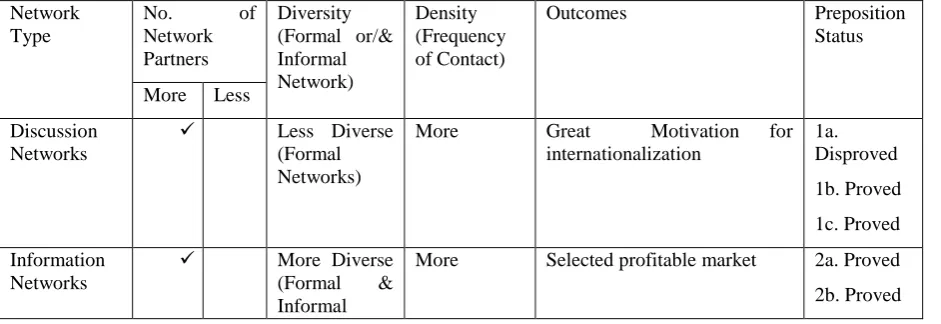
Particularly, each firm‘s choice of foreign market and entry mode was highly influenced by resultant network relationships. So here we find that an entrepreneur discussed their matters which motivate him to internationalize. We also find that he obtained information from his formal and informal contacts which helped him in selection of profitable market like the case of Tanzania and Dubai. However we find that in difficult situations their friends provide him support.
In case of Tex, who was an educated personality and started to export his textile products after his immediate joining. However his domestic business was strong and his captured a large market share domestically. When he joined the business his father has large number of relationships and so his .he used those relationships for gaining information about the international markets. He also made his research for better market, so that he can earn more profit. He believes that first order fulfillment is not an easy task. We need to acquire resources, and work hard to ship the order. An informal contact leveraged him in Australia. The textile industry is technology intensive, so he need upgrade the technology according to the demand and trends. Therefore we can say that an inward relationship facilitates an outward expansion. He believes that for competing in international markets an entrepreneur should know culture of a particular country, about their tastes and trends, and for repeated orders production should be according to the specifications. In disruptive and in critical situations he turn to his friends for emotional support. This behavior also supports the findings of McDougall et al. (1994) in that the small firms externalized particular activities in order to minimize their financial and market risk during international expansion. So here we find that they after discussion and proper research motivate him to expand his business in international markets. And he got business and market information from his friends who helped him selection of profitable market. Addition to those advices from his parents and professional friends about operational decisions about business helped him in entering new markets for exports. Following to that he got resources like human resource from his friends and parents.
In other case of crafts, this business is totally established on network contacts. This is the newly established business with rapid growth. In critical and disruptive situations he seeks help from his professional friends and close friends. Now he is working in the domestic as well as in the international market. He participates in the trade fares in different countries as well as domestically. They are actually working on the revival of old crafts in Pakistan. In this case we find that they use their networks for discussions, in fact they spent time in discussions with their business partners as well as their friends. They also get information, advices, emotional support and resources from their network partners. And in the result they selected profitable market, they decide the mode of entry in foreign market and they also got financial and non-financial resources for their business growth.
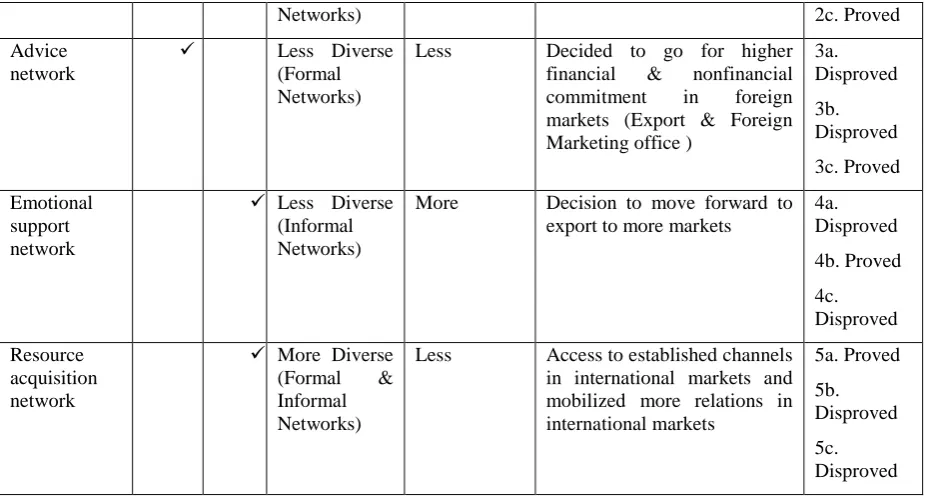
In other case of Soft, his business was established on various network partners‘ relationships. He was member in software export board, from where he got lot of contacts for further expansion in foreign markets, received a lot of help in the form of resources like angel capital and advices for mode of entry and mobilizing the additional relations. For business, one needs to be emotionally stable; it was his family who supported him throughout ups and downs of businesses.
Overall, case findings indicate that international decisions with respect to particular market selection and mode of entry are shaped by their network of formal and informal relationships. Network development and utilization is one of a number of explanatory factors in the ‗‘ability and preparedness of a company to expand its foreign market servicing commitments‖.
9. RESULTS
The main objective of this research was to increase our understanding of the impact of networks on the internationalization patterns and process of small firms, with special interest in the pursuing of network relationships on small firms approach to foreign market selection and mode of entry also. To achieve these four firms was selected to study the process. Case findings also explored those small firms externalizing their international market development activities by investment in network relationships.
The small firms begin operations with the intent to internationalize and this intension is mainly enhanced once the entrepreneur discussed the aspects with people whom he trusts most. It is also found out that with exception they like to discuss the matter with more people but they are the people who are having close relationship not only with him but also with each other, so the discussion become productive and integrated and resulted in the shape of higher motivation to internationalize.
Over time, a network of formal and informal contacts is developed usually facilitated by the small firm's initial relationship. This network provides market knowledge and potential access to profitable markets around the world. For this purpose, entrepreneur likes to have concrete information that is usually gained through few sources and in those sources; they rely on limited number of people. Again there is found a tendency of dense coordination in the information network.
Entrepreneur considers piece of advice important for selecting suitable mode of entry but it varies across the different firms. The entrepreneur working in knowledge intensive industry like software development would like to take advice from few people of their trust and their integration may not be required more. This is because entrepreneur‘s entrepreneurial capital is intensive. And other entrepreneurs who are working in traditional industries seeks advices from many sources and involves variety of expertise in their advisory board so that they may not make any mistake while engaging their resources at stake.
For increasing their commitments in foreign markets, entrepreneurs have to take bold steps that are not an easy task, involves a lot of risk. The entrepreneur is psychologically dependent on many people of their networks and needs reassurance from them for taking risks. The members of this emotional support network are proved less diverse, more dense and less in numbers with few exceptions. And these exceptions may represent the more of entrepreneurial capital like self-efficacy of the entrepreneur.
The members of resource acquisition networks proved more diverse, dense and greater in number and
helped to not only acquire necessary resources but also increase the social capital by providing access to additional relationships in foreign markets.
10. CONCLUSION
This study found that small firm owners extensively use their networks at different stages of internationalization and in different situations which helped them in gaining their desired results. On the basis of results it is concluded that networks impact the internationalization process of small and medium enterprise of firms. It is evident from the study that an entrepreneurs discuss their important matters to whom they trust, which gives them greater motivation. Different types of networks is used by an entrepreneurs for acquiring information, resources, advices, and emotional support for the selection of profitable international market and have financial and non-financial resource commitments in internationalization phase.
11. RESEARCH LIMITATIONS & FUTURE DIRECTION
There are a number of limitations those are applicable to the present study, for example, small number of firms and the duration of some interview. So the findings cannot be generalized (Saunders, Lewis, & Thornhill, 1997). Other limitation is in inherent response bias associated with the self-reporting nature of the interview data (Yin, 2003), and the last limitation is the recording of the interview sometimes causes the interviewee to hesitate and he/she may avoid the sensitive questions. (Ghauri, Grønhaug, & Kristianslund, 1995). So we recommend quantitative approach for future research to enhance and further strengthen our findings of present study.
Table1: Profile of Firms
Name Main Activities Founding
Year
Year of first
international Activity
First International Market
Mode of Entry
No of
international markets
Craft Make & Sale Crafts 2007 2008 United
Kingdom
Export Two & Through
Facebook to
whole world
Soft Develop & Sale
Software & provide IT solutions
1997 2004 Africa Export Many
Tex Manufacture Home
Textile Items
Table 2.1: Tabular Analysis of Network Characteristics of Craft
Network Type
No. of
Network Partners
Diversity (Formal or/& Informal Network)
Density (Frequency of Contact)
Outcomes Preposition
Status
More Less
Discussion Networks
Less
Diverse-Informal Networks
More Great Motivation for
internationalization
1a. Disproved
1b. Proved
1c. Proved
Information Networks
Less Diverse-Informal Networks
More Selected profitable market 2a.
Disproved
2b. Proved
2c. Disproved
Advice network
More
Diverse-Formal & Informal Networks
Less Decided to go for lesser
financial & nonfinancial
commitment in foreign
markets (Export)
3a. Proved
3b. Proved
3c. Disproved
Emotional support network
Less Diverse-Informal Networks
More Decision to move forward to
explore more markets
4a. Disproved
4b. Proved
4c. Disproved
Resource acquisition network
More
Diverse-Formal & Informal Networks
Less Access to established
channels in international
markets and mobilized more
relations in international
markets
5a. Proved
5b. Disproved
5c. Disproved
Table 2.2: Tabular Analysis of Network Characteristics of Soft
Network Type
No. of
Network Partners
Diversity (Formal or/& Informal Network)
Density (Frequency of Contact)
Outcomes Preposition
Status
More Less
Discussion Networks
Less Diverse
(Formal Networks)
More Great Motivation for
internationalization
1a. Disproved
1b. Proved
1c. Proved
Information Networks
More Diverse
(Formal & Informal
More Selected profitable market 2a. Proved
2b. Proved
Cos Make & sale
various cosmetics
Networks) 2c. Proved
Advice network
Less Diverse
(Formal Networks)
Less Decided to go for higher
financial & nonfinancial
commitment in foreign
markets (Export & Foreign Marketing office )
3a. Disproved
3b. Disproved
3c. Proved
Emotional support network
Less Diverse
(Informal Networks)
More Decision to move forward to
export to more markets
4a. Disproved
4b. Proved
4c. Disproved
Resource acquisition network
More Diverse
(Formal & Informal Networks)
Less Access to established channels
in international markets and mobilized more relations in international markets
5a. Proved
5b. Disproved
5c. Disproved
Table 2.3: Tabular Analysis of Network Characteristics of Tex
Network Type
No. of
Network Partners
Diversity (Formal or/& Informal Network)
Density (Frequency of Contact)
Outcomes Preposition
Status
More Less
Discussion Networks
Less
Diverse-Informal Networks
More Great Motivation for
internationalization
1a. Disproved
1b. Proved
1c. Proved
Information Networks
Less
Diverse-Informal Networks
More Selected profitable market 2a.
Disproved
2b. Proved
2c. Disproved
Advice network
More
Diverse-Formal &
Informal Networks
Less Decided to go for lesser
financial & nonfinancial
commitment in foreign
markets (Export)
3a. Proved
3b. Disproved
3c- Proved
Emotional support network
Less
Diverse-Informal Networks
More Decision to move forward to
export to more markets
4a. Proved
4b. Disproved
4c. Disproved
Resource acquisition network
More
Diverse-Formal &
Informal Networks
Less Access to established
channels in international
markets and mobilized more relations
5a. Proved
5b. Disproved
Disproved
Table 2.4: Tabular Analysis of Network Characteristics of Cos
Network Type
No. of
Network Partners
Diversity (Formal or/& Informal Network)
Density (Frequency of Contact)
Outcomes Preposition
Status
More Less
Discussion Networks
Less
Diverse-Informal Networks
More Great Motivation for
internationalization 1a. Disproved 1b. Proved 1c. Disproved Information Networks
Less
Diverse-Informal Networks
More Selected profitable market 2a.
Disproved 2b. Proved 2c. Disproved Advice network
More
Diverse-Formal &
Informal Networks
Less Decided to go for lesser
financial & nonfinancial
commitment in foreign
markets (Export) 3a. Proved 3b. Disproved 3c. Proved Emotional support network
Less
Diverse-Informal Networks
More Decision to move forward to
export to more markets
4a. Disproved 4b. Proved 4c. Disproved Resource acquisition network
More
Diverse-Formal &
Informal Networks
Less Access to established
channels in international
markets and mobilized more relations 5a. Proved 5b. Disproved 5c. Disproved
Table 3: Summary of Findings of Research
Na me
How Influential Networks are Relative
importa
nce of
Functio nal network s
Other Key
Influences motivation to
start/internatio nalize the firm
select profitable market
suitable financial and non-financial resources commitm ent (entry Mode)
increase
financial and
non-financial resources commitment(G rowth) Access establishe d channels of formal networks and additional relationsh ips
Cra In the start, the
entrepreneur
Decision to
select
How to
enter in
Increase in the financial &
ft discussed issues with a
relative who
lives abroad
& discussed the matter on
social media
like face-book
so informal
networks
proved more
influential
particular
market was
influenced by information provided by relative lives
in that
particular market particular market was highly influence d with the advice taken from business acquainta nces & professio nal friends (formal network) non-financial resource commitments
was made
possible due to emotional support
provided by
informal networks
acquisitio n is made possible more from informal networks and they
are the
source of accessing establishe d networks & additional relationsh ips network
s were
more dense, less diverse and lesser in number proved more influenti
al as
compare
d to
other function al network s
proved more
important in
all aspects of internationaliz ation
Soft Firm decision
to
internationaliz
e was
influenced with discussion
with other
exporters & software association (Formal Network)
Which Firms to select for internationali
zation are
decided with the
information provided by software board, government officials (Formal Network) and
a friend
(Informal Network)
Entry in particular market was highly influence d with the advice taken
from an
old & loyal customer
in local
market & exporters of software export board (Formal Networks )
Increase in the financial & non-financial resource commitments
was made
possible due to emotional
support of
Indian friends in country club of that country and also use
medium of
Facebook where he posts status and have feedbacks from informal networks
the resource acquisitio n is made possible more from friends communit ies developed through Facebook (Informal networks ) and they
are the
source of accessing establishe d networks & additional relationsh ips Advice network
s were
less dense, less diverse and greater in number proved less influenti
al as
compare
d to
other function al network s
During whole
process of
internationaliz
ation, both
types of
networks (Formal & Informal) remained
dominant in
all kinds of functional networks
Tex Motivation to
move international was
influenced
with the
discussion with father, classfelow (Informal Networks) and other
exporters in
Selection of
markets is
highly influenced
with the
information being provided from
Chamber of
Commerce
and other
government
To go for export rather than other
types of
entry modes was highly influence d with the advice taken
Increase in the financial & non-financial resource commitments
was made
possible due to emotional support
provided by
father &
brothers who
are partners of the resource acquisitio n is made possible more from informal networks like family & friends and they
Emotion al Support network
s were
more dense, less diverse and lesser in number proved
During whole
process of
internationaliz ation, Informal networks remained more
dominant in
textile industry
bodies(formal Network)
from a
customer who was close friend of entrepren eur (informal networks)
owners as well (informal networks)
are the
source of accessing establishe d networks & additional relationsh ips more influenti
al as
compare
d to
other function al network s
Cos Motivation to
move international was
influenced
with the
discussion with Mother, Friends(Infor mal Networks)
Selection of
markets is
highly influenced
with the
information being provided from
Chamber of
Commerce, Directory of Importers in first
international
country and
other government bodies(formal Network)
To go for export rather than other
types of
entry modes was highly influence d with the advice taken from Chamber of Commerc e (Formal networks) and friend who was having high designatio
n in
chamber of Commerc e (Informal Networks )
Increase in the financial & non-financial resource commitments
was made
possible due to emotional support
provided by
mother &
Spouse (informal networks) the resource acquisitio n is made possible more from informal networks like family & friends, less from state agencies & competito rs (Formal Networks )and they
are the
source of accessing establishe d networks & additional relationsh ips Informat ion network
s were
more dense, less diverse and lesser in number proved more influenti
al as
compare
d to
other function al network s
During whole
process of
internationaliz ation, Informal networks remained more
dominant in
all types of functional networks.
REFERENCES
1. Ahokangas, P. 1998 International orientation and external resource dependence of Nordic engineering companies, in Haahti, A., Hall, G. and Donckels, R., (eds) The Internationalization of SMEs: The Interstratos Project (London: Routledge), 81-100.
2. Ahuja, G. (2000). Collaboration networks, structural holes, and innovation: A longitudinal study. Administrative Science Quarterly, 45(3), 425–455.
3. Aldrich, H. & Zimmer, C. (1986). Entrepreneurship through social networks. In D.L. Sexton & R.W. Smilor (Eds.), The art and science of entrepreneurship (pp. 3–23). Cambridge, MA: Ballinger Publishing Company
4. Aldrich, H., Birley, S., Dubini, P., Greve, A., Johannisson, B., Reese, P. R., & Sakano, T. 1991. The generic entrepreneur? Insights from a multinational research project. Paper presented at the Babson Conference on Entrepreneurship
6. Andersen O, Buvik A (2002) Firms´ internationalization and alternative approaches to the international customer/market selection. International Business Review, vol.11, pp. 347-363.
7. Andersen, O. (1996). The international market selection: A relationship marketing approach. Paper presented at the AIB Conference, Banff, September 26–29.
8. Anthony Pecotich (2001), ―Social factors influencing export initiation in small and medium-sized enterprises,‖ Journal of Marketing Research, 38 (1), 119-31
9. Bailey, S., Marsden, P.V.,1999. Interpretation and interview context: examining the General Social Survey name generator using cognitive methods. Social Networks 21 (3), 287–309
10. Batjargal, B. (2003). Social capital and entrepreneurial performance in Russia: A longitudinal study. Organization Studies, 24: 535–556.
11. Bell, J. (1995). The internationalization of small computer software firms—A further challenge to ―stage‖ theories. European Journal of Marketing, 29(8), 7–27.
12. Birley, S. (1985). The role of networks in the entrepreneurial process. Journal of Business Venturing, 1, 107–117.
13. Björkman, I. & Kock, S. (1995). Social relationships and business networks: the case of Western companies in China. International Business Review, 4: 519-535.
14. Bjorkman, I., & Kock, S. (1995). Social relationships and business networks: The case of Western companies in China. International Business Review, 4, 519–535.
15. Blankenburg Holm, D. (1996). Business network connections and international business relationships.
Doctoral Thesis, No. 65, Uppsala University, Sweden.
16. Blomstermo, A., & Sharma, D. (2003). Three decades of research on the internationalisation process of firms. In A. Blomstermo, A., & D. Sharma (Eds.). Learning in the Internationalisation Process of Firms (pp. 16-35). Cheltenham: Edward Elgar.
17. Bonaccorsi, A. (1992) On the relationship between firm size and export intensity. Journal of International Business Studies 4(4), 605-635.
18. Bruderl, J & Preisendörfer, P, (1998). Network Support and the Success of Newly Founded Businesses, Small Business Economics 10: 213–225, 1998.
19. Brüderl, J., Preisendörfer, P., 1998. Network support and the success of newly founded businesses. Small Business Economics 10, 213–225.
20. Bryman, A. and Bell, E. (2003). Business research methods. New York: Oxford University Press
21. Bucklin, L. and S. Sengtupa, (1993), ―Organising Successful Co-Marketing Alliances,‖ Journal of Marketing, 57(4): 32-46.
22. Bucklin, L. P., & Sengupta, G. C. (1993). Organizing successful co-marketing alliances. Journal of Marketing, 57, 32–46.
23. Buorgel, O. and Murray, G.C. 2000. The International Market Entry Choice of Start-Up Companies in
High-Technology Industries. Journal of International Marketing Vol. 8 No. 2 pp. 33-62
24. Burgel, O., & Murray, G. C. (2000). The international market entry choices of start-up companies in high-technology industries. Journal of International Marketing, 8(2), 33–62.
25. Burt, R. S. 1992. Structural Holes: The Social Structure of Competition . Cambridge, MA: Harvard University Press.
26. Butler, J.E. & Hansen, G.S. (1991). Network evolution, entrepreneurial success, and regional development. Entrepreneurship and Regional Development, 3, 1–16.
27. Cathleen A. McGrath, Larry E. Pate, Edmund R. Gray, Charles M. Vance, (2006) "Getting wired for innovation: An analysis of the advice networks of software entrepreneurs", International Journal of Organizational Analysis, Vol. 14 Iss: 4, pp.317 – 330
28. Chen, T. (2003). Network resources for internationalization: The case of Taiwan‘s electronics firms. Journal of Management Studies, 40: 1107–1130.
29. Chetty, S. & Campbell-Hunt, C. (2004). A strategic approach to internationalisation: a traditional versus 'born global' approach. Journal of International Marketing, Vol. 12(1), pp. 57-81.
30. Chetty, S. & Campbell-Hunt, C. (2004). Internationalisation strategy and its impact on learning during the process. Journal of Asia Pacific Marketing (Special Issue), Vol. 3(2), pp. 37-51.
31. Chetty, S., & Patterson, A. (2002). Developing internationalisation capability through industry groups: The experience of a telecommunications joint action group. Journal of Strategic Marketing, 10, 69–89.
32. Chetty, Sylvie and Desirèe Blankenburg Holm (2000), ―Internationalisation of Small to Medium-Sized
Manufacturing Firms: A Network Approach,‖ International Business Review, 9 (1), 77-93.
33. Chetty, Sylvie K. and Heather I.M. Wilson (2003), ―Collaborating with Competitors to Acquire Resources,‖ International Business Review, 12 (1), 61-81.
35. Cooper, A. C., Folta, T. B., & Woo, C. 1995. Entrepreneurial information search. Journal of Business Venturing , 10(2): 107-120.
36. Coviello, N. E. (2006). The network dynamics of international new ventures. Journal of International Business Studies, 37(5), 713−731.
37. Coviello, N. E., & Munro, H. J. (1997). Network relationships and the internationalization process of the small software firms. International Business Review, 6, 361–386.
38. Davidsson, P., Honig, B., 2003. The role of human and social capital among nascent entrepreneurs. Journal of Business Venturing 18 (3), 301–331.
39. Dichtl, E., H.G. Koeglmayer, and S. Mueller (1990), ―International orientation as a precondition for export success‖, Journal of International Business Studies, 21(1), 23 -39.
40. Dichtl, E., Koeglmayer, H. G., & Mueller, S. (1990). International orientation as a precondition for export success. Journal of International Business Studies, 21(1), 23–40.
41. Donckels, R. & Lambrecht, J. (1995). Networks and small business growth: An explanatory model. Small Business Economics, 7, 273–289.
42. Drakopoulou Dodd, S, Anderson, A and Jack S (2004) ―A Review of Entrepreneurship as Doing: The
Importance of Socio-Cultural and Economic Environment‖, IBAT Journal of Management, 1:2, 37-53
43. Drakopoulou Dodd, S, Jack, S and Anderson, A (2006) ――Entrepreneurship as the nexus of change: the
syncretistic creation of the future‖, presented at the 2006 Organisation Studies Summer Workshop, Mykonos, June 2006
44. Dubini, P. & Aldrich, H. 1991, ‗Personal and extended networks are central to the entrepreneurial process‘, Journal of Business Venturing, vol. 6, pp. 305-313
45. Eisenhardt, K. (1989). Building theories from case study research. Academy of Management Review,
14(4), 532–550.
46. Eisenhardt, K. (1991). Better stories and better constructs: the case for rigor and comparative logic. Academy of Management Review, 16 (3), 620–627.
47. Ellis, P. (2000). Social ties and foreign market entry. Journal of International Business Studies, 31, 443–470.
48. Ellis, P., & Pecotich, A. (2001). Social factors influencing export initiation in small and medium-sized enterprises. Journal of Marketing Research, 28(1), 119–131
49. Ellis, Paul (2000), ―Social ties and foreign market entry,‖ Journal of International Business Studies, 31 (3), 443-70.
50. Fukuyama, F. (1995). Trust: Social virtues and the creation of prosperity. London: Hamish Hamilton. 51. Gabbay, S. M., & Leenders, R. Th.A.J. 1999. CSC: The structure of advantage and disadvantage. In R.
Th.A.J. Leenders & S. M. Gabbay, (eds.), Corporate Social Capital and Liability: 1-14. Boston: Kluwer Academic Press.
52. Granovetter, M.S. (1973), ―The strength of weak ties,‖ American Journal of Sociology 78, 1360-1380. 53. Granovetter, M.S. (1974), Getting a Job: A Study of Contacts and Careers, Cambridge,MA: Harvard
University Press.
54. Granovetter, M.S. (1985). Economic action and social structure: The problem with embeddedness. American Journal of Sociology, 91, 481–510.
55. Greve, A. & Salaff, J.W. (2003). Social networks and entrepreneurship. Entrepreneurship Theory and Practice, 28(1), 1–22.
56. Greve, A. & Salaff, J.W. (2003). Social networks and entrepreneurship. Entrepreneurship Theory and Practice, 28(1), 1–22.
57. Hamilton, G. (1991). Business networks and economic development in East and Southeast Asia. Hong
Kong: Centre of Asian Studies, University of Hong Kong.
58. Hansen, E. L. 1995. Entrepreneurial network and new organization growth. Entrepreneurship: Theory
& Practice, 19(4): 7-19.
59. Hansen, E. L. 2001. Resource acquisition as a startup process: Initial stocks of social capital and
organizational foundings. http://www.babson.edu/entrep/fer/IV/IVB/html/Iv-B.html. (accessed
10/13/01)
60. Havnes, P.-A. & Senneseth, K. (2001). Apanel study of firm growth among SMEs in networks. Small
Business Economics, 16, 293–302
61. Hite, J. M. (2003). Patterns of multidimensionality among embedded network ties: A typology of relational embeddedness in emerging entrepreneurial firms. Strategic Organization, 1(1), 9–49.
62. Hite, J. M. (2005). Evolutionary processes and paths of relationally embedded network ties in emerging entrepreneurial firms. Entrepreneurship Theory & Practice, 29(1), 113–144.
64. Jack, S.L. (2005). The role, use and activation of strong and weak network ties:Aqualitative analysis. Journal of Management Studies, 42(6), 1231–1259
65. Jack, S.L. (2008). Approaches to studying networks: Implications and outcomes, Journal of Business Venturing, doi:10.1016/j.jbusvent.2008.10.010.
66. Jack, S.L., Drakopolou Dodd, S., Anderson, A.R., 2008. Change and the development of
entrepreneurial networks over time: a processual perspective. Entrepreneurship and Regional Development 20 (2), 125–159.
67. Johanson, J., & Vahlne, J. E. (1992). Management of foreign market entry. Scandinavian International Business Review, 1(3), 9–27.
68. Johansson, J., & Vahlne, J. (2003). Business relationship learning and commitment in the internationalization process. Journal of International Entrepreneurship, 1: 83– 101.
69. Jones, M. (1999). The internationalisation of small hi-tech firms. Journal of International Marketing, 7(4), 15–41.
70. Katsikeas, C. S., & Morgan, R. E. (1994). Differences in perceptions of exporting problems based on company size and export market experience. European Journal of Marketing, 28(5), 17–35.
71. Koka, B.R., Madhavan, R., & Prescott, J.E. (2006). The evolution of firm networks: Environmental effects on patterns of network change. Academy of Management Review, 31(3), 721–737.
72. Korhonen, H., Luostarinen, R., & Welch, L. (1995). Internationalisation of SMEs: Inwardoutward patterns and government policy. Working Paper 7/1995, Department of Marketing/ The Centre for International Management and Commerce, University of Western Sydney, Nepean.
73. Korhonen, H., R. Luostarinen and L. Welch. (1996), ―Internationalization of SMEs: InwardOutward Patterns and Government Policy.‖ Management International Review
74. Krackhardt, D. (1992). The strength of strong ties: The importance of philos in organizations. In N. Nohria & R. Eccles (Eds.) Networks and Organizations: Structure, Form, and Action (pp. 216-239). Boston MA: Harvard Business School Press.
75. Larson, A. (1992). Network dyads in entrepreneurial settings: A study of the governance of exchange
relationships. Administrative Science Quarterly, 37(1), 76–104.
76. Lechner, C. & Dowling, M. (2003). Firm networks: External relationships as sources for the growth and competitiveness of entrepreneurial firms. Entrepreneurship & Regional Development, 15, 1–26. 77. Lechner, C., Dowling, M., &Welpe, I. (2006). Firm networks and firm development: The role of the
relational mix. Journal of Business Venturing, 21(4), 514–540.
78. Lin, N. 1999. Building a network theory of social capital. Connections, 22(1): 28-51
79. Lindqvist, M. (1988). Internationalization of small technology-based firms: Three illustrative case studies on Swedish firms. Stockholm School of Economics Research Paper 88/15.
80. Littunen, H. (2000). Networks and local environmental characteristics in the survival of new firms. Small Business Economics, 15(1), 59–71.
81. Loane, S., J.D. Bell, and R. McNaughton. 2007. A cross-national study on the impact of management
teams on the rapid internationalization of small firms. Journal of World Business 42: 489-504.
82. Lu, Jane and Paul W. Beamish, 2001, ―Internationalization and Performance of SMEs‖, Strategic Management Journal, 22(6/7): 565-586.
83. Martine Spence, Dave Crick, (2006) "A comparative investigation into the internationalisation of Canadian and UK high-tech SMEs", International Marketing Review, Vol. 23 Iss: 5, pp.524 – 548
84. Musteen M., Francis J., Datta D.K. (2010) The influence of international network on
internationalization speed and performance: A study of Czech SMEs // Journal of World Business 45: 197-205
85. Nahapiet, J., & Ghoshal, S. (1998). Social capital, intellectual capital, and the organizational advantage. Academy of Management Review, 23, 242–266.
86. Nicole E. Coviello, Hugh J. Munro, (1995) "Growing the entrepreneurial firm: networking for international market development", European Journal of Marketing, Vol. 29 Iss: 7, pp.49 – 61
87. Osland, G. E., & Yaprak, A. (1995). Learning through strategic alliances: Processes and factors that enhance marketing effectiveness. European Journal of Marketing, 29(3), 52–66.
88. Osland, Gregory E., and Yaprak, Attila. 1995. Learning through Strategic Alliances: Processes and Factors that Enhance Marketing Effectiveness, European Journal of Marketing, 29: 52-66.
89. Oviatt, B.M. and McDougall, P.P. (1994), ―Toward a theory of international new ventures‖, Journal of International Business Studies, Vol. 25 No. 1, pp. 45-64.
90. Owen-Smith, J., Riccaboni, M., Pammolli, F., & Powell, W.W. (2002). A comparison of U.S. and European university-industry relations in the life sciences. Management Science, 48(1), 24–43.
91. Peng, M. W. and Y. Luo: 2000, ‗Managerial Ties and Firm Performance in a Transition Economy: The