This is an Open Access article licensed under a Creative Commons Attribution-NonCommercial-ShareAlike 4.0 International License (https://creativecommons.org/licenses/by-nc-sa/4.0/ ), which permits unrestricted Non Commercial use, distribution and reproduction in any medium, provided the original work is properly cited.
Published by Oriental Scientific Publishing Company © 2018
Thyroid Disorders and Semen Quality
PALLAV SENGUPTA
and SULAGNA DUTTA
Department of Physiology, Faculty of Medicine, MAHSA University, Jalan SP 2, Bandar Saujana Putra, 42610 Jenjarum, Selangor, Malaysia.
*Corresponding author E-mail: [email protected]
http://dx.doi.org/10.13005/bpj/1342
(Received: February 16, 2018; accepted: March 13, 2018)
ABSTRACT
Thyroid hormones and their impacts on male reproduction have been reported in numerous studies in past few decades. They are the crucial players in the regulation of male gonadal
developments and reproductive functions. An excess or deficit of thyroid hormones not only alter
the testicular functions but also interrupts neuroendocrine axis through the crosstalk between hypothalamic-pituitary-thyroid (HPT) axis and hypothalamic-pituitary-gonadal (HPG) axis. These changes result in decreased testosterone level and altered seminal plasma components which affect semen quality. The reports on the direct effects of thyroid disorders on semen quality are scanty. Thus, this review scrutinizes the available literature and aims to elucidate (a) the normal thyroidal regulations of semen parameters, (b) effects of hypothyroidism on semen quality (c) effects of hyperthyroidism on semen quality, and (d) the possible mechanism of action of thyroid dysfunctions on the alterations of semen quality. This review also highlights the limitations of the studies carried
out so far and accentuates the necessity of large-scale human studies and animal studies specifically
focusing on the molecular events of thyroid disorder-induced alterations in semen quality.
Keywords: Hypothyroidism, Hyperthyroidism, Semen quality, Sperm count, Sperm motility.
INTRODUCTION
Thyroid hormones have adopted multivariate mechanisms to influence male reproductive functioning and have keenly been investigated since past several years, to aid proper understanding of the relation between the thyroid hormones and male infertility1-3. Over the past few decades, a worldwide declining trend in semen quality has been reported which is an alarming revelation of deterioration of male reproductive health4-10. This threatening trend in semen quality has drawn the attention of reproductive research arena in order to scrutinize the underlying causes
to bring about effective therapeutic and preventive measures. Although extensive research is still needed to unveil all the factors contributing to this global decline in semen quality, several key environmental and lifestyle factors have been
identified in this aspect11-16. All these factors disrupt the normal endocrine milieu including the normal
thyroid hormone profile7, 11, 13 which is reportedly a
vital endogenous factor influencing semen quality,
and its variations are associated with alterations in the later even inducing male infertility17.
the regulation of male reproductive functioning2, 18, but studies revealing the relationship between thyroid disorders with that of altered state in semen quality are barely available19. Hence, this review aims to present a concise concept of, (a) normal thyroid function in the regulation of semen parameters, (b) hypothyroidism and semen quality (c) hyperthyroidism and semen quality, and the (d) possible mechanism of action of thyroid dysfunction on alterations of semen quality.
Normal thyroid function and semen quality Thyroid hormones basically regulate semen quality by altering serum testosterone level20. The other mechanisms of thyroid hormones in the regulation of semen quality are mediated by the regulation of the seminal plasma components (calcium, fructose, magnesium, zinc etc.). By maintaining these components thyroid hormones regulate different seminal properties, like sperm motility, viability, and semen volume. Moreover, sufficient amount of testosterone promotes spermatogenesis and maintains sperm count21. Testosterone, together with the seminal components, also regulates semen parameters like sperm motility and sperm morphology18. Thyroid hormones evidently modulate the hypothalamic-pituitary-gonadal (HPG) axis through the crosstalk between HPG and hypothalamic-pituitary-thyroid (HPT) axis. It may also directly act either individually or in combination with follicular stimulating hormone (FSH) and/or luteinizing hormone (LH) on male reproductive tissues to exert their modulatory actions upon the gonadal development, testosterone synthesis, and spermatogenesis thereby accentuating the semen quality22.
Thyroid hormones, 3,5,3’-triiodothyronine (T3) and 3,5,3’,5’-tetraiodothyronine or thyroxine (T4) may adopt genomic and nongenomic mechanisms to lay their effects upon semen quality2. In various vital male reproductive cells (germ cells, Leydig
cells, and Sertoli cells), specific thyroid hormone
membrane transporters have been detected such as organic anion-transporting polypeptides (OATP)-F in the Leydig cells transports T4 and reverse T3
(3',5’,3-triiodothyronine, rT3) with high affinity23. Also, three novel OATP members have been designated
as gonad-specific transporters (GSTs) in the rat
(GST-1 and GST-2) and human testis24. In rat Sertoli
cells, Leydig cells and spermatogonia, GST-1 and GST-2 are shown to be highly expressed, both of which transport T4 and T3 in these cells. Moreover, two novel splice variants of OATP3A1-V1, OATPs, and OATP3A1-V2 were found to be expressed in Sertoli cells and testicular germ cells respectively25. In adult testicular cells both D1 and D2 are present. Their relative levels of activity indicate that D2 is the predominant activating enzyme in this organ. It is noteworthy that the highest level of D2 expression might play a major role in the intracellular conversion of T4 to T326.
Thyroid hormone receptors are found in various compartments of the testis. Thyroid hormones can bind to specific nuclear thyroid hormone receptor (TR) (family of ligand-dependent transcription factors) in the Sertoli cells and Leydig cells, thereafter binding to the Thyroid Hormone Responsive Elements (TRE) to regulate gene transcription and protein synthesis2. Two genes reportedly encode this receptor, namely, c-erb Ab and c-erb Aa. The c-erb Aa gene encodes three different protein receptors, a1, a2 and a3 through alternative splicing, while the c-erb Aa gene codes for b1 and b2 receptors27. In human Sertoli cells, expression of only the TRa1 and TRa2 isoforms have been documented, expression of TRa2 being higher at all the stages of human development and the TRa2/TRa1 ratio elevates progressively in the Sertoli cells from fetal to adult life. Moreover, thyroid hormone receptors on germ cells suggest
that there is a significant role of thyroid hormones
in maintaining the survival and growth of different germ cells population. These receptors are also being detected on different stages of developing germ cells. TRb1 appears in the intermediate type spermatogonia while expression of TRa has been observed in type B spermatogonia18.
Binding of T3 to T3 receptors on Sertoli cells modulates the secretion and synthesis of Androgen Binding Protein (ABP), activins and inhibins. Thus
T3 regulates testosterone secretion via influencing
(NCAM) whereas; in mature Sertoli cells, the characteristic markers of the androgen receptor (AR) are p27Kip1and p21Cip129. Expressions of immature Sertoli cell markers are suppressed by T3, including AMH, NCAM, and aromatase. Thyroid hormones induce Leydig cell development and also steroidogenesis. Hardy et al., (1993) have demonstrated that in propylthiouracil (PTU) treated hypothyroid rats, the Leydig cell number is
significantly increased as compared with euthyroid
controls30. Thyroid hormones also positively affect Leydig cell steroidogenesis. T3 induces de novo synthesis of a 52 KDa soluble protein, which stimulates androgen production, testosterone synthesis within the Leydig cells31-33.
Thyroid hormones also help to maintain the redox status of the testis by regulating the balance between Reactive Oxygen Species (ROS) and anti-oxidant capacity34.
Thyroid hormones can also affect the semen parameters through the non-genomic mechanism which includes binding to nonnuclear receptors placed in the cytoplasmic membrane, cytoplasm, mitochondria, and cytoskeleton of the spermatozoon, inducing cAMP synthesis and Ca2+ release and enhancing sperm motility35. T4 reportedly augment flagellar movements of spermatozoa and also the number of mature sperm recovered by swim-up. This is also evident from the
study where a significantly greater quantity of motile
sperm was obtained as compared to the samples that received pentoxifylline treatment (cAMP phosphodiesterase inhibitor) in order to perform intrauterine insemination35. Other iodothyronines (3,5 diiodothyronine or T2, rT3) through the nongenomic mechanisms bind to cytoskeleton or mitochondria to modulate semen parameters35.
The available studies suggest that normal putative thyroid activity seems vital for maintaining semen quality via genomic or non-genomic mechanisms, either locally acting on Sertoli cells, Leydig cells or germ cells or by affecting crosstalk between the classical endocrine axes, HPT axis, and hypothalamic-pituitary-testicular axis. Further deep insights are required to obtain clearer knowledge about these mechanisms.
Hyperthyroidism and semen quality
Human studies
Hyperthyroidism is a condition of increased total thyroxine (T4) levels which has been associated with an increase in sex hormone binding globulin (SHBG) in circulation and decrease in the metabolic clearance rate of testosterone36, 37. In hyperthyroid males, bioavailable testosterone was found to be subnormal38 with an elevated circulating estradiol (E2). It can result in gynecomastia38, decreased libido39 and erectile dysfunction40. Studies have also reported that LH and FSH responses to GnRH administration are exaggerated in hyperthyroid males41, 42. Altered reproductive hormone levels affect sperm production and maturation, thus altering semen quality.
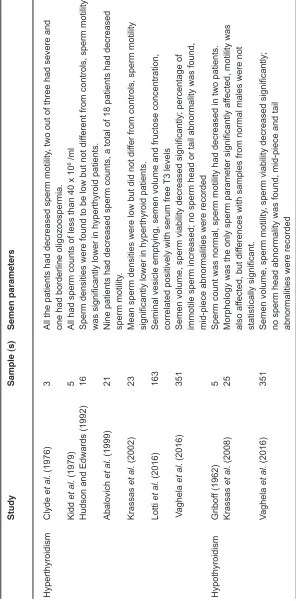
The correlation between hyperthyroidism and semen quality has been reported only in few clinical studies. Clyde et al., investigating in three hyperthyroid male patients, found that out of the three patients, two had marked oligozoospermia with decreased motility while in the third patient they found a borderline low sperm count along with a decrease in sperm motility43. Kidd et al. had
investigated among five hyperthyroid patients and
reported reduced sperm counts (less than 40×106/ ml) in all the patients37. Hudson and Edwards (1992) studied the spermogram of 16 hyperthyroid males and observed reduced sperm density. They have also reported that the sperm motility in these
patients was significantly reduced as compared to
the euthyroid males44. Abalovich et al. studied the effect of hyperthyroidism on spermatogenesis in 21 patients. Nine patients (43%) were found to have low total sperm counts, 18 (86%) were observed with motility defects, and 13 (62%) were presented with progressive motility abnormalities38. Later, Krassas et al. in a prospective study, investigated the semen parameters in 23 hyperthyroid males and compared the results with 15 healthy euthyroid controls. They performed semen analysis both before and after
five months of the restoration of euthyroidism that
Table 1: Hyperthyroidism and hypothyroidism and their effects on semen parameters
Study
Sample (s)
Semen parameters
Hyperthyroidism
Clyde
et al.
(1976)
3
All the patients had decreased sperm motility
, two out of three had severe and
one had borderline oligozoospermia.
Kidd
et al.
(1979)
5
All had sperm counts of less than 40 x 10
6 /ml
Hudson and
Edwards (1992)
16
Sperm densities were found to be low but not dif
ferent from controls, sperm motility
was significantly lower in hyperthyroid patients.
Abalovich
et al.
(1999)
21
Nine patients had decreased sperm counts, a total of 18 patients had decreased sperm motility
.
Krassas
et al.
(2002)
23
Mean sperm densities were low but did not dif
fer from controls, sperm motility
significantly lower in hyperthyroid patients.
Lotti
et al.
(2016)
163
Seminal vesicle emptying, semen volume and fructose concentration, correlated positively with serum free
T3 levels
V
aghela
et al.
(2016)
351
Semen volume, sperm viability decreased significantly; percentage of immotile sperm increased; no sperm head or tail abnormality was found, mid-piece abnormalities were recorded
Hypothyroidism
Gribof
f (1962)
5
Sperm count was normal, sperm motility had decreased in two patients.
Krassas
et al.
(2008)
25
Morphology was the only sperm parameter significantly af
fected, motility was
also af
fected, but dif
ferences with samples from normal males were not
statistically significant.
Vaghela
et al.
(2016)
351
Semen volume, sperm motility
, sperm viability decreased significantly;
after reaching the euthyroid condition, and values did not correlate with the semen parameters or with the pre-treatment level of thyroid hormones. The results of semen parameters had indicated unaltered semen volume in patients but the mean sperm density was reduced than that of controls, however,
this difference was not statically significant45. A similar change was recorded for sperm morphology, however, in hyperthyroid men, the mean sperm motility was found decreased than the controls (mean±SE 28±8% vs. 57±7%, P<0.01). They have concluded that sperm morphology did not change after the treatment of hyperthyroidism. However, improvements in sperm motility and the density was recorded45.
In humans, the excess of circulating thyroid hormones that are found during thyrotoxicosis reported to result in asthenozoospermia in more than half of patients. Oligo- and teratozoospermia are found in about 40% of patients. These abnormalities frequently associated with a reduced semen volume (hypoposia)38, 41. In a recent study on 163 men referred to an infertility clinic, the rate of subclinical or overt hyperthyroidism was 3.7% or nil46. Hyperthyroid patients showed a greater difference in seminal vesicles volume before and after ejaculation compared to hypothyroid patients, which represented 7.4%. This difference, together with seminal vesicle emptying, semen volume and fructose concentration, correlated positively with serum free T3 levels46 (Table 1).
Animal studies
S t u d i e s o n a n i m a l s c o r r e l a t i n g hyperthyroidism and semen quality are scanty. Hyperthyroid rats show a delay in spermatogenesis47, a decrease in seminiferous tubules diameters48, and an impairment of the mitochondrial activity49. Choudhury demonstrated in the murine model that hyperthyroidism positively regulated catalase, but negatively glutathione peroxidase50. Alterations in the redox status of testicular germ cells, Sertoli cells, and Leydig cells may affect the quality of semen.
Hypothyroidism and semen quality
Hypothyroidism is a clinical condition characterized by decreased circulating T3 and T4 levels. This condition has also reported being associated with a decrease in serum testosterone level51, 52. Thus it is related to erectile dysfunction,
delayed ejaculation, hypoactive sexual desire and decreased semen quality53. There are several studies that reported the correlation between hypothyroidism and male infertility20, 43, 52 but the direct effects of hypothyroidism on semen quality have not been well documented41.
Human studies
Though hypothyroidism is less prevalent in men compared to women54, 55, it can be caused due to the chronic exposure of endocrine disruptors56, 57. In hypothyroid men, the concentration of SHBG and serum free testosterone usually remain normal or lower than euthyroid men54, 55. But the response of LH to GnRH, in the hypothalamic-pituitary-testicular axis, in hypothyroid males is not clear54. Plasma testosterone levels in hypothyroid men have been reported to return to normal after T4 therapy53.
In some studies, it has been reported that subclinical hypothyroidism does not to have any impact on sperm density, morphology and motility58. It has not been found to cause seminal alterations
that are sufficient to cause infertility in men, but short
term post-pubertal hypothyroidism might decrease semen volume52, 59. Altered sperm motility, the altered secretory activity of the accessory glands, and low ejaculate volume has been also reported54, 55. In a
study, Griboff examined five patients, aged between
30 and 64 years, with primary hypothyroidism and he had found that they all had normal sperm counts, but sperm motility had decreased in two patients60. De la Balze et al. by investigating six hypothyroid males, aged between 17 and 59 years, reported
that in five patients’, thyroid insufficiency occurred
before the onset of puberty and in one patient it occurred during childhood. All these patients had shown the features of hypogonadotropic hypogonadism. Testicular biopsy of all patients had revealed histological abnormalities. It was concluded that severe and prolonged thyroid insufficiency occurring early in life resulted in the moderate failure of pituitary gonadotropin secretion and abnormal testicular biopsies61. Wortsman et al., in their study, with eight hypothyroid male patients, aged between 37 and 77 years, reported that all
these patients had hypogonadism, out of these five
and Miralles Garcia investigated spermatogenesis in ten patients who had a history of hypothyroidism and was treated with T4. In these patients, hypothyroidism was induced by stopping or by decreasing the dose of T4 over at least one spermatogenic cycle. It is observed that there was a decrease in seminal volume, and progressive forward motility compared to the controls. During euthyroid state, induction of hypothyroidism did not lead to seminal changes as compared with the same patients52. Therefore, it appears, short-term post-pubertal hypothyroidism
does not cause sufficient seminal alterations to
impair male fertility. Jaya Kumar et al. investigated the reproductive and endocrine functions of eight male patients with primary hypothyroidism. They conducted the investigation during the hypothyroid state and after the euthyroid state was achieved with T4 substitution therapy. The authors found low serum testosterone, low SHBG, subnormal testosterone responses to hCG and high mean
gonadotropin levels. In five out of eight patients,
semen analysis was performed but these data were not reported. However, the authors claimed there was some improvement in sperm count and its motility59. In prospective controlled study Krassas et al. investigated the effects of hypothyroidism on male spermatogenesis. They have performed semen analysis and have measured teratozoospermia index, fructose, and acid phosphate concentrations both before and after the treatment with T4 in 25 hypothyroid. They have noticed that hypothyroidism had adverse effects on male spermatogenesis, though the sperm morphology was the only
parameter that was affected significantly, sperm
motility was also affected but the differences were
not statically significant62.
Animal studies
In rats, whose thyroid have been blocked with antithyroidal drugs show an arrest of spermatogenesis with a decrease in of seminiferous tubular diameter, and a decrease in seminal volume, testicular, epididymal and prostate weight, compared with euthyroid rats32,48,50,63. Progressive sperm motility, sperm transit time through the epididymis and epididymal secretory activity are also affected64, 65. Hypothyroidism is also reported to reduce in acrosome integrity and mitochondrial activity of sperm64. Furthermore, the number of testicular germ cells decrease in persistent hypothyroidism but not in those with transient hypothyroidism,
while the number of live sperms is reduced both in transient and persistent hypothyroidism66. This reduction in sperm vitality may result from increased oxidative stress and reduced antioxidant capacity66. Very recently, Sarkar and Singh have shown that oxidative stress reduces the expression of glucose transporter 3 (GLUT3) in Sertoli cells and GLUT8 in Leydig cells in propylthiouracil-treated newborn mice, with a consequent decrease in testicular glucose levels and increased apoptosis of germ cells. Furthermore, oxidative stress downregulates the expression of connexin-43, a gap junctional protein in the seminiferous epithelium that regulates proliferation and apoptosis of germ cells63. Since thyroid hormones promote Sertoli cells differentiation and inhibit their proliferation, lower concentrations of thyroid hormones after birth, such as in rats with congenital hypothyroidism, lead to an extension of the Sertoli cells proliferative period, delaying their differentiation, and resulting in an increase of testicular weight and sperm production47, 67.
Mechanism of action
In hyperthyroidism, increased T4 levels, altered LH and FSH responsiveness, disrupt the endocrine regulation upon development and functioning of male reproductive tissues and germ cells resulting in distortions in tissues such as the reduced diameter of seminiferous tubule and impaired or delayed spermatogenesis. These, in turn, negatively affect sperm count and semen volume. Altered redox status of the testis, Sertoli cells and Leydig cells in hyperthyroidism, such as decreased glutathione peroxidise activities, also affect the quality of semen. Sperm motility may also be hindered in hyperthyroidism via impairment of mitochondrial activities in spermatozoa. Thus, reduced sperm count, vitality, and motility ultimately suggest a decline in semen quality owing to hyperthyroidism.
In hypothyroidism, decreased circulating T3 and T4 levels, reduced SHBG concentrations, decreased serum testosterone level adversely affect
spermatogenesis. Prolonged thyroid insufficiency
semen quality in terms of sperm count, motility and low ejaculate volume. Hypothyroidism is also characterized by a decrease in seminiferous tubular diameter and reduction in testicular, epididymal and prostate weight thus affecting sperm development, progressive sperm motility, sperm transit time through the epididymis. Reduction in sperm vitality may result from increased oxidative stress and reduced antioxidant capacity in reduced thyroid hormone actions.
CONCLUSION
This review summarizes the normal thyroid hormone regulation of semen quality, provides an update on human and animal studies
on thyroid disorders and altered semen quality and also elucidates the possible mechanism of hypothyroidism and hyperthyroidism-induced alterations in semen quality. This review also intends to highlight the necessity of large-scale cohort studies using human subjects, as the available reports used only limited number of subjects, which
confines to obtain a valid conclusion. Animal studies are also required to find out the proper molecular
events occur during thyroidal disorders leading to altered semen quality.
ACKNOWLEDGEMENTS
Authors want to thank MAHSA University College, Malaysia for providing support for the study.
REFERENCES
1. Krassas GE, Perros P, Thyroid disease and male reproductive function. J Endocrinol Invest. 26:372-80 (2003).
2. Wajner SM, Wagner MS, Maia AL, Clinical implications of altered thyroid status in male testicular function. Arq Bras Endocrinol Metabol. 53:976-82 (2009).
3. Krajewska-Kulak E, Sengupta P, Thyroid function in male infertility.Front Endocrinol (Lausanne). 4:174 (2013).
4. Carlsen E, Giwercman A, Keiding N, Skakkebaek NE, Evidence for decreasing quality of semen during past 50 years. BMJ. 305:609-13 (1992).
5. Auger J, Kunstmann JM, Czyglik F, Jouannet P, Decline in semen quality among fertile men in Paris during the past 20 years. N Engl J Med. 332:281-5 (1995).
6. Sengupta P, Reviewing reports of semen volume and male aging of last 33 years: From 1980 through 2013. Asian Pac J Reprod. 4:242-46 (2015).
7. Sengupta P, Dutta S, Krajewska-Kulak E, The Disappearing Sperms: Analysis of Reports Published Between 1980 and 2015. Am J Mens Health. 11:1279-304 (2017).
8. Sengupta P, Nwagha U, Dutta S, Krajewska-Kulak E, Izuka E, Evidence for decreasing sperm count in African population from 1965 to 2015. Afr Health Sci. 17:418-27 (2017).
9. Sengupta P, Borges E, Jr., Dutta S, Krajewska-Kulak E, Decline in sperm count in European men during the past 50 years. Hum Exp Toxicol. 37:247-55 (2018).
10. Sengupta P, Dutta S, Tusimin MB, Irez T, Krajewska-Kulak E, Sperm counts in Asian men: Reviewing the trend of past 50 years. Asian Pac J Reprod. 7: 87-92 (2018).. 11. Sengupta P, Environmental and occupational
exposure of metals and their role in male reproductive functions. Drug Chem Toxicol. 36:353-68 (2013).
12. Sengupta P, Banerjee R, Environmental toxins: alarming impacts of pesticides on male fertility. Hum Exp Toxicol. 33:1017-39 (2014). 13. Sengupta P, Dutta S: Metals. In Reference
Module in Biomedical Sciences: Encyclopedia of Reproduction. Edited by Skinner MK: Elsevier; 2018
14. Sengupta P, Current trends of male reproductive health disorders and the changing semen quality. Int J Prev Med. 5:1-5 (2014).
15. Sengupta P, Recent trends in male reproductive health problems. Asian J Pharm Clin Res. 7:1-5 (2014).
possible mechanism. Mol Cell Biochem. 364:181-91 (2012).
17. Rajender S, Monica MG, Walter L, Agarwal A, Thyroid, spermatogenesis, and male infertility.Front Biosci (Elite Ed). 3:843-55 (2011).
18. Kumar A, Shekhar S, Dhole B, Thyroid and male reproduction. Indian J Endocrinol Metab. 18:23-31 (2014).
19. Sharma MK, Parchwani D, Maheria P, Upadhyah A, Relationship between thyroid
profile and semen quality. Nat J Comm Med. 3:20-24 (2012).
20. Meikle AW, The interrelationships between thyroid dysfunction and hypogonadism in men and boys. Thyroid. 14 Suppl 1:S17-25 (2004).
21. Wagner MS, Wajner SM, Maia AL, Is there a role for thyroid hormone on spermatogenesis? Microsc Res Tech. 72:796-808 (2009). 22. Castaneda Cortes DC, Langlois VS,
Fernandino JI, Crossover of the hypothalamic pituitary-adrenal/interrenal, -thyroid, and -gonadal axes in testicular development. Front Endocrinol (Lausanne). 5:139 (2014). 23. Pizzagalli F, Hagenbuch B, Stieger B, Klenk
U, Folkers G, Meier PJ, Identification of a
novel human organic anion transporting polypeptide as a high affinity thyroxine transporter. Mol Endocrinol. 16:2283-96 (2002).
24. Suzuki T, Onogawa T, Asano N, Mizutamari H, Mikkaichi T, Tanemoto M, Abe M, Satoh F, Unno M, Nunoki K, et al, Identification
and characterization of novel rat and human
gonad-specific organic anion transporters. Mol Endocrinol. 17:1203-15 (2003). 25. Huber RD, Gao B, Sidler Pfandler MA,
Zhang-Fu W, Leuthold S, Hagenbuch B, Folkers G, Meier PJ, Stieger B, Characterization of two splice variants of human organic anion transporting polypeptide 3A1 isolated from human brain. Am J Physiol Cell Physiol. 292:C795-806 (2007).
26. Buzzard JJ, Morrison JR, O’Bryan MK, Song Q, Wreford NG, Developmental expression of thyroid hormone receptors in the rat testis. Biol Reprod. 62:664-9 (2000).
27. Wrutniak-Cabello C, Casas F, Cabello G, Thyroid hormone action in mitochondria. J
Mol Endocrinol. 26:67-77 (2001).
28. Schulte KM, Jonas C, Krebs R, Roher HD, Activin A and activin receptors in the human thyroid: a link to the female predominance of goiter? Horm Metab Res. 32:390-400 (2000). 29. Sharpe RM, McKinnell C, Kivlin C, Fisher
SJ, Proliferation and functional maturation of Sertoli cells, and their relevance to disorders of testis function in childhood. Reproduction. 125:769-84 (2003).
30. Hardy MP, Kirby JD, Hess RA, Cooke PS, Leydig cells increase their numbers but decline in steroidogenic function in the adult rat after neonatal hypothyroidism. Endocrinology. 132:2417-20 (1993). 31. Jana NR, Halder S, Bhattacharya S, Thyroid
hormone induces a 52 kDa soluble protein in goat testis Leydig cell which stimulates androgen release. Biochim Biophys Acta. 1292:209-14 (1996).
32. Maran RR, Arunakaran J, Aruldhas MM, T3 directly stimulates basal and modulates LH induced testosterone and oestradiol production by rat Leydig cells in vitro.Endocr J. 47:417-28 (2000).
33. Manna PR, Tena-Sempere M, Huhtaniemi IT, Molecular mechanisms of thyroid hormone-stimulated steroidogenesis in mouse leydig tumor cells. Involvement of the steroidogenic acute regulatory (StAR) protein. J Biol Chem. 274:5909-18 (1999).
34. Zamoner A, Barreto KP, Filho DW, Sell F, Woehl VM, Guma FC, Pessoa-Pureur R, Silva FR, Propylthiouracil-induced congenital hypothyroidism upregulates vimentin phosphorylation and depletes antioxidant defenses in immature rat testis. J Mol Endocrinol. 40:125-35 (2008).
35. Mendeluk GR, Rosales M, Thyroxin Is Useful to Improve Sperm Motility. Int J Fertil Steril. 10:208-14 (2016).
36. Vermeulen A, Verdonck L, Van Der Straeten M, Orie N, Capacity of the testosterone-binding globulin in human plasma and
influence of specific binding to testosterone
on its metabolic clearance rate. J Clin Endocrinol Metab. 29:1470-80 (1969). 37. Kidd GS, Glass AR, Vigersky RA, The
48:798-802 (1979).
38. Abalovich M, Levalle O, Hermes R, Scaglia H, Aranda C, Zylbersztein C, Oneto A, Aquilano D, Gutierrez S, Hypothalamic-pituitary-testicular axis and seminal parameters in hyperthyroid males. Thyroid. 9:857-63 (1999).
39. Velazquez EM, Bellabarba Arata G, Effects of thyroid status on pituitary gonadotropin and testicular reserve in men. Arch Androl. 38:85-92 (1997).
40. Ridgway EC, Maloof F, Longcope C, Androgen and oestrogen dynamics in hyperthyroidism. J Endocrinol. 95:105-15 (1982).
41. Krassas GE, Pontikides N, Male reproductive function in relation with thyroid alterations. Best Pract Res Clin Endocrinol Metab. 18:183-95 (2004).
42. Zahringer S, Tomova A, von Werder K, Brabant
G, Kumanov P, Schopohl J, The influence
of hyperthyroidism on the hypothalamic-pituitary-gonadal axis.Exp Clin Endocrinol Diabetes. 108:282-9 (2000).
43. Clyde HR, Walsh PC, English RW, Elevated plasma testosterone and gonadotropin levels in infertile males with hyperthyroidism. Fertil Steril. 27:662-6 (1976).
44. Hudson RW, Edwards AL, Testicular function in hyperthyroidism. J Androl. 13:117-24 (1992).
45. Krassas GE, Pontikides N, Deligianni V, Miras K, A prospective controlled study of the impact of hyperthyroidism on reproductive function in males. J Clin Endocrinol Metab. 87:3667-71 (2002).
46. Lotti F, Maseroli E, Fralassi N, Degl’Innocenti S, Boni L, Baldi E, Maggi M, Is thyroid hormones evaluation of clinical value in the work-up of males of infertile couples? Hum Reprod. 31:518-29 (2016).
47. Rijntjes E, Wientjes AT, Swarts HJ, de Rooij DG, Teerds KJ, Dietary-induced hyperthyroidism marginally affects neonatal testicular development. J Androl. 29:643-53 (2008).
48. Fadlalla MB, Wei Q, Fedail JS, Mehfooz A, Mao D, Shi F, Effects of hyper- and hypothyroidism on the development and proliferation of testicular cells in prepubertal rats. Anim Sci J. 88:1943-54 (2017).
49. Watt LO, Ureteral “kinking” following colposuspension. Can Med Assoc J. 126:360,62 (1982).
50. Choudhury S, Chainy GB, Mishro MM, Experimentally induced hypo- and hyper-thyroidism influence on the antioxidant defence system in adult rat testis. Andrologia. 35:131-40 (2003).
51. Wortsman J, Rosner W, Dufau ML, Abnormal testicular function in men with primary hypothyroidism. Am J Med. 82:207-12 (1987). 52. Corrales Hernandez JJ, Miralles Garcia JM,
Garcia Diez LC, Primary hypothyroidism and human spermatogenesis.Arch Androl. 25: 21-7 (1990).
53. Carani C, Isidori AM, Granata A, Carosa E, Maggi M, Lenzi A, Jannini EA, Multicenter study on the prevalence of sexual symptoms in male hypo- and hyperthyroid patients. J Clin Endocrinol Metab. 90:6472-9 (2005). 54. Bjoro T, Holmen J, Kruger O, Midthjell
K, Hunstad K, Schreiner T, Sandnes L, Brochmann H, Prevalence of thyroid disease, thyroid dysfunction and thyroid peroxidase antibodies in a large, unselected population. The Health Study of Nord-Trondelag (HUNT). Eur J Endocrinol. 143:639-47 (2000). 55. Canaris GJ, Manowitz NR, Mayor G, Ridgway
EC, The Colorado thyroid disease prevalence study. Arch Intern Med. 160:526-34 (2000). 56. Chandra AK, Goswami H, Sengupta P,
Effects of magnesium on cytomorphology and enzyme activities in thyroid of rats. Indian J Exp Biol. 52:787-92 (2014).
57. Chandra AK, Goswami H, Sengupta P, Dietary calcium induced cytological and biochemical changes in thyroid. Environ Toxicol Pharmacol. 34:454-65 (2012). 58. Trummer H, Ramschak-Schwarzer S, Haas
J, Habermann H, Pummer K, Leb G, Thyroid hormones and thyroid antibodies in infertile males. Fertil Steril. 76:254-7 (2001). 59. Jaya Kumar B, Khurana ML, Ammini AC,
Karmarkar MG, Ahuja MM, Reproductive endocrine functions in men with primary hypothyroidism: effect of thyroxine replacement. Horm Res. 34:215-8 (1990). 60. Griboff SI, Semen analysis in myxedema.
Fertil Steril. 13:436-43 (1962).
hypogonadism in hypothyroidism: a study of six cases. J Clin Endocrinol Metab. 22:212-22 (1962).
62. Krassas GE, Papadopoulou F, Tziomalos K, Zeginiadou T, Pontikides N, Hypothyroidism has an adverse effect on human spermatogenesis: a prospective, controlled study. Thyroid. 18:1255-9 (2008).
63. Sarkar D, Singh SK, Effect of neonatal hypothyroidism on prepubertal mouse testis in relation to thyroid hormone receptor alpha 1 (THRalpha1). Gen Comp Endocrinol. 251:109-20 (2017).
64. Romano RM, Gomes SN, Cardoso NC, Schiessl L, Romano MA, Oliveira CA, New insights for male infertility revealed by alterations in spermatic function and
differential testicular expression of thyroid-related genes. Endocrine. 55:607-17 (2017). 65. Anbalagan J, Sashi AM, Vengatesh G,
Stanley JA, Neelamohan R, Aruldhas MM, Mechanism underlying transient gestational-onset hypothyroidism-induced impairment of posttesticular sperm maturation in adult rats. Fertil Steril. 93:2491-7 (2010).
66. Sahoo DK, Roy A, Bhanja S, Chainy GB, Hypothyroidism impairs antioxidant defence system and testicular physiology during development and maturation. Gen Comp Endocrinol. 156:63-70 (2008).