IJSRSET185331 | Published :28 April 2018 |March-April-2018 [(5)3: 194-198]
Themed Section : Engineering and Technology © 2018 IJSRSET | Volume 5 | Issue 3 | Print ISSN: 2395-1990 | Online ISSN : 2394-4099
194
Home Automation Using Py-Ardomotics
1K.Anu, 2R.Hemalatha, 3K.Rajesh, 4M.Shenbagapriya, 5C.Gomathi
1 UG Scholar, Knowledge Institute of Technology, Salem, Tamilnadu, India
2,3,4,5 Assistant Professor, Knowledge Institute of Technology, Salem, Tamilnadu, India
ABSTRACT
According to the present world scenario, the word automation extending all over the countries, but in India it doesn’t reach the level till yet. Home automation is becoming popular due to its numerous benefits. Home automation refers to the control of home appliances and domestic features by local networking or by remote control. The main objective of this work is to bring automation in the domestic level without using the GSM or GPS. Domestic automation can be done by using microcontroller arduinos which can be used for applications. Ngrok is software used to convert a local host into a public server and the interfacing can be done by using the Python language. It has numerous applications in the fields of home automation, apartment automation, medicinal fields
Keywords: Python, Arduino, Automation, Ngrok, Local host, GSM, GPS
I.
INTRODUCTIONAutomation is a technique, method, or system of operating or controlling a process by electronic devices with reducing human involvement to a minimum. The implementation of automation in domestic apartments, houses, institutions increasing day by day. Industrialist and researchers are working to build efficient and affordability automatic systems to monitor and control different machines like lights, fans, AC based on the requirement. Automation makes not only an efficient but also an economical use of the electricity and water and reduces much of the wastage.
IoT grant to people and things to be connected Any-time, anyplace, with anyone, ideally using any network and any service. Automation is another important application of IoT technologies. It is the
monitoring and reduces the energy consumption and controlling the
environment in buildings, schools, offices and
museums by using different types of sensors and actuators that control lights, temperature, and humidity. As the automation can be done by creating our own server it will be more reliable and easy to change it as per our
The Smart home which can be also called as automated home, with the use of new technology, to make the domestic activities more convenient, comfortable, secure and economical. The home automation system includes main components which are:
1. User interface: as a monitor, computer, or Phone, for example, that can give orders to control System.
2. Mode of transmission: wired connections (example Ethernet) or Wireless (radio waves, infrared, Bluetooth, GSM) etc.
International Journal of Scientific Research in Science, Engineering and Technology (www.ijsrset.com)
195
4. Electronic devices, a lamp, an AC or a heater, which is compatible with the transmission mode, and connected to the Central control system.
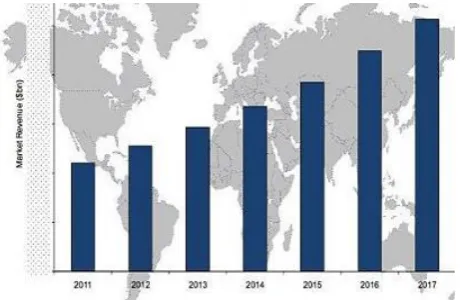
The Figure.1 shows the projected trends in smart home in previous years.
Figure 1: Popularity of Smart home in market.
II.
LITERATURE SURVEYThe Figure 2 shows the basic architecture of Remote Home Automation.
Figure 2: Basic Block Diagram of Home Automation
The home automation system that uses Wi-Fi technology, here the system consists of three main components; web server, which presents system core that controls, and monitors users’ home and hardware interface module(Arduino PCB (ready-made), Wi-Fi shield PCB, 3 input alarms PCB, and 3 output actuators PCB.), which provides appropriate interface to sensors and actuator of home automation system. The System is better from the scalability and flexibility point of view than the commercially available home automation systems. The User may use the same technology to login to the server web
based application. .If server is connected to the internet, so remote users can access server web based application through the internet using compatible web browser.
The application has been developed based on the android system. An interface card has been developed to assure communication between the remote user, server, raspberry pi card and the home Appliances. The application has been installed on an android Smartphone, a web server, and a raspberry pi card to control the shutter of windows. Android application on a smartphone issues command to raspberry pi card. An interface card has been realized to update signals between the actuator sensors and the raspberry pi card.
Cloud-based home appliance monitoring and controlling System is design and implement a home gateway to collect metadata from home appliances and send to the cloud-based data server to store on HDFS (Hadoop Distributed File System), process them using MapReduce and use to provide a monitoring function to Remote user. It has been implemented with Raspberry Pi through reading the subject of E-mail and the algorithm. Raspberry Pi proves to be a powerful, economic and efficient platform for implementing the smart home automation
2.1 DRAWBACKS OF EXISTING SYSTEMS:
III.
METHODOLGY 3.1 NgrokNgrok is one of the software used to convert the local server to a public server can be accessible by the mobile phone. This software produces the specific URL which can be accessible by the mobile devices from anywhere while connected to the internet
3.2 Arduino
Arduino is a microcontroller which is similar to a Personal Computer or a CPU but instead of interacting with human beings they interact with other machines. Basically, Microcontrollers were developed for making process automated. It works on the basis of result taken from the sensor and other output devices.
3.3 Python
Python is an interpreted high level programming language for general purpose programming. Python has a designed philosophy that emphasizes code readability, and syntax that allows the programmers to express concepts in fewer lines of codes .It constructs the enables clear programming on both small and large scales
3.4 Energia:
Energia is an open source electronic prototyping software and community driven Integrated Development Environment and software framework. Based on wiring framework, it provides an intuitive coding environment for coding an microcontroller. The Energia IDE is cross platform and supported on Mac OS, window, and Linux.
3.5 BLOCK DIAGRAM
This block diagram in Figure 3 shows the working principle of the developed method.
Figure 3: Block diagram of Py-Ardomotics
IV.
METHODS AND MATERIALFor this work, HTML based webpage should be created as per user desire and requirements. Then the coding should be written in the Energia software to command what should be done while switching on and off the device. It should contain the port and number of inputs and number of outputs. If the user requires large number of applications, they should insert large output and input pins. Ngrok software must be used to convert the local host address can be accessed by mobile phones anywhere only with the presence of internet. Python is the high level programming language used to interface the Arduino with the Ngrok. Once when all these procedures are done, Ngrok software should be opened in the presence of Wi-Fi or any form of internet accessibility. Once when the Ngrok shows online, it will create two addresses one its own physical internet protocol Address and the another one IP address can be used by any other device like mobile phones which can be used to control all the devices in the home. The encryption keys were included to safeguard our server. The user can see the options what they choose already. For instance, user can know whether the light is on or off already by this the user can get acknowledged for the actions done for the day.
These are the outputs came when implemented this work in real time.
(Local server)
Python
International Journal of Scientific Research in Science, Engineering and Technology (www.ijsrset.com)
197
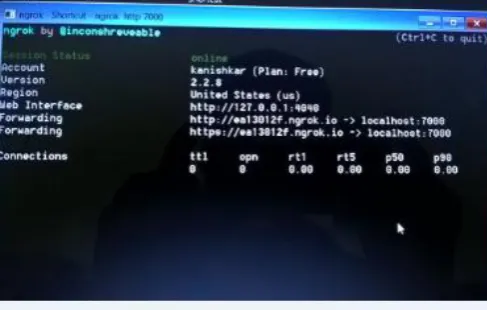
Figure 4: Running of Ngrok softwareHere when the software is running, it form a tunnel to public server from local server and creates the IP address.
Figure 5:Ready for execution
In the Figure 5, when the server is connected with online it is ready to execute the further actions.
Figure 6: Final execution in mobile.
V.
CONCLUSION
As on now, this Ngrok technology is used by some of the industrial resource persons and technocrats. When this software used in home automation it will create major turning point for the automation. In future, it will be accessed by all the domain of the mankind where the need of automation is present. This work helps to access our entire home through our mobile phone without the usage of GPS, GSM, and Bluetooth. In future some of us need to send the acknowledgement for the working of the device. For that a sensor will keep near the light to discover whether the device is on or not.
VI.
REFERENCES[1] Ahmed ElShafee, Karim Alaa Hamed, “Design and Implementation of a Wi-Fi Based Home Automation System”, International Journal of Computer, Electrical, Automation, Control and Information Engineering Vol: 6, No: 8, 2012.
[2] Hayet Lamine and Hafedh Abid , “Remote control of a domestic equipment from an Android application based on Raspberry pi card”, IEEE transaction 15th international conference on Sciences and Techniques of Automatic control & computer engineering - STA'2014, Hammamet, Tunisia, December 21-23, 2014.
[3] YunCui, MyoungjinKim, YiGu, Jong-jinJung, and HankuLee, “Home Appliance Management System for Monitoring Digitized Devices Using Cloud Computing Technology in Ubiquitous Sensor Network Environment”, Hindawi Publishing Corporation International Journal of Distributed Sensor Networks Volume 2014, Article ID 17409.
Reliability, Optimization and Information Technology ICROIT 2014, India, Feb 6-8 2014.
[5] Ardam H. and Coskun I., "A remote controller for home and office appliances by telephone", IEEE Transactions on Consumer Electronics, vol. 44, no. 4,pp. 1291-1297, 1998.
[6] Greichen, J.J., “Value based home automation or today's market,” IEEE Transactions on Consumer Electronics, vol. 38, no. 3, pp.34-38, Aug. 1992