695 |
P a g e
STRENGTH ANALYSIS OF POLY-URETHANE
Shishupal Singh
1, Nishant Singh
2,
Shreyash Chaudhary
31
Assistant professor, Department of Mechanical Engineering, Invertis University, Bareilly (India)
2
Assistant professor, Department of Mechanical Engineering, Invertis University, Bareilly (India)
3
Department of Mechanical Engineering, Invertis University, Bareilly (India)
ABSTRACT
A nylon fabric coated urethane was developed. Poly-urethane materials are considered to be cheap in comparison to other materials with higher strength and properties. As this family of materials is a part of the emerging world of engineering materials, as it has low weight with higher strength, it is fire proof and water proof which makes it more useable for the industries for different purposes. Therefore, in the following research, some tests has been conducted to analyze the strength of the nylon fabric coated urethane. The analyses of strength was done on the basis of Energy Dispersive X-ray Analysis (EDAX), Differential Scanning Calorimetry (DSC) and Universal Testing Machine (UTM).
Keywords-
DSC, Glass Transition Temperature, Isocyanates EDAX, Poly-Urethane, PU Resin.
I. INTRODUCTION
Polyurethanes are any type of polymer containing a urethane linkage. The urethane linkage is -NH-CO-O-.[2]
The way to form polyurethanes is done by reacting iso-cyanates with compounds that have an active hydrogen,
such as diols, that contain hydroxyl-groups, in the presence of a catalyst. Since there are many compounds
containing active hydrogens and many different di-isocyanates, the number of polyurethanes that can be
synthesized is also large. The specific properties of the polyurethane can be tailored to a specific need by
combining the appropriate compounds. Polyurethanes can exist as both rigid and flexible foams, and as a
coating or adhesive material. Since polyurethanes come in so many forms and can have a wide variety of
properties, it is also used in many different applications. Rigid polyurethanes are used as insulation and
flotation, while flexible ones are used for cushioning and packaging.[1] In addition, they are used as adhesives in
construction and transportation. Polyurethanes are mostly thermosets, which means they are hard to melt and
reprocess and can therefore have the disadvantage of being non-recyclable. Differential Scanning Calorimetry
(DSC) is used to find out the different phases of a material at different temperatures when it is heated for a
particular time period.[4] Basically the temperatures of three phases for any material are most important which
includes starting temperature of material, glass transition temperature or transition phase[6] and melting
temperature. Energy Dispersive X-ray Analysis Test (EDAX) is used for X-ray analysis of polyurethane
696 |
P a g e
Machine (UTM) is used for calculating the strength of material under tensile or compressive load. We havecalculated the strength of polyurethane material.
II. MATERIAL SPECIFICATION
As per the analysis and by some measurement using vernier caliper of polyurethane we find out thickness of
coated fabric of the material that is used in making different product. And measured data are mentioned below:
Gram per square meter (GSM) of coated fabric = 1380 gm/cm2.
Thickness of coating on both sides = 0.125mm
Total thickness of coated fabric = 0.5mm
The fabric material is polyester.
The polyurethane coating is used.
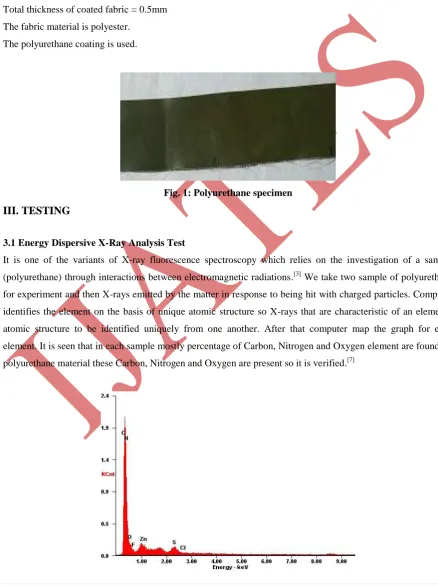
Fig. 1: Polyurethane specimen
III. TESTING
3.1 Energy Dispersive X-Ray Analysis Test
It is one of the variants of X-ray fluorescence spectroscopy which relies on the investigation of a sample
(polyurethane) through interactions between electromagnetic radiations.[3] We take two sample of polyurethane
for experiment and then X-rays emitted by the matter in response to being hit with charged particles. Computer
identifies the element on the basis of unique atomic structure so X-rays that are characteristic of an element's
atomic structure to be identified uniquely from one another. After that computer map the graph for each
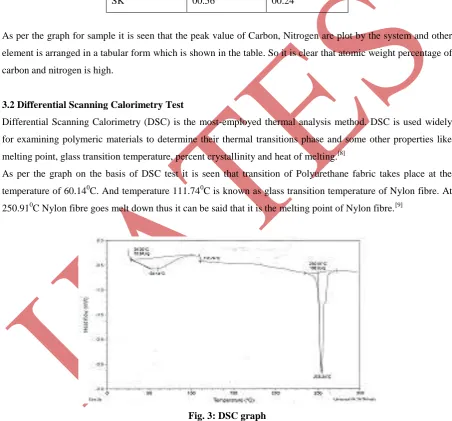
element. It is seen that in each sample mostly percentage of Carbon, Nitrogen and Oxygen element are found. In
697 |
P a g e
Fig. 2: EDAX Graph
TABLE 1 Elemental data of EDAX Graph
Elements Weight% Atom%
CK 26.68 30.28
NK 66.91 65.10
OK 04.37 03.73
FK 00.69 00.49
ZnL 00.78 00.16
SK 00.56 00.24
As per the graph for sample it is seen that the peak value of Carbon, Nitrogen are plot by the system and other
element is arranged in a tabular form which is shown in the table. So it is clear that atomic weight percentage of
carbon and nitrogen is high.
3.2 Differential Scanning Calorimetry Test
Differential Scanning Calorimetry (DSC) is the most-employed thermal analysis method. DSC is used widely
for examining polymeric materials to determine their thermal transitions phase and some other properties like
melting point, glass transition temperature, percent crystallinity and heat of melting.[8]
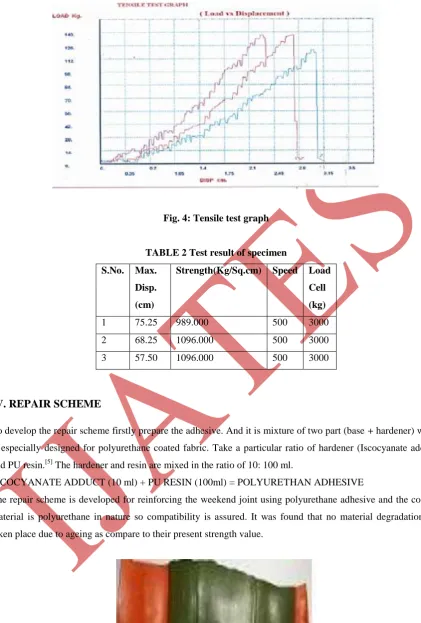
As per the graph on the basis of DSC test it is seen that transition of Polyurethane fabric takes place at the
temperature of 60.140C. And temperature 111.740C is known as glass transition temperature of Nylon fibre. At
250.910C Nylon fibre goes melt down thus it can be said that it is the melting point of Nylon fibre.[9]
Fig. 3: DSC graph
3.3 Strength Test
This test shows the strength of the material. We prepare the specimen for this test with dimensioning of 7× 2.5
cm2 size and then attached to the universal testing machine. When power is on, it will give the breaking load of
material and it come near about 220N. This is good enough. Tensile test perform after the samples are taken out
from oven. These samples are tested for strength on Universal Testing Machine. During tensile test.it is found
698 |
P a g e
Fig. 4: Tensile test graph
TABLE 2 Test result of specimen
S.No. Max.
Disp.
(cm)
Strength(Kg/Sq.cm) Speed Load
Cell
(kg)
1 75.25 989.000 500 3000
2 68.25 1096.000 500 3000
3 57.50 1096.000 500 3000
IV. REPAIR SCHEME
To develop the repair scheme firstly prepare the adhesive. And it is mixture of two part (base + hardener) which
is especially designed for polyurethane coated fabric. Take a particular ratio of hardener (Iscocyanate adduct)
and PU resin.[5] The hardener and resin are mixed in the ratio of 10: 100 ml.
ISCOCYANATE ADDUCT (10 ml) + PU RESIN (100ml) = POLYURETHAN ADHESIVE
The repair scheme is developed for reinforcing the weekend joint using polyurethane adhesive and the coating
material is polyurethane in nature so compatibility is assured. It was found that no material degradation has
taken place due to ageing as compare to their present strength value.
699 |
P a g e
TABLE 3 Stress comparison of specimen
Fabric specimen Breaking Load
Specimen after repair scheme 2400 N
Specimen before repair scheme 2096 N
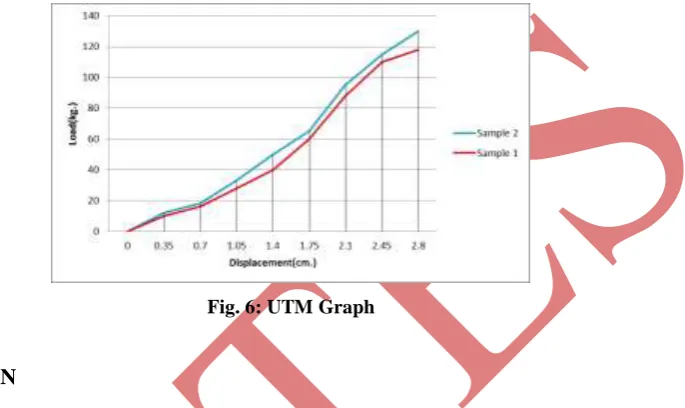
When performed the tensile test on joint fabric then it is found that breaking load for specimen before repair
work is 2096N and after repair work in 2400N. During this tensile test UTM speed is taken as 400 mm/min.
Fig. 6: UTM Graph
V. CONCLUSION
On the basis of the tests and results of the above research we came to the following conclusions:
(a) As per the EDAX test it was found that the percentage of carbon and nitrogen was high and as we know
that carbon increases the strength of any composite material, therefore the strength of the sample is high.
(b) According to the results of the DSC test the melting point of the sample was high, i.e., 250.910C, which
clearly indicates that the composite can withstand high temperature and the elements would not detach to
this value.
(c) The UTM test also showed good results, as on 400mm/min the breaking load before work is 2096N and
after repair work in 2400N.This shows that the strength of the sample is very high and can withstand
considerably high amount of stresses.
REFERENCES
[1] Zodiac Group: AERAZUR (Cognac, France) and Air Cruisers Company (Wall Township, New Jersey, USA)
are two major manufacturing sources for emergency flotation systems requirements. rde09jun09.
[2] The Polyurethanes Recycle and Recovery Council (PURRC), a committee of the Center for the
Polyurethanes Industry. "The Socio-Economic Impact of Polyurethanes in the United States from the
American Chemistry Council". February 2004. Retrieved 2007-09-28.
[3] www.ametekmad.com/edax/index.
[4] M. J. O'Neill."The Analysis of a Temperature-Controlled Scanning Calorimeter". Anal. Chem. 36 (7), 1964, 1238–1245
700 |
P a g e
[6] R.M Overney “Glass and Structural transitions measured at polymer surfaces on the Nano-scale” Journal ofThermal Analysis and Calorimetry, vol 59, 2000, 205-225.
[7] D. K. Sawant “Growth and EDAX of mixed Ca-Ba Tartrate” Archives of Physics Research,4 (2), 2013,1-3.
[8] Riesen R., Widmann G. and Truttmann R., Alternating thermal analysis techniques. Thermochim.Acta 272
,1996, 27-39.
[9] Schawe J.E.K., A comparison of different evaluation methods in modulated temperature DSC.
Thermochim.Acta 260,1995, 1-16.
Biographical Notes
Mr. Shishupal Singh Working As An Assistant Professor In Mechanical Engineering Department, Invertis
University, Bareilly (U.P.).
Mr. Nishant Singh Is Working As An Assistant Professor In Mechanical Engineering Department, Invertis
University, Bareilly (U.P.).
Shreyash Chaudhary Is Pursuing B.Tech.-M.Tech. Dual Degree Course In Mechanical Engineering