Licensed under Creative Common Page 38 http://ijecm.co.uk/
EFFECT OF INFORMATION TECHNOLOGY USE ON
EFFICIENCY OF TENDERING PROCESS IN PUBLIC
SECTOR: A CASE OF EMBU COUNTY, KENYA
Egidio Kariuki Njue
Karatina University, Kenya
[email protected], [email protected]
Teresia Kyalo
Karatina University, Kenya [email protected]
Stephen Muchina
Karatina University, Kenya [email protected]
Abstract
In Kenya, the Public Procurement and Disposal Act seeks among other things to promote
competition, promote the integrity and fairness of procurement and disposal procedures,
increase transparency and accountability the tendering process, and increase public confidence
in those procedures. Despite the provision of Public Procurement and Disposal Act, the
tendering process has been faced by corruption. This study aimed to investigate the effect of
information technology use on efficiency of tendering process in public sector in Embu County,
Kenya. The study adopted a descriptive research. The study used a purposively sampled of 33
members of the tendering committee in the county government of Embu. A structured
questionnaire was used to collect data needed in the study. The study found out that inadequate
information technology affected the tendering process to a large extent. The study also revealed
that the tendering process in public sector is statistically significantly (P = 0.000) affected by use
Licensed under Creative Common Page 39 efficiency and effectiveness of the tendering process in public sector, information technology is
crucial. The study recommended that the government should embrace use of information
communication technology in the procurement departments to enhance transparency of
tendering awards among the applicants, and to minimize misappropriation of public funds by
few individuals in the public sector.
Keywords: Information technology, Information communication technology, Tendering process,
Procurement process
INTRODUCTION
Tendering in the public procurement is a procurement procedure whereby potential suppliers are invited to make a Firm and unequivocal offer on the price and terms in which they will supply specified goods, services or works which on acceptance shall be the basis of a subsequent contract (Lysons & Farrington, 2006). Tendering is based on the principles of competiveness, fairness and accessibility, transparency, openness and probity (World Bank, 2008). Internationally, all Public entities are subjected to open tendering by law so as to prevent fraud, waste, unethical practices or local protectionism (Global Trade Negotiation, 2006).
The tendering is also recognized as a process of making an offer, bid or proposal, or expressing interest in response to an invitation or request for tender. Organizations seek other businesses to respond to a particular need, such as the supply of goods and services, and select an offer or tender that meets their needs and provides the best value for money (Wogube, 2011). Clients all over the world are ready and willing to challenge tendering processes and decisions (Public Procurement Oversight Authority [PPOA], 2012). These has disputed tenders, or “bid protests” in the US, have increased exponentially over the last few
decades as austerity leads to fewer and more competitive tenders (Rabecca, 2013). At the same time, governments have introduced more regulations, giving more ammunition to aggrieved unsuccessful bidders. This development is particularly pronounced in countries such as the UK and Canada, where litigation resulting from public procurement is a relatively recent phenomenon (Mahmood, 2013).
Licensed under Creative Common Page 40 several weeks, for both big and small projects, delaying the award and approval of contracts. In many cases, tender evaluation durations exceed tender validity periods. As a result, the rate of construction projects execution is very low. For instance, in Tanzania about 40%-50% of the budget allocated to the construction projects was used due to the delays in tender evaluation process.
In Kenya, to manage effectively and more efficiently the tendering process, procuring entities through the existing legal framework are required to firstly cons olidate plans to provide the entity’s corporate procurement plan which before its implementation must get the accounting officer’s approval. Basheka (2008) asserted that that a tendering process is
an instrument for implementation of the budget and should be prepared by the user departments with a view to avoiding or minimizing excess votes in the entities’ budgets and
to ensure that procurements do not proceed unless there are funds to pay for them. This implies that all procurement plans must be well integrated into the budget process based on the indicative budget as appropriate and in compliance with the procurement law (Public Procurement and Disposal Act, 2005). The public tendering system in Kenya has evolved from a crude system with no regulations to an orderly legally regulated Procurement System. The Government’s procurement system was originally contained in the Supplies
Manual of 1978, which was supplemented by circulars that were issued from time to time by the Treasury (PPOA, 2012). The Manual created various tender boards for adjudication of tenders and their awards.
Kakwezi and Nyeko (2010) argues that the procurement departments of public entities in Kenya are faced with the problem of not having enough information about the procurement procedure, its inputs, outputs, resource consumption and results, and are therefore unable to determine their efficiency and effectiveness. This implies that such a problem requires establishment of clear procurement procedures and performance standards. Performance standards when adopted can provide the decision-makers in the procurement department with unbiased and objective information regarding the performance of the procurement function. According to the World Bank Group’s 2007 country assessment report, the quality of service in
Licensed under Creative Common Page 41 procurements and expenditures, delays and inefficiencies, poor records management, bureaucracy, rampant corruption, political interests, information communication technology, employee performance, tendering duration, and ethical practices among others. Kioko and Were (2014) pointed that procurement staff competencies, legal framework, institutional culture and information communication technology (ICT) positively affect the efficiency of the procurement function in public institutions in Kenya. Thus, it was against this background that the study sought to investigate the effect of information technology on tendering process with reference to public sector in Embu County, Kenya.
Value of the study
In Kenya, the Public Procurement and Disposal Act seeks among other things to promote competition, promote the integrity and fairness of procurement and disposal procedures, increase transparency and accountability the tendering process, and increase public confidence in those procedures (Public Procurement Oversight Authority, 2009). Despite the provision of Public Procurement and Disposal Act, the tendering process in Kenya has been faced by corruption issues.
There are a couple of studies that have showed the challenges hindering the tendering process. For instance, Bukhala (2003) revealed that the supplies manual did not have sanctions or penalties against persons who breached the regulations. In the same line, a report by Government of Kenya (2010) showed that the public procurement still suffers from fraud and misconduct with public officials distorting the regulations to restrict the participation of interested firms in procurement, or still direct the outcome of others. Further, a survey conducted by National Treasury (2015) in Kenya showed that 30 per cent of the state corporation’s award
tenders fairly while 14 per cent are involved in procurement malpractices. The National Treasury Survey showed that the government losses more than Sh70 billion annually due to fraudulent manipulations in procurement process. Additionally, Ayoti (2012) found that there was practice of favoritism, tribalism and nepotism in the tendering process in public sector in Nyeri County, during tenders grant. Therefore, it is evident that the tendering process is faced by myriad of challenges which if not address it can lead to losses of government funds.
Licensed under Creative Common Page 42 THEORETICAL AND LITERATURE REVIEW
The study employed contingency theory. Contingency theory is a class of behavioral theory that claims that there is no best way to organize a corporation, to lead a company, or to make decisions. Instead, the optimal course of action is contingent (dependent) upon the internal and external situation. Several contingency approaches were developed concurrently in the late 1960s. Historically, contingency theory has sought to formulate broad generalizations about the formal structures that are typically associated with or best fit the use of different technologies. The perspective originated with the work of Joan-Woodward (1958), who argued that technologies directly determine differences in such organizational attributes as span of control, centralization of authority, and the formalization of rules and procedures.
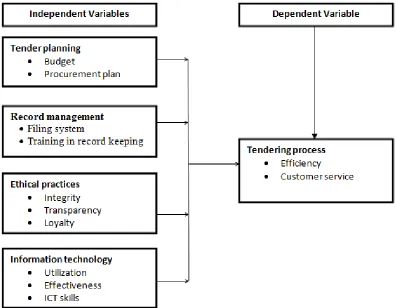
Figure 1: Diagrammatical representation of the interaction of variables in the study
Licensed under Creative Common Page 43 tendering process among organizations. This is because it enhances accuracy of the tendering activities in the organization. In addition, record management also enhances accessibility of tender and procurement activity documents.
The ethical practices such as integrity, transparency and loyalty and respect for rules and fairness may have a great impact on the effectiveness of the tendering process among organizations. Tender planning on the other hand, involves the needs that are not well identified and estimated, unrealistic budgets and inadequacy of skills of procurement staff responsible for procurement. This promotes the effectiveness of the tendering process among organizations because it informs the activities to be adopted by the procurement officers.
This chapter has reviewed literature on factors influencing tendering process in the public procurement law. (Kimaiyo, 2012) has established that according to Public Procurement and Disposal Act 2005 and Regulation Procurement play a very important role in Economic growth and Development of a country if well managed while Patrick, Mamati, and Jonathan (2013) have established that it is vital to ensure that time taken in tendering process is reasonable and is compliant within the law. These researchers have however not addressed the factors influencing tendering process in the public procurement hence this research fills in that gap.
Ahmed (2014) review of the ethics and efficiency of tendering process has established that corruption has hindered the tendering process. Skitmore (2013) found out that, there was witnessed unethical conduct, in the form of unfair conduct, negligence, conflict of interest, collusive tendering, fraud, confidentiality and propriety breach, bribery and violation of environmental ethics. Ahmed and Skitmore have however not addressed the factors influencing tendering process in the public procurement hence this research fills in that gap. Akech (2011) found that that councilors in Uganda were pushed out of Tendering process and were not allowed to get involved in the tendering process to avoid Possibility of compromising their supervisory role while Patrick, Mamati, and Jonathan, (2013) indicated that the move was to eliminate the possibility shoddy work, since councilors were to find themselves in a position where they have to grill one of their own.
Licensed under Creative Common Page 44 facilitated by the lack of transparency in the system; the applicable procedures were invariably inaccessible to the public. These researchers have however not addressed the factors influencing tendering process in the public procurement hence this research fills in that gap.
Patrick, Mamati and Jonathan, (2013) review on training of employees and efficiency of tendering process found that the strategic procedure of employee training and development needs to encourage creativity, ensure inventiveness and shape the entire organizational knowledge that provides the organization with uniqueness and differentiates it from the others. Heinritz, (2014) and Koppelmann, (2014) found that through training participants acquire new sets of values and attitudes. The appreciation of their inherent but untapped potential and reinforce their self-confidence and sense of autonomy as opposed to dependency they further content that for any project to be implemented successfully people involved must be trained. The training offered must be of quality to ensure effective implementation of tendering process. If this is lacking then the tendering process will be adversely affected (Masunga, 2007). According Kamau (2012); Kimaiyo, (2012); Aggrey (2011) review on record management and efficiency of tendering process found that records for procurement are crucial in tendering process. These researchers have however not addressed the factors influencing tendering process in the public procurement hence this research fills in that gap.
METHODOLOGY
The study adopted a descriptive research design that helps to provide answers to the questions of who, what, when, where, and how associated with a particular research problem. Descriptive research was used to obtain information concerning the current status of the phenomena and to describe "what exists" with respect to variables or conditions in a situation. The design is used in preliminary and exploratory studies to allow researchers to gather information, summarize, present and interpret for the purpose of clarification. According to Page and Meyer (2014), descriptive research design is intended to produce statistical information about aspects of education that interest policy makers. The choice of the descriptive research design was made based on the facts that in this study research was interested in the state of affairs already existing in the field and no variable was manipulated. This design was also appropriate since the researcher got information from those who have practical experience with the problem to be studied.
Licensed under Creative Common Page 45 small. A structured questionnaire was used to collect data needed in the study. Content validity was used to validate the tool of data collection. The questionnaire was given to experts in the field of business management for validation. Modification on the instruments was made based on their recommendations. The reliability of the questionnaire was determined using Cronbach’s
Alpha Method whose score was 0.83 which lies between 0.7 and 0.9, then the tool was considered reliable (Nunually, 1978). Both descriptive and inferential statistics were used to analyze quantitative data. Quantitative responses based on Likert scale were coded in the computer using Statistical Package for Social Sciences (SPSS) version 22. Processed data were summarized in tables and then presented using simple frequencies and percentages. Chi-square test for independence was used to analyze whether there is a statistical significance between information technology and tendering process in public sector.
RESULTS
Demographic characteristics of respondents
The demographic characteristics of the respondents included gender, age bracket, education level, and years of working experience. Two thirds (66.7%) of the respondents were female while the remaining 33.3% of them were female. This implies that the respondents were well represented by gender. On the age brackets of the respondents, slightly more than half (55.6%) of the respondents were between 41-50 years, 22.2% of them were between 31-40 years, 14% of them were 20-30 years, and only 7.4% of them were 51 years and above. This shows that there is need for future recruitment to consider employing the youth because majority of the people working in the procurement department of Embu County Government are adults, above forty years of age.
The study also sought to examine the education Level of the respondents. More than half (59.3%) of the respondents had attained bachelor’s degree level of education, 25.9% of
Licensed under Creative Common Page 46 Effects of Information Technology on Tendering Process in Public Sector in Kenya
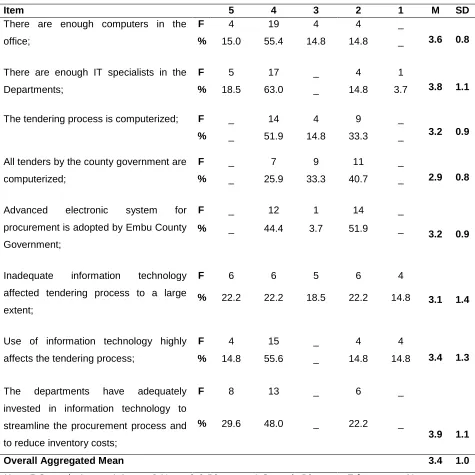
The study investigated the influence of information technology on tendering process in the Public Sector in Embu County Government. A five point Likert scale was used to rate the respondents’ perception toward the effects if information technology on tendering process in the public sector in Embu County. Table 1 shows the distribution of the study participants’
responses on various items.
Table 1: Effect of Information Technology on Tendering Process
Item 5 4 3 2 1 M SD
There are enough computers in the office;
F 4 19 4 4 _
3.6 0.8
% 15.0 55.4 14.8 14.8 _
There are enough IT specialists in the Departments;
F 5 17 _ 4 1
3.8 1.1
% 18.5 63.0 _ 14.8 3.7
The tendering process is computerized; F _ 14 4 9 _
3.2 0.9
% _ 51.9 14.8 33.3 _
All tenders by the county government are computerized;
F _ 7 9 11 _
2.9 0.8
% _ 25.9 33.3 40.7 _
Advanced electronic system for procurement is adopted by Embu County Government;
F _ 12 1 14 _
3.2 0.9
% _ 44.4 3.7 51.9 _
Inadequate information technology affected tendering process to a large extent;
F 6 6 5 6 4
3.1 1.4
% 22.2 22.2 18.5 22.2 14.8
Use of information technology highly affects the tendering process;
F 4 15 _ 4 4
3.4 1.3
% 14.8 55.6 _ 14.8 14.8
The departments have adequately invested in information technology to streamline the procurement process and to reduce inventory costs;
F 8 13 _ 6 _
3.9 1.1
% 29.6 48.0 _ 22.2 _
Overall Aggregated Mean 3.4 1.0
Licensed under Creative Common Page 47 As shown in the Table 1, over two thirds (70.4%) of the study respondents were in agreement that there are enough computers in the procurement office of Embu County. A vast majority (81.5%) of the respondents felt that there are enough I nformation Technology specialists in the tendering departments while 18.5% indicated otherwise. Slightly more than half (51.9%) of the respondents were affirmative that the tendering process is computerized. In contrary, 33.3% of the respondents indicated that the process is still manual. This was also supported by 40.7% of the respondents who disagreed with the statement that all tenders by the county government are computerized. Only 25.9% of the study respondents were satisfied that the County government of Embu had adopted computerized tendering process.
With regards to whether an advanced electronic system for procurement process is adopted by Embu County Government, 44.4% of the respondents were affirmative while slightly more than half (51.9%) of them disagreed. With reference to whether inadequate information technology affected tendering process, 44.4% of the respondents that took part in the study pointed out that it did although 37.0% of them felt otherwise.
Majority (70.4%) of the respondents were in consensus that use of information technology highly affects the tendering process. Another 77.6% of the study respondents were in agreement that the departments have adequately invested in information technology to streamline the procurement process and to reduce inventory costs. The remaining percentage (22.2%) of them was in contrast.
Additionally, the overall aggregated mean of the respondents on the items of the effect of information technology on tendering process was 3.4 with a standard deviati on of 1.0 (M=3.4; SD=1.0). This shows that majority of the respondents were in agreement that information technology influences the tendering process in the public sector of Embu County.
Testing Association between Information Technology and Tendering Process
Licensed under Creative Common Page 48 Table 2: Chi-square Test for the Association between
Information Technology and Tendering Process
Value df Asymp.sig.
(2-sided)
Pearson chi-square
Likelihood Ratio
Linear-by-Linear
Association
N of valid Cases
27.118a 23.372
.667 27
9 9
1
.000 .010
.121
a.Zero (0) cells (.0%) have expected count less than 5.
The minimum expected count is 5.72.
As shown in Table 2, the p-value is smaller than the threshold level of significance (.05), χ² (9,
N=27) = 27.118, P = .000. Thus, there is a statistical significant association between information technology and tendering process in the procurement department in Embu County. This implies that the tendering process in public sector is significantly affected by use of information technology.
DISCUSSION
The study found out that 51.9% of the respondents agreed that tendering process in Embu County is computerized. However, 33.3% of them were in a contrary opinion. This shows that manual procurement processing method is still in operation. This could be a threat to the efficiency and transparency of tenders awarding process because much information can easily be manipulated in manual processes as opposed to the computerized process that accessible to the general public. Therefore, there is need to adopt information technology in the whole process of procurement in the public sector of both national and county governments in Kenya.
Licensed under Creative Common Page 49 savings and greater awareness of new development. The use of IT also enabled Kenyan government ministries to provide excellent service to their suppliers in an effective and transparent manner. Further, Kissang (2014) found out that inadequate use of latest information technology systems affected tendering process to a large extent in Unga manufacturing company limited. This implies that full adoption of the use of information technology in the tendering process in the public sector will not only improve the efficiency of the tender vetting process but would save the cost incurred and increase satisfaction of tender awarding criteria.
Majority (70.4%) of the respondents were in consensus that use of information technology highly affects the tendering process. This was in line with Kendo and Guteno (2016) that established that use of technology highly affects the tendering process. Further, Daud et al.,
(2013) revealed that applications of e-procurement such as e-bidding, e-tendering, e-monitoring and many more can help contractors to improve and enhances their business performance. The study encouraged firms to use the e-procurement in order to improve their business performance through effective tender applicant vetting criteria. In the same vein, Rankin et al., (2006) indicated that the use of information communication technology in tendering process would influence the effectiveness of the process. However, with regards to whether an advanced electronic system for procurement process is adopted by Embu County Government, 44.4% of the respondents were affirmative while slightly more than half (51.9%) of them disagreed. This implies that despite information technology being a determinant factor of an effective tendering process, the public sector is yet to adopt it. This could be attributed to un-ending cases of corruption in the contracts awarding to the tender applicants.
Licensed under Creative Common Page 50 CONCLUSION
The significant role played by information technology use on efficiency of tendering process public sector at Embu County, Kenya has been demonstrated by the findings. This paper has established that among many factors that affect the efficiency and effectiveness of the tendering process in public sector, information technology is crucial. For instance the study established that information technology has a statistical significant association (P>0.05) with the tendering process in the public sector. This relationship was statistically significant. These findings are congruent with those of Kendo and Guteno (2016) that established that use of technology highly affects the tendering process. Further, Daud et al., (2013) revealed that applications of e-procurement such as e-bidding, e-tendering, e-monitoring and many more can help contractors to improve and enhances their business performance. This could be a threat to the efficiency and transparency of tenders awarding process because much information can easily be manipulated in manual processes as opposed to the computerized process that accessible to the general public. Therefore, there is need to adopt information technology in the whole process of procurement in the public sector of both national and county governments in Kenya. From our findings, the p-value is smaller than the threshold level of significance (.05), χ² (9, N=27) = 27.118, P = .000.
Thus, there is a statistical significant association between information technology and tendering process in the procurement department in Embu County. This implies that the tendering process in public sector is significantly affected by use of information technology.
This study concludes that information technology has a positive and significant influence on the efficiency of the tendering process in public sector at Embu County, Kenya. A conclusion that there is an inverse relationship between information technology and efficiency of the tendering process in public sector at Embu County, Kenya meaning that emphasis needs to be given to this effect. The study concluded that information technology in procurement is a significant contributor to organizational performance in improving efficiency of tendering process, therefore public sector organizations should be encouraged to adopt information technology practices in procurement. This conclusion is supported by empirical results of this study and those done by by O'Connell (2010) on effective use of information communications technology in tendering in the Irish construction industry. The study found out that potential cost savings in the Irish construction industry would be achieved through the application of integrated ICT tools in the construction tendering process.
RECOMMENDATIONS
Licensed under Creative Common Page 51 costs. This will satisfy the expectations of the constituents because the government will be able to utilize the limited funds allocated in the budgets to achieve a maximum economic development impact in all counties of the state. Additionally, the government should embrace use of information communication technology in the procurement departments to enhance transparency of tendering awards among the applicants, and to minimize misappropriation of public funds by few individuals in the public sector. This may not only lead to improved service delivery in the public sector but would also enhance employee performance due to adequate supplies of quality resources by qualified contractors.
It is imperative for communal area governments to adopt information technology practices in the procurement process to mend efficiency of tendering process. The Kenya institute of management should initiate integrated information Technology systems and build the capacity of the users in public sector organizations to enable information technology practices in procurement. This ability construction in communal area governments will boost customer service, cost of buying and increase transparency and accountability.
The practise of Information technology practices in state organizations will enable them to be on the watchful to restrain the gigantic expenditures practised by government organisations and will lead to increase responsibility and clearness. The public administration bodies should highlight embracing of information technology practices in the procurement process by public organizations. This can be done through improved procedures, circulars, instructions and protocols regarding procurement. The public administration should also ensure that rule creation and execution has factored in adoption of information technology practices for public procurement process.
Because the use of information technology can result in an innovative change in the procurement process, all government organizations should change their perception about adopt ICT in their departments. This can work to make government organizations performers and reduce the level of corruption. Transparency, accountability and equity distribution of resource will only happen when we make use of ICT.
LIMITATIONS OF THE STUDY
Licensed under Creative Common Page 52 involved in tendering procedures. Another one was that the study employed secondary data that may have been collected for other research thereby diluting the objectivity and consequently, the conclusions were arrived at from use of such data. To mitigate this the researcher used current books that have updated content and also used past research journals only relevant to his arear of study. The last limitation was that Errors of omission and commission that are usually common in the procurement plans, store records and requisition records were not ruled out. Such omissions may have unintentionally influenced the data collection process and hence the analysis. This was taken care of by asking the respondents in the procurement department to countercheck all procurement records for such errors. All errors identified were corrected through reversing the incorrect error and use of second entry to record the transaction.
SCOPE FOR FURTHER STUDIES
Further studies should be done to incorporate other specific variables such Cloud-Based E-Procurement Services for Business, In-House E-E-Procurement Systems for Large Corporations, Government Adoption of E-Procurement Platforms, Big Data and E-Procurement and Block chain Ledgers for E-Procurement. This is because most government organizations tend to concentrate so much on the primary aspects of ICT and forget the current trends in the market. The use of ICT by governments has matured to the next level beyond the basic hardware and software elements hence the need for shift of focus to more serious ICT integration parameters. This is considering the study only focused on the basic ICT concept of ERP. Further studies, could also incorporate the concept of cyber security. Additionally, the study recommends that future researchers should extend this study to other government ministries and the civil service in general so as to be in a position to generalize findings to represent the entire public service sector. Further study should compare use of ICT in procurement processes between various nations in Africa. The purpose will be to benchmark with other government agencies across Africa with the aim of improving processes and practices in our host organizations.
REFERENCES
Adetola, F. (2000). How efficient is the open and competitive tendering system? In N.I.Q.S, open and competitive tendering in the procurement of public and private sector projects. Lagos: Nigerian institute of Quantity Surveyors. Akech,, M. (2011). Development partners and governance of public procurement in Kenya: Enhancing democracy in the administration of aid. Nairobi, Kenya: Government Printer.
Basheka, B. (2008). Procurement planning and accountability of local government procurement systems in developing countries: Evidence from Uganda. Journal of Public Procurement, 8(3), 379-406.
Bell, C. (2001). Exploiting emerging technology corruptly in the NSW public sector. Retrieved from http://pandora.nla.gov.au/pan/21452/20020110/www.icac.nsw.gov.au/pub/public/ pub2_ 42cp.html.
Licensed under Creative Common Page 53 Kabaj, O. (2003). The challenge of African development. Oxford, UK: Oxford University Press.
Kakwezi, P. & Nyeko, S. (2015). Procurement processes and performance: efficiency and effectiveness of the procurement function. Kampala: Makerere University Press.
Kioko, J. N., Were S. (2014). Factors affecting efficiency of the procurement function at the public institutions in Kenya: A case of supplies branch in Nairobi. Nairobi: Jomo Kenyatta University of Agriculture and Technology Press. Kissang, W. (2014). Factors affecting tendering process in a manufacturing company. A case study of Unga group
limited company, Nairobi, Kenya. Retrieved from
http://www.academia.edu/4872967/factors_affecting_tendering_process_in_a_manufacturing_compan. Accessed June 13th 2015.
Lysons & Farrington (2006). Purchasing and supply chain management, 7th Ed. London, UK: Pearson Education. Mahmood, S. (2013). Public procurement and corruption in Bangladesh: Confronting the challenges and opportunities: Journal of public administration and policy research, 2(6), 103- 111.
Moronda, G. (2014). Factors affecting tendering process in public sector: The case of ministry of health and social
welfare, (MSc. Mzumbe University, Tanzania). Retrieved from
http://scholar.mzumbe.ac.tz/bitstream/handle/11192/729/MSc_PSCM_Grace%20B.Moronda_2014.pdf?sequence=1. Ngugi, J., & Mugo, H. (2012). Internal factors affecting procurement process of supplies in the public sector: A survey of Kenya government ministries. Paper presented at 5th International Public Procurement Conference was held on August 17th, 2012 in Seattle, USA. New York: Sages Press.
O'Connell, L. (2010). Electronic tendering: Recognizing a more effective use of information communications technology in the irish construction industry (Unpublished master’s thesis, Dublin Institute of Technology).
Page, W. & Meyer, L. (2014). Social work research methods: quantitative and qualitative applications. Boston: Pearson.
Public Procurement Oversight Authority (PPOA), (2012). General procurement rules. Retrieved from http://www.ppoa.go.ke/downloads/Regulations/part_iii_-general_procurement_ rules.pdf.
Rabecca, K. (2013). Factors influencing efficiency in procurement systems within the public Institutions. Kenya (Unpublished master thesis, Jomo-Kenyatta University of Agriculture and Technology).
Rankin, J.H., Chen, Y. & Christian, A.J. (2006). E-procurement in the Atlantic Canadian AE industry. Journal of Information Technology in Construction, 11, 75-87.
Shiundu, D. & Rotich, G. (2014). Factors influencing efficiency in procurement systems among public institutions: A case of City Council of Nairobi. International Academic Journals, 1 (1), 79-96.
Wogube, S. G. (2011). Procurement planning and service delivery in public enterprises: A case study of Sironko Town Council, (Unpublished Masters’ Thesis).