Pharmacogenomics and Personalized Medicine
Dovepress
O r i G i n A L r e s e A r c h
open access to scientific and medical research
Open Access Full Text Article
A genetic approach to the prediction of drug
side effects: bleomycin induces concordant
phenotypes in mice of the collaborative cross
richard Gelinas1,3
elissa J chesler2
Daphne Vasconcelos1
Darla r Miller2
Yue Yuan3
Kai Wang3
David Galas1,3
1Battelle Memorial institute,
columbus, Oh; 2Oak ridge national
Laboratory, Oak ridge, Tn; 3institute
for systems Biology, seattle, WA, UsA
correspondence: richard Gelinas institute for systems Biology, 401 Terry Avenue north, seattle, WA98109-5234, UsA
Tel +1 206 732 2104 Fax +1 206 732 1299
email [email protected]
Abstract: The antineoplastic drug bleomycin leads to the side effect of pulmonary fibrosis in both
humans and mice. We challenged genetically diverse inbred lines of mice from the Collaborative Cross with bleomycin to determine the heritability of this phenotype. Sibling pairs of mice from 40 lines were treated with bleomycin. Lung disease was assessed by scoring lung pathology and by measuring soluble collagen levels in lavage fluid. Serum micro ribonucleic acids (miRNAs) were also measured. Inbred sibling pairs of animals demonstrated high coinheritance of the phenotypes of disease susceptibility or disease resistance. The plasma levels of one miRNA were clearly correlated in sibling mice. The results showed that, as in humans, the lines that comprise the Collaborative Cross exhibited wide genetic variation in response to this drug. This finding suggests that the genetically diverse Collaborative Cross animals may reveal drug effects that might be missed if a study were based on a conventional mouse strain.
Keywords: collaborative cross, drug side effects, genetic diversity, disease susceptibility,
disease resistance, bleomycin, lung disease
Introduction
The antineoplastic drug bleomycin is now a second-line therapy for certain solid tumors, in part because of its pulmonary toxicity in 10%–20% of patients.1 In about 3%
of treated patients, the pulmonary fibrosis that develops is severe and progressive enough that it can lead to death.2–4 It is therefore critical to predict the likelihood of
adverse responses to this drug. Bleomycin also causes pulmonary fibrosis in mice and classic inbred strains of mice have been identified that are particularly suscep-tible (eg, C57BL/6 J, 129, and DBA/2) or relatively resistant (eg, A/J, BALB/c, and C3Hf/Kam).5–7 Indeed, two research groups have begun to map susceptibility loci
for bleomycin-induced pulmonary fibrosis in the offspring from crosses between susceptible and resistant lines.7–9 We were interested in a complementary approach of
coupling molecular assays to the genetic variation in the Collaborative Cross animals as a way of anticipating adverse drug responses.
While distinct inbred strains of mice or recombinant, congenic strains have been useful in the past for uncovering susceptibility loci for complex traits, we were interested in pursuing a more comprehensive systematic approach, and one that might recapitulate to some extent the levels of human diversity. We thought that our approach might not only lead to the discovery of genetic loci linked to a particular trait, but might also generate candidate biomarkers as part of the process. Here we report the first step towards this goal. We challenged 40 lines from the emerging Collaborative Cross with bleomycin to test the heritability of the phenotype of lung damage and to look
Pharmacogenomics and Personalized Medicine downloaded from https://www.dovepress.com/ by 118.70.13.36 on 26-Aug-2020
For personal use only.
Number of times this article has been viewed
This article was published in the following Dove Press journal: Pharmacogenomics and Personalized Medicine
Dovepress Gelinas et al
for potential biomarkers at the same time. The Collaborative Cross is a panel of recombinant inbred lines of mice derived from eight genetically diverse inbred mouse strains:10,11 A/J,
C57BL/6J, 129S1/SvImJ, NOD/LtJ, NZO/HlLtJ, CAST/ EiJ, PWK/PhJ, and WSB/EiJ. While each of these lines has been highly inbred, as a group they encompass nearly 90% of the known variation present in laboratory mice.12 The
animals used in this study were from the F7–F10 generation of the Oak Ridge National Laboratory stocks, after the eight founding lines were crossbred with one another.11
The Collaborative Cross lines were originally developed for the analysis of complex traits or diseases that arise with contributions from many genes. Since some of the founder strains were known to vary in their sensitivity to bleomycin, we tested whether susceptibility to bleomycin-induced lung damage would be coinherited among sibling pairs that were derived from the founder strains. We also examined the pat-tern of micro ribonucleic acids (miRNA) in the plasma of affected or resistant animals after treatment. In this model experiment, the genetic diversity of the Collaborative Cross could represent the diversity of the outbred human population while bleomycin stands in for an investigational new drug.
Lung pathology was assessed by biochemical assays and histological scoring, and miRNA were measured in the plasma. Sibling pairs of mice derived from any given Collab-orative Cross line showed a high likelihood of coinheritance of the phenotypes related to susceptibility or resistance to lung fibrosis, and some Collaborative Cross lines exhibited extremes of resistance or susceptibility. Plasma miRNA profiles that could be potentially useful as biomarkers of sensitivity or resistance were identified as well. Overall, the results suggested that Collaborative Cross mice are useful for detection of drug-induced side effects, with the advantages that the genetic diversity is potentially higher and that pheno-types may be more extreme. Because of large genetic diversity encompassed within the Collaborative Cross or their derived outbred population, the Diversity Outcross (Pers comm; E Chesler, 2011) represents a powerful way to anticipate the possible side effects of investigational new drugs.
Materials and methods
Generation of recombinant inbred
lines of mice
The Collaborative Cross combines the genomes of eight genetically diverse founder strains:A/J, C57BL/6 J, 129S1/ SvImJ, NOD/LtJ, NZO/HlLtJ, CAST/EiJ, PWK/PhJ, and WSB/EiJ. These strains of mice were systematically and
independently outcrossed to bring together all eight genomes, and then inbred.10,11 The Collaborative Cross progenitor lines
included founder lines previously shown to be susceptible to bleomycin-induced pulmonary fibrosis (129, C57BL/6) as well as a founder line shown to be relatively resistant (A/J).1,5,6,9 A randomly chosen subset of 40 lines was used
in this study.
Dosing with bleomycin
Two male mice 6–8 weeks of age were selected from each of 40 inbred lines of the Collaborative Cross. Animals were dosed intraperitoneally with 0.035 units of bleomycin/g body weight on each of 8 days spread over the next 33 days.13 Animals were dosed on days 1, 4, 8,
11, 15, 18, 22, 25. On day 33, blood plasma was collected for miRNA analysis. Mice were subsequently euthanized and the right lungs were placed in 0.5 M acetic acid (for assay of soluble collagen) and the left lungs were gently inflated and placed in 10% buffered formalin for histol-ogy. Tail DNA was prepared for high-density genotyping from all animals.
Semiquantitative scoring of lung fibrosis
Fixed lungs were prepared for histologic examination and semiquantitative assessment of inflammation and fibrosis. One section from one lung of each mouse was stained with hematoxylin and eosin while the other was stained with Masson’s trichrome for visualization of collagen. Each section was scored by a board-certified pathologist for inflammation, macrophage accumulation in alveoli, and fibrosis using a semiquantitative scale of 0 (no pathologic changes) to 4 (marked pathology approaching maximal). Semiquantitative assessment of each lesion was based on the presence of rare individual affected foci (minimal, grade 1), increased frequency and size of individual lesions with occasional confluence (mild, grade 2), large areas of involvement and confluence (moderate, grade 3), or com-plete lung involvement with the lesion in question (marked, approaching maximal, grade 4). Internal peer review was performed by another board-certified pathologist to confirm findings and obtain consensus as to interpretations.soluble collagen assay
Soluble collagen was measured by dye binding to gly-X-Y collagen fragments (Sircol kit; Accurate Chemical Corp, Westbury, NY). Collagen concentrations were inferred by absorbance at 540 nm following the manufacturer’s
Pharmacogenomics and Personalized Medicine downloaded from https://www.dovepress.com/ by 118.70.13.36 on 26-Aug-2020
Dovepress Drug side effects of bleomycin
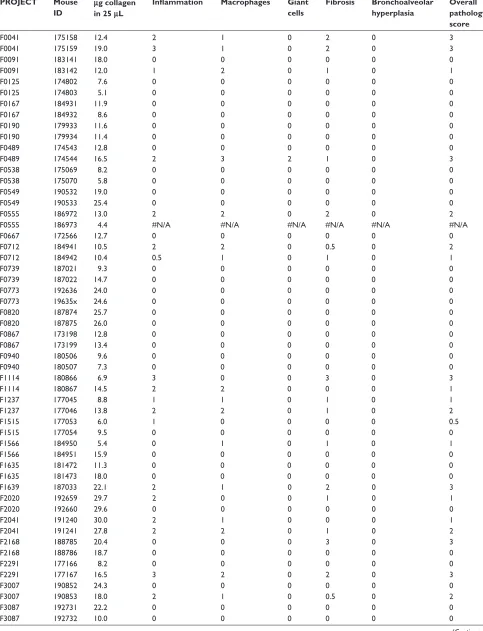
Table 1 soluble collagen data and semiquantitative pathology scores
PROJECT Mouse
ID
µg collagen in 25 µL
Inflammation Macrophages Giant
cells
Fibrosis Bronchoalveolar hyperplasia
Overall pathology score
F0041 175158 12.4 2 1 0 2 0 3
F0041 175159 19.0 3 1 0 2 0 3
F0091 183141 18.0 0 0 0 0 0 0
F0091 183142 12.0 1 2 0 1 0 1
F0125 174802 7.6 0 0 0 0 0 0
F0125 174803 5.1 0 0 0 0 0 0
F0167 184931 11.9 0 0 0 0 0 0
F0167 184932 8.6 0 0 0 0 0 0
F0190 179933 11.6 0 0 0 0 0 0
F0190 179934 11.4 0 0 0 0 0 0
F0489 174543 12.8 0 0 0 0 0 0
F0489 174544 16.5 2 3 2 1 0 3
F0538 175069 8.2 0 0 0 0 0 0
F0538 175070 5.8 0 0 0 0 0 0
F0549 190532 19.0 0 0 0 0 0 0
F0549 190533 25.4 0 0 0 0 0 0
F0555 186972 13.0 2 2 0 2 0 2
F0555 186973 4.4 #n/A #n/A #n/A #n/A #n/A #n/A
F0667 172566 12.7 0 0 0 0 0 0
F0712 184941 10.5 2 2 0 0.5 0 2
F0712 184942 10.4 0.5 1 0 1 0 1
F0739 187021 9.3 0 0 0 0 0 0
F0739 187022 14.7 0 0 0 0 0 0
F0773 192636 24.0 0 0 0 0 0 0
F0773 19635x 24.6 0 0 0 0 0 0
F0820 187874 25.7 0 0 0 0 0 0
F0820 187875 26.0 0 0 0 0 0 0
F0867 173198 12.8 0 0 0 0 0 0
F0867 173199 13.4 0 0 0 0 0 0
F0940 180506 9.6 0 0 0 0 0 0
F0940 180507 7.3 0 0 0 0 0 0
F1114 180866 6.9 3 0 0 3 0 3
F1114 180867 14.5 2 2 0 0 0 1
F1237 177045 8.8 1 1 0 1 0 1
F1237 177046 13.8 2 2 0 1 0 2
F1515 177053 6.0 1 0 0 0 0 0.5
F1515 177054 9.5 0 0 0 0 0 0
F1566 184950 5.4 0 1 0 1 0 1
F1566 184951 15.9 0 0 0 0 0 0
F1635 181472 11.3 0 0 0 0 0 0
F1635 181473 18.0 0 0 0 0 0 0
F1639 187033 22.1 2 1 0 2 0 3
F2020 192659 29.7 2 0 0 1 0 1
F2020 192660 29.6 0 0 0 0 0 0
F2041 191240 30.0 2 1 0 0 0 1
F2041 191241 27.8 2 2 0 1 0 2
F2168 188785 20.4 0 0 0 3 0 3
F2168 188786 18.7 0 0 0 0 0 0
F2291 177166 8.2 0 0 0 0 0 0
F2291 177167 16.5 3 2 0 2 0 3
F3007 190852 24.3 0 0 0 0 0 0
F3007 190853 18.0 2 1 0 0.5 0 2
F3087 192731 22.2 0 0 0 0 0 0
F3087 192732 10.0 0 0 0 0 0 0
(Continued)
Pharmacogenomics and Personalized Medicine downloaded from https://www.dovepress.com/ by 118.70.13.36 on 26-Aug-2020
Dovepress Gelinas et al
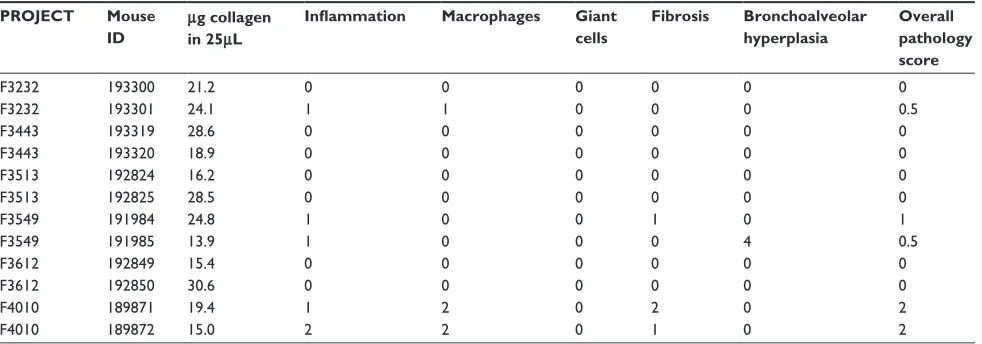
Table 1 (Continued)
PROJECT Mouse
ID
µg collagen in 25µL
Inflammation Macrophages Giant
cells
Fibrosis Bronchoalveolar hyperplasia
Overall pathology score
F3232 193300 21.2 0 0 0 0 0 0
F3232 193301 24.1 1 1 0 0 0 0.5
F3443 193319 28.6 0 0 0 0 0 0
F3443 193320 18.9 0 0 0 0 0 0
F3513 192824 16.2 0 0 0 0 0 0
F3513 192825 28.5 0 0 0 0 0 0
F3549 191984 24.8 1 0 0 1 0 1
F3549 191985 13.9 1 0 0 0 4 0.5
F3612 192849 15.4 0 0 0 0 0 0
F3612 192850 30.6 0 0 0 0 0 0
F4010 189871 19.4 1 2 0 2 0 2
F4010 189872 15.0 2 2 0 1 0 2
instructions. Data were reported as mg collagen per 25 mL volume analyzed.
statistical analysis of data
Members of each sibling pair were randomly assigned to one of two groups such that the two members were in different groups. If a third sample was obtained from a given line, one of the three samples was randomly omitted. To test for genetic concordance of pathology scoring, the odds ratio of concordant vs discordant pairs was obtained.
Odds ratio = P (affected|affected proband)* P (unaffected|unaffected proband)/P (affected|unaffected
proband)*P (unaffected|affected proband)
A 95% confidence interval was obtained for each natural logarithm of the odds ratio, and P values to test whether this value differed from zero (ie, that the observed responses were concordant among sibling pairs) were obtained. Results are presented in Table 1.
A sibling pair regression analysis (performed using SYSTAT[v 12; Systat Software, Inc, Chicago, IL]) is an estimate of genetic correlation, and a significant correlation implies that a common source of genetic variance among the population is responsible for the pairs’ phenotypic value. In a conventional sibling pair regression, individuals are assumed to be 25% similar and therefore, the regression coefficient is multiplied by four to extrapolate to herita-bility in a randomly mating wild population. Because the siblings are from somewhat inbred stocks, this would yield an upwardly biased estimate and because we are not attempting to estimate the true population heritability for this biomedically relevant phenotype, we used the conser-vative raw coefficient.
Plasma miRNA profile
miRNA levels were measured in heparinase-treated blood plasma as described by a slight modification of a previously published reverse transcription polymerase chain reaction protocol.14 For studies of individual miRNAs, total RNA was
extracted from previously frozen mouse plasma using Trizol reagent (Qiagen, Germantown, MD) and purified using a miRNEASY kit (Qiagen) according to the manufacturer’s instructions. The expression level of mature miRNAs was determined by real time polymerase chain reaction analysis following stem-loop reverse transcription with Taqman miRNA assay reagents (Applied Biosystems, Carlsbad, CA). The amplification program included an initial activa-tion and denaturaactiva-tion at 95°C for 10 minutes, followed by 40 cycles of 95°C for 15 seconds, 60°C for 1 minute. The relative amounts of miRNAs were normalized to an equal input volume of plasma. After the reaction, cycle threshold values were calculated using fixed manual threshold settings. A larger group of miRNAs was profiled to test for an associa-tion with pathology scores. In this case, previously frozen blood plasma samples were treated by adding a one-tenth volume of 1 mg/mL Heparinase I (in 20 mMTris-HCl, pH 7.5, 50 mMNaCl, 4 mM CaCl2, and 0.01% bovine serum albumin; Sigma-Aldrich, St Louis, MO) and incubated for 1 hour at room temperature before reverse transcription. Megaplex primers for Taqman miRNA profiling (Applied Biosystems) were used to preamplify samples prior to loading the samples into Taqman low density array miRNA rodent card A, version 2 (Applied Biosystems). The reverse transcriptase polymerase chain reaction was carried out according to manufacturer’s instructions. The amplification program included initial acti-vation and denaturation at 95°C for 10 minutes, followed by 40 cycles of 95°C for 15 seconds, 60°C for 1 minute. Levels
Pharmacogenomics and Personalized Medicine downloaded from https://www.dovepress.com/ by 118.70.13.36 on 26-Aug-2020
Dovepress Drug side effects of bleomycin
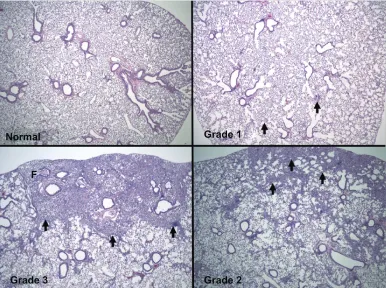
bleomycin-induced pathology encompassing the afore-mentioned changes. Normal lungs were assigned a score of 0 based on the absence of these pathologic signs. Grade 1 lungs showed occasional foci with active inflammation including infiltrating macrophages and a few sites with excess collagen deposition. Lungs scored as grade 2 showed more confluent areas of inflammation with fibrosis and more frequent foci of macrophage accumulation. Lungs scored as grade 3 showed large areas of inflammation, sometimes including the entire lung, with extensive fibrosis and in some cases the emergence of cells with the appearance of myofibroblasts. Deposition of collagen in the fibrotic regions was confirmed in grade 2 and 3 lungs after serial sections were stained with Masson’s trichrome (data not shown). The semiquantitative scores for lung pathology are summarized in Table 1.
The lines of mice in our study were inbred for four to seven generations by following a defined funnel inbreed-ing scheme. From this degree of inbreedinbreed-ing, 65%–80% of genome segments in sibling pairs were predicted to be identical by descent.11 We thus asked to what extent sibling
animals showed a tendency to coinherit the presence or absence of any lung pathology. Since the pathology scores for each miRNA were normalized to the levels of U6 small
nuclear RNA which was measured in parallel.
Results
In this study two male sibling mice from each of 40 Collabor-ative Cross lines were treated with eight doses of Bleomycin over a period of 1 month. At the end of the dosing period all mice were euthanized, blood samples were collected to prepare plasma, lungs were dissected for an investigation of the lung pathology, and tail snips were saved to isolate DNA for genotyping.
The larger lobe from each lung was processed for histologic examination and soluble collagen was assayed in the smaller lobe. The histologic examination of stained lung sections from each Collaborative Cross animal showed that some animals showed no obvious lung damage while others displayed extreme fibrotic lung disease, consistent with the phenotypes of both resistant and susceptible lines in the breeding scheme. As shown in Figure 1, the lungs of some animals appeared normal, and we noted varying levels of pathology among others. Each lung was scored semi-quantitatively for inflammation, fibrosis, and accumulation of macrophages, and then also given an overall score for
Normal Grade 1
Grade 2 Grade 3
F
Figure 1 representative lung photomicrographs. Typical images that were used for semiquantitative assessment of lung pathology are shown (4 × magnification). Upper left:
normal, mouse/slide 81, MouseTrack #193319; Upper right: grade 1, Mouse/slide 34, MouseTrack #184942; Lower right: grade 2, mouse/slide 74, MouseTrack #192908; Lower left: grade 3, mouseslide 73, MouseTrack #192907.
Pharmacogenomics and Personalized Medicine downloaded from https://www.dovepress.com/ by 118.70.13.36 on 26-Aug-2020
Dovepress Gelinas et al
were obtained before we knew the identity of the sibling pairs, we first asked if mice with similar phenotypes were siblings. A preliminary analysis of the scores in Table 1 showed that mice with mild lung pathology were more likely to have siblings with mild pathology than they were to have discordant siblings (P 0.86 . P 0.79), which is suggestive of a genetic contribution to the disease. This relationship was noted especially for inflammation and fibrosis in the lung. Likewise, mice unaffected by the drug treatment were also more likely to have siblings that were unaffected than affected siblings, which is again suggestive of a genetic contribution to disease resistance. The details of the probability analysis are presented in Tables 2 and 3.
To extend these findings, we next calculated the rela-tive risk that if a given animal was affected, that the sibling would be affected. We did this for both affected animals (scores . 0) and severely affected animals (scores . 1). For example we noted that mildly affected probands were 2.45 to 2.9 times more likely to have an affected sibling than unaffected probands on measures of macrophages, inflam-mation, and fibrosis. The relative risk of severe inflamma-tion or excessive macrophages among siblings of affected probands was 1.8 and 1.7 times that of unaffected probands. The most striking finding was that the relative risk for severe fibrosis given an affected sibling was 12.75 times that for those with unaffected siblings. Our analysis also showed a significant concordance of inflammation (odds ratio [OR]: 7.13;P , 0.01) or a macrophage response (OR: 12.00;
P , 0.01) in mildly affected animals with affected siblings. In severely affected animals with affected siblings there was a significant concordance of severe fibrosis (OR: 23.25, P , 0.01) as well as inflammation (OR: 7.14, P , 0.04). These results are presented in more detail in Tables 4 and 5. Thus, mice with either no response or a moderate or severe response to bleomycin treatment tended to have siblings that shared these responses, which is readily explained if there is a strong genetic component to the phenotype of resistance or susceptibility.
Collagen metabolism is active in the fibrotic lung because of the degradation of normal lung structures as well as the synthesis of fibrillar collagens as a component of new extracellular matrix. We thus measured soluble collagen in the lungs of all animals as another independent test of a potentially heritable aspect of the response to bleomycin (Table 1). When simply ranked numerically, soluble collagen scores varied over a six-fold range (Figure 2, panel A) and when the value for one sibling was regressed on the value of its sibling, strong genetic correlation was observed with a regression coefficient of 0.544 (Figure 2, panel B). Sib-ling mice with similar soluble collagen scores were noted throughout the range of observed soluble collagen values and overall disease susceptibility to resistance, consistent with a genetic basis for these responses that segregated into defined inbred lines of mice.
We also profiled selected miRNA species in blood plasma samples, looking first at miRNA that had been reported to have roles in lung disease. MiR-34a was
Table 3 Probabilities of different observed pathologies
Measure P (unaffected) P (mild or
unaffected)
P (unaffected/ affected sibling)
P (mild or unaffected/ mild or unaffected sibling)
Inflammation 0.63 0.78 0.79 0.86
Macrophages 0.74 0.86 0.89 0.82
Giant cells 0.99 0.99 0.97 0.97
Fibrosis 0.70 0.87 0.78 0.91
Bronchoalveolar hyperplasia 0.66 0.99 0.97 0.86
Table 2 Pathology features and numbers of cases observed
Measure Cases Number
of affected
Mild or unaffected
Unaffected proband
Unaffected (0,1) Matched cases
Match (0,1)
Inflammation 76 48 59 24 29 19 25
Macrophages 76 56 65 27 34 24 28
Giant cells 76 75 75 38 38 37 37
Fibrosis 76 53 66 27 34 21 31
Bronchoalveolar hyperplasia
76 72 75 37 37 36 32
Pharmacogenomics and Personalized Medicine downloaded from https://www.dovepress.com/ by 118.70.13.36 on 26-Aug-2020
Dovepress Drug side effects of bleomycin
Table 4
r
elative risk calculations for affected compared to unaffected animals
Affected [ . 0.5], unaffected = 0 Measure Marginal N n Joint N Joint P RR OR In(OR) SE LCL UCL P
-value (concordance)
A1 A0 B1 B0 n00 n01 n10 n11 p00 p01 p10 p11 Inflammation 14 24 14 24 76 19 4 6 9.00 0.25 0.05 0.08 0.12 2.6 7.13 1.96 0.76 0.47 3.46* 0.01 Macrophages 11 27 9 29 76 24 2 6 6.00 0.32 0.03 0.08 0.08 2.5 12.00 2.48 0.94 0.65 4.32* 0.01 Giant cells 0 38 1 37 76 37 1 0 0.00 0.49 0.01 0.00 0.00 Fibrosis 11 27 12 26 76 21 6 5 6.00 0.28 0.08 0.07 0.08 2.9 4.20 1.44 0.76 -0.06 2.93 0.06 Table 5 r
elative risk calculates for severely affected compared to unaffected animals
Severely affected,
2,4 unaffected
, 2 Measure Marginal N n Joint N Joint P RR OR Ln(OR) SE LCL UCL P -value A1 A0 B1 B0 n00 n01 n10 n11 p00 p01 p10 p11 Inflammation 9 29 8 30 76 25 2 7 4.00 0.33 0.03 0.09 0.05 1.8 7.14 1.97 0.97 0.07 3.86* 0.04 Macrophages 4 34 7 31 76 28 4 5 1.00 0.37 0.05 0.07 0.01 1.7 1.40 0.34 1.22 -2.05 2.73 0.78 Giant cells 0 38 1 37 76 37 1 0 0.00 0.49 0.01 0.00 0.00 Fibrosis 4 34 6 32 76 31 2 2 3.00 0.41 0.03 0.03 0.04 12.8 23.25 3.15 1.17 0.86 5.44* 0.01 Notes: Ma rginal n are given as 1 = meets criteria, 0 = does not meet criteria, eg, A1 are the number of pairs for which the Group A (proband) mouse has the indicated response with a score . 0.5 in the above table and . 1 in
supplementary Table 4.
Joint frequencies (Joint
n
) follow,
eg, n01,
indicate the number of mice
for which
the A mouse does not meet the criteria
and the B mouse does. The joint
probabilities
follow.
The
P
values for concordance
of response are given in the right-hand side of the table. Abbreviations:
rr , relative risk for affected versus unaffected probands; O r , odds ratio for concordance versus discordance; ln(O r ), natural log of the odds ratio; se , standard error; Lc L, U c L, lower and upper 95% two-tailed confidence limits.
Pharmacogenomics and Personalized Medicine downloaded from https://www.dovepress.com/ by 118.70.13.36 on 26-Aug-2020
Dovepress Gelinas et al
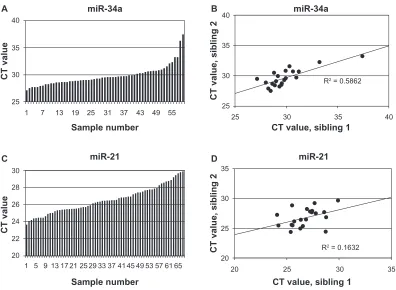
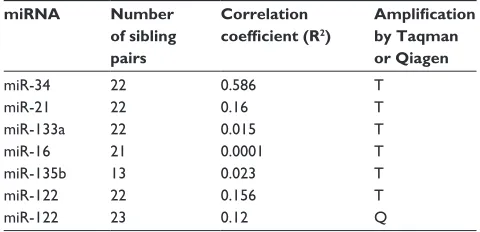
readily detected, as shown in Figure 3A. When the levels of this miRNA were plotted from one mouse as a function of the level in its sibling (Figure 3B), a regression coef-ficient of 0.58 was obtained, suggesting that the plasma levels showed evidence of genetic correlation. In con-trast, a second miRNA, miR-21, showed similar plasma levels, but the levels in siblings showed little correlation (Figures 3C and 3D). Four more miRNAs that are known to
be expressed in the lung showed little correlation between sibling pairs of mice, at least when they were measured in the plasma. The correlation coefficients of these miRNAs are presented in Table 6. Some miRNAs were elevated or decreased in the plasma of animals with the most severe lung pathology, but these data did not quite approach the level of statistical significance (not shown).
35.0 35
30
25
20
15
10
5
0 30.0
25.0
20.0
15.0
10.0
5.0
0.0
1 9 17 25 33 41 49 57 65 73 81 0 5 10 15 20 25 30 35
µ
g collagen in 25
µ
L
Mouse number Sibling two
Sibling on
e
A B
Figure 2 inheritance analysis of soluble collagen levels in the lungs. Panel A: lung soluble collagen values from all animals. Panel B: regression analysis of soluble collagen levels
for 39 sibling pairs of mice. The data show the tendency for the concentration of collagen that was extracted from the lungs to be coinherited, with a regression coefficient of 0.544.
40 40
35
30
25
35
30
25
20
20 25 30 35
25 30 35 40
35
30
25
30
28
26
24
22
20
1 5 9 13 17 21 25 29 33 37 41 45 49 53 57 61 65
1 7 13 19 25 31 37 43 49 55
CT value
A B
C D
miR-34a
miR-21 miR-21
miR-34a
CT value, sibling 1
CT value, sibling
2
CT value, sibling 1
CT value, sibling
2
Sample number
CT value
Sample number
R2 = 0.5862
R2 = 0.1632
Figure 3 mirnA levels in plasma. A: the plasma levels of mir-34a measured in 70 mice; B: data from A replotted by sibling pairs; c: the plasma levels of mir-21 measured
in 67 mice; D: data from c replotted by sibling pairs.
Pharmacogenomics and Personalized Medicine downloaded from https://www.dovepress.com/ by 118.70.13.36 on 26-Aug-2020
Dovepress Drug side effects of bleomycin
Discussion
In this study we found that in response to a drug challenge a group of genetically diverse mice exhibited the same side effects as humans. Since some of these different lines of the Collaborative Cross10,11 were resistant to the drug
chal-lenge, while others were extremely sensitive, our study recapitulated the variability in human responses that have been observed with this drug. A study based on other recom-binant inbred lines such as the BXD which are derived from strains (C57BL/6; DBA/2) that are both quite susceptible to bleomycin-induced pulmonary fibrosis would not have been as informative. The new highly diverse genetic refer-ence and mapping populations made from the eight strains of Collaborative Cross are useful resources to dissect this phenotypic variation.
Our data showed that the phenotype of fibrotic lung dis-ease in response to the drug bleomycin was more likely in a given animal if a sibling was also affected. An independent measure of lung fibrosis, soluble collagen levels derived from the lung, showed the same effect. In our semiquantitative scoring, not all histological features we looked at showed clear evidence of heritability (ie, the presence of inflamma-tion, Table 2) but we did not stain for other features that were likely to have been quite heritable, such as myofibroblasts15
(see for example Figure 1, grade 3 disease). Another source of error is the fact that we only examined two 5 µm sections from a lung that is 5 mm thick. Examining and averaging multiple sections per lung could have given more accurate scores, and more highly quantitative metrics may have led to better detection of covariation. Nonetheless the coinheritance pattern that emerged for the phenotype of destructive lung disease is most easily explained as having a genetic basis that segregated among the 40 recombinant inbred mouse lines we studied.
We also profiled miRNA in blood plasma. We found the plasma levels of at least one miRNA varied among all
Table 6 Regression coefficients for coinheritance by siblings of mirnA peripheral blood levels
miRNA Number
of sibling pairs
Correlation coefficient (R2)
Amplification by Taqman or Qiagen
mir-34 22 0.586 T
mir-21 22 0.16 T
mir-133a 22 0.015 T
mir-16 21 0.0001 T
mir-135b 13 0.023 T
mir-122 22 0.156 T
mir-122 23 0.12 Q
strains tested, but the level in one sibling was predictive of the level in the other sibling, as might be expected if the expression level for this miRNA (miR-34a) was segregating as a heritable trait. But the levels of several other miRNAs were not closely matched in sibling mice. We were also unable to find a statistically reportable association between the plasma miRNA profile and lung disease. Recent work shows that the lung and the blood profile of miRNAs change when single inbred mouse strains are treated with bleomycin (Wang K, Cho JH, Marsh C, et al; unpublished observations) or in mice with destructive lung disease that are deficient for adenosine deaminase (Blackburn M, Cho JH, Wang K, et al; unpublished observations). We suspect that technical problems arising from small sample size and the presence of heparin in the plasma samples hampered the miRNA quantitation in this study. MiRNA profiles in the blood changed dramatically, when mice were challenged with intraperitoneal acetaminophen.14 Despite this, blood miRNA
profiles may still be worth pursuing in drug toxicity studies since the changing profile in the blood may have biomarker information and because the particular miRNAs detected may participate directly in the disease process.15,16
In this study, about 8 months were required to generate the mice while the drug exposure and data analysis added 2–3 months. When the full spectrum of the final Collab-orative Cross lines of mice, inbred to a satisfactory degree, are all available at the same time from one source, such a study could be completed in a fraction of this time, perhaps 3–4 months or less. This is about the same time required for a standard series of preclinical rodent toxicity tests, which are applied to all new novel chemical entities or investigational drugs. Studying mice from the highly diverse Collaborative Cross at the same time or in addition to conventional dose escalation studies in rodents should reveal rare phenotypes or reactions that might be genetically determined and thus entirely missed if only one or two classic laboratory mouse strains were used. Alternatively, this can be done now in the Diversity Outcross recombinant inbred lines available from The Jackson Laboratory (Pers comm; Chesler E, 2011).
The genetic diversity of the Collaborative Cross has been estimated to rival that of the outbred human population.12 If a drug phenotype is heritable in selected
inbred lines of the Collaborative Cross as we demonstrated for the destructive lung disease secondary to bleomycin (Figures 1 and 2), the inbred lines thus identified can be used to uncover the genetic basis of the response in follow-on studies. Since all of the inbred lines of the Collaborative Cross will have genotypes and even imputed
Pharmacogenomics and Personalized Medicine downloaded from https://www.dovepress.com/ by 118.70.13.36 on 26-Aug-2020
Dovepress Gelinas et al
sequence information publicly available, the identification of a pattern of markers that define a region of the genome that segregates with the phenotype should be simplified as would the identification of candidate genes or loci that contribute to the phenotype. Use of genetically diverse mice offers a new way to understand the biological basis of expected or unexpected drug effects in great detail.
For some time, variations in the distribution or structure of the intracellular peptidase called bleomycin hydrolase that can degrade the drug were thought to underlie the induced fibrosis in mice and men.1 More recently, in addition to lung fibrosis,
it is now recognized that subcutaneously injected bleomycin can cause a scleroderma-like condition with autoimmune attributes.17,18 This model of human systemic scleroderma
sug-gests that an early step in the catabolism of bleomycin results in the generation of reactive oxygen species in vascular endothe-lial cells and smooth muscle causing these cells to die by apoptosis or necrosis.19 Dead or dying cells liberate hyaluronan
and HMGB-1 protein that can activate B-cells, CD4 T cells, and possibly macrophages via toll receptors TLR2 and TLR4 to produce profibrogenic cytokines such as IL-6 and TGF-β, resulting in local fibrosis. B cells may infiltrate and persist in lung or skin via CD19-dependent signaling.18,20 Transfer of
CD4 cells from an inflamed animal will transfer scleroderma to a naïve animal.21 The genetic bases of all aspects of this
proposed cascade are amenable to confirmation and explora-tion by using the approach outlined in this study.
We have demonstrated that when the mouse lines of the Collaborative Cross were challenged with a drug, a pattern of adverse events was evoked that closely modeled disease susceptibility in humans.2–4 We suggest that by avoiding the
use of single inbred lines of mice and instead working with a group of lines that were deliberately bred to encompass an extremely high level of genetic diversity, low probability but high consequence drug effects can be revealed in a single experiment. Moreover, for any given phenotype that might arise in such a study, the path to discover the genetic basis for the phenotype is facilitated. Increasingly, there is little excuse for not knowing the full spectrum of adverse events that may be associated with an investigational new drug that can be revealed in a mouse, long before the start of human trials.
Acknowledgments
The authors thank Christine Bhirdo, Lisa Branstetter, Pat Hunsicker, William Parkhurst, Jason Spence, Ginger Shaw, and Sarah Shinpock at the Oak Ridge National Laboratory for the production, treatment, and dissection of the Collaborative Cross mice. We also thank our colleague at Battelle: Connie
Essman-Wood, at the Ohio State University: Melissa Piper, and colleagues at the Institute for Systems Biology: David Baxter and Ji-Hoon Cho. The authors wish to acknowledge support from the Pulmonary Systems Biology Initiative from the Battelle Memorial Institute (to Oak Ridge National Laboratory and Institute for Systems Biology), from the University of Luxembourg and the Luxembourg Centre for Systems Biomedicine (to the Institute for Systems Biology), and the Systems Biology Center Grant (NIH-GM 076547) to the Institute for Systems Biology. The Collaborative Cross was initiated with the generous support of The Ellison Medical Foundation.
Disclosure
The authors report no conflicts of interest in this work.
References
1. Lazo JS, Hoyt DG. The molecular basis of interstitial pulmonary
fibrosis caused by antineoplastic agents. Cancer Treat Rev. 1990;
17(2–3):165–167.
2. Levi J, Raghaven D, Harvey V, et al. The importance of bleomycin in combination chemotherapy for good-prognosis germ cell carcinoma.
J Clin Oncol. 1993;11(7):1300–1305.
3. Simpson AB, Paul J, Graham J, Kaye SB. Fatal bleomycin pulmonary toxicity in the west of Scotland 1991–1995: a review of patients with
germ cell tumors. Br J Cancer. 1998;78(8):1061–1066.
4. Sleijfer S. Bleomycin-induced pneumonitis. Chest. 2001;120(2):
617–624.
5. Schrier DJ, Junkel RG, Phan SH. The role of strain variation in
murine bleomycin-induced pulmonary fibrosis. Am Rev Respir Dis.
1983;127(1):63–66.
6. Ekimoto H, Takada K, Ohnuki T, et al. Different sensitivity to bleomycin-induced pulmonary fibrosis among various strains of mice.
J Clin Biochem Nutr. 1987;2(1):25–31.
7. Haston CK, Wang M, Dejournett RE, et al. Bleomycin hydrolase and a genetic locus within the MHC affect risk for pulmonary fibrosis in
mice. Hum Mol Genet. 2002;11(16):1855–1863.
8. Barth RK, Hanchett LA, Baecher-Allan CM. Mapping susceptibility
genes for the induction of pulmonary fibrosis in mice. Chest.
2002;121(Suppl 3):21S.
9. Lemay AM, Haston CK. Bleomycin-induced pulmonary fibrosis
susceptibility genes in AcB/BcA recombinant congenic mice. Physiol
Genomics. 2005;23(1):54–61.
10. Churchill GA, Airey DC, Allayee H, et al. The Collaborative Cross,
a community resource for the genetic analysis of complex traits. Nat
Genet. 2004;36(11):1133–1137.
11. Chesler EJ, Miller DR, Branstetter LR, et al. The Collaborative Cross at Oak Ridge National Laboratory: developing a powerful resource for
systems genetics. Mamm Genome. 2008;19(6):382–389.
12. Roberts A, Pardo-Manuel de Villena F, Wang W, McMillan L, Threadgill DW. The polymorphism architecture of mouse genetic resources elucidated using genome-wide resequencing data:
impli-cations for QTL discovery and systems genetics. Mamm Genome.
2007;18(6–7):473–481.
13. Baran CP, Opalek JM, McMaken S, et al. Important roles for mac-rophage colony-stimulating factor, CC chemokine ligand 2, and mononuclear phagocytes in the pathogenesis of pulmonary fibrosis.
Am J Respir Crit Care Med. 2007;176(1):78–89.
14. Wang K, Zhang S, Marzolf B, et al. Circulating microRNAs, potential
biomarkers for drug-induced liver injury. Proc Natl Acad Sci U S A.
2009;106(11):4402–4407.
Pharmacogenomics and Personalized Medicine downloaded from https://www.dovepress.com/ by 118.70.13.36 on 26-Aug-2020
Pharmacogenomics and Personalized Medicine
Publish your work in this journal
Submit your manuscript here: http://www.dovepress.com/pharmacogenomics-and-personalized-medicine-journal
Pharmacogenomics and Personalized Medicine is an international, peer-reviewed, open access journal characterizing the influence of genotype on pharmacology leading to the development of personalized treatment programs and individualized drug selection for improved safety, efficacy and sustainability. This journal is indexed on the American Chemical
Society’s Chemical Abstracts Service (CAS). The manuscript manage-ment system is completely online and includes a very quick and fair peer-review system, which is all easy to use. Visit http://www.dovepress. com/testimonials.php to read real quotes from published authors.
Dovepress
Dovepress
Drug side effects of bleomycin
15. Cho JH, Gelinas R, Wang K, et al. Systems biology of interstitial lung diseases: integration of mRNA and microRNA expression changes.
BMC Medical Genomics. 2011;4:8.
16. Pandit KV, Corcoran D, Yousef H, et al. Inhibition and role of
let-7d in idiopathic pulmonary fibrosis. Am J Respir Crit Care Med.
2010;182(2):220–229.
17. D’Cruz D. Autoimmune diseases associated with drugs, chemicals and
environmental factors. Toxicol Lett. 2000;112–113:421–432.
18. Yoshizaki A, Iwata Y, Komura K, et al. CD19 regulates skin and lung fibrosis via toll-like receptor signaling in a model of bleomycin-induced
scleroderma. Am J Pathol. 2008;172(6):1650–1663.
19. Ishikawa H, Ito S, Nishio N, Yuzawa Y, Matsuo S, Isobe K. Injection of bleomycin in newborn mice induces autoimmune sialitis that is
transferred by CD4 T cells. Immunol Cell Biol. 2009;87(4):351–358.
20. Komura K, Yanaba K, Horikawa M, et al. CD19 regulates the devel-opment of bleomycin-induced pulmonary fibrosis in a mouse model.
Arthritis Rheum. 2008;58(11):3574–3584.
21. Ishikawa H, Takeda K, Okamoto A, Matsuo S, Isobe K. Induction of autoimmunity in a bleomycin-induced murine model of
experimen-tal systemic sclerosis: an important role for CD4+ T cells. J Invest
Dermatol. 2009;129(7):1688–1695.
Pharmacogenomics and Personalized Medicine downloaded from https://www.dovepress.com/ by 118.70.13.36 on 26-Aug-2020