R E S E A R C H
Open Access
Projective synchronization of
fractional-order delayed neural networks
based on the comparison principle
Weiwei Zhang
1*, Jinde Cao
2,3, Ranchao Wu
4, Ahmed Alsaedi
5and Fuad E. Alsaadi
6*Correspondence: [email protected] 1School of Mathematics and Computation Science, Anqing Normal University, Anqing, China Full list of author information is available at the end of the article
Abstract
This paper considers projective synchronization of fractional-order delayed neural networks. Sufficient conditions for projective synchronization of master–slave systems are achieved by constructing a Lyapunov function, employing a fractional inequality and the comparison principle of linear fractional equation with delay. The
corresponding numerical simulations demonstrate the feasibility of the theoretical result.
Keywords: Fractional order; Comparison principle; Projective synchronization; Time-delay
1 Introduction
Neural networks have attracted great attention due to their wide applications, including the signal processing, parallel computation, optimization, and artificial intelligence. The dynamical behaviors of neural networks have been widely studied, particularly synchro-nization, which is one of the most important topics and therefore has been given much attention [1–6]. However, the majority of existing results considered modeling integer-order neural networks.
It is well known that fractional calculus is the generalization of integer-order calculus to arbitrary order. Compared to classical integer-order models, fractional-order calculus offers an excellent instrument for the description of memory and hereditary properties of dynamical processes. The existence of infinite memory can help fractional-order mod-els better describe the system’s dynamical behaviors as illustrated in [7–23]. Taking these factors into consideration, fractional calculus was introduced to neural networks forming fractional-order neural networks, and some interesting results on synchronization were demonstrated [24–29]. Among all kinds of synchronization, projective synchronization, in which the master and slave systems are synchronized up to a scaling factor, is an im-portant concept in both theoretical and practical manners. Recently, some results with re-spect to projective synchronization of fractional-order neural networks were considered [30–32]. In [30], projective synchronization for fractional neural networks was studied. Through the employment of a fractional-order differential inequality, the projective syn-chronization of fractional-order memristor-based neural networks was shown in [31]. By
using an LMI-based approach, the global Mittag–Leffler projective synchronization for fractional-order neural networks was investigated in [32].
However, time delay, which is unavoidable in biological, engineering systems, and neural networks, was not taken into account in most of the previous works. To the best of our knowledge, projective synchronization of fractional-order neural networks was previously investigated at the presence of time delay through the use of Laplace transform [33], and no special Lyapunov functions were derived for synchronization analysis. In this paper, new methods are introduced to investigate the projective synchronization of fractional-order delayed neural networks. The study includes constructing a Lyapunov function, applying a fractional inequality and the comparison principle of linear fractional equation with delay, and obtaining new sufficient conditions.
The rest of this article is organized as follows. In Sect. 2, some definitions and lemmas are introduced, and the model description is given. In Sect. 3, the projective synchro-nization schemes are presented, and sufficient conditions for projective synchrosynchro-nization are obtained. Numerical simulations are presented in Sect. 4. Conclusions are drawn in Sect. 5.
2 Preliminaries and model description
It has to be noted that Riemann–Liouville fractional derivative and Caputo fractional derivative are the most commonly used among all the definitions of fractional-order in-tegrals and derivatives. Due to the advantages of the Caputo fractional derivative, it is adopted in this work.
Definition 1([7]) The fractional integral with non-integer orderα> 0 of a functionx(t) is defined by
Definition 2([7]) The Caputo derivative of fractional orderαof a functionx(t) is defined by
In this paper, we consider a class of fractional-order neural networks with time delay as a master system, which is described by
or equivalently, by
Dαx(t) = –Cx(t) +Afx(t)+Bgx(t–τ)+I, (2)
where 0 <α< 1,nis the number of units in a neural network,x(t) = (x1(t), . . . ,xn(t))T∈ Rn denotes the state variable of the neural network, C=diag(c
1,c2, . . . ,cn) is the
self-regulating parameters of the neurons, where ci∈R+. I = (I
1,I2, . . . ,In)T represents the
external input, A= (aij)n×n and B= (bij)n×n are the connective weight matrices with-out and with delay, respectively. Functions f(x(t)) = (f1(x1(t)), . . . ,fn(xn(t)))T, g(x(t)) =
(g1(x1(t)), . . . ,gn(xn(t)))Tare the neuron activation functions.
The slave system is given by
Dαy
For generalities, the following definition, assumption, and lemmas are presented.
Definition 3 If there exists a nonzero constantβsuch that, for any two solutionsx(t) and y(t) of systems (1) and (3) with different initial values, one can getlimt→∞y(t)–βx(t)= 0,
then the master system (1) and the slave system (3) can achieve globally asymptotically projective synchronization, where · denotes the Euclidean norm of a vector.
Assumption 1 The neuron activation functionsfj(x),gj(x) satisfy the following Lipschitz condition with Lipschitz constantslj> 0,hj> 0:
fj(u) –fj(v)≤lj|u–v|, gj(u) –gj(v)≤hj|u–v|
for allu,v∈R, denoteL=diag(l1,l2, . . . ,ln),H=diag(h1,h2, . . . ,hn),lmax=max{l1,l2, . . . ,ln},
hmax=max{h1,h2, . . . ,hn}.
Lemma 1([32]) Suppose that x(t) = (x1(t), . . . ,xn(t))T∈Rnis a differentiable vector-valued
function and P∈Rn×nis a symmetric positive matrix.Then,for any time instant t≥0,we have
DαxT(t)Px(t) ≤xT(t)PDαx(t) +DαxT(t)Px(t), (5)
where0 <α< 1.
Lemma 2([34]) Suppose that V(t)∈R1 is a continuous differentiable and nonnegative
In this section, master–slave projective synchronization of delayed fractional-order neural networks is discussed. The aim is to design a suitable controller to achieve the projective synchronization between the slave system and the master system.
Letei(t) =yi(t) –βxi(t) (i= 1, 2, . . . ,n) be the synchronization errors.
wherediare positive constants,βis the projective coefficient.
Remark1 The control functionui(t) is a hybrid control,vi(t) is an open loop control, and wi(t) is a linear control.
Then the error system is obtained:
or equivalently,
Dαe(t) = –Ce(t) +Afy(t)–fβx(t) +Bgy(t–τ)–gβx(t–τ)
–De(t), (12)
wheree(t) = (e1(t), . . . ,en(t))T,D=diag(d1,d2, . . . ,dn).
Theorem 1 Under Assumption1,if there exists a symmetric positive definite matrix P∈ Rn×nsuch that
–λˆmax+k1max+k¯1maxl2max+k2max
λ–1max>k¯2maxh2maxλ–1min,
then the fractional-order delayed neural networks systems(1)and(3)can achieve glob-ally asymptoticglob-ally projective synchronization based on the control schemes(8), (9), (10), whereλˆmaxdenotes the greatest eigenvalue of–PC–PD,k1max=12PA∞,k¯1max=12PA1,
k2max=12PB∞,k¯2max=12PB1,λminandλmaxdenote the minimum and the maximum
eigenvalue of P,respectively.
Proof Construct a Lyapunov function:
V(t) =1 2e
T(t)Pe(t). (13)
Taking the time fractional-order derivative ofV(t), according to Lemma 1, (13) can be rewritten as
DαV(t) =Dα
1 2e
T(t)Pe(t)
≤eT(t)PDαe(t)
=eT(t)P–Ce(t) +Afy(t)–fβx(t)
+Bgy(t–τ)–gβx(t–τ) –De(t)
=eT(t)(–PC–PD)e(t) +eT(t)PAfy(t)–fβx(t)
+eT(t)PBgy(t–τ)–gβx(t–τ) . (14)
From Lemma 3, we have
eT(t)PAfy(t)–fβx(t) ≤k1maxeT(t)e(t) +k¯1max
fy(t)–fβx(t) T
·fy(t)–fβx(t)
≤k1maxeT(t)e(t) +k¯1maxeT(t)L2e(t) ≤k1max+k¯1maxl2max
eT(t)PBgy(t–τ)–gβx(t–τ) ≤k2maxeTe(t) +k¯2max
Submitting (15) and (16) into (14) yields
DαV(t)≤eT(t)(–PC–PD)e(t) +k1max+k¯1maxl2max+k2max
From Lemma 2, we have that, if
–λˆmax+k1max+k¯1maxl2max+k2max
λ–1max>k¯2maxh2maxλ–1min,
then system (1) synchronizes system (3).
Remark2 If the projective coefficientβ= 1, the projective synchronization is simplified to complete synchronization, and the control input function (8) becomes
ui(t) = –di
yi(t) –xi(t). (19)
Remark3 If the projective coefficientβ= –1, the projective synchronization is simplified to anti-synchronization, and the control input function (8) becomes
In the following, we choose the control input functionui(t) in system (3): itive constants, andβis the projective coefficient.
Remark4 The control functionui(t) is a hybrid control,vi(t) is an open loop control, and wi(t) is an adaptive feedback control.
Remark5 Letdi(0)≥0, thendi(t) =di(0) +Iα(γ
iyi(t) –βxi(t)2)≥di(0). So it is easy to getdi(t)≥0.
Then the system’s error is given as follows:
Dαe
Theorem 2 Under Assumption1,if there exists a symmetric positive definite matrix P∈ Rn×nsuch that
–λˇmax+k1max+k¯1maxl2max+k2max
λ–1max>k¯2maxh2maxλ–1min,
then the fractional-order delayed neural networks systems(1)and(3)can achieve globally asymptotically projective synchronization based on the control schemes(21), (22), (23), (24), whereλˇmaxdenotes the greatest eigenvalue of–PC–PD∗,λminandλmaxdenote the
Proof Construct the auxiliary function
Taking the time fractional-order derivative ofV(t), according to Lemma 1, (27) can be given as follows:
The rest is the same as the proof of Theorem 1, hence omitted here.
Remark6 If the projective coefficientβ= 1, the control input function (21) becomes
ui(t) = –di(t) +di∗yi(t) –xi(t) , (29)
where
Dαdi(t) =γiyi(t) –xi(t)
2
. (30)
Remark7 If the projective coefficientβ= –1, the control input function (21) becomes
ui(t) = –
Remark9 In [33], by using the Laplace transform, the hybrid projective synchronization of fractional-order memristor-based neural networks with time delays was discussed, but the theoretical synchronization results are poor and the sufficient conditions are complex. For comparison purposes, in this paper, the projective synchronization of fractional-order delayed neural networks is studied by constructing a Lyapunov function, with the employ-ment of a fractional inequality and the comparison principle of linear fractional equation with delay. The results are simpler and more theoretical.
4 Numerical simulations
The following two-dimensional fractional-order delayed neural networks are considered in this section:
Dαx(t) = –Cx(t) +Afx(t)+Bgx(t–τ)+I, (33)
where x(t) = (x1(t),x2(t))T, α = 0.97, I= (0, 0)T. The activation functions are given by
f(x(t)) =g(x(t)) =tanh(x(t)), τ = 1. Obviously, f(x) and g(x) satisfy Assumption 1 with L=H=diag(1, 1) andC=1 00 1,A=–5.0 2.02.0 –0.1,B=–1.5 –0.1
–0.2 –1.5
.
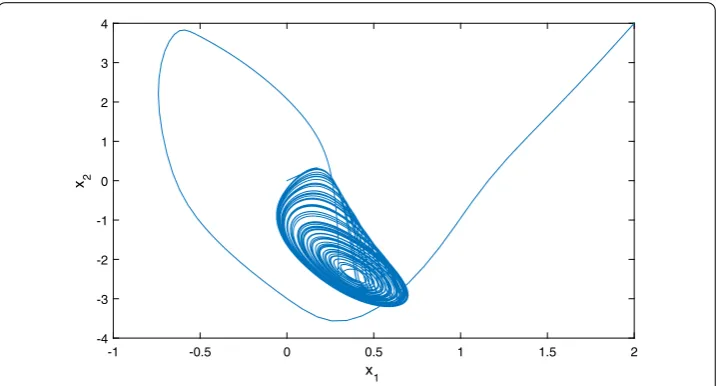
Under these parameters, system (33) has a chaotic attractor, which is shown in Fig. 1. In the control scheme (8), (9), (10), we select the symmetric positive definite matrixP= 1 0
0 2
. By simple computing, we can getd1= 18,d2= 10. Select the projective coefficients
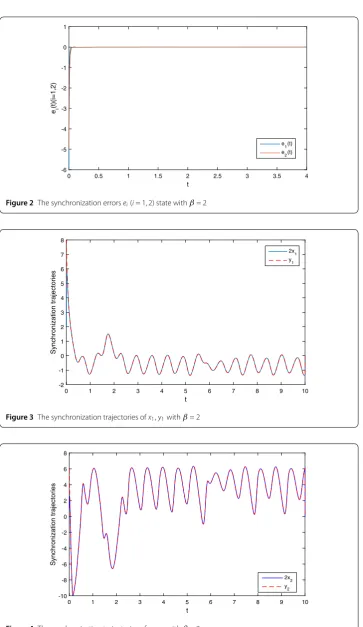
β= 2, initial valuesx1(0) = 4,x2(0) = 2,y1(0) = 3,y2(0) = 1, the projective synchronization
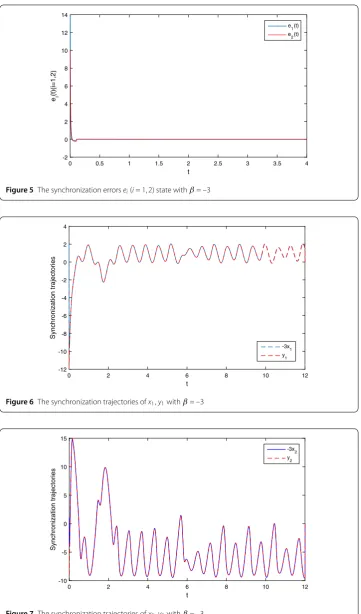
error is shown in Fig. 2. The synchronization trajectories are shown in Fig. 3 and Fig. 4. Similarly, projective synchronization with projective coefficientβ= –3 is given in Fig. 5– Fig. 7.
In the control scheme (21), (22), (23), (24), we select the symmetric positive definite ma-trixP=1 00 1
2
. By simple computing, we can getd1(0) = 10,d2(0) = 24. Select the projective
coefficientsβ= 3,d∗1= 1,d∗2= 2, initial valuesx1(0) = 4,x2(0) = 1,y1(0) = 3,y2(0) = 2, the
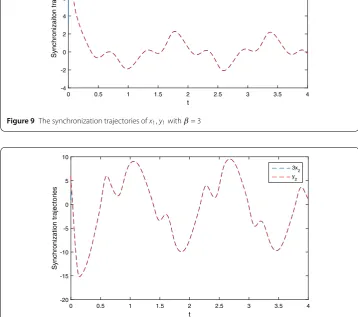
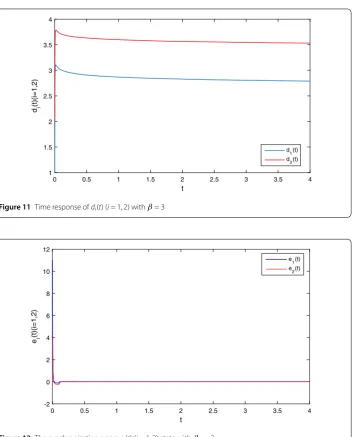
projective synchronization error is shown in Fig. 8. The synchronization trajectories are shown in Fig. 9 and Fig. 10. In addition, the adaptive gainsdi(t) (i= 1, 2) converge to some positive constants, see Fig. 11.
Figure 2The synchronization errorsei(i= 1, 2) state withβ= 2
Figure 3The synchronization trajectories ofx1,y1withβ= 2
Figure 5The synchronization errorsei(i= 1, 2) state withβ= –3
Figure 6The synchronization trajectories ofx1,y1withβ= –3
Figure 8The synchronization errorsei(t) (i= 1, 2) state withβ= 3
Figure 9The synchronization trajectories ofx1,y1withβ= 3
Figure 11 Time response ofdi(t) (i= 1, 2) withβ= 3
Figure 12 The synchronization errorsei(t) (i= 1, 2) state withβ= –2
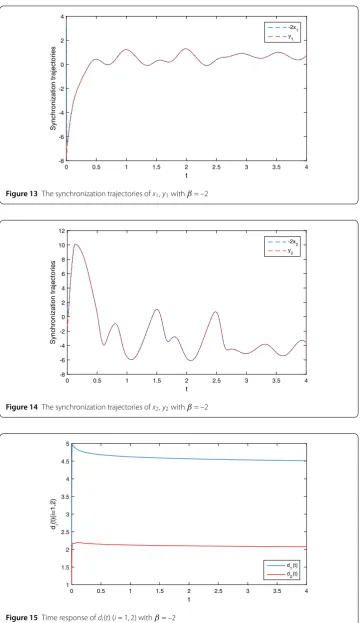
Similarly, projective synchronization with projective coefficient β = –2 is shown in Fig. 12–Fig. 15.
Remark10 In simulations, the projective coefficientβ is a nonzero constant, which is selected arbitrarily.
5 Conclusions
Figure 13 The synchronization trajectories ofx1,y1withβ= –2
Figure 14 The synchronization trajectories ofx2,y2withβ= –2
Acknowledgements
This study is supported by the National Natural Science Foundation of China (No. 11571016), the Natural Science Foundation of Anhui Province (No. 1608085MA14), and the Natural Science Foundation of the Higher Education Institutions of Anhui Province (No. KJ2015A152).
Competing interests
The authors declare that they have no competing interests.
Authors’ contributions
All authors contributed equally to the manuscript. All the authors read and approved the final manuscript.
Author details
1School of Mathematics and Computation Science, Anqing Normal University, Anqing, China.2School of Mathematics, Southeast University, Nanjing, China.3Department of Mathematics, Faculty of Science, King Abdulaziz University, Jeddah, Saudi Arabia.4School of Mathematics, Anhui University, Hefei, China. 5Department of Mathematics, King Abdulaziz University, Jeddah, Saudi Arabia.6Department of Electrical and Computer Engineering, Faculty of Engineering, King Abdulaziz University, Jeddah, Saudi Arabia.
Publisher’s Note
Springer Nature remains neutral with regard to jurisdictional claims in published maps and institutional affiliations.
Received: 12 October 2017 Accepted: 15 February 2018
References
1. Cao, J., Chen, G., Li, P.: Global synchronization in an array of delayed neural networks with hybrid coupling. IEEE Trans. Syst. Man Cybern., Part B, Cybern.38, 488–498 (2008)
2. Cao, J., Wan, Y.: Matrix measure strategies for stability and synchronization of inertial BAM neural networks with time delays. Neural Netw.53, 165–172 (2014)
3. Lu, J., Ho, D., Cao, J., Kurths, J.: Exponential synchronization of linearly coupled neural networks with impulsive disturbances. IEEE Trans. Neural Netw.22, 329–336 (2011)
4. Park, M., Kwon, O., Lee, S., Park, J., Cha, E.: Synchronization criteria for coupled stochastic neural networks with time-varying delays and leakage delay. J. Franklin Inst.349, 1699–1720 (2012)
5. Yang, X., Zhu, Q., Huang, C.: Lag stochastic synchronization of chaotic mixed time-delayed neural networks with uncertain parameters or perturbations. Neurocomputing74, 1617–1625 (2011)
6. Song, Q.: Synchronization analysis of coupled connected neural networks with mixed time delays. Neurocomputing
72, 3907–3914 (2009)
7. Podlubny, I.: Fractional Differential Equations. Academic Press, New York (1999)
8. Butzer, P.L., Westphal, U.: An Introduction to Fractional Calculus. World Scientific Press, Singapore (2000) 9. Hilfer, R.: Applications of Fractional Calculus in Physics. World Scientific Press, Singapore (2000)
10. Ozalp, N., Demirci, E.: A fractional order SEIR model with vertical transmission. Math. Comput. Model.54, 1–6 (2011) 11. Zhang, H., Ye, R.Y., Cao, J.D., Alsaedie, A.: Lyapunov functional approach to stability analysis of Riemann–Liouville
fractional neural networks with time-varying delays. Asian J. Control20, 1–14 (2017)
12. Laskin, N.: Fractional quantum mechanics and Levy path integrals. Phys. Lett. A268, 298–305 (2000)
13. Kilbas, A.A., Srivastava, H.M., Trujillo, J.J.: Theory and Application of Fractional Differential Equations. Elsevier, New York (2006)
14. Ahmed, E., Elgazzar, A.: On fractional order differential equations model for nonlocal epidemics. Physica A379, 607–614 (2007)
15. Zhang, W.W., Chen, D.Y.: Hybrid projective synchronization of different dimensional fractional order chaotic systems with time delay and different orders. Chinese Journal of Engineering Mathematics34, 321–330 (2017)
16. Zhang, H., Ye, R.Y., Cao, J.D., Alsaedie, A.: Delay-independent stability of Riemann Liouville fractional neutral-type delayed neural networks. Neural Process. Lett.21, 1–16 (2017)
17. Wu, G.C., Baleanu, D., Zeng, S.D.: Finite-time stability of discrete fractional delay systems: Gronwall inequality and stability criterion. Commun. Nonlinear Sci. Numer. Simul.57, 299–308 (2018)
18. Wu, G.C., Baleanu, D., Luo, W.H.: Lyapunov functions for Riemann–Liouville-like fractional difference equations. Appl. Math. Comput.314, 228–236 (2017)
19. Baleanu, D., Wu, G.C., Bai, Y.R., Chen, F.L.: Stability analysis of Caputo-like discrete fractional systems. Commun. Nonlinear Sci. Numer. Simul.48, 520–530 (2017)
20. Wu, G.C., Baleanu, D., Xie, H.P., Chen, F.L.: Chaos synchronization of fractional chaotic maps based on stability condition. Physica A460, 374–383 (2016)
21. Jajarmi, A., Hajipour, M., Baleanu, D.: New aspects of the adaptive synchronization and hyperchaos suppression of a financial model. Chaos Solitons Fractals99, 285–296 (2017)
22. Baleanu, D., Jajarmi, A., Asad, J.H., Blaszczyk, T.: The motion of a bead sliding on a wire in fractional sense. Acta Phys. Pol. A131, 1561–1564 (2017)
23. Jajarmi, A., Baleanu, D.: Suboptimal control of fractional-order dynamic systems with delay argument. J. Vib. Control (2017). https://doi.org/10.1177/1077546316687936
24. Zhang, W.W., Cao, J.D., Alsaedi, A., Alsaadi, F.: New methods of finite-time synchronization for a class of fractional-order delayed neural networks. Math. Probl. Eng.2017, 1–9 (2017)
25. Stamova, I.: Global Mittag–Leffler stability and synchronization of impulsive fractional-order neural networks with time-varying delays. Nonlinear Dyn.77, 1251–1260 (2014)
27. Chen, J., Zeng, G., Jiang, P.: Global Mittag–Leffler stability and synchronization of memristor-based fractional-order neural networks. Neural Netw.51, 1–8 (2014)
28. Wang, F., Yang, Y., Hu, M., Xu, X.: Projective cluster synchronization of fractional-order coupled-delay complex network via adaptive pinning control. Phys. A, Stat. Mech. Appl.434, 134–143 (2015)
29. Bao, H.B., Park, J.H., Cao, J.D.: Adaptive synchronization of fractional-order memristor-based neural networks with time delay. Nonlinear Dyn.158, 1343–1354 (2015)
30. Yua, J., Hua, C., Jiang, H., Fan, X.: Projective synchronization for fractional neural networks. Neural Netw.49, 87–95 (2014)
31. Bao, H.B., Cao, J.D.: Projective synchronization of fractional-order memristor-based neural networks. Neural Netw.63, 1–9 (2015)
32. Wu, H., Wang, L., Wang, Y., Niu, P., Fang, B.: Global Mittag–Leffler projective synchronization for fractional-order neural networks: an LMI-based approach. Adv. Differ. Equ.2016, 132 (2016)
33. Velmurugan, G., Rakkiyappan, R.: Hybrid projective synchronization of fractional-order memristor-based neural networks with time delays. Nonlinear Dyn.83, 419–432 (2016)